IMPRISON TRAITOR, PEDOPHILE, AND CONVICTED FELON TRUMP.
Showing posts with label John Hoyt. Show all posts

Thursday, October 2, 2014

Brute Force - 1947


Brute Force (1947) remains a giant among prison movies.  Visually stunning, it has a noir foundation on which is hung an unusually sensitive (for noir) study of men trapped by their circumstances, their sins, their weaknesses, their fears, their anger, and even by their ability, those that still have it, to feel the pain of those around them.

Burt Lancaster heads a sterling cast, even the most minor character is vivid and memorable in this film.  That’s what happens when you have a crisp, literate, and biting script, and most especially, a director and cinematographer who freely turn what could have been a stiff sort of docudrama, or clichéd melodrama—how most prison stories tend to be filmed—into unabashed art.  We are treated to a generous array of stunning close-ups and interestingly framed shots that tell us volumes about the men, especially since they are in a setting where they are close-mouthed, unlikely to tell us everything that’s going on inside them.

Expository dialogue goes to the administrators in the prison.  We have Richard Gaines, so dependable in officious roles as the severe, pompous superintendent, always pressuring the anxious, ineffectual warden, played by Roman Bohnen.  The warden complains of cutbacks in funding, that the prison is overcrowded, that the men need job training…all of which the superintendent balks at, saying what the men need is more discipline. 

The soft voice of the head of the prison security force, played by Hume Cronyn, belies his sadistic nature.  The little man enjoys the fear he excites in the hardened men, most of them much larger and physically imposing—but Cronyn wields power he’s swiped in a vacuum of leadership, tortures them physically and psychologically, and he has Ray Teal following behind him with a billy club like a human swagger stick.

The cast is a feast of favorite character actors, like Sam Levene, and Charles McGraw in one of many uncredited roles that filled the first several years of his film career. 
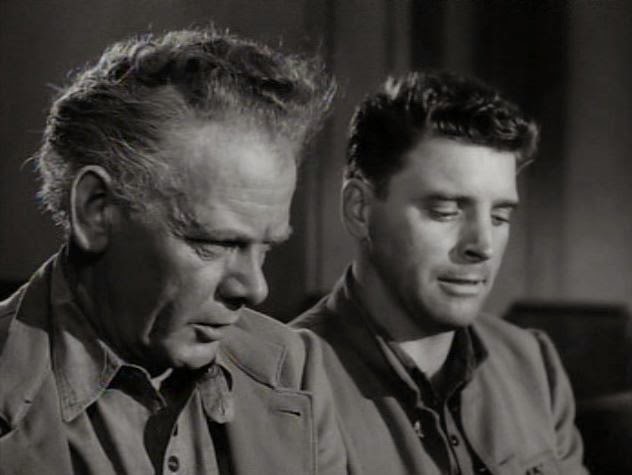
The wonderful Charles Bickford is the level-headed old timer, who breaks up fights in the prison among the other cons, and bides his time until his hoped-for parole.


Sir Lancelot sings calypso rhymes he makes up on the spot to narrate what he sees, as either a funny jest, or a warning, or a requiem for yet another dead prisoner.

There’s Jack Overman as one of the cellmates, an easygoing, simpleton ex-fighter.  One of my favorites, he has a bigger role here for once.  We’ve seen him in a non-speaking minor role in Once More, My Darling (1949) here, and also in Swell Guy (1946) here.  Sadly, Mr. Overman died in late 1949 at only 32 years old.

His cellmates include Whit Bissell, as a small-time embezzler, a sad, brittle fellow who, obsessed his shallow wife, played by Ella Raines in a flashback segment, fearing losing her love, steals from his employer to buy her a mink coat. 

John Hoyt is a stylish grifter, mainly in phoney stocks, a man-about-town with a charming easy-come, easy-go attitude.  I love his line, “I wonder who Flossie’s fleecing now?”

Howard Duff, in his first film, is a former soldier who took the rap for Yvonne De Carlo, an Italian woman he falls in love with during the war.  She has murdered her father to save Duff, but though he takes the blame to save her, I don’t believe his current imprisonment is for that crime.  He remarks about always wanting to get back to Italy to see her, but “one rap led to another.”

The best lines, and probably the best role of the film happily goes to Art Smith, who plays the prison doctor.  He’s just as fatalistic as the cons, and drinks heavily to dull the pain of this miserable place.  It's a terrific performance.   

But unlike the weak warden Roman Bohnen, who gives in to the bullying Richard Gaines and the devious machinations of Hume Cronyn, Mr. Smith is still a man of strong conscience.  He gets into shouting matches with them all, gets right in their faces and bleeds his anger and sarcasm all over them.  Again and again, they slap him down.

Burt Lancaster, whose character as the leader of his cell, and one of the most respected by the other prisoners for his toughness, is beautifully lit, if you can call his deadly cold glare and vicious snarl beautiful. 

We first see him standing in the prison yard in the pouring rain, but with his soaking wet shirt tucked neatly into his soaking wet prison trousers, he strides back to his cell, his shoulders straight, his head held high with an air of nobility.  Though he has just come out of solitary confinement, he is not broken.  He is angrier, and more charismatic to us and to the other prisoners, than ever.  The other men light his cigarettes as a mark of his leadership.  The only one who ranks him is Charles Bickford, who freely reaches into Lancaster’s prison jacket in another scene and swipes a match from Burt’s shirt pocket to light his own cigarette.  Burt lets him, hardly noticing, as if the older man could be his father and is allowed such liberties.

Because this is a setting of confinement, much of the film has the feeling of theatre, and the action that takes place is muted and judicious, until the very end of the film when we have the attempted prison break.  Director Jules Dassin and writer Richard Brooks have the perfect marriage of script and cinematography, where each supports the other, and the pace of the movie flows beautifully, building tension, and then releasing it a bit at a time in unexpected moments of black humor, and when, where the men watch the 1947 comedy The Egg and I starring Fred MacMurray and Claudette Colbert, it seems surreal.

Ann Blyth, like the few other women in the cast, save for the officious and severe secretary of the warden, is shown in flashback.  The women on “the outside” show us what the men’s lives were like before they went to prison.  There has always been a debate as to whether the flashback scenes with the women are necessary to the film.  Some critics and viewers feel they are fitting to the story, and others feel they slow the story down and detract from the intensity of the prison scenes. 

Even director Jules Dassin apparently did not want to use the flashback device.  Author Alan K. Rode in his biography of Charles McGraw, Charles McGraw: Biography of a Film Noir Tough Guy, reveals that Dassin gave in to producer Mark Hellinger and the studio brass to include the four flashback scenes that show women who have influenced the lives of some of the men in the cell.  He quotes Dassin:

“Truly, the film is demeaned by the inclusion of ‘the women.’  I had to choose between not making the film and yielding to having the women nonsense.  Many years later when I looked at the film…I do not forgive myself.”

I don’t know how screenwriter Richard Brooks felt about the women scenes, but I’m inclined to think Mr. Dassin’s dislike of them might be, in part, a director’s usual, and quite understandable, bristling at having to shoot the film to someone else’s vision.

On another note, Mark Hellinger had to fight toe-to-toe with the Breen office because the MPAA wanted to censor many of the films violent scenes, a reference to marijuana, and even to exclude the word “cancer” when referring to Ann Blyth’s diagnosis because the very word was upsetting to the public.  Perhaps Hellinger threw Breen a bone when he has the doctor, Art Smith, reassure Burt Lancaster that, “These days, cancer doesn’t have to mean death at all.”

That’s another reason why Burt has to bust out of prison.  There’s a time element to Ann’s needed operation.

Others have suggested that the flashbacks represent a societal misogyny, or some statement to the effect that these are regular Joes who’ve been led astray by dames.  Again, here I disagree.  They show the men, more than the women, to be flawed.  Though John Hoyt has his car, his gun, and his gambling winnings stolen by a floozy, he was obviously willingly, knowingly taking chances in an underworld game of roulette, and the odds were against him this time.  He shrugs it off, amused and unrepentant.

Whit Bissell’s wife’s cooling ardor for him, and her greed for the mink coat which she clearly treasures more than her husband, leads to his downfall, but she did not force him to embezzle, had no idea he was doing it.  Bissell was not led astray, he was a fool who turned to thievery, and his obsession with his wife was such that it leads to his suicide when Hume Cronyn tells him (whether true or not) that his wife is divorcing him.  “I get quite a kick out of censoring the mail.”

Howard Duff’s taking the rap for Yvonne De Carlo does not make her a villain, her act of love is to protect him; his was to protect her.  But thinking this paints Duff as a hero wrongly placed in prison is also erroneous.  He is not in prison for assuming the guilt for her murder of her father; he plainly tells us he’s had other “raps” since.  Besides, he would have been incarcerated in a military prison were that so.  Look at the scene where he, John Hoyt and Jeff Corey go after a “stoolpigeon” prisoner with blowtorches, forcing him to be crushed in a stamping machine.  Look at their expressionless faces.  These regular Joes are killers. 

We could probably dispense with their flashback scenes (indeed, Anita Colby as Hoyt's floozy girlfriend never even gets any lines), but the one with Burt Lancaster and Ann Blyth I think is important to the film.  We don’t know if Lancaster has committed murder on the outside, but we see he is tied in with a gang he gives orders to, and probably is involved in something more like bank robbery.  Just before he leaves on another “job,” he stops by the house where Ann Blyth lives, an invalid in a wheelchair.  Lancaster hands a caregiver an envelope with money, “See that she doesn’t need anything.”

Ann is at first asleep, then he wakes her, and in their tender scene shows us that Lancaster is tired of running, that this will be his last job, and then he will come back to her for good.  He tells her that when he met her, he was a guy who “found the first important thing in his life.”  She doesn’t know what racket he’s in, but she senses he is troubled.  She wants to help him, wishes she weren’t sick so that she could help him.

“There are all kinds of sick people, Ruth.  Maybe we could help each other.”  The scene is gentle, affectionate, somewhat sad.  Ann’s character is not a gun moll, she’s a sweet, decent girl who trusts him.  This is important because it bolsters the visual image we already have of Burt Lancaster in the film as more a wounded animal than a psychopath.  

Indeed, at the very end of the movie when he is shot in the prison escape, he rears back with a single roar of pain and rage, like an animal in a trap, cut short as he fires several rounds into the guard who wounded him.  Bookending his cold expression of anger through most of the film is the softened, relaxed look of tenderness on his face when he sees her sleeping, and at the very desperate end when he sees that the escape plan has failed, and he looks for a moment like he could cry.

We need this scene with Ann Blyth, maybe all of “the women” scenes, not to remind us that the men are human, but because we are.  We can’t root for criminals to break free from jail, not unless we have some emotional stake in their success.  Without emotion, it becomes as academic as a watching the outcome of a dog race, and without the betting.

Interestingly, their scene ends with the camera remaining focused on Ann after Burt has left the room, tears welling in her eyes, heartbroken, frustrated, and fearful.  Dassin's touch, or Hellinger's?

One wonders what private demons she might have faced in the brief scene.  She was eighteen years old.  In the previous two years she had spent several months really in a wheelchair as a result of her spine injury, and her mother really died of cancer, both discussed in our intro post to this series.  Life's coincidences are occasionally macabre.

Producer Mark Hellinger may have had yet another reason for putting Ann Blyth and Burt Lancaster together.  He had hired her for Swell Guy (1947), and him for The Killers (1946).  They were two of Universal’s most talented up and coming stars, and he may have wanted to turn them into a team.  According to syndicated gossip columnist Dorothy Manners who wrote this in May 1946:

Mark Hellinger, always good for a bright idea, said to me, “Where are those swell romantic teams that used to make the fans goggle-eyed over their love scenes…It’s time the love team is revived on screen,” and Mark is the boy who is going to do it with his two young stars, Ann Blyth and Burt Lancaster…he wants to make three or four with Ann and Burt.  This Blyth girl is the real star stuff—young, tempestuous and definitely a screen personality.  If you saw her as Mildred Pierce’s daughter, you know what I mean.

Having played in her previous two films as young women of dubious, or downright evil, character, her role as the kindly, gentle Ruth in Brute Force would be the first important break in a string of roles that could have left her typecast, and farther away from ever doing the musicals she hoped to make.  But Ann Blyth was not done with bad girls yet: A Woman’s Vengeance (1948), discussed here, and Another Part of the Forest (1948), discussed here, were on the horizon.  She’s in Brute Force all of only about three or four minutes, but her scene is indelible, and does more for Burt Lancaster’s character than the awe the other prisoners show for him.

Their romantic team never did materialize.  Both went on to other films, and Mark Hellinger, who might have made a pet project of bringing them together again on screen, tragically died about six months after Brute Force was released.

Come back next week to Katie Did It (1951), a movie I can’t find, and a few thoughts about that and on Ann’s career as we round the corner and head for the home stretch on this series.


*************************
Milwaukee Sentinel, May 31, 1946, syndicated column by Dorothy Manners, p. 4.

Rode, Alan K.  Charles McGraw: Biography of a Film Noir Tough Guy, (McFarland, 2007), p. 32.


****************************
As  most of you probably know by now, this year's TCM Classic Cruise will set sail (proverbially) in October, and one of the celebrity guests is Ann Blyth.

Ann will be doing a couple hour-long conversation sessions, and will also be on hand for a screening of Mildred Pierce.

Have a look here for the rest of the schedule and events with the other celebrity guests. Unfortunately, the cruise is booked, so if' you're late, you can try for the waiting list.

I, sadly, am unable to attend this cruise, but if any reader is going,  I invite you (beg you) to share your experiences and/or photos relating to Miss Blyth on this blog as part of our year-long series on her career.  I'd really appreciate your perspective on the event, to be our eyes and ears.  Thanks.
****************************
 THANK YOU....to the following folks whose aid in gathering material for this series has been invaluable:  EBH; Kevin Deany of Kevin's Movie Corner; Gerry Szymski of Westmont Movie Classics, Westmont, Illinois; and Ivan G. Shreve, Jr. of Thrilling Days of Yesteryear.  And thanks to all those who signed on as backers to my recent Kickstarter campaign.  The effort failed to raise the funding needed, but I'll always remember your kind support.
***************************
TRIVIA QUESTION:  I've recently been contacted by someone who wants to know if the piano player in Dillinger (1945-see post here) is the boogie-woogie artist Albert Ammons. Please leave comment or drop me a line if you know.
****************************
UPDATE:  This series on Ann Blyth is now a book - ANN BLYTH: ACTRESS. SINGER. STAR. -
*********************
The audio book for Ann Blyth: Actress. Singer. Star. is now for sale on Audible.com, and on Amazon and iTunes.

Also in paperback and eBook from Amazon, CreateSpace, and my Etsy shop: LynchTwinsPublishing.


 "Lynch’s book is organized and well-written – and has plenty of amusing observations – but when it comes to describing Blyth’s movies, Lynch’s writing sparkles." - Ruth Kerr, Silver Screenings

"Jacqueline T. Lynch creates a poignant and thoroughly-researched mosaic of memories of a fine, upstanding human being who also happens to be a legendary entertainer." - Deborah Thomas, Java's Journey

"One of the great strengths of Ann Blyth: Actress. Singer. Star. is that Lynch not only gives an excellent overview of Blyth's career -- she offers detailed analyses of each of Blyth's roles -- but she puts them in the context of the larger issues of the day."- Amanda Garrett, Old Hollywood Films

"Jacqueline's book will hopefully cause many more people to take a look at this multitalented woman whose career encompassed just about every possible aspect of 20th Century entertainment." - Laura Grieve, Laura's Miscellaneous Musings''

"Jacqueline T. Lynch’s Ann Blyth: Actress. Singer. Star. is an extremely well researched undertaking that is a must for all Blyth fans." - Annette Bochenek, Hometowns to Hollywood


Ann Blyth: Actress. Singer. Star. 
by Jacqueline T. Lynch

The first book on the career of actress Ann Blyth. Multitalented and remarkably versatile, Blyth began on radio as a child, appeared on Broadway at the age of twelve in Lillian Hellman's Watch on the Rhine, and enjoyed a long and diverse career in films, theatre, television, and concerts. A sensitive dramatic actress, the youngest at the time to be nominated for her role in Mildred Pierce (1945), she also displayed a gift for comedy, and was especially endeared to fans for her expressive and exquisite lyric soprano, which was showcased in many film and stage musicals. Still a popular guest at film festivals, lovely Ms. Blyth remains a treasure of the Hollywood's golden age.


***************************
A new collection of essays, some old, some new, from this blog titled Movies in Our Time: Hollywood Mimics and Mirrors the 20th Century is now out in eBook, and in paperback here.


Thursday, July 11, 2013

The Unfaithful - 1947


The Unfaithful (1947) is a superior movie to The Letter (1940). 
I just wanted to get your attention.  I’ve been away from this blog for a long time.  I’m still here.
But seriously, I really do prefer The Unfaithful to the much more well-known and deservedly lauded The Letter.  Pour yourself a cuppa and I’ll tell you why.  You don’t mind spoilers, do you?  I didn’t think so.
Both films are based on the story and subsequent stage play by W. Somerset Maugham, (went through a handful of other film versions as well) but The Unfaithful is a re-working of the story to fit into a different locale: post-war Los Angeles.  The original story, you’ll remember, is set in a Malaya rubber plantation.  The Letter stars Bette Davis and Herbert Marshall in the tale of an unfaithful wife, who murders her married lover, and then must hide the truth from her husband and the police.  The device that seals her fate and proves her guilt is a letter written to her lover.  Gale Sondergaard, who strikes fear into the hearts of everybody, not just in this movie—she probably struck fear into the hearts of people just walking down Wilshire Boulevard—is the dead man’s wife who holds the whip hand over Bette Davis.

Directed by William Wyler, The Letter is lush and mysterious, steamy and provocative, beginning with Miss Davis unblinkingly gunning down her lover.  We are plunked down at the edge of the jungle, under a tropical moon, where civilization, i.e. white European society, is represented in a dance at the Raffles Hotel in Singapore.  It is about guilt and revenge and racial stereotypes.  The famous line uttered by Bette Davis: “With all my heart, I still love the man I killed!” is still a shocker, an electric moment. 
But for me, the film is a marshmallow: all air, sticky, and without nourishment.  Even the impressive Miss Sondergaard reminds me of The Dragon Lady in the old Terry and the Pirates comic strip, and so the “mysterious orient” clichés that abound in this movie strike me as somewhat cartoonish.  I prefer The Unfaithful for several reasons.  Here we go:
Ann Sheridan is in the Bette Davis role, but unlike Davis—who we know is guilty from the very first moment in the film—Ann Sheridan’s guilt, her sin of being unfaithful, is not apparent until far into the movie.  We start with a happy Miss Sheridan speaking on the phone with her husband who is away on a business trip.  We see she is in love, and eagerly awaiting his return the next day.  We do not suspect her of an adulterous affair.  What we do learn about her comes through twists and turns, and by the end of the film, we see we do not know her at all.  In comparison, Bette Davis comes off as transparent, and I find her brittle rigidity, though compelling psychologically, still two-dimensional, even if we are shocked by her declaration at the end of the film.
Miss Sheridan attends a party thrown by her husband’s cousin, Eve Arden.  Any movie with Eve Arden is always better than a movie without Eve Arden.  Our Eve has a good role here.  We first meet her as a new divorcee who throws herself a Happy Divorce Party.  All her friends are there, and one who is not her friend: her ex-husband shows up, drunk and angry, and vents his bitterness before he is dragged away.  Douglas Kennedy has this small role.  We saw him previously in South of St. Louis (1949).
Miss Arden is raucous, crude, loud, and tasteless in the early part of the film, but she keeps popping up from time to time, and each time we see her, a little more of her hard shell gets peeled away and we discover by the end of the film she’s really a sad and lonely person, and a mensch.  She turns out to be a real pal to Sheridan and her husband, played by Zachary Scott, when they really need her.

Zachary Scott has a more interesting role than the character played by Herbert Marshall in The Letter.  Though I love Herbert Marshall, and though we feel great sympathy for him as the cuckolded husband of Bette Davis, we also can’t help but regard him as a sap.  She’s playing him like a fiddle.  The story, and the director, allows us to see right through Davis, but he has no such advantage and we may wonder how he could be so dense.
Mr. Scott is nobody’s fool, an enterprising builder taking advantage of the post-war boom.  He’s devoted to Sheridan, but when the clues of her guilt wipe the scales from his eyes, he’s determined to dump her and see her rot.  How quickly, and stunningly, love turns to hate.  It’s all passion in one form or another.
Lew Ayres plays their friend and lawyer in a role similar to James Stephenson in The Letter; likewise he is devoted to his friends, plays knight errant to the accused until he discovers her guilt and then fights his own disgust to be able to save her.
Most especially, I love that The Unfaithful is frankly and most purposefully without that fantasyland setting of the tropics.  It is set in a mundane and more familiar time and place.  (Although, I confess, as a New Englander, I find palm trees, even lined up in front of a shopping mall, extremely exotic.) This is a setting we recognize; these are people with whom we are familiar.  It brings this tumultuous story down to earth, with consequences that are real.  We must take their troubles more seriously because they may be our own.
This being a blog about how classic films teach us much about the eras in which they were made, I find The Unfaithful a very useful tool in examining the post-war era.  It’s got all the details.  The narrator tells us as the camera pans from the home of Sheridan and Scott to the palm-tree lined roadway, “The problem with which it deals belongs not to any one town, city or country, but is of our times.”  In this respect, the movie is less like The Letter and more like The Best Years of Our Lives.
The “problem,” it seems, is that so many marriages begun in haste during the romantic and rushed war years are ending in divorce.  Lew Ayres’ clients are mostly women seeking divorces, and he has mixed feelings about that: a desire to be successful, and yet a sense of disgust for his clients.  Eve Arden is his latest client and his latest victory in the courtroom. 
Ann Sheridan is the opposite of Eve Arden: she is a loving wife who waited patiently for her husband to return from war, who still waits patiently for him to return from every business trip.  She waits around a lot.  She and Eve Arden are not close friends; they are too different.  One is a lady and one is…not.
Things turn very bad for Ann and progressively get worse.  She arrives home from Eve Arden’s divorce party, and parks her car in the back of the house.  As she pulls into the drive, we see a man is watching her.  Instantly, the tone of the movie changes.  She walks to the front of the house and we see her silhouetted in the mist.  We watch her walk towards us, knowing the man is hiding, also watching her.  At her door, the man attacks her, pulls her into the darkened house.  We watch through the windows, from the street, a scene of terror and the sounds of struggle, and screams.  We don’t know what’s happened, but we’ve imagined the worst.
It’s the next morning and Zachary Scott lands at the airport, wondering why his wife isn’t there to pick him up.  I like the way the director, Vincent Sherman, takes his time and lets this scene play out.  He’s very good at developing these very tense scenes from ordinary situations.  Your stomach tightens when you see Ann Sheridan walking at night in her own driveway.  Your stomach tightens when you see Zachary Scott get bad news.  We’ve been there.  This is a large part of why I prefer this movie to The Letter—it brings high drama to smallest, quietest elements of what we know as “real” life.
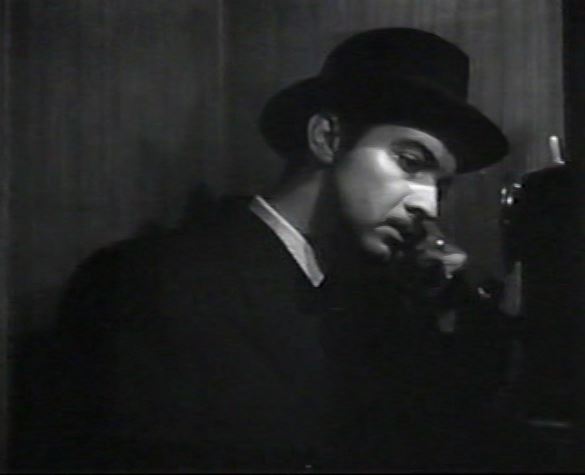
Mr. Scott looks and looks around, finally goes to a phone booth to call home.  Because he’s closed the door of the booth, and because there are constant announcements on the public address system about flights, we barely hear his voice.  We strain to hear him—a nice dramatic touch over not hearing him at all.  It makes us an active participant.  We don’t know what he’s saying—just like we couldn’t see the attack except from yards away and through curtains.  By his expression, we realize somebody on the other end told him shocking news, and he rushes to find his checked luggage and get a cab.
The phone, we learn, was answered the by the police, and we see when he arrives that his home is chaotic with reporters, and police all around.  For the first time, we learn that Ann Sheridan is well and survived the attack, but that her attacker lies dead on the living room floor with an ornamental knife in him that Mr. Scott had brought back from Japan during the war.  That’s about all of the mysterious orient you’ll find in this movie.
When Miss Sheridan is interviewed in her bedroom by the police, with her husband and Lew Ayres at her side, we see that she is traumatized and miserable.  We knew Bette Davis’ distress was just an act, but Sheridan’s horror is real.  The million-dollar question is asked of her “Had you ever seen him before?”  She answers no, and we have no reason to doubt her.  Neither does her husband or her lawyer pal.  The police detective, played by John Hoyt, remains cynical, but that is his job.

The widow of the dead man, played by Marta Mitrovich, accuses Ann of murder. “You killed him!” She is not as scary as Gale Sondergaard, but she’s pretty worked up about it.

By the way, does anyone know who plays the stenographer in this scene?  She has no lines, but she looks familiar.  I love stenographers.  
The detective tells us that the dead man has no criminal record, that he was a sculptor.  His mind, and ours, turns to the question, why did he go to her house?  If robbery wasn’t his motive, we are left with a question of attempted rape, though nobody uses the word.  Ann Sheridan’s expression is our first clue that she’s not being completely honest, she’s withholding some information, but we have to find out the hard way.
Steven Geray plays a smarmy art dealer who contacts Lew Ayres about a bust of a woman, asking him if he wants to buy it.  It was sculpted by the dead sculptor guy.  The face is Ann Sheridan’s.
Ann lied.   The dead scupltor obviously knew her and she knew him, because we are told that this kind of piece would have to be modeled from real life.  He didn’t sculpt it from a photo of her.  I find Ann's scatterbrained, guilt-driven, panic-induced deceit much more understandable and appealing than Bette Davis' psychotic, chilly posturing, but that is not to say that one actress is better than the other in the role; it's just a preference for characterization. 
The art dealer is attempting to blackmail Mr. Ayres’ client, but our noble Lew isn’t having any of it.  He brushes off the smarmy art dealer and goes straight to Ann, who, reluctantly, relents and confesses she did know the dead guy.  It was during the war, and she hired him to do the sculpture, but after a few sittings, he got too personal and creepy and made her feel uncomfortable, so she avoided him and never went back.  He stalked her a few times, but when her husband came home from oversees, it scared the guy off.
Ann tells Lew she didn’t tell him or the police that she knew the guy because, “I was afraid of what people would say.”
Now Lew has to hammer home to her that what people say is not the problem.  The problem is if she knew the guy, a jury might think she let him into the house and murdered him, that it was not self-defense.  She’s frustratingly slow on the uptake about this.
Unless there's more to it that she isn't saying.  

And there is.  

Then Ann goes to the smarmy art dealer herself to pay the blackmail, but the widow doesn’t want her money.  She wants her to go to jail. 
Ann goes back to Lew Ayres in a panic, getting herself in deeper and deeper, and finally Lew understands, as do we, that she had more than a professional relationship with the sculptor.  She had a fling with him.
Lew, lawyer and bachelor, is disgusted.  “You’re no different from all the other cheating, conniving women who parade through my office.”  Now he strips the final layer away:  Did she kill him on purpose to shut him up?
We pause here to watch the how her web of lies has taken on a life of its own.  Smarmy art dealer still wants a cut of the blackmail money he thinks he’ll get, so he contacts Zachary Scott and meets him, like a spy movie, in MacArthur Park (no cake out in the rain here, so just never mind that), one of the many neato Los Angeles scenes we have in this movie.  He takes him to the widow’s run-down apartment and meets Ann’s sculpted likeness as the art dealer hammers him with the old Othello scenario about the treachery of women.  Zachary is crushed.
He goes home to have a showdown with Ann.  She tries to explain her loneliness during the war.  He blasts her, “Millions of women waited, they waited decently, loyally.  They didn’t cheat.”
Mr. Scott wants a divorce, but just as he’s about to storm out, the cops show up at the door to arrest Ann on suspicion of murder.  See, the cops discovered Zachary going to the widow’s apartment with the smarmy art dealer.   They know about the sculpture now.  The jig is up.
Our Lew, despite his profound disappointment in Ann, agrees to represent her at the murder trial, where the prosecuting attorney is our old pal, Jerome Cowan.
The trial sequence builds to a crescendo of self- knowledge—of Zachary about Ann, and of about himself and his failings as a husband.  We learn they knew each other two short weeks before they were married, and he was so eager to pursue his career on his return home, she became an afterthought.  We also learn, somewhat surprisingly, that she was a fashion editor for a magazine before the war, yet we are given the impression she does not have a career now.  She gave up a job like that to stay home and volunteer for the Red Cross?  That is an interesting subplot that is not pursued, however. 
Neither is it fleshed out the possibility that Lew Ayres may feel more than friendship and respect for Ann and could present as a romantic rival, which would have been intriguing, but no triangle happens. 
What we do have is the crime of the century—not the murder, and not just cheating on her husband, but cheating on a vet in a post-war climate that revered them.
Jerome Cowan asks us, “Is this a woman you can believe?”
But Lew Ayres, and the producers remind us, “She is not on trial for infidelity.”  Mr. Ayres, from his own professional perspective as a divorce lawyer counters: “How many personal tragedies occurred far from the battlefield,” and “If there had been no war, she would not be in this court today.”  So it’s the war’s fault.  We see Zachary Scott mulling this over.
The best summation of the story is handled by Eve Arden.  When the jury is out a long time, Zachary Scott goes over his cousin Eve’s house to wait.  The merry divorcee is spending a quiet evening alone, with a book, the radio, and a box of chocolates, still wisecracking, but softer and sympathetic.  Zachary tears up, and cries, and she softly replies, “I’m glad to see you acting like a human being for a change.” 
Though she was never best pals with Ann Sheridan, whom she regarded as too good to be true, she defends her, and Zachary is upset.  “Is it my fault I was sent overseas?”
“You knew you were going when you met her.  Let’s face it, that’s why you married her…what you wanted was a whirl and a memory.  You wanted a beautiful woman waiting for you, and you didn’t want anyone making time with her when you were away, so you hung up a no trespassing sign, like you’d stake a gold claim.  You didn’t marry her; you just took an option on her.”
“She could have said no.”
Eve continues her sane, and somewhat shocking for the times, rebuttal: “When the band was playing?  Listen, I was there.  I saw you making with that uniform and that ‘today we live’ routine.  And then you were off.”
Production on this movie was begun in late 1946.  Just a year after the war, and we’re already negating all that movie patriotism and sacrifice that got us through the worst of it.
Then a phone call lets them know that Ann has been acquitted by the jury.  Mr. Scott quietly says, “Oh.”  So that we are still not sure how the ending will be played.
With Lew Ayres seemingly guiding the shell-shocked couple to a negotiation, it ends with a cigarette on the couch, and the leaden film noir score suddenly lighter, giving us hope, a suggestion of gentleness, and we even hear bells pealing.
We are left with an indictment not of Ann Sheridan, but of the era, and that gave the audience then, and gives the viewer now, something to think about. 
“With all my heart, I still love the man I killed” is just a cheap thrill in comparison. 
And the ending of The Letter where Bette Davis is murdered was not in the original story.  This was tacked on by the stalwart keepers of the Production Code to see that a murderess and adulteress was punished.
Ann Sheridan, in The Unfaithful remarkably gets away with both a killing and adultery, and still holds our sympathy.  She’s rebuked, but still noble.  Way to go, Ann.  It would have been a great scene for the movie if Ann had discussed her affair,  what attracted her to the man and why she needed to be with him.  Perhaps the intimacy of her face and body being so closely studied in creating the sculpture was what seduced her.  But I guess you can push the Hays Office just so far.
You may now rebut.

Related Products