IMPRISON TRAITOR, PEDOPHILE, AND CONVICTED FELON TRUMP.
Showing posts with label Burt Lancaster. Show all posts

Thursday, November 9, 2023

Criss Cross - 1949


Criss Cross
(1949) is a romantic triangle told noir style involving three poor souls who can’t help being themselves.  There’s a heist in there, too. 


This is my entry into the Classic Movie Blog Association fall blogathon:  “Blogathon & the Beast” featuring characters battling, or losing the battle, with their primal inclinations.  In my house, we’ve always called that being your own worst enemy.  But there are enemies aplenty in this yarn, to be sure.

Burt Lancaster and Yvonne De Carlo are in their prime here as both stunningly photogenic and emblematic of the scowling hopelessness of fate in film noir.  Dan Duryea, a favorite sniveling baddie, is the third point in the triangle.  Love and betrayal go together like a horse and carriage.  Or something like that.


The story is set in Los Angeles (where else?) with an aerial shot over the credits of a misty twilight, as we move toward the Bunker Hill section of town that is no more.  Like director Robert Siodmak’s camera shots, the streets are always at a treacherous angle.  We get lots of location views, including Union Station, and the famous Angel’s Flight funicular, which we covered previously here in The Turning Point (1952) and in this essay specifically on the Angel’s Flight in movies.


Burt provides occasional narration, and the plot is revealed drip by drip, so we are always left off balance and wondering.  He is returning home to L.A. after a year of travel about the States, working here and there, coming back to his mother’s house to renew acquaintance with his younger brother, played by Richard Long; his boyhood pal police detective Stephen McNally; and the bar and nightclub where he used to hang out before he went into a self-imposed exile.

The reason for his exile and the reason for his return appear to be the same:  Yvonne De Carlo.


The movie starts with great energy by plunking us down in the middle of a crisis.  Miss De Carlo and Mr. Lancaster, clutching each other between parked cars in the parking lot of the night club, seem to infer that there’s a plan about to the hatched, and she wishes it were all over.  He tells her to wait in a secluded cottage by the beach many miles away, and they must not be seen together.

“It’ll be you and me, the way it should have been from the start.”


Inside, gangster Dan Duryea, smarmy even in an immaculate white dinner jacket, is curt and suspicious when Yvonne enters, badgering her with questions.  Aha!  She’s his wife and she’s messing around with Burt!

Burt’s old pal Stephen McNally sticks his nose in and warns Burt off her and they argue.  He wants to prevent a fight between Burt and Duryea, but he can’t.  They fight, and when he attempts to arrest Duryea for having a knife, both men act like nothing’s wrong.  They don’t want the cops involved.  They both go out in the alley at a dirty old iron set tub to wash.  They don’t have a men’s room?

Here, Duryea, his gang, and Burt have a splintered discussion that clues us in to their mysterious behavior.  The fight is fake.  They are setting up the cops.  But how, and why?


We next see Burt at his job, an armored car driver chatting with his work pals, including old man “Pop” who is his partner and rides in the back of his truck with the money.  They are headed out on a highway, and we see over Burt’s shoulder in the back of the truck is a rifle.  Director Siodmak is meticulous in dropping foreshadowing hints.

But as Burt drives and his mind wanders, we finally get the required noir flashback to tell us the whole story.


Burt has returned to sunny L.A. after a year spent trying to his get ex-wife out of his system.  Yvonne De Carlo.  He swears he’s over her, but we see he’s not.  His worried mother, who never liked Yvonne, sees he’s not.  His interfering pal, Stephen McNally, sees he’s not.  Most especially, a delighted Yvonne De Carlo sees he’s not.

He goes to old haunts trying to accidently run into her on purpose, and finally encounters her at the nightclub dancing a vigorous rumba with Tony Curtis is his first film role.

After a verbal and psychological tug of war between them, Burt wants to get together again, is eager for it, but she disappears and afterward he finds out she has married Dan Duryea.

But why?  Especially when after several months he stalks her again and she haughtily barks at him, but eventually breaks down and says she had no choice.  Stephen McNally threatened to run her in and send her to prison on trumped-up charges if she didn’t stay clear of Burt.  So she married Duryea, who treats her badly.  One look at the bruises on her back, and Burt is steadfastly her hero again, ready to fight the world to protect her and defy family and friends, heaven and earth, to keep her to himself, where he will make her safe and happy.  She is a tragic figure.  So is Burt, by virtue of his big, stubborn heart.


The movie is full of favorite character actors in bit roles, including Percy Helton as the bartender, Griff Barnett as Pop, John Doucette as one of Duryea’s mob.  We have to feel at least a little sorry for Joan Miller for being known in the script and on the credits only as “Lush,” though she does get a few good scenes on her barstool.

The dynamics shift again when Duryea and his gang surprise Burt and Yvonne at Burt’s mother’s house, and we think for a moment Burt is going to be fitted for cement shoes, but Burt surprises everyone with a hastily thought-up excuse to not only diffuse the situation, but to also hatch a plan for his intended escape with Yvonne.


He tries to interest Duryea in a heist of the armored car he drives.  Burt will be the inside man in the crime.  Duryea bites, and they proceed to have a meeting in an empty apartment right next to the Angel’s Flight funicular with an expert to help them plan the heist:  dapper Alan Napier, who we can see without much explanation, is an intellectual loner, with his books, his chessboard, his educated speech and demeanor, and his weakness for alcohol.  Everyone here has a weakness.

He plots out the scheme with mathematical precision, while the gang hovers about drinking beer, and Yvonne De Carlo watches morosely, tensely, clearly fearful of the consequences and not being able to get away with Burt. 

The ploy involves driving the armored truck at a specific time and location, passing by an ice cream truck to be used to take the loot away, a couple of plants at a manhole who will discharge smoke bombs at the right moment, plenty of firepower, and some gas masks.  Burt’s only requirement is that Pop not get hurt, and they all agree.

It’s a nice bit where the gang member who poses as the ice cream truck man pulls a kid away from the traffic about to be hit by the armored car at the last minute. 


But things go wrong, and Pop is killed, and Burt tries to save what’s left by firing his gun on the baddies.  He is shot, too, and he wakes in the hospital, told he is a hero because he saved half the payroll.

Only his pal, cop Stephen McNally suspects Burt was in on it.  He warns him that Duryea will be after him.  Burt tells him to shove off, but spends an anxious night worried that any sound in the hospital corridor will mean one of Duryea’s boys has come to get him.

There’s a nice duality between two scenes with dressers:  Earlier in the apartment when the gang is planning the heist and a few of them sit playing cards around a dresser for a table.  The dresser has supports for a mirror, but the mirror is missing.  Later in his hospital room, Burt is riveted on the dresser with a tilted mirror, trying to see the man sitting in the chair in the hall.

A terrific suspenseful scene with Robert Osterloh, who plays a man visiting his wife in the hospital—who turns out not to be quite that, and we find ourselves with Burt and Yvonne reunited at the secret hideaway, because Burt bribed Osterloh to get him there.

Now that Burt’s got everything he wants—Yvonne and half the money from the heist—he thinks his troubles are over and he’s outsmarted everyone.  “I just wanted to hold you in my arms, to take care of you.”

Yvonne, who was never stupid, blows up at him.  Osterloh, she says, will run right back to Duryea and tell them where they are.  How could he be so stupid?  She packs her things, and the money, and briskly and in no uncertain terms, without an ounce of guilt, tells him she has to look after herself.  Everyone does.  It’s just how people are.  She’s going to leave him there, helpless and injured, and broke.

Poor Burt is gobsmacked.  For such a clever, quick-thinking guy, he never thought of this.  He never thought she was really as mercenary as everyone said. 

Duryea shows up, just like Yvonne knew he would, and plugs them both, and Burt’s last sensation is of holding her in his arms when she claws at him for protection.

Then with satisfaction, Duryea turns away, and then a look of horror as we hear approaching sirens.  Osterloh has sold him out, too.  With all the bribes he’s taken just this night, he’s got to be filthy rich.

Criss cross.  Every betrayal merits a double-cross.  In the film noir world, it’s just the way things are.  Yvonne De Carlo knows it.  Burt can’t help being who he is, even after hard lessons.  Duryea and his boys know no other life.  All of them fight the beast within. 

Except maybe Pop.  He’s a nice old fella.

For more great blog entries in CMBA’s “Blogathon & the Beast” have a look here.

   ************

Jacqueline T. Lynch is the author of Ann Blyth: Actress. Singer. Star. and Movies in Our Time - Hollywood Mirrors and Mimics the Twentieth Century and Hollywood Fights Fascism and Christmas in Classic Films. TO JOIN HER READERS' GROUP - follow this link for a free book as a thank-you for joining.


Thursday, August 18, 2016

Seven Days in May - 1964


SevenDays in May (1964) uses a most meaningful and chilling biblical term in the crackling dialogue: “false prophets”. It is this phrase, so well known, and occasionally exploited by religious fundamentalists, that we hinge this post on, and not so coincidentally, this election year.

This is the fifth and last movie we will discuss in our series on the treatment of fascism in classic films. The previous four films were The Mortal Storm (1940), Address Unknown (1944), Storm Warning (1951), and Keeper of the Flame (1942).

“False prophets” is the term used by star Fredric March to describe General Edwin Walker, a real-life figure, who attempted a political career, unsuccessfully, after President John F. Kennedy accepted his resignation in November 1961. Walker, an outspoken critic of political figures and members of the government he felt were communist sympathizers – naming, in his accusations, President Harry S. Truman, former First Lady Eleanor Roosevelt, and others in government, used his position in the Army to impose his extreme right-wing views and attack those who did not agree with him.  Crossing the line of propriety, not to say prudence, among military figures who desire political power is nothing new. General Douglas MacArthur, also frustrated in political aspirations, was removed from his position by President Truman when he attempted to sidestep the authority of the President and run the Korean War in his own manner, which included his intention to escalate a full-scale war with China.

Adolf Hitler was a soldier in World War I who blamed Germany’s defeat on the politicians, and thought he could run things better, too.

The story in Seven Days in May is fictional, but that it was, and is, entirely plausible makes the movie an important voice not only of those tense days of Cold War crisis when nuclear weapons raised the ante in a war of words with the Soviet Union, but remains relevant today. Nuclear weapons have not gone away. A new demagogue has risen from the dark corners of a free and tolerant society to exploit it. Donald Trump, however, was not a soldier or representative of our arms services. He has declined membership and avoided the draft on several occasions. But he has more support and free range than any false prophet in our history. The lazy, shallow, and inept media, and a moronic legion of extreme right-wing supporters, has allowed this. They even celebrate it.

Though we have seen much in this election year alone to make us jaded, nevertheless I don’t think that keeps us from feeling the power of Seven Days in May, the shock of the characters facing an unimaginable threat to our democracy.  Though it was made at the height of the Cold War, and is set in a vague not-too-distant future of the early 1970s, the theatricality of the movie (it is really a series of “drawing room scenes”); the sharp, literate dialogue; the fast-paced plot; and the stellar acting make this movie as equally relevant today as it is a timepiece from an era when the media wasn’t so much a “loose cannon” as it is today, providing a showcase for other loose cannons.

I first read the novel on which the movie is based when I was in high school, and re-read it before preparing for this post. I understand much more about politics and government, and life, than I did at sixteen – but the eerie chill that something like this could happen remains just as profound in middle age as it did in my teens, but the movie works even simply an entertaining thriller of Cold War intrigue, if one is unaware of how real it is.

Directed by John Frankenheimer, everything in the film is a purposeful tool, right down to the credits which count off to seven numerals superimposed over the Articles in the Constitution. The arrows in the talons of the eagle on the presidential seal, they are weapons. They are a threat – but not to foreign enemies. They also resemble missiles.

We begin with an orderly protest of marchers carrying signs in front of the White House. We, today, might be first struck that the protesters are well-dressed, conducting themselves with cordial dignity. Compared to protest mobs today, it looks like a country club cotillion. We are not sure exactly what they protest, but soon there is a group of counter protesters. They are for the president. They are against the president. They are for a nuclear weapons treaty. They are against the treaty. In another moment, the scene becomes less strange and more familiar to us – the two factions get loud, ugly, and start to beat each other up.


Fredric March is a beleaguered President, who has just signed a pact with the Soviet Union over the use of nuclear weapons. His ratings in the polls has dropped. His doctor warns him about his high blood pressure. He is a man of principle, but he is discouraged and fed up.

Among his confidants is a Southern senator played by Edmond O’Brien, terrific in the role as an acerbic, no-nonsense career politician. He also has a drinking problem, which he recognizes with a mixture of sadness and amusement. Martin Balsam is an adviser. The movie is so jam-packed with the best actors of the day, just picking them out is entertaining.


Burt Lancaster shines as a General of the Joint Chiefs of Staff who has come to The Hill to testify to a senate committee that he feels the treaty with the Soviet Union is a bad idea, that it makes our country vulnerable. He makes several impassioned points. “There hasn't been a single piece of paper written in the history of mankind that could serve as a deterrent to a Pearl Harbor. I sometimes wonder why we haven't learned that lesson by now. Every twenty years or so we have to pick ourselves up off the floor bleeding and pay for that mistake. Those mistakes are delivered to us C.O.D. by peace loving men. And bought and paid for with the lives of other men. Men in uniform.”


Kirk Douglas is Lancaster’s aide, a Marine Corps colonel who agrees with Lancaster’s view that the disarmament treaty isn’t worth the paper it’s printed on. Mr. Douglas will soon become embroiled in a mystery, a political controversy, and inevitable disillusionment in the man he most admires – Burt Lancaster – when he discovers that Lancaster is planning to take over the government and appoint himself as dictator in a military coup.

It begins, innocently enough, when Kirk Douglas discovers betting slips left by the members of the Joint Chiefs of Staff on the coming Preakness horse race. He is amused by this, and especially amused that an admiral is too cheap to cough up a ten-dollar bet.

Soon, the young aide who let this funny gossip slip, as well as the code used by the betters: ECOMCON, has suddenly been reassigned. He’s there one day, gone the next.


An old friend of Douglas, played by Andrew Duggan, is a colonel who has been assigned to a new secret base in Texas, and he confesses to Douglas that he is baffled by the mission for which he and his men are training: not defense, but seizure of the government. Douglas, fearing something is going on behind his boss’s back, keeps his eyes and ears open. We follow him to a Washington cocktail party, where he meets up with Ava Gardner, who happens to be Lancaster’s former mistress, whom Burt has dumped.

We follow Douglas as he tails the car of a firebrand right-wing senator to Lancaster’s home in the middle of the night. We follow Douglas through a darkened parking garage, and through the halls of the Pentagon. We come to understand, as he does, eventually, that Burt Lancaster is plotting to take over the country. Lancaster has established the secret base, unknown to the President and other members of the government, and will take over all the media first, shut them down, and then throw the treaty out.

Douglas, choked by his suspicion, brings it to the President, but neither Fredric March nor his staff believe him at first. Still, they look into the matter.

Edmond O’Brien is dispatched to Texas to find out where this secret base is. He is kidnapped and held in confinement at the base. Knowing his problem with alcohol, O’Brien is brought a steady supply of whiskey to quiet and disorient him, which he heroically pours down the toilet. Andrew Duggan checks on the prisoner, and O’Brien manages to convince him about the plot to overthrow the government. Duggan fires on his own men to free O’Brien in a daring nighttime escape. Then Duggan disappears.

President Fredric March was slated to attend scheduled war games exercises in a secluded bunker with Lancaster, but he declines to go, insisting he is going to go to his fishing camp instead. He doesn’t; he cleverly remains safe at the White House, and it is discovered that Lancaster’s henchmen arrived at the fishing camp on a mission to kidnap March.

Martin Balsam is sent to an aircraft carrier in the Mediterranean to obtain the confession of the admiral who knew about the plot, but decline to place his “bet”. He is played, in his acting debut, by John Houseman. A masterful scene, as Houseman squirms, wishing he  had more time. His gentlemanly guilt turns our stomachs.  But the pot is not foiled just yet. The tables are turned when Balsam, signed confession in hand, dies in a plane crash. Houseman will later lie and insist he never signed any confession document.


Douglas is sent to New York to woo and con Ava Gardner out of her love letters from General Burt Lancaster in an attempt to use anything against him to stop him from taking over the government. It is a chore that sickens him.

It’s a nail-biting finish, but an 11th-hour lucky break for the doomed democracy occurs, and Fredric March, proof in hand, demands the resignations of all the Joint Chiefs of Staff.  Lancaster, with that steely-eyed glare that bores through the unfortunate person to whom he is speaking, arrogantly declines, and openly declares his intentions to take charge. He insults the President, and the presidency, and declares war on democracy to get what he wants. 


Their firey exchange:

Lancaster, resplendent in his uniform, his broad shoulders, his ramrod straight posture of a proud, accomplished man. He is filmed from a low camera angle, so he looks even taller, mightier:  “I'm here to tell you face to face, President Lyman, that you violated that oath when you stripped this country of its muscles, when you deliberately played upon the fear and fatigue of the people and told them they could remove that fear by the stroke of a pen. And then when this nation rejected you, lost faith in you, and began militantly to oppose you, you violated that oath by not resigning from office and turning the country over to someone who could represent the people of the United States.”


President Fredric March, sitting, older, looking defeated and horrified, “And that would be General James Mattoon Scott, would it? I don't know whether to laugh at that kind of megalomania, or simply cry.”

Lancaster, addressing himself in the third person, the telltale sign of the depth of his conceit: “James Mattoon Scott, as you put it, hasn't the slightest interest in his own glorification. But he does have an abiding interest in the survival of this country.”

March responds “Then, by God, run for office. You have such a fervent, passionate, evangelical faith in this country, why in the name of God don't you have any faith in the system of government you're so hell-bent to protect?”

But with evidence in hand, and a still-free press in place, and men in the military—like Kirk Douglas and Andrew Duggan—who may not agree with politicians, but who agree that as military men their purpose is to defend the Constitution and not to circumvent it—Lancaster’s coup collapses. Lancaster accuses Kirk Douglas of being a Judas. “Are you sufficiently up on your Bible to know who Judas was?”


Douglas, at attention, looks him in the eye and answers, calmly, without any passion, “Yes, Sir, I know who Judas was. He was a man I respected and admired—until he disgraced the four stars on his uniform.”

It has been noted that the Pentagon did not want this movie made, but that President John F. Kennedy supported it, through his press secretary, Pierre Salinger, and “conveniently” left for weekends at Hyannis so the film crew would be free to film exteriors in front of the White House.

Fredric March offers a summary of the evil of the day: “He's not the enemy. Scott, the Joint Chiefs, even the very emotional, very illogical lunatic fringe: they're not the enemy. The enemy's an age, a nuclear age. It happens to have killed man's faith in his ability to influence what happens to him. And out of this comes a sickness, and out of sickness a frustration, a feeling of impotence, helplessness, weakness. And from this, this desperation, we look for a champion in red, white, and blue. Every now and then a man on a white horse rides by, and we appoint him to be our personal god for the duration. For some men it was a Senator McCarthy, for others it was a General Walker, and now it's a General Scott.”

I would suggest, however, that this is not a sickness specifically of the nuclear age. Hitler’s rise to power was not a product of the nuclear age, nor Napoleon’s, nor any dictator through history who exploited misery, spread lies, and relied upon the ignorance and bigotry of an easily-manipulated populace to steal power. The only distinction between the dictators or would-be dictators of history and Donald Trump is Trump has the advantage of a media enamored of “reality” television, who regards him as entertainment and thus has given him a platform and stature he would not have so easily attained in another age. He has been given a free ride to fame. He has learned through the process that he can do whatever he likes, the more obnoxious he is, the more attention he gets.

The truth is what he decides it will be. His rabid followers will not complain so long as they agree with him. When he goes after them, they will have no one to turn to for help—except any trace of democracy that might be left to shield them.

Benjamin Franklin announced at the close of the Philadelphia Constitutional Convention in 1787 that his colleagues had created “a Republic—if you can keep it.”

President Barack Hussein Obama told the delegates assembled in the same city at the Democratic National Convention this year that “democracy works, but we’ve got to want it.” As regards Trump, the President noted, “We don’t look to be ruled,” he said. “Anyone who threatens our values, whether fascists or communists or jihadists or homegrown demagogues, will always fail in the end.”

It is up to us to make sure they fail, those “false prophets.”

Returning to that term, for those extreme right-wing fundamentalists who are so fond of looking ahead, almost gleefully, to Armageddon, a warning of “false prophets” occurs several times in the Bible.  We use the imagery of the Bible too much like a Rorschach test, seeing what we want to see.  Look hard and see if you can recognize Donald Trump.

In Matthew 7:15 (quoting from the King James Bible):

Beware of false prophets, which come to you in sheep’s clothing, but inwardly they are ravening wolves.

And from John 8:44:

 He was a murderer from the beginning, and abode not in the truth, because there is no truth in him. When he speaketh a lie, he speaketh of his own: for he is a liar, and the father of it.

This concludes our five-part series on how fascism was depicted in classic films. I would like to conjecture why modern filmmakers don’t cover, intellectually and passionately, the issues of our own times, instead of wiping them away with allegorical stories of space warriors and fictional superheroes. But I don’t know the answer. Perhaps the wish to be “politically correct” has made seeming to take a partisan editorial stance in a film too uncomfortable, leaving one too open to criticism, sort of "damned if you do and damned if you don't," or is just unprofitable. 

Or maybe our society, and especially our movies and media, just needs to grow up.
**************


The audio book for Ann Blyth: Actress. Singer. Star. is now for sale on Audible.com, and on Amazon and iTunes.


Also in paperback and eBook from Amazon.


Thursday, October 2, 2014

Brute Force - 1947


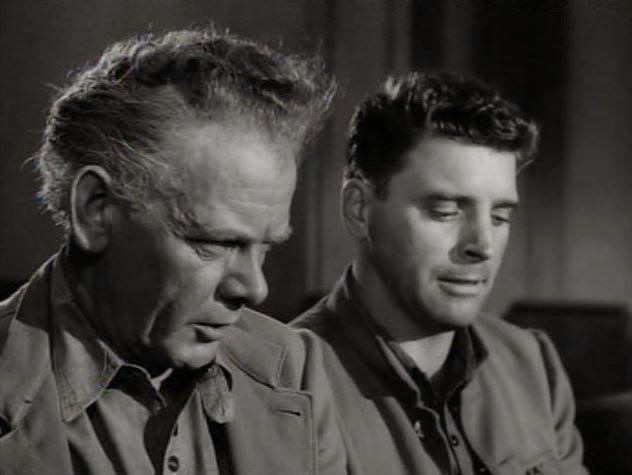
Brute Force (1947) remains a giant among prison movies.  Visually stunning, it has a noir foundation on which is hung an unusually sensitive (for noir) study of men trapped by their circumstances, their sins, their weaknesses, their fears, their anger, and even by their ability, those that still have it, to feel the pain of those around them.

Burt Lancaster heads a sterling cast, even the most minor character is vivid and memorable in this film.  That’s what happens when you have a crisp, literate, and biting script, and most especially, a director and cinematographer who freely turn what could have been a stiff sort of docudrama, or clichéd melodrama—how most prison stories tend to be filmed—into unabashed art.  We are treated to a generous array of stunning close-ups and interestingly framed shots that tell us volumes about the men, especially since they are in a setting where they are close-mouthed, unlikely to tell us everything that’s going on inside them.

Expository dialogue goes to the administrators in the prison.  We have Richard Gaines, so dependable in officious roles as the severe, pompous superintendent, always pressuring the anxious, ineffectual warden, played by Roman Bohnen.  The warden complains of cutbacks in funding, that the prison is overcrowded, that the men need job training…all of which the superintendent balks at, saying what the men need is more discipline. 

The soft voice of the head of the prison security force, played by Hume Cronyn, belies his sadistic nature.  The little man enjoys the fear he excites in the hardened men, most of them much larger and physically imposing—but Cronyn wields power he’s swiped in a vacuum of leadership, tortures them physically and psychologically, and he has Ray Teal following behind him with a billy club like a human swagger stick.

The cast is a feast of favorite character actors, like Sam Levene, and Charles McGraw in one of many uncredited roles that filled the first several years of his film career. 

The wonderful Charles Bickford is the level-headed old timer, who breaks up fights in the prison among the other cons, and bides his time until his hoped-for parole.


Sir Lancelot sings calypso rhymes he makes up on the spot to narrate what he sees, as either a funny jest, or a warning, or a requiem for yet another dead prisoner.

There’s Jack Overman as one of the cellmates, an easygoing, simpleton ex-fighter.  One of my favorites, he has a bigger role here for once.  We’ve seen him in a non-speaking minor role in Once More, My Darling (1949) here, and also in Swell Guy (1946) here.  Sadly, Mr. Overman died in late 1949 at only 32 years old.

His cellmates include Whit Bissell, as a small-time embezzler, a sad, brittle fellow who, obsessed his shallow wife, played by Ella Raines in a flashback segment, fearing losing her love, steals from his employer to buy her a mink coat. 

John Hoyt is a stylish grifter, mainly in phoney stocks, a man-about-town with a charming easy-come, easy-go attitude.  I love his line, “I wonder who Flossie’s fleecing now?”

Howard Duff, in his first film, is a former soldier who took the rap for Yvonne De Carlo, an Italian woman he falls in love with during the war.  She has murdered her father to save Duff, but though he takes the blame to save her, I don’t believe his current imprisonment is for that crime.  He remarks about always wanting to get back to Italy to see her, but “one rap led to another.”

The best lines, and probably the best role of the film happily goes to Art Smith, who plays the prison doctor.  He’s just as fatalistic as the cons, and drinks heavily to dull the pain of this miserable place.  It's a terrific performance.   

But unlike the weak warden Roman Bohnen, who gives in to the bullying Richard Gaines and the devious machinations of Hume Cronyn, Mr. Smith is still a man of strong conscience.  He gets into shouting matches with them all, gets right in their faces and bleeds his anger and sarcasm all over them.  Again and again, they slap him down.

Burt Lancaster, whose character as the leader of his cell, and one of the most respected by the other prisoners for his toughness, is beautifully lit, if you can call his deadly cold glare and vicious snarl beautiful. 

We first see him standing in the prison yard in the pouring rain, but with his soaking wet shirt tucked neatly into his soaking wet prison trousers, he strides back to his cell, his shoulders straight, his head held high with an air of nobility.  Though he has just come out of solitary confinement, he is not broken.  He is angrier, and more charismatic to us and to the other prisoners, than ever.  The other men light his cigarettes as a mark of his leadership.  The only one who ranks him is Charles Bickford, who freely reaches into Lancaster’s prison jacket in another scene and swipes a match from Burt’s shirt pocket to light his own cigarette.  Burt lets him, hardly noticing, as if the older man could be his father and is allowed such liberties.

Because this is a setting of confinement, much of the film has the feeling of theatre, and the action that takes place is muted and judicious, until the very end of the film when we have the attempted prison break.  Director Jules Dassin and writer Richard Brooks have the perfect marriage of script and cinematography, where each supports the other, and the pace of the movie flows beautifully, building tension, and then releasing it a bit at a time in unexpected moments of black humor, and when, where the men watch the 1947 comedy The Egg and I starring Fred MacMurray and Claudette Colbert, it seems surreal.

Ann Blyth, like the few other women in the cast, save for the officious and severe secretary of the warden, is shown in flashback.  The women on “the outside” show us what the men’s lives were like before they went to prison.  There has always been a debate as to whether the flashback scenes with the women are necessary to the film.  Some critics and viewers feel they are fitting to the story, and others feel they slow the story down and detract from the intensity of the prison scenes. 

Even director Jules Dassin apparently did not want to use the flashback device.  Author Alan K. Rode in his biography of Charles McGraw, Charles McGraw: Biography of a Film Noir Tough Guy, reveals that Dassin gave in to producer Mark Hellinger and the studio brass to include the four flashback scenes that show women who have influenced the lives of some of the men in the cell.  He quotes Dassin:

“Truly, the film is demeaned by the inclusion of ‘the women.’  I had to choose between not making the film and yielding to having the women nonsense.  Many years later when I looked at the film…I do not forgive myself.”

I don’t know how screenwriter Richard Brooks felt about the women scenes, but I’m inclined to think Mr. Dassin’s dislike of them might be, in part, a director’s usual, and quite understandable, bristling at having to shoot the film to someone else’s vision.

On another note, Mark Hellinger had to fight toe-to-toe with the Breen office because the MPAA wanted to censor many of the films violent scenes, a reference to marijuana, and even to exclude the word “cancer” when referring to Ann Blyth’s diagnosis because the very word was upsetting to the public.  Perhaps Hellinger threw Breen a bone when he has the doctor, Art Smith, reassure Burt Lancaster that, “These days, cancer doesn’t have to mean death at all.”

That’s another reason why Burt has to bust out of prison.  There’s a time element to Ann’s needed operation.

Others have suggested that the flashbacks represent a societal misogyny, or some statement to the effect that these are regular Joes who’ve been led astray by dames.  Again, here I disagree.  They show the men, more than the women, to be flawed.  Though John Hoyt has his car, his gun, and his gambling winnings stolen by a floozy, he was obviously willingly, knowingly taking chances in an underworld game of roulette, and the odds were against him this time.  He shrugs it off, amused and unrepentant.

Whit Bissell’s wife’s cooling ardor for him, and her greed for the mink coat which she clearly treasures more than her husband, leads to his downfall, but she did not force him to embezzle, had no idea he was doing it.  Bissell was not led astray, he was a fool who turned to thievery, and his obsession with his wife was such that it leads to his suicide when Hume Cronyn tells him (whether true or not) that his wife is divorcing him.  “I get quite a kick out of censoring the mail.”

Howard Duff’s taking the rap for Yvonne De Carlo does not make her a villain, her act of love is to protect him; his was to protect her.  But thinking this paints Duff as a hero wrongly placed in prison is also erroneous.  He is not in prison for assuming the guilt for her murder of her father; he plainly tells us he’s had other “raps” since.  Besides, he would have been incarcerated in a military prison were that so.  Look at the scene where he, John Hoyt and Jeff Corey go after a “stoolpigeon” prisoner with blowtorches, forcing him to be crushed in a stamping machine.  Look at their expressionless faces.  These regular Joes are killers. 

We could probably dispense with their flashback scenes (indeed, Anita Colby as Hoyt's floozy girlfriend never even gets any lines), but the one with Burt Lancaster and Ann Blyth I think is important to the film.  We don’t know if Lancaster has committed murder on the outside, but we see he is tied in with a gang he gives orders to, and probably is involved in something more like bank robbery.  Just before he leaves on another “job,” he stops by the house where Ann Blyth lives, an invalid in a wheelchair.  Lancaster hands a caregiver an envelope with money, “See that she doesn’t need anything.”

Ann is at first asleep, then he wakes her, and in their tender scene shows us that Lancaster is tired of running, that this will be his last job, and then he will come back to her for good.  He tells her that when he met her, he was a guy who “found the first important thing in his life.”  She doesn’t know what racket he’s in, but she senses he is troubled.  She wants to help him, wishes she weren’t sick so that she could help him.

“There are all kinds of sick people, Ruth.  Maybe we could help each other.”  The scene is gentle, affectionate, somewhat sad.  Ann’s character is not a gun moll, she’s a sweet, decent girl who trusts him.  This is important because it bolsters the visual image we already have of Burt Lancaster in the film as more a wounded animal than a psychopath.  

Indeed, at the very end of the movie when he is shot in the prison escape, he rears back with a single roar of pain and rage, like an animal in a trap, cut short as he fires several rounds into the guard who wounded him.  Bookending his cold expression of anger through most of the film is the softened, relaxed look of tenderness on his face when he sees her sleeping, and at the very desperate end when he sees that the escape plan has failed, and he looks for a moment like he could cry.

We need this scene with Ann Blyth, maybe all of “the women” scenes, not to remind us that the men are human, but because we are.  We can’t root for criminals to break free from jail, not unless we have some emotional stake in their success.  Without emotion, it becomes as academic as a watching the outcome of a dog race, and without the betting.

Interestingly, their scene ends with the camera remaining focused on Ann after Burt has left the room, tears welling in her eyes, heartbroken, frustrated, and fearful.  Dassin's touch, or Hellinger's?

One wonders what private demons she might have faced in the brief scene.  She was eighteen years old.  In the previous two years she had spent several months really in a wheelchair as a result of her spine injury, and her mother really died of cancer, both discussed in our intro post to this series.  Life's coincidences are occasionally macabre.

Producer Mark Hellinger may have had yet another reason for putting Ann Blyth and Burt Lancaster together.  He had hired her for Swell Guy (1947), and him for The Killers (1946).  They were two of Universal’s most talented up and coming stars, and he may have wanted to turn them into a team.  According to syndicated gossip columnist Dorothy Manners who wrote this in May 1946:

Mark Hellinger, always good for a bright idea, said to me, “Where are those swell romantic teams that used to make the fans goggle-eyed over their love scenes…It’s time the love team is revived on screen,” and Mark is the boy who is going to do it with his two young stars, Ann Blyth and Burt Lancaster…he wants to make three or four with Ann and Burt.  This Blyth girl is the real star stuff—young, tempestuous and definitely a screen personality.  If you saw her as Mildred Pierce’s daughter, you know what I mean.

Having played in her previous two films as young women of dubious, or downright evil, character, her role as the kindly, gentle Ruth in Brute Force would be the first important break in a string of roles that could have left her typecast, and farther away from ever doing the musicals she hoped to make.  But Ann Blyth was not done with bad girls yet: A Woman’s Vengeance (1948), discussed here, and Another Part of the Forest (1948), discussed here, were on the horizon.  She’s in Brute Force all of only about three or four minutes, but her scene is indelible, and does more for Burt Lancaster’s character than the awe the other prisoners show for him.

Their romantic team never did materialize.  Both went on to other films, and Mark Hellinger, who might have made a pet project of bringing them together again on screen, tragically died about six months after Brute Force was released.

Come back next week to Katie Did It (1951), a movie I can’t find, and a few thoughts about that and on Ann’s career as we round the corner and head for the home stretch on this series.


*************************
Milwaukee Sentinel, May 31, 1946, syndicated column by Dorothy Manners, p. 4.

Rode, Alan K.  Charles McGraw: Biography of a Film Noir Tough Guy, (McFarland, 2007), p. 32.


****************************
As  most of you probably know by now, this year's TCM Classic Cruise will set sail (proverbially) in October, and one of the celebrity guests is Ann Blyth.

Ann will be doing a couple hour-long conversation sessions, and will also be on hand for a screening of Mildred Pierce.

Have a look here for the rest of the schedule and events with the other celebrity guests. Unfortunately, the cruise is booked, so if' you're late, you can try for the waiting list.

I, sadly, am unable to attend this cruise, but if any reader is going,  I invite you (beg you) to share your experiences and/or photos relating to Miss Blyth on this blog as part of our year-long series on her career.  I'd really appreciate your perspective on the event, to be our eyes and ears.  Thanks.
****************************
 THANK YOU....to the following folks whose aid in gathering material for this series has been invaluable:  EBH; Kevin Deany of Kevin's Movie Corner; Gerry Szymski of Westmont Movie Classics, Westmont, Illinois; and Ivan G. Shreve, Jr. of Thrilling Days of Yesteryear.  And thanks to all those who signed on as backers to my recent Kickstarter campaign.  The effort failed to raise the funding needed, but I'll always remember your kind support.
***************************
TRIVIA QUESTION:  I've recently been contacted by someone who wants to know if the piano player in Dillinger (1945-see post here) is the boogie-woogie artist Albert Ammons. Please leave comment or drop me a line if you know.
****************************
UPDATE:  This series on Ann Blyth is now a book - ANN BLYTH: ACTRESS. SINGER. STAR. -
*********************
The audio book for Ann Blyth: Actress. Singer. Star. is now for sale on Audible.com, and on Amazon and iTunes.

Also in paperback and eBook from Amazon, CreateSpace, and my Etsy shop: LynchTwinsPublishing.


 "Lynch’s book is organized and well-written – and has plenty of amusing observations – but when it comes to describing Blyth’s movies, Lynch’s writing sparkles." - Ruth Kerr, Silver Screenings

"Jacqueline T. Lynch creates a poignant and thoroughly-researched mosaic of memories of a fine, upstanding human being who also happens to be a legendary entertainer." - Deborah Thomas, Java's Journey

"One of the great strengths of Ann Blyth: Actress. Singer. Star. is that Lynch not only gives an excellent overview of Blyth's career -- she offers detailed analyses of each of Blyth's roles -- but she puts them in the context of the larger issues of the day."- Amanda Garrett, Old Hollywood Films

"Jacqueline's book will hopefully cause many more people to take a look at this multitalented woman whose career encompassed just about every possible aspect of 20th Century entertainment." - Laura Grieve, Laura's Miscellaneous Musings''

"Jacqueline T. Lynch’s Ann Blyth: Actress. Singer. Star. is an extremely well researched undertaking that is a must for all Blyth fans." - Annette Bochenek, Hometowns to Hollywood


Ann Blyth: Actress. Singer. Star. 
by Jacqueline T. Lynch

The first book on the career of actress Ann Blyth. Multitalented and remarkably versatile, Blyth began on radio as a child, appeared on Broadway at the age of twelve in Lillian Hellman's Watch on the Rhine, and enjoyed a long and diverse career in films, theatre, television, and concerts. A sensitive dramatic actress, the youngest at the time to be nominated for her role in Mildred Pierce (1945), she also displayed a gift for comedy, and was especially endeared to fans for her expressive and exquisite lyric soprano, which was showcased in many film and stage musicals. Still a popular guest at film festivals, lovely Ms. Blyth remains a treasure of the Hollywood's golden age.


***************************
A new collection of essays, some old, some new, from this blog titled Movies in Our Time: Hollywood Mimics and Mirrors the 20th Century is now out in eBook, and in paperback here.


Related Products