IMPRISON TRAITOR, PEDOPHILE, AND CONVICTED FELON TRUMP.
Showing posts with label Angela Lansbury. Show all posts

Thursday, November 30, 2023

Auntie Mame - 1958


Auntie Mame
(1958) presents one of the most concise and yet comprehensive illustrations of Christmas in yuletide filmdom. It is only one episode in the smorgasbord of events in the life of larger-than-life Mame Dennis (catch the “life is a banquet” reference), but it contains more Christmas bang for your buck than a lot of “Christmas movies.”

Rosalind Russell, lovingly and superbly over the top as Mame, has lost her fortune in the infamous October 1929 Wall Street Crash. In the Great Depression, she must work for a living and after losing a string of jobs in the funniest way possible, she finds herself struggling through her latest employment, working the toy counter in a New York City department store. 

This one, as in Miracle on 34th Street (1947), covered here, is in the champion of them all, Macy’s. Roz has trouble filling out her sales slip book for cash transactions, so she encourages her customers to purchase toys C.O.D. The floorwalker morphs from mere steam coming out of his ears to ulcers.

Lucky for Roz, a good-hearted Southern Gentleman millionaire stops in to buy several pairs of roller skates for an orphanage back home. She messes up the sale and gets fired. Hilariously, in a spirit of Christmas revenge, she urges the millionaire, played by Forrest Tucker, to shop at Macy’s competitor, Gimbel’s, instead. 

She walks outside into the dark night of wintry, snowy streets with festively decorated store windows, and “It Came Upon a Midnight Clear” wafting through the air from some unseen choir, and the sound of bell ringing from the street corner Salvation Army volunteer. Roz is poor, but still a good egg, and she drops her last coin into the bucket.

When she arrives back at her apartment, her little nephew, Patrick, played by Jan Handzlik, is home from boarding school and is excitedly decorating the living room. It is a week away from Christmas. There is a table-top tree. He wants to celebrate Christmas now because he’s so excited to give her a present. It’s a costume bracelet, which she treats like diamonds. Taking courage, she calls in the housekeeper Nora, played by our wonderful Connie Gilchrist, and the houseman Ito, played by Yuki Shimoda.

Roz gives Patrick and the staff their presents because they need Christmas now. Christmas is restorative, and a rope to cling to of hope. The staff’s present to her is to have paid off the butcher and grocery bills.

They dance around, sing “Deck the Halls” along with the radio, until Roz, overcome by the joy, the fear, the shame of not paying her bills or her staff, collapses into tears. All the colors of Christmas swirled into the image.

Then, a Christmas miracle. Forrest Tucker has tracked her down, apologizes for her losing her job, and comes to take them all out to dinner. There is joy and celebration again. Of course, those familiar with the story will know he becomes her dearly beloved husband.

The stories her nephew wrote about Mame Dennis were published in a book in 1955, and the Broadway play came in 1956. Roz, little Jan Handzlik, Mr. Shimoda, and also Peggy Cass were all in the stage play (Roz was nominated for a Tony), and this lush and offbeat movie that resurrected Roz’s career came in 1958. She was nominated for an Oscar.

This Christmas scene also left another legacy. In 1966, the stage musical version Mame, starring Angela Lansbury, gave us a popular Christmas song to add to our repertoire, “We Need a Little Christmas”…right this very minute.


*******************

Get your copy of CHRISTMAS IN CLASSIC FILMS here at Amazon in print or eBook...

...and here at Barnes & Noble, Apple, Kobo, and a variety of other online stores.

  ************

Jacqueline T. Lynch is the author of Ann Blyth: Actress. Singer. Star. and Movies in Our Time - Hollywood Mirrors and Mimics the Twentieth Century and Hollywood Fights Fascism and Christmas in Classic Films. TO JOIN HER READERS' GROUP - follow this link for a free book as a thank-you for joining.

Thursday, July 6, 2023

Mary Badham - from Scout to Mrs. Dubose


Mary Badham, famous for playing “Scout” in To Kill a Mockingbird (1962), is currently on tour with the stage version and has grown into playing the role of Mrs. Dubose.

The play recently came to my neck of the woods at the Bushnell in Hartford, Connecticut, but unfortunately, I was not able to attend.  If you google the tour dates you might find it coming to “a theater near you.”

Richard Thomas, who famously played John-Boy Walton and, like Miss Badham, knows something about a fictional role in youth following an actor forever, plays Atticus Finch.  In a recent interview of Mary Badham by Cori Urban for The (Springfield, Massachusetts) Sunday Republican, Badham praises Mr. Thomas in the role and as a cheerful castmate with “a great sense of humor.”

She is new to theater, and really hadn’t done much film work since her role as Jean Louise “Scout” Finch in the 1962 movie.  For that role, at the age of ten, she earned a Best Supporting Actress nomination.  She lost to Patty Duke, who at the ripe old age of 16, won for playing Helen Keller in The Miracle Worker.  The year 1962 was a great year for movies.  Consider the other nominees for just the category of Best Supporting Actress:  Shirley Knight for Sweet Bird of Youth, Angela Lansbury for The Manchurian Candidate, and Thelma Ritter for Birdman of Alcatraz.  You couldn’t go wrong with any of them.

I’ve never covered To Kill a Mockingbird in an essay on this blog yet, but I hope to remedy that someday.  For now, let’s consider the interesting prospect of the evolution of a young actress playing a spirited, inquisitive tomboy whose widowed lawyer father takes on the town bullies to defend an innocent man to playing, in her senior years, an elderly woman who is one of those bullies.

Mrs. Dubose would be called a minor character, but only in the sense she has less time on screen/stage and less lines.  Her being there is an important element to the story.  She is rude, bigoted, says nasty things at passersby from the exalted realm of her front porch. (Scout calls her “the meanest old woman who ever lived.”)  But she is granted leeway, if not respect, because of her age, and because she is ill.  The novel, as novels will, gives us a little more.

When she turns her venom on Atticus for defending a Black man, Scout’s brother Jem is so enraged, he destroys her garden.  But Atticus, wanting to teach his children to turn the other cheek, makes Jem read to the old lady as punishment and to make amends.

We find out that the old lady suffers greatly and is taking morphine for her pain but is weaning herself off the morphine in a streak of righteous independence, but it costs her, making her suffer more.  She and Atticus are not unlike in this respect: his taking a stance for decency is costing him and his family. 

We see the world of this small Southern town and its pleasures and pain, its guilt and its decency through the eyes of young Scout.  Mary Badham’s performance in the movie was indelible, natural, and heartfelt, like a kid who was just feeling, skipping along, forgetting stuff, remembering stuff, and not acting at all.  She and Gregory Peck, who played her father, Atticus, in the movie remained lifelong friends and she always called him Atticus when she saw him, and he always called her Scout.

Her connection with the film is like belonging to an honored society.  She attended a screening of To Kill a Mockingbird to celebrate the 50th anniversary of the film in 2012 as a guest of President Barak Obama at the White House.

(Photo from National Tour by Julieta Cervantes)


How must it feel to her to relinquish the identify of Scout for Mrs. Dubose?  It must be fascinating to play the role of a character so unlike herself.  A stretch like that calls for real acting.  Regarding bigotry, in her article Ms. Urban quoted Mary Badham, “It’s really sad that there are some people who still feel that way.  I think in this day and time we need to lift each other up, take care of each other, love each other and not put each other down.  That divisiveness is so wrong.”

Doesn’t sound like “the meanest old woman who ever lived.”  Atticus, and eventually Jem and Scout, came to acknowledge Mrs. Dubose’s courage in facing the monster of addiction and the enemy of ill health. 

If you are able to see this national tour of To Kill a Mockingbird in your neck of the woods over the remainder of 2023 and 2024, let me know your impressions.  I’d love to hear them.


Here’s a link to a montage of the current the touring play’s scenes - https://youtu.be/Xjn31EdXt0I


Sources:

Cori Urban, "'To Kill a Mockingbird' takes stage at Bushnell" The Springfield Sunday Republican, June 25, 2023 p. D7. 

Photo of Mary Badham as Mrs. Dubose by Julieta Cervantes, National Tour - To Kill a Mockingbird

  ************

Jacqueline T. Lynch is the author of Ann Blyth: Actress. Singer. Star. and Movies in Our Time - Hollywood Mirrors and Mimics the Twentieth Century and Hollywood Fights Fascism.  Her latest book is Christmas in Classic Films. TO JOIN HER READERS' GROUP - follow this link for a free book as a thank-you for joining.

Thursday, October 13, 2022

Angela Lansbury -- Requiescat in Pace


While we mourn the passing of Angela Lansbury, we also are moved to celebrate her long, loving, generous life and an extraordinary career of some 80 years.

Some of her film work has been mentioned on this blog previously, such as roles in The Dark at the Top of the Stairs (1960), her debut role in Gaslight (1944), as well as two episodes of her beloved television series Murder She Wrote"Reflections of the Mind" with Ann Blyth, and a mention of her clever "sequel" as Jessica Fletcher sorts out the solution from a 1949 movie Strange Bargain.

As a theatre fan, I always looked forward to her appearances at the Tony Awards (she won 5 Tonys).  Here's a reunion of Miss Angela and Bea Arthur reprising their roles from Mame.

She did it all.  She adapted to each era and each new audience.  Had there never been a 12-year run of Murder She Wrote on TV, or her voice work in animated features such as Beauty and the Beast where her rendition of the title song still charms and breaks the heart -- she would still have had a prestigious place in the history of film.  But she just didn't stop there, and there was no reason to.  She embraced all opportunities.  We should all be so lucky as to carry her sense of purpose and enjoyment of life.

She was just five days shy of her 97th birthday.  I wish there could have been at least one more adventure with Jessica Fletcher, but I'm glad I have some DVDs to visit my old friend from time to time.

Angela Lansbury doesn't require mourning from us; she deserves, rather, a standing ovation.

Thursday, October 11, 2018

Buttons - 2018

A new movie titled Buttons with a wonderful cast, including no less than Angela Lansbury and Dick Van Dyke, will appear in select theaters in December.  Though I normally do not discuss modern films on this blog, this one seemed worth mentioning -- especially since proceeds for ticket sales will be donated in support of those living with autism.

From the press release:

"Buttons is a new musical fairy tale film, much like the old MGM classics. During a time of robber barons, mills, and rising industry, two orphan children meet two unexpected visitors (Dick Van Dyke & Angela Lansbury) who turn the tide of events and change their lives forever.

It includes an amazing cast, with narration by Robert Redford and Kate Winslet.  The film also features actors Abigail Spencer, Jane Seymour, Roma Downey, Ioan Gruffudd, Katie McGrath, Robert Picardo, Charles Shaughnessy, Paul Greene, John de Lancie, and "Nova" a song written by Sir Paul McCartney.

There is another special treat! Following the film, there is a one of a kind tribute to legendary dancer, director, and choreographer Gene Kelly, hosted by Kelly’s wife and biographer,  Patricia Ward Kelly.

The proceeds of the film will go to benefit Kate Winslet's Golden Hat Foundation, helping those living with autism.

It premieres this December 8th at 12:55 PM in theaters nationwide for one showing only.  

Tickets go on-sale this Friday, October 12th at fathomevents.com."


Thursday, February 20, 2014

Murder She Wrote - "Reflections of the Mind" - 1985


In an episode of MurderShe Wrote, Ann Blyth got to go nuts, stab her husband with scissors, and be accused of murder.  It must have been a swell gig.  Certainly, it was a deviation from the good girl image we discussed in our last post, here.  (As were two murder mystery episodes of Quincy, M.E. that we’ll discuss down the road.)  Not that there weren’t opportunities for more wholesome assignments in the 1970s and 1980s for an actress who had more range than her wholesome reputation seemed to indicate, but wholesomeness trailed her like a long shadow. 

The makers of Hostess snack cakes made good use of that image in a series of television commercials.  Have a look below for these commercials now on YouTube:


There is a collection of Ann Blyth’s Hostess Cupcakes commercials in the Library of Congress.  I don’t know…that just makes me smile.  And crave Crumb Cakes. 

Becoming a television spokesperson for Hostess may have been only a lark for Ann, especially as it gave her a chance to work with some of her children in front of the camera, but she did have her weather eye out for TV roles, even if she was selective.  In an interview with syndicated columnist Vernon Scott in 1976 she remarked,

“Rather than just appear on television for the sake of it, as many do,” she said, “I’d rather wait for things that appeal to me.”

One role she apparently would have liked was a part as Amelia Earhart’s mother in the 1976 NBC-TV movie Amelia, based on the life of aviatrix Amelia Earhart, played by Susan Clark.  Miss Blyth was 48 years old at the time, but according to columnist Marilyn Beck, was not chosen because she looked too young to be the mother of a grown daughter.  We should all have such a problem.  She lost out to Jane Wyatt, then 64 years old, who had once played Ann’s mother in One of Our Own (1950), which we’ll discuss later in the year.

By 1985, the year she did the Murder She Wrote episode, Ann Blyth was still active in a long stage career, performing the role of the Countess in Song of Norway in March at the Long Beach (California) Convention Center for the Long Beach Civic Light Opera.  She played opposite Bill Hayes, with whom she had appeared in Brigadoon in 1968 in St. Louis, would later team in a series of musical variety cabaret performances. 

Just before the show opened, in the decade after she lost the role of Amelia Earhart’s mother for looking too young, Los Angeles Times columnist Jack Hawn remarked, interviewing her at the Brown Derby restaurant, “At 57, she verily glowed.”

The Murder She Wrote episode, called “Reflections of the Mind”, was telecast November 2, 1985, the sixth episode of the second season of what would become a long-running and much beloved series, due mainly to the talent and likeability of its star, Angela Lansbury as the intrepid mystery writer, Jessica Fletcher.

The show would be a reunion of sorts: between Ann and Martin Milner, who played the sheriff in this episode who accuses her of murder, and who appeared with Ann in the above-mentioned One of Our Own as her sister’s boyfriend.

Ben Murphy, who plays Ann’s younger second husband (14 years her junior in real life), was also a regular in the late  TV 1960s show The Name of the Game when Ann did a guest star role on that series in an episode called “Swingers Only” in 1969.

Most especially enjoyable to fans was the matchup of Ann and Angela, who four decades earlier were both nominated in the same Best Supporting Actress category for the 1945 Oscars.  Ann, 17 years old, had been nominated for Mildred Pierce, which we discussed here.  Miss Lansbury, 20 years old, was nominated for The Picture of Dorian Gray.  Both lost out to veteran actress Anne Revere.

A fond and teasing reference to their earlier careers must be the framed photograph we see at the very beginning of the episode of a young Ann and Angela standing together before what appears to be a microphone.  The occasion is clearly not the Oscars, but if anyone knows of any radio show they did together, I’d love to know about it.  It looks like early 1950s to me.  I haven’t been able any to track any information about that photo yet, but I’ll let you know if I do.
This comes from the fun fan blog The Definitive Guide to Murder She Wrote.

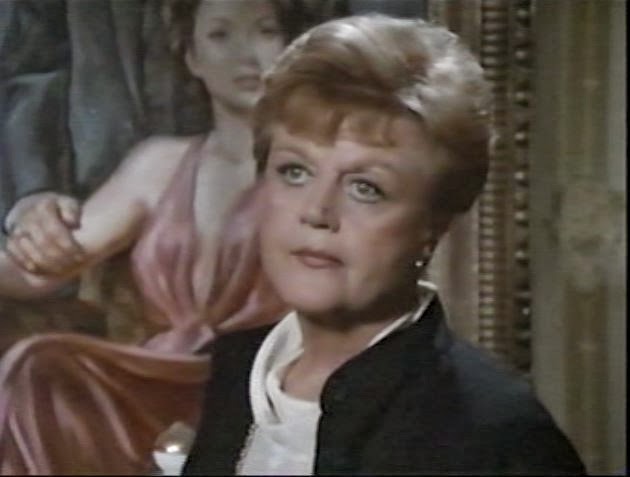
Speaking of intriguing images, there’s a large oil painting in one of the rooms of the mansion (the setting of the story is the home of Ann’s character, who is wealthy).  The painting depicts a young and glamorous Ann lounging seductively in a chair in a long gown with the figure of a man standing behind her.  I’d love to know more about that painting.

The episode starts with a slow pan across family photos, including the pic of Ann and Angela in younger days, and then we see Ann lying on her bed, having nodded off reading one of Jessica Fletcher’s books.  Ann plays Francesca Lodge, a really rich lady in Ohio with a grown daughter and a younger second husband.  She and Jessica are old pals from days gone by.  For those of you familiar with the series, you know that Jessica has friends and family all over the country, all over the world, and they are frequently murdered, have committed murder, or were somewhere on the premises when a murder was committed. 

It’s not really a good idea to be a friend of Jessica Fletcher’s because of this.  But Ann is, so you know there’s going to be a murder.

Ann is troubled lately with forgetfulness, delusions, and seems to be haunted by images and reminders of her late first husband.  She is especially plagued by a music box he had given her years before, that plays unexpectedly by itself.  We hear it, too, so perhaps she’s not really nuts, maybe somebody is driving her nuts, “gaslighting” her, as it were.

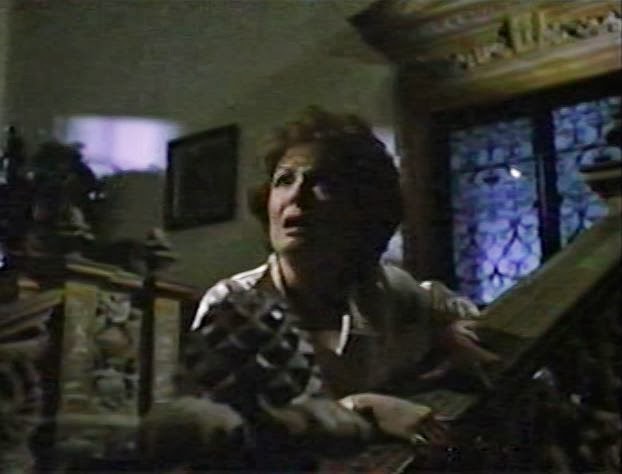
Still, she flips out during a thunderstorm, hears things, sees things, and when her second husband, Ben Murphy arrives home, she attacks him with a pair of scissors.  A manic fit of hysteria is always a good way to start an episode, and we see Ann is in fine form, tearing around the house, staggering down a palatial staircase, and swiping at Ben Murphy like a nervous Zorro.  Anyone who can slap Joan Crawford and send her sprawling down a few stairs is certainly going to be pretty handy with a pair of scissors.

Ann ends up in the psychiatric ward of the city hospital, where Jessica, who has been summoned (you always go to writers for help), arrives at her private hospital room and offers sisterly comfort.

Ann is released (because even Jack the Ripper would be released into the custody of Jessica Fletcher), and Jessica bunks at Ann’s house while we settle into story. 

Mysterious reminders of her first husband continue to terrorize Ann, whose screams rouse Jessica into action.  Funny how on TV people roused in the middle of the night always look perfect in attractive robes. I’d stagger into the hall, disheveled  and  far less articulate than Jessica Fletcher in ascertaining the problem at hand.  My interrogation would be more like, “Huh?  Wha…mmpfh...z-z-z-z-z.”

But I digress.


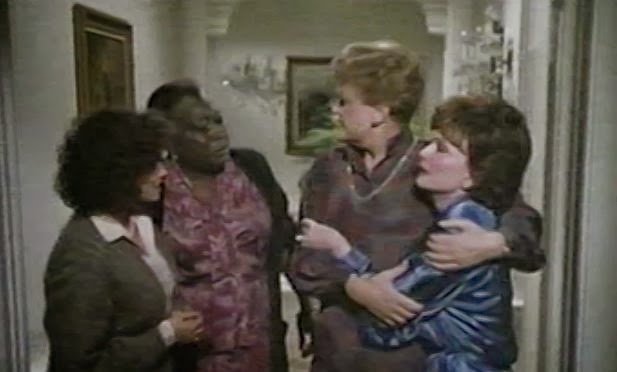
Ben Murphy runs his wife’s family business, and it turns out his secretary is also his mistress.  There’s a lot of suspicious characters around, including that secretary; Ann’s grown daughter who is a former drug user and runaway; a creepy gardener who keeps peering into windows; and the family doctor with the in-your-face manner of a creepy child’s party clown.  The aloof housekeeper played by Esther Rolle also seems suspicious—I still don’t get how the switcheroo with the dead canary could be done so quickly. 

The only two people we trust are Angela Lansbury and Martin Milner as the sheriff.  I love Martin Milner.  He’s been on Murder She Wrote a handful of times as different characters.  The innocent open-faced boy we saw in Life with Father (1947) here, and I Want You (1951) which we discussed here, grew into a frank and confident and no-nonsense guy you’d want on your side.  You can almost smell the Old Spice.

I’ll not give away the details, this being a mystery, but it’s a treat to watch Miss Lansbury and Miss Blyth together as a couple of pros who grew up in the business.  Ann Blyth here is fragile, high strung, at the breaking point.  Regrettably, the climax occurs when she is out of the room.  Our last image of her is back in the psychiatric ward screaming at that weird doctor.

It’s the last time we saw her play a character on television.  Only in her late fifties, she seems too young not to have done more TV, but it had already been an over 50-year career for this woman who started as a child of six.  Nor was the career over, for there would be more live appearances on stage doing what she started out doing as a six-year-old child: singing.

We’ll take that up another time.  Come back next Thursday when we jump back to 1948 and one of Ann’s finest performances as a dramatic actress, playing the sultry and devious young Regina in Lillian Hellman’s Another Part of the Forest.


*******************
The Definitive Guide to Murder She Wrote blog.

Karr Collection Television Commercials, Library of Congress. http://www.loc.gov/rr/mopic/findaid/karr/karr16.html

Los Angeles Times, February 28, 1985, article by Jack Hawn.

The Milwaukee Journal, January 27, 1976, syndicated article by Vernon Scott p. GS1, also April 12, 1976, syndicated article by Marilyn Beck, p. 3.

*********************

UPDATE:  This series on Ann Blyth is now a book - ANN BLYTH: ACTRESS. SINGER. STAR. -

*********************
The audio book for Ann Blyth: Actress. Singer. Star. is now for sale on Audible.com, and on Amazon and iTunes.

Also in paperback and eBook from Amazon, CreateSpace, and my Etsy shop: LynchTwinsPublishing.


 "Lynch’s book is organized and well-written – and has plenty of amusing observations – but when it comes to describing Blyth’s movies, Lynch’s writing sparkles." - Ruth Kerr, Silver Screenings

"Jacqueline T. Lynch creates a poignant and thoroughly-researched mosaic of memories of a fine, upstanding human being who also happens to be a legendary entertainer." - Deborah Thomas, Java's Journey

"One of the great strengths of Ann Blyth: Actress. Singer. Star. is that Lynch not only gives an excellent overview of Blyth's career -- she offers detailed analyses of each of Blyth's roles -- but she puts them in the context of the larger issues of the day."- Amanda Garrett, Old Hollywood Films

"Jacqueline's book will hopefully cause many more people to take a look at this multitalented woman whose career encompassed just about every possible aspect of 20th Century entertainment." - Laura Grieve, Laura's Miscellaneous Musings''

"Jacqueline T. Lynch’s Ann Blyth: Actress. Singer. Star. is an extremely well researched undertaking that is a must for all Blyth fans." - Annette Bochenek, Hometowns to Hollywood


Ann Blyth: Actress. Singer. Star. 
by Jacqueline T. Lynch

The first book on the career of actress Ann Blyth. Multitalented and remarkably versatile, Blyth began on radio as a child, appeared on Broadway at the age of twelve in Lillian Hellman's Watch on the Rhine, and enjoyed a long and diverse career in films, theatre, television, and concerts. A sensitive dramatic actress, the youngest at the time to be nominated for her role in Mildred Pierce (1945), she also displayed a gift for comedy, and was especially endeared to fans for her expressive and exquisite lyric soprano, which was showcased in many film and stage musicals. Still a popular guest at film festivals, lovely Ms. Blyth remains a treasure of the Hollywood's golden age.


Thursday, February 3, 2011

The Dark at the Top of the Stairs

“The Dark at the Top of the Stairs” (1960) gives us a curious mix of cozy nostalgia skewed with a foreboding modern world of alienation.

Thanks to Kate Gabrielle over at Silents and Talkies, I was able to finally see this movie. It doesn’t seem to play on TV much, and I don’t think it’s out on video or DVD. Maybe some of our readers can fill in the blanks on that info.

The film, set in the early 1920s, resonates today with problems of technology eliminating jobs, and the strain on marriage caused by the struggle for money, a lack of communication, and a lack of satisfying sex. But mostly money.

Robert Preston plays the middle-aged traveling salesman whose world is crashing down upon him. His products are horse harnesses and accoutrements, but even he, like most of his customers these days, are driving flivvers. The horse-drawn conveyance business is drying up, and here in small-town Oklahoma, a new world is on the horizon, literally. Oil rigs are going up on lonely farms, and a new era in transportation, and in the American economy, is beginning. Mr. Preston is laid off.

There are a few elements that make this quiet film, based on William Inge’s stage play, quite compelling. One is the serendipitous fact that Robert Preston had just come off Broadway in another hit, “The Music Man”, and was slated to star in the film version. Preston’s indifferent career really took off after the “The Music Man” a role which he was offered apparently only because just about everybody else turned it down. It proved to be his making.

Because of his enormous success in that musical, which today we know continued with the film version, this other traveling salesman character he plays in “The Dark at the Top of the Stairs”, sandwiched between “Music Man” gigs, makes his role as Rubin Flood, downsized harness salesman, seem like a Bizarro World version of the larger than life scamp, Harold Hill. It is impossible not to compare them when watching this movie.

Here, Preston is married to Dorothy McGuire, a sensitive, genteel woman, a warm supportive mother, but whose serenity is shaken by her frustration at being trapped in a helpless situation. It’s the kind of role Dorothy McGuire could play with one hand tied behind her back. The other compelling aspect to this movie is the several strong female roles that give us the range of the “woman’s world” experience in 1920s small-town America. They are played with a vengeance by Miss McGuire, by Eve Arden as her pushy sister, and by Angela Lansbury as the local beauty parlor operator and “other woman”. I don’t suppose the business, as well as the art, of casting a movie is given enough attention by old movie buffs, but whoever made the decisions on putting together the lineup for this team hit a homer.

We might also consider that this movie made in 1960, a time when the “greatest generation” of film stars were losing job opportunities due to their regrettable habit of aging, gives us a chance to see experienced actors and actresses in meaty roles. Had the movie been set in 1960 and not 1920s, would they have still seemed appropriate (marketable) for their roles by the producers? One might wonder if since these stars were leftovers from the Golden Age of Hollywood, did that make them seem old-timey automatically?

For the younger set, we have Shirley Knight, terrific as the shy, awkward daughter of Dorothy McGuire and Robert Preston, who is due to fall in love, and endure tragedy, the extreme highs and lows the movies tend to reserve for those who are young. But we see that highs and lows, falling in love and enduring tragedy belong to their elders as well.

One more note on the casting of Hollywood greats: Dorothy McGuire’s role was played by Teresa Wright on Broadway. The only member of the original Broadway cast to reprise his role in the film was Frank Overton, who plays the henpecked, morose husband of Eve Arden.

The plot seems episodic, and drifts in focus from one set of characters to another. Directed by Delbert Mann, there is a feeling about the cinematography and the pacing of the film that evokes a made-for-TV movie from the 1970s. We have a few outdoor shots, including our establishing shot of the turn-of-the century house with its big porch and gingerbread on the gables, though the paint is peeling here and there enough to keep us from assuming right off that we’re entering an idyllic world. Most of the scenes are interiors, maintaining the atmosphere of stage drama.

Robert Preston begins the film eager to head out on the road again, and Dorothy McGuire laments his frequent absences, clings to her shy daughter and her younger son, bullied by the other boys, in a stifling and over-protective manner, and complains about Preston controlling the purse strings in the family with a purse that doesn’t have much money in it. Shortly, Mr. Preston will learn he is fired, and all the petty annoyances of his life come crashing down on him like great big monsters.

He broods in the back room of the local drug store (the only place in small town Prohibition America where a fellow can get a drink -- because it’s a “prescription”), and angrily wonders “How does everyone else get rich?” Something plenty of us brood about today. Sitting next to him is the town rich guy, deeply troubled and guilty because his wealth came from an insurance scam.

Meanwhile, Miss McGuire fusses over daughter Shirley Knight and pushes the frightened girl into going to her first dance. “My only chance of staying young is through you,” she tells her.

By chance one afternoon, Shirley meets a wiseacre lonely boy from the local military academy, an outcast like her, and forms a bond with him. Later, when she reluctantly comes down the stairs in her home to meet her blind date, she discovers with delighted surprise it is him. It’s like a Cinderella moment.

But there are few magical happenings in this gentle, but realistic setting. Miss McGuire suspects her husband of philandering with the town beautician, Angela Lansbury. Beauticians, like librarians in old movies, seem to be geared to a certain stereotype -- in this case the world-weary, somewhat hardened female. Miss Lansbury doesn’t snap her gum, but she does smoke, so we know she’s been around the block. But, she has a heart of gold, can turn a deaf ear to the petty gossip she hears in the beauty parlor, which is literally her front parlor, and charges a dollar for a perm.

She and Preston are buddies, unusual in the old movies, particularly between traveling salesmen and hard bitten women who’ve been around the block, and Mr. Preston refreshingly acknowledges that she’s really one of his best friends. Partly, as we come to understand, he respects her because as a working woman she knows the value of a dollar, and he thinks his wife does not. Angela Lansbury is not a millstone around his neck.

In a touching scene that also manages to be rife with sexual tension, she talks about the happy marriage she once had, and how being a widow is tough on a woman with normal desires, including a very strong desire for him. The almost-seduction fails because Preston’s heart isn’t in it; he’s faithful to Dorothy McGuire. Miss Lansbury, like the pal she is, lets him off the hook. But when she confesses, without self pity, her loneliness and longing for a romantic relationship, Preston shoots her an expression of wonder, and sadness, and we see he clearly aches for his friend and wishes he could help, but he is no better at lending comfort than he is at finding a job.

The sad and depressing episode spurs him to trying again for a job, any job, and he humiliates himself by asking an old farmer friend to let him be a farmhand. The man tries to let Preston down easy, but must be frank that he’s too long in the tooth for that kind of heavy labor.

Meanwhile, Dorothy McGuire commiserates with sister Eve Arden, and we have yet another look at a broken marital relationship. Miss Arden is gloriously opinionated, funny in her very obnoxiousness, and her strong personality completely overshadows her quietly bitter husband’s moodiness. McGuire envies her a nice respectable dentist husband who works at home, while Eve Arden confesses her husband no longer makes love to her, that she never actually enjoyed sex, and her husband has long since pulled away from even any meaningful discussion with her. “God, I’d like a good fight. Anything would be better than this nothing,” she explodes.

While the grownups are bumbling through their errors, the younger set seem to have more promise. Shirley Knight’s young man, played by Lee Kinsolving, sweetly entertains her with a pretend scenario as he describes what it will be like for him to date her regularly, show up at her house and mow the lawn, being nice to her kid brother and her parents until he is “just like one of the family.” His own mother, a struggling actress in Hollywood, has nothing to do with him and he wants to belong to somebody.

Unfortunately, at the country club dance, we see, and Shirley Knight learns, what he has known all along: that he will never fit in for one reason or another. For tonight, it is because a society matron has decided that a boy named Samuel David Golden is Jewish and therefore does not belong in a restricted country club. He is more than humiliated; his romance and his daydream about fitting in are destroyed.

The film ends with an astonished, and sobered, Robert Preston getting a job as a traveling salesman for the oil corporation, selling drilling equipment about which he knows nothing. But, as he tells the smug young interviewer, he knows how to sell, how to talk to the common people hereabouts. The manager, an older man with enough experience about life to know about such things, decides that Mr. Preston talks horse sense. The job is his.

Becoming employed again does wonders for his marriage, but this is not a film of entirely happy endings. Other troubled lives we’ve seen are still unresolved, and Shirley Knight will carry the memory of a sad boy with her to whatever relationships she has in the future.

Robert Preston remarks with humble satisfaction about his new employment and starting over in his 40s in a new economy driven by new technology, “Now I’m a stranger in the land I was born in…but, I’m doing the best I can.”

A lot of us know the feeling.

Back to Harold Hill. It is irresistible to muse that this might have been the future of Harold Hill and Marian the Librarian 20 years down the line, after the final happy ending scene of “The Music Man”. Maybe they still heard the bells on the hill, but it might have taken more work to concentrate on them when things turned sour. The movie ends with Preston taking Dorothy McGuire’s hair down in the upper floor bedroom, the curtains billowing in the breeze, in the house with the gingerbread gables that need painting.

Thursday, October 23, 2008

Gaslight (1944)


Gaslight (1944) is the third and final entry in our brief series on films where the setting of the house drives the action. The Spiral Staircase (1945), Dragonwyck (1946) and Gaslighwere produced in three consecutive years in the middle 1940s, and all three films were set in the middle 19th through the turn of the 20th centuries. Perhaps the war made the middle 1940s an opportune to time to look far back at a supposedly more peaceful time. Yet the stories were all tales of suspense, and the setting of the house in each was paramount for establishing and maintaining that suspense. A much more unsettling home front.

Gaslight comes first among the three for the year in which it was filmed, but for the time frame in which it was set, it falls between Dragonwyck and The Spiral StaircaseUnlike the other two films, it takes us out of America and plunks us down in the foggy streets of London.

Ingrid Bergman won the Academy Award for her striking and many-layered performance, and Charles Boyer’s performance as her manipulative husband was one of his very best. M. Boyer was a highly regarded actor in his day and much sought after, but as time passed, he seems to have become known more for impersonations of his accent than his talent. Very few radio comedians did not poke fun at him, and even Pepé Le Pew was based on his Gallic inflection. Today, Boyer is perhaps underrated, or at least overlooked. One look at this film would show that he deserves better.

Even if one is not a fan of suspense films, this movie should be watched just for Bergman’s and Boyer’s meticulous and exceptional acting. They were supported very well by Dame May Whitty as the busybody neighbor; Joseph Cotten as the gentleman police inspector; Barbara Everest as the housekeeper Elizabeth; and Angela Lansbury in her first screen role as a flirtatious and impertinent parlor maid, also nominated for the Academy Award.


Directed by George Cukor, the film is a stunning achievement in all things necessary in a suspense film: cinematography, pacing, atmosphere, and acting. The costumes should also be noted as something really splendid. The attention to detail makes this film a treat. It is not, however, always easy to watch. The mental torture and emotional anguish suffered by Ingrid Bergman as she experiences a steady decline into a nervous breakdown is heartbreaking.

The house in this story is a typical London style townhouse, attached to a row of identical other townhouses in a quiet square. This is a home of many floors, of long imposing stairs, and rooms stuffed with bric-a-brac. And gaslight. We are constantly reminded of the movie’s title with actors framed in shots with the gaslight wavering like a bright flower from a wall sconce, dangling above their heads in neat jets from elegant chandeliers, and standing guard outside in the dark, damp night from a single lamppost.

The house was owned by Miss Bergman’s aunt, a famous operatic and concert singer who was murdered here. The murderer was never caught. Bergman, a child in the house at the time, was taken away to Italy, where as a young woman, she meets and marries Charles Boyer, a Continental composer who brings her back to her aunt’s house, which was left to Bergman in her aunt’s will.

At first she does not wish to return to the place of such an unpleasant memory, but her husband describes his dream house and she realizes she already owns such a piece of real estate. “That house comes to me in my dreams sometimes, a house of horror.”

But her love for her new husband is such that “I found peace in loving you. I could even face that house with you… You shall have your dream. You shall have your house in a square.” She sacrifices her discomfort to present her aunt’s home to him as the gift of a loving bride.

Soon after the blissful days of their honeymoon, the dashing husband becomes overly protective, then overly possessive. At first we may suspect he is the typical Victorian lord and master asserting his privileges, but over the course of many scenes the audience comes to realize that M. Boyer is cleverly playing his young wife like a violin, alternately coddling her and then heaping upon her cruel emotional abuse. He chides her for forgetfulness, accuses her of losing objects, making her doubt her memory, then doubt her sanity. He forbids her to have visitors. Though he seems unbalanced at times, we eventually come to realize he is fiendishly controlled and knows exactly what he is doing, that he has a sinister purpose.

But it is not all tension and terror displayed by Bergman. There are scenes of tenderness and warmth, such as the “morning after” scene with her new husband, a mixture of serene comfort, complete trust, and sweet passion on a light-filled patio. There is the scene where Cotten gives her an old souvenir of her aunt, a missing glove, and we are given Bergman’s expression of wonder and amusement, dissolving into sudden aching sorrow for all that has been lost.

Then there is the terrific final showdown with her husband, where she shows yet another side. She can play many emotions at once. Her performance in this film is one of the best by anybody on film in that era.


The house, the home of her innocent childhood before the ghastly murder of her aunt, changes with the emotional changes in Bergman and Boyer. A warm and elegant home with a little more coal thrown on the fire by a sexily brooding Angela Lansbury, the house soon becomes a prison to Bergman, and then a kind of torture chamber.

When her husband leaves the house nightly to go to his private studio to compose music, Miss Bergman pleads for him to stay, “I’m frightened of the house. I’m frightened of myself, too.”

Part of the reason is the gaslight. Boyer does not really compose music in the evenings; he enters the attic from another way and searches for lost treasure he suspects is hidden among her murdered aunt’s possessions which are stored there. He does not realize that when he turns the gaslight on in this boarded up, upper level of the house, that it decreases the amount of gas in the pipes throughout the rest of the house. Therefore, the gaslight in the chandelier of Bergman’s room dims every night, and she thinks she is having an hallucination. She thinks she hears footsteps above her. She fearfully takes it as another symptom of her growing madness.

But when police inspector Cotten arrives to investigate the cold case of her aunt’s murder, he notices the gaslight dimming, too, and thereby solves more than one mystery in the house. The dimming gaslight, though frightening to Bergman, is ironically the clue which saves her. It is both a source of fear and of hope.

And then, of course, the film has famously left us with the word to “gaslight” someone, which is to fool and manipulate someone for some evil purpose.

We have the poignant strains in several scenes of Thomas Moore’s “The Last Rose of Summer” which adds a lovely innocent contrast to the grim psychological suspense of the film. We are told it had been used by Bergman’s famous singer aunt in her concerts as her last encore. It is played once on the piano in a gentler earlier scene by M. Boyer, and then later on by street vendors hawking their wares with organ grinders, as if the last rose of summer, the last bit of loveliness in our lives is thereafter only to be found outside of the house, beyond Bergman’s, and our, grasp.

The house begins as the scene of murder, becomes the rehabilitated gift of a bride to her husband, becomes a prison, a torture chamber, and then the scene of a showdown, where the house is finally set free from the unpleasant experiences of the people who live and have lived there. In its redemption, it becomes nothing more than a just a house. Almost as if it as been exorcised, it is set free of the gloom, but there were no demons here that were not human.

The final scene shows Mr. Cotten and Miss Bergman on the topmost window balcony, standing against the Mansard roof, literally on top of the house, commanding what is perhaps an impressive view of the little world below. Commanding, and no longer being subjugated by the claustrophobic world within.

Interestingly, all three films featured damsels in distress, in the setting of their homes. In that era where the word “housewife” was more commonly used than it is today to describe a woman who did not work outside of the home, these films seem to make use of the irony that the home is meant to be a place of safety and refuge, particularly for women who are, or used to be, carried over the threshold. The most successful suspense films exploit our most cherished images of safety and comfort.

********************

Jacqueline T. Lynch is the author of Ann Blyth: Actress. Singer. Star. and Memories in Our Time - Hollywood Mirrors and Mimics the Twentieth Century. Her newspaper column on classic films, Silver Screen, Golden Memories is syndicated nationally.  Her new book, a collection of posts from this blog - Hollywood Fights Fascism - is available here on Amazon.


Related Products