IMPRISON TRAITOR, PEDOPHILE, AND CONVICTED FELON TRUMP.
Showing posts with label Anne Baxter. Show all posts

Thursday, April 6, 2023

Moses...Moses...Moses!


A blessed Passover and Easter to all who celebrate and watch classic films.  Anne Baxter reminds us who the main character is in The Ten Commandments (1956).

Thursday, May 18, 2017

The Pied Piper - 1942


The Pied Piper (1942) strikes a unique balance between a whimsical adventure—and the ghastly horror of being caught in the middle of a war.  In the world of children, however, what can be terrible can also be an adventure, and what can be an adventure can also horrify.  It is sometimes a very fine line, and that is the nature of childhood: that children are both helpless and yet resilient.

This post is part of the Classic Movie Blog Association (CMBA) “Underseen and Underrated Blogathon.” Please wander over and check out the other great participating blogs.


This post is also the first entry in my new series on the depiction of children during World War II.  In the coming weeks, we’ll be discussing On the Sunny Side (1942) with Roddy McDowall, The Search (1948) with Montgomery Clift, Youth Runs Wild (1944) with Bonita Granville, the short subject You, John Jones (1943) with Margaret O’Brien and James Cagney, and two March of Time short documentaries, Youth in Crisis (1943), and Teen-Age Girls (1945). 

Many classic films from that era tend to show children on the periphery of the wartime crisis and not in the middle of it.  For example, Shirley Temple portrays an American home front childhood as only a reflection of the grownups’ world and not even enough to form a subplot in the movies of Since You Went Away (1944) and I’ll Be Seeing You (1944).  With a stable full of glamorous grownup stars like Jennifer Jones, Ginger Rogers, Claudette Colbert, and Joseph Cotten, the worries of Shirley Temple brooding over collecting scrap and experimenting with too much lipstick is not enough to carry a film, and most directors and producers of the day evidently felt there was not much of a market to make films for children about the war, let alone films about children.  Not that there weren’t any, but if the horrors of war were toned down in a censored Hollywood—censored not just by the War Department, but by the Production Code—then the horrors experienced by children during the war were obviously not going to be dramatized in great detail.  We didn’t have much of a stomach for that.

Paradoxically, there were quite a few series chapter books written for kids during the war that brought the tension, the anxiety, and to a degree, the horrors of wartime to an American middle-grade readership.  Such titles include Norma Kent of the WACS, Red Randall at Pearl Harbor, Dave Dawson with  the R.A.F., Nancy Dale Army Nurse, and a few of the early more famous Cherry Ames books.  As I wrote in this previous post on this topic:

There are several elements to these stories which are quite striking.  One is the, in some cases, unsparing description of death and cruelty, and the fatalistic manner in which the tone of these stories seems to indicate the young reader should accept these conditions.  Nancy Dale’s troop ship is torpedoed, and she spends several days in a lifeboat with a handful of other nurses and crew members.  One dies and they dump the body overboard. 

At one point in the story she receives word her brother is missing in action and presumed dead.  A family friend, comforting her, tells her not to hold out much hope of his survival.  “Don’t let wishful thinking keep you from facing reality, my dear.  There’re many things worse than death in this war.”  How would a kid, who had relatives in the war, take this message?

Due to several other projects, my intention to write a book about this subject has been on the back burner for some years, but I hope to resurrect it possibly next year.  If any of you have any suggestions to add to the list of children’s books, I’d be very interested to hear them.

The Pied Piper, unlike most World War II era movies dealing directly with the war, shows us what it is like to be a child during this hellish period in history, but does so in a light and skillfully handled way.  We are purposefully not made uncomfortable, but we are reminded that very young, very helpless victims are suffering beyond our reach to help them, and that should be horror enough for any compassionate person.


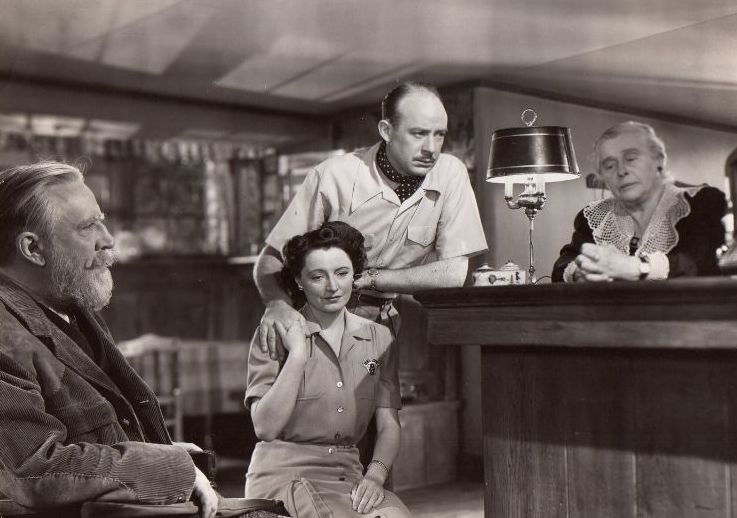
Monty Woolley stars as an irascible Englishman on holiday in Switzerland.  He is a widower, and his son, an RAF officer, has recently been killed in the war.  His only other child is a married daughter living in the United States, so he is alone.  He went to Switzerland, he admits, to sulk because having offered his services to British government authorities, hoping to do his bit for the war effort, he was continually turned down because of his age and told by his vicar he could perhaps instead knit for the soldiers.  Disgusted, spitting nails, he took his fishing rods and went to Switzerland.

There at the rustic inn, he is harassed by young Roddy McDowall, a bright boy who, though polite in the conventional English manner, is not shy of adults and speaks to them on an equal footing: he and Monty Woolley have an argument over whether Rochester is a city in the United States or a state.  Mr. Woolley insists it’s a state and takes such umbrage at Master McDowall’s disagreeing with him that he develops resentment near hatred for the boy.  It is very funny.  Nobody can sputter or sarcastically fly off the handle like Monty Woolley, and he does it a lot in this movie.

Peggy Ann Garner is Roddy’s younger sister.  She is better behaved.

However, it is June 1940, the war is heating up, Dunkirk has just happened, and they hear from the BBC that France is likely to fall to the Nazis soon, and England may be invaded.  Woolley decides his place is home in England, to knit if need be, and packs to leave.  The parents of Roddy and Peggy Ann, played by Lester Matthews and Jill Esmond, ask Mr. Woolley to take their children with him back to England, to live with her sister until the war is over.  Matthews is with the League of Nations in Switzerland and must remain at his post, and his wife wants to remain with him.  They fear that Switzerland will be invaded next.  (As it happens, it was not invaded and the kids would have been safer there, but this injected opinion demonstrates the chaos of the war and how little we knew what was happening, and absolutely no clue as to predict how the events would play out.  When we watch these sometimes sentimental war films, we need to remind ourselves that the Allies were losing for much of the war and we really did not know how it would end.)

Monty Woolley is hesitant to take the kids, but he agrees after delicate questions about their ability to tend to their personal needs, and they’re off on a train to the north of France.  However, the train is stopped before they reach the new and ever-changing front lines.  Woolley, still the domineering Englishman on vacation bellows at the French railroad official, “But I have two small children!”

The harried civil servant replies, “At your age, Monsieur, that is undoubtedly magnificent, but if this is a contest, I have nine.”

Roddy, still irritating, however manages to be useful because he has learned French and is able to converse with all and sundry, especially now that they are being treated like cattle on an overcrowded bus to Chartes.  Here on the bus they pick up a new follower: a small French girl, played by Fleurette Zima, whose aunt has thrust a paper with instructions into Rose’s hand which direct Woolley to take her to her father who works as a waiter in London.


Woolley at first balks at this, but since the child is alone; he takes responsibility and allows her to come with them.  Hence, the title of the movie, The Pied Piper, as he gathers child-followers through the war zone to take to safety in England.  The story is from the book by English author Nevil Shute, who later more famously gave us A Town Like Alice, (the film version we discussed here) and On the Beach.

The bus, crawling along a road choked with refugees straggling away from the front, breaks down, and the passengers alight.  As Woolley and the three kids cool their feet in a nearby stream and eat sandwiches which have been packed for them, Nazi planes swoop down and strafe the ragged column of refugees.  Woolley gathers their bags to continue the journey on foot, unable to shield the kids from the view of dead bodies in the road.  The camera shows the three heads of the kids popping up from an embankment off the side of the road, looking with disbelief at the corpses in front of them.

Just as our protectiveness and our embarrassment makes us try to gloss over terrible aspects of life to kids, so Monty Woolley’s continual funny indignation keeps the movie moving along, though the tone has become darker, as if to ignore the war as a troublesome inconvenience.  He’s trying to keep everybody’s head above water, and soon he finds himself with another child: Pierre, another boy on the bus whose parents were murdered in front of him.  The boy is almost catatonic with the horror of his experience, and Woolley’s shock at Pierre’s mental state, looking into his eyes, is a demonstration to us that we really have no idea what horror is as we tend our victory garden, and collect nickels and dimes for the Red Cross.

Pierre, played by Maurice Tauzin, apparently is speechless and unresponsive to sounds.  Roddy bonds with Monty Woolley as his second in command, and does much to take care of Pierre and the girls.  Soon they are joined by Willem, a Dutch boy who cannot speak either English or French, but with a wound on his head, is apparently orphaned and homeless as well.  By this time, Woolley does not question or balk, he accepts the boy into his protection. 

He searches out the house of a French family whom he and his son met in the previous year on holiday.  They became good friends, and he will learn that Anne Baxter, the daughter of the family, actually was the sweetheart of his son, and she mourns him as well.  In his son’s memory, Miss Baxter lends a hand and helps to usher Woolley and his kids to the Brittany coast, where she will enlist the help of her uncle to arrange a fishing boat to take them across the Channel to England.


But the uncle, played by J. Carroll Naish, is reluctant to help.  He has been living in Occupied France for months, and in despair, cries out that no one can trust anyone, lending a hand to anyone could get them killed.  His fears are real and valid, and we cannot treat them lightly.

But he helps to hook them up with Marcel Dalio, the fisherman with the boat, but soon they are caught by the Nazis and taken to the chateau headquarters of the local commander, played in his movie debut by Otto Preminger.

Why Preminger, with years of directing under his belt, and two years away from his masterpiece, Laura (1944) decided to play a Nazi in this movie I have no idea, except that it is very important for the American audience not to write off this enemy as a mere caricature, because what follows is the hook, and perhaps, the soul of the movie.

Helmut Dantine, incidentally, has a small role as Preminger’s aide.  He also appeared as the German flyer captured by Greer Garson in Mrs. Miniver in the same year.  Both he and Marcel Dalio also turned up in Casablanca (1943).

The Nazis threaten Woolley, Anne Baxter, and the kids, because a plot to kill Hitler, visiting in the general area, had been foiled.  The hunt for conspirators brought a dragnet of the village, and Preminger is especially skeptical of Woolley’s stated intention of taking these five children, none of whom actually belong to him, to England.  Preminger tries to wear down and intimidate Woolley, believing he is covering for something bigger.

At last, Preminger relents, and the prisoners, including the French boat captain, are given food and treated civilly, and Monty Woolley is called to the commander’s office for a private meeting.  The guards are dismissed.

Okay, spoiler coming.  If you don’t want to know the end, go away.  No?  You want to stay?  Fine, it’s no skin off my nose.

Otto Preminger questions Woolley once again on the ridiculous story of taking the children to England, which, he says, is pointless because the Germans are going to invade in a matter of weeks.  Woolley states that he intends to send the children to the United States to the care of his married daughter.  Preminger counters that this is unbelievable—why would she want to take care of strange children?  Why would her husband permit that?

Woolley, irritated with this man’s utter lack of imagination, let alone compassion, insists that it is so.  They are kids, they need to be safe.  Preminger says, “What about the Jewish child?”  He infers that Pierre, who has dark hair and dark eyes, is Jewish.  Woolley says he is unaware of what religion the child is and couldn’t care less and neither would his daughter or her husband care.  He says that in the U.S., many children war refugees have already been taken in without regard to color, race, or religion.

Monty Woolley apparently has never met Donald Trump.

Otto Preminger, never losing his steely glare, nevertheless seems finally to be convinced of Mr. Woolley’s sincerity.  He lowers his voice and becomes confidential.  He will make a deal with Woolley.  He will allow Woolley to leave with the children and go to England, but Woolley must do him a favor.  Woolley stiffens.  He will not be a spy for the Nazis.

Preminger does not want him to spy.  He wants something else.  He wants Woolley to take another child along:  His little niece.  She is the child of his younger brother, now dead, who married a woman they later discovered to be Jewish.  The mother has been murdered by the state.  The child is not safe in Germany now.

Preminger tells Woolley that he has an older brother in the United States, who became a U.S. citizen long ago.  The child should be sent to her uncle.  He lives in Rochester, New York.

Rochester!  A brilliantly comic moment in a dramatic scene.  Woolley’s longstanding argument with Roddy McDowall over whether Rochester is a city or a state comes back to haunt him.  He must admit defeat.

But there is success and triumph in this nightmare of war.  The little niece joins the other kids, and Woolley and the French captain leave for England.  The kids have been traumatized, and this is clear even though the story is focused more on the adult actors.  Woolley, who had felt sidelined in the war due to his age, has become a hero through his sense of responsibility and duty despite the fact that he dislikes children.  Anne Baxter has paid the highest tribute to her deceased love by saving his father.  Otto Preminger, representing evil in his Nazi uniform, can still make an exception to the rules of war and his foul regime, in his affection for his niece.  He cannot believe that Woolley and Baxter have risked their lives for these ragged children, and that strangers in the United States will care for them, even the Jewish girl, but he must believe, because it is his only hope.

As the fishing boat pulls away from the stone wharf, Anne Baxter and Otto Preminger wave goodbye to them.  It is an unlikely scene, but we must believe, because the millions of souls who will not have a happy ending are beyond our comprehension.  Like Pierre, we will become frozen in horror if we think of it. 

I suspect this movie, directed by Irving Pichel and adapted by Nunnally Johnson from Nevil Shute’s book, since I hear of it little mentioned, may well be underseen and underrated.  For other great blog posts, please check out the Classic Movie Blog Association (CMBA) “Underseen and Underrated Blogathon.”

Come back next Thursday for a look at On the Sunny Side (1942) and You, John Jones (1943).

*********************
The audio book for Ann Blyth: Actress. Singer. Star. is now for sale on Audible.com, and on Amazon and iTunes.

Also in paperback and eBook from Amazon, CreateSpace, and my Etsy shop: LynchTwinsPublishing.


Monday, July 23, 2012

Swamp Water - 1941


“Swamp Water” (1941) was what did it for Dana Andrews. After a few years in Hollywood bouncing between bit parts, an apprenticeship at the Pasadena Playhouse, and working as a gas station attendant, it took a trip to the Okefenokee to really launch his film career as a leading man.

This is part of the Dana Andrews Blogathon over at Classic Move Man, with links to other blogs posted this Saturday, July 28th.

Dana Andrews knew himself that ''Swamp Water" would be important to his career. In June 1941 he took “a fast cross country airliner,” to Waycross, Georgia to film on location according to the Waycross Journal-Herald of June 25, 1941. “‘It’s my big chance,’ laughed young Andrews a bit groggy after his first plane trip but fascinated by it all to such a degree he hadn’t been able to sleep.”

Thirty-three years later, in his mid-60s, in another phase of his career when performing dinner theatre in “Best of Friends” at the Alhambra Theatre, Jacksonville, Florida, Andrews took his wife on a side trip to the Okefenokee. He wanted to show her where he had filmed some scenes for “Swamp Water”. He was recognized in a Waycross diner. (Waycross Journal-Herald, February 13, 1974).

Dana Andrews had been the only principal actor to film in the Okefenokee, not counting his hound dog in the film, “Trouble.” According the Journal-Herald, Trouble also arrived on the same plane with Mr. Andrews, “‘sick as a dog’ from flying so high” in these days before jet planes with pressurized cabins.

Director Jean Renoir, in his first American film, and his assistant Irving Pinchel arrived as well, with Mr. Pinchel taking over the location shooting when Renoir went back to Hollywood, where of course most of the film was shot on sets.

It’s an unusual film, a precursor perhaps to Renoir’s “The Southerner” (1945) about Texas sharecroppers, which we’ll probably get around to sometime or other. In both, this esteemed French director, with an impressive body of work in French cinema behind him, and who was also the son of Impressionist painter Pierre-Auguste Renoir, tackles a brooding American landscape. The swamp, with its gothic imagery, is a place of escape and freedom, but also a claustrophobic prison, a place of gruesome death.

Dana Andrews plays a backcountry youth who loses his hound dog, Trouble, in the Okefenokee swamp. He goes after him and meets Walter Brennan, who has been hiding in the swamp for five years, a fugitive from justice. Brennan had been wrongly accused of murdering a man, and he escaped before hanging.

His ragamuffin daughter, played by Anne Baxter, is taken in by storekeeper Russell Simpson as a hired girl. She is no-account by virtue of her father being no-account. She and Dana brave the community’s censure when he buys her a dress and takes her to the square dance.

Mr. Andrews has his own problems with run-ins with his domineering father, played by Walter Huston. There are a few subplots to round out this poor, isolated community -- Mary Howard plays Walter Huston’s young second wife, who is being romantically pursued by a smarmy John Carradine, who is given protection by the bullying brothers Ward Bond and Guinn “Big Boy” Williams, who are actually the ones who committed the murder of which Walter Brennan is wrongly accused.

Did I mention there would be spoilers? No? Sorry.

It’s an interesting film both for Renoir’s perspective on American gothic, complete with the imagery of a skull atop a cross as a warning sign, and for it being Dana Andrews’ first leading role.

Andrews’s voice is what fascinates me most. He speaks his lines with his chin sunk into his chest, pushing the dialogue out of his body with a sound somewhere between growling and weeping. I know he was supposed to have a fine bass singing voice, but I never heard it. I can believe it listening to the fullness of his speech in this performance.

He doesn’t hunker down too much in a southern accent, though as a native southerner he could -- but that would make him stand out from everyone else in the community who do not speak with southern accents. Most especially the Massachusetts-bred Walter Brennan in his alligator skin clothing and his New England long vowels.


Andrews's emotions are raw and on the surface in this movie. In later roles he displayed that skillful knack of showing great depth of emotion under a surface of cool reserve, a man already burdened with too much baggage and afraid to acknowledge it. Here he conceals nothing. He is all joyful shout and angry bluster, yet it is not overacting. He is a young man of considerable pride who perhaps represents for Renoir the sunshine contrast to the dark swamp. His hair curling on his neck, his first bashful, then exuberant discovery of love for Anne Baxter, his physical energy in this film give us no foreshadowing of the haunted war vet, the gloomy private eye, the troubled police detective of future years.

Some of the scenes look straight out of a John Ford copybook -- the fiddle playing of “Red River Valley” at the square dance, and of course, the use of so many Ford regulars like Ward Bond, John Carradine and Russell Simpson.

Eugene Pallette is also along as the sheriff, whose otherwise jolly demeanor is a puzzle against the scene where he allows Ward Bond and “Big Boy” Williams to half drown Dana Andrews to force him to confess Walter Brennan’s whereabouts. It’s a bit of backcountry interrogation. Perhaps if he floats he will be declared a witch.

He and Walter Huston have a father-son reunion when Mr. Huston saves him.

Virginia Gilmore plays Mr. Andrews’s best girl, until she dumps him. Then her jealously over his attention to Anne Baxter drives her to accusing him of hiding the fugitive. She is smug, self-centered, manipulative, and dangerous.

The scenes at the dance are touching for the very way these folk observe courtly rules in contrast to their ragged best clothes and the rotting walls of the local meeting hall. I’ve been in swanky places where the manners were far worse.

They are proud people. It is pride that divides Dana Andrews from his Pa; pride that divides Walter Huston from his young wife, whom he thinks is seeing a man behind his back; pride which makes Dana shun his ratfink girlfriend; pride which makes him refuse to knuckle under Ward Bond. When his pal and surrogate father figure Walter Brennan accuses him of selling him out, it is his pride that makes Dana Andrews stand on purpose to take a bullet from Ward Bond to prove his innocence. More trial by ordeal.

And then back to gothic. There is a scene where “Big Boy” meets his demise in the swamp, slowly sucked up into a bog hole. It’s quite horrifying, and despite my fascination for bottomless pits in movies (see “Make Haste to Live” - 1954, here), I was amazed that the studio allowed Renoir’s fixed camera gaze on Williams screaming in terror as his disembodied head sinks into the mud. It’s something out of monster movie -- which would have been less terrifying because we do not believe in monsters -- than in a movie that has so far kept rigidly to unblinking reality.

Brennan lets a stunned Ward Bond live, to face the same hell he did as fugitive in the swamp. Their justice is crude, and final.

Another less horrifying, but cinematically striking scene is when John Carradine attempts to seduce Mary Howard, declaring his love for her while both are fairly tattooed with the mottled shadows of leaves that mask their expressions.

It’s an unusual film where character actors tell the tale. There are no stars, really, in this movie though certainly Walter Huston had a big name in film and theatre. The only star was the one yet to be -- Dana Andrews.

Monday, March 30, 2009

Confessions On Tape


There must be something eternal about a guilty conscience, something that the guilty need to make eternal by recording their confessions for posterity.

In the recently discussed “Make Haste to Live” (1954) (see post here), Dorothy McGuire leads us to the flashback by setting herself down in her darkened office after hours, yanks a microphone to her mouth and starts blabbing the details of her sordid past to a reel-to reel tape recorder.


Fred MacMurray famously unburdened his guilty conscience with a Dictaphone machine in his darkened office after hours in “Double Indemnity” (1944) as he slowly bled from gunshot wounds. At the end of the film, we see several cylinders beside the machine he has used up. These old Dictaphones were like making records in wax, where the voice delivered an electrical impulse that was scratched onto the cylinders. (For more on "Double Indemnity" have a look at this post from January 2008.)

In “The Blue Gardenia” (1953), Richard Conte tries to trap Anne Baxter into a confession, and has a phone recorder and a transcriptionist standing by. He takes no chances, but gets no confession.

For that, Anne Baxter would have to be in a darkened office, all alone, talking to herself.

Would they have tapped out a text message on a Blackberry today? Speak into a mic to record their voice in digital files on their computer with Dragon Naturally Speaking voice recognition software?

Thursday, March 19, 2009

Ladies of the Noir - Pt 1 - The Blue Gardenia (1953)


Today we begin a three-part series on film noir females, particularly examining three films where the females represented are unique. Not the usual dames, nor even “the usual suspects”, and not the usual supportive girlfriends. They are protagonists, caught in the grimy, shadowy world of film noir, usually a man’s world. But being women, they are not subjected to the same kinds of justice, or fate, or simply recrimination suffered by their male counterparts.

The films we’ll discuss are “The Blue Gardenia” (1953), “The Shadow on the Wall” (1950), and “Make Haste to Live” (1954).

To illustrate what I mean about a woman protagonist’s fate in film noir, we can look at a kind of template noir film. Here is a link to “Detour” (1945) a classic film noir example now in public domain and available for viewing at this website. Tom Neal drives across country to be with his girlfriend, and through bad luck, and a few errors in judgment, finds himself a wanted man once he gets to California, with a shrewish babe blackmailing him into deeper trouble with the law. When the film ends, we see him wandering down a lonely road at night, in an attempt to escape, when the police catch up with him and he placidly succumbs to a seat in their squad car, and we imagine, an eventual appointment in the electric chair. The poor guy’s tale is like a Kafka nightmare.

Most women in film noir flicks are like the two important women in his life, his girlfriend of whom we see very little, and the vicious dame who brings him down. Lots of the best film noir movies have great roles for women, but usually either as vixen or victim, or lesser roles as long-suffering girlfriend, not as the hero protagonist. The three movies on our list for this series feature women who are, however, just like the Tom Neal character. They are the protagonists, the ones who find themselves locked in the grasp of fate and suffering the consequences of their own bad decisions.

None of them, however, ends up sharing Tom Neal’s end, because to be a female protagonist in this era is to be likeable, and likeable girls did not go the electric chair. Bad girls, yes. But according to the standards of the day, good girls had to be saved at the 11th hour.

The first of these films, “The Blue Gardenia” follows this trend, but the other two films deviate in interesting ways. In “Make Haste to Live”, the female protagonist must solve her own problem without help, playing cat and mouse with her persecutor, and in “The Shadow on the Wall”, we have a very unusual scenario where the victim, the villain, and the hero are all played by women.

“The Blue Gardenia” starts out, and ends, with shots of the Los Angles freeway. I don’t know why. There’s nothing about the freeway in the plot, but I suppose it establishes that we’re in Los Angeles.


Anne Baxter, a nice girl, shares an apartment with two nice girlfriends. Ann Sothern plays her typical sassy wisecracking role, and Miss Jeff Donnell plays the sweet naïve baby of the trio who, demonstrating the screenwriter’s sense of humor, reads trashy pulp detective novels.


Miss Baxter’s fiancé is serving in Korea, one of many topical references in this movie, like the freeways. On her birthday, she prepares a candlelight dinner for herself and her beau’s photograph, and opens his latest letter, only to discover he is jilting her for an Army nurse.


Devastated, she takes her pain out to a nightclub called “The Blue Gardenia” where cad Raymond Burr, gets her drunk and takes her to his bachelor pad. We are treated to the Nat King Cole hit “Blue Gardenia” with Mr. Cole himself at the piano. As discussed on this previous blog post from August 2008, the 1950s gave us a lot of movie themes that could turn even a film noir into a musical.

When Raymond Burr gets too physical, the very drunk but still feisty Anne Baxter clunks him on the head. The next morning, very hung over in her own apartment and remembering very little about the night before, she slowly comes to realize through a series of clues and newspaper headlines that Burr has been murdered and that she probably did it. This is her nightmare, and it trails her until the very end of the movie.

It’s too bad we lose Mr. Burr so early on, because his suave, self-absorbed predatory charm is quite good. He has a very compelling screen presence, something the hero of the piece, a newspaper columnist played by Richard Conte, unfortunately does not seem to have. Mr. Conte’s eventual romantic overtures to Miss Baxter even seem to clutter an already flawed ending to the film.


Sometimes a romance in a crime story works to develop the characters more fully, and does not detract from the plot, but it seldom helps the plot. In a movie like “The Big Sleep” (1946), which is notorious for having a quite confusing plot, Humphrey Bogart’s and Lauren Bacall’s romance is so absorbing to the audience that nobody cares about the plot. This isn’t the case with “The Blue Gardenia”. Richard Conte and Anne Baxter, neither separately nor together, are strong enough to make us forget the story is spinning its wheels at the end.

Ann Sothern provides the down to earth advice, with each line coyly delivered as if it should be followed by a snare drum rim shot. She is divorced, but continues to date her ex-husband because though he had a “husband’s faults,” he now has “a boyfriend’s virtues.” She returns from a date with him with a comic indictment of the 1950s LA car culture: “Drive-in diner, drive-in movie, then afterwards you go for a drive.”


Richard Conte’s sharp and sarcastic newspaperman is also a ladies man, like the cad Raymond Burr. We know because he thumbs through his little black book. In Conte’s case, he is reformed from his womanizing ways by his sympathy for one helpless female. We don’t know exactly why he falls in love with Anne Baxter, he just does. Nor does he completely solve the case himself, but has the help of Superman George Reeves in a good role as a police inspector. The ending is slapped together, and sun shines on the innocent, and on the maze of California freeways. Life goes on, at 50mph.


Baxter’s daffy roommate, Miss Donnell, pours over her lurid drugstore novel and exclaims over the tribulations of the book’s femme fatale, “lucky girl, living a life of passion and violence.” Miss Baxter, who starts the film as a wholesome and somewhat dull girl assiduously avoiding any type of excitement, learns firsthand that living a life of passion and violence is not all it’s cracked up to be. She has an interesting position of being a sort of victim, but possibly also a murderer escaping justice as she destroys evidence (the dress she was wearing when she clunked Raymond Burr).

Her guilt and her paranoia are intriguing and carry the story a long way, but Miss Baxter is caught in more than the web of fate; she’s trapped in the 1950s web of being a good girl in a film noir movie, and she’s stuck there.

One of the fascinating aspects of film noir is that it changed 1940s sassy ingénues into world-weary dames and babes, but that, in turn, created a problem. In the moral ambiguity of the film noir world, there is no complete evil in the characters, just as there is no complete virtue. But the shift was not so easily made for women. The sensibilities of the era seemed to indicate that in this film noir world a woman could be more comfortably a victim, or a villain, or a girlfriend little seen. Make her the protagonist and she must follow the film noir precept of being neither completely bad nor completely virtuous. A fine line to walk for an actress, but an even more difficult line to walk for the film producers, apparently.

In a film like “The Blue Gardenia”, the choice is made that this female protagonist ends up with a crusading boyfriend who will look after her. Unlike poor Tom Neal in “Detour”, who is a nice guy in the wrong place and made bad mistakes, she would not be allowed to go down the road to perdition unless she is truly a bad girl. Good girls get rewarded with good men. This is the lesson of 1950s film, even film noir. It’s not so much the Code, as it is a deft interpretation by the studio executives of what the general audience feeling was in those days, and what it would stomach.

Though Anne Baxter’s acting style is a bit melodramatic, just being the lead in the male-dominated film noir genre is unusual enough to make this film worth a look.

“The Blue Gardenia” is being shown on TCM this coming Tuesday, the 24th, if you’d like to have a look yourself. Let us know what you think.

Related Products