IMPRISON TRAITOR, PEDOPHILE, AND CONVICTED FELON TRUMP.
Showing posts with label Robert Osborne. Show all posts

Thursday, June 23, 2022

Remembering Judy Garland this month on TCM


Judy Garland, having been chosen the Star of the Month, made June especially enjoyable for watchers of Turner Classic Movies. Seeing her filmography in bursts is especially poignant for allowing us to follow the bubbly, nervous, awkward girl with the phenomenal talents, as she marches toward maturity and the wonderful roles, but personal hazards, we know she will face.  There are times we just can’t study her hard enough.  Other times, knowing the perils of child stardom and harsh world that eats up the more emotionally vulnerable, we almost wish we could look away.

But we can’t.  Because she’s Judy, and she’s remarkable.


She is no stranger on TCM’s roster, particularly as most of her career was spent at M-G-M, whose films are owned by Ted Turner and WarnerMedia, the pre-1986 anyway, which is what we old movie fans cherish most.  So we do get to see her movies from time to time.  But to really feel the impact of her energy, her skill—which is an achievement above natural talent, for this girl worked hard at her craft—it’s best to see her in a string of her films, and this whole month has been a powerhouse of her impact, even in her smallest roles, which did not stay small for long. 

She did not, however, shoot to stardom on the wings of the publicity department as other stars did—it actually seemed like studio boss Louis B. Mayer didn’t really know what a gem he had.  But when it was time for her to take the lead, she shone.

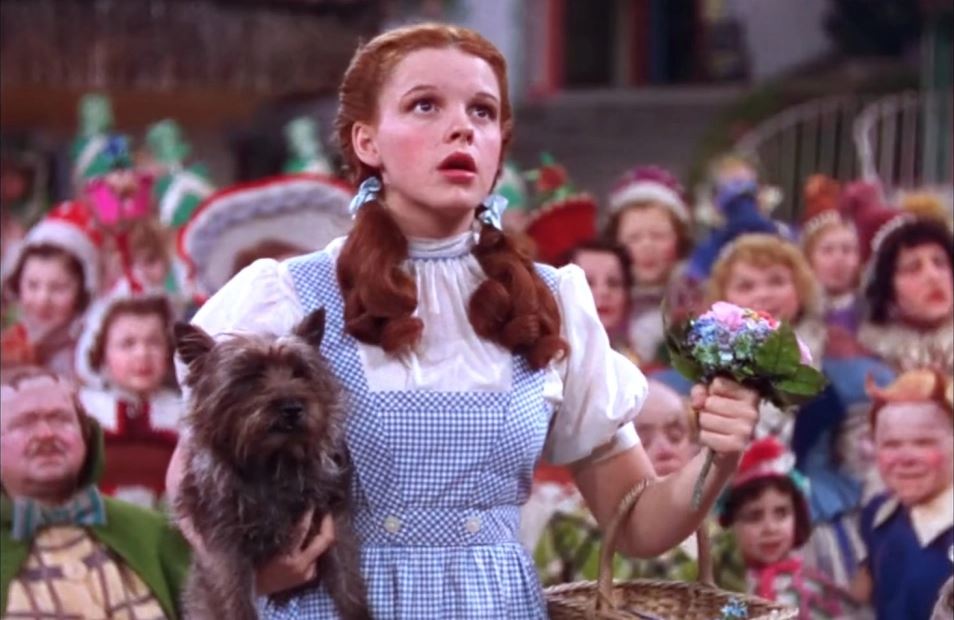
Most fans and critics alike seem to think her moment came with The Wizard of Oz (1939), that resonated with generations of children—and the adults they became—possibly for the ironic image of a girl on the cusp of womanhood who was taking a perilous journey, scared stiff, accompanied by a misfit trio who were not always terribly helpful, but who in spirit had her back, and she defeated a terrible villain, saved a society even as she unmasked the phony leader—who, unexpectedly, was not a villain but yet another victim of his own weakness.

But generations of children who were not old movie buffs would never have seen this movie and it would never have become an iconic experience of American childhood without annual broadcasts on television.  For free.  No cable fees, no subscription.  Not today.

Will future generations of children still feel the warm sisterly bond with Judy Garland in their fascination for this movie without it’s being a regular and expected experience of their childhoods?  To be sure, their parents and grandparents may treat them to home video (in whatever form it may take in the future) and Wizard of Oz-inspired toys, but will that die off when national memory (aside from the classic film buffs’, that is) finally lets it go?  For so many people, this movie is their introduction to classic films.

It was not my introduction to classic films, but it likely was my introduction to Judy.


It's been lovely to hear the outpouring of expressions of enjoyment for the movies shown on TCM this month, but particularly for having the whole month devoted to Judy Garland, to giving her a showcase.  She would have been 100 years old this year, and the tragedy of having died young at the age of only 47 is part of the sadness of considering her career, that one is perhaps unable to completely enjoy her work in A Star is Born (1954) without almost subliminally remembering the train wreck of her own self-destructive demise.  In a sense, we still mourn her.  There are few people on the national stage we still acutely mourn after 53 years.

I’ve often thought what a shame it was for her that she did not live long enough if only to see her films celebrated particularly on TCM.  I like to think she would have enjoyed that, and would have made a heck of an interview for Robert Osborne.

I’ve enjoyed reading posts and comments on Facebook and on Twitter about how deeply fans feel about Judy Garland, and it is a kind of love that has little to do with awe of a big star.  There is something deeply personal she touched in people. 

This month reminded me of two very different people whose appreciation of Judy Garland made an impression on me.  One, was my father.


My parents were teens during the Great Depression, and spent, to hear them talk of it, pretty much the entire decade at the movies.  They were very familiar with Mickey and Judy.  When they were middle-aged and had a house full of kids, Judy Garland hosted her television variety show on CBS, The Judy Garland Show for one season from 1963-64.  Since I was a toddler at the time, I didn’t catch up with this program in until much later in life.  But I have it from an older sister who recalled that whenever the show came on, the kids had to be silent, the family plunked down in front of the TV, and my father’s face just lit up with rapture. 

Now, my father was not a movie musicals kind of guy.  (My mother loved them.)  He preferred Westerns, film noir, crime dramas, political dramas, war movies.  He liked his movies on the heavy side.  He wasn’t into fluff that much.  In fact, if Jerry Lewis had ever crossed his path, my father probably would have belted him because class clown-types annoyed him.


But Judy, sweet vulnerable, funny, offbeat Judy, she could do no wrong.  When she came on the 19-inch screen, in black and white and sometimes fuzzy depending on the reception, a woman in her early 40s that seemed to be pushing back with all her might at some new kind of physical frailty—well, that didn’t matter; he just beamed.  That was her power.

The second person whose devotion to Judy Garland was much younger, and I met her several years ago when she was in high school.  She was involved in the school drama club and she wanted to pursue a career in theatre.  Judy Garland was her favorite.  That surprised me, because I’d thought that young people today who have ambitions for an entertainment career might be drawn toward modern film stars, pop stars, TV stars.  But for her, Judy was tops. She knew all the songs in Judy’s career repertoire.  She identified with her in a way she perhaps did not identify with the glossier, edgier stars of her own era.  Judy was timeless.

Thank you to TCM for giving us a huge banquet of Judy this month.  For Judy’s 100th birthday, it was a wonderful gift to us.

Have a look here at these previous posts of some of Judy Garland’s films: 

Summer Stock (1950) 

For Me and My Gal  (1942)

Life Begins for Andy Hardy (1941)

Judgment at Nuremberg (1961)

    ********************

Jacqueline T. Lynch is the author of Ann Blyth: Actress. Singer. Star. and Memories in Our Time - Hollywood Mirrors and Mimics the Twentieth Century. Her newspaper column on classic films, Silver Screen, Golden Memories is syndicated nationally.  Her new book, a collection of posts from this blog - Hollywood Fights Fascism - is available here on Amazon.

Thursday, July 7, 2016

Tiffany Vazquez - New TCM Host - Part 7 of The State of the Classic Film Fan Series


Tiffany Vazquez, the new host on Turner Classic Movies is a reassuring promise of the future of the classic film fan. She appears to have entered the job with many laudable attributes, but this may be chief of all.

This is part seven in our year-long monthly series on the current state of the classic film fan.

When Ms. Vazquez was announced as the new Saturday morning host, many longtime TCM viewers voiced concern that this was another of the network’s unfortunate drift from its classic film roots. 

The plan to attract a young demographic, though practical in business terms, has its downside—there is the temptation to gear programming specifically to that demographic. While I confess, I dislike some of TCM’s shift to post-classic films, I have never been concerned about the youth of a new host. Indeed, I was an “old” old film buff at ten years old, and I’ll bet I was more familiar with classic films at that tender age than many young people (Tiffany, now 29, reportedly came to classic films late—not until college).  I am delighted, always, to come across a young person who enjoys classic films.

Though we may recall that Ben Mankiewicz met some resistance by fans when he was hired for hosting duties in 2003, unfairly principally for not being Robert Osborne, it was never his being younger that bothered me. Indeed, he’s only about four or five years younger than I. What first annoyed me about Mr. Mankiewicz was what I perceived at the time as flippancy and sarcasm in his delivery, and TCM’s pointed efforts to package him and Robert Osborne as a kind of Odd Couple. The young hip dude and the old guy.

Since then, with his growing into the job, I’ve come to like Ben Mankiewicz. I look forward to his intros, and he now comes off as a person as interested in the movie as me, and with respect for the people who made it. That’s all I ask. Also, I think I started to warm up to him about the time he began to shave and wear ties.  I like grownups to look and act like grownups.  At least insofar as they are guests in my home.

Remember how in the days of comedy/variety shows on TV when the host would sign off at the end of the show and thank us for allowing them to come into our homes? A gracious act. We don’t see that anymore. The people on TV just barge into our homes like The Desperate Hours (1955) and assault us with their crudeness. If we turned our back on them for one minute, they'd eat everything in the refrigerator, spit on the floor, and then maybe kill us.

What we love so much about Robert Osborne isn’t necessarily his knowledge of classic film (though that certainly is extensive), but his class.

Which brings me back to Tiffany Vazquez. Her polish, her well-spoken delivery, her professional appearance all tell me this is a young woman of intelligence, of taste, of maturity. What classic film means to most of its fans (okay, maybe excluding monster flicks and the Marx Brothers) is a sense of elegance and glamour not seen today. TCM has chosen wisely in a young woman who, by her manner and appearance, reflects that appreciation by its fan base for class. This is why we like Robert Osborne so much: he likes the movies as much as we do, he respects them, and he respects us. He looks, talks, and acts like a gentleman.

This is something that should not be undervalued by TCM. The classic film fan is your demographic, TCM, no matter the age.  It’s a very special demographic.

But Tiffany Vazquez is more than a lovely young woman who likes old movies. She hold two graduate degrees, one of them in film studies from NYU, and she interned at the Film Society of Lincoln Center. This most certainly recommends her for the job. If she did not grow up with Saturday afternoon matinees or The Million Dollar Movie like many of us, she still comes with her own pedigree and a special perspective.

It has been noted that she is the first woman to be hired as a regular TCM host, and her Puerto Rican heritage has been commented on as setting her apart as representing a new demographic. But before we skew this into some Madison Avenue pie chart of something up-market, we should remember that  the classic film fan “demographic” has little to do with age, gender, race, or ethnicity, and is remarkably diverse. We’ll comment more on that in future posts in this series.

What is remarkable is not so much that an educated young woman of Puerto Rican ancestry should like old movies, but rather that she does in the face of the overwhelming odds against many young people ever having an opportunity to discover classic films, or if they do, that any appreciation for old movies will be nurtured in a society that has little regard for the elegance and glamour they represent. Especially for a young woman.  Just one case in point:

I recently came across a clothing store website. I think I must have Googled “vests” (I don’t remember why or what now), but the page featured photos of some 12 or 16 models wearing various kinds of vests. Three of them were young men, the rest women, all were from their late teens to early twenties. The boys wore vests as part of a three-piece suit. They did not wear their jackets, but just appeared in shirtsleeves, their ties loosened, their shirts pulled out from their pants and shirttails hanging, their arms crossed. They glared at the camera to send the message of their hipness, their utter unconcern for what we think about them or the vain stubble on their baby faces.  They looked like preppie punks, but each conveyed an image of power. They were confident.

The girls all looked like prostitutes.

They wore vests that were not stylish or businesslike, just various scraps of material to decorate almost as an afterthought the real merchandise—the sexualized, barely of legal age, female. Each by the skimpiness of her unflattering outfits, and mostly by her vulgar posing, represented the old adage “sex sells”. Their dreary Goth-made up faces wore the same look of hip indifference as the boys, but where the boys looked like future executives (God help us), the girls looked like prostitutes. They were not given an image of control as the boys; they were assigned the role of object to be possessed. They were meant to be ogled, but for most of us, their photos are too tragically disgusting to look at. This image was apparently conceived by an ad agency as good business. This image was apparently approved by the store chain as good business.

Neither clearly give a damn about young women.

We often hear in our society today complaints that there are not enough women in Congress, not enough women in business, etc. Well, we’re not exactly encouraging them to wear business suits, are we?

And now TCM has a female host.  I have watched Tiffany Vazquez give her movie introductions for a few weeks now, and I am more than pleased—I am relieved. The future of the classic film fan is going to depend on young people who admire classic films enough not to regard them with snark or condescension, but who will empathize with the long ago generations that made them. They may even want to copy a little of what they see and adopt it for their own personal style. Image, even as those soulless ad agencies and store chains know, is a very powerful tool because it is a personal imprint.

Where the ad agency and the store chain make their mistake (and have bludgeoned our society for the last couple of generations) is trying to bait a younger demographic by imitating that demographic's immaturity, instead of trying to uplift them to something better.

I like Tiffany Vazquez’s style. If she had appeared like one of those repugnant store chain models, and saying, "Like, ya know, awesome," I would not have cared how enthusiastic she was about old movies: I'd have canceled my cable subscription.

I look forward to a future occasion where she might express her opinions on classic films, more than just introduce them. I’m interested to hear what she has to say. When she remarked in an interview that she had a habit of “introducing” films in the shower, where some people sing, I had to laugh because I identify with that.

Not that I ever introduce movies in the shower. I just wash up, sing a couple of show tunes, write my initials in steam on the glass shower door, and I’m out of there.

But I do have a habit of thinking about movies and writing descriptions and opinions and analysis in my mind. It was from that habit that this blog was born. I got tired of talking to myself.

Good luck, Tiffany. Congratulations on your new job. See you Saturday.

********
Part 1 of the year-long series on the current state of the classic film buff is here: A Classic Film Manifesto. 

Part 2 is here: Cliff Aliperti’s new book on Helen Twelvetrees.

Part 3 is here: An interview with Kay Noske of Movie Star Makeover.

Part 4 is here: Evolution of the Classic Film Fan.

Part 5 is here: Gathering of the Clan at Classic Film Festivals.


Part 6 is here: John Greco’s new book of film criticism: Lessons in the Dark.

****************


My audio book version of Ann Blyth: Actress. Singer. Star., narrated by Toni Lewis, is now for sale on Audible.com, and on Amazon and iTunes.
 

Thursday, April 7, 2016

Evolution of the Classic Film Fan


Jack Lemmon arrives home late at night to his New York City apartment, a second-floor walk-up in an ancient brownstone.  It’s a cold, misty night in the late autumn.  He pops a TV dinner in the oven, and when it’s ready, he drops the hot aluminum foil slab on his coffee table and parks himself in front of the TV.  He is cheered by the prospect of Grand Hotel (1932) being broadcast, but is fed up with commercial sponsor interruptions by the announcer, and flicks channels (surprisingly, on an early cable manual remote dial), runs through a western and another show that do not hold his interest, before he lands back on Grand Hotel and finally gives up at yet another commercial.  He snaps off the TV, and it blips into a single white spot, as if the cathode ray tube has been engulfed in a cosmic black hole.

Had his character, C.C. Baxter ever seen this, then 28-year-old movie, before?  Or had he only heard of it?  He is clearly excited at the prospect of seeing it as the announcer trumpets the names of the cast, including Joan Crawford and Lionel Barrymore.

Most of us recognize this scene from The Apartment (1960).  It always fascinated me as possibly one of the first depictions of the old movie buff.  Today we discuss the evolution of the classic film fan, which, as we’ve mentioned on this blog before, was a result of television.

January 25, 1957

In this previous post we took a playful look at some pages of TV Guide from 1976 and the old movie listings.  Here are a few much older pages from the 1950s and 1960s.  Though there were only a few channels then, there was still a lot of time to fill on this new medium, and movies from decades past were pulled out of the vault and used as filler.

But it was also an exciting era of entertainment in a new format.  Dramas, many of them live, featured stars and character actors of Hollywood’s Golden Age.   We might wonder how they felt about sharing the airwaves with old movies featuring their much younger selves?   Here was graphic proof that they had aged—not something helpful in promoting a current career in middle age.  (Catch Claude Rains in an episode of The Naked City below, and Gloria Swanson starring in her own program.)  It's difficult enough to compete against other actors, but to compete against one's younger self?


November 9, 1960


February 8, 1955


The studios were breaking up or had broken up by this time, and the broadcast rights to these movies were sometimes held by no one connected with the making of them.  Certainly, none of the actors received residuals.

But it must have seemed amazing that these old movies—which most studio execs back in the day could never have imaged would have a life beyond the vault—were now being shown to a new generation.  A few “art house” movie theaters across the country might chime in with a retrospective  on a particular film or star, but none of these venues could claim the huge audience numbers of a single night of television.

The 1960s, so forward, fast-moving, and futuristic, was not a particularly nostalgic period, though we see on this TV Guide page an early documentary series, Hollywood and the Stars.  Most remarkably, though, have a look at Silents Please, a program which showed silent movies and listed the credits.


October 7, 1963


October 3, 1962

Most Baby Boomers, though having benefited from the Late Late Show, the Million Dollar Movie, etc., since the 1950s, would recall the 1970s and the curious nostalgia boom as the mechanism that really launched a generation of old movie buffs. 

That’s Entertainment! (1974) had a huge hand in launching it.  Originally intended as a television special for the 50th anniversary of MGM, producer and director Jack Haley, Jr. and the studio execs decided to gamble on a feature release, and its popularity surprised everyone and led to a soundtrack album of highlights.  (I don’t really remember, but I think it could have been one of the first albums I ever bought.) The tag line “Boy.  Do we need it now.” was both an acknowledgement of the fatigue over the political and social upheaval over the past several years, and a slap in the face to modern movie makers, whose style and subject matter were vastly different from the classic era.  It was one of the highest grossing films of the year.  

Aha.  There was a market for this old-time stuff.

The clips are wonderful, but some of the film's most powerful moments are the introductions to each segment hosted by stars of the Golden Age on the run-down sets of the back lot.  These scenes of aging star reviving warm memories of elegance -- on a dilapidated set rotting away -- hammer home the lure of nostalgia like nothing else.

Here is a clip of the festivities and roll call of the stars from the 1974 premiere.  These stars need not have worried about competing with their younger selves anymore. That was water over the bridge.  They could look back safely, and even enjoy being in the limelight for one more special evening.

And for the first time, their fans shouting at them as they walked the red carpet were not their contemporaries -- they were young enough to be their children and grandchildren.

But some modern movie makers, perhaps spurring the nostalgia era, perhaps capitalizing off it, paid tribute to Hollywood’s golden age.  What’s Up Doc? (1972) was a modern film, but a direct tribute to the screwball classics of decades past.  Paper Moon (1973) was not a parody, but a slice of life of Depression-era America, filmed in black and white.  The Sting (1973), decidedly in color, a planned art deco palette.  Young Frankenstein (1974)—also filmed in glorious black and white— represented the most common tribute to classic film in this era—the parody.  Add to this Neil Simon’s The Cheap Detective (1978), a knockoff on Casablanca (1943) and The Maltese Falcon (1941).

During this era we can thank The Carol Burnett Show for making us laugh with superb old movie parodies.  Parodies, and kitschy merchandise (Betty Boop was reborn as key rings and coffee mugs long before anybody thought of rebroadcasting the old cartoons.) fed the old movie nostalgia boom, and a few slim books that tried to cram names and facts if not a deep understanding or analysis of film at this time.


Such books include Richard Lamparski’s Whatever Became Of…? series, and Jerry Lang and Gösta Viertel’s Who Is That? and many others.  These were photo-filled books, lightweight, without much depth to them, but certainly a kind of survey course for newcomers.   Most had little substantive narrative, with a reliance on cliche, and sometimes, as in the case of Who Is That?, an awkward handling certainly in the "separate but equal" gallery of “Negro Actors” along with a roster of vamps and bad guys.  These high school yearbook-style books at least put a name to the face, long before IMDb gave us movie credits.  In all these ways, serious and spurious, the decade was waking up to classic films.


One could argue the chicken-and-egg scenario: did these items feed off the merchandising craze of the nostalgia boom, or did it create it?

Critics and film historians Pauline Kael and Jeanine Basinger wrote contemplative essays on classic film, and colleges began film appreciation courses.  Leonard Maltin published his first book of reviews, which would be updated for the first time during the decade, and, of course, Robert Osborne’s  Academy Awards annual became bibles in the homes of movie buffs.

The term "film noir" came into popularity in the 1970s.  

Those of us who were around then, educating ourselves on classic film from public library encyclopedias and biographies, and many late nights in front of the cathode ray tube, welcomed these and That’s Entertainment and it’s sequel.  It was fun to be reminded of great musicals in an era where they were dying and we were told they would never come back because they were too expensive, but mostly too corny.  Its success, and that teasing moniker, “Boy. Do We Need It Now.” seemed to legitimize our love of old movies.

Television remained our main source for classic film, and in an era where old movies were often shown on primetime, we recall that the very first showings on TV of Gone With the Wind (1939) in 1976 (engendering a famous Carol Burnett parody), and The Sound of Music (1965) in 1975 were huge events and received the highest ratings of the era.  Subsequent yearly showings continued to reap great ratings and became annual favorites for new generations.

Interesting that The Wizard of Oz (1939), another film that received a huge boost from TV and probably would have been forgotten without it, really took off with the advent of color TV, where its special effects could be better appreciated.

I don't believe The Wizard of Oz has been shown on broadcast TV in years.


Another TV tribute—and I’d love to see how many remember this—was the series run on PBS stations called Matinee At the Bijou  in 1980 and ran for five years.  It was probably a first for showing in each episode a cartoon, a short subject, and a serial or “B” movie.  Rudy Vallee was brought out of retirement to sing the show’s theme song.  It was a real treat for the old movie fan to have access to these less prestigious examples of the studio era.  All well and good to celebrate Casablanca, but for the serious film buff, the giants do not tell the whole story, nor satisfy our yen for what else is in the vault.

On the horizon—a tsunami.  The VHS cassette.  Old movies were now being produced in video format to be purchased for home use.  To be sure, collectors of 16mm print films had enjoyed a select assortment of classic films, shorts and cartoons for decades (and some still prefer them), but the VHS cassette offered a less expensive alternative that was easier to use, required less equipment, and a larger variety of movies.  Icing on the cake was the ability to actually record on blank video tape at home.  Now the Late, Late Show offerings were funneled into our private collections.

Watching a particular movie anytime you wanted.  Mind blowing.  A Flintstones-era  “on demand” TV.

And THEN came the movie rental shop.  And “please rewind.”

DVD, of course, was the next big advancement, and Blu-ray, but even before this came on the scene, what I think was more profound to the evolution of the old movie buff and the perpetuation of familiarity with classic films to a new generation was the American Movie Classics channel, and its hosts Bob Dorian and Nick Clooney.   It ran from 1984 to 2002 and was our go-to network for classic movies.  Since AMC (now called American Movie Channel) abandoned classic film programming in 2002, there is always that reference to their going to the “dark side” and fears that one day Turner Classic Movies might follow their example. 

TCM, launched in 1994, I think we can all acknowledge, has been a giant in the appreciation of classic film.  No other TV source has promoted the wide array of studio era films—from features, to shorts, documentaries, live events such as the TCM Film Festival and the TCM Classic Cruise.  We may scorn its drifting into modern films, and the trite “let’s movie” slogan, but TCM is a haven for classic film buffs in a way no other venue has been, not since the old neighborhood movie house from the teens to the late 1950s.  Robert Osborne has earned the respect and love of millions of classic film fans for many reasons, most especially for the dignity with which he presents the movies, for the way he represents us.  Not since the “Boy. Do We Need It Now.” has the appreciation of classic films been raised to the level of esteem it deserves.

We may have reached a climax of sorts—for, as discussed in the first part of this series here, the demographic of the Millennials do not get their entertainment from cable television.  With few classic films shown on broadcast TV these days, younger generations are not apt to be introduced to classic film just by switching the dial, as we were, if they do not subscribe to TCM.

But there are some interesting new venues to promote classic films.  Blogs and websites certainly, but also the growing experiment of showing old movies in cinemas for special releases, allowing fans to see their favorites once again on the big screen.

There are also some intriguing home-grown programming—such as Dana Hersey, who hosted The Movie Loft on Boston-area TV-38 in the 1980s is launching an Internet classic movie streaming channel. Other hosts of online podcasts demonstrate that being a classic film fan is continually evolving according to the technology that allows us to appreciate old movies.  No longer content to be “programmed to”, the classic film fan is now taking the reins and doing the programming.  We'll talk about that more later in the year.

Come back next month, Thursday, May 5th, for part 5 of this series when we discuss the TCM Classic Film Festival.

Come back next week for our regularly scheduled programming—the CMBA “Words! Words! Words!” Blogathon.  My entry is the use of letters in old movies.  Please join us next Thursday for this fun blogathon.

Part 1 of the year-long series on the current state of the classic film buff is here: A Classic Film Manifesto. 


****************************

"Lynch’s book is organized and well-written – and has plenty of amusing observations – but when it comes to describing Blyth’s movies, Lynch’s writing sparkles." - Ruth Kerr, Silver Screenings

"Jacqueline T. Lynch creates a poignant and thoroughly-researched mosaic of memories of a fine, upstanding human being who also happens to be a legendary entertainer." - Deborah Thomas, Java's Journey

"One of the great strengths of Ann Blyth: Actress. Singer. Star. is that Lynch not only gives an excellent overview of Blyth's career -- she offers detailed analyses of each of Blyth's roles -- but she puts them in the context of the larger issues of the day."- Amanda Garrett, Old Hollywood Films

"Jacqueline's book will hopefully cause many more people to take a look at this multitalented woman whose career encompassed just about every possible aspect of 20th Century entertainment." - Laura Grieve, Laura's Miscellaneous Musings

"Jacqueline T. Lynch’s Ann Blyth: Actress. Singer. Star. is an extremely well researched undertaking that is a must for all Blyth fans." - Annette Bochenek, Hometowns to Hollywood


Ann Blyth: Actress. Singer. Star.
 
by Jacqueline T. Lynch

The first book on the career of actress Ann Blyth. Multitalented and remarkably versatile, Blyth began on radio as a child, appeared on Broadway at the age of twelve in Lillian Hellman's Watch on the Rhine, and enjoyed a long and diverse career in films, theatre, television, and concerts. A sensitive dramatic actress, the youngest at the time to be nominated for her role in Mildred Pierce (1945), she also displayed a gift for comedy, and was especially endeared to fans for her expressive and exquisite lyric soprano, which was showcased in many film and stage musicals. Still a popular guest at film festivals, lovely Ms. Blyth remains a treasure of the Hollywood's golden age.


The eBook and paperback are available from Amazon and CreateSpace, which is the printer.  You can also order it from my Etsy shop. It is also available at the Broadside Bookshop, 247 Main Street, Northampton, Massachusetts.

If you wish a signed copy, then email me at JacquelineTLynch@gmail.com and I'll get back to you with the details.

**************************
My new syndicated column SILVER SCREEN, GOLDEN YEARS, on classic film is up at Go60  or check with your local paper.

Related Products