IMPRISON TRAITOR, PEDOPHILE, AND CONVICTED FELON TRUMP.
Showing posts with label Mischa Auer. Show all posts

Friday, January 17, 2025

Gabriel Over the White House - 1933


Gabriel Over the White House
(1933) is an inventive fantasy and apparently, political commentary as well, that has resonance today.  What exactly the meaning or purpose of that commentary is never entirely clear, as there is a great deal of contradiction in ideals presented, and perhaps even a curious display of a lack of knowledge about civics and our political institutions.  There is no innocence about human nature, though, and this was a hallmark of Pre-Code films.  The tone of the movie is sly and sometimes hits hard.


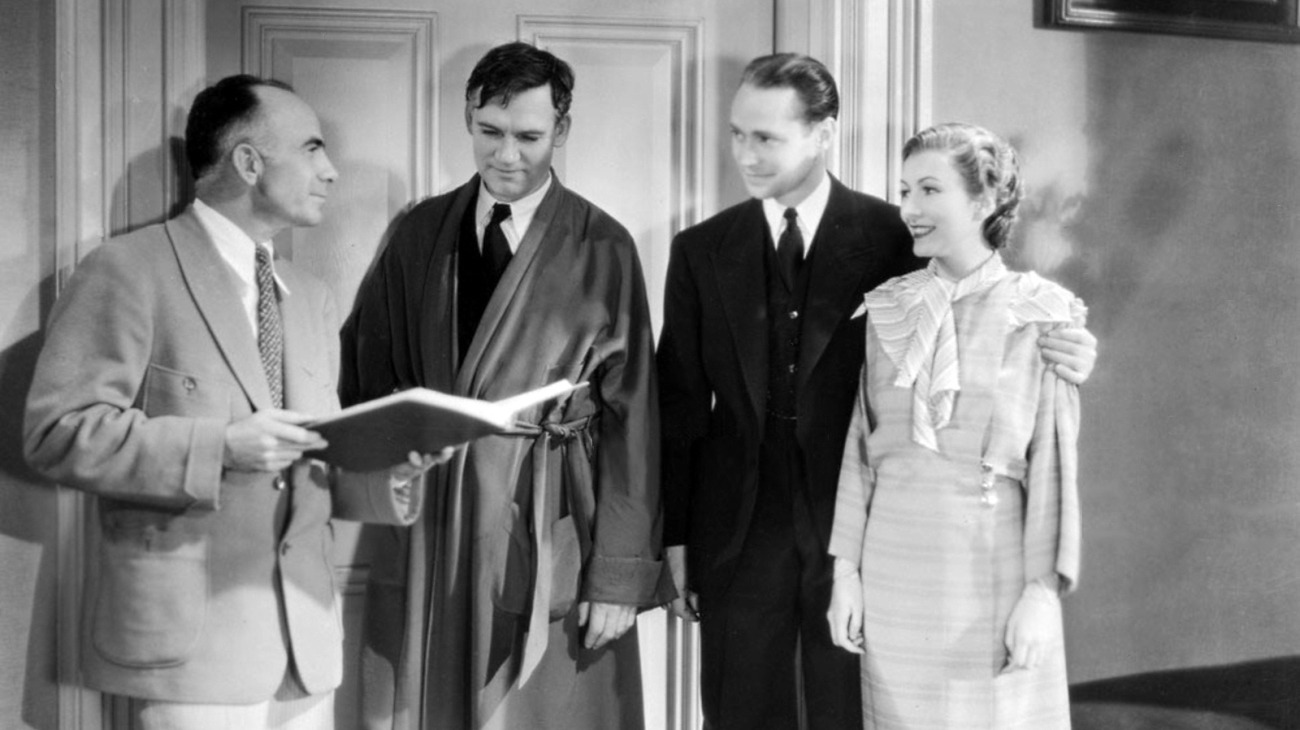
Walter Huston is splendid as the lead, a newly inaugurated president taking the helm of the government during the worst of the early Great Depression years.  He is a freewheeling bachelor, romps with his young nephew played by Dickie Moore as though he were a child himself, and when a sexy, confident, coy woman stops by the White House to see him, he keeps his door open to her and makes up a staff job for her to keep her close.  We already know, even without Franchot Tone’s knowing look, that “Pendie,” played by Karen Morely, is Mr. Huston’s mistress.  He does not trouble to hide it.


Franchot Tone plays Huston’s secretary and presumably chief of staff.  The movie treats what we know about Oval Office appointments with a vague bending of the truth, even as Huston bends the rules, and that is a script writer’s device to funnel the audience into the story he wants to tell without being bogged down by factual details.  Since the movie is frankly a fantasy, there is no need to hold to the mundane facts about actual protocol or how government really works.

But the era is faithfully depicted—if not in a real timeline of events, rather, in the feelings of desperation of a demoralized populace, in angry crowds, in hopelessness.  In such desperate times as these, Walter Huston as president does not seem to be the right man for the job.  He is self-involved, somewhat immature, gleefully corrupt and easily manipulated by special interests, and sometimes astonishingly stupid, which may be the source of his callousness.  Given the actual quill pen (which was NOT the actual pen) that Lincoln signed the Emancipation Proclamation to sign a new bill for a public works project for new sewers in Puerto Rico, Huston jokes flippantly about it, “Well, here goes for Puerto Rican garbage.”  He is coarse, but we may smile at his impishness.  On the other hand, one cannot help but think of another asinine president who threw rolls of paper towels at suffering Puerto Ricans.  He is also immature, gleefully corrupt and easily manipulated by special interests, and sometimes astonishingly stupid.

Mischa Auer plays a serious and disgusted reporter who tries to nail down the details of Huston’s platform, but there are none.  (I half expected Mr. Auer to break into a passionate verse of “Ochi Chornya,” but he’s saving that for director Gregory La Cava’s other movie, My Man Godfrey, which we discussed here.)

However, a change will soon come over the new president.  Huston rides in a short motorcade to an event, but he takes the wheel because he loves to drive himself.  Fast.  Enjoying the white-knuckled response of his Secret Service men, he floors it, trying to pull away from the rest of the staff and police escort in the car behind him, swerving on a winding country highway.  Finally, he loses control and the car flips over.  He is severely injured and near death.

He is kept in seclusion by his doctor for many days, and the public is kept in the dark about the nature of his injuries or details of the accident.  There is some worry about who will take over the reins of government—seemingly unaware that that is precisely why we have vice presidents.


Finally, Huston comes out of his coma—but he is a changed man.  Now serious, now intelligent, now with a sense of purpose.  Franchot Tone and Karen Morely see the change, and notice something supernatural about it.  Huston has been visited by the Angel Gabriel, who is now pulling the strings in Huston’s brain.


Restored to more vigor than he had before, Huston sets about curing the Depression, first by addressing a group of protestors—not unlike the Bonus Army, whose camp was burned out and members shot by Douglas MacArthur’s troops under President Herbert Hoover.

Then he single-handedly repeals the Eighteenth Amendment, getting rid of Prohibition, just as Congress would do under President Franklin D. Roosevelt, but he also establishes government liquor stores to drive out the gangster bootleggers, who bomb the stores.  C. Henry Gordon (in one of an astonishing fourteen movies that year) is compelling as the smooth, sinister mobster in a few devilishly sneering closeups.  Huston fires his cabinet, gets rid of Congress, declares martial law, and has the mobsters shot by firing squad.


In his address, Huston declares that he is a dictator based on Thomas Jefferson’s ideas of democracy.  Here is obviously one of the ridiculous twists in logic, but Huston would not be the first politician, real or fake, then or now, to claim that his fascist intentions would have been applauded by the Founding Fathers. 

Franchot Tone and Karen Morely, meantime, have become romantically involved, but they need not worry about offending Huston.  He has bigger fish to fry, and the Angel Gabriel keeps him pretty busy.   Miss Morely is shot by racketeers, but recovers and Huston blesses their union.


Another bizarre and even troubling move by Huston is when he brings the world powers together during a radio broadcast to demonstrate his new military service—the United States Navy of the Air.  He will move for disarmament of former weapons, but will put billions into the military of the future, which apparently is going to be biplanes, whose pilots will pull a lever and drop a bomb on an enemy ship.  Huston arranges a demonstration, and bullies the foreign governments into paying their World War loans and reparations and promise not to rearm because if they do, we will fly biplanes over them and pull a lever and drop a bomb. 

He tells them and the radio microphones, “The next war will be the story of the failure of antiquated weapons and antiquated myths, of the horrifying destructiveness of the modern agencies of modern arms.  Armies and navies will be destroyed from the air.  And as these planes destroy armies and navies, they will destroy cities, they will destroy populations…the next war will depopulate the earth…invisible gasses, inconceivably devasting explosives.”  Well, he got that right, in part at least. The foreign leaders hurriedly agree to his Washington Covenant.

Now that the important work is done, the Angel Gabriel passes over Huston as in a shadow, and Huston dies.


Even more interesting than the twisting logic of this film, are the sometimes conflicting stories about it.  We know it had its genesis in a novel, but producer Walter Wanger, Democrat and Roosevelt supporter, brought the story to M-G-M head Louis B. Mayer, staunch Republican, under Wanger’s production company owned by newspaper magnate William Randolph Hearst.  Hearst began his unsuccessful political career, including a failed bid for the presidency in 1904, as a Democrat, but as the years rolled by he became more conservative and isolationist, who supported Hitler and the Nazi Party.  Though he was an early Roosevelt supporter, he went to the dark side after 1934 and became his enemy.  We all know he was the prototype for Charles Foster Kane of Orson Welles’ Citizen Kane (1940), but that’s another story.  It is reported that Mr. Mayer held the movie back until after Roosevelt’s inauguration, hoping to pin the stain of fascism on him, rather than on Hoover, as if the story is an examination of the current sitting president.

The political affiliations of these men have a lot to do with any discussion of Gabriel Over the White House today, and because production began during the Hoover administration, but was released just weeks after Roosevelt came into office, what is the message of the film?  Who is the finger of fascism being pointed at—the Democrats or the Republicans, and is dictatorial powers in an American President considered fascism at all, or is it merely what Thomas Jefferson would have liked and what the American people secretly want all along?  Was the film an effort to ingratiate fascism with the American people?  We know only that the movie disappeared quickly enough when by the mid 1930s, fascism appeared to be a clear and present danger at home and abroad.  There were no nice guy dictators.

We are living now in far more dangerous times, and the plot points or message—if there really is any message at all—in Gabriel Over the White House seem innocent in their supposing, though intriguing, and the finger-pointing at what it all means is irrelevant.  What it is, is fantasy in its purest form.  Any good story, fantasy or not, begins with “what if?” and this is a freedom of thought we should celebrate. 

What I admire about many films of the 1930s is the courageous introspection into their own contemporary times, warts and all, and experimenting with different ways of storytelling to do that. The escapist musicals have, I think, sometimes received the lion’s share of attention when movies of the 1930s are recalled as “getting us through the Depression.”  The black-and-white gritty and even grim films of the Dirty Thirties have special historical value, and in their own way, they got us through the Depression, too.

As much as I can this year, I’d like to examine more films of the 1930s that unselfconsciously illustrate their own times. 

*******************************


My new non-fiction book, CHILDREN'S WARTIME ADVENTURE NOVELS - The Silent Generation's Vicarious Experience of World War II -- is now available in eBook here at Barnes & Noble, Apple, Kobo, and a wide variety of other online shops.

Or here from my Shopify store if you want to buy direct from me and avoid the big companies.

And it is here in eBook, paperback print, and hardcover, from Amazon.

From Cherry Ames, to Meet the Malones, from Dave Dawson to Kitty Carter - Canteen Girl, the Silent Generation spent their childhood immersed in geopolitical events through the prism of their middle grade and young adult books.  From the home front to the battlefield, these books are a window on their world, and influenced their hard-working, conformity-loving generation.


Thursday, October 15, 2015

Jane Wyatt - We're Only Human and Pitfall


The two films we cover today displayed Jane Wyatt’s strength on screen, no less steely for being presented with genteel poise. She is two different women here – a young urban career girl, and then, thirteen years later, a settled suburban housewife and mother. We recognize what is often referred to as her “finishing school accent,” but is she the same person? She could be. In both, she is supportive of the men in her life, but she demands they measure up to her standards.

We discussed last week how the Turner Classic Movies showing of four films of hers from the 1930s through the late 1940s in chronological order gives the viewer a fun tour of Jane Wyatt’s range as an actress, but the eras which reflected her film career were sometimes vastly different from her 1950s sitcom role as the suburban wife and mother. Because this long role on TV (for which she won three consecutive Emmys) is how most of us were introduced to her work, her film career is something yet to be discovered, sometimes with surprise.

Her early roles were sassy, sexy, and allowed her to demonstrate her talent for comedy, to be both sensual and scrappy. The unruffled 1950s woman who vacuumed in pearls waits in the future – but we shouldn’t just dismiss that role (screen role or real life for millions of women) as a consolation prize for youthful adventure lost. It was, rather, a progression, a maturity. For those who might consider it a regression forget how profound an impact those 1950s TV moms made on our lives and in pop-culture – so much as to leave us shocked at Jane Wyatt “girl reporter.”


We're Only Human (1935) pits Jane Wyatt against Preston Foster in her third film. It’s a gritty, somewhat manic cops-and-robbers story. Foster is a fascinating study as an aggressive cop who pushes the rules, breaks a few, to round up the bad guys, Depression-era gangsters, just so many notches on his gun. He is an adrenaline-junkie, and this will be his downfall, his greatest strength is his curse.

Jane Wyatt is the girl reporter, new to New York City from Kansas City, and it is refreshing that nobody – neither her photog sidekick, her editor, or Preston Foster – or the script, treats her condescendingly. She is as hard-hitting in her profession as Preston Foster is in his, and interestingly, even her good judgment leaves her at the end.

James Gleason is dependable as Foster's crusty-but-lovable partner. Jane Darwell, likewise, as Gleason’s wife. Foster lives with them, and they are his example of a supportive marriage and domesticity - Darwell bullies Gleason through a cold and rules the roost.

A collection of favorite character actors are on hand – Moroni Olsen as the police inspector who chews out Preston Foster over aggressive police tactics. Ward Bond is in a brief scene as a bank robber. Arthur Hohl is a crooked lawyer in league with gangsters, and Hattie McDaniel is his maid, whom Foster pushes past to have a hasty meeting with the pettifogger.  Even a few minutes of Hattie McDaniel is better than no Hattie McDaniel.

Mischa Auer is surprising as the crime boss, a far cry from his more famous comedy roles. His boisterous, goofy, charm and his Russian accent are gone here. He’s a hollow-eyed sinister creep, recently escaped from prison. Foster catches him with a display of foolhardy daring – angering his superiors for not calling backup – and when Auer eventually escapes his custody, Foster looks doubly bad.

Jane Wyatt is at first impressed with Foster's heroics. They begin a playful relationship – and though he barks, “How’d you like to be my girl?” they are friends rather than lovers. He is socially inept, and she is amused rather than devastated by his preoccupation with Mischa Auer.

She steers the course of their romance, just as she steers the roadster. At one point, he thinks she is offering him a home-cooked meal; she steers him to the delicatessen where he pays for the armload of food. She’s not a homebody.

The movie is a great big canvas for Preston Foster and he splatters himself all over it. Foster is in practically every scene, arguing, fighting, pushing, brooding, and loses none of his momentum – though nearly loses his mind – when his beloved partner James Gleason is gunned down by the bad guys.

The above spoiler was brought to you by Another Old Movie Blog – “Cheerfully Serving You Spoilers Since 2007.”

In an intense scene, Foster, accompanied by Jane Wyatt, must tell Jane Darwell that her husband is dead. Like an antsy kid who can’t keep a secret, he just blurts it out, wild and anxious. Jane Wyatt is shocked. His lack of sensitivity had been annoying to her, but now she sees the depth of his failure to appreciate or even understand the feelings of others.

Foster, as a reaction to his own grief and sense of guilt, goes off the wall, repeatedly haranguing the stunned widow with his defense that he told Gleason not to be too cautious, to rush in, that to hesitate would leave him a target, that a cop is as good as dead if he doesn’t strike first. It is a defense of his own carelessness, and an unrelenting rant of anger at his friend for dying.

Miss Wyatt silences him with a no less shocking, “Shut up!”

He tries to continue, but she slaps him down for good. “Get out!…Get. Out.”

The little woman shames him and controls him far more effectively than his bellowing police superiors, for she has worked her way into his self-serving conscience. He leaves.  She remains to console the widow.

In a later meeting when he tries to reconcile, he asks, “Mind if I sit down?”

“I wouldn’t mind if you fell down.” The sass and humor is back, but she is not punishing him like an angry girlfriend, she’s keeping herself at arm's length for her own protection.

The plot takes several twists and turns in the chase for Mischa, who taunts Foster with messages. In a shoot out, Foster is wounded in the head, and his eyes are bandaged temporarily. Another intense scene brings Jane Wyatt to his room to babysit him when Miss Darwell has left to buy groceries. Wyatt then leaves to go to the corner for a pack of cigarettes, and he has a meltdown, panicked by being alone, jumping at every sound.

A light bulb left on a table pops when it falls to the floor, and it sounds like a gunshot. 

Completely unglued, Foster pulls out his own gun and shoots wildly. He runs out of bullets just as Jane Wyatt reenters the room, the gun pointed at her.


Mr. Foster has at last learn to be cautious, so much so that when an opportunity arises to capture Mischa Auer, he hesitates, preferring to call for backup. Now it is Jane Wyatt who is rash. She has a tip on the bad guys' whereabouts and shares it with Foster, but doesn’t want anyone else to know. It might ruin her scoop. She is the aggressor now, pushing him – as Darwell says it is the job of a woman and a wife – “to make a man of him.”

There is an interesting scene using the lie detector technology of the day. Invariably, some comments left on the IMDb website reveal an unfamiliarity with the time, as some younger viewers forget that films were not made for our era, but for theirs. For example, there seems to be some disbelief over Foster's tendency to intimidate witnesses and force confessions from perpetrators by beating them up. This was, if not wholly acceptable, at least common back in the day. It should not be surprising seeing it surface in a film of that era. What is surprising is that police brutality continues in this country today – in an era where such behavior is more likely to be discovered. One can only attribute this to the fact that brutality and stupidity so often go hand-in-hand.

Preston Foster has his final showdown with the bad guys, pushed by Jane Wyatt. In the final scene, she is still in the driver's seat, recklessly kissing him as she steers – or not. She is a dynamo in a short curly bob, with a feather in her hat, and an infectious smile.

Jane is still driving in Pitfall (1948), and still challenges her man to measure up.


She is billed third behind Dick Powell, who plays her husband, and Lizabeth Scott, who plays the other woman.

Pitfall is a smooth and amazingly intricate noir, well-written and meticulously acted. Dick Powell is a revelation as the bored insurance salesman (the schmucks of film noir), frustrated by the sameness of his everyday life, who is nearly destroyed by events that all began when he finally finds something to interest him at his boring job - Lizabeth Scott.

In the opening scenes, we might almost take this for a family comedy, so funny is Powell in his sarcastic expressions of his restlessness, but he displays no sign of that shallow, smart-mouthed guy in earlier films where flippancy took the place of real acting. His usual wise-guy persona in early films seems to keep us at arm's length, not letting us get to know him too well.

Here, Powell turns himself inside out in a gutsy portrayal of a man whose integrity, his security, his family, his very life is slipping through his hands, with no one to blame but himself.


Lizabeth Scott plays her trademark role of the noir dame down on her luck who is bad luck to others but accepts it all with depressing resignation.  She is, however, very likable in the role and very personable. And the black beret she wears in the lounge scene is all I need to know she’s a great gal.


Raymond Burr is terrific as the sleazy private detective who is obsessed with Miss Scott. The scene where he poses as a customer in the dress shop where she works as a mannequin/model is one of the creepiest and most disgusting scenes of film noir. It is amazing how much is accomplished, how much is gotten away with in these days of Production Code censorship. She stands before him in an off the shoulder evening gown that demonstrates her attributes, and he as a customer has the right to ask her to remove her shawl, to turn around slowly before him while he undresses her with his eyes, a sneer indicating not only his pleasure in looking at her, but his pleasure in forcing her to do what he wants in full view of others.

She stands, fully clothed, in the midst of a crowd of workers and shoppers, almost as completely humiliated as if he had accosted her in a back alley.

John Litel is the district attorney whose speech to Powell on his idiocy for taking a gun to solve his problems remind us of the earlier movie, We’re Only Human, when the police inspector berates Preston Foster for ignoring police protocol.

Jimmy Hunt, whom we saw as the cute kid in the library in Katie Did It, is younger as Powell’s and Wyatt’s son. He adores his pop, although they have a difference of opinion as regards the comic books little Jimmy reads.

Byron Barr is the palooka who went to prison for going too far to dress his girl, Lizabeth, in jewels. Ann Doran is Powell’s dependable secretary.  Burr's secretary steals her scenes with the simple act of applying nail polish as she ignores Powell and other potential clients.

One of the treats of the film are the location shots of Los Angeles streets, Wilshire Boulevard, and the May department store where Lizabeth Scott works.

We get several postwar mile-markers – the so-called Busby Boys chapter book Powell reads to his son to distract him from the lurid comic books. “With perfect coordination” the Busby boys leaped to safety. That cracked me up. Young Jimmy wants to know why the Busby boys don’t use ray guns.

Powell snaps at him, “These are the Busby boys. They don’t have ray guns. They have slingshots.”

Jimmy sullenly answers, “Dopes.”

I also like the very small action of Powell wiping the nib of his dip pen before he uses it.  As one who occasionally uses a fountain pen, I was delighted as this bit of “business” that rings true.  I find myself always wiping the nib and lower barrel after I take off the cap.  Pen wipers used to be standard issue for offices and kids going back to school.

We start with Jane Wyatt cracking eggs in the skillet, feeding husband and son at the start of another busy day in their unvarying lives. She is just as sassy and intelligent as she was as a girl reporter in We’re Only Human. We have the feeling Jane Wyatt could not play in unintelligent person – it would be believable. Her intelligence is a huge part of what makes her an appealing screen presence. There is an excitement about her time on screen that is not really present with the languid Lizabeth Scott.

Dick Powell laments the sameness of their everyday lives.

"Whatever happened to those two people were going to build a boat and sail around the world?”

She replies breezily, while eating, “Well, I had a baby. I never did hear what happened you.”


We see at once that despite the burden he feels, theirs is a good marriage. Though his frustration will prove lethal, he is not looking for an extramarital affair.

Mr. Powell first visits Lizabeth Scott to get an inventory of the items obtaind by her imprisoned boyfriend with embezzled funds. 

His relationship with her starts as a fun and pleasant friendship. She is open, easy-going, shares her past with him as he takes notes on the insured items. She takes him for a ride in her motorboat, (not a boat to sail around the world) and we see he is instantly one of the Busby boys, going on an innocent but thrilling adventure in the middle of the workday. But Johnny stays too long at the fair, and Raymond Burr, jealous boyfriend-wannabe is lurking in the dark.

Through well-crafted twists and turns Powell gets more entangled with Scott, Burr, and the boyfriend soon to be released from prison.

Raymond Burr is a compelling creep, so sinister and if, as in the case of Jane Wyatt’s TV fans, one has been introduced to Raymond Burr through his decade-long stint as the stalwart Perry Mason, this turn as a smarmy stalker is fascinating. 

When events lead to Powell’s shooting a man, his conscience can take no more and he finally tells his wife what he’s been up to. Her reaction is cutting. No mourning and defeated little woman, she stares at him, with her expression sliding from disbelief to resentment, to something close to hatred.

“I can’t go on with this on my conscience," he says.

“Conscience?  You make it sound like a dirty word.  You worry about your filthy little conscience.  But I’ve got my son to think about…”

He wants to confess to the cops, too, but she orders him not to – not to drag the family through the dirt. “You lied once,” she snaps at him, “Came easy enough for you then.  You can lie now.”

In their early scenes, though he is troubled and wanting to break off from Scott, deeply seeking to appreciate his simple life once more, we are treated to some great lines and wonderful banter between husband and wife and son. When he is depressed, she cheers him up with the teasing, “We won the war together.” This is a brief comment that is so telling for so many married couples of that generation. The men didn’t just go away to war. The home front was as much involved. And on VJ day they had a right to slap themselves on the backs.

At one point little Jimmy wants to know what his father did during the war. Powell, somewhat shamefacedly confesses he was stationed in Denver. Jimmy is a little disappointed. Jane amusingly pipes up, "The Japs never got to Denver as long as your father was there.”

But Jane is not an idiot. She knows something’s going on with her husband. She’s just cutting him some slack, keeping observant, and waiting.

It is Lizabeth Scott who admonishes Powell, “What happens to men like you, Johnny? If I had a nice home like you do, I wouldn’t take a chance on losing it for anything in the world.”

Powell’s partner has the same opinion, and also chews him out. We see Powell is a man who desperately wants to unburden himself but he just waits too long.  He’s a decent guy, and we are touched by his humanity and his human failings, by the way he explains a nightmare to his son and kisses him goodnight, and the way he owns up to his mistakes, and tries to solve them.  By the time DA John Litel chews him out, we could cry for Powell.

In a final scene, Jane Wyatt is in the driver's seat again, picking him up from the police station and cruising down Wilshire Boulevard. He is beaten, without energy or hope, but she offers him not so much an olive branch, as a lease on a new life, suggesting that they move away to some new town. She has thought about divorce, and she is still very much on the fence. She doesn’t know if she can put this past her, but with flint in her voice, her determined gaze fixed on the road ahead, she suggests that it might be possible.

No clinch. No passionate, reckless kiss behind the steering wheel. They just go forward from that point in heavy traffic. We don’t really know what’s going to happen to them, or to Lizabeth, or to Raymond Burr, and the open-ended finale is refreshingly honest.

Jane Wyatt has backbone and a streak of independence. Her “finishing school accent” is hard and proud.

She could have been a girl reporter in her youth.

But she’s morphed into a suburban mom, a job no less gritty, shoring up the family, demanding her husband measure up, doing her job to “make a man of him.”


But Wait, There's More: Your friend and mine, Laura of Laura's Miscellaneous Musings covers We're Only Human here.

******************************

And another thing:  Join us next week when we take part in the Planes, Trains, and Automobiles Blogathon hosted by the Classic Movie Blog Association.  My pick will be Bright Eyes (1934) with Shirley Temple, James Dunn, and a bunch of flyboys.


And the week after that, the Universal Pictures Blogathon hosted by the Metzinger sisters over at Silver Scenes.  My pick for the party -- Abbot and Costello Meet Frankenstein (1948).


********************************

"Lynch’s book is organized and well-written – and has plenty of amusing observations – but when it comes to describing Blyth’s movies, Lynch’s writing sparkles." - Ruth Kerr, Silver Screenings

"Jacqueline T. Lynch creates a poignant and thoroughly-researched mosaic of memories of a fine, upstanding human being who also happens to be a legendary entertainer." - Deborah Thomas, Java's Journey

"One of the great strengths of Ann Blyth: Actress. Singer. Star. is that Lynch not only gives an excellent overview of Blyth's career -- she offers detailed analyses of each of Blyth's roles -- but she puts them in the context of the larger issues of the day."- Amanda Garrett, Old Hollywood Films

"Jacqueline's book will hopefully cause many more people to take a look at this multitalented woman whose career encompassed just about every possible aspect of 20th Century entertainment." - Laura Grieve, Laura's Miscellaneous Musings''

"Jacqueline T. Lynch’s Ann Blyth: Actress. Singer. Star. is an extremely well researched undertaking that is a must for all Blyth fans." - Annette Bochenek, Hometowns to Hollywood


Ann Blyth: Actress. Singer. Star. 
by Jacqueline T. Lynch

The first book on the career of actress Ann Blyth. Multitalented and remarkably versatile, Blyth began on radio as a child, appeared on Broadway at the age of twelve in Lillian Hellman's Watch on the Rhine, and enjoyed a long and diverse career in films, theatre, television, and concerts. A sensitive dramatic actress, the youngest at the time to be nominated for her role in Mildred Pierce (1945), she also displayed a gift for comedy, and was especially endeared to fans for her expressive and exquisite lyric soprano, which was showcased in many film and stage musicals. Still a popular guest at film festivals, lovely Ms. Blyth remains a treasure of the Hollywood's golden age.

********************

Jacqueline T. Lynch is the author of Ann Blyth: Actress. Singer. Star. and Memories in Our Time - Hollywood Mirrors and Mimics the Twentieth Century. Her newspaper column on classic films, Silver Screen, Golden Memories is syndicated nationally.  Her new book, a collection of posts from this blog - Hollywood Fights Fascism - is available here on Amazon.


Monday, June 25, 2012

And Then There Were None - 1945


“And Then There Were None” (1945) is an almost perfect blend of solid direction, crisp black and white photography, and somewhat cheeky ensemble acting -- by mostly veteran character actors. It’s also a great example of how well Dame Agatha Christie’s novels translate to the screen.


We should note at the start, however, that this film adaptation is from the successful stage play, also written by Christie, and not an adaption of her novel, Ten Little Indians. The most glaring difference between the novel and the play/screenplay is what happens in the last few minutes. However, since this is a mystery, I won’t go into that.

It’s one of those movies where the atmosphere created is so much a part of the storytelling. We have the remote mansion on the isolated island, the constant bashing of the waves on the rocks, and curtains of sea spray flying before our eyes, and the sound of the wind behind the dialogue.

Except for Walter Huston, much of Hollywood’s English Colony was emptied to make this film. Part of its charm is the ensemble acting with no big stars to take leads.

The story, well known, is of ten visitors to this remote mansion at the request of its absent owner. Two are hired servants, played by delightfully adenoidal Richard Haydn, with Queenie Leonard as his wife.

The guests include Huston’s country doctor, a retired judge played by Barry Fitzgerald, a dissolute self-described “professional houseguest” played by the wonderful Mischa Auer (who, as in “My Man Godfrey” -- where he plays another professional houseguest, bangs a few strains of “Dark Eyes” or Ochi Chornya on the piano).

Judith Anderson is the sublimely puritanical Emily Brent, who wears her almost sinister self-superiority like a protective cloak. Roland Young is a bumbling detective, and C. Aubrey Smith as the forlorn but dignified retired general. June Duprez and Louis Hayward round out the cast as the hired secretary and the bold adventurer. They are younger, and prettier than everybody else.

On their first night together, they all dress for dinner (of course), where upon retiring to the parlor for bridge and cocktails, a spoken record on the gramophone accuses of them of various crimes. One has killed his wife’s lover. One has killed pedestrians by reckless driving, events from their past nobody knows but themselves. They are barraged with examples of the old nursery rhyme “Ten Little Indians”, which begins:

Ten little Indian boys going out to dine,
One choked his little self and then there were nine.

During the evening, one of their party appears to choke, and dies. The camera pans back from the shocked guests in the parlor, back through the open double doors to the dining room where a china centerpiece of ten little Indians had earlier caught their attention. One of the Indian figurines has toppled over and broken.

Now there are nine.

And so this continues through the rest of the poem, one by one as a guest suffers a fatality based on a verse. Each time someone dies, another Indian figurine goes missing.

The action is a mixture of eerie and comic, but neither tension nor comedy are overt or over the top. It’s a smooth balance. A charming moment at the beginning when Mr. Huston and Mr. Fitzgerald, two aging professional men, share an adjoining bathroom and Huston helps Fitzgerald with his detachable starched collar and tie.

At one point later on, Huston describes his doctor’s work as mostly handholding to nervous patients and Fitzgerald teases him, “Don’t you believe in medicine, Doctor?” To which Huston replies, “Do you believe in justice, Judge?”

This becomes the paramount question. What is justice? Can we ever escape it? Who has the right to mete it out?

It becomes apparent that one of them is a murderer and all who die are being punished for crimes they’ve done but for which the law has not caught up with them. The doctor, for instance, lost a patient on the operating table. The doctor had been drunk when he attempted to perform the operation. Butler Richard Haydn and his wife were accused of bumping off a former elderly employer. All are here for their comeuppance.

They grow suspicious of one another, and afraid to be alone with only one other person in a room. A scene as funny as it is tense occurs when Huston and Fitzgerald, companionably enjoying a game of pool, suddenly find themselves alone in the room and panic, wielding their pool cues like defensive weapons.

The mystery -- not only who is the murderer, but who is next to die?

Director René Clair sets up some inventive shots, such as when one guest spies on another through a keyhole. The camera pans back, and we see that guest in turn being spied on through another keyhole.

I’d like to know where the location shooting was done, it’s spectacular.


Richard Haydn is comically pitiful as the beleaguered butler, who after his wife has been murdered, must still keep up with his duties, apologizing for serving cold meat for supper. When he is suspected of being the murderer, he drinks a little too much in resentment and sloppily serves or fails to serve from a silver platter. When he is told to open a door he has locked to accept a key, he replies testily, “Shove it!…under the door, Sir.”

I watched this movie recently after not having seen it since I was a child, and was amazed to discover how much I remembered, how vivid the images were to have stayed with me so many years. It’s a simple story, simply staged, but I think this is probably the best of all versions. Even the character parts that are smaller are neatly delineated so each actor has his moment to create in indelible image. We don’t know much about these people, and yet we know them very well.


Addendum:  Thanks to Casey at Noir Girl for asking where to see this movie.  I should have added this: it's currently on YouTube in it's entirety here: http://www.youtube.com/watch?v=iOXQX6OEd8M.

Thursday, October 6, 2011

My Man Godfrey - 1936


“My Man Godfrey” (1936) pegs the era in such a precise way. It’s duality is its greatest charm --a light and airy foolishness above a message of grim reality that makes it a timeless foray into a specific Depression-era genre: the screwball comedy. Carole Lombard reigned as screwball’s quintessential high priestess. We celebrate the Carole Lombard blogathon today, sponsored by Carole & Company. Have a look for other participating blogs here.

Screwball comedy in the 1930s often doubled as social commentary, that was how it worked best. It threw darts, but lacked pretension. It called a spade a spade with honest and earthy directness, but without being cynical. There was still a luminescent idealism. It told its audiences of the day the way things were, and left an unmistakable footprint for future generations to vicariously experience the 1930s.

The film, directed by Gregory La Cava, begins famously with those credits stylized as neon signs over a cityscape, panning slowly until we pass the glitter and end up at the town dump. A “Hooverville” exists here. As frothy as the café society nightlife is depicted in this movie, the dump set is remarkably gritty and realistic. And big. A lot of work on the detail of that dump set.


Carole Lombard is a ditzy Young Thing on the town. She is on a scavenger hunt, one of the fads of the 1930s, that is organized by the party she is attending at the Waldorf-Ritz. Her older sister, played by Gail Patrick, is also in the competition, and Miss Patrick reaches the dump first for the next item on their list. A “forgotten man”. This was the euphemism in the day for a hobo or bum, or street person. Forgotten man sounds almost politically correct, doesn’t it? President Franklin Delano Roosevelt used the term (though he did not invent it) in referring to the folks who needed relief, and the phrase took off.

The Forgotten Man of the piece is William Powell. Powell is excellent here, a man intelligence and dignity, whose bitterness at living among the ash heaps in the dump is barely contained. Yet there is a careful reserve about him, a latent philosopher, and a wonderful unshaven virility that attracts the audience, and soon, Carole Lombard. He was never more sexy than in this movie.

She is first awed by him, and smitten, especially when he backs Gail Patrick into a pile of ashes. Gail is a haughty, arrogant rich brat who irritates Powell with the condescending offer of $5 to Powell if he will accompany her back to the Waldorf to be inspected by the prize committee as a genuine bum. Uh, forgotten man.

There is no love lost between the sisters. Carole’s delight at seeing her sister humiliated, as well as her more sensitive and shy request that Powell be her forgotten man, makes Mr. Powell allow her the privilege of capturing him.

At the party he sees the wealthy class in an orgy of junk collecting to win a prize.  He finds himself put on display, a little like a slave at a slave market when Franklin Pangborn strokes his cheek to see if the whiskers are real. Powell calls them “empty-headed nitwits” and Carole’s simple conscience, when it exists, realizes he has been humiliated. She feels guilty, and decides to bring him to her parents’ mansion to give him a job as their butler.

Of such simple stuff is excellent screwball comedy made.

Alice Brady, no sensible earth mother as we last saw her in “In Old Chicago” here, plays a society woman ten times ditzier than Carole Lombard.

Mischa Auer, in the “mad Russian” role he patented, plays a social parasite Alice Brady takes into their home as her protégé. He is a musician when he is not eating, or doing gorilla impersonations.

Eugene Pallette, he of the lordly, imposing girth and the foghorn vocal chords, plays the husband and father, and keeper of the keys to this nuthouse. The 1930s longsuffering rich guy, out of step in a world undisciplined and nutty. He is left paying the check.

Jean Dixon, longsuffering herself, plays their maid with that typical 1930s wisecracking sensibility that keeps us all levelheaded. I love the scene where she lovingly sews a button on Powell’s jacket, and Lombard strokes the sleeve. “It’s his, isn’t it?” Powell is unaware of the harem he has made of the household females.

Our beloved Grady Sutton (see this previous post), has a brief role as the bewildered fellow Carole Lombard takes as a fiancé for spite when William Powell exhibits no interest in her.

William Powell, it is disclosed to us, but not his employers, is not really a servant. He is from an upper class Boston family. He ran away after a failed romance, intending to kill himself. When he stumbled upon the destitute in the Hooverville, he instead learned a less about life and the grit and nobility of survival. He takes the butler’s job as part of his own self-rehabilitation -- part therapy and part penance, and he applies himself with diligence to his job. He is a very good butler.

We might remark that the rich people in this movie are child-like and foolish, and irresponsible and we may wonder if the audiences of the 1930s were disgusted or ridiculing of the upper class because of it. How could people like this be running the show? On the other hand, we have their neighbors in the lower class section of town, the Sycamore family of “You Can’t Take It With You” in their own self-imposed fantasy world of foolishness. Mischa Auer, you’ll remember, shows up as the perennial guest for dinner in that one, too.

I wonder if “Ochi Chornya” (pick your favorite spelling) or “Dark Eyes” could be considered a minor anthem of the 1930s? We hear it in so many movies of the day, including repeated bursts from music boxes in “The Shop Around the Corner” (1940) here.

Another musical reference we may note is Alice Brady’s musing that nobody knows the words to “The Star Spangled Banner”. It had become officially our national anthem only in 1931, five years before this movie was made.

Perhaps my most favorite topical reference from this movie, because it turns to be just as relevant today, is when Powell responds to his business partner’s question, “When do you start paying dividends?”

He replies, “Well, we’re giving food and shelter to 50 people in the winter and giving them employment in the summer. What do you want in the way of dividends?”


And the Art Deco nightclub they build over the old landfill is called The Dump.

The lines are fast and furious, and funny, and subplots include Mr. Powell’s plan to rehabilitate the dump just as he has rehabilitated himself and get his homeless friends there jobs. Meanwhile, the evil sister, Gail Patrick, plots to have him arrested for stealing her pearl necklace, which she plants in his room.

It is refreshing, in an odd way, to see two sisters really dislike each other and be shown as truly incompatible. “Yah! Yah! Yah!” as Miss Lombard would shout. Her incorrigible sweetness mixed with a cloying immaturity is a tough balance to maintain, but Carole Lombard does it well and probably better than anyone else could. William Powell knew this, and so when this project came up, he pushed for Lombard to get the part. That they were divorced in real life clearly made no problems in their chemistry for this movie.

Powell has chemistry with everybody in this movie, including the nasty Gail Patrick, and even poor Jean Dixon is so lovesick for him by the end of the movie, she and Lombard sob in each other arms over his leaving.

But it is Gail Patrick’s character I find more interesting. For all her meanness, the spark of attraction she feels for Powell is intriguing. Her encounters with him in the drawing room, and at the bar where she intrudes upon his meeting with a friend from the old days are snide but sexy jousts. She knows he has a secret and wants to ferret it out, ostensibly to humiliate him, to take revenge for his backing her onto her bum in the ash pile at the beginning of the movie.

She bullies him, she threatens him, she insults him. She uses her womanly wiles against him. He is impervious, and, in a superior and classy way tells her off, and this drives her nuts and makes him more attractive to her. In the end, another subplot reveals that Powell, through his own private scheme to raise money, has also saved her father from bankruptcy and a possible jail sentence.

Miss Patrick’s steel butterfly persona melts under the realization that Powell is their savior. Gratitude, contrition, and humility wash over her, and that is what really saves her as a human being. We wonder what kind of person she will turn out to be now that she has undergone a conversion. With Lombard’s character, we may assume both her unflappable charm and her childish tantrums will continue without change.

If we weren’t talking about the great Carole Lombard, I would say I preferred Patrick to end up with Powell at the end. But, it’s sweet, ditzy Carol that captures, truly this time, William Powell and leads him into wedlock before he knows what’s happening. In time she may end up being a carbon copy of her mother and Powell a copy of her longsuffering father.

That infectious, almost maniacal giggle bursts forth from her at the very end of the movie when Powell is ten seconds away from saying “I do”. Lombard makes this childish ditz lovable, so it is no wonder she gets away with it. And unlike Gail Patrick, who leads men around on a leash, Lombard needs someone to look after her. Naughty girl that she is.

Don't forget to check out the rest of the great blogs participating in the Carole Lombard blogathon.

Related Products