
Kismet (1955), a lush and lavish musical, carries the tarnished
reputation of being made by a director who hated the project, who disliked most
of his cast, and couldn’t wait to get it over with, yet I think this truly
lovely spectacle deserves a better legacy.
It succeeds despite the spite of its director, the poor box office
showing, and the decades of dismissal by critics who, perhaps, were more than
unduly influenced by director Vincente Minnelli’s disdain.
It was shot between May and July
1955 (a few additional retakes were done in early August by Stanley Donen),
when Ann Blyth was 26 years old and pregnant with her second child. It would be her last movie musical, and the
one that truly allowed her to unleash her magnificent trained lyric soprano
voice to its fullest advantage. It gave
her signature tunes to sing in concert for the rest of her life.
She started her film career in
musicals at the age of 15 when Universal plunked her in four in a row
“Mickey-and-Judy” type shows, only in this case it was Ann and Donald
O’Connor. They were light, teenage
peppy, and a little goofy, a pleasant introduction for Ann to filmmaking and a
pleasant introduction for the audience to this bright new talent. (We’ll talk about them in a later
post). After her unexpected casting in Mildred Pierce when she was 16, Ann’s
film career took a sharp turn for the dramatic, and it was some time before she
had an opportunity to do a musical again.
She wanted to do drama; she wanted to do musicals. She just didn’t want to do either
exclusively. Studios, however, wanted to
“brand” their actors and seldom allowed a variety of challenges.
When Ann Blyth came to MGM, she
hoped to finally have a go at some big-budget musicals for which that studio
was famous, and though The Great Caruso,
The Student Prince, and Rose Marie each gave her a whack at the
famous Freed Unit at MGM, Kismet was the most fulfilling of the promise of her talent. The Student Prince and Rose Marie, though colorful,
were, by 1950s standards, pretty worn material and neither did that well at the
box office. Kismet, however, had just come off a very splashy and successful
Broadway run, closing only a few weeks before this film went into production. Its tunes were based mostly on the work of
Aleksandr Borodin, and the song “Strangers in Paradise” was already a huge hit
and had become solidly a part of the pop canon.

A magazine poll chose Ann and Gordon McRae for the leads in Oklahoma, but the female lead went to Shirley Jones,
and with musicals on the decline, Kismet
must have seemed like a great break. It
was a rollicking fable in the style of the tales of Scherazade, a world of
Persian opulence and color, and vivid characters from all walks of life.

Ann plays Marsinah, the daughter
of a poor street poet played by Howard Keel in a delightfully exuberant
performance as a charming con man who must deal with the trappings of fate or
“kismet” in which his fortunes rise and fall, and rise and fall, and rise, in
the course of one day.

Sexy Dolores Gray plays Lalume, the
bored wife of the Wazir, who is the chief of police in Bagdad. She and Howard Keel team up to deal with the
obstacles to their happiness and exploit the luck that happens their way. They are two of a kind, and Miss Gray matches
Mr. Keel’s sly opportunism, and street smarts. Both throw themselves into their numbers with
a very sexy silliness.

Sebastian Cabot is the evil Wazir. I like him in this role. He is the villain, but not the
mustache-twirling kind. His blasé
self-interest is drôle and even his abject cruelty one can smile at because in his own snide way he's as over the top as
Howard Keel—and Keel could find himself just as blissfully uncaring for all but
his own purse as the Wazir, except he has a conscience and a daughter he loves.

Vic Damone plays the Caliph, the
ruler of all this Mesopotamian menagerie, a young man who just came to the
throne and is determined to be a fair and just ruler. His chief charm, along with his boldly sensual
singing voice, is his being helpless in a world of commoners. He
falls in love with Ann Blyth. With a knowing sense of fun learned from her
father, she teases Mr. Damone about his stiff manner and lack of a sense of humor.
He’s the Persian Mr. Darcy and she is the sensible and mocking ElizabethBennett of the Fertile Crescent. I wish
the movie could spend more time with their romance, but the story is really
about Howard Keel.

Their scenes, courtly and
romantic, shy and tempered by protocol, balance out the lusty abandon of the
Dolores Gray and Howard Keel scenes. The
young folks, one poor and one magnificently rich and lord of all the land, are
equal in their restrictions of behavior that society has placed on them. The middle aged Miss Gray and Mr. Keel,
scoundrels and scamps both, are free to indulge themselves in carefully choreographed lust, plan their scams, and monkey with
other people’s lives.
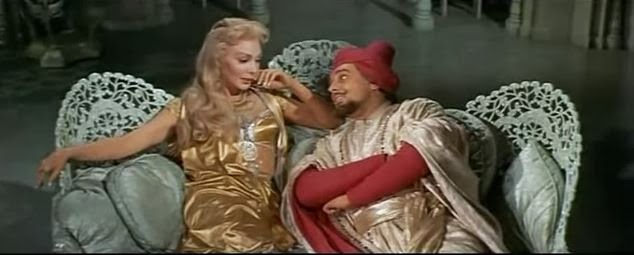
Monty Woolley, as the Caliph’s
servant and advisor, rounds out the cast.
I think my favorite moment is when he tells a whirling dervish, “Oh,
STOP IT!” This was Mr. Woolley’s last
film. He wears his turban, and of course
his beard, well.

I love how the whirling dervish
behind Howard Keel, while Keel is singing “Fate,” slows his spinning to
correspond with the rhythm of the music.
I understand Barrie Chase is
somewhere in the crowd as a dancer, but you’ll have to point her out to me,
because I don’t see her.
The story, originally based on a
play by Edward Knoblock from 1911, had gone through a few other film
incarnations, including the most recent one in 1944 with Ronald Colman, JoyPage, and Marlene Dietrich. We’ll have
to talk about that one sometime. The
story transports well to the world of musical theatre, and on Broadway won a
slew of Tonys, including for lead Alfred Drake.
Producer Arthur Freed tapped
Vincente Minnelli to direct, dangling in front of him the carrot of allowing
him to make the project that had long caught his eye, the life of artist
Vincent van Gogh—and what became Lust forLife pulled Mr. Minnelli’s interest away, if there had been any to begin
with, for Kismet.
According to biographer Emanuel
Levy, Minnelli worked on the Kismet set
design but left the staging of musical numbers to what was done on
Broadway. “Bored, restless, displeased
with the cast, and already preoccupied with Lustfor Life, Minnelli paid more attention to the décor than to the performers,
most of whom he disliked.” He apparently directed most of his disdain toward Vic Damone, on whom he came down hard and humiliated through most of the shooting, episodes which Mr. Damone describes in his memoir, Singing Was the Easy Part. Mike Mazurki, who plays the Wazir's underling, offered to punch Mr. Minnelli for him more than once.
Usually meticulous about camera
composition, this time around he printed first or second takes in a rush to get
through the job, and “the timetable was too tight to afford rehearsals with the
actors, who were soon exhausted by the pace.”
The movie I think has been lost
in the Technicolor fifties among an embarras de richesses of other big musicals, to the lore of Mr. Minnelli’s disinterest, and the
tepid audience response when it was released.
Most classic film fans, however, know that many movies are eventually
redeemed by time and taken to the hearts of the faithful upon reassessment. Reassessing this one, here’s a few scenes to
consider:

The “Strangers in Paradise”
number. Vic Damone has followed Ann to
the walled garden of a small house. She
is trespassing, but he thinks she is the well-do young woman of the house and
he falls in love with her. He doesn’t
tell her he’s the Caliph; he lets her think he is a gardener.

He is dressed in colors making
him a part of the garden—sand and bright green, and she is in yellow, like the
flowers dotting the foreground in this scene.
He is the plant; she the flower. They are both organic to the place, they belong here.

Note the staging, how they stand
in tableau in the arches, how they part, she slightly above him on steps as his
adored one on a pedestal, with a peacock between them.

Next, as the song, which is their
courtship, progresses, they stand together with another peacock unfurling his
magnificent white fan of tail feathers.

Finally, they come together in a
section of the garden with red flowers, the color of romance, when their
passion culminates in a kiss and a promise.
Interestingly, they step back away from us to kiss. I’m not sure if it was to get their full
forms in view—as mentioned in other posts, CinemaScope did not work really well
with close-ups, so it may have been to pull them apart from each other and
us. Minnelli makes CinemaScope work
really well for this picture with gracefully framed shots.


Ann promises to meet Vic here at
moonrise. It’s a lovely scene, and my
only fault with it is dissolving too quickly when we really want to linger on
her watching him leave. I think it's one of the most graceful and elegant scenes ever filmed in CinemaScope.
When the movie starts, the
setting is just the opposite of this elegant world of romance. Ann and Howard Keel awaken in a stable with no
food and one piece of a blanket for her.
Their morning prayer is less reverent than it is desperate, and we hear
Mr. Keel’s voice wearily asking that his daughter may eat today and wear shoes.

Ann is hungry, but sprightly and full of hope,
energy and gaiety. Her voice is high and
girlish; it drops when she is romanced by Mr. Damone to compliment the sudden
sophistication that the pretty new yellow clothes have given her.

Before this scene, she steals an
armload of oranges in the marketplace.
You may recognize the orange seller, played by Jameel Farah, AKA Jamie
Farr, AKA Corporal Klinger on M*A*S*H.
Another scene, spectacular by any
standards, is the “Night of My Nights” procession where Vic Damone, now not
disguising that he is the Caliph, rides with his household staff back to the
garden at nightfall where he hopes to reunite with Ann Blyth, reveal who he is,
and take her for his bride. The
reflection of the procession in the water is stunning.

If this is Vincente Minnelli on a
bad day, it’s pretty fabulous.
Through twists and turns in the
plot, which I won’t go into detail, Howard Keel convinces the nasty Sebastian
Cabot that he has magic powers, which he will work to Mr. Cabot’s advantage if
Cabot bestows riches and a royal title on him (while Keel romances his wife, Dolores
Gray, behind his back). But Keel’s
kismet changes from moment to moment, and he must go into hiding, dragging Ann
from the garden where she is waiting for Vic Damone, making her miss her
appointment with destiny.

Another terrific scene where,
high on the walls of the Wazir’s palace, Ann, broken-hearted, sings “This is My
Beloved” in an unconscious duet with Vic Damone, who sings from his palace,
also brooding on the crescent moon sailing in the velvet sky, of his love for
her.


A little suspense is added during
Keel’s number “The Olive Tree”, as he tries to convince Ann that taking chances
is what makes life worth living and that only a fool settles for just what’s in
front of him—we see the royal procession, or the tail end of it, moving outside
the stable.
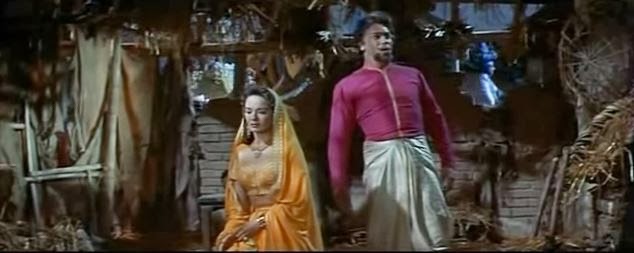
You want to say, “Turn
around! It’s Vic Damone! He wants to marry you and you’re listening to
Howard Keel singing about fools sitting beneath an olive tree! Turn around!”
Too late. They’re gone, and Ann
thinks she will never see her love, the gardener, again.

Of course, she will, but not
before an attempted murder, her father being threatened with execution, and her
forced marriage to Sebastian Cabot.
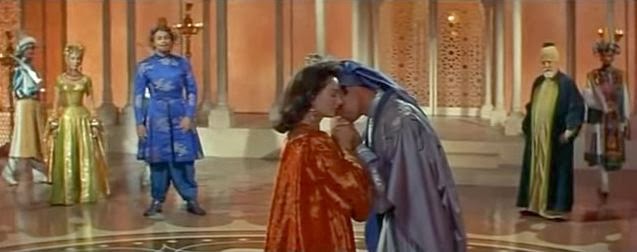
It was a quite a 24 hours.
The movie is visually satisfying
as a long drink in the desert, with judicious use of color that evokes an oil
painting. The base color is sand and
ivory, and here and there, dotted with brilliant colors, but never
overpowering. The movie, with its fable
storyline is purely a pop-up book, but visually is never garish. Here a man’s turquoise-colored turban, a red
fez, a woman’s green scarf, another woman draped in pink.

When Howard Keel sings
philosophically about fate, we see a man shoot past from the bottom of the
screen with a gold band around his turban that catches our eye and we follow it to the top of the frame. The oranges in the market place, the black
leather armor of Sebastian Cabot’s guards.

The golden costume of Dolores Gray
and her white and tan Afghan dogs who behave very well and appear to enjoy
lounging with her.

The red Asian acrobat costumes of
the three prospective brides from Abbaboo, who spring like jack-in-a-box
figures from a kind of enclosure and decide they do not like Bagdad, until two
shirtless men in lime green pants dance to a little Persian jazz, and they
join in a fury of Mesopotamian bebop. A couple moves look straight out of Guys and Dolls. It’s all about color, and if there is any
message, it’s that our eyes are captives to the beauty around us. Director Minnelli distracts and entertains us the same way we distract a baby with a colorful rattle. He may have wanted to film a movie about Vincent Van Gogh, but Kismet is where we really see, and are made to feel, an appreciation for the subtle lift to the senses and to the heart by judicious use of color.

Which brings us to Ann’s most
famous number, “Baubles, Bangles, and Beads,” a slow waltz-tune during which
she changes from a ragged street urchin to desirable woman. A bolt of yellow cloth is chucked across the
screen and she catches it, like grabbing the brass ring.

A bevy of marketplace salesladies
hoist the cloth and dress Ann behind it in a flowing costume of the same
color.


Her hair, free from the dirty
scarf she had worn, suddenly looks as if she’s been to the hairdresser.

Could she ever imagine, lip-synching
that lovely tune to the playback of her lovely voice on the faux Persian
soundstage, that she’d still be singing it in concert decades later?
With filming over, Ann awaited
the birth of her child at the end of the year and filled up the time with vocal
training. Working with singing teachers
had long been part of her regimen away from the camera. She even confessed of her hope one day of
singing Puccini. She would eventually
perform in The King and I and The Sound of Music and all the really big
musicals, but in a more challenging venue than a Hollywood set. She performed them live on stage. Down the road, we’ll discuss her long career
in musical theatre.

Kismet, despite the tepid original
reception, despite Vincente Minnelli’s disdain is a feast for the eyes, embroidered with rich and lovely music, and his cast was better than he knew.
Have a look here at Laura's Miscellaneous Musings for Laura’s exciting experience watching Kismet at the TCM
Festival with Ann Blyth in person to introduce the film.
And have a look here for a
terrific post from Cameron Howard at TheBlonde at the Film blog on Kismet
and some fabulous screen captures.
Come back next Thursday when we
drop back ten years earlier, to 1945, and Ann’s fledging career shoots into
orbit with…wait for it...Mildred Pierce.


******************
Damone, Vic. Singing Was the Easy Part (NY: St. Martin's Press, 2009) pp. 154-157.
The Deseret News, June 30, 1954, syndicated article by Sheilah
Graham, p A7.
Levy, Emanuel. Vincente
Minnelli – Hollywood’s Dark Dreamer (NY: St. Martin’s Press, 2009), p. 267.
The Southeast Missourian, August 8, 1955, syndicated article by
Erskine Johnson, p. 4.
UPDATE: This series on Ann Blyth is now a book - ANN BLYTH: ACTRESS. SINGER. STAR. -
*********************
The audio book for Ann Blyth: Actress. Singer. Star. is now for sale on Audible.com, and on Amazon and iTunes.
The audio book for Ann Blyth: Actress. Singer. Star. is now for sale on Audible.com, and on Amazon and iTunes.

Also in paperback and eBook from Amazon, CreateSpace, and my Etsy shop: LynchTwinsPublishing.

"Lynch’s book is organized and well-written – and has plenty of amusing observations – but when it comes to describing Blyth’s movies, Lynch’s writing sparkles." - Ruth Kerr, Silver Screenings
"Jacqueline T. Lynch creates a poignant and thoroughly-researched mosaic of memories of a fine, upstanding human being who also happens to be a legendary entertainer." - Deborah Thomas, Java's Journey
"One of the great strengths of Ann Blyth: Actress. Singer. Star. is that Lynch not only gives an excellent overview of Blyth's career -- she offers detailed analyses of each of Blyth's roles -- but she puts them in the context of the larger issues of the day."- Amanda Garrett, Old Hollywood Films
"Jacqueline's book will hopefully cause many more people to take a look at this multitalented woman whose career encompassed just about every possible aspect of 20th Century entertainment." - Laura Grieve, Laura's Miscellaneous Musings''
"Jacqueline T. Lynch’s Ann Blyth: Actress. Singer. Star. is an extremely well researched undertaking that is a must for all Blyth fans." - Annette Bochenek, Hometowns to Hollywood

Ann Blyth: Actress. Singer. Star.
by Jacqueline T. Lynch
The first book on the career of actress Ann Blyth. Multitalented and remarkably versatile, Blyth began on radio as a child, appeared on Broadway at the age of twelve in Lillian Hellman's Watch on the Rhine, and enjoyed a long and diverse career in films, theatre, television, and concerts. A sensitive dramatic actress, the youngest at the time to be nominated for her role in Mildred Pierce (1945), she also displayed a gift for comedy, and was especially endeared to fans for her expressive and exquisite lyric soprano, which was showcased in many film and stage musicals. Still a popular guest at film festivals, lovely Ms. Blyth remains a treasure of the Hollywood's golden age.
The eBook and paperback are available from Amazon and CreateSpace, which is the printer. You can also order it from my Etsy shop. It is also available at the Broadside Bookshop, 247 Main Street, Northampton, Massachusetts.
If you wish a signed copy, then email me at JacquelineTLynch@gmail.com and I'll get back to you with the details.


