IMPRISON TRAITOR, PEDOPHILE, AND CONVICTED FELON TRUMP.
Showing posts with label Another Part of the Forest. Show all posts

Thursday, April 3, 2014

Once More, My Darling - 1949


Once More, My Darling (1949) is one of the funniest comedies of the era, and one of the most charming ever made.  I’m not sure why it’s not more well known because it deserves to be lumped with the greats, especially in the madcap heiress genre.  Perhaps because it is so deliciously offbeat, it requires, just as Robert Montgomery discovers, you have to accept certain things at face value.  Its humor is more gentle and subtle than broad, a kind of hybrid between the screwball comedies of the 1930s and a more wry, introspective humor.
The title comes from the speech star (and director) Robert Montgomery delivers on set as a struggling movie actor. 
It’s a funny scene, where he has trouble proclaiming his love to thin air, so the director gets him a body to talk to—a bored and uncomfortable movie grip played by Jack Overman.  Mr. Montgomery looks equally uncomfortable with this situation, but he plods ahead proclaiming his love to Mr. Overman, who is deeply affected.


Montgomery is actually a lawyer, from a noted family of lawyers, but is bored with the work and, now that the war is over (where he served in the Army in Europe as an investigations officer in the military police), he wants to pursue a fanciful dream of acting.  He is smart, savvy, a bit of a ladies’ man who doesn’t want to be tied down to anything—not a wife, not his family’s law practice, and not the Army.  Unfortunately for him, he’s still considered Reserve status, and is called back to uniform to help in the investigation of a jewel theft that happened late in the war.
When he is called into the colonel’s office, he firmly responds, “I will not go in without my mother.”
He immediately attracts the attention of everyone in the office.  His mother, standing with dignity beside him, is played by theatre great Jane Cowl.  She is an even better lawyer than Montgomery is, and he wants her there as his attorney to get him out of the army.  She doesn’t do it though, because she really wants him to give up this silly acting hobby, get married, and join the law firm.
The case to which Mr. Montgomery is assigned involves Ann Blyth, who plays the daughter of a wealthy American industrialist who spends his time between the US and South America.  The jewel thief, like a lot of shady characters in the post-war years, left Europe for South America, met Ann and attempted to woo her with the stolen jewels.  She is innocent about the heist, but she has publically worn the jewels, notably in a magazine advertisement for perfume she did as a lark.  The government wants Robert Montgomery to woo Miss Blyth himself to flush the jealous bad guy out of hiding so they can nab him.
It’s a simple plot that is carried along with effervescent silliness and beguiling charm.  Robert Montgomery smoothly straddles the savvy and in-control aspects of his character—and helplessly rides the crest of the completely goofy and out-of-control situations in which he finds himself.  He is not entirely a calculating straight man, like, say, Gregory Peck in RomanHoliday (1953), but not entirely a vulnerable and befuddled guy like Cary Grant in Bringing Up Baby (1938) who sometimes seems like a sap Katharine Hepburn culled from the herd for amusement.  Montgomery is more mature and adapts to the moment like the kind of good improvisational actor his character yearns to be.
Here Mr. Montgomery plays out the split personality of his character—a capable man able to think on his feet, but also a “romantic dreamer” as Ann Blyth calls him, who prefers dressing in costumes and acting, to a dull law practice.
Ann Blyth, in the role of the heiress he pursues, also has a duality about her character.  She is sure of herself, bursting with a courageous curiosity about the world, and yet utterly naïve.  I love how she plays this socially dysfunctional character, how she speaks and how she moves.  She leans into people, someone who has no concept of “personal space,” and has a slightly nearsighted squint as she navigates conversations, studying the faces of people to whom she speaks like someone who cannot read expressions 
Unlike Hepburn’s rapid-fire take-charge prattle in Bringing Up Baby, Ann enunciates her words carefully in a manner which illustrates perfectly the kind of young woman this is: someone who, having spent many years bouncing between North and South America probably learned English and Spanish together so that neither is her first language or her second language.  Her speech is formal, sounding as if she’s gleaned much of it from 19th century novels, sprinkled with bits of odd-sounding modern slang she’s probably picked up in off moments from the radio.  She’s likely spent the bulk of her lonely life in the charge of tutors.
She is socially awkward, but lacking shyness, charges into social situations like an excited child discovering new friends at kindergarten, and is completely oblivious to what an oddball she seems to others.  This is consistently hysterical, but also I think rather poignant.  She has no siblings, no friends, and has been sheltered in the care of a dismissive father.
He is played by Taylor Holmes, a veteran movie character actor since the silents of the ‘teens, when he wasn’t on Broadway.  Somewhat of an eccentric himself, her father has lately taken to dressing like his hero, Winston Churchill, and has taken up painting to emulate him.  When Robert Montgomery approaches Mr. Holmes for permission to get to know Ann, and accidently knocks over his easel, Holmes launches into a furious tirade in Spanish.  Ann and her father speak Spanish back and forth, she trying to appease him, flinching at his rage.  When Mr. Montgomery requests a translation, Ann replies, “My father wants to beat you up.”
Catch the reference to the pollsters’ recent infamous mistake on the Truman-Dewey election.
Their chauffer, played by my favorite gravely-voiced guy, Charles McGraw, is an ex-boxer, also very protective of Ann, whom he calls by her nickname: “Killer.”  She is an excellent tennis player, and proudly wears a short-sleeved sweatshirt with the name Killer on the front some vanquished opponents gave her because she has a killer forehand.
In her tennis duds is where she first meets Robert Montgomery, and with her hair tucked under her cap, sunglasses, and Killer across her chest, and he at first doesn’t realize this is his quarry.   She doesn’t look at all like the glamorous debutante photo in the perfume advertisement he was given back in the Colonel’s office, in which she wore an evening gown, with a jeweled pendant—one of the stolen jewels—glinting on her cleavage, and on which Montgomery blissfully concentrates when he is shown the ad. 
She was given gallons of the perfume for doing the ad, which she uses liberally ("I practically swim in the stuff") and there is a running gag about the strong scent.
So Montgomery does not recognize her when he first meets her in this tennis getup, but she is drawn to him immediately.  When she remarks, “I’m sorry there isn’t a puddle so I could take something off and spread it for you to walk on,” we might first think she is being sarcastic, as he does.  Very soon, however, it becomes apparent that this is the love-talk of somebody who doesn’t know how strange she sounds.
Some favorite moments in the film:  When Robert Montgomery, unwillingly, brings Ann home to meet his mother on the night his mother is hosting a party at home for some influential friends. 
Ann is clearly the oddball in this scene, and sweetly, and painfully, doesn’t know it.  She eagerly pounces on Jane Cowl, expressing her love for Mother Cowl’s boy Robert.  She announces that she intends to do "the right thing" by Robert and marry him, pleading that Jane be a mother to her, too, since she never had a mother.  Jane Cowl looks at her like she's got two heads.

I love when Ann, kneeling on the ottoman before Jane Cowl, sits back on her heels a moment and considers the company in the room, momentarily breathless, with a slight, self-satisfied wiggle, like kids do when they’re pleased.
The well-heeled society ladies and gents are astounded and don’t know what to make of her, but are clearly entertained, and all react comically to her strong perfume.  I love when the wallflower daughter of one them, a brainiac, played by Dee J. Thompson, Mother Cowl has been trying to set Robert up with, stands upon being introduced to Ann, and she towers over her, booming a basso profundo “How do you?”
Ann, the daughter of a wealthy and influential industrialist, is socially equal to everybody in the room, and probably wealthier than all of them put together, but her ignorance on how to fit in puts her at a disadvantage.
The only one she connects with is Mamie, the maid, wonderfully played by Lillian Randolph.  Miss Randolph has a stronger role in this film than most domestics, and not stereotyped.  She has a personality of her own, and is clearly amused and delighted with Ann.  She seems to be the only one who is not repelled by her perfume. 
It’s another telling aspect of Ann’s character that, rather than dismiss a servant without a second look as would most young ladies of her class, she befriends Mamie instantly upon meeting her, telling her a long, involved story about how she came to wear pajamas this evening in order to sneak out of the house.  Ann is a girl whose closest friend is her father’s chauffeur and doesn’t know the difference between the status of the maid and the lady of the house.
I love Montgomery’s discomfort through the party scene and his rising sense of panic: “I may start laughing and crying at the same time.”  As much as I admire Robert Montgomery’s dramatic roles, especially in Night Must Fall (1937) which we discussed here, he really was terrific at comedy, especially in a situation like this where he is a kind of victim.
Another marvelous aspect to the party scene is Ann Blyth’s skillful command of it, how she is the engine that drives the scene, and how strong she is against the veteran actors. 
Another favorite moment is her proposal of marriage to Montgomery in the restaurant.  At this point, we see clearly that she is wooing him, not subtly with coy, inviting feminine wiles, but boldly, probably much in the same manner she has read of the speech and actions of ardent lovers in books, of heroes wooing maidens, of the way the few men who have had access to her, like the jewel thief, have attempted to woo her, grandly and with flourish.  Her lovemaking is necessarily bluntly masculine because she hasn’t the sophistication to lure him any other way.
In this manner does she woo Robert Montgomery, regretting that she cannot give him a scene of orange blossoms like he deserves.  It’s spectacularly silly, and yet somehow touching that she apologizes that the force of her passion and her impatience to marry immediately that denies him, “a big church wedding with your mother and all your friends there.”
He stumbles for an appropriate response, stalling, “Well, yes, it is the most important day in a man’s life.  He gets to wear a cutaway and striped trousers, and then there are the presents…”
Montgomery’s reaction is in keeping with both his mission—to carry on a public romance with her and flush out the jewel thief—and his nature, to be a good actor.  So he goes with the flow on what seems to be an incredible inprov scene dropped in his lap and plays “blushing bride” to her ardent groom behavior.  "You've won me, Killer."
This culminates on a long drive to a wedding chapel in Vegas.  He drives slowly, trying to drag out the miles, hoping everybody from the jewel thief, to the Army, to his mother, to her father will catch up with them before he has to really marry this fruitcake.  She senses his growing anxiety.  Like any thoughtful and concerned groom, she gently asks him if he is nervous about the wedding night.
He responds, “Well, a little maybe.  No more than the average man, I guess.”
She delicately tries to reassure him, as if he were a virgin in a 19th century English novel about to faint in the clutches of a highwayman, “There’s nothing to be afraid of, dear.  I’ll be awfully gentle and tender.”
He shoots her an incredulous look, this devil-may-care bachelor having lost all control of the situation.
We are brought to a kind of Marx Brothers ending in a cheap motel bungalow, and then the final scene moves us to a posh hotel and gambling casino where, curtain call style, we encounter all of the characters one more time as Robert Montgomery searches out Ann Blyth to apologize. 
She is angry and hurt that their “romance” was nothing more than a military mission, but he succeeds in truly winning her at last with his old standby, his “Once more, my darling” movie speech.  Just like the grip at the beginning of the film, she is deeply moved, and he is rewarded by resounding applause by the cast.  It’s an off-beat ending, a romantic comedy that is more comedy than romance, but we have the feeling that these two, so deep in their own fantasies, are probably made for each other.
Another aspect to this film I love is the score by Elizabeth Firestone, a breezy, melodic refrain that I’m surprised was never developed into a popular song.  According to the IMDb site, this film is the first to be scored entirely by a woman.  Daughter of the Firestone tire magnate, Elizabeth Firestone, I believe, worked on the scores of only a couple other movies.
Jane Cowl spent the bulk of her impressive career in heavily dramatic roles on stage.  She died only the year after this movie was made, and came to Hollywood with trepidation.  It was her first movie role in 32 years since she took a brief stab at the silents.  In a New York Times article of May 1949, Miss Cowl confessed that working on this movie was “a terrifying experience.”  Arriving at 5:00 a.m. for makeup to arrive on set at 7:15, “she was as panicky and bewildered as a neophyte."
“'In those opening shots…I found myself almost helplessly clinging to Mr. Montgomery; to such an extent, in fact, that I actually upstaged him.  Luckily he was most kind and understanding.  Those being his scenes, he would gently take me by the wrist and put me where I belonged.  Finally, I told him, ‘If you catch me doing that again, just slap me down.’
“On the second day, still unable to adjust herself to such unfamiliar instructions as: Toe that mark; don’t look too much to the left; don’t look too much to the right—but be perfectly natural, Miss Cowl gave what she described as a ‘wild bleat’ and desperately announced she was taking the first train to New York.  But the next morning, however, she had recovered her accustomed poise…”
After One More, My Darling, Ann would move on to another comedy, Free for All, which we’ll discuss down the road.  That is a weaker film, and surprisingly, has a much weaker role for Ann as a straight-man to Bob Cummings, considering what a fine flare for comedy she exhibits in Once More, My Darling.  There seemed to be an inconsistency in the quality of scripts she was getting from Universal.  She was twenty years old when did this film, already her film career had covered a wide range of roles and genres, even if it was hit-or-miss, and she would continue to play roles roughly around her actual age, and, as far as the script allowed, she was able to display her splendid versatility.  Regina in Another Part of the Forest (1948), which we covered here, is about the same age as Killer Connell, but they could not be more different than night and day. 
I do not believe Once More, My Darling is currently available in DVD, but I hope someone will correct me.  You can find it on YouTube, at least for now.  Two years later, in January 1951, she reprised the role on radio in the Lux Radio Theater, playing opposite Van Heflin. I like him in the role, and he probably would have been great in the movie, but the radio version is not as silly a romp as the movie, partly because it is necessarily abbreviated, and partly because so much of the movie relies on physical comedy.  You can have a listen here at the Internet Archive website.  Just scroll down to the episode.
Come back next Thursday when we jump to 1963, when Ann appeared as a guest in the new TV drama series about New York City reporters, Saints and Sinners, in an episode with the teasingly tongue-in-cheek title, “The Year Joan Crawford Won the Oscar.” 

****************
The New York Times, article by J. D. Spiro, May 15, 1949, p. X5.
**************

UPDATE:  This series on Ann Blyth is now a book - ANN BLYTH: ACTRESS. SINGER. STAR. -

*********************
The audio book for Ann Blyth: Actress. Singer. Star. is now for sale on Audible.com, and on Amazon and iTunes.

Also in paperback and eBook from Amazon, CreateSpace, and my Etsy shop: LynchTwinsPublishing.


 "Lynch’s book is organized and well-written – and has plenty of amusing observations – but when it comes to describing Blyth’s movies, Lynch’s writing sparkles." - Ruth Kerr, Silver Screenings

"Jacqueline T. Lynch creates a poignant and thoroughly-researched mosaic of memories of a fine, upstanding human being who also happens to be a legendary entertainer." - Deborah Thomas, Java's Journey

"One of the great strengths of Ann Blyth: Actress. Singer. Star. is that Lynch not only gives an excellent overview of Blyth's career -- she offers detailed analyses of each of Blyth's roles -- but she puts them in the context of the larger issues of the day."- Amanda Garrett, Old Hollywood Films

"Jacqueline's book will hopefully cause many more people to take a look at this multitalented woman whose career encompassed just about every possible aspect of 20th Century entertainment." - Laura Grieve, Laura's Miscellaneous Musings''

"Jacqueline T. Lynch’s Ann Blyth: Actress. Singer. Star. is an extremely well researched undertaking that is a must for all Blyth fans." - Annette Bochenek, Hometowns to Hollywood


Ann Blyth: Actress. Singer. Star. 
by Jacqueline T. Lynch

The first book on the career of actress Ann Blyth. Multitalented and remarkably versatile, Blyth began on radio as a child, appeared on Broadway at the age of twelve in Lillian Hellman's Watch on the Rhine, and enjoyed a long and diverse career in films, theatre, television, and concerts. A sensitive dramatic actress, the youngest at the time to be nominated for her role in Mildred Pierce (1945), she also displayed a gift for comedy, and was especially endeared to fans for her expressive and exquisite lyric soprano, which was showcased in many film and stage musicals. Still a popular guest at film festivals, lovely Ms. Blyth remains a treasure of the Hollywood's golden age.


The eBook and paperback are available from Amazon and CreateSpace, which is the printer.  You can also order it from my Etsy shop. 

If you wish a signed copy, then email me at JacquelineTLynch@gmail.com and I'll get back to you with the details.

Thursday, February 27, 2014

Another Part of the Forest - 1948


Another Part of the Forest (1948) is one of the finest movies made in this era, and Ann Blyth displays her ability to inhabit the role of a lusty, complex conniver so thoroughly that her film reputation as a meek good girl of only a few years later, mentioned in this post, is an almost shocking contradiction. 

The film is currently not available for sale either in VHS or DVD, and this is a shame.  I think it’s time to take a large battering ram to the Universal vault.  Where are all those rampaging village idiots with the flaming torches and pitchforks when you really need them?  Off chasing Frankenstein's monster when they should be here.  UPDATE: This film has been newly released on DVD in 2017!

Long post.  Oh, stop crying and pull yourself together.

All three elements of acting, writing, and direction come together so perfectly, so intensely that the movie stands as a remarkable work of art—truly, and timeless.  The screenplay by Vladimir Pozner is based on the Lillian Hellman stage play.  The story is of the Hubbard family, a prequel to her The Little Foxes, which had been wildly successful both on Broadway and in the 1941 film starring Bette Davis.  Another Part of the Forest takes us to the earlier years of the three inscrutable Hubbard siblings and how they got to be that way. 

The second element is the flawlessly creative and evocative direction by Michael Gordon, which we’ll get into in a little bit.  It is, I think, the best filmed version of a stage play I’ve ever seen, because it takes the intimacy and the dynamics of a live stage setting and yet implements those tricks and nuances of film to make it a kind of hybrid film-play.  Some stage plays are filmed with a static camera and so we are left with what appears to be an authentic image of the play, but it seems stiff on film.  Conversely, some stage plays are adapted to film in such a manner that we forget they ever were on stage; the director applies superfluous action and settings that draws away from the intensity of the literary drama. 

But in Another Part of the Forest, we have a director who understands the subtleties of the finest elements of film and stage, and combines them in a beautifully artistic way. 

The third basic element to the making of any great film, of course, is the acting and here we have an ensemble cast who simply could not be better.  We see on the opening title card the unusual setting of the four main players all listed equally above the title and they deserve it.  They are a well-oiled team.  I wonder how long these scenes, particularly the dining room scene, was rehearsed, because it looks for all like they’ve been playing it on stage for months.

The story is set in 1880.  Fredric March plays Marcus Hubbard, patriarch of this dysfunctional clan.  His real-life wife, Florence Eldridge plays his wife Lavinia.  He is a storekeeper and up-and-coming businessman in a sleepy southern town, and he has been branching out into different investments that have been profitable for him.  He gives loans, he takes over mortgages, growing his tiny economic empire.  He is a shrewd and cunning man, and not at all likable.  He is rude and blunt, and openly displays his disdain for his customers, his family, his community.

He is also something of a pariah in his town because of an incident that happened fifteen years earlier during the Civil War.  He was a merchant even then, and he was accused of profiteering from the war by securing a supply of badly needed salt and then charging high prices for it to a war-torn townspeople who couldn’t pay for it.  Marcus is proud, defiant, and totally uncaring in a kind of Scrooge-like way about the needs of others.  He is focused on his own advancement.

His wife, Lavinia, a soulful, gentle, frightened woman is his whipping boy in the sense that she carries the burden of his guilt because only she feels it.  But there is another secret between them, and another secret in the town of a terrible betrayal that occurred during the war leading to the ambush and massacre of several local boys in the Confederate army, and it isn’t until the end of the movie that we discover the traitor. 

Fredric March is riveting.  The character alone is intriguing. Marcus had pulled himself up by his bootstraps, emerged from a hardscrabble boyhood through very hard work.  When he was still a boy, he took his first hard-earned dollar and bought a card at a lending library.  While he was still a child in the fields and driving a mule team, with what little free time he had he taught himself to read and then he taught himself languages: French, Latin, Greek.  He read the classics and he desired what he saw in those classics: a sense of beauty and grace that was denied him in shabby poverty.  There is much to admire in Marcus.

But like those ancient Greeks and their tales and fables, he bears a fatal flaw, and that is his avarice.  Though he has a deep love of beauty and literature and music, there is a very strong strain of the acquisitor in him, so much so that like all acquisitors, his main joy is not in the appreciation, but in the simply possessing, the controlling.  Fredric March is stunning in this role, and we at turns can despise him, can feel sorry for him, and yet also can admire him for his clear thinking.  There is a certain nobility about him.  If it weren’t for his weaknesses, he could be a great man. 

His three children are the sins he created and also the burdens on his back.  Edmund O’Brien plays Ben, the eldest, a man about thirty years old who is taking after his father, inheriting his father’s intelligence, shrewdness, and acquisitive acumen, and also his hardness of heart.  But he has something his father hasn’t, and that is a true sense of graciousness.  It is a false graciousness in many instances.  He is able to speak to people, to make people like him, to ingratiate himself when he needs to, to close a business deal, where his father is just rude.  Edmond O’Brien does not have his father’s arrogance, but he is double the monster because, like his father, he has no heart or feelings for others.  Any display of affection or kindness is merely a tool he uses to get what he wants.  The wheels are always turning in that sneaky mind.

I think it is one of Edmond O’Brien’s best roles and he commands most of the scenes he’s in.  It makes you wish he had done more leading man parts instead of character roles, but in a role like Ben Hubbard he gets to do both, and he’s quite good. 

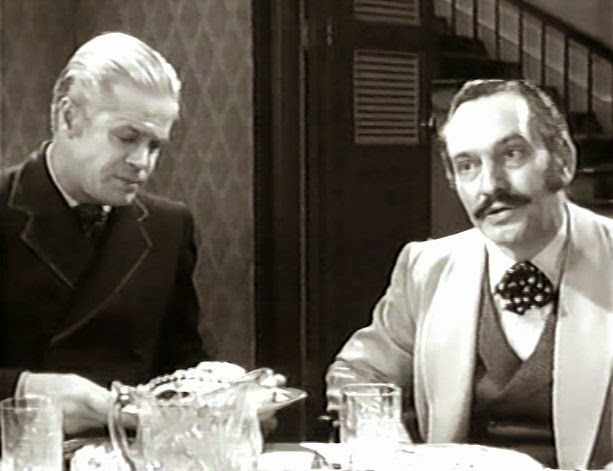
The second son is Oscar, a weak-willed sniveling creep, who has the position in this film as a kind of comic relief.  He’s played by Dan Duryea in whimsical casting because Mr. Duryea earlier played Oscar’s son in the film The Little Foxes.  Oscar’s son Leo in that film was very much like his father is in this film. 

Duryea does not have that sinister sneer he wears in other villain roles.  Here he is helpless in his petty self-absorption, and we can even feel sorry for him, particularly in the luncheon scene when he says something stupid and his father makes a sarcastic reply.  Duryea looks down, wearing an expression of pain, because he knows he put his foot in his mouth again. 

He just can’t please his father, lacking shrewdness, and he is the most despised by his father for his ignorance.  Duryea is also an undisciplined hothead, much more so than his father.  He is easily led, and by the end of the movie, Edmund O’Brien will do the leading. 

The youngest sibling is Regina, played Ann Blyth.  Here she has one of her best roles and one of her most complex and sinister, even to rival Veda Pierce.  In the movie The Little Foxes, Regina is played in middle age by Bette Davis.  Perhaps not so coincidentally, Ann Blyth in this period of her career was being called a young Bette Davis.

Regina is attractive, sexy, and her moods rise and fall--coldness to her mother, a beguiling charm to those who can do most for her.  She is shrewd and intelligent like her elder brother and her father.  She also bears their flaw of avarice and the need for power, but she has another need which neither father nor elder brother seem to share: she juggles a strong sexual longing, where the other two men appeared to be asexual.  They lust only for money.

John Dall plays Capt. John Bagtry, a man in his thirties who left the best part of his life behind him in the Civil War.  He is the cousin of Miss Birdie Bagtry played as a delicate flower by Betsy Blair.  Betsy and her mother still run the old plantation and are struggling financially.  John lives there on charity, not able or willing to contribute to his support.  He just loafs and dreams of the old days when he was a gallant soldier.  When we first see him, he is still in uniform, having attended a Confederate Day service.  He is the pathetic object of Ann Blyth’s lust, and though John Dall is happy to let himself be captured for stolen liaisons, he does not want to marry her.  He does not want to do anything but live in the past, and it takes a while for her to see that. 

Another sticky relationship she juggles is the one with her father.  Fredric March has only one weakness—and that is his daughter.  He loves her more than his wife, more than his despised sons and his relationship with her is somewhat incestuous.  Not literally of course, but emotionally.  He splurges on her and when he arranges to go for a walk with her, it looks for all as if he is courting her.  She refuses an invitation to spend the afternoon with her mother, who suddenly looks like a wallflower losing her beau to a more glamorous rival.


In one scene, several boxes of dresses have arrived that she ordered from Chicago, and she takes them out and shows them off to the family, like a child trying to make her brothers jealous that her father is spending money on her.  She lifts one gown out of its box and goes to sit on the arm of her father’s chair.  She spreads the skirt of the dress over her lap and over his, and he is obviously delighted with her, and she knows this, and she’s using it.  She’s manipulating him, and in certain scenes, seems to coyly dangle herself before him.  They are always “Darlin’” to each other.

But she’s playing with fire, as her older brother Edmond O’Brien teasingly reminds her.  She and Mr. O’Brien walk up the stairs, a promenade-cum-plot exposition, while she gloats about her ability to control her father and O’Brien suggests that one day she will be a forty-year-old woman and will still be taking care of her father because he won’t let her go.  

Edmond O’Brien is in the background, a calm look of command on his face.  In the foreground, we see Ann’s expression has turned from gloating to one of cold fear.  Staying with her father until she is forty is just the thing she does not want, and knows that she must not let her father get too great a control over her.  She spends the better part of the movie walking a tightrope in her unnatural relationship with her father.

She wants the pretty things he buys her, but she wants to be in John Dall’s bed.  Controlling him.

Late in the film, a climactic scene occurs when the Bagtrys come to a train wreck of a party at the Hubbard’s house, along with a floozy girlfriend Mr. Duryea has invited, played by Dona Drake, and we see a smashing of wills, intentions, and the worst of these people come pouring out.

John Dall has a plan to take borrowed money and travel to Brazil where they are having a revolution.  He wants to be a soldier again.  As Betsy Blair explains, the “radicals” are trying to abolish slavery down there and “ruin the country” and her cousin is going to fight for his “ideals” to preserve slavery.  Fredric March is the only courageous one in this polite bunch who dares to snub the "quality" folk and tell the once-and-future Confederate to his face that he's a jerk.  But his reasons for doing so are only partly because of his admiration for the vox populi of his heroes of Ancient Greece.  Mainly, he just enjoys telling people off.

He is also jealous of the man who appears to have turned his daughter's head.  He refuses to lose her to anyone.

Ann Blyth, in a profile view, stands silent during the discussion while a leaden epiphany sneaks up on her, her eyes curiously roaming on John Dall as her father berates him.  We see the truth is settling in that John Dall will never be anything than what he is—a boy in his thirties who can’t give up playing the soldier, a job that was never really more than an ego trip for him and if he were fighting for as ideals, his ideals are pretty shabby.  And yet she wants him for the sexual hold he has over her, which she imagines is reciprocal.

However, she gets another grim surprise that evening when the floozy that Duryea invites also appears to know John Dall intimately.  Clearly, he is not as obsessed by Ann as she is with him.

The intricate plot flip-flops constantly in the tricks the siblings and father play on each other, like kids playing keep-away with somebody’s hat on a schoolyard, only it is bits of information they toss around and keep from each other, and tell lies instead. It is all a lovely, literate, shell game.

There is so much to admire in the staging of the film, in the camera blocking where characters in the background are as much as part of the intensity of the scene, and where mirror shots allow for a larger grouping.    March’s store is filled with goods and items and trinkets and you could spend the whole movie just looking at everything. 

There’s a comic scene where Dan Duryea, afraid that a lynch mob might be after him for something he did, walks through the store and bangs his head on a pair of men’s riding boots hanging from the ceiling.  He looks up and we see instantly it is like an image of a man being hanged, and we see only his boots dangling from a tree.  It’s sinister, but it’s also funny. 

Another fascinating sequence is where Duryea and his gang of KKK friends chase down a Yankee visitor and beat him up.  There’s a scene where a horse rears and we see the horse’s mouth open and his sharp teeth parted in a grimace. 


Immediately we cut to the local saloon where Duryea’s floozy girlfriend is dancing a can-can.  In a flirtatious toss of the head to her audience, her teeth are parted in the same manner as the horse. 

We cut back to the Yankee being dragged to the ground, trampled in the forest of legs around him.

Then cut back to the can-can where the floozy drops to the floor of the stage looking submissively at the audience, tauntingly, seductively in the forest of legs of dancers around her.  The shots of the brutal beating and the dance are erotic mixture of violence and pleasure. 

The camera work flows beautifully from the very beginning of the movie.  There is a Confederate memorial celebration where a speaker refers to an act of betrayal and he points to a far hill to discuss an event of the past.  But the past becomes instantly the present, as the camera swoops to the hill and we see Florence Eldridge hiding with a bouquet of flowers waiting to place it at the memorial. 

We hear a train whistle, and she looks over her shoulder at a distant passing train and the camera swoops to the interior of the train and there is her son, Edmond O’Brien.  It is so flawless and keeps the action moving wonderfully.

The costumes, the hair, the makeup, the men’s full sideburns and muttonchops are historically accurate and not caricature.  There is no cartoon campiness of the Old South, here it is all very real and unblinking. 

We see the mother has a good relationship with their three black servants, especially with Coralee, played by Libby Taylor, who finds small and clever ways of protecting Lavinia from her family’s meanness.  In the play, we are told that Mrs. Hubbard actually goes to the black church because she feels more at home there.  She feels the congregation is more spiritual; besides, she is the wife of Marcus Hubbard and so she is ostracized from the white townspeople, the "quality folk." 

At the end of the film, Edmond O’Brien has wrested his father’s business and fortune from him through blackmail.  Fredric March wants to run away with his daughter, and tells her he will continue to find a way to provide for her.  But Ann Blyth has had enough of this cloying “suitor."  She considers her options, pouring herself a cup of coffee on the patio while Edmond O’Brien announces his plans to invest his father’s money and make still more, that they will all be rich.  Her father, beaten and begging her attention, asks her to pour him a cup of coffee too.  In a priceless image of nasty survival instinct, Ann Blyth, one eyebrow raised, walks away from her father and sits down by her brother.  She gleefully agrees to let Mr. O’Brien plan her marriage to his future business partner, Horace Gibbons.  She gives up her lust for the fleeing John Dall in exchange for a profitable, and loveless, marriage.

She, Edmond O’Brien and Dan Duryea will continue to squabble and play tricks on each other the rest of their lives and become the people we know from The Little Foxes.  Part of our enjoyment of this film is knowing where they ended up.

It’s difficult to pick out favorite scenes because they’re all so very fine, and the dialogue crackles, especially when Fredric March rises to sarcasm.  Then there is the delectable cagy sparring between Edmond O’Brien and Ann Blyth.  Dressed in her new finery, showing it off for O’Brien, she taunts him, “I just wanted to show you what you’ve been paying for.  How do I look?”

He replies, “Bright and shiny, honey, like a new two-bit piece.”  A lovely backhanded compliment, and we see the insult is not lost on her.

And when the Yankee carpetbagger, a guest at the Confederate memorial ceremonies, responds with surprise, “In Boston, we stopped fighting the war fifteen years ago.” 

To which the old Confederate soldier, a town pillar, replies, “You won it.  You can afford to forget.”

And I love Dan Duryea's nervous Woody Woodpecker laugh, that Fredric March even imitates at one point. 

Today we have many sequels and prequels of films.  It’s become kind of a standard practice, but it is not done for the storytelling—it is for the merchandising, and we know that. Yeah, I’m looking at you “Star Wars 23.”  Another Part of the Forest was created by Lillian Hellman for the excitement of discovering more about the characters, knowing with a writer's instinct that there really was more to the story she had left on the table.  This film was one of the first times a prequel was created and some of the critics didn’t seem to know how to take a prequel.

Lillian Hellman, unfortunately, did not really have any part in the making of this film.  At this time, she became blacklisted in Hollywood for her refusal to cooperate with the House Un-American Activities Committee.  Lillian Hellman, who wrote the play Watch on the Rhine, which Ann appeared in on Broadway as a child, discussed here in our intro post, proved to be good luck again for Ann.  She shows again how adept she is at playing complex women, not simply females who were dastardly. 


Louella Parsons announced in December 1946 that Ann, “…that marvelous child actress, who did so well in Mildred Pierce,” had won the role of Regina.  It was a splendid opportunity for Ann Blyth to work as part of a top-notch ensemble cast, and so demonstrate an ability to stand out among them.  Syndicated columnist Dorothy Manners wrote, “In spite of her tender years, she is one whale of an actress…When Fredric and Florence March were here, they said they would like to do a show with Ann on Broadway.  That’s real praise, because the Marches do not usually like anything in Hollywood.”

The columnist Sue Chambers wrote, “Fredric March, who doesn’t usually go overboard for the young and unsophisticated told me, ‘She’s a great actress,’ when he was doing Another Part of the Forest with Ann.”  Apparently March wanted her for his upcoming film Jupiter’s Wife, but according to this columnist, William Powell snagged her for Mr. Peabody and the Mermaid (For which she took time out from Another Part of the Forest to fabricate the mermaid’s tale, which we discussed here), and Chambers commented, “How about all this for a girl who isn’t yet twenty?” 


I’ll go one more and say that, as regards her portrayal of Regina Hubbard, if Gone with the Wind had not made it to the screen until 1949, instead of having been made ten years earlier in 1939, Ann Blyth would have been a top contender for Scarlett.

Ann remarked of Fredric March and Florence Eldridge in a 2006 interview with Eddie Muller: "To watch both of them so impressed upon me. They were so good at what they did. He was terrific. It was just electric to be on the set even if I wasn't in a scene with him. He was wonderful."
Another Part of the Forest was also made as a Lux Radio Theater presentation, with Ann as the only cast member from the film.  Walter Houston played her father Marcus and Vincent Price played her brother Ben.  You can hear it here at the Internet Archive website.  Unfortunately, the quality is a bit muffled, but it will give you an idea of the story.  Later on in November 1948, Ann also re-teamed on radio with Edmond O’Brien in the Suspense story “Muddy Track.”  The quality is quite good and you can listen to it here.  She plays a woman who is not all what she seems to be, and he is a man in trouble and on the run.  At the end, the announcer reminds us that she can now be seen in Mr. Peabody and the Mermaid.

The copy of Another Part of the Forest I managed to obtain was in poor condition, but I was lucky to be able to find it at all.  This film badly needs to be restored and released for sale, not only because it is one of the best films of the era, but because it is an example of stellar American playwriting of the twentieth century, and about distinctly American themes.   I don’t know about the complex legal machinations involving the Universal vault and what keeps so many Universal films, thereby of course, several Ann Blyth films, from not being widely shown again, but I certainly hope that TCM is able to use its influence and free these films from that stupid vault.

I still think a battering ram is a good option.  SEE UPDATE ABOVE -- The film has been released on DVD!  Saints be praised!

Come back next Thursday when we jump ahead to 1957, the year Ann’s last three movies were released, all very different and showing, not surprisingly, her versatility.  However, her film career was winding down as good roles were getting harder to come by for a 29-year old in an industry that was changing.  Her second-to-last film was The Buster Keaton Story, the last time she was paired on film with her first co-star and old friend, Donald O’Connor.


**********************************

The Deseret (Salt Lake City, Utah) News, syndicated article by Dorothy Manners, February 4, 1949, p. F-3.
The Evening Class Blog, July 28, 2007, transcript of Eddie Muller's interview with Ann Blyth July 2006 at Castro Theater, San Francisco.

Milwaukee Journal, syndicated article by Sue Chambers, February 29, 1948.

Milwaukee Sentinel, syndicated article by Louella Parsons, December 27, 1946, p. 10.

*********************************

UPDATE:  This series on Ann Blyth is now a book - ANN BLYTH: ACTRESS. SINGER. STAR. -

*********************
The audio book for Ann Blyth: Actress. Singer. Star. is now for sale on Audible.com, and on Amazon and iTunes.


Also in paperback and eBook from Amazon, also available in eBook at:


and my Etsy shop: LynchTwinsPublishing.


 "Lynch’s book is organized and well-written – and has plenty of amusing observations – but when it comes to describing Blyth’s movies, Lynch’s writing sparkles." - Ruth Kerr, Silver Screenings

"Jacqueline T. Lynch creates a poignant and thoroughly-researched mosaic of memories of a fine, upstanding human being who also happens to be a legendary entertainer." - Deborah Thomas, Java's Journey

"One of the great strengths of Ann Blyth: Actress. Singer. Star. is that Lynch not only gives an excellent overview of Blyth's career -- she offers detailed analyses of each of Blyth's roles -- but she puts them in the context of the larger issues of the day."- Amanda Garrett, Old Hollywood Films

"Jacqueline's book will hopefully cause many more people to take a look at this multitalented woman whose career encompassed just about every possible aspect of 20th Century entertainment." - Laura Grieve, Laura's Miscellaneous Musings''

"Jacqueline T. Lynch’s Ann Blyth: Actress. Singer. Star. is an extremely well researched undertaking that is a must for all Blyth fans." - Annette Bochenek, Hometowns to Hollywood


Ann Blyth: Actress. Singer. Star. 
by Jacqueline T. Lynch

The first book on the career of actress Ann Blyth. Multitalented and remarkably versatile, Blyth began on radio as a child, appeared on Broadway at the age of twelve in Lillian Hellman's Watch on the Rhine, and enjoyed a long and diverse career in films, theatre, television, and concerts. A sensitive dramatic actress, the youngest at the time to be nominated for her role in Mildred Pierce (1945), she also displayed a gift for comedy, and was especially endeared to fans for her expressive and exquisite lyric soprano, which was showcased in many film and stage musicals. Still a popular guest at film festivals, lovely Ms. Blyth remains a treasure of the Hollywood's golden age.


The eBook and paperback are available from Amazon and also available in eBook at:


You can also order it from my Etsy shop.

If you wish a signed copy, then email me at JacquelineTLynch@gmail.com and I'll get back to you with the details.

Related Products