IMPRISON TRAITOR, PEDOPHILE, AND CONVICTED FELON TRUMP.
Showing posts with label Our Miss Brooks. Show all posts

Thursday, April 2, 2026

Happy Easter with Old Time Radio


Easter silliness is celebrated with misadventures on Our Miss Brooks, when Eve Arden and her stellar cast get themselves covered in Easter egg dye.  This radio program was actually aired Easter Sunday, April 9, 1950.


Over in The Great Gildersleeve's neighborhood, the cast prepares for a more spiritual Easter, with plans to attend the Easter Sunrise Service, at which Birdie, played by the wonderful Lillian Randolph, is to have a solo in the choir.  Intentions are good, but, for corn's sake, we know how Gildy, played by Harold Peary, messes up.  This episode was broadcast April 9, 1952.


Have a listen to the shenanigans while you're preparing for the holiday.  

As today is Passover, I had hoped to find an old-time radio tribute to that holiday, but the only show, radio or TV, that seemed to visit Passover as a topic was The Goldbergs, which of course, ran on radio from 1929 through 1946, and then enjoyed a popular run on TV from 1949 to 1956.  I couldn't locate the episode called, "The Passover Seder," but I'll keep trying.  If you know of any other old-time radio or classic TV episodes that feature Passover, I'd love to hear about it.

Since Christ was actually observing a Passover meal at The Lord's Supper, one would think discussion of Passover would have a bigger place in modern Easter observances, with a little less emphasis on bunnies, chocolate or otherwise.

Not that I have anything against chocolate bunnies.  Heaven forfend.  

I suppose there's always The Ten Commandments (1956). I usually watch that when I'm eating my chocolate Easter bunny.

We had a look at the movies based on Our Miss Brooks and The Great Gildersleeve, here.


*******************************


My new non-fiction book, CHILDREN'S WARTIME ADVENTURE NOVELS - The Silent Generation's Vicarious Experience of World War II -- is now available in eBook here at Barnes & Noble, Apple, Kobo, and a wide variety of other online shops.

Or here from my Shopify store if you want to buy direct from me and avoid the big companies.

And it is here in eBook, paperback print, and hardcover, from Amazon.

It is also here in paperback from Ingram.

And here in hardcover from Ingram.

From Cherry Ames, to Meet the Malones, from Dave Dawson to Kitty Carter - Canteen Girl, the Silent Generation spent their childhood immersed in geopolitical events through the prism of their middle grade and young adult books.  From the home front to the battlefield, these books are a window on their world, and influenced their hard-working, conformity-loving generation. 

Buy this or any of my books online here at Bookshop.org.

Thursday, July 14, 2022

A Public Service Announcement - Our Miss Brooks


At the conclusion of the Our Miss Brooks radio show starring Eve Arden, of an episode called "English Test" which was broadcast over CBS radio on August 14, 1949 -- but after the final Colgate toothpowder commercial, that is -- came the following public service announcement:

Here is something for all of us to think over seriously:  Democracy stands for freedom, love, and tolerance, and it's up to each of us citizens to practice it daily, otherwise we subject America and our democracy to severe and destructive criticism from forces wishing to do away with the democratic way of life.

Now more than ever before, we must openly protest against anyone around us who speaks or infers slander against any individual or group because of racial or religious difference.  If not, we are selling out our heritage, our freedom, and our peace.

Many episodes of Our Miss Brooks and other popular programs were concluded with public service announcements of one kind or another: pleas for donations to the Red Cross, the Community Chest, a cancer fund.  This particular announcement is striking.  The dark forces waiting to bring down democracy by our failing to live up to it are not stipulated to be only foreign adversaries.  It seems inferred that these dark forces could exist here in this country.

It's a powerful passage especially for today.  We are balancing on a knife edge of insurrection.  People exist among us who want to take down democracy if we let them by our behavior.

A fascinating way to end a lighthearted screwball comedy radio show.  Today we are more on guard against being preached to, which for some people is far more egregious than losing our democracy.  Were the producers of Our Miss Brooks bold in taking such a stance?  Or did they know that their audience, who had just fought a long and terrible war against fascism, and winning it, would be receptive?

Were such a public service announcement made today at the end of a popular television show, what percentage of the population would complain that it was "political"?

And reject it?

We discussed the radio show, the TV show, and the movie Our Miss Brooks in this previous post.


    ********************

Jacqueline T. Lynch is the author of Ann Blyth: Actress. Singer. Star. and Memories in Our Time - Hollywood Mirrors and Mimics the Twentieth Century. Her newspaper column on classic films, Silver Screen, Golden Memories is syndicated nationally.  Her new book, a collection of posts from this blog - Hollywood Fights Fascism - is available here on Amazon.

Thursday, February 10, 2011

Our Miss Brooks - 1956


Our Miss Brooks (1956) is probably one of the earliest, if not the earliest, movie spinoff of a successful television show. It pales in comparison to the string of TV-to-movie hits (or flops as the case may be) that we’ve been subjected to for a few decades now. This movie is much less flashy and not at all campy. However, it serves a simple purpose: to re-unite us with old friends.

The prosaic adventures of high school English teacher Constance Brooks were first told on radio from 1948 through 1957, an extremely successful nine-year run that coincided with a foray into a television series from 1952 to 1956, and finally, this movie when the TV show ended. Hitting all media, and winning all kind of awards and tributes, Eve Arden finally slipped out of the second banana billing of her film career, and became the star she deserved to be.

The original radio cast included the incomparable Gale Gordon as the blustering Principal Conklin; Richard Crenna’s adenoidal whine voiced nerdy student Walter; Jane Morgan as the scatterbrained landlady Mrs. Davis; Leonard Smith as the dimwitted Stretch Snodgrass, whose malapropos and mangled English gave Connie Brooks a chance to show off her English teaching skills; and Jeff Chandler as the shy, and unassuming biology teacher Philip Boynton. He was later replaced by Robert Rockwell in the role. Gloria McMillan plays Harriet, the principal’s typical teen daughter with the rapid-fire giggle.

The cast was so tight and smooth, that they worked with precision radio screwball comedy for the better part of a decade, and probably the chief interest in this 1956 film, then and now, is for fans of the radio show to see what the characters looked like. The plot doesn’t offer much else. Strangely, the movie “introduces” us to Connie and the gang at the beginning of their all meeting at Madison High School. It makes for an awkward leap, when we already know the characters so well.

A sub plot involves Eve Arden making a special effort to reach a troubled, angry boy in her class, played by Nick Adams. His rich publisher father, played by Don Porter, ignores him, and Miss Arden, while fending off the romantic advances of the father, must bring these two together.

This aspect of the story deepens the tone of the film and shows Miss Brooks as a selfless, compassionate teacher. All well and good, and there should be more such teachers in the world, but what was really special about Connie Brooks wasn’t her deeper qualities, but her superficial ones. The radio Connie was always in financial arrears -- she makes several jokes about a teacher’s salary -- and buys everything on time. She pines for a romantic relationship with Mr. Boynton, and gets herself entangled in embarrassing situations because of it. She is more fallible on radio, and more loveable.

Also missing from the film are Mrs. Davis’ inedible breakfasts, with running gags about MixMasters and Rye Crisp. The movie Mrs. Davis is far more cunning and on the ball than the radio landlady.

The archetypal teens, Walter, Harriet, and Stretch get much less play in the film, and the boys are clearly men by this time, despite their perfect voices that would hide the fact on radio.


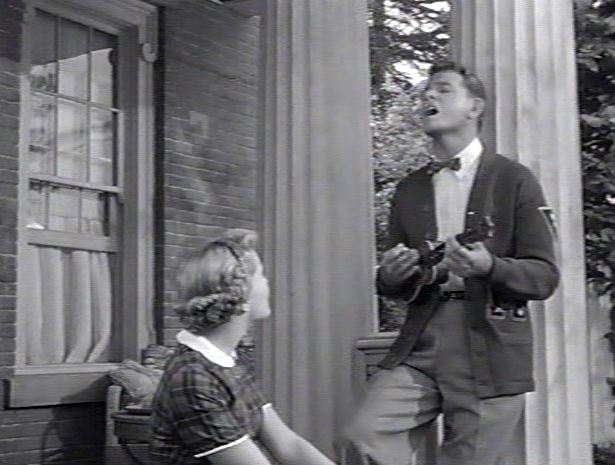
One of the funniest scenes in the movie is when Walter croons the Doris Day hit, “It’s Magic” to his lady-love. I love his unselfconscious flaunting of that tortured voice.

Chiefly missing is the snappy pace of the radio show dialogue and plots. The movie drags its feet here and there. The viewer is bludgeoned with awkward facial reactions and double takes to emphasize a line or joke. They did not have need such visual emphasis on the radio.

Radio also offers a wider screen, if you will. Gale Gordon’s blow-ups or snide retorts are magnified in our imagination when we hear them. When Miss Brooks steps on his glasses, the crunch is funnier for hearing it. The vision in our minds of disastrous surprise parties, indelible Easter egg dye on their faces, Miss Brooks being hoisted down a second-story ladder so that Mr. Boynton can practice being a volunteer fireman, or Miss Brooks, Mr. Boynton, and Mr. Conklin sinking in a rowboat on the radio are hard to top  by this weak, but well-meaning movie.

One radio episode, which involved them driving out of town to attend an “away” school football game is like a Seinfeld episode where “nothing happens” but everything that could possibly happen, happens.

It was a perfect match of witty writing to a suitable medium. We will never see the like again.

The Our Miss Brooks radio episodes are all in public domain now. Listen, or download them here from the Internet Archive website.

The movie is pleasant, but it is really more of a curtain call, or victory lap for the TV show. The radio show would actually run another year, truly surpassing the other two versions.

********************

Jacqueline T. Lynch is the author of Ann Blyth: Actress. Singer. Star. and Memories in Our Time - Hollywood Mirrors and Mimics the Twentieth Century. Her newspaper column on classic films, Silver Screen, Golden Memories is syndicated nationally.  Her new book, a collection of posts from this blog - Hollywood Fights Fascism - is available here on Amazon.

Related Products