IMPRISON TRAITOR, PEDOPHILE, AND CONVICTED FELON TRUMP.
Showing posts with label Jim Backus. Show all posts

Thursday, December 25, 2025

Stars Caricatured in Christmas Television Cartoons


Classic film stars have been caricatured in many animated cartoons, even Christmas cartoons as noted in this previous post of Toyland Premiere (1934).  But the made-for-television holiday cartoons of Rankin/Bass utilized caricatures of stars of Hollywood’s heyday not for satire or even humor, but to lend cachet to their well-scrubbed retellings of pop Christmas folklore.


While not all classic film stars who voiced animated characters had their likenesses caricatured in the cartoon – Mickey Rooney, for instance, in the several times he voiced Santa Claus (The Year Without a Santa Claus – 1974, Santa Claus is Comin’ to Town – 1970, and Rudolph and Frosty’s Christmas in July – 1979) Santa never looked like Mickey Rooney.  I suppose Santa Claus is too well-known (or perhaps, trademarked?) to look like Mickey Rooney.


But Fred Astaire, playing a generic mailman character in Santa Claus is Comin’ to Town is okay to look like a caricature of Fred Astaire, likewise Red Buttons as the ice cream man in Rudolph and Frosty’s Christmas in July – which also gave us a stupendously (or perhaps stupefying is the word) over-the-top Ethel Merman who runs a carnival show.  It’s a lumbering feature cartoon with no discernable point, but Hal Peary has his last role as a whale, with a Great Gildersleeve giggle.  I find that endearing.

These cartoons were all animated with the mesmerizing stop-motion photography of jerky movements and stiff portrayals, literally.

There were two Christmas cartoons of my childhood which were especially profound for me, first Mr. Magoo’s Christmas Carol (1962), which I’ve mentioned before in this previous post. Definitely NOT stop-motion photography here. Jim Backus owned the role of Mr. Magoo so thoroughly and was my introduction to Dickens at the tender age of probably three. 


The second cartoon that was really meaningful to me was The Little Drummer Boy (1968).  Like the other Rankin/Bass cartoons mentioned above, this also featured stop-motion photography (and all the cartoons are musicals) and told the story of an orphaned boy during the time of the Nativity who hates people because his parents were killed by bandits, and finds healing with the power of love.  I was fascinated by the scenes of ancient Judea, of narrow streets, endless desert dunes, and the people who came to their ancestral cities to be taxed by the Roman emperor.  Even as a six or seven-year-old, stories about real people interested me more than fairy tales about snowmen or Heat Miser (though I still know the words to that song).


Jose Ferrer (not caricatured) plays a rogue, a carnival showman who enslaves the orphan boy when he discovers the boy can sing and play a drum and charm animals into dancing.  The showman thinks he can make a bundle off the kid.  (Painting a phony smile on the kid's face horrified me as a child.) He even sells the boy’s cherished camel to one of the Wise Men, and the boy is even more furious and heartbroken.  


The boy follows the Star as the Three Kings are doing so that he can catch up to them and get his camel.  But then a Roman centurion charges by on his chariot like an ICE thug and runs over the boy’s other little friend, a lamb.  We suspect if he’d had a Taser, he’d have used it just for the thrill of cruelty.  Authoritarian governments haven’t changed in thousands of years.  This boy has suffered so much in this cartoon, we can barely take any more at this point.

One of the Three Kings tells the boy to appeal to the Baby Jesus for help, and here we have our opening to the song (cue Vienna Boys Choir) “The Little Drummer Boy” and “I have to no gift to bring…shall I play for him?”  Though the stop-motion photography is just as jerky and crude as in the other cartoons, the story here is deeper, and the thoughtful, contemplative telling of it leaves a greater impression.  This cartoon, for me, was also notable for introducing me to Greer Garson.

Miss Garson is an unseen narrator and is credited as “Our Storyteller.”  Her rich, cultured voice is soothing and enchanting, and we are carried through time and space in her opening, “And it came to pass that there went out a decree from Caesar Augustus that all the world should be taxed…”


When the boy’s heart is touched by the pure love of the Infant, and his lamb is healed, Greer tells us, “He realized the hate he carried there was wrong, as all hatred will ever be wrong.”

It would be many years before I discovered Mrs. Miniver or Pride and Prejudice, so The Little Drummer Boy was my introduction to Greer Garson, or at least her beautiful speaking voice.

Perhaps a cartoon Greer in caricature would have lessened the gravitas of the story, but I think I would have liked to have seen Our Storyteller.  A woman in such a serious, venerable role would have been inspiring.

But to depict her in caricature or not?  Hmm.

Wishing a peaceful and happy Christmas to all who celebrate.


 ***********************************

GIFTS FOR THE CLASSIC FILM FAN!!!!!!!


Christmas in Classic Films
 
provides a roster of old movies with scenes to conjure Christmas of days gone by.  Makes a nice gift, if you know an old movie buff, or if you just like to give presents to yourself.  

The paperback is available at Amazon, but also here at Barnes & Noble.

The hardcover, so far, is available only at Amazon.

Here are a few other classic movie books I've written for your gift-giving pleasure:


Ann Blyth: Actress. Singer. Star. - for sale in paperback and hardcover at Amazon,

And in paperback and hardcover here at Ingram,

And in paperback and hardcover here at Barnes & Noble.

And in paperback here at Walmart.


Hollywood Fights Fascism 
-  here in paperback at Amazon.


Movies in Our Time - 
here in paperback at Amazon.

And all of these books are available as well at my page on Bookshop.org, which helps support independent bookstores.


Thursday, December 14, 2017

Mankind Was My Business - A Christmas Carol (1951) and Scrooge (1935)


John Krakowski, Chicopee, Mass., 1911, photo by Lewis Wickes Hine, Library of Congress

A Christmas Carol by Charles Dickens is a novella written in six weeks in 1843 whose power to entertain has lasted over a century and a half.  It has received several film treatments; today we have a look at Scrooge (1935), and A Christmas Carol (1951), but Dickens always invites us to look beyond the tale on the page—or the screen. There is a rich background to our experience with this story, a tale that instructs as much as it entertains.

One year I attended a local community theatre production of A Christmas Carol, which I will always remember for a charming blooper at the very end of the show.  The little boy who played Tiny Tim was lifted onto the shoulders of the man playing his father, Bob Cratchit, and he was to jubilantly shout the last line of the show: “God bless us, everyone!”  He literally stopped the show—by forgetting his line.  The other members of the cast, all dressed in some semblance of Victorian London, as much they could with a limited budget, huddled around with frozen, expectant grins, waiting for him to end the show.  Nothing.  The boy just calmly observed the audience, daydreaming with a pleasant smile from the advantage of his perch.  “Bob Cratchit” grew nervous, and perhaps a little tired, as the boy got heavier with each moment.

Crickets.  Finally, a handful of people in the audience started to shout out, “God bless us…”

And then the rest of the audience, laughing as we did so, finished the sentence, “EVERYONE!”   Then, of course, the little boy remembered he had forgotten to say something, so he quickly blurted it out, “Godblessuseveryone!”  In any other play, the audience probably would have thought that the play ended with silence, and begun to file out after some applause.  This was one of the few plays in existence where every member of the audience KNEW the last line, and we weren’t going anywhere until we heard it.  That we supplied it ourselves made for a lovely, interactive sort of theatre.

I’ve always felt that A Christmas Carol was a very interactive piece of literature.  It does not render us as passive readers or a passive theatre or film audience.  We are intimately involved because we must ponder every nuance of Scrooge’s experiences and wonder at the enormity of the lessons he is learning, and sometimes even wonder if he is actually learning them.  It has been said that author Charles Dickens is the father of the modern Christmas because of this book and its impact, and that may be so in a world where tales of Bethlehem and the Messiah seem diminished in nearly two centuries of an industrialized world where commercialism is the new religion.  I would imagine that there are many homes where the Crèche has been replaced by a ceramic village meant to evoke a largely fictional Victorian Good Old Days where the only thing held sacred is sentimentality.

Despite Tiny Tim’s blessing on us, there is really very little sentimentality in AChristmas Carol, however; it is one of the few modern Christmas tales whose message is redemption—that same powerful point of the First Christmas.  Instead of a biblical setting, we have a claustrophobic brick and mortar jungle during the early years of the Industrial Revolution.

The story has always been a favorite of mine; my twin brother and I read it aloud to each other for years, often making some of the characters sound like Yosemite Sam or Sylvester.  We were cartoon junkies at an early age.  One of my earliest memories is watching Mr. Magoo’s Christmas Carol (1962), with Jim Backus, of course, as Mr. Magoo; the wonderful Paul Frees supplying several voices; Royal Dano as Marley’s Ghost; and in an interesting bit of casting, Jack Cassidy as Bob Cratchit.  As delightful as this musical cartoon version is, the segment where young Ebenezer is singing about his loneliness in the boys’ school, “I’m All Alone in the World,” destroys me.  Perched on a stool in an empty classroom, trying to draw a hand on the chalkboard to pretend to grasp it—all I can think of are the playground outcasts, those with difficulty being accepted, the shy, the physically or mentally challenged, the different, those who are not approached and find it hard to approach others.  How many autistic children mourn their childhoods as being people to avoid, “A hand for a hand was planned in the world, why can’t my fingers reach?  Millions of grains of sand in the world, why such a lonely beach?”  I’ve been watching it for fifty years; it still brings tears.

This is the power of Dickens’ masterful tale, and his exquisite telling of it.  Even in a Mr. Magoo cartoon, it is not sentimental.  But neither is it so cynical that we are given a villain to despise and destroy.  It would be so easy to have Scrooge vanquished and let everyone live happily ever after, but Dickens doesn’t do that.  He shows us a sad boy who became a greedy man, and then allows him to be redeemed.

But the path to redemption is not easy.

Speaking of cartoons, I also recall watching the 1971 animated version (which you can watch on YouTube here) that is the scariest and most bleak telling of the story I have ever seen.  It haunted us as kids.  Ebenezer Scrooge is voiced by Alastair Sim.


Which brings us to the 1951 film, A Christmas Carol. Sim played Scrooge here as well, in a British-produced film that was the standard for a generation.  Movies would not revisit the story again until 1970 and the musical Scrooge.  Sim pastes a continual sneer across his face as an expression of Scrooge’s distaste for others and his sarcasm for his kindly nephew; to the many poverty-stricken renters who owe him money and whom he evicts; to his longsuffering clerk, Bob Cratchit, whom he berates for using more coal to bank the fire in their chilly office.  He even humiliates Bob by suggesting he is a fool for celebrating Christmas on the meager salary he pays him.

At the end of the movie, however, when Scrooge embraces the meaning of Christmas and the idea of charity to others, he erupts into hearty giggles, laughing at himself for trying to suppress them, which, more than other actors who have played the role, lets us see that Scrooge all along has had a sense of irony, a latent sense of humor.  Who but a man with a sense of humor could knock out, “There’s more of gravy than of grave in you,” to Marley’s Ghost.

The movie also presents us a textbook telling of the ills of capitalism, the end game of which we’re witnessing today, which seems to indicate that AChristmas Carol is in some ways as prescient as Jeremy Rifkin’s The End of Work.  When the Ghost of Christmas Past takes Scrooge to Fezziwig’s, the company where he was apprenticed as a young man, he witnesses a venture capitalist of the day trying to get Mr. Fezziwig to invest in a new scheme where machine manufacturing takes the place of humans.  Fezziwig is a bit of a Luddite, perhaps, because he will not change his business to the new model.  “There’s more to life than money,” he replies.

The venture capitalist makes an impression on young Scrooge, and he and his partner Marley will buy out Fezziwig’s.  When one of the young clerks anxiously asks Scrooge if he will be retaining him under the new management, Scrooge replies that yes, he can keep his job—for four shillings instead of the five Fezziwig had been paying him.  And so it goes.  Even today, we know the pattern.  Scrooge learns, “control the cashbox and you control the world.”  How many in the current Republican-held Congress and White House would agree?

Dwight mill gate, Chicopee, Mass., photo by J.T. Lynch

Looking back, I suspect another reason I was always so taken with this story as a child is because it seemed real and true to me, its setting and circumstances was something that was familiar to me and with which I could identify. I grew up in a New England factory town.  Enormous manufacturing bastions of soot-stained red brick were the backdrop of my childhood, and since some of them, as well as some commercial buildings in town, date from the early 1840s when A Christmas Carol was written, you can easily, on a cold, grey, foggy December evening, imagine yourself back in the days of Charles Dickens—the scene was, as they say, Dickensian.  Generations of my family worked in these factories.  We had a few farmers, craftsmen, small business owners as well, but it was the factory workers for whom I felt the most affinity.  They seemed to have endured much, and yet enjoyed a zest for life that belied their limited opportunities.  I’ve done factory work as well, and appreciated having the opportunity to know something firsthand of their experience. 


Sophie, Chicopee, Mass., 1911, photo by Lewis Wickes Hine,
Library of Congress
The sociologist and photographer Lewis Wickes Hine, who documented child labor in the early twentieth century, came to my town and shot this photo, now in the Library of Congress, of a girl named Sophie, who tended the bobbins in a cotton textile mill here, in 1911.  The venture capitalists in Boston made a mint off her.  The dreaded poorhouse was just down the street for those—perhaps like Tiny Tim—who would never have the strength to work 13-hour days at the mill.

Much of those nineteenth century and early twentieth century industries in my town closed during the Great Depression, though some factories closed because the corporations moved their operations to the South, where there were no unions and they could pay their employees much less.  The union to which my father belonged in his 40-year factory job fought—over many, many strikes—to grant him the peace of mind in my parents’ old age they would not have otherwise had:  A modest monthly pension and decent health insurance.  They had little else at the end of their lives, but they had that.  These came from the union’s bulldog efforts; the corporation would never have been so generous otherwise.  That was a lesson from my childhood, and one that I take into my reading of A Christmas Carol.

But even Scrooge knew the importance of an employer’s benevolence, when he comes to the defense of his employer Fezziwig when the Ghost of Christmas Past chides him for his praise of a simple Christmas party at work:


“He has the power to render us happy or unhappy; to make our service light or burdensome; a pleasure or a toil.”

Mr. Dickens came to New England on his first American book tour and was taken to Lowell, Massachusetts—a planned industrial city that was the model for my own town—and marveled at how the English-born Industrial Revolution exploded with a new American vigor.  He also came to my area to give readings from A Christmas Carol.  See my New England Travels blog next Tuesday the 19th for more on Dickens’ trip through New England.

Because Dickens had been sent to a workhouse as a young man to pay off his father’s debt, some of the most poignant and politically charged passages of A Christmas Carol are borne of his firsthand knowledge of getting squashed in the cogs of the Industrial Revolution.

In A Christmas Carol, those pesky “snowflake” social do-gooders come to Scrooge asking for a donation to their fund for the poor:


"At this festive season of the year, Mr. Scrooge, it is more than usually desirable that we should make some slight provision for the poor and destitute, who suffer greatly at the present time. Many thousands are in want of common necessaries; hundreds of thousands are in want of common comforts, sir."

"Are there no prisons?"
"Plenty of prisons..."
"And the union workhouses." demanded Scrooge. "Are they still in operation?"
"Both very busy, sir..."
"Those who are badly off must go there."
"Many can't go there; and many would rather die."
"If they would rather die," said Scrooge, "they had better do it, and decrease the surplus population."


Soon, Marley’s Ghost will chastise him for his soul-destroying greed, and warns him not to fall into the same otherworld of everlasting torment that Marley has earned:


"Business!" cried the Ghost, wringing its hands again. "Mankind was my business. The common welfare was my business; charity, mercy, forbearance, and benevolence were all my business. The dealings of my trade were but a drop of water in the comprehensive ocean of my business!"


In Scrooge (1935), another British-produced film, we have Seymour Hicks in the title role, who had a long history of playing the character.  He’d been Scrooge on stage since the late 1800s, so we have an authentic bit of theatre history in this actor who’d practically originated the role on stage.  This movie also, quite interestingly, is filmed in a simplistic theatrical manner, with some scenes almost like the tableau of nineteenth century theatre, or reminiscent of silent film techniques.  The ghosts who visit him are mere shadows, we have no actors playing them, and Mr. Hicks remains center stage for most of the film—though look for a brief scene with Shakespearean actor and future father of Samantha Stevens on television’s Bewitched, Maurice Evans, in the role of a poor fellow whom Scrooge evicts.


Scrooge is more nervous in this interpretation, more eccentric and less evil than in Alastair Sim’s crusty characterization.


When Cratchit’s poor, struggling family toast Scrooge as “the founder of the feast” we are reminded that the under classes acknowledge that there are masters and there are servants—especially in the then rather rigid caste system of British society.  Particularly touching is the scene where a large banquet is held by some wealthy folk and they toast the Queen, singing “God Save the Queen.”

The camera pans back to the dark, cold, alley where a mob of poor—children and adults—wait for scraps.  They immediately stand to attention and sing the anthem as well, just as reverently and as proudly.  They are not seeking revolution.  Perhaps they cannot even imagine equity.


What these two films omit is the searing message Dickens puts in the scene where the Ghost of Christmas Present confronts Scrooge with his own arrogant assumption that the wealthy are more important than the poor. It is a lesson that the greedy need to learn over and over again.  For some, like a stupid man who would install gold toilets in his gaudy home, the lesson is too difficult to learn.


This scene was played out, however, in the excellent 1984 television version starring George C. Scott.  The Ghost refers not only to the rapacious Scrooge, but those who prop up their own power by dismissing the humanity of others:


"There are some upon this earth of yours," returned the Spirit, "who lay claim to know us, and who do their deeds of passion, pride, ill-will, hatred, envy, bigotry, and selfishness in our name, who are as strange to us and all our kith and kin, as if they had never lived. Remember that, and charge their doings on themselves, not us… Will you decide what men shall live, what men shall die? It may be, that in the sight of Heaven, you are more worthless and less fit to live than millions like this poor man's child."

There is a suggestion of revolution, perhaps, as well, when the ghost shows him two child specters:


"This boy is Ignorance. This girl is Want. Beware them both, and all of their degree, but most of all beware this boy, for on his brow I see that written which is Doom, unless the writing be erased."


That is probably the most important, most profound passage in the book.


Scrooge’s conversion is the crux of the story that really links the Modern Christmas with the Biblical One.  Dickens approached the Christian idea of salvation and loss of salvation through his world of the Industrial Revolution, and deftly merges Scrooge’s redemption—a greedy guy who has a change of heart for the sake of his fellow man, and a guy who recognizes his sins and tries to atone for them for his own sake.  The story becomes appealing for both those who are religious and those who are not.  It reaches us on all levels.  His salvation is based largely on his newfound empathy, for that is what leads to his atonement, perhaps equally if not more than his fear of eternal retribution for his behavior.  The arrogant don’t fear hell—they feel they are omnipotent, and those lacking in empathy cannot imagine the distress of others. 


But Dickens gives us a Scrooge who can change—for most of us, a herculean task. A villain who becomes a hero.  Alastair Sim and Seymour Hicks marvel that they made it to Christmas Day and a new, clean slate is before them.  Because of Scrooge's change of heart, maybe Bob Cratchit and his kids can soldier on through the Industrial Revolution a little easier.


God bless us.  Everyone.

photo by Lewis Wickes Hine, Library of Congress

Thursday, January 5, 2012

Meet Me in Las Vegas - 1956


Meet Me in Las Vegas (1956) is a fun and frothy pastiche uniting the two themes upon which the reputation of that town is built: gambling, and nightclub acts. We get a little of the first, and a lot of the second.

Today we wrap up a two-post trip to Las Vegas. Have a look here at Monday’s post on Las Vegas Story (1952). From that black and white crime story we move on to color, lots and lots of colors.

Dan Dailey is a happy-go-lucky rancher who drives his coral convertible, with the matching horse trailer, to visit the casinos. Where he is not lucky at all. He is well known and well liked for being a good loser, and only a loser. But a swell guy.


His career in big movie musicals of the 1940s and 1950s puts Dan Dailey somewhere in the same universe, though in a lesser orbit, as Fred Astaire and Gene Kelly. I don’t know where his dancing puts him against those gentlemen; I think he’s a swell hoofer, and I particularly like the “Gal with the Yaller Shoes” number in this movie where he performs with Cyd Charisse and the male ensemble to Hermes Pan’s vigorous and playful choreography.  

But what sets Mr. Dailey apart is not his dancing; it’s his screen personality. Astaire and Kelly were both famous for playing confident wise guys who turned out to be nice underneath the wisecracking. Dan Dailey always seemed more sensitive, even troubled, a guy who really wasn’t that confident, but whose tenderness was never hidden.  He is never a card sharp or gamester on the make in this movie. He’s a frequently obtuse stumblebum, something Astaire and Kelly never played.

Cyd Charisse is a ballerina appearing at the casino where Mr. Dailey is losing his money. She’s a fish out of water here, just trying to make some dough herself in a world about which she knows nothing. She has several opportunities to dance in this movie, ballet, a jazzy “Frankie and Johnny” routine (narrated and sung by Sammy Davis, Jr.), and a very funny impromptu venture into burlesque. Having had too much to drink, she invades a parade of lady hoofers dressed in gaudy costumes representing “lucky charms”.


The plot is about as simple as they get. Dan Dailey, who believes in luck even though he doesn’t have any, grabs the hands of passing ladies, in lieu of a rabbit’s foot, while the roulette wheel spins. The only time it works is when he lunges for the hand of a passing Cyd Charisse. He insists she is his lucky charm.

She thinks he’s loony and angrily tries to discourage him, but when she relents to give the experiment a try, they discover that, yes, every time at any game he plays, if he’s holding her hand, he wins.

They start winning all over the place, up and down The Strip. Miss Charisse, at first attracted by the money, is secondly attracted by this new world she’s discovering outside the rehearsal hall. Her life thus far has been very disciplined, with no time for play. Now she sees how the other half lives, and she likes it. I like her line when, seated in a restaurant with him, a couple of huge steaks in front of them, she’s too excited to eat, even though as a dancer on a perpetual diet, she marvels, “I’ve been hungry for ten years.”

She is thirdly attracted by Dan Dailey, and it is to get his attention that she joins the burlesque kick line. His drooling over Cara Williams makes her jealous. Miss Williams belts out “I Refuse to Rock and Roll” (which was just beginning to beat down the drawbridge of popular music and storm the castle).


Sultry Lena Horne also sings, as does Frankie Laine. One of the fun things about the movie is the shameless name dropping. The Four Aces start the movie. We have cameos by Frank Sinatra, Debbie Reynolds, Vic Damone, Peter Lorre, Tony Martin (Cyd Charisse’s husband).


 Paul Henried also has a minor role, and Jim Backus as the hotel manager gets to briefly bluster, and Jerry Colonna rips his otherworldly tenor on "Lucky Charm".

The marquees on the casinos -- many of the same ones we mentioned in Monday’s post on Las Vegas Story, give us a snapshot of the big names of the 1950s: Louis Prima and Keely Smith, Marge and Gower Champion, Danny Thomas, The Mills Brothers, Johnnie Ray, Donald O’Connor.


Dan Dailey finally notices more than just Cyd’s hand, particularly after a brief ballet (which features a game of volleyball in the middle of it), “That was the most beautiful thing I’ve ever seen.”


He takes her home to his ranch to meet Mother, who is played by Agnes Moorehead. It’s always good see her in any movie, though there’s not much for her to do here.  She’s feisty, opinionated, and likes the cut of Cyd’s jib because Cyd is a career woman with no intention of giving up her career.


I found myself distracted by Miss Moorehead’s hair color, a cross between tomato soup and the fires of hell. I guess when you use Technicolor, you have to shoot the works. Might explain the coral-colored convertible, too. Most of the film is painted in a rainbow of soft, lush colors.

The lucky couple’s luck continues at the ranch, where as they stroll around holding hands, the barren chickens lay eggs, and the cow gives birth, and a new oil well gushes forth black gold.

But we know the old axiom “lucky at cards, unlucky at love.” So, too here. When they fall in love, their luck at gambling leaves them. Will they stay together anyway? You can probably figure that out yourself. It’s  refreshing that they compromise to spend six months in her world of dance and six months on the ranch.

Except for a couple of numbers, most of the songs performed in this movie are staged as nightclub acts, so there isn’t that jolting of reality for people who dislike musicals for that reason.


But I’ve never quite understood that. “People don’t burst into song in real life,” the movie musical curmudgeon might complain.

Sure they do. They’re called entertainers.


*********

Monday, August 9, 2010

The Man with the Cloak - 1951


The Man with a Cloak (1951) is a deft melding of equal parts historical drama and film noir. Set in New York City in 1848, we follow the cloak-(literally) and-dagger schemes of a wealthy, aged, and dying rapscallion played with superb aplomb by Louis Calhern, and the sycophantic but secretly devious household staff.

Joe De Santis plays his thuggish-looking butler with the threat of violence beneath a thin veneer of servitude. Margaret Wycherly is the comically frumpy, ineffectual but surprisingly knowing cook and housekeeper. Barbara Stanwyck, yes, Barbara Stanwyck, is Louis Calhern’s hostess and most prized possession. She is a former actress whom Mr. Calhern has collected, now reduced to playing the role of devoted dogsbody to a man she despises. All three are tired of playing the waiting game for their exasperating master to die, and are plotting to hurry him along to his final reward.

Enter Leslie Caron, in her second film after An American in Paris, with her wide waif’s eyes and determination to appeal to Louis Calhern for his financial support. She has just arrived from Paris, where her lover, who is Calhern’s grandson, leads a revolt against the current Orleans monarchy to establish the Second Republic. Grandpa Calhern, however is on the opposite political side, having fought for the Emperor, escaping to the United States when Napoleon was ousted. He has been estranged from his grandson, but his heart is softening as he realizes he has little time to live.

And Calhern, still the rogue, is captivated with Mademoiselle Caron, which drives Miss Stanwyck up a tree.

On the outskirts of this mélange, but soon to be an integral part, is Joseph Cotten, the man with the cloak. Though he gives his name to the affable bartender played by Jim Backus, we nevertheless come to understand early in the film that he is a man of mystery, and that this is likely not his real name.

In this film, Mr. Cotten plays a real historical figure. We get a few clues throughout the movie about his identity, but his name, finally revealed at the very end of the movie when his signature is scrawled on an I.O.U., may still come as a poignant surprise.

The movie’s film noir aspects include a score by David Raksin that at some points sounds almost like it would belong with a 1950 police drama. However, Raksin also wrote the 19th century-flavored tune “Another Yesterday” which Barbara Stanwyck sings. It’s her own voice, low and with limited range, but very smoothly and pleasantly done. Mr. Raksin also wrote the tune “Laura” for the other famous detective drama, so he’s no stranger to mood pieces.  We discussed his work in this previous post on The Next Voice You Hear (1950).

The bulk of the 19th century is carried on the shoulders of costumer Walter Plunkett. The costumes and sets seem both spot-on for the period.

The mood of Dickensian grimness and 20th century noir is woven together as well in the damp nights on cobblestone streets lit by gaslight, the layers of deception, the bungled plot that results in not one dead body but two, and a very crisp and literate script that concludes with a surprisingly wordless and violent fight scene.

Perhaps the signature of film noir is represented in this costume drama in the character played by Joseph Cotten, who is the original anti-hero, the man down on his luck, a slave to drink, who roams with bitter failure on his back, his own worst enemy, and yet who with cunning and cynical savvy, becomes Leslie Caron’s knight in shining armor.

Leslie Caron, however is not the typical damsel in distress. Here she plays a courageous young woman who is Cotten’s intellectual equal and together they solve a few riddles before the game is done. Mademoiselle Caron, in this and in many of her films, seems to exude a unique serenity, a confidence and sureness despite her youth that results in her characters looking completely natural. There is no staginess, despite the precision of her speech and her movement.

Mr. Cotten’s relationship with her is not romantic, nor is it particularly fatherly, but there is a comfortable confidentiality to their scenes together.

Another fine aspect of this film is that it manages to be an ensemble piece. Jim Backus, as the philosopher bartender, who remarks, “Some men leave good will. Other just a will,” is as important to the plot as the brutish butler, and as important as Miss Stanwyck, who with her customary professionalism, seems content to be a team player. She also has the guts to play a woman of a certain age with fading charms, who desperately uses everything left in her arsenal.

To be sure, however, she takes center stage easily when sparks fly in her scenes with Joseph Cotten, when the tension builds and the stakes are higher. They size each other up like they are about to have a knife fight instead of kiss. Stanwyck is as still and cold as a statue, playing the grand lady and every inch a woman of another era. One can see early shades of her Victoria Barkley character from The Big Valley television series here, only evil. And no horse. But, boy howdy (as Heath would say), she can descend a staircase with the best of them.

Cotten remarks of Louis Calhern, “He was a roué in the grand manner. A connoisseur of wine, women, and wit. Now he’s an ancient ruin with one arm paralyzed and one foot in the grave.” Cotten, who sees through just about everybody, makes cutting, sarcastic remarks, but is a foremost gentleman who after each dig mumbles a perfunctory, “Forgive me” in between sips of wine.

One of my favorites is when he brushes by the hateful butler and murmurs, “Try to get the murder out of your face.”

While Joseph Cotten and Leslie Caron are attempting to protect the old man’s life against his murderous household servants, the old man pulls a fast one on everybody, writes a new will, and then attempts to end his life with poison.

In the grand manner of a horror tale, the poison is consumed accidentally by another, while Calhern, silenced by another stroke, must watch helplessly.

In the end, the reluctant hero solves the riddles, and the Parisian waif may return home triumphant, and the household staff…they receive a most ironic and fitting legacy from their master.

Thursday, December 4, 2008

I Want You (1951)

On December 4th, in 1950, when the Korean War was roughly about six months old, Navy Ensign Jesse L. Brown was shot down near the Chosin Reservoir. His wingman, Lt. Thomas Hudner crash landed his own plane on purpose to try to rescue Brown, but even when a rescue helicopter arrived to help, they were unable to free Ensign Brown from the wreckage of his Corsair. They were forced to leave him there, and Jesse Brown died.

That Ensign Jesse Brown was the first African-American Naval aviator in a newly desegregated U.S. armed forces, and that Lt. Hudner later received the Medal of Honor for his daring attempt to rescue his pal are more than footnotes to the tragic story. This shadowy war is a grim backdrop, but a curiously subconscious one to the movie I Want You. It’s seldom discussed out in the open; it’s just there somewhere on the radio and in the back of the mind.

I Want You (1951) is roundly acknowledged to be producer Samuel Goldwyn’s Korean War answer to his wildly successful World War II era The Best Years of Our Lives (1946) discussed here. When I Want You succeeds, it is in moments of unconscious reflection that World War II might as well have ended one hundred years ago as five years ago, because the world is in a different place. The movie creaks a bit with slavishly trying to use Best Years as a template, though this must have been understandably irresistible to the Goldwyn staff. Despite this, it is a valuable film for showing us what 1950 looks like, even if inadvertently so.

At the outset we may note that the “template” aspect of using The Best Years of Our Lives is employed first by using a handful of familiar actors from that film. Walter Baldwin, who played the worried father of disabled sailor Homer Parish in Best Years here plays the worried father of young recruit George, Jr., played by a very young Martin Milner. Ray Collins, who memorably played the insincere and controlling bank executive boss of Fredric March in Best Years here plays another man of great power over others, a judge who sits on the local draft board.

Most especially we have the central figure of Dana Andrews, who stars as a World War II vet, a husband and father, who runs a contracting firm. Sitting at a work bench, fiddling with a slide rule in his work shirt, the kind he wore at the end of Best Years when Fred Derry is finally offered a job in construction and peels off his iconic bomber jacket to go to work, Dana Andrews’ character, Martin Greer, is presented to us almost as an extension of Fred Derry. This is what Fred might have been like five years down the road, working in construction, sharing a modest suburban home with wife and kids. It’s the kind of thing Fred Derry used to dream about, but was afraid he wasn’t good enough for, or not lucky enough to ever have. We finally get to see Fred’s happy ending.

But in real life, happy endings are usually temporary. Then a new story begins.

Much of the film involves the contracting firm as being the key to avoiding the military draft. The World War II draft that ended in 1947 was reinstated in 1948 to be implemented for young men who were required to serve 24 months, eventually discontinued in 1973. The draft became a sword hanging over the heads of millions of young men and their families when hostilities broke out in Korea in the summer of 1950. Dana Andrews’ younger brother, played by charming and handsome Farley Granger, is a prime candidate for the draft, and so is his young employee Martin Milner, whose father Walter Baldwin also works for the firm.

Dana Andrews is being pulled in all directions to label the young men under his charge as “indispensable” to excuse them from the draft, like Noah pulling animals out two by two to be saved on the ark. He easily could save his brother, for as his mother reminds him, their family has given enough to their country. Another brother was killed in World War II.

The film begins with a kind of flashback to The Best Years of Our Lives, in an aerial shot of his small town, emulating the ride that the three returning vets took at the beginning of that movie, swooping low over the town. In Andrews’ narration, the scene is described as what the town would look like in a bomber run. His narration, like the character himself, is somewhat world-weary. In his voice over introduction he admits, “I don’t run as fast as I once did. I don’t sleep as well.” When he loosens his belt under the table while enjoying a big meal, he contentedly lets us know that he is going to “retire with honor” from ever being young again.

Dana Andrews also calls his father, who drinks too much, “Pop,” which what Fred Derry called his alcoholic father. His father is a bit of a fool, a man who brags too much, eats and drinks too much, and continually recounts his glory days in World War I as if he’d won that war by himself. He shirks his work at the family contracting business to socialize at the bar down the street. For all that he appears harmless and lovable, and as a result, his careworn wife appears aloof and strained, probably because she has had to bear on her shoulders the responsibility that her husband avoids.


Andrews’ younger brother is played by Farley Granger. He is a likeable rogue and as much a goof-off as his father, and borrows money from an indulgent sister-in-law played by Dorothy McGuire. Granger playfully tells her, “When I get married, I must make sure to find somebody just like you.” He will all but insist that his girlfriend played by Peggy Dow take her for a model, and there lies one of many interesting differences between the World War II era generation and the Korean War generation, even though they are not really of different generations. They might as well be. Though it is only five years since the ending of World War II, the young people are different. Their world is different. And the next generation that is really a generation apart, the little son and daughter of Andrews and McGuire, read comic books about superheroes with atomic powers.

Peggy Dow is a college girl, sassy and independent, with no immediate desire to get married, so she says. She is not the small-town beauty queen that Dorothy McGuire was when she married her solider husband on a weekend pass. Miss Dow has far more advantages and far fewer cares, yet unlike Miss McGuire’s character, has no real ambition for herself, no purpose and no direction. And the young Farley Granger is clearly not his brother. He’s not a serious solider with serious post-war dreams. He’s a happy-go-lucky guy still storming about in the same jalopy he was so proud of as a high school kid. Granger resents her college education and sulks at her time away from him.

Clearly, Dow’s college career is seen by her, by Granger, and possibly by her parents as little more than finishing school experience. This was an era where some, though certainly not all, young women went to college not to obtain credentials for a particular career but to obtain upwardly mobile college men as husbands. We get the feeling Miss Dow is toying with Granger, holding out for something better. She ruminates that “maybe” she will one day get a job.

One of the best lines in the movie goes to Jim Backus, who plays Dana Andrews’ former colonel, “You still salute like a WAC in the Bulgarian Medical Corps.” Backus, who commanded Andrews in an engineering unit, might take a job with his contracting firm, but is waiting to see what transpires with this news from Korea. Backus might re-enlist.

They discuss building being an essential industry and their being fortunate to be considered “indispensable.” Andrews is too old to be drafted and has no desire to return to the military. He intends to apply for the exemption to which he is entitled. Their conversation, a casual plot exposition for our benefit, suddenly seems heartless when we see that his employee played by Walter Baldwin, the father of Martin Milner, has been listening. Only the evening before, Dana Andrews refused, though gently and politely, to write for a deferment for Milner. Baldwin is seething in his resentment.

Milner, called Junior by everybody, which he hates, is looking forward to the Army because he desperately wants to be a man. He is told, by the bombastic Robert Keith who plays Andrews’ foolish father, that the Army will make a man of him. Andrews invites Milner for his first beer to celebrate joining the army, but the bartender refuses to serve him, because he is only 19. Another WWII vet at the bar razzes him, and Milner barks back at him, “Because you guys were old enough to be drafted in the last war, you think you’re something. It wasn’t my fault I was born in 1931.”

Poor Junior is suffering from what every generation of young men experiences who have followed in the wake of heroes. They are emasculated by their very youth and lack of exposure to danger. We can imagine how acute was the humiliation of young men, both North and South, who came after the generation that fought in the Civil War. No matter what wealth or fame they achieved in their lives, they would never be a great as the private who suffered through the heat of Gettysburg and the mud and cold of Fredericksburg.

But then the radio behind the bar announces worse news from Korea, and the bartender grants Milner his beer. We may recall Homer Parish, hoisting a pilsner glass in his prosthetic hook in his homecoming visit to his uncle’s bar in Best Years. Homer is relaxed, and looking very manly with buddy Dana Andrews by his side, who is already half drunk and both happy because they think the worst is behind them. How stark is the contrast with Milner, who hoists his first beer with boyish excitement, and how Dana Andrews by his side watches him a little sadly. All the men in the bar watch Junior in complete silence, knowing better than he what he is in for.

Perhaps the scene still plays in Dana Andrews’ mind when he sits down late at night to try to write an excusal letter for his brother. But the radio interrupts again with news about action at some parallel. It is a war of “parallels” and not very parallel to World War II.

It is interesting that we do not see a single television set in this film. Though most people did not own one in 1950, some people did and perhaps we are still at the stage where movies are ignoring the enemy.

Retiring to find his wife still awake, Andrews remarks with his world-weary demeanor that the news is the same, “People shooting each other as usual. On the domestic scene, hair tonic as usual, rumbas as usual, saloons as usual.” In a world more parallel to the one we know today, the home front is disconnected from the frontlines and society seems rudderless because of it.


Miss McGuire sits up in her twin bed, her knees drawn up to her chest and asks wistfully, “Are you pleased with me? Has it turned out the way that you wanted back in that miserable little Louisiana town when you got your weekend pass and we got married?” In a very sweet scene teasing the Production Code, he sits on her bed and rests his head on her knees as they talk quietly. It’s really more a rhetorical question, and we find this husband and wife, this World War II couple, habitually re-evaluating where they are and where they are going. They take nothing for granted. They have been through too much to take anything for granted. Another difference between them and the younger set, who seem to own the world.

Farley Granger, much more self-confident than Martin Milner, and much more carefree than his older brother ever was or ever will be, gets angry when he is ordered to report to the draft board. Andrews could not bring himself to write the request for deferment, though never articulates why.

Granger’s girlfriend’s father, the judge, sits on the draft board and for a moment we get a brief lesson to Granger on freedom and how other people in the world don’t have any. But it bounces off the fuming Granger, like telling a little kid he should eat his spinach because people in some other country don’t have any. The little kid doesn’t care, and neither does Granger.

We get another lesson in geopolitics when Dana Andrews’ little son shows a neighbor lady his toy B-17 bomber, a gift from his war-mongering grandfather. The lady is a British war bride, and she relates her experience of being bombed in London. Like all young children, he is nonplussed, and helpfully tells her that in school they learned to “duck and cover” when the atomic flash comes. He giddily romps behind a tree showing her how. I don’t know if that broke anybody’s heart in 1950, or if because we’re more aware of the futility of jumping behind a tree during “the flash” that it’s so heartbreaking now.

But his young uncle Farley Granger has a similarly defiant and naïve attitude about atomic weaponry. So self-pitying is he to be drafted, he sulks aloud that he was “railroaded” by his girlfriend’s dad to get rid of him, and wishes that we would just “drop the bomb” so he wouldn’t have to go to Korea.
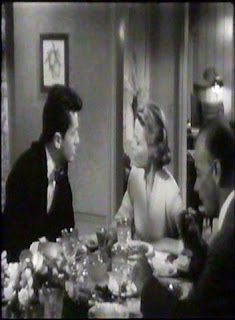
Dorothy McGuire has a good scene here where she calls Granger down on the carpet for being so immature and heartless. Her moral outrage over his indifference to millions of innocent people shows us she is not just the settled suburban housewife. She is still in her heart the idealistic bride of a soldier who left his wife to make a better world, honestly believing that he would.

Her chastising Granger brings down a family rift between her and her mother-in-law, who shortly gets a fantastic scene of her own. When Granger leaves for duty, Mom, played by Mildred Dunnock, rips down all the old World War I souvenirs that Pop collected and hung on the living room walls, making their home look like a boy’s clubhouse. She knocks all the empty shell casings off the mantle, tosses aside bayonets and helmets, and berates him for what she has known all along: he was an orderly to a general in World War I in a Paris hotel. He never heard a shot fired. She calls him a liar to his face.


Robert Keith slinks, humiliated, to a chair, as she shouts, “Your son Riley was killed; you were proud. When Martin was missing for four days in France, it made you feel important…As of this evening, there are no more professional heroes in this house!” The backbone of the family has had it, and there will be only reality served up in this house from now on.

Strong women seem to be a thread running through this film, as even Peggy Dow confronts the still whining Farley Granger on his accusations against her father. She counters that her father was wounded in World War I, with the shrapnel still in his body and suffers pain every day of his life. He has kept this secret because he does not want pity. Granger, so deeply mired in his own self-pity, no sooner makes up with her than he churlishly goads her into marrying him despite her protestations. He wants her to be like his sister-in-law, to follow him from assignment to assignment.

This being an ensemble movie, we jump from character to character and most of the threads of their stories are held together pretty well. Milner and Granger, both in uniform, have a night on the town, which the jubilant Milner predicts, “It’ll be V-J Day all over again” as they imagine swarms of girls surrounding them. Another feeble and out-dated reference to World War II, and they are disillusioned when it does not happen. Milner even confesses to Granger that he has never kissed a girl. He gets his chance at the Army making him a man, though, when he is shortly sent to Korea and is listed as missing in action. “That poor little boy,” Miss McGuire remarks, and Jim Backus shakes his head, “That little boy.” Even after his sacrifice, Milner will never be called a man.

We wonder if Farley Granger will grow up. He is not going to be sent to Korea; he has drawn a luckier card and is being sent to Europe. He gets his war bride after all when Miss Dow quits college, like so many young women of her generation did, to marry him. When they leave on their honeymoon, it is in his teenager’s jalopy.

Eventually we get back to Dana Andrews’ date with destiny. We know, though it is not hammered at us, that he is tormented about re-enlisting. Jim Backus goes back into the Army and requests Andrews as part of his runway-building crew. The very essential industry of building that makes Andrews eligible for deferment, also makes him indispensable to the Army.


The notion of who is indispensable is given subtle but clever examination in the movie. Maybe nobody is indispensable, and maybe everybody is. Milner’s heartbroken father spends a lot of time at the bar down the street now. In a confrontation with Andrews, he broods on some people’s luck at being indispensable, and mourns of Junior, “Maybe he was only indispensable to me.” Sorrowing Walter Baldwin scoffs at the radio behind the bar with its updates on the war, “Bad news traveling from one end of the world to another before you can blink an eye.” He should see CNN. Or the Internet.

Mr. Andrews comes to conclusion that he can no more demand an exemption from service for himself than he could Milner or Granger. His simple articulation of this complicated decision to his wife is only, “I’ve got to make peace with myself. Ever since I was 15 years old I’ve thought of myself as honest and responsible.”

No mention of fixing of the world’s troubles; that is the remarkable thing. No end in sight to the troubles, either.

One of the most affecting scenes in the film is when Dana Andrews puts his children to bed the last time before reporting for duty. He weaves a bedtime story for his daughter who falls asleep in his arms, about a princess who is partly her mother and partly herself. He is the picture of a man of his era, in his shirtsleeves and his burdens. He tells his wife that someday his son will want to know what Daddy did “when the world was going to pieces” and he wants to be able to tell his son he did more than build luxury hotels. In the hindsight granted to us old movie fans decades later, we know both his son and daughter will come of age during the Vietnam War, and they may never understand him. Only his wife understands him.

It is peculiarly fitting that their farewell takes place not at a crowded train station, but in their own quiet living room, the Shangri-La of the 1950s suburban couple. Miss McGuire sighs, looking around the room, “This is nice. This is a nice house, isn’t it?” It’s not just small talk before the final goodbye. It’s another re-evaluation of where they stand as a couple and where they are going and what they have accomplished together.


Embracing her, Andrews’ voice seems to catch when he says, “Your nose. I’ll never be able to get over your nose.” He might even cry in another moment. Dana Andrews plays the heart wrenching combination of sad and valiant like nobody. In any film, he can be terribly moving when life forces his character to face facts.

His father has faced facts as well. Andrews and Pop hug when it’s time to say goodbye, something pretty unusual in Hollywood films of this era to see two men embracing.

Our hindsight will also cause us to remember that the Korean War never really ended. An armistice was signed in 1953, but no peace treaty. Technically, North and South Korea are still at war, and therefore so are we. Even the morass that was the Vietnam War ended. Today, long after Jesse Brown died, in the cold of a long ago December 4th, there are U.S. military personnel on duty in South Korea on guard near the Demilitarized Zone. They could be the grandchildren or even great-grandchildren of Dana Andrews’ character Martin Greer.  Or Fred Derry.
*********
Jacqueline T. Lynch is the author of Ann Blyth: Actress. Singer. Star. and Memories in Our Time - Hollywood Mirrors and Mimics the Twentieth Century. Her newspaper column on classic films, Silver Screen, Golden Memories is syndicated nationally.

Related Products