IMPRISON TRAITOR, PEDOPHILE, AND CONVICTED FELON TRUMP.
Showing posts with label Boris Karloff. Show all posts

Friday, May 6, 2022

The Case of Charlie Chan and The Caftan Woman


When Patricia Nolan-Hall, a.k.a. Paddy, a.k.a. The Caftan Woman left us in March, the classic film blogger world lost one of its greatest champions and one of its dearest friends.  This is my entry for The Caftan Woman Blogathon.  A delightful aspect to Paddy’s love of classic films is that she embraced a wide range of genres and wrote about them with passion and humor.  She liked the great films, but also loved series movies, especially the mystery genre, and especially Charlie Chan.

Have a look at the rest of the Blogathon participants atthis page.  Visit them all and leave a comment.  You know Paddy would.


The character of the great Chinese-American detective, Charlie Chan, was created by novelist Earl Derr Biggers in the early 1920s.  Mr. Biggers was inspired by reading about two real-life Chinese-American police officers in Honolulu.  He created Chan as a protest against the “Yellow Peril” bigotry in California of the day.  He wrote six novels in the Chan series, and by the late 1920s, Hollywood tentatively expressed interested by producing a few films where Charlie Chan was only a supporting character.  But his popularity took off when Warner Oland was cast in Charlie Chan Carries On (1931), and played the detective for the remainder of his life.  Upon his death, the role was taken over by Sidney Toler for another decade.

The Charlie Chan series was quite popular, but in later decades its place in film history seems tarnished – or at least challenged – by modern sensibilities which naturally recoil from ethnic or racial stereotypes, particularly when played by white actors. The critiques are fair, but only in part.  Charlie Chan spoke in broken English and spouted Confucius-like proverbs, but that was the extent of his being a Chinese stereotype.  Inspector Chan was a world-famous detective, intelligent, kindly, urbane, courageous, honorable, modest, and his kids called him “Pop.”  His fast-talking American kids, who he had to cut down sometimes to keep them from messing up his latest case.  He was an exasperated father who still managed to save the day despite bad guys, uncooperative witnesses, and sons who didn’t always listen to him. 

Keye Luke, who played his eldest son and sidekick in many movies felt strongly that the Charlie Chan character was not demeaning to Chinese.  He is reported to have replied, “Demeaning to the race? My God! You've got a Chinese hero! He noted, quite accurately, that they “were making the best damn murder mysteries in Hollywood.”


There were something like 47 Chan movies made in the U.S. from 1926 through 1949, which made it one of the longest, if not the longest, movie series.  This is not counting the Spanish-language Chan movies, or the movies (including parodies) which featured Chan in later decades.  The honorable Inspector Chan found his way into radio shows, television, comic books, and even a 1970s cartoon series. 

Chan was something of a cultural phenomenon.  Paddy covered at length or at least mentioned something like fifteen Charlie Chan movies on her blog.  She did not approach the series with any apologetic debate about stereotypes.  She expressed wholeheartedly her delight at his personality, cleverness, the plots of the films, and her fangirl crush on Number One Son, Keye Luke.  I’m with her on that one.  In fact, I’m remiss at not having covered Chan movies before on this blog because I’m also a fan. 

Paddy covered in depth the origins of Chan in all formats, and traced the careers of the character actors who appeared in the films with her typical encyclopedic knowledge, and most of these posts were for blogathons.  Paddy loved blogathons.  There is a banner in her sidebar for every blogathon she joined.

I wanted to pay tribute to Paddy by co-hosting this blogathon and with my post, but unexpectedly, I also discovered a sense of comfort in going through her Charlie Chan posts for this entry.  Re-reading the words reflecting the vibrancy and wit of my dearly missed friend wasn’t as painful as I thought it would be and I even found myself laughing at some of her wry and always enjoyable observations. 

Here then, is The Caftan Woman facing off with Charlie Chan.  Please follow the links to read her full posts on The Caftan Woman blog.


REEL INFATUATION BLOGATHON: Keye Luke as Lee Chan

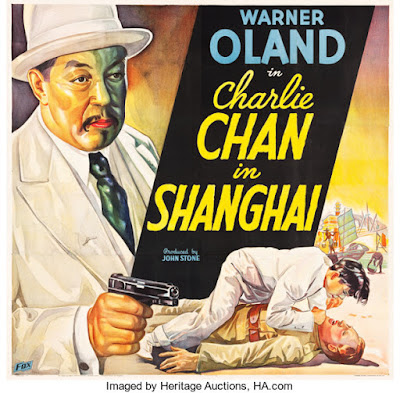
“My tween years were devoted to sneaking up late at night and watching whatever old movie I could find. One momentous night I was introduced to Inspector Charlie Chan, 60 summers young and 60 winters old, and his number one son, Lee in Charlie Chan in Shanghai.”

“The first scene in the movie had introduced me to Inspector Chan who seemed a movie detective worth following. Lee immediately impressed me with his good looks and enthusiasm. It's even more fun to solve a fictional crime if you have a crush on one of the detectives!”

“Immediately, we can sense the bond of affection between Charlie and his firstborn. Warner Oland and Keye Luke became close, with Oland a mentor to the young man, and Luke a fond protector to his often troubled older friend.”

“My admiration and affection for the actor runs deep, but my crush, the crush of that tween girl up late when she was supposed to be sleeping on a school night, is only for Lee Chan, #1 son.”


VISITING PARIS WITH INSPECTOR CHAN: Charlie Chan in Paris (1935) and City in Darkness (1939) 

“Charlie Chan in Reno… a terrific movie that could easily be paired with The Women for a great movie night.”

Of Harold Huber in Charlie Chan on Treasure Island: “Huber literally throws himself into the unaccustomed comic relief duties as a character that comes off like Inspector Clouseau's grandfather.”


Favourite movies: Charlie Chan at the Olympics (1937)

Charlie Chan at the Olympics is set amidst a background of political turmoil, contentious ideology and threats of violence at a sporting event that sees itself in a bubble apart from those things surrounding it. Perhaps that is the celebration that the Games should be, but can never be. The movie is an entertaining visit to the past with an uncomfortable connection to our present.”


AT THE CIRCUS BLOGATHON: Charlie Chan at the Circus (1936)

“One of the outstanding features of the character of Chan, as opposed to many other fictional crime-solvers, is the fact that he is a family man. A family man in a big way with 12 offspring. During the course of the series, he even becomes a grandfather (Charlie Chan in Honolulu). We don't generally see a lot of granddads going head to head with the criminal class.”

“One of the thrilling aspects of the movie is that it was filmed on the winter location of The Barnes Circus and utilized the sights, sounds, people and animals from day-to-day circus life.”


Horseathon: Charlie Chan at the Race Track (1936)

“Oland found an alter ego that touched his soul.  He approached the role of Inspector Chan through diligent study of Chinese history and philosophy and so fused his personality with that of Chan's that he became the character.  Enduring international fame was Oland's reward for such fidelity of purpose, especially in China, the land of the fictional detective's ancestors.”

“Keye Luke always spoke fondly and admiringly of Warner Oland in interviews, and refused to continue in the series after the death of his friend in 1938.”

“Charlie Chan 101 for Newbies:  If there is a young romantic couple, and there always is a young romantic couple, you can erase them from your suspect list.  They are included only to be young and romantic.”


Harold Huber

“He is a welcome sight in enjoyable crime programmers and most important to this child of the late show, he is a superstar in the Charlie Chan universe.”

Of his work in City of Darkness: “To Harold Huber fell the job of comic relief. I have acquaintances who do not care for his work in this movie. I am not of their mind. Perhaps it is because I like Huber or that I have a soft spot in my heart for those who toil as comic relief…I can't help but think of him as the emotional Pere de Clouseau, and I get a kick out of the work.”


Backstage Blogathon: Charlie Chan at the Opera (1936)

“Boris Karloff rightfully received top billing with Warner Oland in Charlie Chan at the Opera…Karloff's performance is touching and assured.  It also lays the groundwork for Maurice Cass' line, as Mr. Arnold, "I'm stage manager here and this opera's going on tonight even if Frankenstein walks in." 

Corny?  Perhaps, but delivered with unabashed gusto and always gets an appreciative chuckle.”


Beach Party Blogathon: The Black Camel (1931)

“When I read the Nancy Drew mystery The Secret of the Golden Pavilion as a young girl I longed to visit Hawaii.  Later on when I read Earl Derr Bigger's The House Without a Key my fondest wish was to visit Hawaii in the 1920s.  I imagine the closest I'll ever get to that far-fetched whim is in watching the 1931 Charlie Chan feature The Black Camel.”

“If I really could go back in time, I might have tea with Earl Derr Biggers and ask him about one of the plot points that has always bothered me concerning the clue of the ripped out newspaper photos.  If it didn't bother Biggers or his editors, it probably shouldn't bother me, but there it is.”


For Your Consideration: Sen Yung

“With only extra work in his background (Mr. Moto Takes a Chance and The Good Earth), Sen Yung was most happily cast with the new Chan, Sidney Toler. He proved adept at the comic enthusiasm which was Jimmy Chan's trademark and had a nice chemistry with star Toler. It is a pleasure watching him in the role today.”

“The Academy should have been taking note of the 24-year-old actor's work in William Wyler's adaption of W. Somerset Maugham's The Letter in 1940. As Ong Chi Seng, the law clerk with an agenda, Sen Yung steals scenes and gives the audience something to think about. While the British go about pretending the world is theirs, the unctuous young man reminds them that there is another world around them, one they cannot control. There is not a trace of the ebullient would-be detective in this fine characterization. It is a highlight in a film full of wonderful atmosphere and performances.”


Decorating with Boris

In which The Caftan Woman recounts acquiring this poster for her kitchen.

“As I spent a joyful couple of hours going through the wares of a shop it occurred to me that I - one of the world's noted Charlie Chan fans - I did not have a Charlie Chan poster among my collection. I turned to the vendor's assistant and, barely able to contain the excited anticipation from my voice, asked "Do you have Charlie Chan at the Opera"? "Why?" he responded. "What's so hot about Charlie Chan at the Opera?"

Taken aback may accurately describe my reaction to his query, but it was more than that. I was shocked…

"Perhaps," I responded politely, yet coldly, "if I used the full title card you will realize the folly of your question. I am speaking of Warner Oland vs. Boris Karloff in Charlie Chan at the Opera." Unimpressed, the lackey pointed in a vague direction. "Yeah, that's here somewhere."


THE HOLLYWOOD GANGSTERS BLOGTHON: Charlie Chan on Broadway (1937)

The movie world of Charlie Chan finds him often dealing with cunning murderers and spies, but Charlie Chan on Broadway is the only time in his 20th Century Fox period where he dealt with bona fide gangsters.”


And she ends with her 2011 second-place winning Haiku, a sublime piece:


The gathered suspects

Tremble 'neath Inspector's glare

You are murderer


Sailing Away on Charlie Chan's Murder Cruise, 1940

Published on her blog only weeks before she passed. 

“Charles Middleton and Claire Du Brey play the Watsons. Jimmy rightly calls them "bluenosers." They are killjoys and she claims to be psychic. Just the sort you want along on a cruise…

“It's all fun and games until there is another murder or two.”


Paddy Nolan-Hall touched so many bloggers and readers in the past 14 years of writing her blog.  I will continue to visit The Caftan Woman from time to time, the way we continue to rewatch favorite movies to visit our old friends on film.

Have a look at the other bloggers’ entries to this blogathon hereat this page.

Thank you for reading.

Thursday, October 29, 2015

Abbot and Costello Meet Frankenstein - 1948


Abbott and Costello Meet Frankenstein (1948) is an example of that minor genre – sub genre – miniscule or microscopic genre generally known as horror/comedy. I don’t know if any film critic or historian has ever compiled a list of them, or waxed philosophic on this kind of movie. But we know it when we see it, and Abbott and Costello fans seem to consider this movie one of the duo’s best.

This is our entry in the Universal Pictures Blogathon hosted by the Metzinger sisters at Silver Scenes.

I confess to not being a diehard Abbott and Costello fan myself – I’ve always found them less witty than other knockabout duos like Laurel and Hardy, and though I probably saw this film as a child (Universal monster movies were a favorite then) my most recent reintroduction to this film was this candid publicity photo taken on the Universal lot at the time the movie was in production.  We posted it here a couple years ago as a preview to the Year of Ann Blyth series.

Here we see Glenn Strange as the Frankenstein monster transporting Ann as her mermaid character in Mr. Peabody and the Mermaid (1948) covered here, which was also filming at the same time. This photo is really a kind of tribute to the work of Bud Westmore, head of the studio’s makeup department, who was responsible for these, and so many other imaginative creations.

Universal, as pretty much any old movie buff can tell you, cornered the market on monster movies. It gave us Dracula, Frankenstein, a slew of wolfmen and their victims, sequels, and progeny. It is interesting to have Universal turn their cash cow on its ear by putting their most famous monsters in a comedy feature to play second fiddle to Abbott and Costello.

To be sure, Bud and Lou were huge stars in the 1940s, top box office draws, and perhaps the studio felt it could give the monsters a little more exposure, a new life, by hooking them up with the new kids on the block.


Some monster movie purists feel this destroyed the genre when all the bullets, burning windmills, and stakes to the heart could not.

Then again, with the atomic age and a host of new “sci-fi” creatures coming to a theater near you, perhaps the days of patiently waiting for the mummy to lumber close enough to get to the horrified archaeologist was as good as – you’ll pardon the expression – dead.

Abbott and Costello Meet Frankenstein is an homage to the genre, even if it exploits it. Bud and Lou are freight delivery guys who attempt to deliver the crated monsters to a wax museum, and when the monsters get out, and Bud spends most of the movie trying to get someone to believe him that he saw them. There are some mildly amusing gags, but it is the monsters and their actors – Bella Lugosi’s Dracula, and Lon Chaney Jr as the Wolfman that bring an unusual panache and dignity to the proceedings. Lon Chaney Jr, bearing the burden and angst of morphing into a werewolf treats this less as a curse and more as an affliction. It strikes me as a very modern perspective.


Glenn Strange is the newbie as the Frankenstein monster. Taking over from Boris Karloff, he has big shoes to fill.

Sometimes I just crack myself up.

He has the most arduous makeup and the least amount of lines and acting to do. Most of Mr. Strange’s roles throughout his career were uncredited. He had a bit part in All the Brothers Were Valiant (1953), covered here, also with Ann Blyth – the only time they worked in the same film, despite taking a stroll around the Universal sound stages with the mermaid in his arms.

One delight of the film, for me anyway, is seeing dependable Frank Ferguson as the wax museum gallery owner, perpetually in a state of having a nervous breakdown because Bud and Lou haven’t delivered his monsters.

My other favorite part was the animated cartoon opening title and credits.

And a special treat (run screaming in the night from the Spoiler) is the voice of Vincent Price as the invisible man behind Bud in the rowboat as the boys row frantically away from the burning dock on which the Frankenstein monster is meeting his demise.  Again.

Bud and Lou were not done with monsters. They would run into more of them from time to time including Abbott and Costello Meet the Killer, Boris Karloff in the following year 1949, but by then nobody took a curse seriously anymore. Not with flying saucers, ray guns, and giant radiation-infused insects on the horrible horizon.

Universal has done its own magical morphing through the decades – the theme park, of course – and the vault – or crypt – where so many movies, from Universal and Paramount studios, are held back from us. Truly horrific.


Please check out the other great posts participating in the Universal Pictures Blogathon at Silver Scenes.

***********************
"Lynch’s book is organized and well-written – and has plenty of amusing observations – but when it comes to describing Blyth’s movies, Lynch’s writing sparkles." - Ruth Kerr, Silver Screenings

"Jacqueline T. Lynch creates a poignant and thoroughly-researched mosaic of memories of a fine, upstanding human being who also happens to be a legendary entertainer." - Deborah Thomas, Java's Journey

"One of the great strengths of Ann Blyth: Actress. Singer. Star. is that Lynch not only gives an excellent overview of Blyth's career -- she offers detailed analyses of each of Blyth's roles -- but she puts them in the context of the larger issues of the day."- Amanda Garrett, Old Hollywood Films

"Jacqueline's book will hopefully cause many more people to take a look at this multitalented woman whose career encompassed just about every possible aspect of 20th Century entertainment." - Laura Grieve, Laura's Miscellaneous Musings

"Jacqueline T. Lynch’s Ann Blyth: Actress. Singer. Star. is an extremely well researched undertaking that is a must for all Blyth fans." - Annette Bochenek, Hometowns to Hollywood


Ann Blyth: Actress. Singer. Star. 
by Jacqueline T. Lynch

The first book on the career of actress Ann Blyth. Multitalented and remarkably versatile, Blyth began on radio as a child, appeared on Broadway at the age of twelve in Lillian Hellman's Watch on the Rhine, and enjoyed a long and diverse career in films, theatre, television, and concerts. A sensitive dramatic actress, the youngest at the time to be nominated for her role in Mildred Pierce (1945), she also displayed a gift for comedy, and was especially endeared to fans for her expressive and exquisite lyric soprano, which was showcased in many film and stage musicals. Still a popular guest at film festivals, lovely Ms. Blyth remains a treasure of the Hollywood's golden age.


The eBook and paperback are available from Amazon and CreateSpace, which is the printer.  You can also order it from my Etsy shop. It is also available at the Broadside Bookshop, 247 Main Street, Northampton, Massachusetts.

If you wish a signed copy, then email me at JacquelineTLynch@gmail.com and I'll get back to you with the details.


**************************
My new syndicated column on classic film is up at http://go60.us/advice-and-more/item/2047-everybody-comes-to-rick-s, or check with your local paper.


Thursday, December 10, 2009

Boris Karloff as Captain Hook on Broadway


Moira Finnie came to the rescue and supplied this publicity photo of Boris Karloff in his role as “Captain Hook”. We discussed Karloff’s Broadway stint in “Peter Pan” in this post, part of Frankenstenia’s Boris Karloff Blogathon.

Thanks so much to Moira for this very theatrical image of the monster thespian in his stage makeup. Have a look at Moira’s “Skeins of Thought” here, and at the TCM Movie Blog.

By the way, having discussed a couple of Grace Kelly’s early television appearances in this recent post, we might also note that in 1952, Boris played Don Quixote opposite Grace Kelly as Dulcinea in an episode of the anthology series “CBS Television Workshop.”

Boris Karloff as Don Quixote, with Grace Kelly as Dulcinea.

Let me say it again just because I like how it sounds: BORIS KARLOFF as DON QUIXOTE, with GRACE KELLY as DULCINEA. Oh, please let there be a Kinescope of this one floating around somewhere.

Monday, November 23, 2009

Boris Karloff in the Macy's Thanksgiving Day Parade


Boris Karloff, dressed as a pirate, rode down Broadway on a blustery cold November morning, on a float designed to look like pirate ship. In honor of Frankenstenia's Boris Karloff Blogathon, and in honor of Thanksgiving, we have a look today at Boris Karloff's participation in the 1950 Macy's Thanksgiving Day Parade.

The New York Times reported the scene in its Friday, November 24th edition the following day. The giant balloons in the sky were nothing that would be familiar to today's cartoon-watching, video-game playing children. Sailing above them, were the un-merchandised and generic Dachshund, a Gnome, a Clown, and a Fish. The St. Bernadette Cadet Corps “blared the approach” of Boris Karloff, “the ‘bad man’ of the films, who, this time, was garbed as the swashbuckling Captain Hook, in command of his pirate ship and flanked by his buccaneers.”

Then the reporter notes that the cheers for Karloff erupted into a huge “din” for Hopalong Cassidy, played by William Boyd, “in full regalia.” We’ll discuss a film that parodied the “Hoppy” phenomenon of the early 1950s at a later time. For now, we have the image of the aging icon Karloff perhaps surpassed by a newer hero. But only temporarily, for Hopalong Cassidy is remembered now only by older Baby Boomers, and Karloff has achieved immortality, curiously not only for the body of his work, but also for the single role of Frankenstein’s Monster that shot him to stardom in middle age.

That was the early ‘30s, but by the late 1940s Mr. Karloff’s career was seemingly on the wane. His last film in the previous year of 1949 was “Abbot and Costello Meet the Killer, Boris Karloff.” Despite the honor of having one’s name actually in the title of the movie, Mr. Karloff’s monster image now was poked fun at, his eerie screen persona perhaps demystified, if not actually debunked. It wasn’t that hard to do, for Mr. Karloff, as many have noted, conveyed a gentleness that brought a depth of humanity to his roles. We discussed Boris Karloff’s humanity, despite his monster image, a few weeks ago in this post. He wasn’t just Frankenstein’s Monster, he was Pagliaccio, Cyrano, and Hamlet, playing Frankenstein’s Monster. If Pagliaccio, Cyrano, and Hamlet did not speak majestic passages but, rather, grunted and stumbled around a lot.

He could also convey, superbly, heartrending innocence.

Boris Karloff’s stint on the parade route as Captain Hook was a day off from his current gig, which was to play the dual role of Mr. Darling and Captain Hook in the Broadway musical “Peter Pan”, opposite fellow Hollywood escapee Jean Arthur in the title role. “Peter Pan” opened at the Imperial Theater on April 24, 1950. In early October, the play moved over to the St. James Theater, where it remained until January 27, 1951, for a total of 321 performances.

Author Beverly Bare Buehrer in her Boris Karloff: a Bio-bibliography (Greenwood Press, Westport, CT, 1993) notes that the role was exhausting for a man of Karloff’s age (he would be 63 years old on November 23rd, Thanksgiving Day), with six costume changes, and three makeup changes. When the show closed in 1951, he then toured in the road production.

The opening night notices raved in delight at the turnabout for the old monster. The New York Journal American coyly noted, “Boris Karloff’s Captain Hook is no more scary than Boris Karloff’s Mr. Darling, who is no more scary than Tinker Bell.”

The New York Herald Tribune called Karloff “captivating.”

And the New York Times announced, “This is Mr. Karloff’s day of triumph.”

Did the kiddies waving at Captain Hook on the passing float know that? Or, were they just craning their heads, waiting for Hopalong Cassidy, who they knew from TV, a more intimate friendship because Hoppy was in their living rooms and not down at the neighborhood movie house (where he used to be the previous generation).

“He is at the top of his bent,” the Times crowed.

Did the parents of the kiddies pay special attention to the grand old thespian in the pirate costume, batting away the burst of snow flurries with his hook, and whisper to their children, “That’s him! That’s Frankenstein! That’s the Mummy!” while they disbelieved?

“Mr. Karloff is an actor of tenderness and humor, with an instinct for exact inflection,” so the New York Times lovingly paid the old monster tribute on his opening night on Broadway.

At the end of the parade route, Santa Claus, and parade marshal Jimmy Durante, and Hopalong Cassidy, and Boris Karloff extended their holiday greetings to the crowd in front of Macy’s. Perhaps that was the moment Karloff entered the pantheon of giants in the world of children, standing shoulder to shoulder with Hoppy and Santa, in front of a store with an enormous toy department.

He had entertained children before, on the screen, and privately in hospital wards, and on the Broadway stage. The recordings would follow, and his famous turn as the “Grinch”, which is still shown on television where Hoppy once ruled the roost but now no more. Boris’ magnificent “exact inflection” is heard every December by children sitting in front of…the television.

Perhaps in a way, that Thanksgiving Parade, rather than his opening night, was his “day of triumph”.

Happy Birthday, Mr. Grinch, and the same to Captain Hook.

Monday, October 19, 2009

Boris Karloff


We’re going to start the Halloween celebration this week with a not-so-scary look at a monster and a witch. Next week we’ll get into the scary stuff, which, ironically, has nothing to do with monsters or witches, but with the economy.

Above we have the Hollywood Walk of Fame star for Boris Karloff, one of two which honors the iconic actor. This one, you can see by the little TV below his name, is for his career in television. He did quite a few guest appearances on shows through the 1950s and ‘60s, and hosted the “Thriller” anthology. Perhaps his biggest claim to fame in this period is voicing The Grinch.

The Grinch wasn’t exactly a cuddly person, but he found redemption through being nice and returning the roast beast, cans of Who Hash, etc. Boris Karloff went through several phases in his real life as well, but he was always a much sweeter and gentler man than his monstrous characters.

Karloff’s real name was William Henry Pratt, who left his home in England to tour Canada and the USA in theatrical groups, filling in the lean times with manual labor. He took some minor roles in silent films to make ends meet, and was all of 44 years old before his big break came, “Frankenstein” in 1931.

After that enormous hit, it was hard for some to picture Mr. Karloff as anything else, but some who celebrate his famous horror film appearances may forget he was nominated for a Tony Award for his Broadway role in “The Lark”, a drama about Joan of Arc, with Julie Harris. Or, they may be unaware entirely that Karloff won a Grammy Award for his spoken record of “How the Grinch Stole Christmas”. Karloff made other records as well, for children, reading fairy tales with his unique (but not very sinister this time) lisp.

There’s a story about Karloff recounted on the IDMb website where the crew of “Frankenstein” were concerned about the little girl in that famous scene would be terrified of Karloff when she first saw him in full makeup. No worries. She happily ran right up to her new buddy. Karloff’s Frankenstein Monster had something special that elicited our sympathy. Maybe it was something “human” about him.

Thursday, October 30, 2008

The Walking Dead (1936)

For Halloween tomorrow, we have a look at a rather unusual monster movie. “The Walking Dead” (1936) is a unique combination of hard-boiled gangster movie and the kind of campy film where the creature escapes from the lab. It is also a look at the sacredness of both life and death against the cold reality of profane daily corruption. Not the usual stuff of monster flicks, but Warner Bros., that bastion of gangster films and socially conscious films, could turn even a movie with the lurid title of “The Walking Dead” on its axis and make it into something more.

Boris Karloff stars as an ex-con, a gentle musician, who is set up by a mob out to murder a judge. They pin the crime on the innocent Karloff. Ricardo Cortez suavely plays the head of this mob gang. Edmund Gwenn, complete with professorial Van Dyke beard and trim moustache, pince-nez glasses and wing collar, plays the scientist who brings Karloff back to life after he has been executed in the electric chair.

Oh, yeah. You didn’t think you were going to see a Warner Bros. gangster flick without an electric chair, did you? The film actually starts off as a gangster movie with all the types, screaming headlines and a gunman named “Trigger.” Unless you happened to be Roy Rogers’ horse, if you were named “Trigger” you were going to grow up to be a hired gun.

Then poor Mr. Karloff is framed for a crime he didn’t commit, and we have the mournful march to the chair accompanied by his favorite piece of music on the cello, because it reminds him of heaven. We have the waiting for the last minute reprieve from the governor, the prayers read in Latin (not by a priest, by a man in suit?) as he walks the last mile, and the inevitable, popcorn-selling dimming of the lights when the switch is thrown.

After this point is when it becomes a monster movie.

His body is taken by scientist Edmund Gwenn to be brought back to life. I believe this is not the usual procedure our criminal justice system, but would the Warner Bros. lie to us?

A complication has ensued. Mr. Gwenn’s two young lovebird lab assistants saw the crime and can testify to Karloff’s innocence. But not until the 11th hour do they confess this because for months and months all during the trial they did not want to get involved. Now suddenly they feel bad. One of the most edge-on-your-seat moments in the film is when the governor’s office, armed with this new information, calls to cancel the execution, and two uniformed guards at the prison do not answer the phone in time because they are discussing baseball. The audience is thrown into a frenzy of anxiety because we know the ringing phone will save Karloff’s life, and the cop who moves to answer it keeps stopping to continue their conversation about baseball. It’s a wet your pants moment.

But, Karloff has a second chance at life in the hands of kindly but science-obsessed Mr. Gwenn. We have the standard lab scene of bubbling test tubes, coils and an exam table that rocks up and down when the switch is thrown. Why being shaken like a cocktail will induce a dead person back to life has not yet been proven by The New England Journal of Medicine, but this seems to be a common feature in movies where a dead body is brought back to life. I particularly like that the x-ray or fluoroscope of his body shows a skeleton and a beating heart shaped somewhat like a valentine heart. Now, that’s just cute.

And of course, we have the standard line by the scientist….ready? All together now…

“He’s alive!”

But Gwenn does not shriek it with the wild abandon that Colin Clive does in “Frankenstein” (1931). It’s more like a whisper of quiet satisfaction.

There are similarities to the Frankenstein monster in the revived Boris Karloff, with a slow, lumbering gait, a shock of white through his dark prison haircut, an empty, hollow expression and a rather monotone voice. But this “monster” plays the piano. Karloff portrays him with a sweet, sad poignancy as a man caught between two worlds, the world of the living and the world of the hereafter.

Gwenn probes Karloff’s conscious for information on the great beyond, especially since Karloff is suddenly able to pick out the men who framed him, though he had no knowledge of it before his execution. One by one, he visits these men, as if stalking them, not to revenge himself, but to ask them why they did what they did, to confront their consciences. Each of them dies in freak accidents.

It is probably a nod to the Code that the studio attempts to wrench this lurid, campy tale into a moral tapestry of good and evil. As Karloff tells Gwenn, “Leave the dead to their maker. The Lord our God is a jealous God.” It’s a bit self-conscious, and Gwenn repeats the line at the end of the film, as if to say he has learned his lesson, and will only work on cures for dry skin from now on.

Directed by Michael Curtiz, the film seems to have some early moody film noir traits, such as the shot of the judge in the courtroom through the desk lamp of the clerk, and the shot of the cellist downward from the slowly revolving blades of a ceiling fan in the prison, and a few floor-to-ceiling shots of crime scenes.

Boris Karloff, for his part, gets to actually act in this movie, which he did really not get to do in the more splashy, more famous “Frankenstein.” A touching performance in many respects, this man with the distinguished speaking voice and the gentle manner would have been fascinating in more than just horror films. In a studio system where actors were pegged as types, he tried his best, when he could, to get beyond that. I think he does here, even with this lightweight script.

Tuesday, October 30, 2007

Frankenstein (1931)

Universal’s second blockbuster monster hit of 1931 was “Frankenstein” which made a film star out of Boris Karloff in the way “Dracula” did Bela Lugosi. The physical appearance of the monster, the burning windmill, have all become iconic now.

The film is noted in the opening credits to be taken from a novel by Mrs. Percy B. Shelley, as if she were some society dowager writing short stories for “The Saturday Evening Post.” The audience is not informed that this is a classic of English literature, and it is not treated as such, as both the films “Frankenstein” and “Dracula” were based more on the play adaptations than the original novels.

The film opens with a gentleman master of ceremonies introducing the film, and warning us, “I think it will thrill you. It may shock you. It might even horrify you. So, if any of you feel you do not care to subject yourselves to such a strain, well, we warned you.”

Well, now, them’s fighting words and of course not only are we going to stay for the feature, we’re going to take it darned seriously.

Colin Clive plays Dr. Frankenstein, a highly strung scientific genius who lives for his work, at the expense of his friends, his fiancée Elizabeth, played by Mae Clark, and his curmudgeonly father. John Boles plays Victor, who in a role similar to David Manners’ role in “Dracula,” has the less glamorous supporting role as the friend and all around good guy.

Our old friend David Frye appears in this film as well, as Dr. Frankenstein’s assistant, Fritz. Fritz is hunchbacked, subservient, and not overly intelligent. Fritz does a lot less scenery chewing than the crazed Renfield of “Dracula,” but Mr. Frye now seems locked into spending his considerable talent on horror films.

The film begins with Frankenstein and Fritz (sounds like a law firm), robbing a grave. Dr. Frankenstein has cobbled together a body from different body parts, and now needs a brain. The hanged man they find will not do because his neck has been broken, (well, yeah) and so Fritz heads off to the lab of Dr. Frankenstein’s mentor, where there are brains conveniently in jars, to get one.

There are two brains, one labeled “normal” and one “abnormal,” which the lecturer tells his students is the brain of a criminal. One wonders if there is a bit of eugenics of that period involved here. In Mary Wollstonecraft Shelley’s novel, the creature is not born evil.

Dr. Frankenstein’s secret laboratory is a cavernous stone castle full of beakers and electrical coils. He is a brilliant megalomaniac who wants to create life from scratch. Getting married to Elizabeth and creating life the old fashioned way doesn’t seem to appeal to him. As he prepares to complete his experiment during a terrific thunderstorm, his mentor, his fiancée, and John Boles crash the party. Mr. Clive’s exasperated, “Of all times for anybody to come!” is almost comic. We’ve all felt the same way at one time or another about unexpected guests.

In a few moments, the inert body of the monster will be hoisted to the skylight to absorb the electricity of the storm outside, Mr. Clive gets to shriek his classic words, “It’s alive! It’s alive!” and we get soon get a monster on the loose.

We hear the heavy footsteps of the creature, and are introduced to the monster in an extreme, but brief close-up, on his drooping lids, his morose expression, the bolts in the neck. The really high forehead and the really flat head. His sleeves are too short. He obeys simple commands, and cannot speak. There is less horror than sympathy for this creature, whom even his creator calls “it” and not “he.”

When the monster kills Fritz, the completely unstrung Dr. Frankenstein is led back home by the dependable Mr. Boles, while his mentor, Dr. Waldman, prepares to destroy the monster. No such luck, and monster heads for the foggy hills. Waldman was played by Edward Van Sloan, who we last saw as Professor Van Helsing in “Dracula.” He also plays the MC at the beginning of this film.

We see jubilant preparations being made in town for long-awaited wedding of Dr. Frankenstein and Elizabeth, which his curmudgeonly father, played with comic irascibility by Frederick Kerr, has been whining for all along. Curiously, none of the citizens of this German village speaks with a German accent. They all sound like a mix between London’s East End, and somewhere in Missouri.

A poignant scene between the monster and his new friend, a little girl who wants to play with him and hasn’t the sense to run away from very big strangers with flat heads, turns tragic when he accidentally kills her. Horrified by what has happened, the monster runs away, more agitated than before, and wrecks the boudoir of Elizabeth, dressed in her wedding gown. Soon all the people with torches and clubs are after him. Evidently nobody owns a gun. Dr. Frankenstein changes from his formal wedding attire and puts on a pair of Jodhpurs, so you know he means business.

Eventually there is a showdown between creator and creation on the stony heights of an impressive set, and the monster knocks Dr. Frankenstein silly, dragging him to the windmill, where of course, the villagers set fire to it. This film has a bit more graphic horror than “Dracula” in the sense that we see the monster throw the little girl into the lake, and we see him throw Dr. Frankenstein’s limp body from the windmill, and we see the flames encircle him as he shrieks in terror. It is as if Universal is starting to push the envelope a bit.

The film ends with a recovering Dr. Frankenstein supposedly having learned his lesson, but quite tellingly, matinee idol John Boles does not get the girl in this film, as David Manners was allowed to in “Dracula.” Both these men were stars who were relegated to these minor roles probably to jump-start the hoped-for popularity of these films. Both films were financial successes, leading to new stars being created, to the point where the handsome leading men were no longer needed to attract an audience.

One note on Boris Karloff’s work in this film, though he does little more than pantomime and grunt, what Karloff endured to create this character is remarkable. The makeup, devised by Jack P. Pierce, took 3½ hours to apply. The costume weighed nearly 70 pounds, and each shoe weighed about 21 pounds. No wonder his footsteps always sounded heavy.

Thursday, August 23, 2007

Going to the Movies - Two B-Horror Films

Two recent trips to the movies brought an interesting perspective. The first trip to see a current feature film was enjoyable enough, despite the inevitable scenes which are geared to attract the immature and unintelligent, and enough of those folks to pay for the making of the film. Enjoyable despite the previews of coming attractions which contained enough key scenes of similar immature and unintelligent (read vulgar) material to attract some key demographic which will evidently stomach that sort of thing better than I do.

However, though I was curious to see the film, I probably would not have gone had I not gift certificates to use. A brief stroll through the mega movie cavern where multiple films played, and a glance at the variety and prices of the food served, left me more in awe than the film. As, I think, it always does.

Then another movie going experience brought a curious balance to this. Since this is a blog about OLD movies, it fits in here. A group of friends and I met on a warm summer evening, after a spur of the moment meal at a family-owned diner/hot dog stand of the kind of variety that has been called Road Food, where the food is homemade, great, and inexpensive and the shack of a building has more history than your family tree, we went to the movies.

Not just any film, but a double feature of horror B-flicks from days gone by, back when you dressed for the movies like you dressed for church (since a lot of people who still go to church don’t dress for it, this might not be a good analogy). These were two really lousy films, and we had a terrific time.

The films were “The Terror” (1963) with Boris Karloff and a young Jack Nicholson in one of his early roles. Mr. Nicholson has likely crossed this one off his resume and done his best to forget it. It is perhaps inelegant of me to raise it here. The second was “House on Haunted Hill” (1959) with Vincent Price and a young Richard Long, and a genuinely spooked Elisha Cook, Jr.

We played trivia and won prizes. We laughed when the evil ones were terminated, and applauded when the “scary” parts occurred. We mimicked the actors as we left the theater. None of this was done in derision, but ironically, in appreciation of being entertained. There were men as well as women in the audience enjoying the show equally, because these were not chick flicks, nor action films, so we were not marketed to by gender. There were all ages in the audience, from nerdy teens taking it much too seriously, to oldsters with shining eyes remembering their first dates at the drive-in. When the film was over, we talked spontaneously about our old neighborhood movie houses, long since gone, where we had seen films of this sort. When the audience was asked to fill out a survey in the lobby, many hands eagerly reached for the forms and pencils, not brusquely passing by as usual, but wanting to share what they felt. Conversations erupted among strangers.

It occurred to me that the big difference between the first experience of seeing a current pretty okay Hollywood film and the double feature of two ridiculous old ones, was that we enjoyed the old ones more because we felt entertained. As silly as the “frightening” scenarios were, we were not made uncomfortable by unnecessary vulgarity intended to play us like an instrument. What violence that occurred in these films was laughable. Mostly, and above all, we did not feel as if we had just been targeted, marketed, merchandized, and been viewed by the operating officers of some media conglomerate as a demographic to be exploited. Which is how I usually feel when I go to the movies, like I've been had.

We felt entertained, and when we clapped at the end of the double feature, (not having clapped at all at the current film, only slipped away from the theater as quickly as possible without lingering), it was with real appreciation at having been given a night of lighthearted fun for the price of admission (a much lower price obviously than the feature film). Perhaps it's simply because films are not made for a general audience anymore that we do not experience this sense of community. Much in the same way there are no more "popular songs" that everyone knows.

The business of making movies has always been about making a profit. That is a given, but it seems there is less showmanship, for want of a better word, than there used to be. Only push the product to a targeted market until the shelf life expires. It’s not the same thing.

That’s it for this week. See you Monday. Have a good weekend.

Related Products