IMPRISON TRAITOR, PEDOPHILE, AND CONVICTED FELON TRUMP.
Showing posts with label Gordon Gebert. Show all posts

Thursday, May 5, 2011

The Narrow Margin - 1952


“The Narrow Margin” (1952) is a speeding bullet of a movie that stuns and entertains like no other B-noir. And that it happens almost entirely on a moving train is icing on the cake.

I do, however, wish it had a different title. When I was planning on using this film for our celebration of National Train Day, (Saturday, May 7th), I couldn’t remember the title of the movie. Took me forever to research enough scraps of cast names that I could recall to get it. If it had been called “That Train Movie with the Gangster’s Moll and the Gravelly-Voiced Guy Running from the Mobster with the Fur on His Coat Collar” I would have had no trouble locating this at all.

The premise of the film is simple. A pair of detectives in Chicago are assigned to escort a gangster’s moll to appear as a witness in court in Los Angeles. They take the train across the country. Bad guys are after her to shut her up.  It's a race for their lives, a game of terminal (mind your head on the pun) hide and seek.

No sooner do we understand the gravity of the situation, when the senior detective, played by Don Beddoe, is shot dead, taking the bullet intended for the gangster’s moll. The other detective (with the gravelly voice) is played by Charles McGraw. Losing Beddoe is almost like losing his own father. There’s a nice bit where, cradling Beddoe in his arms, he brushes off Beddoe’s lapel that had cigar ash fall on it, a reprise of his similar protective flick of ash off Beddoe’s lapel when they talked in the cab ride earlier.

Torn up, and furious at the mouthy moll, played terrifically by Marie Windsor, McGraw has his work cut out for him now that he has to take this she-devil on to Los Angeles by himself. The bad guys do not know what she looks like because the police have been protecting her. They do know what McGraw looks like though, so they assume if they follow him on board the train, he will lead them to her.

A bit of a complication occurs when McGraw is seen conversing with another lady passenger, played by Jacqueline White. Love that first name. Has a ring to it.

Uh-oh, the gangsters mistakenly think Miss White is the moll they want to kill. McGraw realizes this, and as if the pressure wasn’t bad enough, now he must protect two women, one of whom does not even know her life in is danger.

That’s all you’re going to get from me on the plot. It has so many twists and turns, and is so fast paced, you’d need a scorecard to follow it. A few surprises occur that will be ruined if I say anything else. So, just a few observations of how the train in this movie IS the movie.

We start with the opening credits, a powerful locomotive zooms at us in the night, the title splashes in our faces, and we hear the clanging and train whistle. There is no musical score to this movie. The soundtrack is all train noises. At one point, the gangster’s moll file her nails with an emery board, in an extreme close-up. It mimics the rhythmic sound of the train as we dissolve to a close-up of the trains wheels. The train is alive.

Richard Fleischer, son of the noted animator Max Fleischer, who gave us Popeye and Betty Boop, directs this taut film. His creativity is delightful. In another scene, a body falls after being shot and inadvertently brushes against a record player, thereby turning it on to blast a bluesy requiem. The movie said to have been shot in 13 days, and you can believe it because the entire movie is constant motion.

There is the train, first and foremost, a world unto itself that flies by cities and towns, stops at a few of them, but never stays for long. There is also the inherent sociability of train travel, so different than with planes. We are seated in dining cars and lounge cars with strangers, and introductions naturally follow, conversations begin, and we enter other people’s lives. The rolling village is self contained, but you can get on and off whenever you feel like it.

This represents another conundrum for our gravelly-voiced McGraw. What bad guys are getting on the train where, and who are escaping by getting off?

Mr. McGraw is seen constantly running down the corridors of the train cars, a lot of cat-and-mouse deception with the bad guys. They try to search his compartment. He sneaks Miss Windsor out at one point to the ladies’ room, then hustles her back. She bolts down the corridor hugging her suitcase, dressed in a black negligee. Watching them running on the swaying train through narrow corridors is one of the most entertaining parts of this movie.

At one point, one of the mob henchman and McGraw duke it out in the men’s room. We have several minutes of no dialogue, just shoving each other’s mugs into sinks, punching, and at one point McGraw kicks right towards the camera and we get the bottom of his gumshoe in our faces.

A little boy on board, played by Gordon Gebert (you’ll remember him as the Janet Leigh’s son in “Holiday Affair” from our post here), has seen McGraw’s gun and takes him for a train robber. If McGraw thinks the mobsters are tenacious, they’ve got nothing on this little boy, who will not leave him alone.

Several peeks back into the compartment where Marie Windsor fumes, still in her black negligee, and waits for food. Her ugly attitude makes us hate her almost as much as McGraw does, or would if her snappy repartee weren’t so entertaining. At one point, McGraw tells her, “You make me sick to my stomach!” She fires back, “Well, use your own sink.”

They are either the worse enemies in the world, or they are like an old married couple. Their chemistry with each other is terrific.

Hide and seek continues, roaring through the West like destiny unleashed. A very large gentleman, who keeps bumping into McGraw and therefore, because of his girth in the narrow corridor, provides comic bits, is suddenly turned into a suspicious character when he innocently (or knowingly?) answers McGraw’s question of when they are to pull into the next scheduled stop.

The fat guy, played by Paul Maxey (who in credits in other movies is actually billed as the fat guy or the heavy gent), answers him politely, but suddenly, we have a flash of passing lights splashing across his serious expression and a startling shriek of train whistle. He holds the position, like a tableau, for several startling seconds. It’s as if the train is trying to tell us something about this guy.

Another treat about this movie is the many close-ups, probably because we are in such small quarters. We also get a lot of shots done through reflections in windows and mirrors, and the final climax features this device.

This is a movie to be experienced, not just watched. It was filmed in the last days of what we might think of as the glamorous era of train travel. “Union Pacific”, which we covered on yesterday’s post, showed us the beginnings, rough and hard, yet without the bleakness of this modern film noir.

Still, even with a gash in his head and the threat of murder around every narrow corner, a mouthy dame back in the compartment, and a small boy attacking him in the sleeper car, Charles McGraw can make this train trip seem snazzy and elegant.

Have a look here for more on National Train Day. Don’t let train travel, which is the most economic and eco-friendly way to travel, be left to old movies. According to the U.S. Department of Energy, domestic travel by train is 20% more efficient than air travel and 28% more efficient than travel by car on a per-passenger-mile basis. Train travel may seem nostalgic, but it can also be our future.

Book your next trip by train. I will, too. It’s the only way to fly.

See you in the dining car.

Thursday, December 23, 2010

"Holiday Affair" - 1949

“Holiday Affair” (1949) could almost be an extension of the “war stories” series we did a couple weeks ago, with its examination of a war widow still fighting the good fight on the home front. The trouble is, the war’s over and she cannot make herself move on.

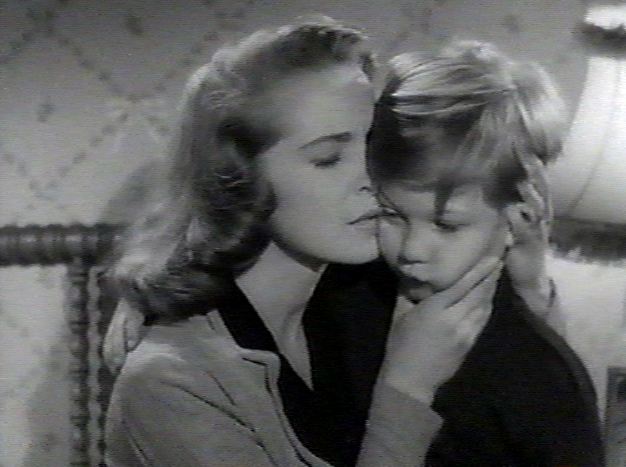
Janet Leigh plays the single mother of little Timmy, played with all-American boy golly gosh sweetness by young Gordon Gebert. Master Gebert has a cute line when, given a present he especially wanted, replies, “I’m so happy if I was a dog, my tail would be wagging.” It’s something a six-year would say.

A war widow, Janet Leigh still keeps the lamp in the window by subconsciously, and sometimes consciously, raising her boy to be a replacement for his father, and by not allowing a new husband and father a place in her heart.

Not that Wendell Corey isn’t trying. He plays her attorney beau, a steady, nice guy with an easy, intelligent manner who waits patiently for her to accept his marriage proposal, washes the dishes with her, and meanwhile works hard at being Timmy’s pal. Timmy is ambivalent, for his mother is raising him to be, like her, self sufficient and needing nobody but each other.

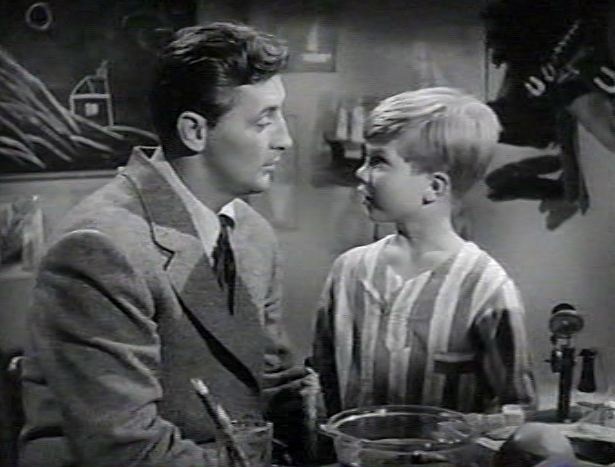
Enter Robert Mitchum, just as good at being a charming sweetie as he is being a sadistic scary guy. Who’d have thought? He and Miss Leigh cross paths in a department store, and continue to cross paths throughout the movie in situations both coincidental and contrived. He wins Timmy over first with his playfulness and man-to-man camaraderie, but Janet Leigh is more resilient. He has to hammer home some painful truths to her before she allows the war to be finally over.

I like the scene where Mitchum and Corey ruminate on how it doesn’t seem to snow as much as when they were kids, and how Corey muses it might have something to do with the atom bomb.

As we mentioned in our last post on “The Shop Around the Corner”, we’re looking at a commercial Christmas in these posts. What had been a cozy and quaint 1930s gift shop on a snowy Budapest side street in that movie becomes a bustling downtown post-war department store here. The kind of scene for which many old movie buffs are, in these days of mega malls and online shopping, nostalgic for, despite how the inconvenient dressing up and taking a cab downtown would seem today.

We love this old stuff, but I wonder if we have the guts and stamina, and patience for it?

Particularly clever is the use of electric trains, the iconic Holy Grail of Christmas presents, and also a foreshadowing of a cross-country train trip Mr. Mitchum intends to take to start his life over.

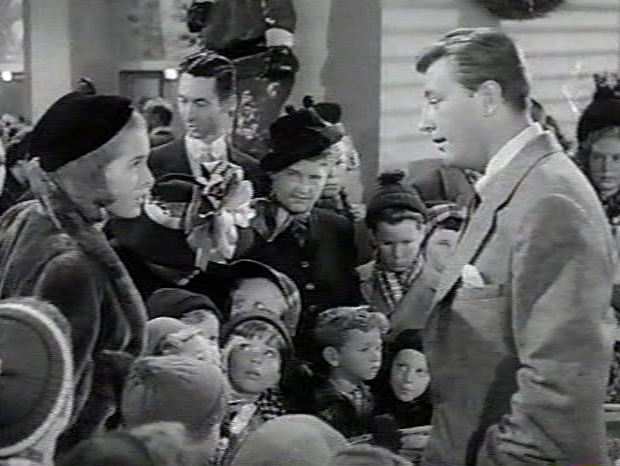
When the opening credits roll, we are shown a train barreling by, and as the camera pans back from the countryside, we see that it is nothing more than a toy electric train setup in a store toy department. Robert Mitchum takes center stage, part Pied Piper and part pitchman, as he demonstrates the marvelous toy trains to the rapt audience of kids. He is a salesman here, a hero to his young customers, a bane to the suspicious floorwalker who keeps an eye on him.

Janet Leigh buys a train, but not for her little boy who would kill for one. She is a comparison shopper incognito, a kind of commercial spy who investigates prices, quality of merchandise, buys trains and then returns them. Mr. Mitchum is on to her, but when he fails to report her to the manager, his floorwalker nemesis turns him in, and he’s fired. Out of job at Christmas.

His dream is to travel to California and work at a boat building business, but he needs the dough to get there. Still, he buys Timmy the train he won’t otherwise get for Christmas, and puts himself next in line behind Wendell Corey for Janet Leigh’s hand in marriage. If she can just realize the fact that she’s free to marry.

A couple of good scenes are the Christmas dinner with Janet Leigh’s in-laws, a kindly elderly couple, played by Esther Dale and Griff Barnett, doting on the grandson who reminds them so much of their deceased son. Wendell Corey and Robert Mitchum also have seats at the table, and for a while it’s very pleasant how these grownups behave so grown up, suppressing their own angst and desires for the sake of Christmas.


They give toasts, and when it’s Mr. Mitchum’s turn, he frankly states his case, in lawyer-like fashion, to the lady and her lawyer that he wants to marry her. Rarely has a personal confrontation come off as so classy.

It’s also a punch in the gut for Wendell Corey to have to sit through it, for Janet Leigh who fears it, and for her in-laws, who gamely suffer the logical discussion of who is better to be their grandson’s next father, a replacement for their son.

Another good scene is when Mitchum calmly blasts her between the eyes with self knowledge at its most uncomfortable, of what she is doing to herself and her son by not letting go of her widowhood.


Likewise when Wendell Corey breaks off with her, acknowledging to her what he has known for some time, she just doesn’t love him. It’s killing him, but he faces it stoically. Neither men try to beat each other’s time; they just want the facts which Janet Leigh is too frightened, or guilty to face.

Just before the end credits roll, we see a real train trip and watch Robert Mitchum take off on his new life adventure, but not alone. Just as at the beginning, the camera pulls back and the train cleverly becomes a toy again on a new train setup with tiny palm trees of his California destination. It’s like “Holiday Affair Meets Gumby.”

By the way, this film was released on Christmas Eve, 1949. In this previous post, we covered how most Christmas-themed movies were not released during the holiday at all.

Thanks for shopping with me this week. And for carrying the packages. You can put them down, now. For those who celebrate Christmas, I wish you a peaceful and pleasant holiday.

For all readers of this blog, I have a gift (should you choose to accept it, as they used to say on “Mission Impossible”). For today only you can order my novel “Meet Me in Nuthatch” FREE from Smashwords. This is an ebook, which can be downloaded to any ebook reader in different formats, and can also be downloaded to your computer and read on your computer without needing any Kindle or Nook or other ereader. When you go through the checkout, put in this coupon code: JQ29S -- and your book will be free.

Merry Christmas.

Related Products