IMPRISON TRAITOR, PEDOPHILE, AND CONVICTED FELON TRUMP.
Showing posts with label Don Porter. Show all posts

Thursday, October 22, 2020

The Turning Point - 1952


The Turning Point (1952) depicts a government committee’s investigation of organized crime. In film noir style, it becomes a kind of anti-crusade, a bleak tale of shattered illusions, of mobsters who get away with pretty nearly everything just by seeing how far they can go, of cops on the take, and a romantic triangle that blows up into bits.


This is our entry into the Politics on Film Blogathon hosted by the Classic Movie Blog Association.
  Have a look here at more participating blogs.


Edmond O’Brien plays the head of the investigating committee, a college-educated, idealistic, and unimpeachable hero out to crush the gangsters and their tenacious reach into law enforcement and politics.  Though he states he has no political ambitions himself, nailing the crime syndicate would be his ticket to fame and almost any future political office he wants.


William Holden is his boyhood pal, now a cynical and savvy reporter who will follow the doings of the do-gooders and spare them as little mercy in his crusty observations as he does the mobsters.  The two of them are 1950s men in the gray flannel suits, better educated than their fathers, and considered to be more successful, certainly with more polish. But rather than easier, their lives seem even more complicated.


Alexis Smith also has considerable polish.  She is also college-educated, and comes along with Edmond O’Brien as his gal Friday.  She holds a kind of secretary’s position, we gather, but she is seen more often pouring coffee than taking notes, and hosting cocktail parties for the committee.  Holden sizes her up with a sexist if not exactly misogynistic attitude, noting at once that this apparently high-class society dame might be slumming.  He senses phoniness.  She challenges his self-superiority and his cynicism with her own well-pointed remarks and a withering glance or two, getting him only to admit that as a reporter, he only points out the problems of life and never the solutions.


Tom Tully plays Edmond O’Brien’s father, a tough cop.  Tom Tully is one of those wonderful character actors equally adept as playing lovable as playing hard-edged and sarcastic.  Mr. O’Brien invites his dad to help in their investigation, counts on it, but Tully begs off, wanting no part of politics or some high-tone committee holding meetings in a swank hotel ballroom.  He says he’s just a cop and wants nothing more than that until they pension him off.  O’Brien insists that he wants an honest cop like Dad on his side.
 

But Tully is a cop on the take.


William Holden, who always seems to be giving everybody the side-eye, suspects this almost immediately and spends a good deal time tailing Mr. Tully, who is working directly at the pleasure of the head mobster, played by Ed Begley, who is so effective in these kinds of blustering, snide roles.  Tully got involved with the mob years earlier when he wanted more money to send his boy Edmond to college.  So we have the irony of Edmond’s superior education and supposedly superior morals bought with dirty money.


Tailing Tully brings us some wonderful location shots of the more run-down neighborhoods of Los Angeles (though the movie is evidently supposed to be set in some fictional Midwest town). There is a great sequence on the Angel’s Flight funicular, which we covered in this previous post.


Don Porter is also one of Ed Begley’s boys, as is Danny Dayton.  Even Whit Bissell, whom we see briefly when Tully goes to ask for some official records to be photo-stated, is also on the take when he rats to the mobsters that Tully has copied some info on them he shouldn’t have.

The result is Ed Begley putting out a hit on Tom Tully, and also having the mobster who shoots Tully to be killed in turn.  Nobody left to implicate him.  Anybody’s expendable, according to Begley.


William Holden, along with his cynicism for do-gooders as to how much good they do, now carries the burden of keeping the knowledge from Edmond O’Brien that his father is a crook.  Holden confronted Tully and gave him a chance to go straight by getting the info on Begley, for which Tully was murdered, and for which Holden now feels responsible.  If that wasn’t enough to carry on his plate, Alexis Smith shows up at his apartment to confront his arrogant detachment, and when he takes her on another tailing of bad guys, pretty soon she’s pouring his coffee as his gal Friday. Alexis is smart, and fearless, and honest with herself and others, and he likes that.  It’s a role Alexis plays so well, her intelligence and her elegance is part of her sexiness.  Pretty soon he has another burden; he’s betraying his best buddy.

Edmond O’Brien, who declares, “I’d rather nail one crooked cop than a hundred hooligans,” will eventually be crushed to find out his dad is one.  In the meantime, his dad has been murdered.


Edmond also catches Alexis with her head on William’s shoulder, but he asks no questions.  Some things can keep, or maybe he doesn’t really want to know.

One standout feature of the movie is the televised committee hearings conducted by Edmond O’Brien as he deposes the lesser figures in the crime syndicate in order to get at the top.  This is based on the Senator Estes Kefauver hearings on organized crime from 1950 and 1951 as a special committee of the United States Senate.  This was for forerunner of all the televised investigations that would become part of our social zeitgeist through the decades: the Army-McCarthy Hearings, Watergate, right up through the Impeachment of Donald Trump. 


Such TV hearings make us familiar with the individuals of our legislature, make household names of senators from states other than our own, and become part of pop culture.  We may expect that the trajectory of his political career will only rise for Edmond O’Brien after this. (Two other films released this same year of 1952 also featured Kefauver-like committee hearings: The Captive City and Hoodlum Empire, so we can imagine the impact that first-ever live TV hearing made on America.)


Carolyn Jones stands out in her debut film performance as a comic gangster’s “moll” being questioned by the exasperated Edmond O’Brien.


One of the witnesses blurts out the information that a company owned by Ed Begley will yield documents pointing to his guilt, and while O’Brien and his men prepare to follow this lead, Begley arranges an intricate setup of a gas explosion and fire that will destroy the building, and the apartments above it. When one of his men questions him going that far, murdering a bunch of residents in the building just to cover his tracks, Begley sneers, “You wouldn’t think we’d do it?  That’s what makes it good.  I don’t think a jury would believe it either.”  Pushing evil to the extreme to dare people to believe their own eyes is another tactic used infamously today.

Walking among the bodies of innocent victims after reaching the blast too late, Edmond O’Brien is disgusted, defeated, and he wants to give up, but Holden urges him to continue.  He tells him about his father’s being a crooked cop and makes the frank, and in spite of himself, idealistic viewpoint, “Even allowing for the apathy of the people and their lack of integrity and their occasional lack of intelligence, and that’s the fact that they all want desperately to believe in a certain majesty of the law.  And for people like you and me, the greatest crime in law is the lack of faith in the law, and that’s when we join hands with the hoodlums.  If they can convince us of the uselessness of knocking out crime, the difficulty, the fact that personal sacrifices may be too great, then we might as well hand over the city and the state and the nation, too…”

Then O’Brien and Holden shift gears to separately track down the girlfriend of the mobster who shot his father, because she has more info that would nail Ed Begley and she wants to talk.  Adele Longmire is great in her brief scenes. It’s a suspenseful search, but we find ourselves in the bowels of boxing arena (which is actually the Olympic Stadium in L.A.) where Holden is hunted by an assassin, played by Neville Brand.


Alexis catches up to him, but he pushes her away just the gun trained on him is fired.  Edmond O’Brien shows up too late again, and though we are certain by now that there is enough evidence on Ed Begley to bring the racketeers to justice, we don’t see that happen in front of us, and we are left with an ambiguous ending also for what future Edmond and Alexis are going to face.  The individual stories of the trio are brushed aside, made almost irrelevant in the wake of the enormity of political intrigue.

The Turning Point can be seen, at least for now, on YouTube if you want to have a look.

Have a look at the other great blogs participating in the Classic Movie Blog Association’s Politics on Film Blogathon.

************

Jacqueline T. Lynch is the author of Ann Blyth: Actress. Singer. Star. and Memories in Our Time - Hollywood Mirrors and Mimics the Twentieth Century. Her newspaper column on classic films, Silver Screen, Golden Memories is syndicated nationally.  Her next book, a collection of posts from this blog - Hollywood Fights Fascism - is available for pre-order here on Amazon.


Thursday, February 21, 2013

Resisting Enemy Interrogation - 1944


“Resisting Enemy Interrogation” (1944) is an intriguing film partly because of what it accomplishes, and partly because of what it represents.  It was a training film made by the Army Air Corps, but tells a story so skillfully that it was nominated for an Academy Award for best feature-length documentary.  Some well-known Hollywood stars appear in it, and some unknowns who later became stars.
This post is part of the Fabulous Films of the 1940s Blogathon hosted by the Classic Movie Blog Association.  Please visit the other blogs listed here at the CMBA website for more great films of the Forties.
“Resisting Enemy Interrogation” is a short film, only just over an hour, that shows a bomber crew being captured by the Germans.  The film begins with the narrator, Lloyd Nolan, who will also appear later on in the film as a US debriefing officer.  Nolan drones the comfortable opening words, “Tired of it all, gentlemen?” 
The camera pans on a pleasant pastoral scene, but an undercurrent of tension soon begins to filter through and we are brought to an interrogation camp in this idyllic countryside where the men of this crew, and us by proxy, will be put through a very serious test.  How much will they reveal to the enemy? 
 
The film was made by the US Army Air Corps First Motion Picture Unit (or FMPU).  We’ll discuss more about this unique unit of World War II American forces next week.  Hundreds of films were made by this unit, some were for raising morale, some were meant for recruitment, but most were like “Resisting Enemy Interrogation”, training films.
One of the marvels of US participation in World War II was our country’s speedy production of war materials (we had a lot of ground to make up when our enemies had spent a generation preparing for war), and also our speedy preparation of fighting troops.  We took hundreds of thousands of civilians with no military experience and en mass turned them into warriors.  Urgency and survival compelled us to act quickly.  One of the best tools for doing this turned out to be film.
The young people who became our fighting forces were the first generation to have grown up watching movies.  What better device to teach them?  This was a new tactic for teaching, not only for the military, and would lead to the use of multi-media in education ever afterward.
“Resisting Enemy Interrogation” was not just a series of do’s and don’ts.  It had a story, and what may be surprising to the audience is that the Germans here are not presented as bombastic, evil, stupid stereotypes.  They are the tricky enemy, to be sure, with no good intent.  But we look over their shoulders watching their efforts to deceive the Americans; we spend as much time observing their viewpoint as their captives'.  Their calm sleuthing is set against the Americans’ anxiety.  It makes for a fascinating story. 
 
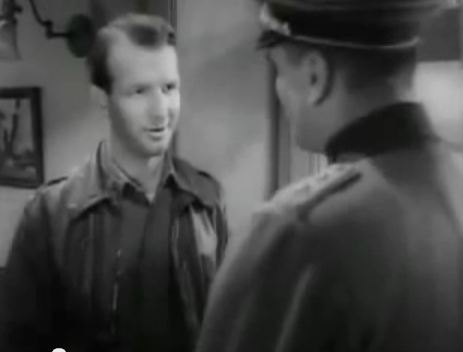
As the American crew is led to their captivity, they are warned by co-pilot Don Porter, “We will not talk.”  He reminds them they are to provide to the enemy only their name, rank, and serial number.  As the movie unfolds, we see the many devious ways the Germans have of extracting more information from them—using trickery, kindness, intimidation, and even using simple small talk as a way of furthering how much information they acquire.
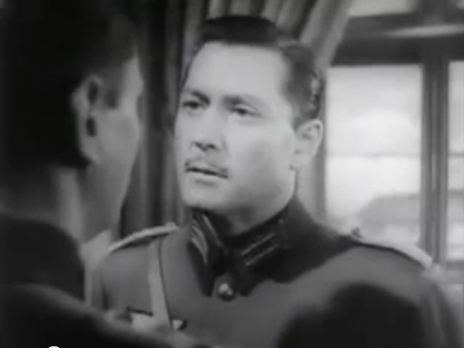
The German head of command, played by Carl Esmond, whom you may have seen in dozens of films and TV, is a clever, mannered chap who is teaching a new officer (and us) about interrogation.  He remarks, “Just as there is no such thing as an innocent question, there is no such thing as a valueless statement.”
Anything the American men say can be useful to the enemy.  One by one, through the course of this film, we see how they are tricked.  If we found ourselves in the same situation we might be fooled in the very same way.  It all seems so innocent.
Like many of FMPU’s films, this had a cast largely of unknowns, some of whom would later become more familiar to us.  Don Porter plays an officer in the downed bomber crew, easy going, and genuinely surprised to be given a nice room and treated royally by his captors.  Later in the film when Commandant Esmond primes the pump by dropping hints that he already knows all about the bomber’s mission, Porter shrugs, figures, oh, well, if it’s common knowledge—and spills facts.
Kent Smith plays a German officer who was raised in the US, and so with his knowledge and his comfortable camaraderie with the American boys, tricks them into trusting him.
Hans Twardowski has minor role as a German Red Cross representative, also out to trick the men into filling out Red Cross forms that ask too much information.  You may remember him from “Casablanca” as a Nazi soldier.
James Seay plays the bomber crew Captain, most stalwart of the group, yet even he slips up and gives information he has no idea he’s giving.
Arthur Kennedy is a standout in the film as a cocky crewmember who thinks he’s going to outwit the Germans by giving them false info, but they are onto him and twist his words so that they find out the truth.  Kennedy gives a raw performance as man who is clearly rattled by these mind games.
It’s interesting to watch the Germans cleverly sort out the mystery of where the downed bomber came from, and where it was going.  By putting together small bits of information the men have unwittingly given them in unguarded moments, the Germans discover where the next raid of American bombers is likely to come from and where their next target is to be. 
When that next bomber mission occurs, the Nazis are waiting for them.  They shoot down most of the squadron of planes.  The footage, simulated obviously, of the American planes being shot down is not what that first generation of boys who grew up on movies would have ever expected to see.  It is brutal, with planes on fire, with machinegun fire ripping through crews, and images of blood spurting from the heads and faces of pilots and gunners.  The lesson about not talking is driven home graphically.
Only a few crews from this mission limp home.  They are debriefed by Lloyd Nolan, and bewildered over how the mission could have failed so badly. 
Rand Brooks has a small part as an American  back at the base, who grimly makes the accusation, “Somebody talked!”
George O’Hanlon, whom you might remember from a bunch of “Joe McDoakes” shorts also appears back at the base.  Mel Torme has a bit part as a pilot, though I confess I didn’t spot him.
Craig Stevens plays a returning pilot back at the base as well, interrogated by Lloyd Nolan after the disastrous mission.  Nolan, in that wonderfully edgy, serious tone that makes you pay attention to him no matter how quietly he is speaking, calms the men and tells them that the only information they are ever to give is their name, rank, and serial number.  Above all, don’t talk.
 
Then he looks right into the camera, right at us.  “Don’t talk.  Don’t talk.  Don’t talk.”
We may never talk again.
The FMPU was comprised of men from all the different Hollywood studios.  Some of them were not actually in the Army Air Corps, like Nolan, and like occasional guest actor Guy Kibbee.  The others who were, ranged from actors, writers, directors, cameramen, many of whom served their entire hitch here in Hollywood, and others who went on combat missions photographing the war, or to serve in other units.  More on that next week.
I’m not certain at this time the military rank of the men who performed in this film or many other FMPU training films.  I do believe Arthur Kennedy was a sergeant.  I believe Craig Stevens was a corporal.  Sgt. David Rose, incidentally, composed the music score for this film.
The AMC channel broadcast a documentary in 1997 made by Gregory Orr Productions called
“Hollywood Commandos”, about the First Motion Picture Unit, and we’ll be discussing that next Thursday.
“Resisting Enemy Interrogation”, now in the public domain, can be watched here on YouTube.

Thursday, February 10, 2011

Our Miss Brooks - 1956


Our Miss Brooks (1956) is probably one of the earliest, if not the earliest, movie spinoff of a successful television show. It pales in comparison to the string of TV-to-movie hits (or flops as the case may be) that we’ve been subjected to for a few decades now. This movie is much less flashy and not at all campy. However, it serves a simple purpose: to re-unite us with old friends.

The prosaic adventures of high school English teacher Constance Brooks were first told on radio from 1948 through 1957, an extremely successful nine-year run that coincided with a foray into a television series from 1952 to 1956, and finally, this movie when the TV show ended. Hitting all media, and winning all kind of awards and tributes, Eve Arden finally slipped out of the second banana billing of her film career, and became the star she deserved to be.

The original radio cast included the incomparable Gale Gordon as the blustering Principal Conklin; Richard Crenna’s adenoidal whine voiced nerdy student Walter; Jane Morgan as the scatterbrained landlady Mrs. Davis; Leonard Smith as the dimwitted Stretch Snodgrass, whose malapropos and mangled English gave Connie Brooks a chance to show off her English teaching skills; and Jeff Chandler as the shy, and unassuming biology teacher Philip Boynton. He was later replaced by Robert Rockwell in the role. Gloria McMillan plays Harriet, the principal’s typical teen daughter with the rapid-fire giggle.

The cast was so tight and smooth, that they worked with precision radio screwball comedy for the better part of a decade, and probably the chief interest in this 1956 film, then and now, is for fans of the radio show to see what the characters looked like. The plot doesn’t offer much else. Strangely, the movie “introduces” us to Connie and the gang at the beginning of their all meeting at Madison High School. It makes for an awkward leap, when we already know the characters so well.

A sub plot involves Eve Arden making a special effort to reach a troubled, angry boy in her class, played by Nick Adams. His rich publisher father, played by Don Porter, ignores him, and Miss Arden, while fending off the romantic advances of the father, must bring these two together.

This aspect of the story deepens the tone of the film and shows Miss Brooks as a selfless, compassionate teacher. All well and good, and there should be more such teachers in the world, but what was really special about Connie Brooks wasn’t her deeper qualities, but her superficial ones. The radio Connie was always in financial arrears -- she makes several jokes about a teacher’s salary -- and buys everything on time. She pines for a romantic relationship with Mr. Boynton, and gets herself entangled in embarrassing situations because of it. She is more fallible on radio, and more loveable.

Also missing from the film are Mrs. Davis’ inedible breakfasts, with running gags about MixMasters and Rye Crisp. The movie Mrs. Davis is far more cunning and on the ball than the radio landlady.

The archetypal teens, Walter, Harriet, and Stretch get much less play in the film, and the boys are clearly men by this time, despite their perfect voices that would hide the fact on radio.


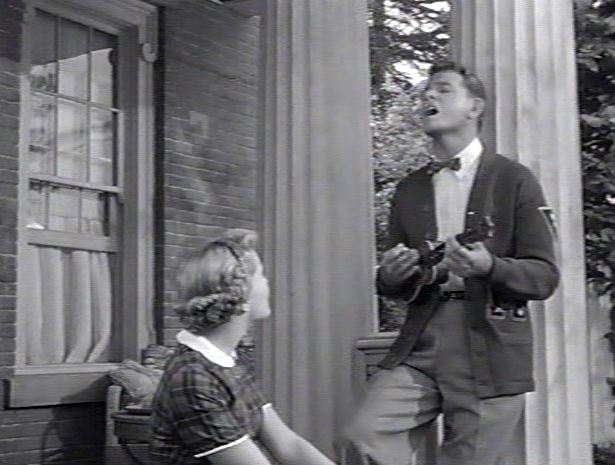
One of the funniest scenes in the movie is when Walter croons the Doris Day hit, “It’s Magic” to his lady-love. I love his unselfconscious flaunting of that tortured voice.

Chiefly missing is the snappy pace of the radio show dialogue and plots. The movie drags its feet here and there. The viewer is bludgeoned with awkward facial reactions and double takes to emphasize a line or joke. They did not have need such visual emphasis on the radio.

Radio also offers a wider screen, if you will. Gale Gordon’s blow-ups or snide retorts are magnified in our imagination when we hear them. When Miss Brooks steps on his glasses, the crunch is funnier for hearing it. The vision in our minds of disastrous surprise parties, indelible Easter egg dye on their faces, Miss Brooks being hoisted down a second-story ladder so that Mr. Boynton can practice being a volunteer fireman, or Miss Brooks, Mr. Boynton, and Mr. Conklin sinking in a rowboat on the radio are hard to top  by this weak, but well-meaning movie.

One radio episode, which involved them driving out of town to attend an “away” school football game is like a Seinfeld episode where “nothing happens” but everything that could possibly happen, happens.

It was a perfect match of witty writing to a suitable medium. We will never see the like again.

The Our Miss Brooks radio episodes are all in public domain now. Listen, or download them here from the Internet Archive website.

The movie is pleasant, but it is really more of a curtain call, or victory lap for the TV show. The radio show would actually run another year, truly surpassing the other two versions.

********************

Jacqueline T. Lynch is the author of Ann Blyth: Actress. Singer. Star. and Memories in Our Time - Hollywood Mirrors and Mimics the Twentieth Century. Her newspaper column on classic films, Silver Screen, Golden Memories is syndicated nationally.  Her new book, a collection of posts from this blog - Hollywood Fights Fascism - is available here on Amazon.

Related Products