IMPRISON TRAITOR, PEDOPHILE, AND CONVICTED FELON TRUMP.
Showing posts with label Edward Arnold. Show all posts

Thursday, October 31, 2024

We Hold These Truths - a radio reprise


Major Hollywood stars of the day participated in this live radio broadcast dramaticizing the significance of the United States Constitution and the Bill of Rights.  At the conclusion, Jimmy Stewart, who had been narrating at the microphone, pulled back, whipped his headphones off, and burst into tears.


It was one week after Pearl Harbor.  This monumental broadcast was described in this previous post.  It's time for a reprise, a pivotal time just as dangerous to our country as our entry into World War II after the Pearl Harbor attack.  Listen to it.  This is what they were fighting for.  

This is what we are voting for.  The stakes were never higher.


Here is a portion of that original post from 2017:

Walter Huston is a blacksmith.   He doesn’t want anyone telling him he has to pray the way somebody else tells him.  Doesn’t like state religion.  Wants to make sure there won’t be any.

Others are suspicious of authority.  They know that just wanting law and order isn’t enough—Nero had such.   

Marjorie Main plays a woman whose husband died in the war.  She wants guarantees that he didn’t die in vain.

Edward Arnold is a bricklayer who argues that the work is unfinished.  There’s only a foundation and no house.

So many voices, so much dissent, so much yearning for rights.   We are taken on a journey not only through history, but through the minds and souls of this nation.

Thomas Jefferson, Patrick Henry, James Madison lend their voices, and George Mason warning us not only about a monarchy, but a “tyrannical aristocracy” taking over, the monied class.

Now the First Congress begins sifting through the amendments to the Constitution and hammering them out for the future.  It’s not an easy job, but it’s important and they persist.  Stewart passionately narrates, cajoles, shouts.

Most profound is Orson Welles’ impassioned speech.  He takes over at this point and adds the other voices to the founders of the Bill of Rights – not just the men in Congress, but from the victims of the ages – “They had much help, the many nameless and unknown – from bleeding mouths, burnt flesh – from numberless and nameless agonies.  The delegates from dungeons, they were there.  The delegates from ashes at the bottoms of the stakes were there.”

We hear a voice, weak, pleading.

Orson continues, “The gallows delegates, whose corpses lifted gently in the breeze, they too…”

His voice grows booming, horrified:  “The Christians killed for being Christians, Jews for being Jews, the Quakers hanged in Boston town, they made a quorum also… The murdered men, the lopped off hands, the shattered limbs, the red welts where the whip lash bit into the back.  Must you know what they said?  Must you know how they argued?  Must you be told the evidence?

“Listen, then!”

We hear a blood-curdling scream.

“That was an argument for an amendment.”

They are words for our times, how shockingly, sickeningly current.

Traitor Trump, among his other vile crimes and deeds, has stated that he intends to suspend the Constitution.

Vote while you still have the right.


************

Jacqueline T. Lynch is the author of Ann Blyth: Actress. Singer. Star. and Movies in Our Time - Hollywood Mirrors and Mimics the Twentieth Century and Hollywood Fights Fascism and Christmas in Classic Films. TO JOIN HER READERS' GROUP - follow this link for a free book as a thank-you for joining.

***************

My new non-fiction book, CHILDREN'S WARTIME ADVENTURE NOVELS - The Silent Generation's Vicarious Experience of World War II -- is now available in eBook here at Barnes & Noble, Apple, Kobo, and a wide variety of other online shops.

Or here from my Shopify store if you want to buy direct from me and avoid the big companies.

And it is here in eBook, paperback print, and soon, hardcover, from Amazon.

From Cherry Ames, to Meet the Malones, from Dave Dawson to Kitty Carter - Canteen Girl, the Silent Generation spent their childhood immersed in geopolitical events through the prism of their middle grade and young adult books.  From the home front to the battlefield, these books are a window on their world, and influenced their hard-working, conformity-loving generation.


Thursday, August 10, 2017

We Hold These Truths - Hollywood Broadcast


A week after the attack on Pearl Harbor, a program celebrating the 150th anniversary of the Bill of Rights was produced on all four radio networks of the day – CBS, NBC Red and Blue networks, and the Mutual network.  It was narrated by James Stewart, and a host of Hollywood players joined him in bringing to life not only the struggles of post-Revolutionary War America to come up with this Bill of Rights, but how important it was to reflect on it, and rely on it, in a time of modern troubles.  The program was performed live.

It is a remarkable and deeply emotional dramatization that not only speaks to us today, but sings, shouts, cries, and cheers.  Norman Corwin wrote the beautiful script, performed on December 15, 1941, and it is estimated over half the U.S. population listened to it.  Performed in a Hollywood studio, live hookups also included performances in New York City, and an address by President Franklin D. Roosevelt from Washington, D.C.  Bernard Herrmann composed original music for the program, and at the very end of the show, Maestro Leopold Stokowski conducted “The Star Spangled Banner.”

James Stewart was, at that time, a corporal in the Army Air Corps, loaned to the project for the occasion.  His fellow players included Edward Arnold, Lionel Barrymore, Walter Brennan Marjorie Main, Bob Burns, Walter Huston, Edward G. Robinson, Rudy Vallee, and Orson Welles.

Walter Huston, rolling his r’s, introduces the program.  Then, the familiar voice of Lionel Barrymore is brought to the mic.

“My name is Barrymore. I’m one of several actors gathered in the studio in California….”  He joins 130 million fellow Americans in praise of a document “that men have fought for, that men are fighting for…”

He announces the cast, and adds, “Our names are meaningless unless your names are added.”  

Then one by one, the cast fills in, leaving their Hollywood personas and adopting the guise, in our imaginations, of post-Revolutionary Americans.  Jimmy Stewart like his character in Mr. Smith Goes to Washington (1939),which we covered in this post, leads us on a tour of modern Washington, D.C., and as he describes monuments and their inscriptions, we are reminded of the movie, for he is intentionally channeling Mr. Smith’s awe and wonder.  

Not only the message, but the script beams with elegant writing, no longer in fashion.  Perhaps it is too idealistic, and we have learned to distrust everything.  

On the National Archives building it is written,  “ What is past, is prologue.”  We hear the clicking of footsteps as Stewart climbs the stone steps to see the Bill of Rights in glass – the old parchment with faded writing.  Then Stewart and the other actors proceed to bring it alive.  “The words are dim, but not the meaning of the words…”  Perhaps not.  Perhaps we need this lesson.

Stewart brings us to the hall as the great men rise to speak and call the roll, to sign their names the draft when Constitution is written, which is then brought back to the states for review, but the people are suspicious.  They want guarantees of certain protections.  And so, this is the story of how the Bill of Rights came to be added as the most important addendum in history.  

Other actors jump in to be those common people in the different states who express their curiosity for the new document, but who want more guarantees, more explanations of just what they have won in the Revolutionary War.

Walter Huston is a blacksmith.   He doesn’t want anyone telling him he has to pray the way somebody else tells him.  Doesn’t like state religion.  Wants to make sure there won’t be any.

Others are suspicious of authority.  They know that just wanting law and order isn’t enough—Nero had such.   

Marjorie Main plays a woman whose husband died in the war.  She wants guarantees that he didn’t die  in vain.

Edward Arnold is a bricklayer who argues that the work is unfinished.  There’s only a foundation and no house.

So many voices, so much dissent, so much yearning for rights.   We are taken on a journey not only through history, but through the minds and souls of this nation.

Thomas Jefferson, Patrick Henry, James Madison lend their voices, and George Mason warning us not only about a monarchy, but a “tyrannical aristocracy” taking over, the monied class.

Now the First Congress begins sifting through the amendments to the Constitution and hammering them out for the future.  It’s not an easy job, but it’s important and they persist.  Stewart passionately narrates, cajoles, shouts.

Most profound is Orson Welles’ impassioned speech.  He takes over at this point and adds the other voices to the founders of the Bill of Rights – not just the men in Congress, but from the victims of the ages – “They had much help, the many nameless and unknown – from bleeding mouths, burnt flesh – from numberless and nameless agonies.  The delegates from dungeons, they were there.  The delegates from ashes at the bottoms of the stakes were there.”

We hear a voice, weak, pleading.

Orson continues, “The gallows delegates, whose corpses lifted gently in the breeze, they too…”

His voice grows booming, horrified:  “The Christians killed for being Christians, Jews for being Jews, the Quakers hanged in Boston town, they made a quorum also… The murdered men, the lopped off hands, the shattered limbs, the red welts where the whip lash bit into the back.  Must you know what they said?  Must you know how they argued?  Must you be told the evidence?

“Listen, then!”

We hear a blood-curdling scream.

“That was an argument for an amendment.”

They are words for our times, how shockingly, sickeningly current.

“How much of all this must be told to be believed?  How much of this must be diagramed: X marks the spot where decency was last observed?”

Nero was there, Caligula, Cotton Mather, all the tyrants were observing in the hall.  “All the long and bloody history of fanaticism, murder in the name of God.”  

Christ was there too.  “He, too, sat in the Congress, the mild Man, with scars in His hands and feet where the spikes went through.  He was a consultant in the business at hand.  Had He not died because the rulers of the realm denied free speech?  Was He not nailed up on a cross between two thieves because His preachments were considered treason?”

Orson growls, wails his words.  “Out of the agonies, out of crisscrossed scars of all the human race they made a Bill of Rights for their own people…To stand against the enemies within, connivers, fakers, those who lust for power, those who make of their authority an insolence.”

Listen to Orson’s impassioned speech, and think of now.

The Bill of Rights “Threw up a bulwark…and made a sign for their posterity against the bigots, the fanatics, bullies, lynchers, race haters, the cruel men, the spiteful men, the sneaking men, the pessimists…”

The Bill of Rights is ratified!  Jimmy Stewart breathes easier and brings the document to the thirteen states.

Then Edward Arnold, Walter Huston, Marjorie Main, Walter Brennan and others join in as the amendments are read, each one, and voices answer to illustrate what each one means.  We go to the homes of farmers, the blacksmith shop, all the new citizens.  The war gave them separation from Great Britain, but the Constitution and the Bill of Rights makes them citizens.

We hear a woman tending the grave of her soldier husband.  We hear a Colonial folk tune.  Through all, James Stewart’s folksy ruminating weaves a thread to guide us to the present.  Edward G. Robinson is a political protester who praises the rights that allow him to speak and fight corruption in city hall.

“A promise is a promise,” Jimmy Stewart says, “Has America’s been kept?”

It is a fair question, but in only a short time Japanese Americans would have their rights taken away by virtue of their ethnicity.  It was not the Bill of Rights that failed them; it was their fellow citizens and a president and government who shamefully allowed their mistreatment.  Even in those days when war was declared and Americans were coming together for mutual support, even in times of great pride, patriotism and cheerleading, something monstrously unfair could occur.  How much easier it is to occur in times when we are not one, when we are fighting amongst ourselves?  When a foreign enemy knows how to divide and conquer.  Abraham Lincoln said:

“From whence shall we expect the approach of danger? Shall some trans-Atlantic military giant step the earth and crush us at a blow? Never. All the armies of Europe and Asia...could not by force take a drink from the Ohio River or make a track on the Blue Ridge in the trial of a thousand years. No, if destruction be our lot we must ourselves be its author and finisher. As a nation of free men we will live forever or die by suicide.” 

We've come to that suicidal brink, however, with the aid of Vladimir Putin’s mafia, and the fascism that is rotting our government. We have far superior technology in our media than they did when this radio program was broadcast in December 1941, but we have lost the gift of eloquence that they possessed then.  Such well-written and carefully crafted words would today seem to be talking above the heads of the crowds whom the spokesmen try to reach.  Maybe because they are above the intelligence of the spokesmen.


This was a live program, so neatly coordinated, so passionately and intimately put together.  Listen to this program and marvel not only at how it was written, acted, and produced according to the technology of the day when we were only a week at war, but marvel – for God’s sake, marvel at the message of warning, of love, and of integrity, of pride for our Bill of Rights.

At the end of the program, James Stewart introduces in a soft, gentle voice President Roosevelt, who then speaks live from Washington, D.C.   “Ladies and gentlemen, the President of the people of the United States.”

Of the people.

It was reported by Screen Guide magazine in the March 1942 issue, from which some of these photos are taken, that after James Stewart introduced the President, he ripped off his earphones at the mic, and burst into tears.


Listen to We Hold These Truths or download at the Internet Archive, or here at YouTube.


Thursday, February 9, 2017

Easy Living - 1937


Easy Living (1937), despite the surface of innocent goofiness, is a remarkably sophisticated reflection of Depression-era attitudes and coping.  We should expect nothing less from the marvelous Jean Arthur.

The tale is deftly told, both in term of script, direction, and the precise timing of the actors; and yet the premise is ridiculously simple: Jean Arthur, a struggling working girl rides in an open-top bus and an expensive fur coat lands on her head.  That triggers a series of events involving mistaken impressions, taking us and Jean on a riotous adventure.  Along the way fools are exposed, suffer consequences of their own making, and are ultimately redeemed.  There are no real villains or heroes—though Jean is an Everywoman who rides the waves with dogged determination to just get by.

Edward Arnold plays a blustering millionaire banker with his usual aplomb, but this is no bad guy such as he played in Meet JohnDoe (1941).  We really have to admire his ability to use basically the same techniques and equipment to play sinister as well as he does silly.  One of Hollywood’s most talented and solid character actors, Mr. Arnold could do both with ease.  Part of the film's sophistication lies in the very presentation of Edward Arnold’s character, though rich and supporting an indolent wife and son living in wasteful fashion, his not being an evil rich man.  He’s really just a regular guy—not overly nice, but not overly terrible, either.  Just a guy; and we may even feel sorry for him when his spendthrift son, played by Ray Milland, spends $11,000 for a foreign sports car, and his wife (played by Mary Nash) spends $58,000 on yet another fur coat (she has a closet full of them.)  Fed up, Mr. Arnold throws the new fur coat off the roof of their townhouse.

Though the cook’s charge to him, “Go fry yourself in lard, you dirty capitalist,” is pretty funny, it's a lightweight comment on Arnold's extreme wealth; he’s just mad he was told to use lard in his cooking.

The fur coat lands on Jean’s head, and though she attempts to return it when she meets up with Arnold, he insists she keep it because he’s furious with his wife.  She does not know it’s mink; he has told her (because his wife has told him, in a lie) that it is a Kolinsky, which is a species of weasel from which inexpensive coats were made (as well as artist’s sable brushes).

She is also blissfully unaware that those who have observed her with Edward Arnold and wearing his gift of a mink coat—believe that she is his mistress.  The fawning florist, played by the wonderful Franklin Pangborn, who can take disdain and disgust to levels of high art, and Mr. Louis Louis, played by Luis Alberni, who runs a downtown hotel and is in debt to Banker Arnold are two such gossipers.  He offers Jean a resplendent suite in the hotel to appease Mr. Arnold, curry his favor, and get him to extend his loan.  Soon, the whole town is talking about Banker Arnold and his mistress, but he has no idea of the gossip, and neither does Jean.  But her newfound reputation as a kept woman has left her jobless—her publisher at The Boy’s Constant Companion fires her for the rumors over her questionable lifestyle—and has left her homeless, as she is  behind in her rent already, and being without a job will put her on the streets.

Two indelible scenes are the result: when Jean smashes her piggy bank for food money and comes up with only a couple coins, and when she takes the coins to the Automat.  We covered the old movies’ love affair with New York’s Automat in this previous post.

The piggy bank is a master class in comedy.  Jean puts a Kleenex blindfold on the pig before she tries to hit him with her shoe.  Her first swipe misses completely—no one does comedy like this better.  We are all prepared for the smashing of the ceramic pig, and she bangs the dresser top with the heel of her shoe instead, just missing the pig.  We are fooled, and it’s hysterical.

The Automat is more of a traditional set-up to a food fight.  Ray Milland, son of the millionaire banker, is, unexpectedly, working there as a busboy.  He and his father have split over differences and Ray has no income beyond his father’s largesse.  He feels sorry for Jean, tries to slip her some food from the Automat’s little cubbies, but the boss catches him and a furious melee ensues with street crowds coming in to take advantage of the chaos and eat free food.

It’s the Great Depression.  Nobody in the audience blames them for trying to sneak a meal, but no one is sorry, either, when some of them get the worst of the food fight.  Ray Milland’s not the hero, and the boss who catches him isn’t the bad guy, but nobody blames anybody for doing what they have to, to survive, and to maybe make life a little happier.

But even though everybody’s side is understandable, there is a brilliant put-down to everybody not to take themselves so seriously.  The stuffy and officious publisher of the boy’s magazine (just the name “The Boy’s Constant Companion” is a suggestion of unrelenting bludgeoning piety), is told off by Jean, “You don’t have to get mad just because you’re so stupid.”

Ray, of course, loses his job after the Automat food riot, and Jean, feeling sorry for him, invites him to stay at her palatial suite at Luis Alberni’s hotel.  We tease the Production Code in several scenes, most notably when they both lie in different directions, but head-to-head on a divan close together and engage in sleepy pillow talk.  He seals a quick kiss, and she rouses, but instead of shock or insult, smiles at him with delightful cheeky knowing, and it’s the ol’ Fade to Black.

Of course, in the next scene, she wakes up alone in her large bedroom, and we are told Ray just went out that earlier that morning, so we really don’t know where he spent the night and, with what is true sophistication—it isn’t dwelled on.  We can connect whatever dots we want to ourselves.

Just a note as well on the phone conversations: Jean speaks into two phones at once at her bedside when she is roused by other people wanting to curry the banker’s favor to offer her stuff.  She has no idea what’s happening, she’s harried, a little panicked, and she speaks as if she’s really trying to have two phone conversations at once.  (“I just want to brush my teeth!”)  She never leaves the audience with the impression that she’s faking it; we can easily believe there are people talking to her and badgering her with their salesmanship.

Though her hotel flat is opulent, to say the least, it is not presented—either by Mr. Alberni’s grand tour of the place or in Jean’s reaction to it—as something we should envy.  It all seems less awesome than it is comical, including the large shell-like bathtub that leaves everyone who examines it stupefied as to what it is.  The scene where Ray and Jean inspect it, and accidently get caught in a sudden spray of multi-water jets, is another cheeky jab at the censors as the couple innocently and fully clothed share a bath together in bacchanalian setting.

Another proof of Edward Arnold’s being just a guy is his insistence when he takes a room at this hotel, that he wants “a room with a bath.”  Alberni tries to—wink, wink, nudge, nudge—get him a joining suite with Jean, but Mr. Arnold insists grumpily he wants a room with a bath, as if he’s at the YMCA.

By the way, some of the best exchanges are the rapport between blustering boss and his secretary played by the wonderful Esther Dale.

Ray and Jean are falling for each other, and even though he doesn’t seem like a hero worthy of our Jean, if not the sharpest tool in the shed, he’s a nice guy.  She proves to be the biggest mensch of the lot: when a series of daffy circumstances brings her $18,000 from a stock tip, she gleefully shares half of it with Milland, as if they are teenagers going Dutch at the malt shop.

It is only at the end of the story that she finally understands that Alberni thinks she’s Edward Arnold’s mistress.  Her indignation is smashing: “And you thought I took a sable coat from him?!” She slaps him twice.  We’ve been waiting for that.

To juggle all these characters with their separation motivations, foibles, and failings and make them all gloriously ridiculous but likeable, and to keep Jean the moral compass of all is a splendid coping mechanism with the social, psychological, and emotional ills of the day.  The wolf might not have been at the door in Hollywood where stars made fabulous salaries and moguls owned them, but the movie industry had canny knowledge of what the public wanted, what it needed, and what it was willing to take.  Classic films, like popular music of the day, were a barometer of hard times, good times, scary times.  Despite splashy musical fantasies, there was more that was real in old Hollywood than there is today.  There was a fearlessness, as if, along with Jean, we dare to survive and even to be happy, because there is nothing left to lose. There is something quintessentially American in such good-hearted sensible…nonsense.

***

Come back next Thursday when we sit in court with William Powell in For the Defense (1930).

*********************
The audio book for Ann Blyth: Actress. Singer. Star. is now for sale on Audible.com, and on Amazon and iTunes.


Also in paperback and eBook from Amazon.

Monday, November 5, 2012

Mr. Smith Goes to Washington - 1939


Mr. Smith Goes to Washington (1939) has grown to legendary status. It represents an icon of 20th Century American popular culture. It stands tall among the giants of that pantheon of 1939 films. It generated great controversy at its release, but today, though it enjoys restoration and placement in the Library of Congress as a film of significance, it is perhaps seen in the soft nostalgic glow as just another example of “Capra-corn.”

Its simplicity is both its greatest dramatic asset and its singular fault among critics. That is the dichotomy of any Capra film. Paradox is the order of the day. Just a few examples:

This movie was banned both in Nazi Germany and the Soviet Union for showing the American democratic process in a positive light. However, this film was roundly criticized by Washington as showing senators in a negative light and the political process as being rife with corruption. They wanted it banned, too.

The movie shows corruption in Congress, but no political party is ever named. Claude Rains plays the senior senator, who has compromised his integrity for graft, and James Stewart plays the junior senator from the same state. We do not know with which party they are affiliated. We do not even know which state they are from, but since the story is partly based on a book which named Montana as the home state, the senator from Montana walked out on this movie at its preview at Constitution Hall in Washington. Many other senators were no-shows in protest.

Art reflects life, as we realize the main message of this film is the crime of arrogance. Politics is rife with it. Both political parties are guilty. Graft is graft, no matter who does it.

And it’s easy see how Capra both pulled away and exploited the combustible nature of politics in this film. We take politics personally. We cringe and get our backs up when we hear an opposing political viewpoint. That is human nature. How we behave about how we feel is what makes us ladies and gentlemen…or thugs.

Politics is also rife with idealism, sometimes pure and hopeful in its natural state; sometimes exploited in creative political ads meant to play on the emotions of the public and how well they respond to dramatic backlighting of a candidate in his shirtsleeves superimposed over a waving flag. It’s hokey, and it’s still being done. The arrogance of politicians in believing we are really that stupid.

Director Frank Capra was a conservative Republican. The scriptwriter, Sidney Buchman, was a Communist Party member between 1938 and 1945. Yet, they shared ideals and vision for this movie. (Buchman would be blacklisted in the 1950s when he refused to name names.)

Most of those shots of Washington buildings and monuments were taken on the sly; the United States Parks Service denied the filmmaker access.

One more paradox: despite this canon of idealistic films of Capra’s, Mr. Smith Goes to Washington is actually quite a dark movie, sinister and cynical. James Stewart is the only Pollyanna of the bunch, and by the end of the movie even he gets his teeth kicked in.

Long post ahead. You’ve come this far. It would be a shame to turn back now.

We begin the movie with that heartthrob Charles Lane as a reporter, holed up in a phone booth barking in his sexy nasal twang about the sudden death of a senator and the need for his state to send an immediate replacement.

Only a truly great movie would start the show with Charles Lane.

We learn right off the bat that Edward Arnold, the prototype of the greedy corporate thief, runs his state with an iron hand and a bottomless wallet. Guy Kibbee is the harried governor, who asks “How high?” when Mr. Arnold tells him to jump, much to the chagrin of his wife, Ruth Donnelly, and his large family of children. The kids suggest James Stewart as a replacement senator. Stewart runs the Boy Rangers (because the Boy Scouts of America didn’t want to touch this film with a ten-foot pole) and publishes a boys’ newspaper and recently heroically fought a forest fire.


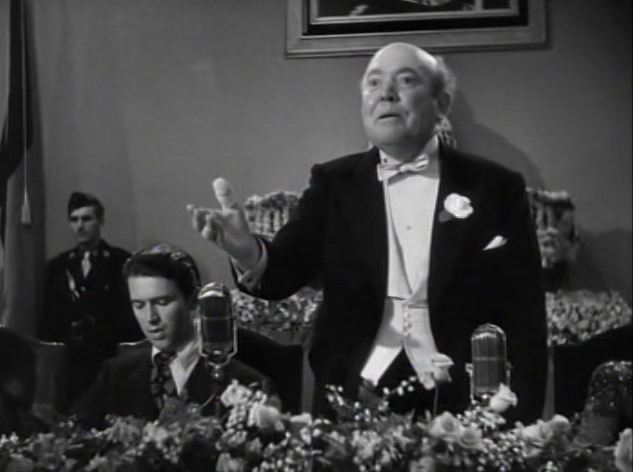
Edward Arnold is great in this film, with his voice kept low and sneering. If he bellowed and blustered it would not be half so chilling as that snide, quiet confidence he displays.

One of the real delights of this film is spotting the character actors. Porter Hall and Grant Mitchell are senators, Jack Carson gets a couple lines as a reporter. Lafe McKee (who we discussed in this previous post) gets a brief, but iconic moment in this film when he stands before the Lincoln Memorial helping his little grandson to pronounce the difficult words in the Gettysburg Address, which is engraved in stone on the building.

As he says the word “freedom,” we get a shot of an elderly African-American man standing nearby, who has removed his hat in respect for Honest Abe. If this man is over 77 years old, he might have been born a slave. Politics is personal.

Eugene Pallette is on board as Edward Arnold’s right-hand man. Catch the scene where Pallette struggles to get his large body out of a phone booth. Dub Taylor, who we last saw in Cowboy Canteen (1944), is a wisecracking reporter who is part of a gang that interviews a bewildered James Stewart upon his arrival in Washington. You might even catch a glimpse of a young Craig Stevens as a reporter in the Senate chamber gallery writing fast and furious with a pencil.

Dickie Jones, the young Senate page who helps out Stewart, you’ve likely seen in many films.

Much of this movie, when it really works well, hinges on the magnificent Jean Arthur. Her performance is transcendent. She is secretary to Claude Rains, and has seen enough of Washington’s seamy side to stamp out any idealism she once might have had. As she tells Rains, “When I came here my eyes were big blue question marks. Now they’re big green dollar marks.”

She is assigned to babysit James Stewart, whom she first regards with eye-rolling bemusement tinged with disdain. Gradually, however, her own latent idealism is re-ignited under his slow-talking, sincere, nervous charm. He tells her about the beauty of his state, and his father, a small-town newspaper publisher who was murdered for standing up to a mining company, and how his father told him to look with wonder at life around him and “Always try to live as if you’ve just gotten out of a tunnel.”

She is moved, in spite of her own misgivings and fear of being duped. You can see all of that in her delicate expression, her sense of breathlessness, and we watch her falling in love with him. As we’ve discussed before, Jean Arthur had a remarkable ability to play pathos and comedy right at the same time. I can’t think of anybody else who could work as well at this deceptively complex role, with perhaps the exception of Barbara Stanwyck. Jean Arthur’s faith in politics and mankind is rekindled, and then dashed again as her heart is broken when James Stewart becomes the prey of Edward Arnold and his machine.

Stewart gets himself targeted when he proposes a bill, with Jean Arthur’s help, to create a national boys’ camp where boys from all walks of life, races and creeds, can come together. The land he chooses is the spot Edward Arnold wants and has been sneakily buying up under false names. Claude Rains, the “Silver Knight,” a respected senator who has been kept in office for decades by allowing himself to be Mr. Arnold’s stooge, must now crush James Stewart on the orders of his boss. He even dangles his society snob daughter, played by Astrid Allwyn, in front of Stewart as a diversion.

Jean Arthur, who knows all of this, is heartsick. One of her best scenes is in the press club bar with pal Thomas Mitchell, as she self-medicates her pain with booze. She and Mitchell also played confidantes that same year in Only Angels Have Wings discussed here. Frank Capra, quoted in Frank Capra-The Catastrophe of Success by Joseph McBride (Simon & Schuster, NYC, 1992), p. 417 - “I defy any other actress to play that scene,” Capra marveled, “She’s a great actress, much better than she knows. She made it believable with little things, like the way she tried to pick up her glass and didn’t know which glass she was picking up.”

During this scene she tipsily mourns sending James Stewart off to the Senate with a bill that was going to make him a target of the bad guys: “I felt just like a mother sending her kid off to school for the first time. Watching the little fellow toddling off in his best bib and tucker. Hoping he can stand up to the other kids.” It’s hysterical, and heartbreaking at the same time.

Though I think my favorite line is when Thomas Mitchell, in her apartment looking for stuff to mix cocktails, asks her where the bitters are. She replies absently, “In the thing there. Behind the thing.”

At her drunken scene, she accepts Mitchell’s longstanding marriage proposal as a way to escape Washington and the hypocrisy around her. In Jean Arthur - The Actress that Nobody Knew (Limelight Editions, NYC, 1997), p. 116 - author John Oller quotes Howard Hawks, who directed Mitchell and Miss Arthur in Only Angels Have Wings, remarking of Arthur’s work in this scene, “That was a beautifully-done thing.”

Jean is quoted explaining the scene, “The trouble about a woman being drunk is you have to be careful not to go overboard because then it’s not funny…A man can be awfully funny when he’s drunk but not a woman.”

Still a little drunk, she and Mitchell head back to her office so she can clean out her desk (her stuff, comically, includes a large rag doll). She runs into Mr. Stewart there, and vents her anger at him for being so gullible. She clues him in on the facts of life, how he is being used, and how the bad guys are playing him for a sap. When she marches out, she stops, as if overwhelmed by her own misery, and leans on the wall out in the empty hallway. Thomas Mitchells hovers by her, concerned. Her back to us, she sobs with her head against the wall and we see, as does Thomas Mitchell, that there will be no marriage between them, that she is in love with Stewart, and that she is hopelessly afraid for him. It’s wordlessly eloquent, all done with body movement.

Two more brief moments I love: When she sleepily awakes, still sitting in the Senate gallery to watch him below standing alone in the middle of the night during his filibuster reading softly from the Bible, “and the greatest of these is charity.” Also when she sends him a love note tucked inside a bound copy of the Constitution.

James Stewart grows up a lot now. He sees the corruption, confronts Claude Rains and tries to spill the beans in Congress. He is silenced when Rains pulls a fast one on him and accuses him of corruption instead. Stewart gets pilloried. Jean Arthur finds him, at last, with his suitcases prepared to leave town, sitting before the Lincoln Memorial at night, crying with that bewildered pain we suffer when people, whether it’s the kids on the playground, our coworkers, or our family, have rejected us.

Just as Jean Arthur was so perfect for her role, I don’t think any other actor would have done as well in his part as James Stewart. Capra had originally hoped to use Gary Cooper in an extension of his “Mr. Deeds” role, but that fell through. Cooper was great, and Jean Arthur loved working with him, had a crush on him, but Cooper’s innocent heroes had something yet sly and knowing about them. Stewart is completely at the mercy of his own unthinking exuberance.

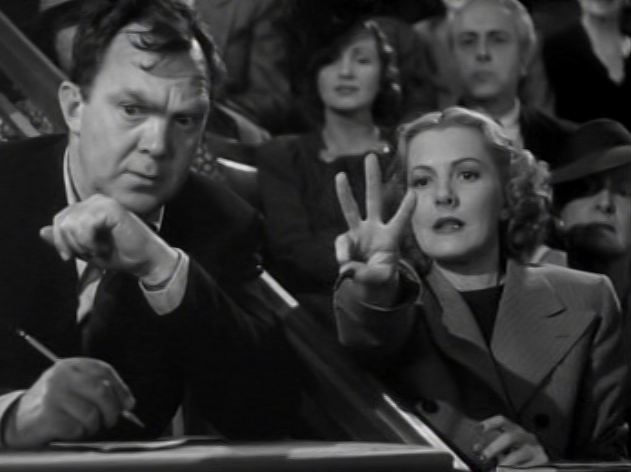
Jean Arthur saves him. She coaches him through a filibuster from her perch in the gallery of the Senate chamber. It’s a terrific showdown, a gunfight with ideals and stubbornness rather than six-shooters.

As Stewart’s voice grows hoarse through the weary hours of his filibuster, Edward Arnold tries to spin lies in the press to their home state, telling the public only what he wants them to know, faster than you can say Fox News.

These scenes are where Capra, in another paradox, both captures the emotions of the audience but also loses believability when small newsboys on the side of James Stewart are used to convey the David versus Goliath aspect. I suppose it’s difficult to find imagery to support the nobility of the common man without getting hokey. It’s difficult sometimes for Capra, anyway.

I get a kick out of real radio newsman H.V. Kaltenborn used here, standing in front of a mic, narrating the magnitude of the moment. Waxing eloquent with the few minutes allotted him in days when live news was in its infancy. Today, we have hack media personalities -- I hesitate to call them journalists -- telling us about the latest poll or topic trending on Twitter. And the overuse by CNN of “breaking news” with asinine repetition to hijack our attention over topics which are neither news nor breaking.

Many of us remember a time when the announcement “Special Report” was given sparingly and only for really big news. Our stomachs turned when we heard it because it usually followed with the first reports of an assassination.

But Mr. Kaltenborn stands at his post, using proper English and trying to give the circus some dignity, instead of trying to turn something dignified into a circus.


The Senate chamber scenes are wonderful. A replica was created on the Columbia lot. The pageboy explains to Stewart, and to us, who sits where, and the history and significance of the setting. In many scenes, we may note that many of the desks are empty -- a silent gesture showing that our senators are not always on the job.

I love the shots of Jean Arthur in the gallery throwing signs to Stewart like a catcher to a pitcher to guide him through the filibuster process.

There is some strong imagery in the Senate chamber. We see Claude Rains and the other senators filmed from the floor to the ceiling so they look like giants. We see shots down from the ceiling at the menagerie of “senators” and extras looking small as they fill the room, a tight cluster of humanity. The arrogance of the senators when they turn their backs to Stewart as he speaks.

The climax is strangely quiet. Claude Rains directs the pageboys to carry in baskets of telegrams from an angry public denouncing James Stewart because of the lies they have been fed by Edward Arnold. It’s almost like that glorious scene in Miracle on 34th Street (1946) when the letters to Santa arrive. But these scraps of paper do not save Mr. Stewart. They condemn him.

He first looks heavenward, a Christ-like figure as if to say, “Why hast Thou forsaken me?” Then he locks his gaze on Harry Carey, who is sublime as President of the Senate, smiling through his fingers as he tries to mask his bemusement at Stewart through previous scenes. He is a kind of craggy-faced Will Rogers-type character whose eloquence is not in his quips, but in his expression.

Mr. Carey gives him a gentle smile of encouragement, and Mr. Stewart finds the will to continue despite it being a lost cause. James Stewart is triumphant in this moment, not because he has won, but because he has fought the good fight.


I find the ending is where Frank Capra loses us again in a saccharine solution. Claude Rains, overcome by his conscience, hysterically confesses his guilt. Convenient, but unlikely. We know too well that people in office rarely admit guilt. Especially if it would lead to a conviction.

Claude Rains is fascinating to watch in the film. He has a complex role and his evolution is just as important as Stewart’s or Arthur’s. He is a man of ideals who gave up most of them in order to survive in the Washington jungle.

Early on in the film, a banquet is held to welcome Stewart to political life, and Mr. Rains is surprised to discover that Stewart is the son of his old friend. He leans over the dais to spy Stewart’s mother, the lovely Beulah Bondi, who exchanges a look of fond reminiscence. Here is where we first see that Rains has an honest past, and this is where his struggle of conscience begins. He carries the burden through the film.

We see a lot of father-son imagery in the movie: between Rains and Stewart, between Stewart and his Boy Rangers, with the pageboy, between Harry Carey and Stewart.

The first time I went to Washington, D.C., as a young woman and stood in the visitors’ gallery of the Senate chamber, I could not help but think of how it looked in Mr. Smith. It was one of many trips. Washington, D.C., is a place I never get tired of visiting. One can feel cynical and still be inspired.

Despite its occasional hokey sentimentality, these are the real truths expressed in this movie. Jean Arthur reminds a disgusted Stewart that, “They aren’t all Taylors and Paines in Washington. That kind just throw big shadows, that’s all.”

Another truth is Claude Rains’ dismissal of the people voting him out when they learn of the corruption: “You can’t count on people voting. Half the time they don’t vote anyway.”

We get heartily sick of the nastiness of political campaigns, especially when they seem to last so long. But it is a good thing, I think, that we air our grievances so publicly and that other nations can see our anger and discontent. Because they also see that it all leads to election day. No coups, no hanging or shooting the opposing party when you’ve won and they’ve lost. The winners take office. At the end of the term, we vote again. Like clockwork. It’s that splendid confidence in our own system that drove both Nazi Germany and the USSR to ban this movie. It was our suspicion of our own leaders that drove Washington insiders to criticize this film at its premiere. Trust and suspicion, in healthy doses. A marvelous paradox Frank Capra didn’t create, but was clever enough to appreciate. [Addendum: from the perspective of 2022, this last paragraph seems sadly naive.]

This movie, despite, or because of, its sentimentality has inspired many over the decades. It was one of my mother’s favorite movies, and she presented it to me as a kind of civics lesson. When the reporters rush from the Senate chamber shouting, “Filibuster! Filibuster!” -- I recall my mother echoing, “Filibuster!” excitedly when I saw it the first time on TV, grinning, urging me to see what happens next. She was one of the most politically astute people I ever knew. Though neither of my parents were joiners of causes, they learned early the intimate place politics had in their lives when as children the programs like the CCC and the WPA created by President Franklin Delano Roosevelt saved their lives.

Growing up in poor families, President Roosevelt literally kept them from starving and gave them job training and hope for the future. They never took politics for granted after that. It was personal. The most important program in my house was the news. They devoured news magazines and newspapers, and we watched conventions like some people watched the World Series.

When they got ready to go vote, my father shaved. My mother put on makeup. Reading glasses, check. Notes on specific ballot questions, check. They announced with almost theatrical dignity, “We Are Going to Vote,” as if they were about to save the world.  Being able to vote gives you a great sense of power.  Ask anybody who can't.

We were to be good until they got back from saving the world.

I am voting tomorrow because that is what I was raised to do. Because my mother loved Mr. Smith Goes to Washington. Because my mother, rest her soul, who never had a driver’s license or a passport, were she living today would be denied the right to vote by some politicians who are aching to get a whip-smart, no nonsense liberal like her off the books.

And because like James Stewart in the movie, I get all choked up when I visit the monuments in Washington, D.C.

   ********************

Jacqueline T. Lynch is the author of Ann Blyth: Actress. Singer. Star. and Memories in Our Time - Hollywood Mirrors and Mimics the Twentieth Century. Her newspaper column on classic films, Silver Screen, Golden Memories is syndicated nationally.  Her new book, a collection of posts from this blog - Hollywood Fights Fascism - is available here on Amazon.

Related Products