IMPRISON TRAITOR, PEDOPHILE, AND CONVICTED FELON TRUMP.
Showing posts with label Pat O'Brien. Show all posts

Thursday, January 26, 2017

American Madness - 1932


American Madness (1932) reaffirms the decency and pluckiness of the American people even though filmed during the depths of the Great Depression and boldly addresses the financial crisis of the day.

Hollywood has the reputation of producing fantasy films during this period to take us away from our troubles, but really there were just as many hard-hitting and bravely realistic films that unflinchingly examined the perils of everyday life among a population with 25% unemployment.

“It is what it is” is a saying common today, and this is the attitude adopted by the characters in this movie with the foreboding title.  They see things the way they are and they scramble to survive.  It was the worst year of the Great Depression, but the presidential campaigns of Herbert Hoover versus Franklin D. Roosevelt get no play in this story, nor any mention of “someday this will all be over”.  Nobody’s waiting for someday; we’re just waiting out today, and yet this is not a movie of weary acceptance, but of vigor, humor, and if there is little optimism, there is at least a belligerent refusal to succumb.

Pat O’Brien plays a bank clerk in a large New York City bank.  He opens the vault in the morning in a long sequence, a process of many steps, while fellow tellers wait to enter and remove rolling steel cases with all the money in it.  Director Frank Capra uses this imagery masterfully.  They laconically talk of $25,000 transactions for the bank, but when O’Brien asks a fellow teller if he can borrow ten bucks, he is told, “Sorry, pal, didn’t you ever hear of a Depression?”

The scene is both an ironic image of water, water everywhere but not a drop to drink—which must have driven poor audiences crazy, and also sets up the plot of the story.  The bank will be robbed, and Pat O’Brien will be the prime suspect.

Sterling Holloway, with that slow and sticky as honey Winnie the Pooh voice and the impossible mop of hair as his trademark is another teller. He self-importantly milks his story, being the one who discovered the vault had been broken into and a guard killed.  Black humor is the order of the day.   Later Holloway tells O’Brien, “I’ll be seeing you in the breadlines.”

Photo from Stars of the Photoplay, 1930

But this is no gangster movie; it’s a message film, as so many movies during the Depression and distinctly about the Depression were message films.  Walter Huston is the bank president, who built this business from nothing.  Though he has a board of directors, it’s his bank.  He picks and chooses his deals, he loans to people he trusts rather than who have a good credit rating.  He is no airy optimist who sees only good in people; he can spot a no-good person in a minute.  He is stubbornly independent, and this makes his board crazy.  They are trying to take power from him and merge with another bank.

“Talk is you’re too liberal,” his chief antagonist accuses him in an angry moment.

“Yes, and I’m going to going to continue to be liberal.” he answers.  When he rolls off a list of names of small businessmen he’s made loans to—to the chagrin of the board of officers—it reads like a who’s who of the “huddled masses yearning to breathe free”: Manny Goldberg, Tony Rosario, Joseph McDonald, Alan Jones.  The script writer is pointedly including an ethnic smorgasbord as a demonstration of Walter Huston’s lack of bigotry as much as his fiscal liberality.

“Character.  It’s the only thing you can bank on, and it’s the only thing that’ll take this country out of the doldrums,” he says.

Sometimes in movies of this period, the big businessman is portrayed as a bad guy, and sometimes as a pie-in-the-sky dreamer of well-intentioned but almost moronic innocence.  Huston is neither.  He’s a savvy banker, and a great guy who treats his employees like pals, and even rescued Pat O’Brien from his life as an ex-con, trusting him with handling the bank’s money in his teller’s job—but Huston is not a man without fault.  He is impatient, brusque with those who oppose his solitary command, and so intently focused on his business that he neglects his adored wife.  This will lead to trouble.

Interestingly, pretty nearly all the action in this movie takes place in the bank.  It is a marble temple of columns and mahogany, where a large staff, from male tellers in suits to the secretaries, receptionists and telephone operator, and uniformed guards, are on the payroll and serving the public with polished shoes and brave smiles. Not an ATM in site.  It’s gloriously opulent in architecture, décor, and human service in a way banks now are not.  It lends confidence as much as money.

The head cashier, played by Gavin Gordon, is involved with gangsters, to whom he owes $50,000 from gambling losses.  To square things with them, he agrees to fiddle with the timed lock on the vault so they can sneak in, in the middle of the night, and rob the bank.  To plan his own alibi, he cozies up to Walter Huston’s neglected wife, played by Kay Johnson, takes her out for the evening, and brings her back to his apartment.  She is more interested in a fun evening with someone to talk to, not an affair, and when he gets too amorous, she is embarrassed and backs away.  At that moment, Pat O’Brien interferes.  He suspects their relationship and wants to protect the boss who gave him a second chance.

Photo by Ruth Harriet Louise from Stars of the Photoplay, 1930

There is a tense scene of confrontation, and a gun drawn, but both O’Brien and the wife leave, neither realizing the bank is about to be robbed in five minutes.  O’Brien, by virtue of his criminal past, will be accused of orchestrating the job and he will not confess to the cops where he was when the job went down—getting his boss’s wife away from a dalliance in other man’s apartment.

A dual plot of the bank’s solvency runs along with the news of the theft the next morning, and a scene that steamrolls through the rest of the movie concerns the public’s trust of the bank.  A few come to make transactions, and when they notice the cops doing their investigation, rumors spread of the bank’s insolvency.  More and more people spread the gossip on the phone and in whispered, then screamed conversations on the street.  A full-blown panic occurs, and a mob of customers floods the great marble lobby of the bank, a sea of bobbing heads and urgent, angry shouting.  Lots of extras got work that day.  It’s an exciting, fast-paced sequence of events.  Capra doesn’t just film the mob as an inhuman mass—he picks out the individuals and never fails to show us inside the soul of the common man.

An elderly woman begs for her money, fearful of going to “the old ladies’ home.”  No social safety nets (this is before FDR).  She’d be lucky to get into an old ladies’ home.  The only other alternative was a Hooverville in a park or under a highway bridge.

Mob mentality is ugly and stupid, and frightening.  The bank’s board of directors, though understandably horrified, nevertheless are pleased to use this as an opportunity to pry Huston from his seat of power.  They wait for him to fail, so they can sell their shares of the bank and complete the merger.

Pat O’Brien endeavors to rescue his boss. He shouts two conversations at once into two candlestick telephones to alert the small-time businessmen who have loans with the bank to come and help. He and his girlfriend, played by Constance Cummings, who also works at the bank, man the phones like election campaign workers.

Finally, the cavalry comes in the form of the aforementioned small businessmen: Manny Goldberg, Tony Rosario, Joseph McDonald, and Alan Jones, and all their like who got their loans from Walter Huston.  It’s a It’s a Wonderful Life ending with the men pushing their way through the chaos and announcing in defiant voices that they are depositing thousands of dollars, that they will put their faith in Huston. 

The panic is over.  The board of directors have a change of heart, as armored cars arrive and guards carry in sacks of money. People cheer as at a football game, and leave in relief.

But Huston’s troubles are not over.  Though Pat O’Brien stubbornly will not tell the cops he has an alibi for the time of the robbery—because it would implicate the boss’s wife and shame his benefactor—nevertheless the cops put two and two together and go after head teller Gavin Gordon.  There is a chase in the bank, through employees’ lockers in the cloakroom.  Gordon has a gun.

But the news about Huston’s wife gets out, and Huston is devastated, on the brink of suicide.  His wife attempts to console him.

Pat O’Brien is exonerated.  The panic is over, but, just as in the days after the stock market crash of 1929, the time has come to settle in, calm down, and figure out what to do next.

The ending is less exuberant than we might expect ordinarily, but it is more comforting.  Pat O’Brien keeps his job, he and his girl will marry, and Huston has patched things up with his wife.  He is not going to neglect her anymore, but will start on a second honeymoon and travel to Europe on the great liner, the Berengaria.

A footnote that the movie does not refer to, but that we may note here, is that the R.M.S. Berengaria, as we noted in this previous post, sailed from London to New York that very week of the great stock market crash in October 1929.  It was the first ship to have a special salon for trading stocks over the shortwave radio.  Millionaires passed the time during the sea voyage keeping up with the news of their investments.

They left England millionaires, at least.  They docked in New York, paupers.

Huston’s bank evidently weathered the Crash.  The movie ends with another long, ponderous sequence of Pat O’Brien carefully opening up the vault for another business day.  Shoulder to the wheel, literally.

**********

Tomorrow, Turner Classic Movies is presenting a day of Debbie Reynolds films to commemorate her passing and celebrate her movie career.  One of those films will be Singin’ in the Rain (1952).  Come back next week for a discussion on the recent big screen showing nationwide of Singin’in the Rain.

*********************

The audio book for Ann Blyth: Actress. Singer. Star. is now for sale on Audible.com, and on Amazon and iTunes.


Also in paperback and eBook from Amazon.


Thursday, September 3, 2015

Slim - 1937


Slim (1937) is a hymn to the workingman, the kind of quiet and laudatory look into a segment of our working population that we don’t see in too many films today, but were a staple of the Great Depression when work was scarce, and valued, and interpreted on screen as the subject of tales of great heroism, social comment, and inspiration.  The job was the journey, the quest, the challenge, and the actors—even the biggest stars of the day—remarkably secondary to that.

Today we mark the upcoming Labor Day with a gang of hardworking average Joes who build towers for electric lines.  Henry Fonda is the farm boy who looks admiringly skyward at these daredevils and wants to join them in a job he sees as glamorous and full of adventure.  

Pat O’Brien is the veteran lineman, a man with a mysterious past, who travels from job to job in what he calls a “tumbleweed life” and takes the young Fonda under his wing.

J. Farrell MacDonald is the boss on one jobsite—who, despite his years, looks pretty fit in a poolroom brawl scene, and Stuart Erwin is the comic relief, a shiftless fellow with lots of tall tales.  In a very brief cameo, we see Jane Wyman as his girlfriend.  John Litel gets a small role as one of workers.

Margaret Lindsay is a Chicago nurse, Cally, who once treated Mr. O’Brien after a terrible work-related injury and is in love with him and pining for the day when he gets all this dangerous “tumbleweed” life out of his blood.   When O’Brien and Fonda visit and they paint the town red as a threesome, Miss Lindsay falls for young Mr. Fonda instead.  Together, they toast, “To a long, hard life and a quick checkout.”


When Fonda gets hurt on the job, Miss Lindsay sells the expensive bracelet O’Brien bought her, to pay for Fonda’s medical bills in this world without medical insurance.

It’s a fairly simple story, but the real “electricity” in this film comes from some quite lyrical and really exciting camera images:  Fonda climbing the metal tower for the first time, holding on for dear life at the top, almost sick from the dizzy height—a new perspective on the flat Midwest land for this former farm boy.  The men wear battered fedoras, apparently unconcerned about the wind taking their wide-brimmed hats.

There’s a couple great shots of the men around the tower saying their lines, another shot climbing, while in the background, coincidentally, a massive locomotive plows by, pulling freight in a juxtaposed image of industrial America; electrical power and steam power.

Shots of an electric substation during a blizzard, spitting off sparks from wires downed by the storm, and the men having to climb the icy towers to repair them.  The body of one unlucky man falling to his death, electrocuted when he becomes ensnared in “hot” wires.

A carefree auto trip through Chicago where Fonda, and we, gawk at the enormous buildings which O’Brien reminds us would not be possible without electricity and the work that he and Fonda do.


The film is valuable for what exists between the “lines.”  This was an era when only about 10 percent of the rural population during the Great Depression had electricity.  Fonda’s farm, where he lived with an aunt and uncle, likely had none.  President Franklin Delano Roosevelt’s infrastructure projects sought to remedy that, and in the process, created tens of thousands of jobs.  His public works projects saved a generation from starving, and brought the United States a wealth of new construction that benefited generations to come.

Though the movie is not specifically an homage to FDR, but rather to the linemen, we cannot help but note the hat-tip to the government in an era where private industry was not always necessarily stepping up to the plate.  The intro narration is typically poetic, but nonetheless true:

“Mankind’s control over the natural forces of electricity...the very air we breathe is harnessed and made subservient...the power that girdles the globe...and annihilates distance and gives him control of time and space.

“…without the courage and the fidelity of the men who labor at all hours and in all weather to keep aloft the lines that bring us our electrical supply, this era of miracles would not have come to pass.”

The voiceover guides us over broad empty prairie and a cityscape at night with the dotted lights of windows in skyscrapers against a black sky.

The electricity that makes this possible, “…runs our factories and trains, the current that lights our great cities stands obedient, ready to answer the pull of a switch.”

To all of our linemen, and to workers everywhere:  Happy Labor Day.
****************


Ann Blyth: Actress. Singer. Star. 
by Jacqueline T. Lynch

The first book on the career of actress Ann Blyth. Multitalented and remarkably versatile, Blyth began on radio as a child, appeared on Broadway at the age of twelve in Lillian Hellman's Watch on the Rhine, and enjoyed a long and diverse career in films, theatre, television, and concerts. A sensitive dramatic actress, the youngest at the time to be nominated for her role in Mildred Pierce (1945), she also displayed a gift for comedy, and was especially endeared to fans for her expressive and exquisite lyric soprano, which was showcased in many film and stage musicals. Still a popular guest at film festivals, lovely Ms. Blyth remains a treasure of the Hollywood's golden age.


The eBook and paperback are available from Amazon and CreateSpace, which is the printer.  You can also order it from my Etsy shop. It is also available at the Broadside Bookshop, 247 Main Street, Northampton, Massachusetts.

If you wish a signed copy, then email me at JacquelineTLynch@gmail.com and I'll get back to you with the details.


**************************
My new syndicated column on classic film is up at http://go60.us/advice-and-more/item/2047-everybody-comes-to-rick-s, or check with your local paper.


Thursday, August 15, 2013

Crack-up - 1946


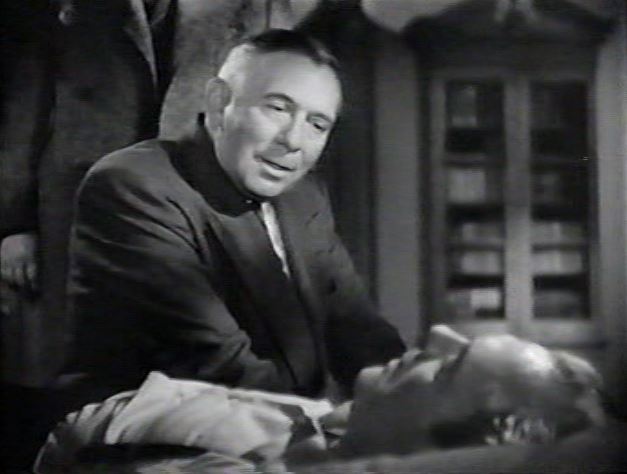
Crack-up (1946) takes us to the art world, not usually the sphere of film noir, but this brooding little mystery is unabashed in its take on salons of high culture and waterfront thugs.  Especially appealing is abating this quirkiness by casting veteran priest-coach-boring nice guy Pat O’Brien as the hero.  Pat was 47 when this picture was made, seems a bit long in the tooth for some of the stunts he (or rather his stunt double) is required to do, but his brand of sly, knowing maturity is particularly suitable for this protagonist who must solve the mystery with his brains and his expansive knowledge of art.
I also like that the plot hinges on a phone call he gets regarding his ailing mother, and how he rushes to see her in the hospital.  Real men worry about Mom.
Since this is a mystery, I’ll try to side step the spoilers, but there are some interesting scenes that push the plot along for their atmosphere.  First, we have the pulsating theme music over the opening credits and sounds like the rhythmic pounding of train wheels. A train figures prominently in the mystery.  Look at the lettering on the title.  Just that tells you we’re in for real noir.  Them’s real noir fonts.

We begin with Pat O’Brien in a crazed fit, smashing his fist through the glass doors of a New York City museum, tangling with a cop—in a hall of marble statues where a broken figure of a nude male topples to the floor and smashes—there’s a little artistic symbolism for you.  Pat passes out, psychotic or drunk, we don’t know.  Pat works at the museum.  The museum administrators, in a late meeting, are shocked and try to hush the matter up when detective Wallace Ford wants to haul him in.
Good old Wallace Ford.  He deserves a post of his own someday, for many reasons.
Ray Collins is a doctor on the board of the museum, the voice reason in this mess.
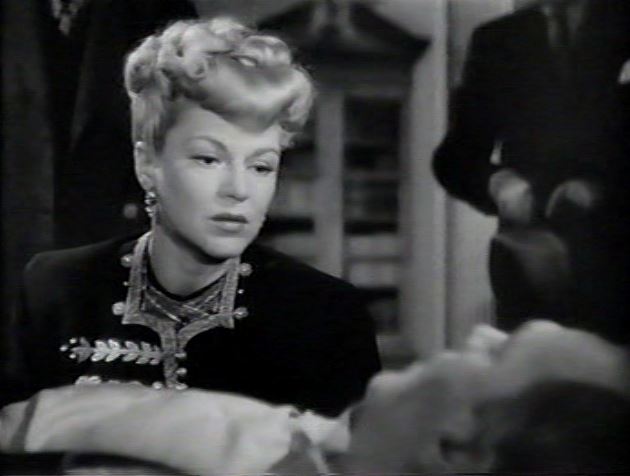
Claire Trevor is a society dame and magazine writer who appears in a different outfit and a different hairdo every time we see her.  She sparkles, but she’s a regular dame.  We gather she and Pat were an item once, and he’s still interested enough in her to be jealous and sarcastic of any man who takes her to dinner, like Herbert Marshall. 
Our old favorite Mr. Marshall is typically elegant and eloquent here as an international man of mystery.  We don’t really find out who he is or what his game is until nearly the end of the movie.  Mr. O’Brien does not disguise his distrust and disdain for him.
Pat is a docent at the museum and gives lectures on art.  (How many cool film noir guys do that?)  We are told that the museum curators regard Mr. O’Brien as revolutionary—in their eyes not a good thing—and that if it weren’t for his service record, they might have sacked him long ago.
This being film noir, nine times out of ten, the protagonist is a war vet trying to adjust to this weird new world he’s come home to but doesn’t recognize.  Especially interesting is that later we get some background on O’Brien’s war record—he worked for the Allied Reparations Committee investigating the Nazi theft of precious works of art. 
We trace Pat O’Brien’s psychotic disturbance to a train wreck he claims he was just in, though there are no reports coming to Wallace Ford that a train wreck has occurred.
Now we go to the requisite flashback as Ray Collins asks Pat to tell them what he remembers happened to him today.
We pick up from Pat’s docent job and his lecture, and the call about his mother.  When Pat rushes to the train station to start his frantic journey to see his mother in the hospital, we follow him pretty much step-by-step—the ticket line, the empty commuter car filling with nighttime stragglers getting off work late, a sarcastic butcher boy selling fruit, magazines and cigarettes.  There’s a guy half-dragging his buddy who appears to have had a little too much to drink.
The train car is already a place of tension because of Pat’s anxiety about his mother and trying to reach her as soon as possible.  He glances with impatience at the people around him, not studying them with interest, but as if they are adding to his annoyance and tension.  We hear the omnipresent sound of the train wheels, which seem to grow louder.  Pat seems to grow acutely aware of all the sounds and images around him, and so we, too, focus on these sensations.
He looks out the moisture-tinged train window, and sees in the distance, around a kind a bend in the track, a beam of light.  To his horror and ours, it appears to be another train on the same track.  Look at Pat’s frozen expression as he’s mesmerized by the sight, a sense of unavoidable doom.  Suddenly, the train whips around the bend and heads right toward us.  The flash of light splashes across his train window, and we hear screams.


Then the flashback ends and we are back in the present.  He is physically and mentally exhausted.
He is told by Wallace Ford that his mother is fine.  She was never in the hospital.  There was no train wreck.  They all think Pat is cracking up, and his clothing reeks of alcohol.
Poor Pat, baffled and shaken, and doubting his own sanity, is released by Ford for the time being, but the museum fires him.  You can’t have a loony giving lectures on Salvador Dali in the gallery.  Pat fears he really is cracking up, like other ex-GIs he’s known.  He confesses, “It’s the one fear everybody had.
Claire Trevor and her apparent new beau, Herbert Marshall, take Pat back to his apartment.  It’s all messed up, as if somebody has overturned everything looking for something.  We also see Pat is being tailed.
Pat, scared, but wanting to get to the bottom of this, even if it means he proves he’s a nut, tries to retrace his steps according to what scraps he can remember.
He goes to the train station, rides the same train, tries to track down the same butcher boy or others who might remember seeing him.  Nobody saw him, nobody remembers him.  We are filled with the same sense of tension as before, afraid another “wreck” will happen.  Just at the pivotal moment, that train that looks as if it’s on the same tracks comes barreling at us again, and Pat is panicked.  Then-whoosh!  It passes by.  It was a double track.  The conductor calls out the name of the next stop.
Aha.  Pat realizes this was the moment something must have happened to him.  He gets off at that stop, and the station master in this tiny, empty depot remembers him from the night before, as a drunk guy being dragged off the train and into a car.
Now he knows he’s not crazy, but he’s in somebody’s way.  Mr. O’Brien is mad and on the hunt.
A murder occurs meanwhile, and he’s implicated, and Wallace Ford is after him, so Pat takes it on the lam.  We are taken to a penny arcade where he meets up with Claire Trevor trying to help him hide.  It’s a neat setting, showing what typical urban penny arcades were like in the day, a place for grownups and not kids—see the “No Minors” sign—because there’s nickelodeon peep shows and stuff.
 
Pat slugs people.  He x-rays masterpieces.  He appeals to the mousy secretary of his museum boss to help him investigate a forgery connection to the museum.  Even Mary Ware, played by Mary Ware, is not what she seems.
We go to a cocktail party, end up at a rusty freighter at the wharf, where Pat saves a valuable canvas from a fire.  Ultimately, we have a showdown between Pat and the mastermind of the mysterious gang, and we discover the reason for his psychotic episode at the beginning of the film.  It might seem like a slightly goofball ending after all that noir atmosphere, but it’s a fun movie, especially for being offbeat.  Keep an eye out for Ellen Corby as a maid.
But, especially keep your eye on the graying middle-aged action hero with the knowledge of art history, a devotion to his mom, and a growing paunch at his belly.  Pat O’Brien was lucky to get the part with so many younger pretty boys in Hollywood, but none of them would probably be as interesting.  He earned it, because he gives it not so much an “edge” as a burnished shine. 
 
Besides, film noir protagonists are supposed to be world-weary and haunted—and who is more tired and cynical, and has as deep a back story as a middle-aged man?
As we discussed in last week’s Adventure in Manhattan, also about art theft, the surprise mystery or what we do not expect from a film doesn’t have to be a shocking plot device.  It can just be a little quirk that sticks out and fools us—and intrigues us.
 
***
 
Here's a preview of the cover of Dismount and Murder - number three in my cozy mystery series.  The book will likely come out in November, and I'll post more about that in weeks to come.  The artwork here is by the amazing Casey Koester, the Noir Girl.


Related Products