The Shocking Miss
Pilgrim
(1947) is an affectionate spoof of a suffragette (or suffragist, as they
actually called themselves) and her mission to become independent and
self-supporting as a first step to gaining the right to vote, which, as we
know, was a long way off. We celebrate
the 100th anniversary of the 19th Amendment this week,
which gave women the right to vote in all federal and state elections. It was not “universal.” The poll tax and civil rights abuses kept
women (and men) of color, and Native Americans, from voting in certain parts of
the country until the late 1950s and finally, until the Voting Rights Act of
1965, which prohibited discrimination in registering to vote and being able to
vote.
The real story of
the fight for women to achieve full voting rights in this country, which took
several generations, is a frustrating and often harrowing, even horrific,
series of events. Recently, PBS tackled the subject in an excellent two-part
documentary, “The Vote,” as part of its American Experienceseries. Have a look at the clips on the website, and
don’t miss the chance of watching it the next time you see it scheduled on your
local PBS station. It is a well-told examination of the truly dramatic and inspirational
fight that women endured to gain this most basic right of citizenship.
The Shocking Miss
Pilgrim,
obviously, does not tell the story of women’s suffrage in all its fullness, or grim
realities. To give it its due, it does
show strong, intelligent women bucking the powers that be to gain respect
(which, without civil rights, no respect would be required), and it shows the
men to be grudging, but ultimately won over by the ladies’ perseverance. And charm. That, it seems, would always be a
necessary element. Hollywood was certainly frank about that.
Classic films were
not dismissive of the 19th Amendment, but on the few occasions Hollywood
tackled the subject, it was always in this quaint, stereopticon view of The
Good Old Days and my, wasn’t Grandma spunky?
We covered The Strawberry Blonde (1941) here, which showed Olivia
de Havilland’s suffragette as a foil and a mere subplot to James Cagney’s
aspiring dentist dealing with legal issues who didn’t get the girl of his
dreams. Again, the story is quaint and affectionate, down to the singalong
ending. The suffragette theme is mere
window dressing.
When it comes to
this cozy view of the fight to gain suffrage, I think my favorite example is
from Mary Poppins (1964), where Glynis Johns sings with ladylike gusto, “Well
done, Sister Suffragettes!” My favorite
line, delivered with gentle sincerity: “Though we adore men individually, we
agree that as a group – they’re rather stooopid.”
Her jubilant,
sunny, marching rant in the foyer of her home is turned into a party when the
servants, Reta Shaw and Hermione Baddeley join in, dragging into the chorus the
reluctant Elsa Lanchester (the children’s nanny who is about to quit, thereby creating
a job opening for the new nanny, Mary Poppins).
The background to Glynis
Johns’ suffragette activities is sketched out for us by her husband, played by
David Tomlinson, who sings with self-satisfaction, “King Edward’s on the
throne; it’s the age of men!” He is
lordly, and therefore is somewhat clownish, but his wife is equally clownish, hiding
her activities from him, stuffing her sash in a closet before he comes home. “You
know how the cause infuriates Mr. Banks.”
At the end of the movie, she will give up her sash to make a tail for
her son’s kite.
Interestingly, the
magical, yet no-nonsense Mary Poppins is the ultimate feminist in the movie –
independent, self-assured, not taking orders.But she is humanized for us by being vain in a typically feminine
manner.
It is 1910 in Mary
Poppins, but The Shocking Miss Pilgrim takes us back to 1874. Female independence from men is tied to, for
me, a beloved object—the typewriter. Betty
Grable stars as Miss Cynthia Pilgrim, a new graduate of a business school in New
York which has admitted women for the first time. She and the other female students are admonished
at the beginning of their course of study: “Until now, the business world has been
a man’s world. If you fail, it will remain so!”
That’s quite a
burden on their shoulders, but they are courageous pioneers, and Betty becomes
the class champion at typing. The
students are referred to prospective employers (in an immediate job placement
program that might be enviable for any college student today) and Betty draws a shipping company in Boston
run by Dick Haymes.
Mr. Haymes runs
his family firm, which is actually owned by his suffragette aunt, played by
Anne Revere. Haymes, however, thinks
that women do not belong in the workplace and is surprised when Miss Grable shows
up for work, as he thought he would be sent a male typewriter (or typist, when the
person doing the work was finally viewed as separate from the machine).
Another person in
the all-male office who disdains women in the workplace is Gene Lockhart, who
plays the office manager. The guys at
first mock her, but her moxie, and her good-natured ability to take kidding endears
her to them. They put on their suit coats
in a gentlemanly effort to not show her disrespect by working in the same room
with her in their shirtsleeves. Ah, me,
but such niceties are lost to us today.
All are fascinated
by her clatter on the typewriter, which was introduced in this same year of
1874 to commercial offices, though it would be a long time before they became common
in workplaces or even had a standard keyboard.
Though Betty was the class champ in typing,
we can see she does not know how to touch-type.
She does the old hunt-and-peck with two fingers. Actually, the touch-typing system was not invented until 1888, so this is not an error.
You will notice also that her typewriter appears to be operated with a foot treadle; this is because the first typewriters put out this year of 1874 were mounted on sewing machine stands and the foot treadle operated the carriage return. They typed only in capital letters. So all your business correspondence would be screaming.
Betty takes a room
at one of the few lodging houses in Boston that accepts women office workers,
who are shunned as undesirables, women of probably questionable virtue. Like actresses.
Elizabeth
Patterson is her kindly landlady who takes her in and who belligerently accepts
all outcasts from Boston society, including artists and writers. Gad! Arthur
Shields and Allyn Joslyn are two of her vagabond lodgers, and together they
make up a happy family.
Anne Revere recruits
Betty into the local suffrage movement and Betty makes a hit making speeches.
She drags the reluctant Dick Haymes along, and we have our obligatory, if
clunky, romance budding between them. Dick introduces Betty to his mother, a
high society lady played by Elisabeth Risdon, who is also a closet suffragette
and who will, at the end of the film, buy her own typewriter. I love the line when Betty, who is surprised
to discover the great lady is a kindred spirit, is answered by Miss Risdon, “You
expected to find a witch burner.” This,
of course, a nod to a period in Massachusetts history when intolerance, as it
will, brought ghastly tragedy. (It’s a common
euphemism, of course. Nobody was burned in
Salem for witchcraft; nineteen were hung, one was pressed to death, and others
died in jail. Burning at the stake in Europe,
of course, was another matter.)
As long as we’re being
sticklers on accuracy on my home state, I’d like to congratulate those
responsible for this film for the correct pronunciation of “Peabody.” Hereabouts, it is not pea-body. It’s PEAbudee. One of the men in the office, Mr. Peabody, who presents her flowers, corrects Betty on her pronunciation.
Like Glynis Johns,
Betty Grable dons her “Votes for Women” sash and heads out for another rally. True love does not run smooth, especially
when the ardent young man thinks suffragettes are frustrated old maids. But Betty
is sensible, not flighty or shrewish. She thinks women should gain equality by entering many careers, rather than just protesting. When he tries to replace her with male secretaries, he finds them
lacking in…uh, charm. Finally reverting
back to female secretaries, he finds them plain, unattractive, and none suit
him. He goes to the Boston Academy of
Typewriting for a new graduate. Our old
friend Mary Field is the receptionist who refers him to the manager—Betty Grable. Ah, Dick Haymes sees the light. It is implied, rather than stated, that he
has come around to the idea that women are just as capable in business as are
men. Will they marry? Will she give up
her job if she does marry him?
How old will she
be when she finally gets to vote in 1920?
Many social issues
were covered across a broad spectrum in films from the 1920s through the 1950s,
yet women’s suffrage was not really addressed except in parody.
There is a line in
the “Sister Suffragette” song from Mary Poppins that Glynis Johns sings:
“Our daughters’ daughters will adore us, and they’ll sing in grateful chorus, ‘Well
done, sister suffragette!’”
Hollywood has
never really said, “Well done,” or given them their due, and perhaps even
today, neither have we. Watch the PBS
documentary. Then go vote, each and
every election you can. It took a lot of sacrifice and fighting to get that
right. If circumstances arising from the
pandemic makes it more difficult for you to vote, or the current traitorous administration of criminals tries to stop you,
then move heaven and earth to do it.
Abe
Lincoln in Illinois
(1940) carries both historical insight while at the same time being
remarkably and most startlingly current in its message. Surely writer Robert E. Sherwood made no
attempt to be prescient, in the same way Abraham Lincoln seemed to foresee his
own doomed future, but we may take as a sad state of fact that
all life is a cycle and we must continually fight the same battles every
couple generations.
We celebrate Lincoln’s Birthday today
with probably the best movie ever made depicting Abraham Lincoln, both in
script, and in characterization by Raymond Massey, who played this role on
Broadway before Sherwood adapted his own script for the screen. John Cromwell directs, and we are treated to
a nineteenth century fairy tale land of innocence and danger, but always
familiar because it is part of our American consciousness—the log cabin, the
reading by firelight, the lusty backwoodsmen who “wrassle” and drink, the hoop
skirts, the stovepipe hat, but stringing everything along is the message of a gentle,
reluctant man, sometimes self-admitted blunderer, who is idealistic enough to expect better from his country, and pragmatic
enough to know “a more perfect union” wasn’t going to happen without an awful
lot of trouble, and that some in the dysfunctional family of states would have
to be dragged kicking and screaming to the table. Behind all, shaping his journey and
shouldering it, are his periods of depression that threaten his nimble mind,
sap his courage, and crush his soul.
Raymond Massey’s Abe Lincoln is not a
schoolroom saint. He is flawed, human,
and beset by troubles that include a nagging wife, certainly the most homespun
and prosaic of incidents that ride the coattails of his more Herculean crisis—that
of publically standing against slavery, and of trying to keep the union
together when so many preferred it to be dissolved. He makes compromises, he allows himself to be
shepherded into the political process by backroom dealers. Our American democracy is on display here for
all that is good about it and all that is shady.
Election night, with vote tabulations
cast by magic lantern onto a screen, and crowds cheering everything by
torchlight, with relentless tinny tapping of Morse code relaying results from
across the country—which is presented by a crude map of states and territories
and pins—is no less accurate and no less exciting than were it covered ad nauseam between commercials on CNN.
That Raymond Massey, for whom Abe
Lincoln was his signature role, was, and probably remains the best actor to
have played him, was able to convey Lincoln’s self-deprecating humor, his
cleverness, his anxiety, his good nature all at once is a splendid feat of
acting. His manner of speech is a marvel
and mesmerizing. However, he was helped
along by the very legacy we have of Lincoln’s personality in context of the opinions
of his countrymen. There are fewer films
in which George Washington is depicted, largely because we still, I think, don’t
know how to approach the father of our country.
He remains a schoolroom saint in many respects, as least for the
non-historian.
We know more about Lincoln, and he has
become a flesh and blood, more down-to-earth person to us in large part
probably because so much was written about him in his own day that was
extremely critical. The Confederacy, of
course, considered him an enemy, up to and including the nutcase who murdered
him. John Wilkes Booth’s act was borne
of cold, deep-seated hatred, political resentment, and vengeance. Such an action is not an anomaly; it is the
end result of resentment carried to the extreme. Then—and today.
But there were many in the North who
felt just as much antagonism for Lincoln, even if they did not carry their
anger to such extremes. Lincoln was
dogged by critics every step of his years as President, in his own party, in
his own cabinet, by some of his own generals.
All Presidents are met with criticism while
in office, especially from the opposing political party; that is normal and the
sign of a healthy democracy. But few
Presidents are reviled and mocked and vilified to the extent Lincoln was. We may add Franklin Delano Roosevelt in this
category, for his programs to lift the nation out of the Great Depression were
all hated by those who considered them communistic. FDR, just as Lincoln, was considered by those
who felt they had a great deal personally to lose under his administration, as
dangerous anti-American radicals.
And they were two of our greatest Presidents,
who brought us through two of this nation's great periods of crisis, and we know them for their flaws as well as for their great deeds. It’s a funny kind of paradox that those who
hate to the extreme shine an accusatory light not only on their intended enemy,
but on themselves. Lincoln’s detractors,
including those who mocked the Gettysburg Address, are regarded as fools today,
standing on the wrong side of history.
So are the factions into the early twentieth century who felt that child
labor was necessary and that without it, our economy would collapse; that if
women were allowed the right to vote family values would collapse; etc. and we
could go on about those who fear equality for others because it might mean they
would lose their own enviable position in society, or their own imagined moral superiority.
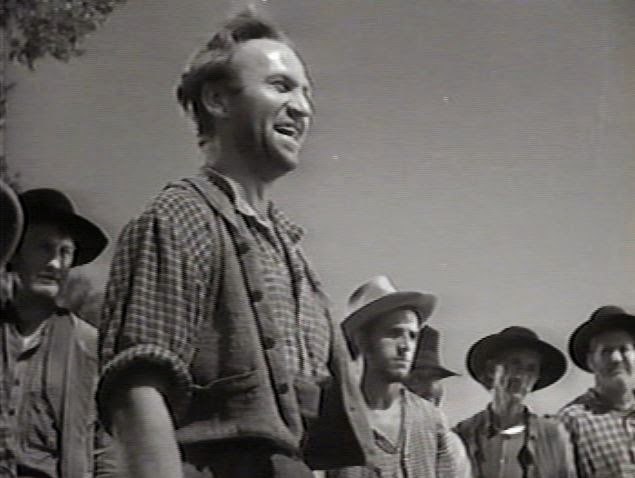
Massey delivers, in a depiction of a
Lincoln-Douglas debate on a wooden platform under torchlight:
“All men are created equal except Negroes. If we are to accept this doctrine of race or
class discrimination, what is to stop us in time of decreeing all men are
created equal except Negroes, foreigners, Catholics, Jews, or just poor people?”
Stephen Douglas, played here by Gene
Lockhart, upholds slavery as it is decreed lawful by the Supreme Court. We could certainly draw similarities to a
Supreme Court bought by special interests today, could we not?
Lincoln further warns that we are
sliding into a morass where “there is no right principle of action but
self-interest.”
It is a literate script that carries us
from Abe’s adventures, and misadventures, as a young man, his doomed love for
Ann Rutledge, his business failures, his start as a lawyer, his troubled
courtship of Mary Todd. John Cromwell’s
direction is artistic and full of feeling. We look down over the shoulders of these historical
figures, we look up at them, we stand in the doorway and watch their turmoil.
A few high points: Mr. Massey’s singing of the old campaign song
for William Henry Harrison and John Tyler: “Tippecanoe and Tyler Too” and the
crowd later singing the campaign song for Lincoln, “Lincoln and Liberty Too.”
Stage actress Ruth Gordon gives a strong
performance as Mary Todd Lincoln.
Howard
Da Silva (who originated the role on Broadway) is the town bully and eventual
loyal supporter of Lincoln.
Louis Jean Heydt as Mentor Graham, who
tutors Abe in the law. Look for Ian
Wolfe as newspaper editor Horace Greeley.
Alan Baxter is Billy, the young law
clerk Abe takes under his wing, who, almost like Mary Todd, nags him to take up
the torch of politics and defeat slavery.
An interesting minor character, he is not fawning and idealistic; he is tortured,
angry, and a kind of Greek chorus. All
the minor characters who stay in Abe’s life through the film visibly age with
him, and it is a poignant thing to see.
The scene where Lincoln has just won the
election and Billy explains the new President’s grim attitude by reminding us
that the South has threatened to secede if he won. Now, war is inevitable, and Lincoln is
walking straight into it. Literally. As Massey is about to leave to the room, suddenly
the double doors open and a there is a uniformed guard detail: at once a sign
that he is the President, that he will need security because there are already
threats against his life, and also as a portent of Civil War and the soldiers
over whom he will have authority as Commander in Chief.
The final scene is Cromwell’s dramatic
touch, as Lincoln stands on the train platform offering a curiously ominous
farewell to Illinois as he is about to leave for Washington. He won the election, but seems somehow the loser. The train slowly pulls
away, he manages a weak half-wave, and he slips into the darkness of the night,
as we finally imagine, as he has done already, his doom. It is not a moment of triumph; it is an eerie
moment of foreboding as the train chugs away into the blackness.
My book on Ann Blyth's career--Ann Blyth: Actress. Singer. Star. will be published on June 18th. To that end, I’ll be looking for some help in the pre-launch phase, so I’d like to invite any blogger—film blogger or book blogger—to participate in a blog tour. I’ll be looking for blogs to schedule publicity-oriented posts beginning Monday, June 1st. The last day will be June 17th. If anyone wants to pick a day, please let me know so I can coordinate with others. Think of it as a kind of blogathon. On your day, you can post a review of the book (I’ll have ARCs – advanced reading copies - available in PDF form which I’ll email to you that you can read on your computer), or you can do a Q&A with me, or I can just send you a 250-word excerpt of the book, or you can just post the cover and a link to the Amazon page, if you will. Just a little something to spread the word. I will be posting here every day from June 1st through the 18th and I’ll be linking to your blogs, pushing traffic to you.
Among those 17 bloggers who participate, I’ll throw your names in a hat and pick five winners who will receive a print book of Ann Blyth: Actress. Singer. Star. when it is published on the 18th. The rest will receive an eBook file in whichever format you choose: ePub, Mobi, or PDF (Note, the ARC copies will not have the index).
Today is the 100th anniversary of the birth of Rosalind Russell, one of Hollywood’s most sassy fast-talking leads in an age of clever and sassy independent women. Since the earliest days of women’s involvement in theater (which was much later than men’s), the prominent roles for female leads were either as the victim or the whore. The film industry continued this somewhat frustrating theater tradition until actresses like Rosalind Russell came along to prove there was yet another side to women.
She was not the only one, there was an elite corps of female troopers ready to give a punch as well as take it, mask uncertainty and face adversity with a lot of lip and a classy attitude. Claudette Colbert, Myrna Loy, Barbara Stanwyck, Jean Arthur, a line of ladies who stood up for themselves and were funny to boot.
In her breezy and anecdotal autobiography, “Life is a Banquet,” (with Chris Chase, Random House, New York, 1977), Miss Russell insists she was not of the upper echelon of stars at Metro Goldwyn Mayer, and even joked that she got Myrna Loy’s cast-off scripts, but when “The Women” (1939) came along, there was nobody who could do the part of busybody, troublemaking Mrs. Fowler like her. It pushed her into comedic roles after a lot of what she called “Lady Mary” roles.
One of her most memorable of these comedic films was “His Girl Friday,” (1940) a remake of the successful stage hit and film, “The Front Page.” Director Howard Hawks’ decision to change the character of Hildy to a female changed the scope and direction of the film, obviously, and took off some of the edge the original film in its biting commentary on cynical newsmen, crooked politicians, exploitation of race, and a circus of a police, crime and graft in order to slide in a romantic comedy in the middle of it all. But, there was still plenty of cynicism left, batted about like ballplayers practicing on the infield by a group of terrific character actors as the newshounds in the pressroom, including Regis Toomey, with Gene Lockhart as the smarmy Sheriff Hartwell, Helen Mack as the tragic Mollie Malloy, and John Qualen as the pitiful hangdog murderer on the lam. Billy Gilbert steals the scenes as Mr. Pettibone, the hapless, bumbling, just-doing-my-job messenger trying to deliver the governor’s pardon.
Rosalind Russell floats nicely between moods as Hildy. In her soft, intimate interrogation of John Qualen in the jail, speaking to him through a chain link pen, she lights him a cigarette from her own mouth, passes it to him and mutters, “Sorry about the lipstick, Earl,” as she softly continues her questioning. This is in contrast to her fast and furious bandying with Cary Grant, who slaps her word for word, shout for shout, goad for goad as her editor who is determined to wring one last assignment out of her and mess up her plans to marry the ever patient Ralph Bellamy. Noted for his regular guy roles, Grant even pokes fun at Bellamy by saying that his character, “looks like that fellow in the movies. Ralph Bellamy.”
In her autobiography, Russell claims that some of the script was ad libbed, and some doctored up by a writer she had hired on the side for jokes, but the lines flow together seamlessly with Charles Lederer’s script (based on the stage play by Ben Hecht and Charles MacArthur), and make this a film that needs to be seen over again to catch all of them.
“Earl shot the professor in the classified ads,” she tells Cary Grant, and once she realizes her dream of marrying the stable Ralph Bellamy and his interfering mother is not for her, “I’m no suburban bridge player, I’m a newspaperman.” Newspaperman. In her pinstripe suit, she is one of the guys, and a better writer than all the other lying ambulance chasers barking on candlestick telephones around the table in the newsroom.
It is a great film to snag even a small part in, because everyone gets a piece of the pie as far as great lines are concerned. When Grant’s hired thug, Louie, kidnapping Hildy’s future mother-in-law gets into a car wreck with a couple of police cars, he returns shaken, moaning, “Can you imagine bumping into a load of cops? They come rolling out like oranges.”
In her book, Miss Russell recounts her famous description of acting as, “standing up naked and turning around very slowly.” There has been plenty written about the personal scandals and private lives of Hollywood stars, but not enough about how the everyday film work was accomplished. It is fortunate she documented a small part of her career for us, fortunate to have participants in Hollywood’s golden age give us the nuts and bolts of the work involved behind the magic. As always, she is a sensible and sassy voice, still.