IMPRISON TRAITOR, PEDOPHILE, AND CONVICTED FELON TRUMP.
Showing posts with label Gloria DeHaven. Show all posts

Thursday, July 31, 2025

Modern Times (1936)


Modern Times
(1936) says goodbye to The Little Tramp and hello to a brave new world. Charlie Chaplin takes aim at the horrors of industrialism and the tribulations of the Great Depression, and yet he brings along a nostalgic zest for the earlier twentieth century that is not going gently into that good night.  Inevitably, he presents us with a Valentine.

Continuing our look this year at films from the 1930s that make a social commentary on that decade, as I’ve mentioned before, many filmmakers in this era chose to deliberately comment on social conditions in that challenging time and make “modern times” the backdrop of even silly comedies.  You didn’t have to look far to see a message.   We turn now to a giant (a little giant maybe, but still a giant) in the history of film who does just this, and uses it to give his most famous and beloved character not just a curtain call, but a socially relevant one.


Mr. Chaplin came to realize that The Little Tramp’s era of particular innocence was over, and practically speaking, there was no way to continue his adventures not speaking.  Therefore, this is the last “silent film” made featuring our hapless hero.  However, it is also the first film we hear Chaplin’s voice—later in the movie when he sings a silly song.


The film is mostly silent, with some sound effects and very little dialogue—mostly from the boss of the factory who bellows at his employees via a large television-type screen.  This is not your father’s industrial revolution; in fact, the factory where Chaplin works is almost Buck Rogers futuristic, an Art Deco version of a factory.  It is the 1930s, after all.


The movie starts with a stark title screen and a rather film noir-ish musical theme, threatening and foreboding.   We see the image of a flock of sheep, and then the image of men climbing subway steps in a herd, running to the factory, to suggest that they are sheep.  The title card tells us this is “A story of industry, of individual enterprise—humanity crusading in the pursuit of happiness.”

Will humanity succeed in finding happiness?  Maybe only at times.


It doesn’t start well for The Little Tramp and quickly goes downhill from there.  We see him tightening nuts on an assembly line, having trouble keeping up.  The bellowing owner from his omniscient screen observes them and wants more speed.  He is played by Al Ernest Garcia.


Charlie takes a smoke break in the washroom, but he gets yelled at by the face on the screen even in there.  Big Brother is even in the bathroom.

Efficiency experts come to the factory to demonstrate a new machine that will make the workers eat lunch faster—and poor Charlie is chosen to demonstrate.  Strapped into a chair, a revolving, demonic lazy Susan is placed before him, and he is force-fed soup, corn on the cob, and gets the traditional slapstick pie in the face from a mechanical arm, while his face is blotted intermittently with a large office blotter.  It’s a funny skit, and levity helps us—if not Charlie—from going crazy at the imprisonment of his workplace. 


When Charlie is on a break or off the line, he continues to twitch with the motion of tightening nuts with two large wrenches.  Poor Charlie goes berserk from the stress, ends up being threaded through the giant cogs of a machine in the iconic scene.  Afterwards, he takes his large wrenches and attempts to tighten anything—including the large dress buttons strategically placed on the breasts of a passing woman.  This is one of those gags that’s more funny if we are led right up to the moment and then is suddenly cut off, because what we imagine could happen is always funnier.


Playfully and maniacally out of control, Charlie is chased by his co-workers, taken to a hospital, and later, cured of a nervous breakdown, and must start his life over.

He is constantly starting over from square one in this movie, and that, too, is a comment on the modern condition.  We must be prepared to start over.  Always.

In another funny mistake, he falls into a manhole and comes up with a red warning flag, such that construction workers would take on a job, and when he emerges from the manhole with the flag, just at that moment, a protest march by a communist workers’ group is going by and he gets swept up with them.  He is rounded up and taken to the police station. 


Meanwhile, Paulette Goddard plays a poor girl living in a shack by the waterfront with her widowed father and two kid sisters. She is The Gamin. Dad is out of work, heavily burdened by the Depression, and Paulette, with a scrappy survivor’s instinct, steals bananas to feed the family.  Reportedly, one of her little sisters was played by Gloria DeHaven at 10 or 11 years old in her first role.


Charlie is sent to prison, and when cocaine is smuggled to another prisoner via a salt shaker, referred to on our helpful title card as “nose powder,” Charlie inadvertently douses his food with it.  His wide-eyed reaction tells us he is high.  One wonders how that got by the Production Code.  Helpless to control himself, he accidentally foils a plot by revolting prisoners to overtake the guards, and he is rewarded with release.  He doesn’t really want to leave, though.  He is cozy in his cell, with no responsibilities and three squares a day.  It’s a good setup for a guy like Charlie, who loses every job he gets.  When he is freed, he is told, “Now make good.”


The Gamin, meanwhile, gets into trouble when her poor father is shot to death.  The authorities step in and take the two younger girls, but Paulette escapes.  She finally crosses paths with Charlie when he gets fired from a shipbuilding company on the waterfront where she lives, and he accidentally launches a half-built ship. She has stolen bread and runs smack into him.  Gentleman that he is, and out of work besides, he allows himself to be arrested and carted off to the hoosegow once again.  He offers his seat to Paulette in the police van and helps her to escape.  Even eating a big meal in a restaurant without the money to pay for it won’t keep him in jail for long, but when he meets Paulette, Charlie decides it’s better to stay out of jail, and he vows he will get a home for them both, “even if I have to work for it.”

They are two lost souls battling the storms of life, but The Little Tramp is a man-child, and their relationship is as playful as brother and sister.

He takes a job as a night watchman in a department store.  Again, as we’ve seen in this previous post on Employees' Entrance (1933), the multi-story downtown department store has a special place in the Great Depression.  It is the cathedral of commerce, with the promise of good times coming again, despite most people not having enough money to do more than window-shop.


Charlie provides a place for Paulette to sleep on home furnishings floor, and while she luxuriates in a comfortable floor model bed, he runs into a former co-worker from the factory that has now been shut down.  He is Big Bill, played by Stanley “Tiny” Sandford, and he is going to rob the store.  One of his accomplices explains, “We ain’t burglars—we’re hungry.”  


It ends, of course, with Charlie taken off to jail again, but before that we have that stunning scene where he tries out roller skates and nearly plumets to his death on a floor where renovation construction is not finished and he comes very close to falling several stories while cutting a caper with fancy skating moves.  Classic film fans may know this is just a very clever matte shot, and Chaplin was not in danger doing the stunt, but it looks terrific.

When Charlie is released from jail this time, Paulette faithfully waits for him, and provides a tumbledown shack for their home, and she has returned to stealing food. 


The factory where he worked at the beginning of the movie is reopening and he hopes to get a real home for them.  He is assigned as an assistant to a mechanic, played by Chester Conklin.  This time, Chester gets caught in the cogs and Charlie’s not much help.  Paulette, Charlie, and Chester would all reunite in The Great Dictator (1940).

Believe it or not, he has another stay in jail, while Paulette gets a job as a dancer in a café, and she gets him a job as a singing waiter there when he’s out of the lockup.  Here’s where we get to finally hear Charlie Chaplin’s voice.  He cannot remember the words to the song he’s supposed to sing, so he makes up gibberish and we see him dashing about the dancefloor, twisting himself into a frenetic ballet, and singing a song Chaplin wrote called, “Je cherche après titine,” which is a mixture of French and Italian that he roguishly performs as a supposedly risqué song. Have a look here.

But wouldn’t you know, life comes down hard again, and the authorities who have been looking for Paulette all this time have returned.  She and Charlie escape, but scrappy Paulette has finally run out of courage.  They stand on the dusty open road that stretches out miles ahead of them.  Is it promising, or is it bleak?  Perhaps it’s just a matter of viewpoint.

“What’s the use of trying?” she says in tears.

He answers, “Buck up—never say die.  We’ll get along!”  It is the theme of the Great Depression for those who survived it.  I can remember many years ago watching a documentary series on the Great Depression with my father, who was a teenager during those years, and who joined the Civilian Conservation Corps to help send money back to support his widowed mother and kid sisters.  At the time, it was an adventure.  Bad times were shrugged off because if they weren’t, you were done for just by giving up.  But as an old man, looking back, with perhaps less courage than he had when he was a teen, and having acquired a great deal more knowledge about life in the meantime, he muttered, stony-faced at the TV:  “My God, it’s a wonder we ever survived it.”

In the background, while Charlie is comforting Paulette, we hear the music he wrote, which would later gain lyrics and the title “Smile.”  The first to record it supposedly was Nat King Cole, many years later.  You can listen to it here.

There was no single anthem of that generation, but this quiet, hopeful song may have been one of them.


It was a perfect way, as Charlie and Paulette gather their things and walk down the road together to meet head-on whatever happens next, for The Little Tramp to leave us.  I like to think he’s still down the road somewhere, shrugging off mishaps.

  *******************************


My new non-fiction book, CHILDREN'S WARTIME ADVENTURE NOVELS - The Silent Generation's Vicarious Experience of World War II -- is now available in eBook here at Barnes & Noble, Apple, Kobo, and a wide variety of other online shops.

Or here from my Shopify store if you want to buy direct from me and avoid the big companies.

And it is here in eBook, paperback print, and hardcover, from Amazon.

It is also here in paperback from Ingram.

And here in hardcover from Ingram.

From Cherry Ames, to Meet the Malones, from Dave Dawson to Kitty Carter - Canteen Girl, the Silent Generation spent their childhood immersed in geopolitical events through the prism of their middle grade and young adult books.  From the home front to the battlefield, these books are a window on their world, and influenced their hard-working, conformity-loving generation. 


Thursday, February 15, 2024

Hollywood actresses model military uniforms...


Four Hollywood stars model the new fashions in this November 1944 Photoplay spread.  Laraine Day shows the Women Marines uniform on the far left.  Next to her is Jeanne Crain in the uniform of a SPAR, which was the U.S. Coast Guard Women's Reserve.  Next is Gloria DeHaven as a WAC -- Women's Army Corps.  On the far right is Joyce Reynolds in a WAVES uniform - Women's Naval Reserve (or Women Accepted for Volunteer Emergency Service).

Women were encouraged to do their bit in many civilian endeavors during World War II, and for the first time, also encouraged to join the military.  Perhaps Photoplay thought they might like to choose a branch of service based on the style of uniform.  It has been well documented that war movies usually increased recruitment among the men.  We don't know the effect this feature article might have done for female enlistment, but the ladies look swell.

*******************


Our greatest gift from the Greatest Generation was freedom from fascism. Relive, and celebrate, how evil was faced, discussed, dramatized...and fought. Classic films were the weapon.

Get your copy of Hollywood Fights Fascism here at Amazon in print or eBook, or here at Barnes & Noble, Apple, Kobo, and a variety of other online shops.

  ************

Jacqueline T. Lynch is the author of Ann Blyth: Actress. Singer. Star. and Movies in Our Time - Hollywood Mirrors and Mimics the Twentieth Century and Hollywood Fights Fascism and Christmas in Classic Films. TO JOIN HER READERS' GROUP - follow this link for a free book as a thank-you for joining.


Thursday, August 19, 2010

Roz Russell's Waterbury Premiere

Rosalind Russell experienced a very special, but precarious, movie premiere when her comedy “The Girl Rush” (1955) premiered in her hometown of Waterbury, Connecticut. What began as an exciting and poignant celebration of, as the newsreel narration put it, “hometown girl makes good”, ended in a frightening disaster when an unforeseen flood nearly obliterated Waterbury that night.

She wrote in her autobiography, “Life is a Banquet” (with Chris Chase, Random House, NY, 1977) “Nineteen fifty-five was my year for attracting natural disasters.”

Mayor Snyder, Rosland Russell, and Gloria DeHaven.


The festivities were scheduled for August 18th. Roz (as she was referred in the local paper), was due to arrive by train along with her co-stars from the film, Fernando Lamas, Eddie Albert, and Gloria DeHaven (who we last saw in this post on “Summer Stock” - 1950)

According to author Bernard F. Dick’s biography, “Forever Mame - The Life of Rosalind Russell” (University Press of Mississippi, 2006), Miss Russell arrived the day before, visited with siblings and her elderly mother, and prepared to take on the public mantle of hometown hero.

Miss Russell remarks in her autobiography, “Waterbury authorities explained that I was the only motion picture star to have a theatre named for her (I don’t know whether they meant in Waterbury or in the United States or in the entire world, but how could such a declaration not go to a girl’s head?)”

In “Life is a Banquet” she puts us right in the middle of the scenario, “Before the rains came, I rode in a parade in a white satin dress that was all beaded, with a matching little thing that sat on my head, being Princess Grace all over the joint.”

The stars, along with the flock of Paramount newsreel men, the inevitable publicity department, and some 10,000 townspeople straggling on the sidewalks to watch the parade, would be taken from the railroad station to the Elton Hotel, the swank spot in town.

After a luncheon, the Hollywood contingent were then to be whisked away to City Hall where Mayor Raymond E. Snyder, Sr. (who incidentally had bought Rosalind Russell’s parent’s home a couple of decades before and turned it into a funeral parlor, which it remains), would present her with the key to the city. They were also to get a tour of town, including some of the Brass City’s famous industries, and Roz’s birthplace.

Dave Garroway (who is mentioned as having a problem with chimpanzees on the set of The Today Show in this post from Monday), showed up with his Today Show crew to film the festivities live on television from the Elton Hotel.

Roz’s take: “There was a big dinner at the great snob Waterbury Club, and my brother had to make a speech, and everything was to be televised - crews had been there for a week, setting up cameras all over the Waterbury green.”

They were in the right place to broadcast an even bigger surprise story the next day.

The evening of the 18th, they all headed over to the State Theater, which had just been re-named the Rosalind Russell State Theater, to watch the premiere of “The Girl Rush.” The Mattatuck Drum Band and a U.S. Marine Color provided escort.

Roz writes in her autobiography that, “there was a drum and fife corps - that’s very big in Connecticut; they always wear tricorne hats.”

The shots of Roz accompanying this post are all from a newsreel. Here is the plaque Roz unveiled marking the occasion.

Limos downtown, and powerful spotlights sweeping the cloud-covered night sky. Nothing like it had ever been seen in this factory town. Nothing ever would again. By morning, the Rosalind Russell State Theater, like much of the downtown, would be under several feet of water.

That cloud-covered sky. It had been raining pretty steadily all day during the celebrations on the 18th. By late that evening, smaller brooks in the Naugatuck River valley would jump their banks. The mighty Naugatuck itself, which powered so much industry in Waterbury, would morph in the wee hours to a monstrous thing that scraped factories, stores, and homes to rubble before morning, and leave some 30 people dead in Waterbury and over 90 people dead or missing and presumed dead total in the towns of the Naugatuck Valley.

Astonishing was the suddenness of the event. To be sure, Hurricane Diane had spent a couple of weeks sliding up the Eastern seaboard, but it made a sharp right turn out to sea before ever entering New England. It, and Hurricane Connie, dropped more rain than the already sodden ground could take, and what had begun as a gloomy day became a fearful night of torrential downpour, causing destruction no one could have predicted.

Roz fortuitously left right after the premiere, rented a car with her maid and a driver, and they made their way to New Haven while the bridges were being washed out in Waterbury.

From Roz’s autobiography: “I directed the driver - ‘Go up this hill, go down that lane, I know this town’ - because I realized if we could get to New Haven, we could get from there to New York. There was no hope of driving along the Naugatuck Valley toward Bridgeport; the Naugatuck River had overflowed.”

Her intention was to make it to the next publicity chore, the Ed Sullivan Show in New York City on the 21st, for an appearance with co-star Gloria DeHaven to promote “The Girl Rush.”

According to Mr. Dick's book, Miss DeHaven, however, got stuck in Waterbury temporarily until train service resumed.

Recovery took weeks, months, even years for some people. Some businesses, and people, never did recover.

According to this Cinema Treasures information, the State Theater had at various times, been called the Broadway, the Bijou, or the Rialto. It was torn down a couple decades ago. Currently, it is a parking lot.

This remarkable event was the last time Rosalind Russell ever visited Waterbury. Truly, the dual theatrical masks of comedy and tragedy were worn on this night.

For more on the New England Flood of 1955, have a look at tomorrow’s “New England Travels” blog.

Thursday, July 22, 2010

Summer Stock - 1950


Summertime will always carry for many of us the intangible essence of freedom, the pursuit of dreams, and a sense of suspended work for play. There are plenty of tangibles that go along with this: the hot weather mainly. But if the livin’ is not always easy, the vague promise of a better life even in just a lawn chair or hammock for a handful of weekends seems like Shangri-la compared to rat race we’ve chosen for ourselves the rest of the time. I don’t know if we can really catch the idyll of summers of our childhood, but the memory of them, perhaps romanticized, is what probably pushes us to think we can.

“Summer Stock” (1950) seems to evoke a lot of what is possible about achieving dreams, or just being left alone to dream them, in the summer. I doubt this was intentional by MGM, for which this was just another (hopefully) blockbuster musical with Judy Garland and Gene Kelly in a post-War era where movie musicals were just about to launch into a decade which would prove both their Golden Age and their swan song. Clearly, in the backwash of World War II, at the dawn of the Korean War, we were dreaming of the easy life, but squirming with a restless foreboding of the summer’s end.

Judy and Gene are grown ups, but this is the old “let’s put on a show” formula Judy had been playing since she was in pigtails. Her next musical four years later, “A Star is Born” would be much more grown up, if still from well-worn material.

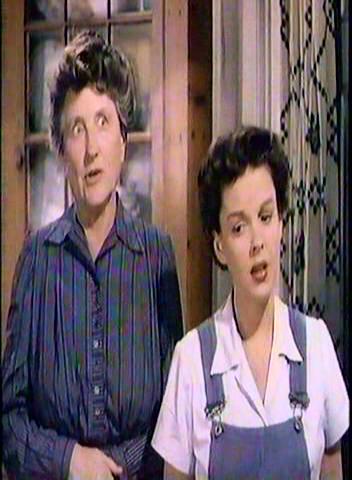
Here, Judy runs the family farm in Connecticut, with reliable Marjorie Main in her patented role as a daffy housekeeper. Gloria DeHaven plays Judy’s spoiled kid sister, whom Judy has supported through various colleges and aborted creative endeavors.

The farm is struggling. Judy’s two ancient farmhands are leaving her to go down to “Hartford way” in their Sunday suits to get jobs in factories. But, all is not lost, because kid sister is finally coming home to help on the farm. And Judy has a new tractor to help with the harvest.

Judy’s beau, played by sickly, and very funny, Eddie Bracken, is plagued with allergies and a lack of confidence. The latter we can attribute to his overbearing father, the dependable Ray Collins in a delightfully skewered version of his usual authoratative figures. He runs the general store, in which his milksop son is the clerk. Father wants the two to be married to unite the two oldest families in the community. Judy seems sympathetic to Eddie Bracken, but in no special rush to tie the knot.

The plot thickens. Spoiled kid sister brings home her boyfriend, Gene Kelly, and Mr. Kelly’s crew of actors and stagehands. He is a hopeful young director, and spoiled kid sister has promised him the use of Judy’s barn to put on his show.

We mentioned in this recent post about “A Stolen Life” (1946) how old movies depicting rural New England frequently demonstrate our apparent love of square dancing. But, as we see here, barns in New England (uh, that’s b-a-a-h-n-s), have another use. No, not for housing cows. That other use, summer stock, which is often called The Barn Circuit.

Here we get a two-fer deal, as Judy’s barn is the setting for both a square dance and a summer stock theater. According to Ray Collins, “Square dancing is part of our tradition.” The scene begins with a very proper Portland Fancy (which is an old-time contra dance very popular in New England once upon a time and can still be found in the odd place or two of a summer evening). In this post in my New England Travels blog about the scrapbook of a young girl, you see a dance card from the early 1920s, on the back of which lists the dances to be performed. One is the Portland Fancy.

Before too long, however, this b-a-a-h-n dance turns to be-bop, as the rowdy acting company takes over, and this is only a small bit of havoc they wreak on the farm. Ray Collins is mostly incensed at their presence just because they are, well, actors. You know what theater people are like.

Mr. Collins reminds Judy that her ancestors were part of the community in 1694 that banned “theatrical entertainment of any kind.” This sounds bombastic, funny, and ridiculous, but it’s not. It’s historically true. Puritan, and then Victorian, New England had such a hard time accepting theatre that some early theaters, like the Boston Museum, called themselves…well, museums. Author of “Little Women” Louisa May Alcott loved to attend plays at the Boston Museum. She and her sisters even play acted stories at home in Concord. In the b-a-a-h-n.

At some point in the 20th century, old prejudices died out enough for rural New England communities to take visiting actors as guests in their homes when they played at the local summer stock theater. There weren’t a whole lot of Ramada Inns or quaint B&Bs back in the day, so the theatre folk relied on a spare room where it was offered.


In “Summer Stock”, we have the wonderfully boorish Hans Conried as the lead actor, a peacock who smoothly turns everyone into his servant. He rates his own bedroom in Judy’s farmhouse, while the rest of the cast bunk out in the b-a-a-h-n.

The women are separated from the men, of course, in the dormitory hay loft, with ever-vigilant Marjorie Main guarding their virtue with a double barreled shotgun. Yes, sir, all the comforts of home.

Back to Judy’s troubles. Wanting to support spoiled kid sister, she allows the show to go on, provided the actors help with the farm chores. Never ask Phil Silvers, who plays Gene Kelly’s inept and brutally annoying sidekick, to do anything for you.

We see the rehearsals which, because they are performed regular clothes, with a box and an old cart for sets, look silly and amateurish. We cannot imagine what the show is really supposed to look like, but they can because it’s their show. Like children, it is real to them. They are living their summer fantasy.

And Judy and Gene fall for each other. Nobody wants to hurt anybody, but this is a musical, and everybody gets hurt.

Judy must have been hurting pretty badly in real life about this time. “Summer Stock” has come down to us as the third and final time she was paired with Gene Kelly, the last time she ever worked for MGM, and the movie that was filmed during one of her worst periods of rocky health due to drug addiction. There are backstage stories with this as with just about every film, but what’s remarkable is you’d never know it by what you see on screen.

Judy Garland was what many called a triple threat: she could sing, she could dance, and she could act. Anything she turned her hand to on stage, she did well, and often brilliantly. Here we see her precise comedic timing. She could do more with a look or a gesture than the other comics could do with pages of the best material.

She displays swift and sudden sadness, brittle disappointment, and her eyes tear as she speaks. She makes you believe her. Then she does the “Get Happy” number, filmed after the rest of the movie was in the can, having lost some extra pounds and looking fabulous. How many times had she pulled a rabbit out of the hat?

She certainly pulls a hat trick in this movie, in real life, and reel life. Spoiled kid sister takes off with Hans Conried and Judy must save the day. Gene coaches her, and she does a Ruby Keeler act, learning all the songs and dances in a couple days so they can have still have opening night in the b-a-a-h-n when all the big producers from Broadway will be there.

The acting company names itself “Falbury Farm Players” and their show is called “Fall in Love.” About the second most vague title in play-within-a-movie history, losing out to “Playing Around”, which was the show Bing Crosby and Danny Kaye produced in “White Christmas” (1954). Which was put on up the road in Vermont. In a b-a-a-h-n.

We see numbers from the big show, and we know that Judy and Gene are sweethearts now as well as co-stars. What we don’t know is if she can give up her family farm to become his leading lady in New York. We don’t know what the judgment of the big time Broadway producers is, because the show ends at the final song. There is no one running up from the audience with a contract. The song ends, a playful parody of barnyard hijinks with garish colors and arms thrown upward as if to send that last high note on its way. Roll credits.

It’s a summertime moment, where the adults are kids putting on a show, and act out their dreams, and don’t worry too much if they are practical or even possible. It is a suspended moment. We don’t hang around for harvest time.

This film was made in 1950. For more on Hollywood actors appearing in real New England summer stock in the summer of 1950, have a look at yesterday’s post in my Tragedy and Comedy in New England blog.

Below, have a look at the trailer for “Summer Stock”, and also for Judy’s “Get Happy” number.


Related Products