IMPRISON TRAITOR, PEDOPHILE, AND CONVICTED FELON TRUMP.
Showing posts with label Douglas Kennedy. Show all posts

Thursday, July 11, 2013

The Unfaithful - 1947


The Unfaithful (1947) is a superior movie to The Letter (1940). 
I just wanted to get your attention.  I’ve been away from this blog for a long time.  I’m still here.
But seriously, I really do prefer The Unfaithful to the much more well-known and deservedly lauded The Letter.  Pour yourself a cuppa and I’ll tell you why.  You don’t mind spoilers, do you?  I didn’t think so.
Both films are based on the story and subsequent stage play by W. Somerset Maugham, (went through a handful of other film versions as well) but The Unfaithful is a re-working of the story to fit into a different locale: post-war Los Angeles.  The original story, you’ll remember, is set in a Malaya rubber plantation.  The Letter stars Bette Davis and Herbert Marshall in the tale of an unfaithful wife, who murders her married lover, and then must hide the truth from her husband and the police.  The device that seals her fate and proves her guilt is a letter written to her lover.  Gale Sondergaard, who strikes fear into the hearts of everybody, not just in this movie—she probably struck fear into the hearts of people just walking down Wilshire Boulevard—is the dead man’s wife who holds the whip hand over Bette Davis.

Directed by William Wyler, The Letter is lush and mysterious, steamy and provocative, beginning with Miss Davis unblinkingly gunning down her lover.  We are plunked down at the edge of the jungle, under a tropical moon, where civilization, i.e. white European society, is represented in a dance at the Raffles Hotel in Singapore.  It is about guilt and revenge and racial stereotypes.  The famous line uttered by Bette Davis: “With all my heart, I still love the man I killed!” is still a shocker, an electric moment. 
But for me, the film is a marshmallow: all air, sticky, and without nourishment.  Even the impressive Miss Sondergaard reminds me of The Dragon Lady in the old Terry and the Pirates comic strip, and so the “mysterious orient” clichés that abound in this movie strike me as somewhat cartoonish.  I prefer The Unfaithful for several reasons.  Here we go:
Ann Sheridan is in the Bette Davis role, but unlike Davis—who we know is guilty from the very first moment in the film—Ann Sheridan’s guilt, her sin of being unfaithful, is not apparent until far into the movie.  We start with a happy Miss Sheridan speaking on the phone with her husband who is away on a business trip.  We see she is in love, and eagerly awaiting his return the next day.  We do not suspect her of an adulterous affair.  What we do learn about her comes through twists and turns, and by the end of the film, we see we do not know her at all.  In comparison, Bette Davis comes off as transparent, and I find her brittle rigidity, though compelling psychologically, still two-dimensional, even if we are shocked by her declaration at the end of the film.
Miss Sheridan attends a party thrown by her husband’s cousin, Eve Arden.  Any movie with Eve Arden is always better than a movie without Eve Arden.  Our Eve has a good role here.  We first meet her as a new divorcee who throws herself a Happy Divorce Party.  All her friends are there, and one who is not her friend: her ex-husband shows up, drunk and angry, and vents his bitterness before he is dragged away.  Douglas Kennedy has this small role.  We saw him previously in South of St. Louis (1949).
Miss Arden is raucous, crude, loud, and tasteless in the early part of the film, but she keeps popping up from time to time, and each time we see her, a little more of her hard shell gets peeled away and we discover by the end of the film she’s really a sad and lonely person, and a mensch.  She turns out to be a real pal to Sheridan and her husband, played by Zachary Scott, when they really need her.

Zachary Scott has a more interesting role than the character played by Herbert Marshall in The Letter.  Though I love Herbert Marshall, and though we feel great sympathy for him as the cuckolded husband of Bette Davis, we also can’t help but regard him as a sap.  She’s playing him like a fiddle.  The story, and the director, allows us to see right through Davis, but he has no such advantage and we may wonder how he could be so dense.
Mr. Scott is nobody’s fool, an enterprising builder taking advantage of the post-war boom.  He’s devoted to Sheridan, but when the clues of her guilt wipe the scales from his eyes, he’s determined to dump her and see her rot.  How quickly, and stunningly, love turns to hate.  It’s all passion in one form or another.
Lew Ayres plays their friend and lawyer in a role similar to James Stephenson in The Letter; likewise he is devoted to his friends, plays knight errant to the accused until he discovers her guilt and then fights his own disgust to be able to save her.
Most especially, I love that The Unfaithful is frankly and most purposefully without that fantasyland setting of the tropics.  It is set in a mundane and more familiar time and place.  (Although, I confess, as a New Englander, I find palm trees, even lined up in front of a shopping mall, extremely exotic.) This is a setting we recognize; these are people with whom we are familiar.  It brings this tumultuous story down to earth, with consequences that are real.  We must take their troubles more seriously because they may be our own.
This being a blog about how classic films teach us much about the eras in which they were made, I find The Unfaithful a very useful tool in examining the post-war era.  It’s got all the details.  The narrator tells us as the camera pans from the home of Sheridan and Scott to the palm-tree lined roadway, “The problem with which it deals belongs not to any one town, city or country, but is of our times.”  In this respect, the movie is less like The Letter and more like The Best Years of Our Lives.
The “problem,” it seems, is that so many marriages begun in haste during the romantic and rushed war years are ending in divorce.  Lew Ayres’ clients are mostly women seeking divorces, and he has mixed feelings about that: a desire to be successful, and yet a sense of disgust for his clients.  Eve Arden is his latest client and his latest victory in the courtroom. 
Ann Sheridan is the opposite of Eve Arden: she is a loving wife who waited patiently for her husband to return from war, who still waits patiently for him to return from every business trip.  She waits around a lot.  She and Eve Arden are not close friends; they are too different.  One is a lady and one is…not.
Things turn very bad for Ann and progressively get worse.  She arrives home from Eve Arden’s divorce party, and parks her car in the back of the house.  As she pulls into the drive, we see a man is watching her.  Instantly, the tone of the movie changes.  She walks to the front of the house and we see her silhouetted in the mist.  We watch her walk towards us, knowing the man is hiding, also watching her.  At her door, the man attacks her, pulls her into the darkened house.  We watch through the windows, from the street, a scene of terror and the sounds of struggle, and screams.  We don’t know what’s happened, but we’ve imagined the worst.
It’s the next morning and Zachary Scott lands at the airport, wondering why his wife isn’t there to pick him up.  I like the way the director, Vincent Sherman, takes his time and lets this scene play out.  He’s very good at developing these very tense scenes from ordinary situations.  Your stomach tightens when you see Ann Sheridan walking at night in her own driveway.  Your stomach tightens when you see Zachary Scott get bad news.  We’ve been there.  This is a large part of why I prefer this movie to The Letter—it brings high drama to smallest, quietest elements of what we know as “real” life.
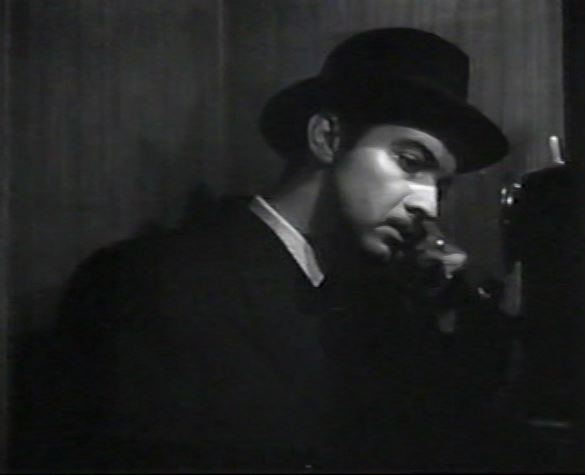
Mr. Scott looks and looks around, finally goes to a phone booth to call home.  Because he’s closed the door of the booth, and because there are constant announcements on the public address system about flights, we barely hear his voice.  We strain to hear him—a nice dramatic touch over not hearing him at all.  It makes us an active participant.  We don’t know what he’s saying—just like we couldn’t see the attack except from yards away and through curtains.  By his expression, we realize somebody on the other end told him shocking news, and he rushes to find his checked luggage and get a cab.
The phone, we learn, was answered the by the police, and we see when he arrives that his home is chaotic with reporters, and police all around.  For the first time, we learn that Ann Sheridan is well and survived the attack, but that her attacker lies dead on the living room floor with an ornamental knife in him that Mr. Scott had brought back from Japan during the war.  That’s about all of the mysterious orient you’ll find in this movie.
When Miss Sheridan is interviewed in her bedroom by the police, with her husband and Lew Ayres at her side, we see that she is traumatized and miserable.  We knew Bette Davis’ distress was just an act, but Sheridan’s horror is real.  The million-dollar question is asked of her “Had you ever seen him before?”  She answers no, and we have no reason to doubt her.  Neither does her husband or her lawyer pal.  The police detective, played by John Hoyt, remains cynical, but that is his job.

The widow of the dead man, played by Marta Mitrovich, accuses Ann of murder. “You killed him!” She is not as scary as Gale Sondergaard, but she’s pretty worked up about it.

By the way, does anyone know who plays the stenographer in this scene?  She has no lines, but she looks familiar.  I love stenographers.  
The detective tells us that the dead man has no criminal record, that he was a sculptor.  His mind, and ours, turns to the question, why did he go to her house?  If robbery wasn’t his motive, we are left with a question of attempted rape, though nobody uses the word.  Ann Sheridan’s expression is our first clue that she’s not being completely honest, she’s withholding some information, but we have to find out the hard way.
Steven Geray plays a smarmy art dealer who contacts Lew Ayres about a bust of a woman, asking him if he wants to buy it.  It was sculpted by the dead sculptor guy.  The face is Ann Sheridan’s.
Ann lied.   The dead scupltor obviously knew her and she knew him, because we are told that this kind of piece would have to be modeled from real life.  He didn’t sculpt it from a photo of her.  I find Ann's scatterbrained, guilt-driven, panic-induced deceit much more understandable and appealing than Bette Davis' psychotic, chilly posturing, but that is not to say that one actress is better than the other in the role; it's just a preference for characterization. 
The art dealer is attempting to blackmail Mr. Ayres’ client, but our noble Lew isn’t having any of it.  He brushes off the smarmy art dealer and goes straight to Ann, who, reluctantly, relents and confesses she did know the dead guy.  It was during the war, and she hired him to do the sculpture, but after a few sittings, he got too personal and creepy and made her feel uncomfortable, so she avoided him and never went back.  He stalked her a few times, but when her husband came home from oversees, it scared the guy off.
Ann tells Lew she didn’t tell him or the police that she knew the guy because, “I was afraid of what people would say.”
Now Lew has to hammer home to her that what people say is not the problem.  The problem is if she knew the guy, a jury might think she let him into the house and murdered him, that it was not self-defense.  She’s frustratingly slow on the uptake about this.
Unless there's more to it that she isn't saying.  

And there is.  

Then Ann goes to the smarmy art dealer herself to pay the blackmail, but the widow doesn’t want her money.  She wants her to go to jail. 
Ann goes back to Lew Ayres in a panic, getting herself in deeper and deeper, and finally Lew understands, as do we, that she had more than a professional relationship with the sculptor.  She had a fling with him.
Lew, lawyer and bachelor, is disgusted.  “You’re no different from all the other cheating, conniving women who parade through my office.”  Now he strips the final layer away:  Did she kill him on purpose to shut him up?
We pause here to watch the how her web of lies has taken on a life of its own.  Smarmy art dealer still wants a cut of the blackmail money he thinks he’ll get, so he contacts Zachary Scott and meets him, like a spy movie, in MacArthur Park (no cake out in the rain here, so just never mind that), one of the many neato Los Angeles scenes we have in this movie.  He takes him to the widow’s run-down apartment and meets Ann’s sculpted likeness as the art dealer hammers him with the old Othello scenario about the treachery of women.  Zachary is crushed.
He goes home to have a showdown with Ann.  She tries to explain her loneliness during the war.  He blasts her, “Millions of women waited, they waited decently, loyally.  They didn’t cheat.”
Mr. Scott wants a divorce, but just as he’s about to storm out, the cops show up at the door to arrest Ann on suspicion of murder.  See, the cops discovered Zachary going to the widow’s apartment with the smarmy art dealer.   They know about the sculpture now.  The jig is up.
Our Lew, despite his profound disappointment in Ann, agrees to represent her at the murder trial, where the prosecuting attorney is our old pal, Jerome Cowan.
The trial sequence builds to a crescendo of self- knowledge—of Zachary about Ann, and of about himself and his failings as a husband.  We learn they knew each other two short weeks before they were married, and he was so eager to pursue his career on his return home, she became an afterthought.  We also learn, somewhat surprisingly, that she was a fashion editor for a magazine before the war, yet we are given the impression she does not have a career now.  She gave up a job like that to stay home and volunteer for the Red Cross?  That is an interesting subplot that is not pursued, however. 
Neither is it fleshed out the possibility that Lew Ayres may feel more than friendship and respect for Ann and could present as a romantic rival, which would have been intriguing, but no triangle happens. 
What we do have is the crime of the century—not the murder, and not just cheating on her husband, but cheating on a vet in a post-war climate that revered them.
Jerome Cowan asks us, “Is this a woman you can believe?”
But Lew Ayres, and the producers remind us, “She is not on trial for infidelity.”  Mr. Ayres, from his own professional perspective as a divorce lawyer counters: “How many personal tragedies occurred far from the battlefield,” and “If there had been no war, she would not be in this court today.”  So it’s the war’s fault.  We see Zachary Scott mulling this over.
The best summation of the story is handled by Eve Arden.  When the jury is out a long time, Zachary Scott goes over his cousin Eve’s house to wait.  The merry divorcee is spending a quiet evening alone, with a book, the radio, and a box of chocolates, still wisecracking, but softer and sympathetic.  Zachary tears up, and cries, and she softly replies, “I’m glad to see you acting like a human being for a change.” 
Though she was never best pals with Ann Sheridan, whom she regarded as too good to be true, she defends her, and Zachary is upset.  “Is it my fault I was sent overseas?”
“You knew you were going when you met her.  Let’s face it, that’s why you married her…what you wanted was a whirl and a memory.  You wanted a beautiful woman waiting for you, and you didn’t want anyone making time with her when you were away, so you hung up a no trespassing sign, like you’d stake a gold claim.  You didn’t marry her; you just took an option on her.”
“She could have said no.”
Eve continues her sane, and somewhat shocking for the times, rebuttal: “When the band was playing?  Listen, I was there.  I saw you making with that uniform and that ‘today we live’ routine.  And then you were off.”
Production on this movie was begun in late 1946.  Just a year after the war, and we’re already negating all that movie patriotism and sacrifice that got us through the worst of it.
Then a phone call lets them know that Ann has been acquitted by the jury.  Mr. Scott quietly says, “Oh.”  So that we are still not sure how the ending will be played.
With Lew Ayres seemingly guiding the shell-shocked couple to a negotiation, it ends with a cigarette on the couch, and the leaden film noir score suddenly lighter, giving us hope, a suggestion of gentleness, and we even hear bells pealing.
We are left with an indictment not of Ann Sheridan, but of the era, and that gave the audience then, and gives the viewer now, something to think about. 
“With all my heart, I still love the man I killed” is just a cheap thrill in comparison. 
And the ending of The Letter where Bette Davis is murdered was not in the original story.  This was tacked on by the stalwart keepers of the Production Code to see that a murderess and adulteress was punished.
Ann Sheridan, in The Unfaithful remarkably gets away with both a killing and adultery, and still holds our sympathy.  She’s rebuked, but still noble.  Way to go, Ann.  It would have been a great scene for the movie if Ann had discussed her affair,  what attracted her to the man and why she needed to be with him.  Perhaps the intimacy of her face and body being so closely studied in creating the sculpture was what seduced her.  But I guess you can push the Hays Office just so far.
You may now rebut.

Monday, May 28, 2012

South of St. Louis - 1949


“South of St. Louis” (1949) displays an almost startling lack of moral righteousness. Set in the comfortable Western venue, the good guys, instead of seeking justice, are looking for a profit. Against the backdrop of the American Civil War, what sides are taken are easily abandoned. Its moral ambiguity could make it film noir, except it’s shot in Technicolor and a burst of final sentiment makes over ninety minutes of vendetta crumble away. Still, there are no lessons, no morals, except to let go of one’s hatred because it kills everything around you.

On this Memorial Day, we once again turn our attention to Hollywood’s treatment of the Civil War, the war that gave us Memorial Day.

The prologue narration describes a “wall of hate between North and South,” but if we are expecting a story of torn loyalties, we get fooled. There is precious little loyalty to either North or South going on in this movie.

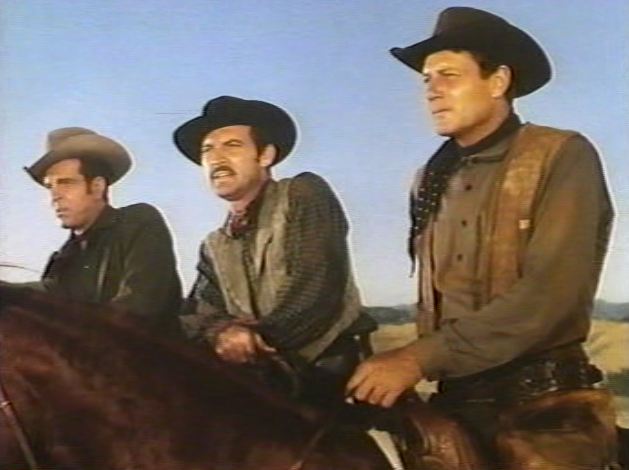
Joel McCrea, Zachary Scott, and Douglas Kennedy are pals who run a ranch together in Texas. The ranch is called Three Bell, and they each wear a tiny bell on one spur that jingles when they walk. When they are off rounding up cattle, Victor Jory and his band of raiders burn out the ranch, abscond with some cattle and chase off the rest. The three pals are left with nothing.

Victor Jory, in his patented nasty heavy role is currently working for the Union Army, which has just taken the border town Brownsville, Texas from the Confederates. Jory scatters and terrorizes the settlers.

One of which is Dorothy Malone, who here is a couple years after her intriguing book shop proprietress from “The Big Sleep” (1946), and several years away from her Oscar-winning mambo in “Written on the Wind” (1956). You might not recognize her in her long brown curls and gingham. She’s as pretty -- and as static -- as a daisy. Not her fault, though. She clearly got the leftovers on this gig.

The flashy part goes to Alexis Smith as dance hall singer Rouge. She was quoted in an article by Bob Thomas syndicated in the Regina, Saskatchewan Ledger-Post (July 28, 1948): “It’s a pleasure to be playing someone named ‘Rouge’ after seven years of ‘Ceciles’”.  It amuses me that Canadian newspapers back in the day never missed a chance to publish anything on Alexis Smith, usually heading the article "Penticton, B.C. girl...."

She elaborated her delight on shifting from icy clotheshorse to lusty babe for the Dayton Beach Morning Journal (June 15, 1948): “For seven years I’ve played society dame parts and begged for a role with guts. Now I’ve got my wish and I’ll probably spend the next seven years wishing to get back into clothes.”

Not likely.  The seven-year contract days were ending for the Hollywood studios, and she would soon be, along with hundreds of others, cast into the freelance lagoon to sink or swim.

Joel McCrea and the boys head for Brownsville to beat up Victor Jory for torching their ranch. McCrea, his matinee idol face now craggy and softer -- he would turn to cowboy movies pretty much for good now -- tells Jory to get out of Texas. Jory flees to Matamoros, Mexico, just over the Rio Grande.

The movie is kind of "a tale of two cities" -- Brownsville and Matamoros.

Zachary Scott and McCrea have to scrounge up some money to replace their herd and fix their ranch. This is where Alexis Smith comes in.  She sets them up in the gunrunning business. They will take weapons from Matamoros into Texas and sell them to the Confederate Army.

Douglas Kennedy bows out, decides he wants to join the Confederate Army. His pals tease him. There is no question of fighting for “the cause” for McCrea or Scott. Neither of them are pacifists or Unionists -- they hate the Yankee soldiers in Brownsville -- but they wander around in a most curiously self-involved cloud, as if the monumental events of the day, the battles ranging all around them are far away and none of their business.

Their self-preservation is not unique. Everybody in Brownsville is afflicted with it. When Joel makes his first gunrunning attempt and gets caught by the Union Army, he is sent to the stockade, possibly to be shot -- Alexis bribes the marshals to get him out.

She explains, “They’re southerners -- for $100 gold.”

There is much back and forth between Brownsville and Matamoros. McCrea and Scott get themselves a band of cutthroats to help them smuggle the guns into Texas. One of these men, played by Bob Steele, wears a long knife in his belt and has an almost psychotic silent-movie stare. No wonder, for Mr. Steele, who made about a zillion westerns, began his film career in 1920.

The gunrunning trade shows us a complex economy. They pick up the guns in Matamoros, and sell them to the Confederates in Texas, but are paid in Texas cotton. Then they must take the cotton back to Matamoros where they sell it to a British agent for pounds. Remember, the Union blockade of southern ports hit the British textile industry. The cotton mills of Manchester were waiting for Joel McCrea to get them some more raw material.

All this has been set up by Alexis, a shrewd businesswoman with no seeming loyalty to North or South. When we meet her, she is singing in Alan Hale’s saloon (Hale too little used, by the way), “Yankee Doodle.” The Union men are cheering her and buying another round, making Mr. Hale very rich and very happy. Later on, after the Confederates have taken Brownsville again (though actually the Union Army abandoned Brownsville), she sings to Confederate men, noting to Zachary Scott, “I’ve got a couple of fences that need mending.”

Hale is happy, too, for after all, he stresses he was born in Missouri. Alexis is from Baton Rouge (her nickname Rouge is from her birthplace and not her fancy gal cosmetics). Both southerners, each blows with the wind. (All the main characters in this movie are southern, and none have appropriate accents.)

Alexis’ singing in this movie is done by herself, according to the syndicated article in The Deseret News (Salt Lake City, December 29, 1949), but the IMDb lists her as being dubbed by Bonnie Lou Williams. I believe the first number, “Yankee Doodle” is definitely Alexis, but I’m not sure about the other two numbers. In the quiet, sultry, “Too Much Love”, which she croons, bitterly tipsy, to Joel McCrea could be dubbed, but it’s just such a good vocal match it’s hard to tell. I’m even less certain about the third song, “It Must Be Fun to Have a Soldier”.


Somewhere between gunrunning and vendettas with Victor Jory, Miss Smith has fallen hard for Joel, who is planning to marry Dorothy Malone. Smith’s “How pretty is she? Very pretty? Kip, is she very pretty?” shows the showy saloon girl with a heart full of pain, asking for what can only hurt her.

Her song and dance number, “It Must Be Fun to Have a Soldier” comes with other consequences. You can see as she sings that the dark beauty spot located just to the right side of her mouth has slipped off her face and landed conspicuously on her right breast.  Blooper?  Joke?


For those of you who sing in public, please be sure your beauty spot is fastened firmly to your face, or you may lose it on the next chorus. This has been a public service announcement from Another Old Movie Blog - Serving Your Old Movie and Saloon Girl Cosmetic Needs Since 2007.

Dorothy Malone, no beauty spot needed, works as a nurse in a makeshift hospital for Confederate soldiers. Douglas Kennedy has become an officer and is posted to Brownsville. In one of the most ironic scenes in the movie, McCrea’s gunrunning band dresses as Union men to steal weapons from Victory Jory and sneak across the border, but runs into a Confederate patrol. A skirmish occurs and men are killed on both sides. McCrea’s band, who are running guns in support of the Confederate Army, have just wiped out a Confederate patrol.

So many true-life senseless killings happened in that war, but rarely has old Hollywood acknowledged it, let alone treated it with such a blasé shrug of the shoulders. Douglas Kennedy finds out and is of course outraged, but no pangs of conscience hit his buddies.

“We couldn’t help it,” McCrea says, “They started shooting. We had to defend ourselves.”

“Defend the wagons, you mean,” Kennedy answers, “You were willing to fight us, kill our men, anything just to make sure you got your money.”

Vendettas continue between Jory, who is no longer working for the Union Army, but is selling guns to the Confederates in competition with McCrea and Scott. Scott takes it up a notch by looking the other way when Bob Steele attempts to assassinate McCrea so they could have a greater share of the wealth.

The only two people with a sense of commitment are Dorothy Malone and Douglas Kennedy, who finally commit to each other and intend to marry, and McCrea is disgusted at one buddy who tries to kill him and one who steals his girl. It is from disgust, more than any moral epiphany, that he resigns from the gunrunning business and tells Scott he can have all the money.

Alexis follows him, even though he doesn’t want her, and Zachary Scott, who fancies her himself, wants to know why she’d give up a lucrative business for a saddle tramp who doesn’t even know she’s alive.

“He ain’t got nothing but the clothes on his back.”

“It’s how you wear them, Charlie,” she responds, “It’s all in how you wear ‘em.”

Eventually he does notice Alexis in a scene more sweet than passionate, and has a final showdown, helping Douglas Kennedy, now a Texas Ranger that the “hostilities have ended” -- you’d think the end of the war was nothing more than a passing thunderstorm -- fight off the bad guys.

We hear the tiny jingle of silver bells on their spurs, and cut to a shot of Zachary Scott’s face. Will he remember past friendships? Will he have a change of heart before the trigger is pulled?

There is no sense of redemption for anyone, but a lesson nevertheless as Alexis slams Joel, who is caught it a morass of anger, self-pity and vengeance, “What are you going to do, spend the rest of your life getting even?”

With malice toward none, with charity to all.

A peaceful day of solemn remembrance to everyone this Memorial Day.

Related Products