
Skirts Ahoy (1952), just the title tells us we’re in for a
bit of frothy fun on the waves. Or with
WAVES, but this musical lightweight still deceptively carries a few
undercurrents (pun intended) of serious reflection on its era.

Esther Williams, Joan Evans, and Vivian Blaine play a kind
of female version of On the Town, which, though that featured three sailors in
a musical, had nothing to do with the Navy.
The girls get a scene of being on the razzle in Chicago looking for
dates just as the boys were looking for a good time in New York City. Though their adventure ends with Esther
Williams punching out some WACs for hitting on her guy (off camera of course),
it begins, unpromisingly, with a visit to a tearoom.

Such is the difference in exploring women’s experiences in
the military as opposed to men. The
barroom brawl (even an off-camera one) was meant to be parody. The tearoom was meant to show what nice WAVES
did on leave.

The ladies begin as civilians, and as was typical of the
early 1950s, begin as prospective brides or bride wannabes. Joan Evans, who had a very brief career, most
of it on television, is a bride left at the altar by a runaway groom. Her funny little brother suggests she join
the Foreign Legion to forget. She
settles on the WAVES.

Esther Williams is in the opposite predicament. She’s the one doing the jilting, escaping
from her wedding ceremony in her bridal gown to seek a solution to her restless
spirit. Of the three, she takes to the
Navy life with the best attitude.
Vivian Blaine, in between her Broadway smash Guys and Dolls and her film appearance in the same roll in the 1954 film of the same
name, continues to play a variation on Miss Adelaide here. She’s a sweet, dumb blonde with an adenoidal
voice, who works in a dress shop, dismayed to find her boyfriend has just
joined the Navy. It does not seem to
occur to her that he might want to get away from her.

In the back room of this dress shop are seamstresses bent
over sewing machines. Pleased to see one
of them is Kathleen Freeman, one of my favorite bit actresses, who, dubious
about Vivian’s attachment to the guy, delivers the line in Brooklynese, “Please
don’t take it personally, but you’re a schmo.”

Off they all go to the Great Lakes Training Center, where we
don’t really see much training. I like
the bugler who wakes them up, in a bathrobe and pin curls with the hoarse caterwauling,
“Hit the deck!”

Lovely Margalo Gillmore, more known for her stage work than
film career, plays the female officer in charge, more a den mother figure than
a boss. She says things like, “There,
there, my dear,” and calls them children.

The five DeMarco Sisters have also joined the WAVES, and they
get to exhibit their very close harmony singing on a couple occasions.

The ladies tell us they are tired from marching, though we
don’t see much of it. We do, however,
get to watch some of their training in swimming. Being an Esther Williams
movie, you know she’s never going to be far from a pool. We may smile at our first glimpse of her in
the water, looking askance at a pair of inflatable water wings — because, in
order to stay with her buddies, she has not told her superiors that she’s already
swum in several other movies and had been a member of the 1940 U.S. Olympic Swim
Team.

Later on she gets to do her thing without any restraint;
first with two small children, Russell and Kathy Tongay, who are clearly
Aquaman’s kids. I confess, though, I am
uncomfortable with long scenes shot underwater.
I find myself holding my breath.
When I regain consciousness, lying on the floor, staring up
at the underside of the coffee table, I realize I’ve been watching too many
Esther Williams movies.

I think her best swimming partner is the inflatable pool
toy. He’s a charming companion. She drops her skirt and swims in her skivvies
in this scene. I think her nighttime
swim with the pool toy is the most romantic and erotic scene she ever did. I laugh as I type this. But it’s true.

Her cutest number is non-swimming, but still all wet. She sings a camp show number called “What
Makes a Wave?” A whole lotta water, we
are told, is what makes a wave, and she and her backup singers get slapped in
the face with wet mops, squirted with water pistols, and at one point, Esther
gets a bucket of water dumped on her while she’s singing.

I don’t know how she felt about this scene,
but she really looks like she’s having a lot of fun. I’d like to know how many takes it took to
get the final version. We see her great comedic timing in this movie; unlike
her swimming films, she is not presented as a kind of mythic goddess.
This film may invariably be called “dated”, and of course,
it is. However, I can’t think why anyone
would dismiss this movie (or any for that matter) because it is dated. Being dated is what tells us more about an
era than a movie that is so-called “timeless.”

We move, startlingly, from prospective brides to shy Joan
Evans (who was only about 17 or 18 here) telling off her returning fiancé with
a remarkable speech of self-empowerment, “You didn’t make a fool of me when you
left me at the altar. I was a fool for
being there in the first place!”
He later joins the Navy to follow her.
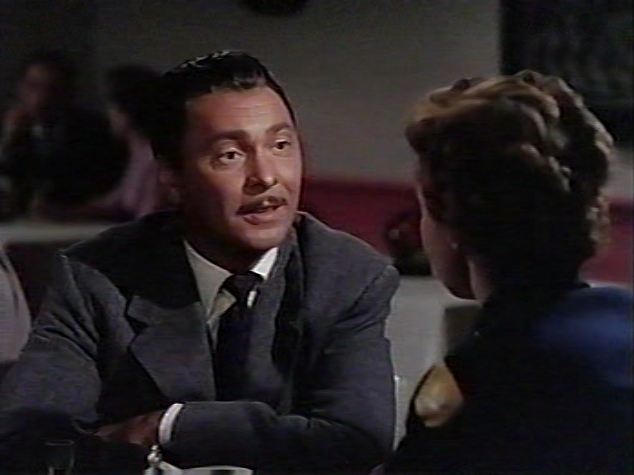
Esther “picks up” Barry Sullivan in a bar (whom she does not
know is the camp doctor, because he is out of uniform) and we have a cute scene
of role reversal where she picks the food, the wine, and defends his honor
against a trio of unladylike WACs. We last saw Barry Sullivan in Tension (1949). She
will spend the rest of the film pursing him, but he rejects her. He sees from her file that she only wants
something if she can’t have it, then changes her mind once she’s got it. At the end of the movie when he confronts her
with this, she acknowledges she is assertive and, instead of bending to his
will, admits she will never change.

We leave it to Margalo Gillmore, at the final graduation
speech to drag us back into the sexual stereotypes of the 1950s by
congratulating the women that they have learned to grow beyond the typical
cattiness of their sex, that they have proved that women are not “the natural
enemies of each other.” Real-life women
already knew that; it’s the movies that stereotyped them.

Other scenes in this movie only raise tantalizing questions. For instance, at the USO dance, a platoon of
drill team members performs close-order marching in a very jazzy and precise
routine. Drill teams such as this have
long been a part of the military, where competitions are held among them. This unit, however, is made up entirely of
African-American women. One wonders why
we are being shown an all-black unit in a military that was desegregated by
President Harry Truman’s Executive Order in 1948? It is true that it took a few years for all
units to be desegregated; it didn’t happen all at once. Were there still all-black units in the WAVES
in 1952?

These women, by the way, were not real WAVES, despite their
proficiency at close order drill. They were dancers and actresses, and
according to IMDb, one of them was Juanita Moore, best known for Imitation of Life (1959), who we last saw here in Witness to Murder (1954); and Arte
Young, who had a role in the The Bronze Buckaroo (1939) which we mentioned here in our tribute to Herb Jeffries.

Billy Eckstine’s appearance here as a nightclub singer is
likely due more to his great popularity at the time than any erstwhile
intention to film this movie with a racially diverse cast. Musician, bandleader and singer, Mr. Eckstine
was the first African-American singer of romantic ballads to find success among
the general public. Nevertheless, I could
not help but notice he did not look at any white female patron in the nightclub
where he sang. Usually a singer throws
out a line or two to his audience, to involve them in the song. He looks blankly forward, not interacting
with his all-white audience. Who told
him not to, I wonder?
We also have, in this hodgepodge of images, a scene where
Keenan Wynn, as an announcer, and Debbie Reynolds and Bobby Van, all portraying
themselves, sing and dance at the USO show.
And when Esther goes to the movies, we see on the marquee of
the theater The Great Caruso is playing.
A little cross-publicity never hurt any studio. (Update: speaking of cross-publicity - we covered The Great Caruso in this post here.)
WAVES stands for Women’s Auxiliary Volunteer Emergency Service,
disbanded when women were integrated into the Navy in the early 1970s.

In all this, we get very little of what it’s like for women
in the Navy in 1952. The Korean War is
going full-tilt, but it’s not mentioned.
Women were not allowed in combat areas or aboard combat ships anyway, so
it’s not likely their overseas assignments would take them anywhere near
danger.
We are given no messages to convince us that women have a
place in the military, such as we saw in Keep Your Powder Dry or Cry Havoc,
though Barry Sullivan does admonish Esther Williams about behaving badly in
public, “People are still prejudiced about women in the service, as you
know…”
But we have the feeling that who could complain about women
in the military when it seems like the girls are having such a good time at
this college sorority/summer camp/ debutante cotillion in uniform?

Leaving their half-eaten lollipops around for poor “Pops”
the plumber to dislodge from the swimming pool pump.
By the way, we have an Innocent Southern Gal in this one
too, but amusingly, she is referred to only and never seen.

Esther, as she relates in her autobiography, did have a
lasting impact on the WAVES. She spurned
their ugly and impractical swimwear and demonstrated to the Secretary of the
Navy a modern latex version that offered greater comfort and support. The Navy ordered 50,000 suits.
Come back Thursday for our final look at women in the
service with Rosalind Russell’s manic turn as a WAC in Never Wave at a WAC (1953).
Jacqueline T. Lynch is the author of Ann Blyth: Actress. Singer. Star. and Memories in Our Time - Hollywood Mirrors and Mimics the Twentieth Century. Her newspaper column on classic films, Silver Screen, Golden Memories is syndicated nationally. Her new book, a collection of posts from this blog - Hollywood Fights Fascism - is available here on Amazon.

