IMPRISON TRAITOR, PEDOPHILE, AND CONVICTED FELON TRUMP.
Showing posts with label Jack Overman. Show all posts

Thursday, October 2, 2014

Brute Force - 1947


Brute Force (1947) remains a giant among prison movies.  Visually stunning, it has a noir foundation on which is hung an unusually sensitive (for noir) study of men trapped by their circumstances, their sins, their weaknesses, their fears, their anger, and even by their ability, those that still have it, to feel the pain of those around them.

Burt Lancaster heads a sterling cast, even the most minor character is vivid and memorable in this film.  That’s what happens when you have a crisp, literate, and biting script, and most especially, a director and cinematographer who freely turn what could have been a stiff sort of docudrama, or clichéd melodrama—how most prison stories tend to be filmed—into unabashed art.  We are treated to a generous array of stunning close-ups and interestingly framed shots that tell us volumes about the men, especially since they are in a setting where they are close-mouthed, unlikely to tell us everything that’s going on inside them.

Expository dialogue goes to the administrators in the prison.  We have Richard Gaines, so dependable in officious roles as the severe, pompous superintendent, always pressuring the anxious, ineffectual warden, played by Roman Bohnen.  The warden complains of cutbacks in funding, that the prison is overcrowded, that the men need job training…all of which the superintendent balks at, saying what the men need is more discipline. 

The soft voice of the head of the prison security force, played by Hume Cronyn, belies his sadistic nature.  The little man enjoys the fear he excites in the hardened men, most of them much larger and physically imposing—but Cronyn wields power he’s swiped in a vacuum of leadership, tortures them physically and psychologically, and he has Ray Teal following behind him with a billy club like a human swagger stick.

The cast is a feast of favorite character actors, like Sam Levene, and Charles McGraw in one of many uncredited roles that filled the first several years of his film career. 
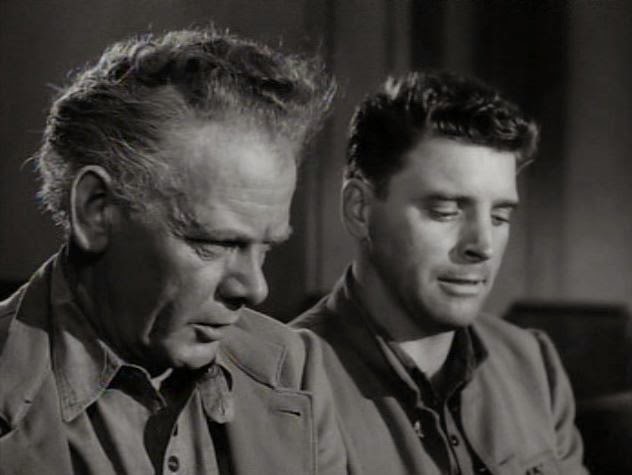
The wonderful Charles Bickford is the level-headed old timer, who breaks up fights in the prison among the other cons, and bides his time until his hoped-for parole.


Sir Lancelot sings calypso rhymes he makes up on the spot to narrate what he sees, as either a funny jest, or a warning, or a requiem for yet another dead prisoner.

There’s Jack Overman as one of the cellmates, an easygoing, simpleton ex-fighter.  One of my favorites, he has a bigger role here for once.  We’ve seen him in a non-speaking minor role in Once More, My Darling (1949) here, and also in Swell Guy (1946) here.  Sadly, Mr. Overman died in late 1949 at only 32 years old.

His cellmates include Whit Bissell, as a small-time embezzler, a sad, brittle fellow who, obsessed his shallow wife, played by Ella Raines in a flashback segment, fearing losing her love, steals from his employer to buy her a mink coat. 

John Hoyt is a stylish grifter, mainly in phoney stocks, a man-about-town with a charming easy-come, easy-go attitude.  I love his line, “I wonder who Flossie’s fleecing now?”

Howard Duff, in his first film, is a former soldier who took the rap for Yvonne De Carlo, an Italian woman he falls in love with during the war.  She has murdered her father to save Duff, but though he takes the blame to save her, I don’t believe his current imprisonment is for that crime.  He remarks about always wanting to get back to Italy to see her, but “one rap led to another.”

The best lines, and probably the best role of the film happily goes to Art Smith, who plays the prison doctor.  He’s just as fatalistic as the cons, and drinks heavily to dull the pain of this miserable place.  It's a terrific performance.   

But unlike the weak warden Roman Bohnen, who gives in to the bullying Richard Gaines and the devious machinations of Hume Cronyn, Mr. Smith is still a man of strong conscience.  He gets into shouting matches with them all, gets right in their faces and bleeds his anger and sarcasm all over them.  Again and again, they slap him down.

Burt Lancaster, whose character as the leader of his cell, and one of the most respected by the other prisoners for his toughness, is beautifully lit, if you can call his deadly cold glare and vicious snarl beautiful. 

We first see him standing in the prison yard in the pouring rain, but with his soaking wet shirt tucked neatly into his soaking wet prison trousers, he strides back to his cell, his shoulders straight, his head held high with an air of nobility.  Though he has just come out of solitary confinement, he is not broken.  He is angrier, and more charismatic to us and to the other prisoners, than ever.  The other men light his cigarettes as a mark of his leadership.  The only one who ranks him is Charles Bickford, who freely reaches into Lancaster’s prison jacket in another scene and swipes a match from Burt’s shirt pocket to light his own cigarette.  Burt lets him, hardly noticing, as if the older man could be his father and is allowed such liberties.

Because this is a setting of confinement, much of the film has the feeling of theatre, and the action that takes place is muted and judicious, until the very end of the film when we have the attempted prison break.  Director Jules Dassin and writer Richard Brooks have the perfect marriage of script and cinematography, where each supports the other, and the pace of the movie flows beautifully, building tension, and then releasing it a bit at a time in unexpected moments of black humor, and when, where the men watch the 1947 comedy The Egg and I starring Fred MacMurray and Claudette Colbert, it seems surreal.

Ann Blyth, like the few other women in the cast, save for the officious and severe secretary of the warden, is shown in flashback.  The women on “the outside” show us what the men’s lives were like before they went to prison.  There has always been a debate as to whether the flashback scenes with the women are necessary to the film.  Some critics and viewers feel they are fitting to the story, and others feel they slow the story down and detract from the intensity of the prison scenes. 

Even director Jules Dassin apparently did not want to use the flashback device.  Author Alan K. Rode in his biography of Charles McGraw, Charles McGraw: Biography of a Film Noir Tough Guy, reveals that Dassin gave in to producer Mark Hellinger and the studio brass to include the four flashback scenes that show women who have influenced the lives of some of the men in the cell.  He quotes Dassin:

“Truly, the film is demeaned by the inclusion of ‘the women.’  I had to choose between not making the film and yielding to having the women nonsense.  Many years later when I looked at the film…I do not forgive myself.”

I don’t know how screenwriter Richard Brooks felt about the women scenes, but I’m inclined to think Mr. Dassin’s dislike of them might be, in part, a director’s usual, and quite understandable, bristling at having to shoot the film to someone else’s vision.

On another note, Mark Hellinger had to fight toe-to-toe with the Breen office because the MPAA wanted to censor many of the films violent scenes, a reference to marijuana, and even to exclude the word “cancer” when referring to Ann Blyth’s diagnosis because the very word was upsetting to the public.  Perhaps Hellinger threw Breen a bone when he has the doctor, Art Smith, reassure Burt Lancaster that, “These days, cancer doesn’t have to mean death at all.”

That’s another reason why Burt has to bust out of prison.  There’s a time element to Ann’s needed operation.

Others have suggested that the flashbacks represent a societal misogyny, or some statement to the effect that these are regular Joes who’ve been led astray by dames.  Again, here I disagree.  They show the men, more than the women, to be flawed.  Though John Hoyt has his car, his gun, and his gambling winnings stolen by a floozy, he was obviously willingly, knowingly taking chances in an underworld game of roulette, and the odds were against him this time.  He shrugs it off, amused and unrepentant.

Whit Bissell’s wife’s cooling ardor for him, and her greed for the mink coat which she clearly treasures more than her husband, leads to his downfall, but she did not force him to embezzle, had no idea he was doing it.  Bissell was not led astray, he was a fool who turned to thievery, and his obsession with his wife was such that it leads to his suicide when Hume Cronyn tells him (whether true or not) that his wife is divorcing him.  “I get quite a kick out of censoring the mail.”

Howard Duff’s taking the rap for Yvonne De Carlo does not make her a villain, her act of love is to protect him; his was to protect her.  But thinking this paints Duff as a hero wrongly placed in prison is also erroneous.  He is not in prison for assuming the guilt for her murder of her father; he plainly tells us he’s had other “raps” since.  Besides, he would have been incarcerated in a military prison were that so.  Look at the scene where he, John Hoyt and Jeff Corey go after a “stoolpigeon” prisoner with blowtorches, forcing him to be crushed in a stamping machine.  Look at their expressionless faces.  These regular Joes are killers. 

We could probably dispense with their flashback scenes (indeed, Anita Colby as Hoyt's floozy girlfriend never even gets any lines), but the one with Burt Lancaster and Ann Blyth I think is important to the film.  We don’t know if Lancaster has committed murder on the outside, but we see he is tied in with a gang he gives orders to, and probably is involved in something more like bank robbery.  Just before he leaves on another “job,” he stops by the house where Ann Blyth lives, an invalid in a wheelchair.  Lancaster hands a caregiver an envelope with money, “See that she doesn’t need anything.”

Ann is at first asleep, then he wakes her, and in their tender scene shows us that Lancaster is tired of running, that this will be his last job, and then he will come back to her for good.  He tells her that when he met her, he was a guy who “found the first important thing in his life.”  She doesn’t know what racket he’s in, but she senses he is troubled.  She wants to help him, wishes she weren’t sick so that she could help him.

“There are all kinds of sick people, Ruth.  Maybe we could help each other.”  The scene is gentle, affectionate, somewhat sad.  Ann’s character is not a gun moll, she’s a sweet, decent girl who trusts him.  This is important because it bolsters the visual image we already have of Burt Lancaster in the film as more a wounded animal than a psychopath.  

Indeed, at the very end of the movie when he is shot in the prison escape, he rears back with a single roar of pain and rage, like an animal in a trap, cut short as he fires several rounds into the guard who wounded him.  Bookending his cold expression of anger through most of the film is the softened, relaxed look of tenderness on his face when he sees her sleeping, and at the very desperate end when he sees that the escape plan has failed, and he looks for a moment like he could cry.

We need this scene with Ann Blyth, maybe all of “the women” scenes, not to remind us that the men are human, but because we are.  We can’t root for criminals to break free from jail, not unless we have some emotional stake in their success.  Without emotion, it becomes as academic as a watching the outcome of a dog race, and without the betting.

Interestingly, their scene ends with the camera remaining focused on Ann after Burt has left the room, tears welling in her eyes, heartbroken, frustrated, and fearful.  Dassin's touch, or Hellinger's?

One wonders what private demons she might have faced in the brief scene.  She was eighteen years old.  In the previous two years she had spent several months really in a wheelchair as a result of her spine injury, and her mother really died of cancer, both discussed in our intro post to this series.  Life's coincidences are occasionally macabre.

Producer Mark Hellinger may have had yet another reason for putting Ann Blyth and Burt Lancaster together.  He had hired her for Swell Guy (1947), and him for The Killers (1946).  They were two of Universal’s most talented up and coming stars, and he may have wanted to turn them into a team.  According to syndicated gossip columnist Dorothy Manners who wrote this in May 1946:

Mark Hellinger, always good for a bright idea, said to me, “Where are those swell romantic teams that used to make the fans goggle-eyed over their love scenes…It’s time the love team is revived on screen,” and Mark is the boy who is going to do it with his two young stars, Ann Blyth and Burt Lancaster…he wants to make three or four with Ann and Burt.  This Blyth girl is the real star stuff—young, tempestuous and definitely a screen personality.  If you saw her as Mildred Pierce’s daughter, you know what I mean.

Having played in her previous two films as young women of dubious, or downright evil, character, her role as the kindly, gentle Ruth in Brute Force would be the first important break in a string of roles that could have left her typecast, and farther away from ever doing the musicals she hoped to make.  But Ann Blyth was not done with bad girls yet: A Woman’s Vengeance (1948), discussed here, and Another Part of the Forest (1948), discussed here, were on the horizon.  She’s in Brute Force all of only about three or four minutes, but her scene is indelible, and does more for Burt Lancaster’s character than the awe the other prisoners show for him.

Their romantic team never did materialize.  Both went on to other films, and Mark Hellinger, who might have made a pet project of bringing them together again on screen, tragically died about six months after Brute Force was released.

Come back next week to Katie Did It (1951), a movie I can’t find, and a few thoughts about that and on Ann’s career as we round the corner and head for the home stretch on this series.


*************************
Milwaukee Sentinel, May 31, 1946, syndicated column by Dorothy Manners, p. 4.

Rode, Alan K.  Charles McGraw: Biography of a Film Noir Tough Guy, (McFarland, 2007), p. 32.


****************************
As  most of you probably know by now, this year's TCM Classic Cruise will set sail (proverbially) in October, and one of the celebrity guests is Ann Blyth.

Ann will be doing a couple hour-long conversation sessions, and will also be on hand for a screening of Mildred Pierce.

Have a look here for the rest of the schedule and events with the other celebrity guests. Unfortunately, the cruise is booked, so if' you're late, you can try for the waiting list.

I, sadly, am unable to attend this cruise, but if any reader is going,  I invite you (beg you) to share your experiences and/or photos relating to Miss Blyth on this blog as part of our year-long series on her career.  I'd really appreciate your perspective on the event, to be our eyes and ears.  Thanks.
****************************
 THANK YOU....to the following folks whose aid in gathering material for this series has been invaluable:  EBH; Kevin Deany of Kevin's Movie Corner; Gerry Szymski of Westmont Movie Classics, Westmont, Illinois; and Ivan G. Shreve, Jr. of Thrilling Days of Yesteryear.  And thanks to all those who signed on as backers to my recent Kickstarter campaign.  The effort failed to raise the funding needed, but I'll always remember your kind support.
***************************
TRIVIA QUESTION:  I've recently been contacted by someone who wants to know if the piano player in Dillinger (1945-see post here) is the boogie-woogie artist Albert Ammons. Please leave comment or drop me a line if you know.
****************************
UPDATE:  This series on Ann Blyth is now a book - ANN BLYTH: ACTRESS. SINGER. STAR. -
*********************
The audio book for Ann Blyth: Actress. Singer. Star. is now for sale on Audible.com, and on Amazon and iTunes.

Also in paperback and eBook from Amazon, CreateSpace, and my Etsy shop: LynchTwinsPublishing.


 "Lynch’s book is organized and well-written – and has plenty of amusing observations – but when it comes to describing Blyth’s movies, Lynch’s writing sparkles." - Ruth Kerr, Silver Screenings

"Jacqueline T. Lynch creates a poignant and thoroughly-researched mosaic of memories of a fine, upstanding human being who also happens to be a legendary entertainer." - Deborah Thomas, Java's Journey

"One of the great strengths of Ann Blyth: Actress. Singer. Star. is that Lynch not only gives an excellent overview of Blyth's career -- she offers detailed analyses of each of Blyth's roles -- but she puts them in the context of the larger issues of the day."- Amanda Garrett, Old Hollywood Films

"Jacqueline's book will hopefully cause many more people to take a look at this multitalented woman whose career encompassed just about every possible aspect of 20th Century entertainment." - Laura Grieve, Laura's Miscellaneous Musings''

"Jacqueline T. Lynch’s Ann Blyth: Actress. Singer. Star. is an extremely well researched undertaking that is a must for all Blyth fans." - Annette Bochenek, Hometowns to Hollywood


Ann Blyth: Actress. Singer. Star. 
by Jacqueline T. Lynch

The first book on the career of actress Ann Blyth. Multitalented and remarkably versatile, Blyth began on radio as a child, appeared on Broadway at the age of twelve in Lillian Hellman's Watch on the Rhine, and enjoyed a long and diverse career in films, theatre, television, and concerts. A sensitive dramatic actress, the youngest at the time to be nominated for her role in Mildred Pierce (1945), she also displayed a gift for comedy, and was especially endeared to fans for her expressive and exquisite lyric soprano, which was showcased in many film and stage musicals. Still a popular guest at film festivals, lovely Ms. Blyth remains a treasure of the Hollywood's golden age.


***************************
A new collection of essays, some old, some new, from this blog titled Movies in Our Time: Hollywood Mimics and Mirrors the 20th Century is now out in eBook, and in paperback here.


Thursday, April 3, 2014

Once More, My Darling - 1949


Once More, My Darling (1949) is one of the funniest comedies of the era, and one of the most charming ever made.  I’m not sure why it’s not more well known because it deserves to be lumped with the greats, especially in the madcap heiress genre.  Perhaps because it is so deliciously offbeat, it requires, just as Robert Montgomery discovers, you have to accept certain things at face value.  Its humor is more gentle and subtle than broad, a kind of hybrid between the screwball comedies of the 1930s and a more wry, introspective humor.
The title comes from the speech star (and director) Robert Montgomery delivers on set as a struggling movie actor. 
It’s a funny scene, where he has trouble proclaiming his love to thin air, so the director gets him a body to talk to—a bored and uncomfortable movie grip played by Jack Overman.  Mr. Montgomery looks equally uncomfortable with this situation, but he plods ahead proclaiming his love to Mr. Overman, who is deeply affected.


Montgomery is actually a lawyer, from a noted family of lawyers, but is bored with the work and, now that the war is over (where he served in the Army in Europe as an investigations officer in the military police), he wants to pursue a fanciful dream of acting.  He is smart, savvy, a bit of a ladies’ man who doesn’t want to be tied down to anything—not a wife, not his family’s law practice, and not the Army.  Unfortunately for him, he’s still considered Reserve status, and is called back to uniform to help in the investigation of a jewel theft that happened late in the war.
When he is called into the colonel’s office, he firmly responds, “I will not go in without my mother.”
He immediately attracts the attention of everyone in the office.  His mother, standing with dignity beside him, is played by theatre great Jane Cowl.  She is an even better lawyer than Montgomery is, and he wants her there as his attorney to get him out of the army.  She doesn’t do it though, because she really wants him to give up this silly acting hobby, get married, and join the law firm.
The case to which Mr. Montgomery is assigned involves Ann Blyth, who plays the daughter of a wealthy American industrialist who spends his time between the US and South America.  The jewel thief, like a lot of shady characters in the post-war years, left Europe for South America, met Ann and attempted to woo her with the stolen jewels.  She is innocent about the heist, but she has publically worn the jewels, notably in a magazine advertisement for perfume she did as a lark.  The government wants Robert Montgomery to woo Miss Blyth himself to flush the jealous bad guy out of hiding so they can nab him.
It’s a simple plot that is carried along with effervescent silliness and beguiling charm.  Robert Montgomery smoothly straddles the savvy and in-control aspects of his character—and helplessly rides the crest of the completely goofy and out-of-control situations in which he finds himself.  He is not entirely a calculating straight man, like, say, Gregory Peck in RomanHoliday (1953), but not entirely a vulnerable and befuddled guy like Cary Grant in Bringing Up Baby (1938) who sometimes seems like a sap Katharine Hepburn culled from the herd for amusement.  Montgomery is more mature and adapts to the moment like the kind of good improvisational actor his character yearns to be.
Here Mr. Montgomery plays out the split personality of his character—a capable man able to think on his feet, but also a “romantic dreamer” as Ann Blyth calls him, who prefers dressing in costumes and acting, to a dull law practice.
Ann Blyth, in the role of the heiress he pursues, also has a duality about her character.  She is sure of herself, bursting with a courageous curiosity about the world, and yet utterly naïve.  I love how she plays this socially dysfunctional character, how she speaks and how she moves.  She leans into people, someone who has no concept of “personal space,” and has a slightly nearsighted squint as she navigates conversations, studying the faces of people to whom she speaks like someone who cannot read expressions 
Unlike Hepburn’s rapid-fire take-charge prattle in Bringing Up Baby, Ann enunciates her words carefully in a manner which illustrates perfectly the kind of young woman this is: someone who, having spent many years bouncing between North and South America probably learned English and Spanish together so that neither is her first language or her second language.  Her speech is formal, sounding as if she’s gleaned much of it from 19th century novels, sprinkled with bits of odd-sounding modern slang she’s probably picked up in off moments from the radio.  She’s likely spent the bulk of her lonely life in the charge of tutors.
She is socially awkward, but lacking shyness, charges into social situations like an excited child discovering new friends at kindergarten, and is completely oblivious to what an oddball she seems to others.  This is consistently hysterical, but also I think rather poignant.  She has no siblings, no friends, and has been sheltered in the care of a dismissive father.
He is played by Taylor Holmes, a veteran movie character actor since the silents of the ‘teens, when he wasn’t on Broadway.  Somewhat of an eccentric himself, her father has lately taken to dressing like his hero, Winston Churchill, and has taken up painting to emulate him.  When Robert Montgomery approaches Mr. Holmes for permission to get to know Ann, and accidently knocks over his easel, Holmes launches into a furious tirade in Spanish.  Ann and her father speak Spanish back and forth, she trying to appease him, flinching at his rage.  When Mr. Montgomery requests a translation, Ann replies, “My father wants to beat you up.”
Catch the reference to the pollsters’ recent infamous mistake on the Truman-Dewey election.
Their chauffer, played by my favorite gravely-voiced guy, Charles McGraw, is an ex-boxer, also very protective of Ann, whom he calls by her nickname: “Killer.”  She is an excellent tennis player, and proudly wears a short-sleeved sweatshirt with the name Killer on the front some vanquished opponents gave her because she has a killer forehand.
In her tennis duds is where she first meets Robert Montgomery, and with her hair tucked under her cap, sunglasses, and Killer across her chest, and he at first doesn’t realize this is his quarry.   She doesn’t look at all like the glamorous debutante photo in the perfume advertisement he was given back in the Colonel’s office, in which she wore an evening gown, with a jeweled pendant—one of the stolen jewels—glinting on her cleavage, and on which Montgomery blissfully concentrates when he is shown the ad. 
She was given gallons of the perfume for doing the ad, which she uses liberally ("I practically swim in the stuff") and there is a running gag about the strong scent.
So Montgomery does not recognize her when he first meets her in this tennis getup, but she is drawn to him immediately.  When she remarks, “I’m sorry there isn’t a puddle so I could take something off and spread it for you to walk on,” we might first think she is being sarcastic, as he does.  Very soon, however, it becomes apparent that this is the love-talk of somebody who doesn’t know how strange she sounds.
Some favorite moments in the film:  When Robert Montgomery, unwillingly, brings Ann home to meet his mother on the night his mother is hosting a party at home for some influential friends. 
Ann is clearly the oddball in this scene, and sweetly, and painfully, doesn’t know it.  She eagerly pounces on Jane Cowl, expressing her love for Mother Cowl’s boy Robert.  She announces that she intends to do "the right thing" by Robert and marry him, pleading that Jane be a mother to her, too, since she never had a mother.  Jane Cowl looks at her like she's got two heads.

I love when Ann, kneeling on the ottoman before Jane Cowl, sits back on her heels a moment and considers the company in the room, momentarily breathless, with a slight, self-satisfied wiggle, like kids do when they’re pleased.
The well-heeled society ladies and gents are astounded and don’t know what to make of her, but are clearly entertained, and all react comically to her strong perfume.  I love when the wallflower daughter of one them, a brainiac, played by Dee J. Thompson, Mother Cowl has been trying to set Robert up with, stands upon being introduced to Ann, and she towers over her, booming a basso profundo “How do you?”
Ann, the daughter of a wealthy and influential industrialist, is socially equal to everybody in the room, and probably wealthier than all of them put together, but her ignorance on how to fit in puts her at a disadvantage.
The only one she connects with is Mamie, the maid, wonderfully played by Lillian Randolph.  Miss Randolph has a stronger role in this film than most domestics, and not stereotyped.  She has a personality of her own, and is clearly amused and delighted with Ann.  She seems to be the only one who is not repelled by her perfume. 
It’s another telling aspect of Ann’s character that, rather than dismiss a servant without a second look as would most young ladies of her class, she befriends Mamie instantly upon meeting her, telling her a long, involved story about how she came to wear pajamas this evening in order to sneak out of the house.  Ann is a girl whose closest friend is her father’s chauffeur and doesn’t know the difference between the status of the maid and the lady of the house.
I love Montgomery’s discomfort through the party scene and his rising sense of panic: “I may start laughing and crying at the same time.”  As much as I admire Robert Montgomery’s dramatic roles, especially in Night Must Fall (1937) which we discussed here, he really was terrific at comedy, especially in a situation like this where he is a kind of victim.
Another marvelous aspect to the party scene is Ann Blyth’s skillful command of it, how she is the engine that drives the scene, and how strong she is against the veteran actors. 
Another favorite moment is her proposal of marriage to Montgomery in the restaurant.  At this point, we see clearly that she is wooing him, not subtly with coy, inviting feminine wiles, but boldly, probably much in the same manner she has read of the speech and actions of ardent lovers in books, of heroes wooing maidens, of the way the few men who have had access to her, like the jewel thief, have attempted to woo her, grandly and with flourish.  Her lovemaking is necessarily bluntly masculine because she hasn’t the sophistication to lure him any other way.
In this manner does she woo Robert Montgomery, regretting that she cannot give him a scene of orange blossoms like he deserves.  It’s spectacularly silly, and yet somehow touching that she apologizes that the force of her passion and her impatience to marry immediately that denies him, “a big church wedding with your mother and all your friends there.”
He stumbles for an appropriate response, stalling, “Well, yes, it is the most important day in a man’s life.  He gets to wear a cutaway and striped trousers, and then there are the presents…”
Montgomery’s reaction is in keeping with both his mission—to carry on a public romance with her and flush out the jewel thief—and his nature, to be a good actor.  So he goes with the flow on what seems to be an incredible inprov scene dropped in his lap and plays “blushing bride” to her ardent groom behavior.  "You've won me, Killer."
This culminates on a long drive to a wedding chapel in Vegas.  He drives slowly, trying to drag out the miles, hoping everybody from the jewel thief, to the Army, to his mother, to her father will catch up with them before he has to really marry this fruitcake.  She senses his growing anxiety.  Like any thoughtful and concerned groom, she gently asks him if he is nervous about the wedding night.
He responds, “Well, a little maybe.  No more than the average man, I guess.”
She delicately tries to reassure him, as if he were a virgin in a 19th century English novel about to faint in the clutches of a highwayman, “There’s nothing to be afraid of, dear.  I’ll be awfully gentle and tender.”
He shoots her an incredulous look, this devil-may-care bachelor having lost all control of the situation.
We are brought to a kind of Marx Brothers ending in a cheap motel bungalow, and then the final scene moves us to a posh hotel and gambling casino where, curtain call style, we encounter all of the characters one more time as Robert Montgomery searches out Ann Blyth to apologize. 
She is angry and hurt that their “romance” was nothing more than a military mission, but he succeeds in truly winning her at last with his old standby, his “Once more, my darling” movie speech.  Just like the grip at the beginning of the film, she is deeply moved, and he is rewarded by resounding applause by the cast.  It’s an off-beat ending, a romantic comedy that is more comedy than romance, but we have the feeling that these two, so deep in their own fantasies, are probably made for each other.
Another aspect to this film I love is the score by Elizabeth Firestone, a breezy, melodic refrain that I’m surprised was never developed into a popular song.  According to the IMDb site, this film is the first to be scored entirely by a woman.  Daughter of the Firestone tire magnate, Elizabeth Firestone, I believe, worked on the scores of only a couple other movies.
Jane Cowl spent the bulk of her impressive career in heavily dramatic roles on stage.  She died only the year after this movie was made, and came to Hollywood with trepidation.  It was her first movie role in 32 years since she took a brief stab at the silents.  In a New York Times article of May 1949, Miss Cowl confessed that working on this movie was “a terrifying experience.”  Arriving at 5:00 a.m. for makeup to arrive on set at 7:15, “she was as panicky and bewildered as a neophyte."
“'In those opening shots…I found myself almost helplessly clinging to Mr. Montgomery; to such an extent, in fact, that I actually upstaged him.  Luckily he was most kind and understanding.  Those being his scenes, he would gently take me by the wrist and put me where I belonged.  Finally, I told him, ‘If you catch me doing that again, just slap me down.’
“On the second day, still unable to adjust herself to such unfamiliar instructions as: Toe that mark; don’t look too much to the left; don’t look too much to the right—but be perfectly natural, Miss Cowl gave what she described as a ‘wild bleat’ and desperately announced she was taking the first train to New York.  But the next morning, however, she had recovered her accustomed poise…”
After One More, My Darling, Ann would move on to another comedy, Free for All, which we’ll discuss down the road.  That is a weaker film, and surprisingly, has a much weaker role for Ann as a straight-man to Bob Cummings, considering what a fine flare for comedy she exhibits in Once More, My Darling.  There seemed to be an inconsistency in the quality of scripts she was getting from Universal.  She was twenty years old when did this film, already her film career had covered a wide range of roles and genres, even if it was hit-or-miss, and she would continue to play roles roughly around her actual age, and, as far as the script allowed, she was able to display her splendid versatility.  Regina in Another Part of the Forest (1948), which we covered here, is about the same age as Killer Connell, but they could not be more different than night and day. 
I do not believe Once More, My Darling is currently available in DVD, but I hope someone will correct me.  You can find it on YouTube, at least for now.  Two years later, in January 1951, she reprised the role on radio in the Lux Radio Theater, playing opposite Van Heflin. I like him in the role, and he probably would have been great in the movie, but the radio version is not as silly a romp as the movie, partly because it is necessarily abbreviated, and partly because so much of the movie relies on physical comedy.  You can have a listen here at the Internet Archive website.  Just scroll down to the episode.
Come back next Thursday when we jump to 1963, when Ann appeared as a guest in the new TV drama series about New York City reporters, Saints and Sinners, in an episode with the teasingly tongue-in-cheek title, “The Year Joan Crawford Won the Oscar.” 

****************
The New York Times, article by J. D. Spiro, May 15, 1949, p. X5.
**************

UPDATE:  This series on Ann Blyth is now a book - ANN BLYTH: ACTRESS. SINGER. STAR. -

*********************
The audio book for Ann Blyth: Actress. Singer. Star. is now for sale on Audible.com, and on Amazon and iTunes.

Also in paperback and eBook from Amazon, CreateSpace, and my Etsy shop: LynchTwinsPublishing.


 "Lynch’s book is organized and well-written – and has plenty of amusing observations – but when it comes to describing Blyth’s movies, Lynch’s writing sparkles." - Ruth Kerr, Silver Screenings

"Jacqueline T. Lynch creates a poignant and thoroughly-researched mosaic of memories of a fine, upstanding human being who also happens to be a legendary entertainer." - Deborah Thomas, Java's Journey

"One of the great strengths of Ann Blyth: Actress. Singer. Star. is that Lynch not only gives an excellent overview of Blyth's career -- she offers detailed analyses of each of Blyth's roles -- but she puts them in the context of the larger issues of the day."- Amanda Garrett, Old Hollywood Films

"Jacqueline's book will hopefully cause many more people to take a look at this multitalented woman whose career encompassed just about every possible aspect of 20th Century entertainment." - Laura Grieve, Laura's Miscellaneous Musings''

"Jacqueline T. Lynch’s Ann Blyth: Actress. Singer. Star. is an extremely well researched undertaking that is a must for all Blyth fans." - Annette Bochenek, Hometowns to Hollywood


Ann Blyth: Actress. Singer. Star. 
by Jacqueline T. Lynch

The first book on the career of actress Ann Blyth. Multitalented and remarkably versatile, Blyth began on radio as a child, appeared on Broadway at the age of twelve in Lillian Hellman's Watch on the Rhine, and enjoyed a long and diverse career in films, theatre, television, and concerts. A sensitive dramatic actress, the youngest at the time to be nominated for her role in Mildred Pierce (1945), she also displayed a gift for comedy, and was especially endeared to fans for her expressive and exquisite lyric soprano, which was showcased in many film and stage musicals. Still a popular guest at film festivals, lovely Ms. Blyth remains a treasure of the Hollywood's golden age.


The eBook and paperback are available from Amazon and CreateSpace, which is the printer.  You can also order it from my Etsy shop. 

If you wish a signed copy, then email me at JacquelineTLynch@gmail.com and I'll get back to you with the details.

Related Products