IMPRISON TRAITOR, PEDOPHILE, AND CONVICTED FELON TRUMP.
Showing posts with label Stephen McNally. Show all posts

Thursday, November 9, 2023

Criss Cross - 1949


Criss Cross
(1949) is a romantic triangle told noir style involving three poor souls who can’t help being themselves.  There’s a heist in there, too. 


This is my entry into the Classic Movie Blog Association fall blogathon:  “Blogathon & the Beast” featuring characters battling, or losing the battle, with their primal inclinations.  In my house, we’ve always called that being your own worst enemy.  But there are enemies aplenty in this yarn, to be sure.

Burt Lancaster and Yvonne De Carlo are in their prime here as both stunningly photogenic and emblematic of the scowling hopelessness of fate in film noir.  Dan Duryea, a favorite sniveling baddie, is the third point in the triangle.  Love and betrayal go together like a horse and carriage.  Or something like that.


The story is set in Los Angeles (where else?) with an aerial shot over the credits of a misty twilight, as we move toward the Bunker Hill section of town that is no more.  Like director Robert Siodmak’s camera shots, the streets are always at a treacherous angle.  We get lots of location views, including Union Station, and the famous Angel’s Flight funicular, which we covered previously here in The Turning Point (1952) and in this essay specifically on the Angel’s Flight in movies.


Burt provides occasional narration, and the plot is revealed drip by drip, so we are always left off balance and wondering.  He is returning home to L.A. after a year of travel about the States, working here and there, coming back to his mother’s house to renew acquaintance with his younger brother, played by Richard Long; his boyhood pal police detective Stephen McNally; and the bar and nightclub where he used to hang out before he went into a self-imposed exile.

The reason for his exile and the reason for his return appear to be the same:  Yvonne De Carlo.


The movie starts with great energy by plunking us down in the middle of a crisis.  Miss De Carlo and Mr. Lancaster, clutching each other between parked cars in the parking lot of the night club, seem to infer that there’s a plan about to the hatched, and she wishes it were all over.  He tells her to wait in a secluded cottage by the beach many miles away, and they must not be seen together.

“It’ll be you and me, the way it should have been from the start.”


Inside, gangster Dan Duryea, smarmy even in an immaculate white dinner jacket, is curt and suspicious when Yvonne enters, badgering her with questions.  Aha!  She’s his wife and she’s messing around with Burt!

Burt’s old pal Stephen McNally sticks his nose in and warns Burt off her and they argue.  He wants to prevent a fight between Burt and Duryea, but he can’t.  They fight, and when he attempts to arrest Duryea for having a knife, both men act like nothing’s wrong.  They don’t want the cops involved.  They both go out in the alley at a dirty old iron set tub to wash.  They don’t have a men’s room?

Here, Duryea, his gang, and Burt have a splintered discussion that clues us in to their mysterious behavior.  The fight is fake.  They are setting up the cops.  But how, and why?


We next see Burt at his job, an armored car driver chatting with his work pals, including old man “Pop” who is his partner and rides in the back of his truck with the money.  They are headed out on a highway, and we see over Burt’s shoulder in the back of the truck is a rifle.  Director Siodmak is meticulous in dropping foreshadowing hints.

But as Burt drives and his mind wanders, we finally get the required noir flashback to tell us the whole story.


Burt has returned to sunny L.A. after a year spent trying to his get ex-wife out of his system.  Yvonne De Carlo.  He swears he’s over her, but we see he’s not.  His worried mother, who never liked Yvonne, sees he’s not.  His interfering pal, Stephen McNally, sees he’s not.  Most especially, a delighted Yvonne De Carlo sees he’s not.

He goes to old haunts trying to accidently run into her on purpose, and finally encounters her at the nightclub dancing a vigorous rumba with Tony Curtis is his first film role.

After a verbal and psychological tug of war between them, Burt wants to get together again, is eager for it, but she disappears and afterward he finds out she has married Dan Duryea.

But why?  Especially when after several months he stalks her again and she haughtily barks at him, but eventually breaks down and says she had no choice.  Stephen McNally threatened to run her in and send her to prison on trumped-up charges if she didn’t stay clear of Burt.  So she married Duryea, who treats her badly.  One look at the bruises on her back, and Burt is steadfastly her hero again, ready to fight the world to protect her and defy family and friends, heaven and earth, to keep her to himself, where he will make her safe and happy.  She is a tragic figure.  So is Burt, by virtue of his big, stubborn heart.


The movie is full of favorite character actors in bit roles, including Percy Helton as the bartender, Griff Barnett as Pop, John Doucette as one of Duryea’s mob.  We have to feel at least a little sorry for Joan Miller for being known in the script and on the credits only as “Lush,” though she does get a few good scenes on her barstool.

The dynamics shift again when Duryea and his gang surprise Burt and Yvonne at Burt’s mother’s house, and we think for a moment Burt is going to be fitted for cement shoes, but Burt surprises everyone with a hastily thought-up excuse to not only diffuse the situation, but to also hatch a plan for his intended escape with Yvonne.


He tries to interest Duryea in a heist of the armored car he drives.  Burt will be the inside man in the crime.  Duryea bites, and they proceed to have a meeting in an empty apartment right next to the Angel’s Flight funicular with an expert to help them plan the heist:  dapper Alan Napier, who we can see without much explanation, is an intellectual loner, with his books, his chessboard, his educated speech and demeanor, and his weakness for alcohol.  Everyone here has a weakness.

He plots out the scheme with mathematical precision, while the gang hovers about drinking beer, and Yvonne De Carlo watches morosely, tensely, clearly fearful of the consequences and not being able to get away with Burt. 

The ploy involves driving the armored truck at a specific time and location, passing by an ice cream truck to be used to take the loot away, a couple of plants at a manhole who will discharge smoke bombs at the right moment, plenty of firepower, and some gas masks.  Burt’s only requirement is that Pop not get hurt, and they all agree.

It’s a nice bit where the gang member who poses as the ice cream truck man pulls a kid away from the traffic about to be hit by the armored car at the last minute. 


But things go wrong, and Pop is killed, and Burt tries to save what’s left by firing his gun on the baddies.  He is shot, too, and he wakes in the hospital, told he is a hero because he saved half the payroll.

Only his pal, cop Stephen McNally suspects Burt was in on it.  He warns him that Duryea will be after him.  Burt tells him to shove off, but spends an anxious night worried that any sound in the hospital corridor will mean one of Duryea’s boys has come to get him.

There’s a nice duality between two scenes with dressers:  Earlier in the apartment when the gang is planning the heist and a few of them sit playing cards around a dresser for a table.  The dresser has supports for a mirror, but the mirror is missing.  Later in his hospital room, Burt is riveted on the dresser with a tilted mirror, trying to see the man sitting in the chair in the hall.

A terrific suspenseful scene with Robert Osterloh, who plays a man visiting his wife in the hospital—who turns out not to be quite that, and we find ourselves with Burt and Yvonne reunited at the secret hideaway, because Burt bribed Osterloh to get him there.

Now that Burt’s got everything he wants—Yvonne and half the money from the heist—he thinks his troubles are over and he’s outsmarted everyone.  “I just wanted to hold you in my arms, to take care of you.”

Yvonne, who was never stupid, blows up at him.  Osterloh, she says, will run right back to Duryea and tell them where they are.  How could he be so stupid?  She packs her things, and the money, and briskly and in no uncertain terms, without an ounce of guilt, tells him she has to look after herself.  Everyone does.  It’s just how people are.  She’s going to leave him there, helpless and injured, and broke.

Poor Burt is gobsmacked.  For such a clever, quick-thinking guy, he never thought of this.  He never thought she was really as mercenary as everyone said. 

Duryea shows up, just like Yvonne knew he would, and plugs them both, and Burt’s last sensation is of holding her in his arms when she claws at him for protection.

Then with satisfaction, Duryea turns away, and then a look of horror as we hear approaching sirens.  Osterloh has sold him out, too.  With all the bribes he’s taken just this night, he’s got to be filthy rich.

Criss cross.  Every betrayal merits a double-cross.  In the film noir world, it’s just the way things are.  Yvonne De Carlo knows it.  Burt can’t help being who he is, even after hard lessons.  Duryea and his boys know no other life.  All of them fight the beast within. 

Except maybe Pop.  He’s a nice old fella.

For more great blog entries in CMBA’s “Blogathon & the Beast” have a look here.

   ************

Jacqueline T. Lynch is the author of Ann Blyth: Actress. Singer. Star. and Movies in Our Time - Hollywood Mirrors and Mimics the Twentieth Century and Hollywood Fights Fascism and Christmas in Classic Films. TO JOIN HER READERS' GROUP - follow this link for a free book as a thank-you for joining.


Thursday, August 11, 2016

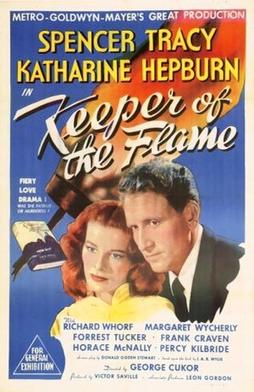
Keeper of the Flame - 1942


Keeper of the Flame (1942) is a daring examination of the existence of fascism in this country. We had come late to the fight against fascism in Europe, and in wartime it was easy to identify those monsters.  But this movie takes a hard look at American fascism. We were not safe from it then; we are not safe from it now.  However, Hollywood, that fantasy factory that brought us so many upbeat, escapist movies prettied up by the Production Code, could still be remarkably vigilant when it came to the depiction of American ideals on screen—when they were being maintained and when they were not.

This is the fourth film in our series on the treatment of fascism in classic films.  We’ve already discussed the foreign-born variety in The Mortal Storm (1940), Address Unknown (1944), and then our home-grown variety among racist thugs in Storm Warning (1951).  Today we take up a film that tackles the notion that the bad guys aren’t always the ones in the propaganda posters, and that fascism often comes to us from the minds, and wallets, of rich and powerful people.  Evil in our midst is always a tricky subject. The audience does not like being preached to; the studio does not like being accused of taking a partisan political position, in order to protect its bottom line.  It was reported that studio head Louis B. Mayer was not happy with this film, feeling it equated fascism with wealth.

But Keeper of the Flame, directed by George Cuckor, brilliantly transcends that with an eerie mystery story, a moody and atmospheric setting, and stellar acting. It is an early example of film noir.


Spencer Tracy stars as a reporter, a foreign correspondent just back from Europe where things have become too hot for him to remain. Though we had many terrific political correspondents back in that era, for me he brings to mind William L. Shirer, whose Berlin Diary was published soon after Mr. Shirer left his political beat in Germany when things got too hot for him. His voice was one of the earliest to warn a complacent America on the danger of Adolf Hitler’s powers of seduction.

This post also serves as our entry into the TCM Summer Under the Stars blogathon, hosted by Kristen Lopez at Journeys in Classic Film. Today is Spencer Tracy day on Turner Classic Movies, and though Keeper of the Flame is not on the roster, this move is a great example of his cool, understated acting, and of how Tracy, however troubled he was in private life, or what private demons he fought ( or didn't fight), embodied the image of the decent American. He was quiet, cool, contemplative, intellectual in a sort of masculine regular-guy way. He could be wry, sarcastic, but his characters were basically humble, even if he didn't take any guff from anybody.

It was as if he could see straight through any situation and see the truth of it.

But in this movie, he has a little trouble getting down to the truth.  Keeper of the Flame is probably my favorite in the Tracy-Hepburn partnership.

Yes, Kate’s in this one, too, and I think it is one of Katharine Hepburn’s best roles, though many feel she is too passive a character here. I like her work in this film for its hesitancy, its reserve. We are used to seeing her bounding through a set like a gazelle. In an unusual twist, she commands our attention by trying to avoid it. We don't know if she's stuffy, haughty, reclusive, or just deeply hurt.  She’s photographed beautifully here, and her grieving widow is, like Tracy, played in an understated manner that complements her enigmatic character.

The cinematography is splendid, and the telling of the story reminds one of Citizen Kane (1941).  We begin with screaming headlines and the sudden, shocking death of Robert Forrester, a much-beloved national figure, as his car plunges into a ravine one stormy night. We don’t know much about him, but bit by bit through the film the layers are peeled away and we have a better picture of him through the people that knew him best: his employees, his household staff, his mother, and his wife—Katharine Hepburn.  Even the great man’s home, a large, remote, wooded estate, is reminiscent of the “Shangri-La” of Charles Foster Kane.  Yet, there are even darker tones here, and it is not just the stormy weather.

Spencer Tracy comes to the nearby town where the great man lived where tributes are being paid, and a flurry of reporters are trying to beat each other’s time to get inside scoops, spinning flowery prose on the loss to the country.  The funeral is witnessed by thousands. Tracy, a great admirer of the great man, is also here to pay his respects.  He is not here to write any stories; he has had enough of politics in Europe.  He’s back home in the U.S. for the first time in years, and he’s looking forward to kicking back and relaxing.

His reporter colleagues include a competitive Stephen McNally, who we’ve covered in previous villain roles, but here he was in his first year of film acting, in, amazingly, his 11th bit part of 1942.

Especially delightful is Audrey Christie as a wisecracking “girl reporter,” who teases the Production Code by helping out Tracy, who needs a room, by inferring to the desk clerk at the local hotel that she and Tracy are married.  The flippancy of the reporters adds a lot of fizz and sparkle to the early part of the movie and throws us off the scent.  We might be prepared to think we are entering a romantic comedy, but very soon, and quite unexpectedly, a mystery pops up.

It is entirely due to Tracy’s powers of observation. In all the throng watching the funeral procession, he is most curious about a young boy, clinging to a lamppost to get a better view, sobbing over the death of the great man.  Tracy comforts him, befriends him, and soon finds himself roaming around the great man’s estate because the boy has found a secret entrance for him.

The boy, very well played by Darryl Hickman, is the son of the great man’s gatekeeper, played by Howard Da Silva.  He is making himself sick over a sense of guilt because he did not warn the deceased that the bridge was out, which led to the great man’s auto crash. Soon, Tracy finds himself on a hunt for some truth—but he doesn’t know what. He only senses that there is a greater story going on, one that he is reluctant to cover, but that he cannot ignore.


Through the mysterious, rather bitter, remarks of the gatekeeper, through a bizarre stolen interview with the great man’s vague mother, played by Margaret Wycherly, and through the careful wall put up by the grieving widow, Tracy slowly finds himself smack in the middle of a huge conspiracy. The great man may have been murdered. At least, that’s what his mother thinks. “Men like Robert aren’t killed by accident. They’re stabbed in the back.”  She doesn’t like her daughter-in-law at all.

Now Tracy is compelled to ferret out the truth he can no longer ignore, not just because he is a reporter and that’s his job, but because he admired this man so deeply, that it is a matter of honor to avenge his death by bringing the murderer to justice.

But his mother also drops another odd remark: “Big people have big houses and little people work for them.”  It turns out to mean a lot more.

Clues point to the grieving widow.

Spoiler time.  Go get yourself a snack if you don’t want to hear.  But if you’re going to stay and listen, then pour yourself a stiff drink.

Kate knew the bridge was washed out that night.  She could have warned her husband.  She chose not to.

Tracy, who has been falling for her a little bit, impressed and almost transferring his hero worship from the deceased to his valiant widow, is gobsmacked and disgusted. He’s only too happy to turn over this venomous—but wait. There’s more.

It doesn’t come out all at once, that’s the brilliance of this film.  Like Tracy, we must become observant searchers of the truth.  We cannot just sit back and be entertained with a mystery story, we are obligated to participate, to assemble the jagged puzzle pieces in our mind and come to terms with what we cannot possibly believe.


Kate unwillingly, as one sickened, relates to Tracy her realization in the early years of her marriage her discovery of her husband’s populist fascism. “They didn’t call it fascism.  They painted it red, white, and blue and called it Americanism.”

His supporters were private individuals who wanted power, but couldn’t get it democratically.  The campaign was a tapestry of hates. Hates for Jews, for city dwellers, for Catholics, for blacks, which appealed to the Ku Klux Klan.

“What was really shocking to me was the complete cyniscm of the plan. Each of the groups was simply to be used until its usefulness was exhausted.”  Again, as we mentioned earlier in this series, the cannibalistic nature of fascism that attacks its own.

“In the end, all the poor little people who never knew what the purpose they were lending themselves would be in the same chains.”

Tracy, coming to terms with the shock of this news about his hero, merely whispers his name, “Robert Forrester.”

Miss Hepburn adds, like a whimper, “He envied the dictators.”

Tracy whispers again, in horror, “Robert Forrester.”  His hero.

Hepburn’s further revulsion intimates a greater, more personal horror for her in her humiliating marriage, where she was, “A poor creature who couldn’t give him sons.” It’s a long speech, which she delivers delicately, with levels of awe and shame.

When she failed to warn her husband of the collapsed bridge, it was a moment’s decision. His paid saboteurs were waiting for his cue to begin the plan of taking over the government. His chief lackey and henchman is his oily and conniving secretary, played by Richard Whorf, who is terrific in the role.


Also look for Percy Kilbride as a laconic cab driver, and Forrest Tucker as Kate’s ne’er do well cousin in an excellent supporting cast.

“Now he’s in your hands,” she tells Tracy.  The great man’s legacy, as well as the weakness of a great society to be exposed is a terrible crisis. She tried to keep his murder secret not to protect herself, but to protect the country from tumbling off into the ravine, too, in its blind devotion to a con artist.

Tracy counters, “People are not children. Sometimes they act like children when you get them scared or confused, but down in their hearts they know and they’re not afraid. They want the truth, and they can take it.”

It is a speech for the ages, and the hope on which I pin the outcome of the coming presidential election and the millions of Trump supporters who are apparently blind to his lack of integrity, his lack of intelligence, and the evil of the man.  Are they, too, lacking in integrity and intelligence?  Are they, too, evil?  I don’t know.  Like Hepburn, I, too, am horrified at the danger my country is in.  But like Tracy, I have hope in the basic decency of the American people, and I feel that courage is needed now more than ever to face the crisis.

Hollywood faced this issue unblinkingly with a fictional character. (We see another treatment in director Frank Capra’s Meet John Doe, covered previously here.) Movies today ignore the elephant in the room.

It ain’t over ‘til it’s over.  The evil henchmen step in to salvage the planned takeover of the government, and Tracy and Hepburn are trapped by fire, shot at, and one is them is murdered.  The ending gives us a comforting bit of flag-waving as the bad guys are exposed and the country is safe now that it knows the truth.

But our country knows the truth, and yet it is not safe. There are too many who do not care about the truth.  Fascism is too appealing to them.

Hitler would have been right at home at the Republican National Convention. It would have been a bizarre, but strangely comforting, homecoming for him. Trump campaign signs hammered into American front lawns would have made him smile.

Come back next week when we wrap up this series with Burt Lancaster and Kirk Douglas in a frightening and fascinating treatment of a planned military coup in Seven Days in May (1964) here. 


****************


My audio book version of Ann Blyth: Actress. Singer. Star., narrated by Toni Lewis, is now for sale on Audible.com, and on Amazon and iTunes.
 

Thursday, October 27, 2011

Split Second - 1953


Split Second (1953) straddles the portal from 1940s film noir to 1950s paranoia genre, and we can see an era turning before our eyes.

It almost aspires to a horror movie, but there are no giant insects or Martians. Just one atom bomb ready to explode at dawn, marking the end of this hellish night, with no new day to follow.

This movie marks the directorial debut of actor Dick Powell. His work here is strong, fast-paced, and solid. Note the alarm clock on the table in many scenes, reminding us that time is precious and slipping away from us. The script by William Bowers and Irving Wallace keeps the story moving briskly, with unexpected touches of macabre humor. This  keeps us and the characters on an even keel and brings us down to earth when our skin begins to crawl.

Keith Andes is a reporter assigned to cover the latest atom bomb test blast in the Nevada desert, but he gets taken off the story when a bigger one (if you’ve seen one atom bomb go off, you’ve seen them all) occurs. Murderer Stephen McNally and his partner Paul Kelly have broken out of prison and are on the loose.

Somewhere in the restricted test blast area.

Mr. Andes stops at a lonely desert diner and meets up with Jan Sterling, a night club dancer down on her luck, on her way to Reno. He comes up with the 50 cents for her pie and coffee. Yeah, we’ve seen this before. This part of the film, with the lone car driving on the dusty highway, the run-down diner, the gas pumps, looks like we’re about to enter a 1940s film noir nightmare. All the usual suspects start to show up.

McNally, one of the very best bad men in movies, whose handsome, rugged charm and wry, funny delivery to his lines, is offset by his suddenly volatile personality. We don't dare take our eyes off him.  He's exciting.

Paul Kelly is his older sidekick, and he’s been shot in the stomach. McNally won’t ditch his friend. They meet up with a pal called Dummy played by Frank DeKova. Frank doesn’t say much, but he reads comic books constantly, and the subject matter -- atomic super heroes, is our first clue that we’re about to enter a weird new world.

Alexis Smith and Robert Paige drive up to the gas pump. She’s in the driver’s seat. For now. It will be the last time she has control in this movie. Her fur stole is over the back of the seat between them. He’s not her husband.

Alexis, who we lamented in this recent post about not getting very good roles during her contract with Warner Bros., gets a good role here. She’s the restless, well-to-do wife of a doctor back in California. She’s run off with family friend Mr. Paige, who sells insurance.

Which, forgive me insurance brokers, cracks me up. Funny how insurance salesmen always end up being the fall guy in the old movies. Think of poor sap Fred MacMurray in our favorite insurance movie, Double Indemnity (1944) which we covered here.

Mr. Paige is likewise behind the 8-ball because of some very bad choices and a very bad dame.


Eventually, all seven unlikely travelers end up packed together in Mr. Andes’ big woody station wagon with the leaky radiator, driving through the desert like a Bizzaro World field trip. Mr. McNally, smart enough to work an ace up his sleeve, calls Alexis’ doctor husband, played by Richard Egan. McNally threatens to kill Alexis unless Mr. Egan comes to their hideout and takes the bullet out of his pal Paul Kelly.

Their hideout, until they can hook up with the rest of the gang, is an abandoned saloon in a ghost town.

In the atom bomb test range.

We’ve been well warned that the bomb will go off at dawn, so the alarm clock is ticking. Stephen McNally, with the bravado of a psychopath, is willing to play “chicken” with the bomb, until his friend gets medical help. The ensemble cast suffers agonies -- over the bomb, over their own past and present mistakes, and must submit to the brutality of their captor.

They are joined suddenly by Arthur Hunnicutt, who plays a folksy lone prospector on his way out of town. Mr. Hunnicutt, full of long-winded tall tales, brings humor to the script in his ability to annoy the others, but he’s also a safety value in his own homespun way. He’s a hoot.

They are a collection of interesting contrasts. Andes, the reporter, is not your typical cynical tough guy with rapid fire speech. He is quiet, easy going, charming, but passive. He’s willing to watch and bide his time.

Jan Sterling has some of the best lines, which she delivers with her blasé pout. Her character does not grow or change much, but she is a tough cookie with a heart and a conscience. When the doc shows up, she’s the one who helps with the operation.

At one point, McNally orders her to the kitchen of this old saloon “with that other dame to fix us something to eat.”

Being women, Alexis and Jan are naturally in charge of meals though they have nothing to cook. I am likewise, by virtue of my gender, able to put together a four-course meal with nothing but a can of beans, two soda crackers (Crown Pilots, ayah) and a teaspoon of Crisco. It’s a gift. Any woman can do it.


We never do get to see what they’ve had for supper, but afterwards they all settle down to listen to the portable radio and smoke. Just a relaxing evening at home.

The soft dance music and melodious ballads are interrupted by the radio announcer gleefully telling them, “We’ll try to give you ample warning so that you can get to your roofs and watch the flash from the explosion.”

Were we ever so innocent? I recall some comment singer/actress Kitty Carlisle made in her autobiography about watching a bomb blast from a hotel terrace, I think, in Las Vegas, a momentary distraction from a party. Like Alexis Smith in this movie, dressed to the nines.

These are strange days. McNally jokes about DeKova’s comic book, “In the next chapter, the Martians invade.”

The old prospector is fascinated by the bomb. A veteran of World War I, he marvels, “Just think what we could have done with a couple of them things at the Marne.”

Jan Sterling quips about their predicament, “Quite a spot. Between the devil and the bright red bomb.”

They are waiting for Richard Egan to show up, driving all the way from California into the restricted area here in Nevada. I’m not sure how he makes it through security checkpoints, but he’s Richard Egan. We trust him to do the job.

Alexis doubts he will come, knows that a cheating wife need not expect such devotion.

“He wouldn’t cross the street for me, much less risk his life.”

She tries to hedge her bets by urging her Insurance Man lover to do something.  Still, she is a little fascinated by the brute with the gun. Her Insurance Man looks less dashing in this dim light.  He is careful, perhaps regretting taking this trip, but when a leering McNally orders Alexis to go with him to the kitchen, Mr. Paige challenges McNally to a fight.

Mr. McNally, with a coolness that belies his own anxieties this evening, calmly shoots him dead. And drags Alexis off to the kitchen.

With a tear-streaked face she begs him not to kill her, but then the penny drops and she realizes he’s got another use for her just now. Hedging her bets again, she lets him kiss her. She’s not being clever or calculating, she’s just in a dead panic, like a drowning person ready to cling to anything floating by. If he wants a woman, by gorry, she’ll be his woman with everything she’s got.

Here’s where the subtlety of many classic films in addressing scenes of extreme violence or sexual situations is intriguing. We are taken back to the main room where the others sit and wait or sleep, or talk in whispered conversations. We get a tale from Jan Sterling about her miserable childhood and rotten parents. Time passes, but we don’t know how much time. Our attention is diverted to what is happening in the main room.

But we keep thinking about the sexual assault in the kitchen.

A funny paradox.  An explicit scene of violence that hammers the message home tends to make us draw back.  Here instead, lured into imaging the worst, we are drawn ever closer emotionally to the assault precisely because we have the safety of being voyeurs in our imaginations.

Alexis is eventually released from the kitchen like a skittish heifer after being branded -- self-conscious, shaky, nervously swiping her hair from her eyes. Jan Sterling sidles up to her, not to comfort, but to ask for a drink from Alexis’ hip flask and get the dirt.

Alexis, tense as a cat, fumbles with yet another cigarette, and masks degredation with another application lipstick, “Why don’t you just ask me what you want to know?”

“Do I have to?” Jan fires back, with a sarcastic smile. No, she doesn’t, and neither do we.

Richard Egan finally shows up to dig the bullet out of Paul Kelly. McNally needles Mr. Egan about his wife. “She decided not to depend on you entirely.” Alexis slinks away. The evening for her is a string of bad choices, panic, and humiliation. For everyone, a night of confidences, threats, secrets, and compromises.

McNally has had Alexis, so now he pursues Jan, who is smarter and better at pretending. She can handle McNally. She’s known men like him before.

Alexis, meanwhile, is baffled at Egan’s heroism.

“Are you still in love with me?” It's a fine moment; she's genuinely struggling to understand, perhaps even hoping that he does still love her.  She does not know, and even before this night is over, will never learn unselfishness and compassion. Her life has been ruled by her immediate desires, and she assumes that is everyone’s motive.

Mr. Egan is the stalwart, dependable man, a disappointed husband who’s been hurt enough and is more than willing to cut Alexis loose, (similar to his role in A Summer Place - 1959) but he’s genetically programmed to do the right thing and sticks his neck out for her, the room full of strangers, and his patient.

When the operation begins, Paul Kelly gets religion and wants a verse read from the Bible. The prospector has one in his gunny sack, right next to his gun.

His gun? Why he did not reveal to his fellow captives when he first arrived that he had a gun is a mystery and can only be chalked up to his maddeningly independent personality. He gets around to things when he gets around to them.

Nice, ironic scene where McNally reads to his pal in a flat voice, “Blessed are the meek for they shall inherit the earth” as the Sodium Pentothal is being injected.

But the gun comes out during the operation when Mr. Andes makes a play for it. McNally beats him to a pulp, and even slaps around Jan Sterling for trying to interfere. This cements the bond between Andes and Miss Sterling, and in a cozy moment when they become resigned to the fact that they are probably going to die, he jokes, “Sooner or later one of us has got to learn to fight.”

“We’ll take up judo in the next world,” she replies. If there was more time there would be a romance, but touching their sore heads together is the best they can do now.

Now the morning dawns, and McNally gets ready to make tracks. Alexis hangs on to him, begging him to take her with him, but he responds, “You’re a real bad dame…nobody can count on you for ten seconds.” He is sickened by her. She has fallen so low that a murderer won’t dirty his hands with her.

We get taken from the ghost town for a moment to some government file footage on preparation for the test in the command bunker. A voice announces, “At thirty seconds the master robot will take over.”

I think that’s the scariest line in the movie. We are no longer able to make choices for ourselves, not once we’ve gone past a certain point. Then we are all slaves of the Master Robot.

Spoilers coming up, so head to the fallout shelter if you don’t want to know.

Last minute fisticuffs, last minute choices, and only two of the cons get away, with Alexis, who practically dives into the passenger’s seat. They drive in the wrong direction.

“The bomb!”

She needs to be with them because otherwise we wouldn’t care if they drove off into the bomb blast. As flawed a person as she is, she is still the most interesting character there (except for McNally, but we already have him figured out) -- I think mainly because of the complex and layered way she plays it rather than the way it’s written. We really don’t know which way she’s going to go, because neither does she.

In one of his last-minute confounding ruminations, the prospector announces there is an abandoned mine nearby where they can shield themselves from the atomic blast.

Now, why in the name of Aunt Mary’s knickers did he not say that before? That would have given everybody another interesting choice to mull over. Do they tell the bad guys? Or, do they play God and keep the cave for themselves? They already played God with poor DeKova, who gets knocked out and left to die. They could have dragged him to the mine with them. They just leave him there with the corpse of the insurance man.

What if Alexis, fairly crazed by the end of the movie, was given the chance to hide in the mine? What if McNally had gone through with plugging Paul Kelly with a bullet when Kelly betrayed him at the last minute?

“The master robot is now taking over” is the next announcement as McNally’s car spins its tires in the desert sand, and the other captives rush for the abandoned mine. All our choices are gone.

The blast, with its white light and nuclear wind demolishing the ghost town is similar to declassified test bomb blast footage you may have seen.

“Let’s take a look at the world of tomorrow,” Richard Egan grimly says as the survivors crawl from the mine. In ten years they will probably all get cancer, but that’s another story. For today, it’s a flatter, whiter desert, and a giant mushroom cloud in the distance with the words “The End” written in script over it.

No monsters. Nothing is ever scarier than a bad reality.  Especially when we've caused it ourselves.

Thursday, March 26, 2009

Ladies of the Noir - Pt 3 - Make Haste to Live (1954)


“Make Haste to Live” (1954) is our last entry in our look at a few film noir female protagonists. What makes this film interesting is it is more of a character study than just an action piece, unusual for film noir. However, this movie has a weak thread running through it partly because it never takes full advantage of exploring characterization, and partly because in those moments when action should take over, the plot wavers and pulls punches. This may be just another case of not knowing how far to push the envelope when the protagonist is a female. The 1950s is too early for Lifetime television.

The script seems to be the culprit. The direction gives us our moody shadows, our eerie setting of a lonely, windswept, isolated Southwestern town, and a man on the prowl who has just been released from prison.

Dorothy McGuire plays Crystal Benson, a woman who runs the local newspaper. She has a daughter on the verge of graduating high school, and a devoted boyfriend with a fascinating job superintending a local archeological dig in an ancient pueblo. He wants to marry her, but Miss McGuire keeps holding him off from marriage. McGuire has a deep, dark secret, and the day of reckoning has come.

This past coming back to haunt is classic film noir, where the protagonist is caught in a web of fate, but partly at fault through mistakes made. There is also a flashback sequence here, typical of noir, where we see how she got to the mess she is in today.

Before we get to the flashback, we see a nervous Miss McGuire on edge, walking through her house at night, listening anxiously for sounds of intrusion. We see her ask her friend the local sheriff, played with familiar Old West hombre charm by Edgar Buchanan, to borrow a handgun.

We see her give a sealed envelope full of money to her daughter’s boyfriend to keep in a safe and give to her daughter in case something happens to her. She gives no one reasons for what she is doing, and brushes off questions.

Then we see her sit before her reel-to-reel tape recorder and give us the answers as to why she’s done all this.

It’s an intriguing beginning to the film. The flashback is also handled well, as McGuire recounts to the tape recorder how, as a girl in Chicago, only a little older than her daughter is now and going by her real name then, which wasn’t Crystal Benson, she fell for a handsome rogue who she soon discovers is a hit man for a mob gang. Married, pregnant, and with no other family since the death of her mother, she suffers his possessiveness and physical abuse, until she finds her opportunity to escape.

She takes off on a cross-country bus ride to nowhere in particular, when she reads in the newspapers that her husband has been arrested for her murder. It seems a girlfriend he had on the side died in an accidental explosion from some stored weaponry in his house, and the authorities assumed it was McGuire who died because she knew too much. He is likely to be given the death sentence.

If this were a 1990s Lifetime TV-movie, she’d just thank her lucky stars and keep going. But it’s the 1950s, and moral ambiguity is a dicey thing for a female protagonist. Miss McGuire would love to see her husband sent to prison, but not to the electric chair for something he didn’t do. So, with the help of her pal, played by Carolyn Jones, she gets word back to the authorities that she’s alive. The death of the other woman is ruled as an accident, his charge is reduced to manslaughter, and he gets 20 years.

Now it’s 20 years later, and handsome Stephen McNally, who plays her vengeful husband, is on the loose and looking for her. McNally could have played heroes but Hollywood seemed to prefer to place him as the bad guy, at which he was equally adept. Villainy with a charming surface is sometimes more dangerous than a mere thug.

When he finds McGuire, rather than snuff her out, he takes the more subtle route by planting himself in her life, her home, and her community, telling everyone he is her long-lost brother. His method of terrorizing her is to keep right at her side, extort money from her, and ingratiate himself to her daughter, also his daughter. In effect, to take all the trappings of her life away from her and leave her without any semblance, any feeling of security. He cleverly asserts his old possessiveness.

In a way the movie is way ahead of its time as a film noir piece, using psychological terror as an expression of villainy rather than just the same old blackjack on the back of the skull.

Mr. McNally has, in his search for his runaway wife, done meticulous research on her. He has perceived correctly that she has told no one, not her daughter, nor her beau, about her past. Before his arrival on the scene, her excuse for this secretiveness would be of course to keep herself and her daughter safe. But now that the game is up and he’s found them, why not tell her boyfriend, her daughter, her pal the sheriff? Why not scream to the rooftops that this smooth-talking man who calls himself her brother is really her ex-con husband who keeps threatening to kill her?

Here is where the film, after an orderly start, seems to unravel. There is more that could be explored about Miss McGuire’s character that could keep the suspense in this story, that could provide logical impetus for her behavior. Instead, the film does not reach far enough into characterization, and seems to shy away from too much terrorizing of Dorothy McGuire.

There is a line in the flashback sequence that is simple but very evocative. McGuire returns to her deceased mother’s rented room to claim her mother’s things after the funeral, and her pal Carolyn Jones suggests McGuire leave the sad job to her.

McGuire refuses help, wanting instead to handle the disposition of her mother’s few belongings herself. She replies regretfully, “She had six kids, and I’m the only one of them that lived.”

It’s a line that does nothing to advance the plot, but it’s a great little trigger as to the kind of hard life McGuire has led, and the kind of person she is, with a sense of honor and a sense of perspective. Later on in the film we could use more of this kind of exploration, these kinds of hints as to what is happening with the character.

For instance, McGuire adopts the name “Crystal Benson” when she arrives in this remote Southwestern town to begin her life over. Why Crystal? Why not something less glamorous like Mary Jones or Jane Smith? How did she, a girl with barely a high school diploma and no work experience, come to become editor and publisher of a small town newspaper? How did she earn enough money in this depressed little town to own a two-story Victorian house? Where did the furnishings come from? Those antique portraits on the walls we see in the background as McGuire steps cautiously through her house at night, fearful of sounds -- who are they? Did she make up fake ancestors with fake names for her daughter’s benefit?

Her daughter, about to graduate from high school is played by Mary Murphy. She is a pleasant, restless, somewhat self-absorbed and empty-headed young woman just drifting along with a nice boyfriend who bores her. When she is told this visiting Stephen McNally is her uncle, she never questions this. Most teens would be annoyed that a secret had been kept from them. They would at least express surprise.

The daughter’s boyfriend, a likeable lug played by Ron Hagerthy, has a warm relationship with McGuire. How interesting that McGuire would trust this young man with her life savings in an envelope and not her own boyfriend, a man with greater sense and maturity, and resources at his disposal to help her.

Her boyfriend, played by John Howard, who you might remember as the stuffy George Kittredge in “The Philadelphia Story” (1940), is also a likable chap, clearly devoted to McGuire. His role is like the typical supportive girlfriend/spouse in film noir where he doesn’t have much to do; he just rounds out the life of the protagonist.

The cat-and-mouse game she plays with McNally, which also involves a local murder pinned on an innocent man, comes to head when she tricks him into following her into the nearby pueblo ruins, where there is a bottomless pit.

There just aren’t enough movies with bottomless pits in them. I really like bottomless pits and sidewalk elevators. (See this post from last April.)

The ending, however, falls flat as the writers and producers resort to a kind of accident removing McGuire’s problem once and for all. She has an opportunity to kill her husband in self defense, but this is 1950s film noir with a female protagonist. Killing in self defense is still killing, still a repugnant act, at least if the protagonist is female. Though there may be perceived justice in the act, it still stains the virtue of the heroine. If McGuire’s role were being played by Gary Cooper, he would have killed seven or eight people by now and not lost his hero status.

Sinless, she runs back to the arms of her boyfriend, whom she is now presumably free to marry, and to her daughter. We may wonder if she ever tells them the truth about her past. We may wonder if she ever plays for them, or destroys, the tape recording she made telling of her past. It would have been a stronger movie if she had to confess or at least unburden herself to somebody other than us. Dorothy McGuire plays the role with her customary sensitivity and intelligence, and with her talent could have taken the character to a more edgy level, if only the script had not pulled punches.

McGuire never has to face her mistakes, not really. She just has to outrun them until the movie is over.

Related Products