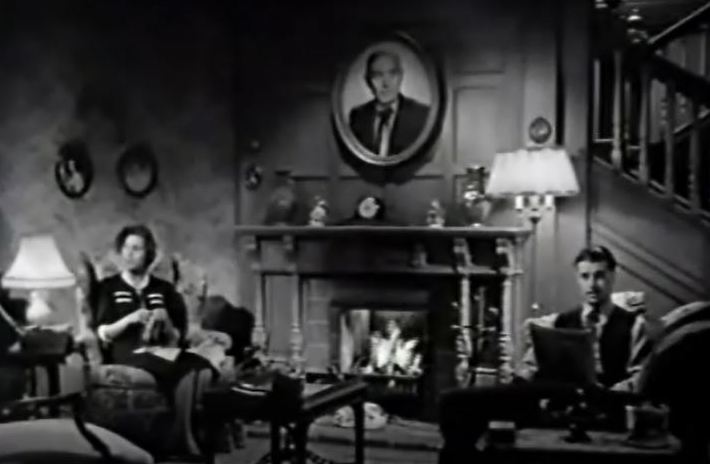
IMPRISON TRAITOR, PEDOPHILE, AND CONVICTED FELON TRUMP.
Showing posts with label Dickie Moore. Show all posts

Friday, January 17, 2025

Gabriel Over the White House - 1933


Gabriel Over the White House
(1933) is an inventive fantasy and apparently, political commentary as well, that has resonance today.  What exactly the meaning or purpose of that commentary is never entirely clear, as there is a great deal of contradiction in ideals presented, and perhaps even a curious display of a lack of knowledge about civics and our political institutions.  There is no innocence about human nature, though, and this was a hallmark of Pre-Code films.  The tone of the movie is sly and sometimes hits hard.


Walter Huston is splendid as the lead, a newly inaugurated president taking the helm of the government during the worst of the early Great Depression years.  He is a freewheeling bachelor, romps with his young nephew played by Dickie Moore as though he were a child himself, and when a sexy, confident, coy woman stops by the White House to see him, he keeps his door open to her and makes up a staff job for her to keep her close.  We already know, even without Franchot Tone’s knowing look, that “Pendie,” played by Karen Morely, is Mr. Huston’s mistress.  He does not trouble to hide it.


Franchot Tone plays Huston’s secretary and presumably chief of staff.  The movie treats what we know about Oval Office appointments with a vague bending of the truth, even as Huston bends the rules, and that is a script writer’s device to funnel the audience into the story he wants to tell without being bogged down by factual details.  Since the movie is frankly a fantasy, there is no need to hold to the mundane facts about actual protocol or how government really works.

But the era is faithfully depicted—if not in a real timeline of events, rather, in the feelings of desperation of a demoralized populace, in angry crowds, in hopelessness.  In such desperate times as these, Walter Huston as president does not seem to be the right man for the job.  He is self-involved, somewhat immature, gleefully corrupt and easily manipulated by special interests, and sometimes astonishingly stupid, which may be the source of his callousness.  Given the actual quill pen (which was NOT the actual pen) that Lincoln signed the Emancipation Proclamation to sign a new bill for a public works project for new sewers in Puerto Rico, Huston jokes flippantly about it, “Well, here goes for Puerto Rican garbage.”  He is coarse, but we may smile at his impishness.  On the other hand, one cannot help but think of another asinine president who threw rolls of paper towels at suffering Puerto Ricans.  He is also immature, gleefully corrupt and easily manipulated by special interests, and sometimes astonishingly stupid.

Mischa Auer plays a serious and disgusted reporter who tries to nail down the details of Huston’s platform, but there are none.  (I half expected Mr. Auer to break into a passionate verse of “Ochi Chornya,” but he’s saving that for director Gregory La Cava’s other movie, My Man Godfrey, which we discussed here.)

However, a change will soon come over the new president.  Huston rides in a short motorcade to an event, but he takes the wheel because he loves to drive himself.  Fast.  Enjoying the white-knuckled response of his Secret Service men, he floors it, trying to pull away from the rest of the staff and police escort in the car behind him, swerving on a winding country highway.  Finally, he loses control and the car flips over.  He is severely injured and near death.
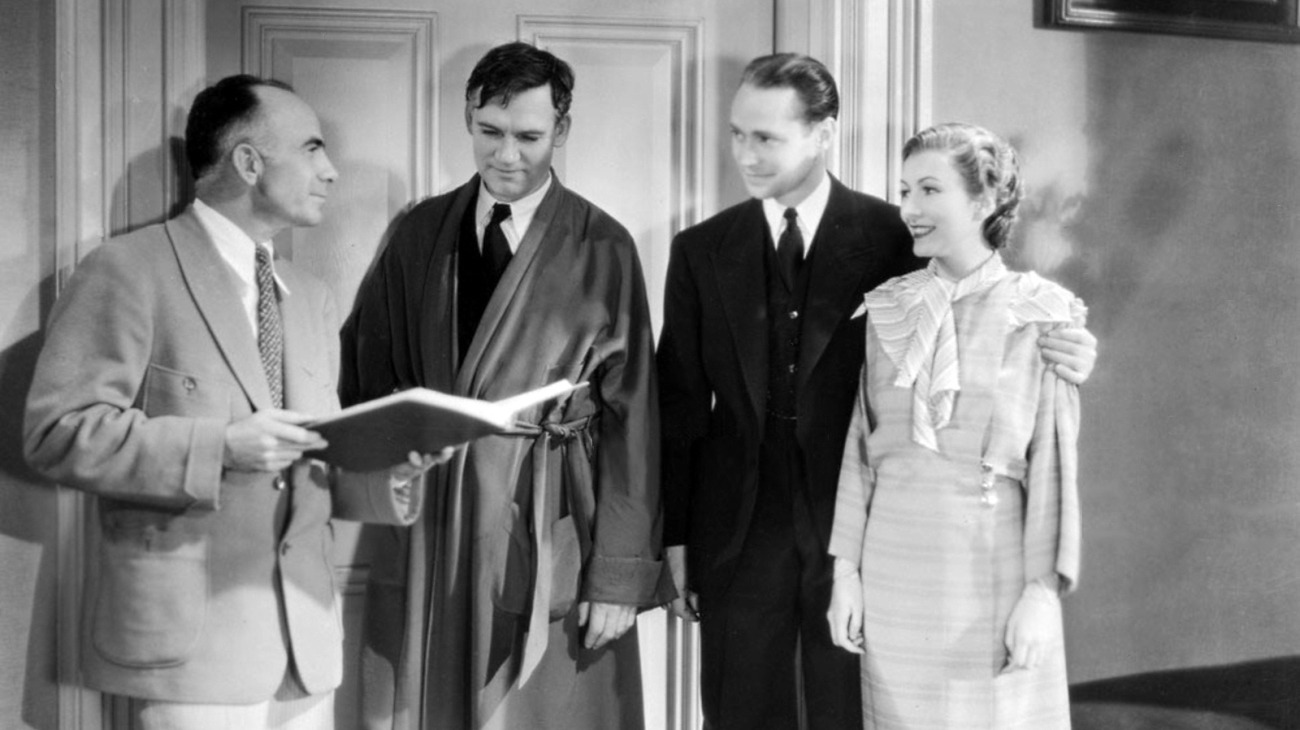

He is kept in seclusion by his doctor for many days, and the public is kept in the dark about the nature of his injuries or details of the accident.  There is some worry about who will take over the reins of government—seemingly unaware that that is precisely why we have vice presidents.


Finally, Huston comes out of his coma—but he is a changed man.  Now serious, now intelligent, now with a sense of purpose.  Franchot Tone and Karen Morely see the change, and notice something supernatural about it.  Huston has been visited by the Angel Gabriel, who is now pulling the strings in Huston’s brain.


Restored to more vigor than he had before, Huston sets about curing the Depression, first by addressing a group of protestors—not unlike the Bonus Army, whose camp was burned out and members shot by Douglas MacArthur’s troops under President Herbert Hoover.

Then he single-handedly repeals the Eighteenth Amendment, getting rid of Prohibition, just as Congress would do under President Franklin D. Roosevelt, but he also establishes government liquor stores to drive out the gangster bootleggers, who bomb the stores.  C. Henry Gordon (in one of an astonishing fourteen movies that year) is compelling as the smooth, sinister mobster in a few devilishly sneering closeups.  Huston fires his cabinet, gets rid of Congress, declares martial law, and has the mobsters shot by firing squad.


In his address, Huston declares that he is a dictator based on Thomas Jefferson’s ideas of democracy.  Here is obviously one of the ridiculous twists in logic, but Huston would not be the first politician, real or fake, then or now, to claim that his fascist intentions would have been applauded by the Founding Fathers. 

Franchot Tone and Karen Morely, meantime, have become romantically involved, but they need not worry about offending Huston.  He has bigger fish to fry, and the Angel Gabriel keeps him pretty busy.   Miss Morely is shot by racketeers, but recovers and Huston blesses their union.


Another bizarre and even troubling move by Huston is when he brings the world powers together during a radio broadcast to demonstrate his new military service—the United States Navy of the Air.  He will move for disarmament of former weapons, but will put billions into the military of the future, which apparently is going to be biplanes, whose pilots will pull a lever and drop a bomb on an enemy ship.  Huston arranges a demonstration, and bullies the foreign governments into paying their World War loans and reparations and promise not to rearm because if they do, we will fly biplanes over them and pull a lever and drop a bomb. 

He tells them and the radio microphones, “The next war will be the story of the failure of antiquated weapons and antiquated myths, of the horrifying destructiveness of the modern agencies of modern arms.  Armies and navies will be destroyed from the air.  And as these planes destroy armies and navies, they will destroy cities, they will destroy populations…the next war will depopulate the earth…invisible gasses, inconceivably devasting explosives.”  Well, he got that right, in part at least. The foreign leaders hurriedly agree to his Washington Covenant.

Now that the important work is done, the Angel Gabriel passes over Huston as in a shadow, and Huston dies.


Even more interesting than the twisting logic of this film, are the sometimes conflicting stories about it.  We know it had its genesis in a novel, but producer Walter Wanger, Democrat and Roosevelt supporter, brought the story to M-G-M head Louis B. Mayer, staunch Republican, under Wanger’s production company owned by newspaper magnate William Randolph Hearst.  Hearst began his unsuccessful political career, including a failed bid for the presidency in 1904, as a Democrat, but as the years rolled by he became more conservative and isolationist, who supported Hitler and the Nazi Party.  Though he was an early Roosevelt supporter, he went to the dark side after 1934 and became his enemy.  We all know he was the prototype for Charles Foster Kane of Orson Welles’ Citizen Kane (1940), but that’s another story.  It is reported that Mr. Mayer held the movie back until after Roosevelt’s inauguration, hoping to pin the stain of fascism on him, rather than on Hoover, as if the story is an examination of the current sitting president.

The political affiliations of these men have a lot to do with any discussion of Gabriel Over the White House today, and because production began during the Hoover administration, but was released just weeks after Roosevelt came into office, what is the message of the film?  Who is the finger of fascism being pointed at—the Democrats or the Republicans, and is dictatorial powers in an American President considered fascism at all, or is it merely what Thomas Jefferson would have liked and what the American people secretly want all along?  Was the film an effort to ingratiate fascism with the American people?  We know only that the movie disappeared quickly enough when by the mid 1930s, fascism appeared to be a clear and present danger at home and abroad.  There were no nice guy dictators.

We are living now in far more dangerous times, and the plot points or message—if there really is any message at all—in Gabriel Over the White House seem innocent in their supposing, though intriguing, and the finger-pointing at what it all means is irrelevant.  What it is, is fantasy in its purest form.  Any good story, fantasy or not, begins with “what if?” and this is a freedom of thought we should celebrate. 

What I admire about many films of the 1930s is the courageous introspection into their own contemporary times, warts and all, and experimenting with different ways of storytelling to do that. The escapist musicals have, I think, sometimes received the lion’s share of attention when movies of the 1930s are recalled as “getting us through the Depression.”  The black-and-white gritty and even grim films of the Dirty Thirties have special historical value, and in their own way, they got us through the Depression, too.

As much as I can this year, I’d like to examine more films of the 1930s that unselfconsciously illustrate their own times. 

*******************************


My new non-fiction book, CHILDREN'S WARTIME ADVENTURE NOVELS - The Silent Generation's Vicarious Experience of World War II -- is now available in eBook here at Barnes & Noble, Apple, Kobo, and a wide variety of other online shops.

Or here from my Shopify store if you want to buy direct from me and avoid the big companies.

And it is here in eBook, paperback print, and hardcover, from Amazon.

From Cherry Ames, to Meet the Malones, from Dave Dawson to Kitty Carter - Canteen Girl, the Silent Generation spent their childhood immersed in geopolitical events through the prism of their middle grade and young adult books.  From the home front to the battlefield, these books are a window on their world, and influenced their hard-working, conformity-loving generation.


Thursday, September 23, 2021

Requiescat in Pace - Jane Powell

 A memory of Jane Powell in a simple, elegant, long-sleeve gown with a bateau neckline at what must have been some televised awards show (how many years ago?), and especially comments made by some reviewers in effect that she outshone all the younger female entertainers.  It was true.  It was not a patronizing tribute to her representing a fond remembrance of Old Hollywood, like a treasured fossil we take down from the shelf and pay homage to that they don't make them like that anymore -- rather, it was the honest acknowledgement that this lady displayed class and that class is timeless.

I remember feeling proud of her, with that sense of ownership old movie buffs generally have for Old Hollywood.

One would suspect, however, that her elegance and her class on this evening was not effortless; a troubled childhood and difficult apprenticeship in the film industry -- a career she never wanted -- she revealed in her autobiography, The Girl Next Door and How She Grew.  

An interesting quality Jane Powell had, however, was that she was able to observe that world like a fly on the wall and inspect it for what it was, holding herself apart.  Her diffidence might have given her that quality, but her impressions, feeling as she did like an outsider looking in, give us a view of the studio system that we don't find in other memoirs. It's also interesting that Jane Powell finally found personal peace and happiness with another child actor with conflicting feelings on his film career, and first met Dick "Dickie" Moore when he was writing his own book: Twinkle, Twinkle, Little Star, Don't Have Sex or Take the Car.

She eventually accepted her role as an alum of that rare world, and took it in good grace, as evidenced in her appearances in film industry events, and especially taking over the host position on TCM in 2011 when Robert Osborne was on medical leave. She had a long career on film, television, and the stage, and if being the girl next door in her early movies was such a small part of her life, she seemed resigned to allowing us to cherish it, even if it did not mean quite so much to her.  


Thursday, June 1, 2017

Youth Runs Wild (1944) and Youth in Crisis (1943)


Youth Runs Wild (1944) and Youth in Crisis (1943) show us American teens led into juvenile delinquency during World War II.  For children on the home front, the war means neglect – and danger.

This is the third post in our series on how Hollywood depicted the experiences of children during World War II.  Have a look at The Piped Piper (1942) here, and On the Sunny Side (1942) and You, John Jones! (1943) here.

Youth Runs Wild, directed by Mark Robson, features Glen Vernon and Tessa Brind as star-crossed pair of teens successfully navigating their awkward years and the nation at war. They are left behind and left out.

We are shown even in the film’s first moments the message that, in the wartime emergency, we are not taking proper care of our children.  Jean Brooks walks down a city street with her three-year-old son, while a truck plows over a sign cautioning drivers about children at play.  As she proceeds through a working-class neighborhood, she stops at one rundown workers’ row house. Her parents live here with her fifteen-year-old brother.  Miss Brooks is returning home to live with them while her soldier husband is away.

Art Smith and Mary Servoss are her folks, who both work the night shift at the local war plant and sleep during the day. Their son, played by Glen (or Glenn) Vernon, is in trouble at school, skipping class to work in a local garage to earn money for a present for his girl.

Tessa Brind, literally the girl next door, is the oldest of three daughters of a couple who also work at the war plant. Her parents are even more neglectful, they go out to bars after work, or bring friends home to play cards (one friend openly leers at their teenage daughter) leaving the housework and the care of their younger daughters to Tessa. (Using her birth name of Smylla Brind, she was Ann Blyth’s understudy in the Broadway drama Watch on the Rhine in 1941, and went on to play the role of Babette in a touring company.  A writer and an artist as well, Brind would later take the name of Vanessa Brown in her acting career.)

Glen and Tessa have a sweet, rather innocent relationship, a stark contrast to their rough surroundings and rougher companions. Interestingly, they carry the story, unlike more established stars playing supporting roles including Kent Smith, who plays the soldier husband of Jean Brooks, discharged from the military hospital; Lawrence Tierney, a shady guy (he’s Lawrence Tierney, what else?); and Bonita Granville, who is a smart-talking tough moll for Tierney.  She provides the only gloss for this B-movie.

The neglected teens – seemingly thrown under the bus by their parents – will have unlikely support from Kent Smith, Tierney, and Granville, adults on the periphery of their lives and with no responsibility toward them, but who actually help them turn their lives around. Tierney, at first leading Tessa Brind astray, helps Glen get away from the cops when he and his buddies (including Dickie Moore) are committing a crime.  He regularly sends kids to the war plant at night to steal tires off the cars in the parking lot to sell on the black market in his garage.  Tires of course were rationed during the war.  This time, he doesn’t want Glen involved because he’s such a nice kid from a nice family.  (The car the boys are robbing has a toddler in the back seat crying.  This is probably the most heart-wrenching scene of the movie, but it actually happened that parents busy in war plants locked their children in their cars, having no other place to put them and no babysitters. There are no comments made about the baby in the car, we just see it and so the effect and our shock is far more profound.)

Bonita Granville takes Tessa under her wing when her folks kick her out of the house and she gets her a job in a dive. Ultimately, it is up to Kent Smith to put things right, taking Tessa to his in-laws house to live where she will be safe and protected; taking the boys under his wing and being responsible for them when they are paroled for stealing the tires; and helping his wife run a daycare in the small backyard of the company row house.

Things we may wonder about but which are never discussed in this movie: fifteen-year-old Frankie smoking openly in front of the grown-ups and no one seems to mind (cigarettes were rationed too.  Where did he get them?) And the fact that Kent Smith never gets to have a reunion scene with his wife and baby.  It’s all about the teens.

Not every kid can count on a Kent Smith in his life and so the message of Youth in Crisis (1943), an Academy Award-nominated March of Time short subject is quite important in wartime.  More terse and blunt, this interesting documentary carries the same message about the tension and anxiety of children during war and the teens going astray.  We begin with a line of young men stripped to their shorts undergoing examination at the Army induction center.  Most of them look no older than teens themselves.  We are told that many men are being rejected because of mental and emotional problems and the documentary explores what could be long-lasting effects on our society from these young people who are so troubled during the war years.

Teens without supervision are shown flaunting authority, getting in trouble, smoking marijuana, and the girls are portrayed as being the easy prey of servicemen on leave.  There is a mixture of frankness and delicacy in the delivery of the message of sexually transmitted disease and the alarming statistics of the sharp rise in crime since 1941 in burglary, rape, and prostitution.  Crime rates had actually dropped during the Depression.

Latchkey kids are seeing coming home to a house of dirty dishes and no mom.  Women are seen at war plants.  As a remedy, we are shown teen clubs and with a positive message and image of an articulate African-American youth speaking his mind in front of a group of white peers, and a roster of boys letting out their pent-up energy in the gym with the names showing variety of ethnicities.  There’s a lot packed into this short documentary: toddlers needing daycare, rising prices, rationing, race riots, and teens growing up too fast.

What happened to this generation of wartime excitement and angst?  They began smoking early, drinking early, and suffered growing pains like perhaps no other generation before.  Not old enough to fight in the military, they still felt the fallout of the world at war.  They were told they had to do their bit for the war effort, but there was apparently no assigned role, or not enough for them to do.

The documentary, though showing parents at the war factories, particularly women, does not indicate that women workers are to be blamed for the delinquency of the children.  It was still 1943 and moms were still needed the war plant.  But one wonders if, upon the end of the war, when so many women were let go from the factories, even ones who wanted to keep their jobs, their being forced out of the factories was a result of messages in such films as Youth Runs Wild, and Youth in Crisis?  Teens developing too much autonomy for good or ill was a concern during wartime, but it was a necessary evil when our hands were tied fighting a bigger evil.  The 1950s would see a return to what was considered a woman’s traditional place in the home. But the teens?

That did not stop the teenager from becoming a new force in society.  The genie was already out of the bottle and there was no putting it back.  We’ll take up that topic in a future March of Time documentary.

Come back next Thursday when we take up the plight of a child concentration camp survivor in post-war Berlin with Montgomery Clift in The Search (1948).

*********************
The audio book for Ann Blyth: Actress. Singer. Star. is now for sale on Audible.com, and on Amazon and iTunes.

Also in paperback and eBook from Amazon, CreateSpace, and my Etsy shop: LynchTwinsPublishing.


Thursday, February 23, 2017

Happy Land - 1943

Happy Land (1943) is a gentle, yet powerful film of common decency, and the discipline and quiet courage that common decency sometimes requires.  We used to attribute these as American values.  The movie is sentimental about this, and yet bravely forward-thinking for all its nostalgia: there is an underlying current of foreboding almost as if they knew how delicate decency is, and that is must be nurtured.


The title of the movie, as related by the strains of the theme song, comes from the lines in “Hail Columbia,” composed for George Washington’s inauguration, that was often used as a national anthem up until the time “The Star Spangled Banner” was officially made the National Anthem in 1931.  With all due respect to our anthem, I have a preference for “Hail Columbia”.  It is stirring, and sweet, and nobly idealistic, and perhaps a little naïve. “Hail Columbia, happy land!”  Listen to song here on YouTube. 

Don Ameche stars as a man from a Middle West small town at the height of World War II.  He is a pharmacist and owns the town’s drugstore on Main Street, and much of what we see will remind us of a Norman Rockwell painting.  He is married to Frances Dee, lives in a cozy white wood frame house, and his only son is away in the Navy.  He knows all his customers personally.  It is a good life.

At the very beginning of the movie, we see a telegram delivery girl ride her bicycle up to the front steps of Don Ameche’s house.  Perhaps no image ever instilled more fear in the United States during World War II than the telegram delivery person.  Here it is a mere girl.  Her name is Hilda, and Don Ameche, of course, knows her.

Pleasantries are quickly dispensed with.  She hands him the telegram without looking at him.  He stands silently, and the close-up lingers on his expressionless face, on which we see only a flicker of realization that his son has been killed.

The movie is filled with moments like this, strong, gutsy, brave moments that are no less courageous from the actors and the director, Irving Pichel, because they are placed in a comfortable and nostalgic setting.  Sometimes the movie may well remind us of what The Best Years of Our Lives (1946) would have been had it been filmed three years earlier; and it is perhaps no coincidence that the material is from a novel by MacKinlay Kantor, just as Best Years was.

We shift quickly to the town’s newspaper office where the editor composes a hasty eulogy for Ameche’s son in his daily editorial.  There is slight leap forward in time—Ameche takes a leave of absence from his drugstore and his employees are left to run the shop: good old Mary Wickes among them.  The minister calls on Mr. Ameche to lend comfort with the true words, “Suffering and pain are part of life too.  We must accept them.”

But Ameche’s loss of his son Rusty is compounded by his sense of injustice that Rusty “never had a chance at life.  He never went anywhere.  Just a youngster living at home, going to school, working for his dad…It isn’t right.  It isn’t fair.”

Ameche’s next visitor will have a stronger impact: Harry Carey, who plays his deceased grandfather.  We may compare this scenario with It’s a Wonderful Life (1946), but Harry Carey is no bumbling angel.  He speaks frankly with a kind of homespun horse sense we might expect from Will Rogers or Mark Twain, and though he has been dead twenty-one years, he is still very much alive to Don Ameche.  We know this because of Carey’s prominent portrait in Ameche’s home and at the drugstore.  Grandfather Carey’s influence is strong.  So it is with certain people in our lives, who seem to walk with us now and again even though they’re gone.

Ameche goes for walk into town, and Mr. Carey goes with him, and soon they travel not just through town, but through time.  We are brought to the end of World War I, when Harry Carey and the rest of the town welcomed home a parade of doughboys, including a younger Don Ameche.  (It is really something to consider that Ameche was still playing romantic leads at this point in his career, but in this movie he plays a character who ages, whose main purpose in the film is to be a father.  This would, as it does for aging actresses, signal a turning point, perhaps even a demise of his film career, but this movie is a gem and I hope he didn’t regret it.)  Grandpa Carey ran the drugstore then, and Don becomes a pharmacist as well.  We are then given a tour through Ameche’s adult life, of which his marriage to Frances Dee, and his son Rusty, is the biggest part.

Grandpa Carey died shortly after Rusty was born, and we jump to a Memorial Day of placing flags on Civil War vet Grandpa’s grave when Rusty is about six.  He is impressed, and knows that soldiers get flags.  He says that someday he wants one.  It is a moment of foreshadowing of doom, but Frances Dee confidently notes, “There aren’t going to be anymore wars.”  That, after all, was the slogan of World War I, when it was just still called The World War.

Grandpa Carey’s ghost remarks to Don Ameche, “She was right.  That’s the way to bring up American kids, not to be thinking always of conquests and battles, but to learn to enjoy the homely, simple things that are here all around them.”  It is a mighty thought, that to be peace-loving and grateful should be patriotic, for if we do not appreciate what patriots have won for us in war, we do not deserve the peace.  Then the strain of “Hail Columbia” repeats in chorus during this exchange.  The tune becomes our conscience.

We see Rusty playing with his friends at being Indians in a cornfield, and being dragged home by Mom to take his nap.  He balks at being called and answers, “Me no Rusty, Woman!”

Rusty gets spanked by Pop for refusing to go to kindergarten, but goes and makes pals there of two brothers who live on the other side of the tracks.  He brings them to the drugstore to meet Pop, and Ameche gives them free ice cream and orders some groceries for their family.  Their dad is out of work.  Ameche tells Rusty, “When you come across a fellow that hasn’t got anything and you’ve got things, why, you just give him some of your things.  Some folks call that charity.  I don’t like that word.  All it is, is being friendly.”

Rusty grows older, joins the Boy Scouts, and saves for a hatchet to take on a camping trip with the Scouts.  He’s almost got enough, but when he’s left in charge of the store and an old man comes in for medicine and can’t pay for it, Rusty buys it for him with his own money. Ameche witnesses the scene.  The expression of pride on his handsome face is exquisite.

He buys the hatchet for his son, and we see Rusty with other Scouts singing “MyDarling Clementine” to a harmonica accompaniment.  We are back to homespun pleasures, and a montage of scenes as Rusty plays football and runs track in high school.  He was not always the star, but tried his best, and his father notes with equal pride, “He was a good loser.” This is a virtue as important as being a good winner.

Rusty dates, and his eventual best girl, Ann Rutherford, shares with him an unusual but pleasingly respectful relationship, an old-fashioned courtliness borne of modern wariness.  She does not gush over him, and withholds her kisses from him because she has seen him lose his head over flashier girls and she will not lower herself to compete.  He must win her, and with gallant gentlemanliness, he acquiesces to kisses only on the forehead until the moment when the time for passion is right.

Rusty, played by Richard Crane as an adult, is touchingly mature.  He and his friends have fun at a late summer backyard party, but listen to Hitler’s invasion of Poland on the radio and soberly understand, wise beyond their years, that their future has just been altered.  As President Franklin D. Roosevelt had said only three years earlier in 1936: “There is a mysterious cycle in human events.  To some generations much is given.  Of other generations much is expected.  This generation of Americans has a rendezvous with destiny.”

Back at the drugstore, Old Ben, who works in town as a night watchman, played with eloquent, natural grace by Leigh Whipper, veteran of Broadway and the first African American to receive membership in the Actors Equity Association, remarks of the latest news on the radio about the threat of fascism, “It’s the same old thing, weasel talk.  The same old bunch of gangsters and killers out to make slave of the rest of Europe.”  Mr. Whipper’s too disgusted to be scared.  He sets a fine example in righteousness for the Rusty and his pals planning on joining the service, some fighting in these pre-Pearl Harbor days for Canada.

Along with Leigh Whipper, we must note how well chosen the cast is, from Richard Crane, who despite the enthusiasm of a boy coming of age really plays his role in a careful, understated manner which makes his character very likeable that makes us, like his father, seem to take pride in him.

His best friend is played by Dickie Moore, and Ann Rutherford’s character is played as a child by Darla Hood.  Also for the trivia buffs, this was five-year-old Natalie Wood’s first movie.  She has a brief walk-on as a child who drops an ice cream cone.  It also warms the heart see Adeline De Walt Reynolds in a brief role as a patron of the drugstore who trades homemade loganberry wine for a “snake oil” tonic. (We discussed her career in this previous post.)  The wine is reprised in several scenes as Rusty shares his first drink with Dad, and other momentous occasions.

Rusty decides, rather than enlist in a knee-jerk reaction to the world news, that he will go to pharmacy school.  After the war, he wants to join his father in business, and he feels that if he has his pharmacist’s license, he will be of more use to the service with this skill.  Don Ameche is once again beaming with pride, and invites his son for a toast of loganberry wine.

Rusty’s a strapping sailor in his Navy uniform.  But the world comes crashing down on us when we see his smiling face in the bus window pulling out of town and Ameche says in his soft, low voice, “That was the last time I saw him.”

Grandpa Carey is at his side again; we’re back in the present.  Carey says, “It was all worthwhile, the whole thing.”

We know what he means, that just because Rusty’s life was short doesn’t mean it didn’t have value, and that he didn’t pack a lot into it.  Ameche understand, too, but responds, “Rusty led a good life.  You’re right about that.  I know all the other things you’re hoping I’ll say, but I can’t.  He was my boy.  And now he’s dead.  I miss him.  I can’t help it.  I’ll always miss him.  I’ll always wish he was back, as long as I live.”

This exchange, during the height of World War II, was a very frank thing to say, and brave in its open-faced acknowledgement of grief.  We are most respectful to the grieving not when we try to cheer them up, but when we acknowledge their grief.  There is no cheerleading here, but the end of the movie gives us and Ameche a startling task.  It dares us to continue our lives and force ourselves to find a purpose.

The gentle but no less firm admonition for Ameche comes in the form of Henry Morgan.  He’s a young sailor, a shipmate of Rusty’s.  He shows up to the drugstore on furlough, and in an exchange of very few words, almost as if they are reading each other’s minds, Ameche invites Henry, who has no family of his own, to stay at his house.  Frances Dee, also awed by an unspoken epiphany, kisses Henry upon meeting him as if he was her son, and they, without talking about it, suggest he take Rusty’s room.  We know their bond is sealed when Ameche takes out the loganberry wine.

The strains of “Hail Columbia” rise again with lyrics, “peace and safety we shall find.”

But we shall only find it together.


Special thanks to fellow blogger Moira Finnie (see her blog The Skeins) for introducing me to this movie.  You can watch it here on YouTube.

*********************
The audio book for Ann Blyth: Actress. Singer. Star. is now for sale on Audible.com, and on Amazon and iTunes.


Also in paperback and eBook from Amazon.

Related Products