IMPRISON TRAITOR, PEDOPHILE, AND CONVICTED FELON TRUMP.
Showing posts with label Grant Mitchell. Show all posts

Thursday, January 15, 2026

The Impatient Years (1944)


The Impatient Years
(1944) is an example of the kind of movie that is hardly ever made anymore, but was a staple of Hollywood’s heyday: current events.  In this case, the consequences of a hasty wartime romance, a quickie marriage and a baby – but when the couple are reunited when the soldier returns Stateside, they discover they are strangers.

(By the way, have a look at the "A" sticker on the car windshield in the picture above - and have a look at this previous post on gas rationing as depicted in the movies of World War II here.)

It’s a comedy, but it’s also a poignant and even rather sad take on what was a common problem as the divorce rate soared in the post-war years.  Even for those couples choosing to stay together, it was often a tough adjustment.  In a real sense, there was no getting back to “normal.”  There was only a mature and resigned acceptance that adapting to a new life was the only course.  Both husband and wife would have become different people in the meantime, due to their wartime experiences.


Jean Arthur is the lady, and she brings her trademark comic chops and intelligent silliness to the role of a young woman, repeatedly described by her father as a “nice girl,” so that we wouldn’t mistake her marrying a soldier almost the moment she met him as indicative of a “V-girl.”  “But that doesn’t mean she wasn’t brought up right…it was wartime and they fell in love.” 

Now, however, waiting with her father at the bus station to welcome home her soldier husband on medical leave, she’s as nervous as a cat and clearly uncomfortable with the idea of being married to somebody she knew only for four days.


Lee Bowman plays her husband, home on temporary medical leave.  He’s just as uncomfortable with Jean as she is with him, more so because he is coming home not only to a wife he barely remembers, but to a father-in-law he’s never met, and must try to make himself at home in a house he’s never been to and is already crowded.

Charles Coburn is Jean’s father, reprising a similar role of curmudgeonly matchmaking as he did in The More the Merrier (1943) of the previous year.  In fact, you’ll notice his “The Torpedo Song” of that movie being reprised as a theme for his character in The Impatient Years every time Coburn enters a scene.  He is the voice of common sense, trying to get his daughter and son-in-law to give each other a chance before they divorce – the movie starts in divorce court and the plot is then revealed in flashback.


There are two more people in the house who are strangers to Lee Bowman, one is his infant son, in whom he is delighted, but nervous as to how to hold him.   He has seen only pictures, and is disappointed to have missed his first words – which include “Mama,” and “Henry.”

Henry, played by Phil Brown, is the other stranger, a boarder in the house.  He is a young man who has been immensely helpful with the baby and who regards Jean and the baby as his surrogate family.  A proper fellow who enjoys the routine around the baby that Jean Arthur has established for the home, Henry, as Charles Coburn remarks to Lee Bowman, “He’s a very fine young man.  You’re going to get very sick of him.”

And we see why, but I feel rather sorry for poor Henry, usurped by the baby’s real father.  Despite his late-hour, petulant confession to Jean Arthur that he is in love with her, he stands no chance.  Yet there he is, in Jean’s room, soothing the baby while she goes to warm up the bottle of milk, with Lee Bowman staggering around, trying to find a place to hang up his uniform.  


When Jean returns and the baby is settled, Bowman asks casually, “You finally got him in bed?” and we know that her uneasy reply of “yes,” just short of a double-take is because at that moment, they are both thinking of Henry.  It is one of a few clever double meanings in this script.

As I remarked in the post on her work in The More the Merrier: “Miss Arthur makes this brittle woman interesting, and lovably obtuse.”  One could say the same for her character here in The Impatient Years, except that here she is slightly more irritable as a means of defense.  Her skittishness, and his own being baffled by the strange surroundings and stranger family, Lee Bowman nonchalantly decides to sleep on the floor, giving the excuse that he is not used to a bed after rugged Army life.  It is a gallant move to put his wife at ease, though we can see that she might also take it as an insult.  He ruefully remarks of the baby in the crib next to her bed, “I think he’d be ashamed of his old man.”  It is both self-deprecating and a shaft of conscience to Jean Arthur.


But they quickly get on each other’s nerves the next day and decide to call their marriage quits.  We are brought back to the courtroom scene where Charles Coburn, in an attempt to force them to get to know each other as a way to avoid divorce, suggests to the judge, played by Edgar Buchanan, that they be required to re-live the four days of their courtship that led to their marriage.  Judge Buchanan remarks, “You boys and girls think it’s very romantic to get married just because it is wartime.  You don’t stop to think for a minute that there’s going to be an after the war time, with a whole long life to be lived together.”  Yes, if they're lucky.


It is an admonishment to the young lovers in the audience, and it is a daffy screwball comedy turn in the great tradition of that era, and so we have our second half of the movie as the now bickering couple find themselves in the scenes of their hasty courtship in San Francisco, revisiting the same restaurants, tourist sights, hotel, and marriage license office, leaving confused desk clerks in their wake.  As Miss Arthur grumbles about a marriage license clerk who does not understand that they need to fill out a marriage license to get a divorce, “For heaven’s sake, if he’s going to be so stupid, let’s go.”


Ironically, it is their very spatting like an old married couple that brings them closer together, along with reliving the scenes of their romance and being away from Pop, the baby, the crowded house, her regimentation with household chores, and Henry. 

Because they need to follow through on the judge’s orders, they kiss, but only to avoid committing perjury.  But aha, there’s a glimmer of falling in love again.


Grant Mitchell plays a befuddled hotel desk clerk very concerned about Jean Arthur’s welfare when he thinks Lee Bowman is not only a wolf, but mentally unstable; and Charley Grapewin is the world’s oldest bellboy.  


He loyally sits outside Jean’s door all night to protect her, and humors Lee Bowman when Lee says “I love you,” meaning this is the message he was trying to tap in their old code on the wall of Jean’s adjoining room.  Charley thinks Lee loves him.


When sailor Frank “The Old Magoo” Jenks cuts in at a hotel dance, we see Lee Bowman getting jealous, to Jean’s delight.  But she saves Bowman from the MPs by vouching he is her husband and takes him firmly by the arm, “C’mon, darling.”


Finally, they trek to the house of the minister who married them.  He is Harry Davenport, and his sweet wife is Jane Darwell.  She remembers the couple, and the old folks are thrilled that a couple married in their livingroom, for once, came back to visit them.  It is not a screwball moment, but a very sober example of what a long and dedicated marriage is, and Mr. Bowman and Miss Arthur feel somewhat shamefaced at their fecklessness.


Afterward, they end up at the place where they had their wedding dinner—a Chinese restaurant where the vocalist is Bob Haymes, actor and singer Dick Haymes’ younger brother.  I’m not sure the point of this interlude of him singing at their table, except to give the up-and-coming fellow a bit of screen time. He has a nice voice.  But the dinner is where they really relive their wedding night—Jean becomes ill on fried shrimp, just as she did the first time.


The hotel clerk and his erstwhile bellboy are on the alert when Bowman must carry her up the stairs and she blithely announces her husband has poisoned her.  Charles Coburn and poor Henry arrive at the 11th hour with a telegram ordering Bowman to the military hospital for his end-of-furlough checkup. 

It now appears that since their trial courtship is over and Bowman is ordered back to active duty, there’s nothing to keep them together anymore. 

In a sweet ending, however, Jean returns to her father’s house to reunite with her baby and discovers Bowman there, playing with him on the floor.  Miracle of miracles—the little boy takes his first steps to Daddy, and Jean is overcome with emotion.  She wants the toddler to walk to her next, and Bowman asks, “Can I come too?”

We have our happy ending, except for Henry, of course.  He's out of luck.


The movie, while not packing a punch like The More the Merrier, has some good moments, and it is particularly noteworthy that the screenwriter and associate producer for the film was Virginia Van Upp (1902-1970) – a child actress in silent films, later a script writer, producer, film editor, casting director, agent – pretty much a Hollywood jack-of-all-trades, unusual for a woman at that time.  (And is this a swell photo or what?) She had been brought over from Paramount to Columbia for Cover Girl rewrites that same year by studio boss Harry Cohn.  Lee Bowman also appeared in that film.

Speaking of the studio boss, The Impatient Years was Jean Arthur’s last film for Columbia under her much-hated contract with much-hated Harry Cohn.  She was free at last, and the wonderful A Foreign Affair (1948) here, and Shane (1953), discussed here, were ahead of her.

*******************************


My new non-fiction book, CHILDREN'S WARTIME ADVENTURE NOVELS - The Silent Generation's Vicarious Experience of World War II -- is now available in eBook here at Barnes & Noble, Apple, Kobo, and a wide variety of other online shops.

Or here from my Shopify store if you want to buy direct from me and avoid the big companies.

And it is here in eBook, paperback print, and hardcover, from Amazon.

It is also here in paperback from Ingram.

And here in hardcover from Ingram.

From Cherry Ames, to Meet the Malones, from Dave Dawson to Kitty Carter - Canteen Girl, the Silent Generation spent their childhood immersed in geopolitical events through the prism of their middle grade and young adult books.  From the home front to the battlefield, these books are a window on their world, and influenced their hard-working, conformity-loving generation. 

Buy this or any of my books online here at Bookshop.org.

Thursday, July 14, 2011

Footsteps in the Dark - 1941


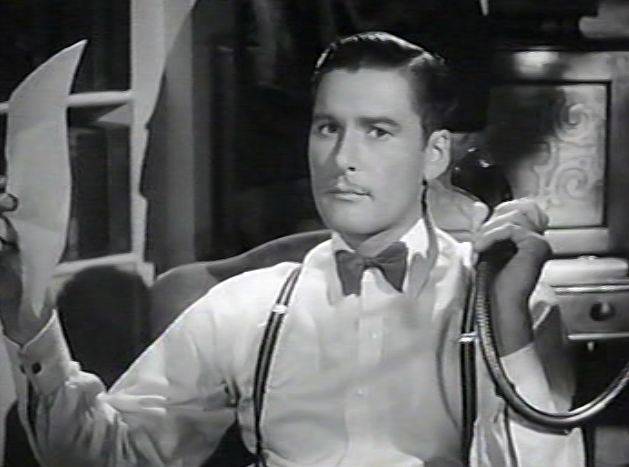
“Footsteps in the Dark” (1941) displays Errol Flynn’s ease and confidence in a comic role, and provides another showcase for his unique and unabashed charm. He carries the film, and is in practically every scene, which is good and bad. He is far and away never boring and delightful to watch; however, he’s got a great cast of character actors in supporting roles that don’t get to do too much.

Mr. Flynn plays a society blue-blood, an investment broker who lives with his lovely wife, Brenda Marshall, and his patrician mother-in-law, Lucile Watson. His relationship with both is good, and it’s particularly funny to watch him flatter his mother-in-law with comments that her new hairdo makes her look like a girl, practically every time he sees her. He does not seem insincere, just like a man who has the gift of making people happy, especially when their being happy makes things run smoother for him.

Except for the police inspector Alan Hale, and his sidekick detective, William Frawley. Unknown to his family, Flynn leads a double life. He writes murder mysteries on the side, and his latest is called “Footsteps in the Dark”, where we get the title of the film. In his book, he lambastes the very society set his mother-in-law so proudly represents, and so to keep peace in his home, he writes under a pseudonym.

He hangs out with the police to get story ideas and to help them solve their cases, because he is, of course, smarter than everybody. Especially William Frawley, who is the stupidest police detective in the universe.

Mr. Flynn’s closest relationship appears to be with Allen Jenkins, his chauffeur who also lives a double life as Flynn’s secretary. I love the scenes when Flynn leaves his brokerage office for lunch and heads out with Jenkins to a cozy suburban house he keeps for his writing space.


They peel off their suit coats, and Flynn dictates his story into a Dictaphone (have a look here at our previous post on movie Dictaphones and tape recorders), while Mr. Jenkins types out the manuscript. We see Jenkins with transcription earphones, but I can’t tell if there is also a foot pedal. I’d love to know more about the mechanical devices and method of transcription in the 1940s if anybody has any information.

I’ll leave the plot alone so as not to ruin the story, but Flynn encounters shapely but not overly talented burlesque queen Blondie White, played with trampy gusto by Lee Patrick (for whom he poses as a naïve, “aww-shucks, Ma’am” Texas oilman. Catch his funny attempt at an accent.)

Grant Mitchell plays the family attorney, about whom Flynn makes up outrageous stories of being romantically involved with the burlesque queen in order to cover up his own activities.

Roscoe Karns is a smarmy private detective Brenda Marshall hires to track her husband.

Ralph Bellamy, always reliable and believable in any situation, is a dentist, and there is one particular scene with he and Flynn, with Flynn in the dentist’s chair, that flits alternately between both comedy and tension. It’s almost hard to concentrate on the nuances of the scene, at least for us today, because at one point Bellamy joins his patient in a cigarette break, and companionably plunks an ashtray down on the instrument tray for them to use. Yuck.

We want to see more of these great character actors, but the movie is Flynn’s, and so we see them only through his brief interaction with each one of them in turn through the course of the movie. They really are wasted.

Another good scene: Brenda Marshall, having discovered Flynn’s preoccupation with Blondie White, goes to the burlesque theater herself to see what’s so special about her. We later find Miss Marshall play-acting a strip tease in front of her bedroom mirror to practice for her husband, when she is interrupted by the butler. It’s one of the few scenes without Flynn; the rest of the movie rests on his capable shoulders. However, because he is so capable and so charming, we know he’ll win the day and there is no real suspense, except for a scene at the very end.

The studio could have taken this further and made sequels, but this lightweight, breezy whodunit stands on its own.

Monday, June 20, 2011

Conflict -1945


Conflict (1945) starts with title and credits that ooze like residue from the background of a dark and stormy night, and melt in a sinister haze while we squint through the curtain of rain. Could be a monster movie with an opening like that, but film noir adopted such techniques from their monster movie cousins, and presented a new kind of monster for us: the darker side of ourselves.

Robert Siodmak, who directed such films as the magnificently creepy The Spiral Staircase (1945), which we discussed here, co-wrote this script which blends the customary fatalism of film noir with a new emphasis on psychiatric analysis to help solve the mystery.

The psychiatric element to the story begins innocently enough. Sydney Greenstreet is a jovial, avuncular bachelor professor of psychology (love that man’s jolly guffaws), a practicing psychologist, and an avid grower of prize roses, who hosts a small intimate dinner party to honor the fifth wedding anniversary of his two friends, played by Humphrey Bogart and Rose Hobart. The film opens with what we suppose is Mr. Greenstreet’s beefy hand patiently writing out an invitation in elegant handwriting, one of the lost social graces.

Because this is a mystery, I’m going to try not to heave any gigantic spoilers at you, but step as delicately as I can around this movie by focusing on the performances. The performances give us a lot of back story we may assume about the characters, which gives the movie more depth than appears on the surface. In fact, the plot of the film is spilled out for us at the very beginning, and the real mystery is not so much who done it, or even who done what, but how is the guilty party going to meet with just desserts?

This is one of Bogart’s most interesting roles, not so much for the character as written, but for what he does with it. We meet him and his wife getting dressed to attend Mr. Greenstreet’s house party. They seem to bicker a bit, but there is nothing really to suggest an unhappy marriage. His moaning about wanting to stay home tonight and her complaining that he leaves his clothes all over the place make them seem comfortable with each other, a solid marriage if not a very exciting one.

Then a bombshell. Rose Hobart, with a single, severe streak of gray in her pompadour, speaks with the coolness of a sophisticate when she suddenly remonstrates him for his “ridiculous infatuation with Evelyn.”

Evelyn is her younger sister, played by Alexis Smith.

Mr. Bogart is surprised, but remains calm, even when she chides him that, “The way you look at her and hang on her every word is positively nauseating.” His wife insinuates, due to her sister’s extreme youth and inexperience, that Bogart is entering a kind of second childhood. His wife does not seem threatened or hurt, as much as she seems embarrassed for him. Her accusation is belittling.

Seeing himself through her eyes, perhaps he also feels that such an infatuation should be beneath him. He replies when she asks him what he’s going to do about it:

“I’m not going to do anything about it…I haven’t said anything to her and I don’t intend to.”

I like that shot of him answering her with a confident, if somewhat world-weary acceptance, in his voice. He is not apologetic or defensive. His code is self-restraint, which is what makes his later loss of self-restraint so interesting.

“When I married you, your sister was just a kid. Now she’s grown up and I happen to find myself in love with her. It’s just one of those things that can’t be helped.”

Yet, he has no intention of leaving his wife, even acknowledges that she would never let him go. Miss Hobart also contends that were he to confess his love to Alexis Smith, she’d never marry him out of loyalty to her sister, and he knows that, too. Bogart has this all figured out, he’s done a lot of brooding on it, and seems determined to face his comfortable rut of marriage and his unspoken crush on his young sister-in-law, and keep them separate.

But his stoic veneer cracks a little when Rose Hobart, who can’t seem to leave well enough alone, taunts him that Alexis would laugh at him were she to find out. This stings him. Bogart looks hurt.

But he’s determined to soldier on through this new unpleasant turn in his marriage. His love for his sister-in-law was a precious thing as long as nobody knew about it. Now it’s spoiled for good.

Alexis Smith pops her head into their bedroom and reminds them to hurry. She is fresh-faced, beautiful, and open. What back story she brings to her role is largely in these qualities, and in a lack of sophistication that makes her utterly unaware of both her beauty and her affect on Humphrey Bogart.

She lives with them. Their mother lives in another part of the country. We are told nothing about a father or other siblings. We may assume she was a teenager when her sister and Bogart married, and now she is in her early 20s. Her guileless good-natured attempts to be both pleasant and useful might make her seem a dishwater character on paper, but what Alexis brings to the role is a gentle vulnerability. She seems in awe of both of them and holds them as an example of the perfect married couple.

There is a subtle difference between her relationship with her sister and her relationship to Bogart. She seems deferential to the older, more confident, more worldly sister, who has taken her into her home. In some respects, her sister will always be the knowing grownup and she will always be the mousy youngster. With Bogart there is a more comfortable friendship, as if she has not quite grown out of the teen who finds herself with the unaccustomed pleasure of an indulgent older brother. There is not a little hero worship for him.

“I only hope that someday I’ll find a husband as good as you,” she says, and drops an affectionate kiss on his cheek after a round of congratulations at the party, which Bogart accepts with a charming look of being comforted. He nearly blushes. Yeah, Bogie, no less.

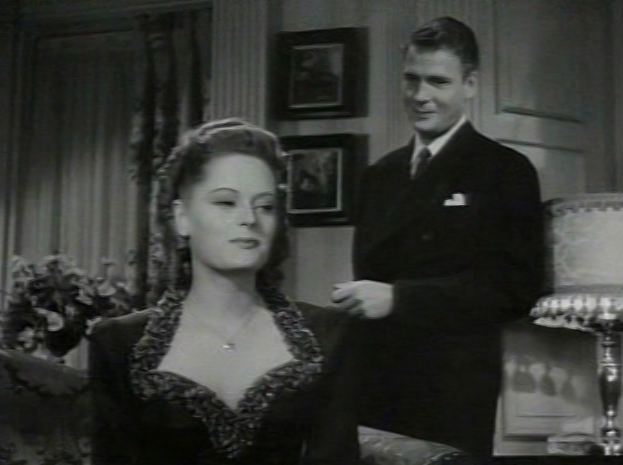
Family doctor Grant Mitchell is also at the party, and so is Sydney Greenstreet’s young colleague, played by Charles Drake. Mr. Greenstreet does his best at matchmaking through the course of the movie, trying to get the lovelorn Drake and the reticent Alexis Smith together.

The party conversation turns to the nature of love and the psychology of it. Alexis wants to know what Mr. Greenstreet does as a psychologist, and he explains that he battles the nature of psychosis.

“Sometimes a thought can be like a malignant disease that starts to eat away the willpower.”

Bogie is visibly uncomfortable with this, and we know he is afraid his precious, private infatuation might be construed by the misunderstanding outside world, certainly by his wife, as a mental disease.

“Love and its frustration is the worst offender,” Greenstreet pontificates, but Alexis Smith counters with an eager recitation of all the famous lovers in history and literature. Here we see for an instant, another flash of Bogart’s versatility. Look at his expression as he watches her tentative attempt to illustrate the enviable flush of romance that she has never experienced. His adoring expression is the picture of a schoolboy crush. Yeah, Bogie, no less. Maybe the most sensitive tough guy that ever lived.

But when forced to bring her fantasies about romance down to earth Alexis affirms to her sister, “When I marry, I want it to be something solid, like you and Dick.”

They drive home in the omnipresent film noir rainstorm, Bogie and the missus in front, the kid sister in the back -- because of the camera angle, literally as well as figuratively between them. Miss Hobart suggests Alexis go home to Mother because Mother misses her. Obedient Alexis regretfully agrees, and Bogart sneaks an anguished look at her in the rearview mirror.

Which causes the car crash.

The car plows right at us in a sickening flash, and may cause you to use your favorite exclamation of alarm.

A brief, film noir dream (or nightmare) sequence of the faces of the conflicting personalities in his life, from his wife, to Alexis, to Greenstreet, all jumbled in a wet whirlpool, and we see that Bogart is just regaining consciousness. Doc Grant Mitchell assures him he has only a broken leg, and that the ladies are fine. Bogart has asked after Alexis first.

Confined to a wheelchair back home, though hobbling on a cane when nobody is looking, Bogart is the picture of helpless frustration. Alexis has been sent away. He and his wife resume their comfortable rut of a passionless marriage.

Then his wife goes missing.

It’s no secret what happened to her, but I’m going to sidestep that and just go on to another couple of interesting aspects of the movie. Though she is missing and the police haven’t got any clues as to what happened to her, personal items of hers that she wore or had with her when Bogart last saw her begin to show up here and there. Traces of her follow Bogie around. We may wonder if this is a ghost story, or an elaborate hoax and who are involved?

Through the cat and mouse trickery played on Bogart, he begins to unravel. We see the man once an example of confidence and strength become testy, nervous, quick to anger, and nearly unglued by weird happenings, as well as by psychological symbols that almost seem as hallucinations (some of which are something Alfred Hitchcock might have used in Spellbound or Vertigo discussed here). 

Speaking of becoming unglued, we discussed Mr. Bogart's other forays into the wonderful world of Losing It in this previous post on Crazy Bogie.

His only comfort is the return of Alexis Smith, who arrives to commiserate about the disappearance of her sister, to bring to and find comfort from, her only other really close relationship: her bereft brother-in-law.

Interesting how the Production Code must not have been invoked by these two sharing a home together unchaperoned, but Bogart’s self-control returns enough to keep him from entering her bedroom across the hall from his.

Lots more rain, the iconic sight of Bogie in his trench coat (did I mention it rains a lot?), and carefully stocked cigarettes in slim cases for smokers on the go.

One small point, but somehow as sweet as his unspoken crush on Alexis Smith, is the unselfconscious and natural picture of her being taller than him. Alexis Smith was 5’9”, and in at least one movie I can think of, Here Comes the Groom (1951), discussed here, her height was used for comic effect and she played a wallflower partly because of it.

Bogart was 5’8”, and in some of his films, notably Casablanca (1943), he wore lifts to compensate for his appearance with the taller Ingrid Bergman (like Alexis Smith, 5’9”) and Paul Henreid. In Conflict, Bogart and Miss Smith stand an inch, and worlds apart.

Another iconic sight, but from another movie is the Maltese Falcon. The statue. It appears high on a cabinet in the police detective’s office, just over Bogart’s shoulder as he paces anxiously and demands progress in the investigation. I don’t know whose joke it was to put it there, but it’s easy to miss if you’re not looking for it. Sydney Greenstreet was, of course, in The Maltese Falcon (1941) with Bogart.


Speaking of the police detective, played by Patrick O’Moore: close your eyes and listen to him. Doesn’t he sound just like Claude Rains?

And one more: catch all the “B” stickers on all cars? This movie was released in June 1945, so wartime regulations on gas rationing were still in force. However, this does not explain why they are free to take trips to their favorite mountain lodge. A “B” sticker would get you about eight gallons a week (the lodge was something like 100 miles away), and pleasure travel was illegal during the war anyway.   We discussed gas rationing and the movies in this previous post.

But, by the time this movie was in theaters, V-E day had come and gone, and though we were still struggling with the war in the Pacific, the light was at the end of the tunnel and war-weary audiences might not have jumped to their feet hollering, “Hey! What gives? How come Bogie can drive around whenever he wants and I can’t?”

Except Rose Hobart’s car, which, oddly enough, has no sticker. Arrest that woman.

One funny moment: When Bogart, in a daze over a new creepy event, wanders away from a cab he had instructed to wait for him. The cab driver, annoyed, yells, “Hey! Sweetheart! Remember me?”

Now Alexis and Bogart, with sis out of the way, can explore their relationship. Bogart tests her feelings by confessing that his wife “imagined that I’d fallen in love with you.” Her reaction of sisterly concern and discomfort is less than he might have wanted, but Mr. Greenstreet arrives before things develop.

Off they go to the mountain lodge to ease the stress of the tragedy of the missing older sister, fish, and dance in rustic surroundings. Greenstreet’s along, and still tries to shove Charles Drake at Alexis as a prospective suitor.

Bogie, his self-control now stretched to the limit, gets jealous and openly confesses his love for her in a harassing manner, almost as if daring her to laugh at him. She does not deny or confirm her feelings, only pulls uncomfortably away and reminds him, “It can never be.”

After enough badgering, she finally tells him she doesn’t feel that way about him, but diplomatically continues to insist her sister would always be between them. Why he lets her go suddenly is never completely fleshed out, but we may assume his self control has returned in the face of his acceptance that it really cannot ever be.

It’s a stylish film, and even if one or two plot holes keep it from being perfect, Conflict is an absorbing movie.

For more on Conflict have a look here at our Laura’s recent post on “Laura’s Miscellaneous Musings”.

*********

Jacqueline T. Lynch is the author of Ann Blyth: Actress. Singer. Star. and Memories in Our Time - Hollywood Mirrors and Mimics the Twentieth Century. Her newspaper column on classic films, Silver Screen, Golden Memories is syndicated nationally.

Thursday, November 11, 2010

Heroes for Sale - 1933

We mark Veterans Day today with the film “Heroes for Sale” (1933), which was produced in that era when Veterans Day was Armistice Day and the prevailing view of Armistice Day and World War I was pacifist. By the end of the decade, war returned and pacifist sentiments would be something akin to treason.

Gone finally, or overwritten at least, was that era, not innocent, but world weary, when the loss and the futility of war was still felt so keenly. Richard Barthelmess shows the many sides of being a veteran. This is not so much a welcome home story as it is a what do you do now story. We begin in the trenches, and we end on a long lonely road to nowhere.

Richard Barthelmess and Gordon Westcott are part of the platoon that is engaged in a raid on the enemy. We are with them in the mud soaked trenches. We crawl along the barbed wire of No Man's Land in the night, in the pouring rain with cannon fire all around us. Mr. Westcott perhaps reflects our sentiments more purely when he has a panic attack and refuses to continue. He hides in the trench, while Mr. Barthelmess moves forward and captures the enemy. He brings the German officer back to the trench, a valuable prisoner to be interrogated. But just after he gets the German officer to safety, Barthelmess is shot and collapses.

Westcott brings the German officer back to headquarters and is proclaimed a hero. This is a film that could have been divided into two or three different movies, because there's a lot happening that is very interesting in terms of the illustrating great demons we carry around. Mr. Westcott is a perfect case study. He is a poster boy for that old line from Shakespeare’s “Julius Caesar”, “cowards die many times before their deaths; The valiant never taste of death but once.” Westcott’s fear at being found out dogs him this entire movie.

The first time we think he might be exposed is when the German officer is being interrogated in German by an American officer, and the German glances at Westcott with a wry, mocking smile, as if he knows that this coward, who did not capture him, is getting the credit for being a hero. We wonder if the German will tell. Westcott suffers agonies wondering.

There are several times when someone could spill the beans and Westcott’s dirty secret will be out, which lends a great deal of dramatic tension as we wait for his inevitable humiliation. It also reminds us throughout the film that the War, and its various consequences, is never over for these vets.

Meanwhile the valiant that taste of death but once, Barthelmess, we discover is not dead. Westcott thought he was and we thought he was, but he was captured by Germans and he was brought to a hospital behind enemy lines.

Here we see another aspect in a war movie that we would not see again for many, many years, and that is a humanistic, if not exactly empathetic view of the enemy. We see the Germans have their hospital and they treat the enemy as they would their own soldiers. They are not the monsters we seen the World War I posters. They are overburdened and overworked and desperately trying to save lives.

After the Armistice there is a prisoner exchange, and the German officer in charge of the hospital tells Barthelmess that he may go home. He gives him morphine to take because Barthelmess still has slivers of schrapnel in his spine which causes him great pain. Barthelmess is thankful, respectful, and they part like gentlemen.

We see what is probably a newsreel shot of a troopship coming home. Here, Westcott meets up with Richard Barthelmess again unexpectedly. The sick expression comes over Westcott’s face and he knows that he will have to come clean with this secret he carries, if not with the world, at least with Mr. Barthelmess. He confesses what he did, but Barthelmess has a nonchalant attitude towards it and lets him off the hook. He doesn't care. He says, “I've been in the shadow of death so long. Nothing seems very important anymore.”

It is an admirable sentiment and probably common to most soldiers after seeing absolute hell. They've seen the worst in they are not looking for the best anymore, just a little peace.

In a cameo role on this troopship we see James Murray, who we last saw in this post on “The Crowd” (1928). We mentioned the unfortunate circumstances of both his career and his life that took place a few years after this film was made. Since “The Crowd” was a silent movie, this film is the first time I've heard him speak. I was surprised to hear he sounds something like George Brent.

Westcott the hero goes home to a hero's welcome and Barthelmess goes home with a dependence on morphine. Westcott is a rich boy; his father owns the bank. Barthelmess works as a teller, and we see him behind the bars of his teller's cage looking for all like he is in jail.

He is struggling at work, he needs a fix, and he sneaks out of the alley to see the drug pusher. But the pusher has raised his prices, and Barthelmess can't afford it. We think for a moment that he might steal from the bank, but he doesn't. He goes to a doctor and the doctor reports him to the public authorities. His boss is unsympathetic. When Westcott tries lamely to defend Barthelmess the boss says, “You fellows forget the war is over. It's time to quit beating the drum and waving the flag.” The boss wants to fire him for his “loathesome cowardly habit”.

We see how these words sting his son, who is the real coward. Barthelmess finally does hysterically spill the beans when he is cornered, about the son’s cowardice, defending his drug habit by saying he got wounded while his son did nothing.

For a moment we think Westcott is finally exposed, but his father won’t believe the accusation. Westcott won’t admit to it, either. He dismisses Barthelmess’s words as the “ravings of a dope fiend.”

Barthelmess is sent to the state narcotics farm for several months. When he is released, we see by his file card that his morphine habit is cured, and we see from Barthelmess’ stroll around the cemetery that his mother has died in the meantime.

Now he heads to Chicago for a new start, and now we have what could be a completely different movie. Some aspects of this film are very similar to Paul Muni's experiences in “I Was a Fugitive from a Chain Gang” (1932). One could make a lot of comparisons.

In Chicago, Aline MacMahon, who we last saw as a chorus girl in this post on “Gold Diggers of 1933”, and her father, Charley Grapewin, run a small hole-in-the-wall diner and a rent rooms upstairs. Aline is her usual sharp but nice girl with snappy dialogue and a heart of gold. A plain Jane in whom no one is interested romantically, but probably should be. When Barthelmess comes in asking for a room, she brings him upstairs and tests the mattress out for him by vigorously bouncing on it, while Barthlemess watches incrediously in one of those naughty/innocent moments.

Loretta Young, with her large pale eyes and enormous smile also rooms here, Barthelmess, no surprise, is smitten by her. Another roomer is a German Communist, played by Robert Barrat who was probably one of the funnier people in this movie.

He is one of the gang here, and he always rants about the doctrines of servitude in a capitalistic society. But nobody dislikes him for his political leanings; they take him with a grain of salt. He is an equal here, even if he is a “Red”. They see him only as an obnoxious loudmouth. He could be just a minor character in this movie, but he actually ends up having a pivotal role. Cleverly though, his presence is meant more for comic relief rather than to nail the audience on the head with a social message.

Loretta works in a laundry, and Barthelmess gets a job there. He starts at the bottom and works his way to the top. Grant Mitchell is his boss.

Life is good for a while for our Mr. Barthlemess, coming home to the rooming house where the gang, who have become like a family, await him. Especially Aline MacMahon, whom pa Charley Grapewin teases for looking like she’s primping for Barthlemess.

She says no, “just trying not to look like the family”. A great line, and a great delivery.

In a bittersweet scene, Loretta and Barthelmess are preparing to go out on the town and they ask Aline to come with them. She is excited about going out, leaving the drudgery of running the place and looking after pa for a few hours to be with people her own age.


She goes off to get her hat and coat, but she sees Barthelmess and Loretta hugging, and she closes her bedroom door in a private moment of agony, being tactful and noble and crushed all the same time. Three is a crowd. She tells them to go on without her, and we see that not only has she lost what she thinks might have been a romantic relationship with Barthelmess, she has lost their companionship as well. Miss MacMahon is very good, very subtle in this scene. She is clearly one of those actresses who can do a whole lot with very little.  The director lets the camera linger on her while she works through her emotions.

Loretta and Barthelmess marry and they have a little boy. Barthelmess is a success in business. Communist Mr. Barrat, who is an engineer, invents a machine to use in the laundry business. It will increase production. He comes to Barthelmess for help to promote and to get investors. Both see this wonderful machine as a benefit for employees. They will have more leisure time, and their work will be easier. They sell this machine to Grant Mitchell, and he agrees that no one will be fired, no salaries will be cut. A little Depression-era message.

But the illusion of utopia is shattered when a new owner takes over and does what new owners do: fires employees because who needs them with this great new machine?

We get a shot of the factory. There are few people at work, and those that are working at menial jobs, which do not require their intelligence or their creativity. They push buttons.

A riot of unemployed workers breaks out. I've read where director William Wellman hired real hobos for the fight scene, which one can believe because it is very realistic. There is one shot of Loretta Young, trying to struggle her way through the crowd looks as if she's in real danger. Barthelmess tries to stop the riot. Loretta gets beaten and trampled to death in a shocking scene of implied violence hidden by some quick cuts.  Several others are killed, and Barthelmess is sent to jail for five years for being an agitator.

Good old dependable Aline MacMahon takes his son and raises him and tells him his father is in Alaska. There is a sweet goodbye scene when the little boy, sitting on his lap playfully pokes Barthelmess's tear-streaked face. When Barthelmess is taken away by the police and the child comes fretful, Aline tells the little boy soldiers don't cry.

They don't get much of a break, either. After five years, Barthlemess is released, but in the meantime, the Communist has sold many of his machines to many laundries and has gotten filthy stinking rich. He doesn't care if people are being thrown out of work because of his invention. He's made an amazing and humorous change. He turns from Communist to capitalist.

Conversely, Barthelmess's conscience is weighed down by the idea of people being thrown out of work. But the Communist has proven a valuable and trusty steward, because he saved Barthelmess’ royalties for him in a bank account, and now Barthelmess has a nice nest egg for the rest of his life.

They do a nice job aging Barthelmess. He looks haggard, not so baby faced when he was a young soldier out of the trenches. It's not too much or overdone, but you can see the lines in his face, the dark circles under his eyes.

The Communist is now wearing a millionaire’s tuxedo and derby, and attending University Club suppers. All this time Aline has been taking care of the boy. And now it is the Depression, and she and Charley Grapewin run a soup kitchen. When they run out of soup, and they must close the door to the next people in line, men and women, old folks stare desperately through the window.

Barrat calls them lazy moochers. Barthelmess gives Aline his bankbook and tells her to run her soup kitchen with his money. But the Communists has no use for charity. He says it is like a snowball that keeps growing and growing. If you feed them once they will always return. He says, “If I was running the world I would kill anybody that needed anything.”

This character has made the most amazing transformation in the history of the movies since Scrooge became a good guy. Communist, to capitalist, to fascist. A little more movie message here, but couched in clownishness.

Barthelmess, an ex-convict now smeared as a Red for having been involved in the labor riot, becomes the target of vigilante squads, self-important bullies with too much time on their hands, who run him out of town and grab a few Italians, too, because most likely they are Reds. Proof is not essential when you hate.

Barthelmess leaves Chicago, and like many other hobos in the Great Depression, rides the rails from one hobo jungle to another. In one he meets up again with Gordon Westcott. The “hero” is just out of jail for bank fraud, and his father who had been stealing from the bank for years, has shot himself to avoid prosecution. Westcott explains his father's thievery “is just one of those things. When you start, you can't stop.” It is ironic, and we think of Barthelmess’ drug habit long ago.

Ward Bond has a small cameo as one of the hobos in the jungle. It is rainy and muddy, just like when they were in the trenches years ago. The end of the movie is like where they began. Westcott still carries on his shoulders the guilt of his cowardice. But Barthelmess no longer cares, and if Westcott ever gains any absolution it is in the way his long ago human act of fear no longer matters in a world where even the World War no longer matters.

Westcott glances around, the rain dripping off his battered fedora, and mumbles, “This country can't go on this way. It's the end of America.” How many times have we heard that?

But Barthelmess, though not exactly an optimist, has a more fatalistic and practical approach. He brings up FDR's inaugural address (President Roosevelt was just beginning his first term when this film was released), and thinks things will iron themselves out in the end.  He thinks America will come back stronger than ever.

And when the police raid their hobo jungle and move them on farther down the road, Barthelmess looks up and notes happily that it has stopped raining. He has a soldier’s fatalism, the kind you get when you've seen the worst. And you don't expect the best anymore, just a little comfort will do.

As the movie ends, we look into the eyes of his son. A boy who idolizes his father, a distant figure who supports the soup kitchen where Aline is raising him. We look into the eyes of the future. He says he wants to be just like his dad.

We know he probably won't be, because the circumstances of his life will be different. The circumstances in which we live have a way of making all of us who we are, for better or for worse, some of us rise above it and some of us do not.

He will be old enough to fight in World War II, but they don’t know that yet, because this movie was made in 1933, and we all knew that there wouldn’t be any more wars after the War to End All Wars.

Related Products