“The Dark at the Top of the Stairs” (1960) gives us a curious mix of cozy nostalgia skewed with a foreboding modern world of alienation.
Thanks to Kate Gabrielle over at
Silents and Talkies, I was able to finally see this movie. It doesn’t seem to play on TV much, and I don’t think it’s out on video or DVD. Maybe some of our readers can fill in the blanks on that info.
The film, set in the early 1920s, resonates today with problems of technology eliminating jobs, and the strain on marriage caused by the struggle for money, a lack of communication, and a lack of satisfying sex. But mostly money.
Robert Preston plays the middle-aged traveling salesman whose world is crashing down upon him. His products are horse harnesses and accoutrements, but even he, like most of his customers these days, are driving flivvers. The horse-drawn conveyance business is drying up, and here in small-town Oklahoma, a new world is on the horizon, literally. Oil rigs are going up on lonely farms, and a new era in transportation, and in the American economy, is beginning. Mr. Preston is laid off.
There are a few elements that make this quiet film, based on William Inge’s stage play, quite compelling. One is the serendipitous fact that Robert Preston had just come off Broadway in another hit, “The Music Man”, and was slated to star in the film version. Preston’s indifferent career really took off after the “The Music Man” a role which he was offered apparently only because just about everybody else turned it down. It proved to be his making.
Because of his enormous success in that musical, which today we know continued with the film version, this other traveling salesman character he plays in “The Dark at the Top of the Stairs”, sandwiched between “Music Man” gigs, makes his role as Rubin Flood, downsized harness salesman, seem like a Bizarro World version of the larger than life scamp, Harold Hill. It is impossible not to compare them when watching this movie.

Here, Preston is married to Dorothy McGuire, a sensitive, genteel woman, a warm supportive mother, but whose serenity is shaken by her frustration at being trapped in a helpless situation. It’s the kind of role Dorothy McGuire could play with one hand tied behind her back. The other compelling aspect to this movie is the several strong female roles that give us the range of the “woman’s world” experience in 1920s small-town America. They are played with a vengeance by Miss McGuire, by Eve Arden as her pushy sister, and by Angela Lansbury as the local beauty parlor operator and “other woman”. I don’t suppose the business, as well as the art, of casting a movie is given enough attention by old movie buffs, but whoever made the decisions on putting together the lineup for this team hit a homer.
We might also consider that this movie made in 1960, a time when the “greatest generation” of film stars were losing job opportunities due to their regrettable habit of aging, gives us a chance to see experienced actors and actresses in meaty roles. Had the movie been set in 1960 and not 1920s, would they have still seemed appropriate (marketable) for their roles by the producers? One might wonder if since these stars were leftovers from the Golden Age of Hollywood, did that make them seem old-timey automatically?
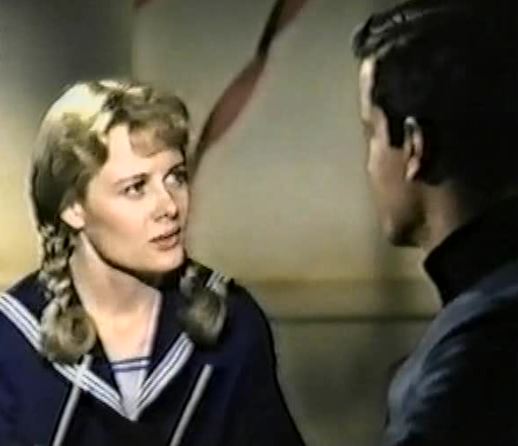
For the younger set, we have Shirley Knight, terrific as the shy, awkward daughter of Dorothy McGuire and Robert Preston, who is due to fall in love, and endure tragedy, the extreme highs and lows the movies tend to reserve for those who are young. But we see that highs and lows, falling in love and enduring tragedy belong to their elders as well.
One more note on the casting of Hollywood greats: Dorothy McGuire’s role was played by Teresa Wright on Broadway. The only member of the original Broadway cast to reprise his role in the film was Frank Overton, who plays the henpecked, morose husband of Eve Arden.
The plot seems episodic, and drifts in focus from one set of characters to another. Directed by Delbert Mann, there is a feeling about the cinematography and the pacing of the film that evokes a made-for-TV movie from the 1970s. We have a few outdoor shots, including our establishing shot of the turn-of-the century house with its big porch and gingerbread on the gables, though the paint is peeling here and there enough to keep us from assuming right off that we’re entering an idyllic world. Most of the scenes are interiors, maintaining the atmosphere of stage drama.
Robert Preston begins the film eager to head out on the road again, and Dorothy McGuire laments his frequent absences, clings to her shy daughter and her younger son, bullied by the other boys, in a stifling and over-protective manner, and complains about Preston controlling the purse strings in the family with a purse that doesn’t have much money in it. Shortly, Mr. Preston will learn he is fired, and all the petty annoyances of his life come crashing down on him like great big monsters.
He broods in the back room of the local drug store (the only place in small town Prohibition America where a fellow can get a drink -- because it’s a “prescription”), and angrily wonders “How does everyone else get rich?” Something plenty of us brood about today. Sitting next to him is the town rich guy, deeply troubled and guilty because his wealth came from an insurance scam.
Meanwhile, Miss McGuire fusses over daughter Shirley Knight and pushes the frightened girl into going to her first dance. “My only chance of staying young is through you,” she tells her.
By chance one afternoon, Shirley meets a wiseacre lonely boy from the local military academy, an outcast like her, and forms a bond with him. Later, when she reluctantly comes down the stairs in her home to meet her blind date, she discovers with delighted surprise it is him. It’s like a Cinderella moment.
But there are few magical happenings in this gentle, but realistic setting. Miss McGuire suspects her husband of philandering with the town beautician, Angela Lansbury. Beauticians, like librarians in old movies, seem to be geared to a certain stereotype -- in this case the world-weary, somewhat hardened female. Miss Lansbury doesn’t snap her gum, but she does smoke, so we know she’s been around the block. But, she has a heart of gold, can turn a deaf ear to the petty gossip she hears in the beauty parlor, which is literally her front parlor, and charges a dollar for a perm.

She and Preston are buddies, unusual in the old movies, particularly between traveling salesmen and hard bitten women who’ve been around the block, and Mr. Preston refreshingly acknowledges that she’s really one of his best friends. Partly, as we come to understand, he respects her because as a working woman she knows the value of a dollar, and he thinks his wife does not. Angela Lansbury is not a millstone around his neck.

In a touching scene that also manages to be rife with sexual tension, she talks about the happy marriage she once had, and how being a widow is tough on a woman with normal desires, including a very strong desire for him. The almost-seduction fails because Preston’s heart isn’t in it; he’s faithful to Dorothy McGuire. Miss Lansbury, like the pal she is, lets him off the hook. But when she confesses, without self pity, her loneliness and longing for a romantic relationship, Preston shoots her an expression of wonder, and sadness, and we see he clearly aches for his friend and wishes he could help, but he is no better at lending comfort than he is at finding a job.
The sad and depressing episode spurs him to trying again for a job, any job, and he humiliates himself by asking an old farmer friend to let him be a farmhand. The man tries to let Preston down easy, but must be frank that he’s too long in the tooth for that kind of heavy labor.
Meanwhile, Dorothy McGuire commiserates with sister Eve Arden, and we have yet another look at a broken marital relationship. Miss Arden is gloriously opinionated, funny in her very obnoxiousness, and her strong personality completely overshadows her quietly bitter husband’s moodiness. McGuire envies her a nice respectable dentist husband who works at home, while Eve Arden confesses her husband no longer makes love to her, that she never actually enjoyed sex, and her husband has long since pulled away from even any meaningful discussion with her. “God, I’d like a good fight. Anything would be better than this nothing,” she explodes.

While the grownups are bumbling through their errors, the younger set seem to have more promise. Shirley Knight’s young man, played by Lee Kinsolving, sweetly entertains her with a pretend scenario as he describes what it will be like for him to date her regularly, show up at her house and mow the lawn, being nice to her kid brother and her parents until he is “just like one of the family.” His own mother, a struggling actress in Hollywood, has nothing to do with him and he wants to belong to somebody.
Unfortunately, at the country club dance, we see, and Shirley Knight learns, what he has known all along: that he will never fit in for one reason or another. For tonight, it is because a society matron has decided that a boy named Samuel David Golden is Jewish and therefore does not belong in a restricted country club. He is more than humiliated; his romance and his daydream about fitting in are destroyed.
The film ends with an astonished, and sobered, Robert Preston getting a job as a traveling salesman for the oil corporation, selling drilling equipment about which he knows nothing. But, as he tells the smug young interviewer, he knows how to sell, how to talk to the common people hereabouts. The manager, an older man with enough experience about life to know about such things, decides that Mr. Preston talks horse sense. The job is his.
Becoming employed again does wonders for his marriage, but this is not a film of entirely happy endings. Other troubled lives we’ve seen are still unresolved, and Shirley Knight will carry the memory of a sad boy with her to whatever relationships she has in the future.
Robert Preston remarks with humble satisfaction about his new employment and starting over in his 40s in a new economy driven by new technology, “Now I’m a stranger in the land I was born in…but, I’m doing the best I can.”
A lot of us know the feeling.
Back to Harold Hill. It is irresistible to muse that this might have been the future of Harold Hill and Marian the Librarian 20 years down the line, after the final happy ending scene of “The Music Man”. Maybe they still heard the bells on the hill, but it might have taken more work to concentrate on them when things turned sour. The movie ends with Preston taking Dorothy McGuire’s hair down in the upper floor bedroom, the curtains billowing in the breeze, in the house with the gingerbread gables that need painting.