IMPRISON TRAITOR, PEDOPHILE, AND CONVICTED FELON TRUMP.
Showing posts with label Jimmy Lydon. Show all posts

Thursday, May 13, 2021

Gasoline Alley - 1951


Gasoline Alley
(1951) brings the popular comic strip to life, and like the strip seems to reflect that life goes on and time doesn’t stand still, for the story is mainly about main character Skeezix’s younger brother Corky.

The comic strip is the longest currently running strip in U.S. history, begun in 1918.  Unlike most strips, the characters in Gasoline Alley aged, and much of the storyline chronicles the life span of Skeezix Wallet.  Skeezix was an abandoned baby found by Walt Wallet on Valentine’s Day 1921.  Walt was a bachelor, but he took the baby in and raised him.  Walt and his pals liked to tinker with their autos – a new-fangled invention still in the early ‘20s, and so the alley behind their street was nicknamed Gasoline Alley.


Skeezix did not remain a baby, but readers followed along his boyhood as he aged in the 1920s and 1930s – While Walt married, had another son, and then another baby, a girl, was abandoned in his car in the mid-thirties.  Walt just seemed to attract foundlings, apparently.  Skeezix joined the Army during World War II, married in 1944 and had a couple of kids of his own.  He’s a great-grandfather today, having celebrated his 100th birthday this year.

This was another strip, like last week’s Winnie Winkle the Breadwinner, that my mother loved, because she grew up with it and she reminded me many times that Skeezix shared childhood milestones with her, as they were close in age.  She talked about him as if he was a cousin.


The comic strip was very popular in its day, spawning radio versions, a children’s middle-grade chapter book, and a couple movies: this one and its sequel Corky of Gasoline Alley, also released in 1951. Frank O. King, the cartoonist, is also a co-writer of this script.

Corky, played by Scotty Beckett, stars in both movies, as the focus had shifted from Skeezix, now perhaps viewed as more settled with a wife and kids, onto a younger fellow with more trouble in his life. 

Corky’s main problem is his discontent about growing up in Skeezix’s shadow.  He has never measured up to his older brother’s steady qualities, and now that Skeezix has his own business – a garage called Gasoline Alley, a wife and kids and his own home, Corky wants to catch up to him.  The movie begins when Corky unexpectedly arrives home from college announcing he has quit school, and brings in his new bride. 

His parents are understandably shocked, a little annoyed, and worried as heck about their boy’s habit of acting in haste.  Corky and Hope, his new wife, live with Ma and Pa until Corky can get a job and afford a place to live. 


Walt is played by Don Beddoe, and he is the only person in the cast to actually resemble the cartoon character he plays, with that shock of hair pasted high over his forehead.  A great job by the hair and makeup folks.  None of the other actors look like the characters they portray, but probably could not be expected to, after all, these were cartoon drawings. That Don Beddoe looks so much like Walt Wallet is delightful and, I suppose, a little distracting.  He draws your attention in every scene he’s in.


Skeezix is played by Jimmy Lyndon, who we last saw here in Life with Father (1947).  He doesn’t get much screen time, unfortunately.  Patti Brody plays little sister Judy, who has a few funny lines and delivers them well.  Susan Morrow makes her screen debut as Hope.

Corky’s first attempt at working for living is to become an underwear model for a catalogue, which has its funny moments, though a sexy woman model he meets pops back in the story from time to time as a prospective danger to his marriage.  This is no soap opera, however, and the movie’s director, Edward Bernds, transfers some of his experience on Three Stooges and Bowery Boys flicks in broad comedy sprinkled throughout the movie, especially in a wild car chase at the end. (Where, told to stop the car by throwing out the clutch, the terrified driver exclaims, “I haven’t got one, it’s Dyna Flush!”  I’m assuming this is a comic reference to the Dynaflow early automatic transmission in Buick cars.)

Corky next gets a job as a dishwasher for a restaurant, and with incredible luck, or hutzpah, decides to take a lease on a run-down diner.  Fry cook Pudge, played by Dick Wessel is along for the move – turns out he was in the Army with Skeezix, and Gus Schilling’s hired as a dishwasher with a prison record.  Corky gives him a job to help him go straight, though Schilling’s light-fingered skills will help later on when they need to stall signing a contract.  We last saw Gus Schilling here as the beleaguered TV deliveryman in Our Very Own (1950).

With his wife, Hope, as waitress, and a big loan from Skeezix, Corky’s in business and much of the movie follows the ups and downs of getting established. A wolf after Hope happens to be a shill for a competitor.  Corky and his crew run and out of the diner so often on emergencies, that at one point the cook, heading out the door, yells to a customer, “Turn off the lima beans in ten minutes!”


It’s possible that since two movies were made in the same year featuring the Gasoline Alley characters that it might have been intended to make a series, such as the long and successful Blondie series of movies produced from the late 1930s through 1950, also, of course, based on a famous comic strip. However, no more followed and it’s possible Scotty Becket’s own personal troubles might have played into that decision.  He’d been around Hollywood since a small child, first coming to attention in the Our Gang series.  As an adult, his self-destructive behavior destroyed his career and eventually, his life at only 38 years old.  He played his role in Gasoline Alley with great energy and likeability. 

The strip continues today, having passed through its fascination with the Tin Lizzie, with the Depression, World War II, post-war family life, Skeezix's children having served in Vietnam and in the Peace Corps, and each fad and whim in succession through the last ten decades of our history. It survived by examining the small stuff of life, and then letting it go, because life goes on and time doesn’t stand still.

Next week we join the Classic Movie Blog Association’s Hidden Classics Blogathon, with a look at Till the End of Time (1946).


********************

Jacqueline T. Lynch is the author of Ann Blyth: Actress. Singer. Star. and Memories in Our Time - Hollywood Mirrors and Mimics the Twentieth Century. Her newspaper column on classic films, Silver Screen, Golden Memories is syndicated nationally.  Her new book, a collection of posts from this blog - Hollywood Fights Fascism - is available here on Amazon.


Thursday, April 21, 2011

Life with Father - 1947


Oh, GAD! It is with only a little tongue in cheek that I wish those who celebrate Easter a pleasant holiday by discussing a movie about a man who refuses to get baptized.

From the first glimpse in the stereopticon images to the opening theme swelling with a rhythm that suggests the clip-clop of trotting horses, “Life with Father” (1947) sweeps us back to a simpler time that is part history, and part parody.

One could categorize this film along with some of the others in the post-War era that seemed to soothe our raw nerves from the experiences of wartime with gentle nostalgia, a family of films that would include “I Remember Mama” (1948), “Good News” (1947), “Cheaper by the Dozen” (1950). But, “Life with Father” has its own pedigree.

The film is based on the famous stage play that, at the time, had been the longest running show on Broadway. On my New England Travels blog this week, we have a look at the Lakewood Theater in Skowhegan, Maine, where this premiered in 1939. A young Teresa Wright, before she came to Hollywood, played the role taken by Elizabeth Taylor in the film.

Like “Mama” and “Cheaper by the Dozen”, “Life with Father” began as a book. In each case, the authors wrote humorous and heartwarming reminisces about their parents. Opposite of the angst-filled, vitriolic, tell-all books popular today, it’s interesting to think that Mama, and Frank Gilbreth, and Clarence Day could be manufactured by their children into characters in American literature.

Perhaps they are not so well known characters these days, but there was a time when at least a couple of generations of readers claimed familiarity with them. Have a look at this post where we discussed popular novels turned into films.

The movie, with sets painted in those pleasing, soft colors we’ve noted in some other post-War color films, takes us back to 1883 New York City, where irascible Clarence Day, a Wall Street financier, domineers his family not so much with sternness as with overpowering confidence that his own judgment is unfailingly right.  The first glimpse we get of the great man is of his shadow on an upstairs hall landing.  It's a great entrance.

William Powell plays Mr. Day in a performance that deservedly earned him an Oscar nomination. His tolerant wife is played by Irene Dunne. These two, at the sunset of their film careers, are charming in their roles. She would earn her own Oscar nomination the following year for “I Remember Mama”.

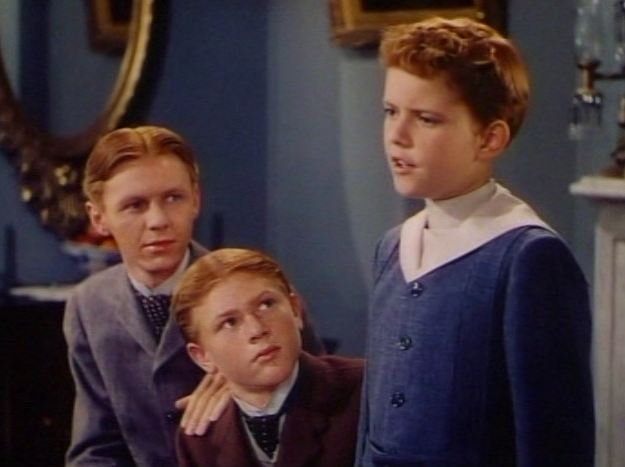
They have a family of four sons, played by Jimmy Lydon, best known for his portrayal of Henry Aldrich (“Coming, Mother!”) in a series of B-movies; a tall 15-year-old Martin Milner in his first film. We last saw Martin here in “I Want You” (1951). Johnny Calkins is next in line, and little Derek Scott plays the youngest. All the boys, like their father, are redheads. Martin Milner reportedly mused that of all the cast, he was the only natural redhead of the bunch.

Monte Blue, from silent film days, gets a brief role as the cop. Zasu Pitts, like Mr. Powell and Miss Dunne, a veteran of Hollywood’s heyday, plays a visiting cousin, but though her role is chipper and chatty, she does not get to display here her tremendous gift for slapstick comedy that we noted in this post on “Bargain of the Century” (1933). It is almost something of a shock to see her act like a regular person, and not that lovable but almost tragically obtuse comic character she created so many years before in Mack Sennett shorts. There’s something vaguely disappointing about Zasu Pitts being normal.  I miss the Olive Oyl warble in her voice, and those hysterical expressions that despite their goofiness seemed to indicate a superior knowledge of the human condition.

Miss Pitts comes to town with a young Elizabeth Taylor. With a handful of films already under her belt, Elizabeth plays her ingenue role with confidence. Much has been written lately in the aftermath of Miss Taylor’s passing about her beauty, her iconic image, and her power as an actress. I can’t refute any of that, but I would note that one scene in this film has always stood out for me, and perhaps it’s because it shows the possibility of an alternate future for Elizabeth Taylor.

I mean the scene where she and oldest boy, the Yale-bound Jimmy Lydon attempt a violin-piano duet on “Ye Servants of God”. She does not recognize the tune, though she is familiar with the words of the hymn on the sheet music. The Day family are Episcopalian, and Elizabeth confesses that she was raised a Methodist. The tune is different in the Methodist church. They make several false starts and struggle badly through the piece.

“It was my fault,” Mr. Lydon gallantly states, but Elizabeth, like a 19th Century Juliet unable to socially bond with her Victorian Romeo:

“No, you’re the Episcopalian.” She then remembers that her father had been baptized in the Episcopal church, but joined the Methodist church when he married her mother.

She was the Methodist,” Elizabeth says, as if she is calling her mother something vile, and it is a sparkling moment of deft comedy. It makes one wonder if Elizabeth Taylor could handle comedic timing so well, so young, what would her career have been like had she not also been so beautiful? Her chirpy voice is an affectation of the moment, but might she have blossomed into a less iconic leading lady, but with a larger range of roles had audiences been allowed to identify with her more and deify her less.

The question of religious affiliation drives a good part of the film, beginning with third son Johnny Calkins constantly seeking help to practice his catechism for his upcoming Confirmation. Still troubled by the “mixed marriage” of her parents, Elizabeth Taylor asks William Powell if he had been baptized Episcopalian, and Mr. Powell jovially confesses he was never baptized at all.

Irene Dunne nearly pops her corset in shock, deeply upset both by Powell’s cavalier insistence that it’s not important, and by the thought that he will not join her in heaven, that they are not really married in the eyes of the church, and that her children are quite possibly illegitimate.

Though she has taken great pains to accommodate the master of the house in all things from scaring away nervous Irish servants, to banishing her new rubber plant, to maintaining accurate household accounts (mostly), she is unrelenting about the horror of his not being baptized and insists he get the ceremony done immediately.

He insists, with what we might consider a quite modern outlook, that he will be a Christian in his own way.

“They can’t keep me out of heaven on a technicality!”

Of course, among Christians, the idea of being a Christian in one’s own way is nothing new. If this were not the case, there would never have been any Methodists or Episcopalians, Lutherans, Quakers, or Baptists, etc. Re-defining, honing perhaps, the essentials of religious practices seems to be part and parcel of what it is to be a Christian.

The movie has a lighthearted grip on this irony, as well as on the elements of Victorian society that also pit tradition versus change. In a scene where Jimmy Lydon asks his father about women, we have William Powell sitting down to tell his son the facts of life, only to sputter about wrong his mother is over her stubborn beliefs. When Lydon wants clarification on men’s relationships with women, Powell turns back into the Victorian father and sternly remarks, “Gentlemen don’t discuss such things.”

Edmund Gwenn plays the gentle minister who makes Powell squirm in his pew (which Powell informs his wife has lost property value in two years - “If the market ever goes up, I’m going to unload that pew.”), by sermonizing on the perils of not being baptized.

“I don’t go to church to be preached at as if I’m some lost sheep!” Powell blusters.

Eventually, Mr. Powell takes his troubles directly to God when Irene Dunne becomes ill. Powell, in a funny, but moving prayer, hollers at the Deity, “Have mercy, I say!” and promises to become baptized if she is spared.

She gets well. It’s time for Powell to pay up, but he still refuses, and it takes a bit more cajoling to get him to the font. It’s another humorous touch that one of the motivating factors that makes him decide to proceed with getting baptized is that the cab Irene Dunne has hired for that purpose is costing him $2 an hour just waiting outside.

One of the sweetest moments in the film is a scene of domestic bliss between Mr. Powell and Miss Dunne, when they sit together, their discussion fading off into a soft duet of “Sweet Marie”. We knew Dunne could sing, but Powell is charming. The camera pans back and we see the stillness, the orderliness of the drawing room with the only movement a slight billowing of the lacy curtains at the window, sifted by the summer breeze. It is a cameo image of the 19th Century.

Michael Curtiz directs this film with his customary economy, but moments like these make one think of Vincente Minnelli.

Another memorable moment is when Jimmy Lydon, wearing one of his father’s old cut-down suits, is unable to kneel in church, or sit with a girl on his lap, or do anything his father wouldn’t do in this suit. The suit seems to control him. When Elizabeth curls up to him, he growls helplessly, “Get up! Get up!” What bigger insult can a young lady have?

The boys try to raise money, and Jimmy Lydon offers his “piece of John Wilkes Booth’s finger” to Martin Milner.

When Irene Dunne laments the newspaper article about a wreck on the old New Haven railroad line because it would disturb Wall Street and therefore her husband: “I do wish the New Haven would stop having wrecks. If only they knew how it upset your father.”

There is, above all, the glorious, just short of scene chewing mastery of William Powell, with his pince-nez glasses on a ribbon, his colossal ranting, and his clear, helpless devotion to his wife. His flirty, “Shall I leave the room?” when Zasu Pitts wants to show Irene Dunne her purchases of intimate apparel.

The horse-drawn streetcar, the quiet country lane that once was Madison Avenue in New York City, and the stereopticon pictures. It’s a feast for the eyes.


And could be a better visual feast if only the film was restored, but it is now in public domain and has become an orphan. (Oh, GAD!)   If you’d like to see it right now, here’s a link where you can watch the whole thing, interrupted by a few commercials. It’s not the best way to see this delightful movie, but even Clarence Day couldn’t argue about the price.

Related Products