IMPRISON TRAITOR, PEDOPHILE, AND CONVICTED FELON TRUMP.
Showing posts with label Lana Turner. Show all posts

Thursday, December 15, 2022

Love Finds Andy Hardy (1938)


Love Finds Andy Hardy
(1938) represents Christmas only as a deadline and an event on the social calendar.  As with many classic films, the holiday is a backdrop, not the focus of the plot.  As with all the movies in the Andy Hardy series, sixteen of them, Andy’s focus is on Andy.  We may not learn any lessons at the end of the tale, but Andy always claims he does.

Then we have another movie where he has forgotten them.


This post is part of the countdown to Christmas coinciding with the launch of my newest book, 
Christmas in Classic Films.

The story begins in early December, and the Hardy family are occupied with their usual challenges:  father Judge Hardy played by Lewis Stone censures a young juvenile delinquent in his courtroom for driving under the legal age and getting in a crash.  Sis Marian, played by Cecilia Parker has broken up with her boyfriend and melodramatically swears off men.

Andy, played by the energetic powerhouse Mickey Rooney, wants to buy his first car, a fixer-upper which will cost him the astronomical price of $20.  He pays down $12, and owes $8 and must find some way to pay it so he can have the car by Christmas Eve.  (His pop does not want him to have a car, so he has to do this on the sly.) There is to be a big formal dance at the country club on Christmas Eve and he wants to take his girlfriend, Polly played by Ann Rutherford. 

Normally, Ann Rutherford is a pretty high-maintenance girlfriend with expensive tastes and a somewhat controlling attitude, but young Mr. Rooney’s dead gone on her so he does his best to keep up to keep getting those kisses.  However, in what will be a rash of people going away for the Christmas holiday, Miss Rutherford is leaving with her family to go to her grandma’s and will miss the big dance.  Andy swears to her he will take nobody else and will just go stag.

However, his pal Beezy, played by George P. Breakston, is also going away for the Christmas holiday with his family, and he asks Rooney to date his girlfriend to keep the other wolves in the class away from her.  She is a hottie and he’s afraid of losing her.  He promises to pay Rooney the $8 he needs to buy the car.  The girlfriend is played by Lana Turner in her fourth film, in what was actually her first featured role.


Another new girl is entering Andy Hardy’s life: Betsy Booth, played by Judy Garland in her first of three Andy Hardy outings, and her second of some ten films she played opposite Rooney.  Young Miss Garland plays a 13-year-old visiting her grandma for a few weeks running up to Christmas.  Her grandma lives next door to the Hardys, and she becomes instantly smitten with Andy.


Not to be outdone, the Hardy family has its own grandmother issues when Mrs. Hardy’s mother, who lives on a farm in Canada, has suffered a stroke.  They receive the telegram with the bad news and the house is all a-flutter with what to do.  Mrs. Hardy, played by Fay Holden, and her sister who lives with them, Aunt Milly, played by Betsy Ross Clarke, will take the next train and leave the family rudderless.  The Judge hires a cook, played by goofy Marie Blake, and sister Marian takes charge of the house like General Patton, driving Andy nuts.

The movie could have been called “Christmas with Grandma” or “Grandma Messes Up Everybody’s Christmas Plans.”

In the days leading up the Christmas, Judge and sister Marian decorate an enormous tree in the living room.  There is the familiar scene of Pop feeling victorious that the lights actually work, and the stepladder is out to reach the high branches.  It’s a homey scene, but the son of the house is too busy moping on the running board of the family car in the driveway, worrying about his troubles.  He does not appear to have any joy or anxiety about Christmas wishes or shopping for others.  It’s all about the upcoming dance.

Amid Rooney’s hijinks and stress juggling dates (Beezy found a new girlfriend and no longer wants Lana Turner, so the deal’s off), problems at home, and yearning for his car, with the deadline of Christmas Eve looming before him—he marks off the days on the calendar—is a charming relationship with Judy Garland.  She has a crush on him and tries to interest him, but he thinks of her as a child.  Judy sings the plaintive-comic “In-Between” regretting she has no glamor—and briefly glances down at her chest.  “No glamor at all.”

Judy is the one who helps Mickey the most, serving as a shoulder to cry on, a sounding board for his schemes, and with much less heavy-handedness than either Ann Rutherford or Lana Turner, manipulates our young hero into taking her to the dance, eventually ditching Turner, and she herself patches up his romance with Miss Rutherford.  Judy and Mickey are pals through this film, and he couldn’t find a better one.

We have some interesting pop culture references in this movie, including the sending and receiving messages from Mother in Canada via ham radio, Andy’s ruminating on how there were no cars or planes when his father was a boy, and the Judge’s eerily prescient remark, made when admiring the 12-year-old boy ham radio operator and former delinquent in his court, played by future television producer Gene Reynolds, “Heaven only knows what this generation has coming.”

It would have a world war the following year.

Perhaps for these and much more, including the delightful performance of Judy Garland—who commands every scene she’s in—the movie was named for preservation in the U.S. National Film Registry by the Library of Congress in 2000 for being “culturally, historically, or aesthetically significant.”

To be sure, the Andy Hardy series is a window on an era. 


Christmas Eve arrives, and Mickey takes Judy to the country club dance.  He is in a tux with a top hat.  He is astounded by how grown-up she looks with her new long gown.  He takes possession of his car (she has bought a flashy hood ornament for him for Christmas) and incongruously, as in many classic films, they drive in an open jalopy through the cold.  It might have looked good on a Hollywood soundstage, but nobody seems to have considered the very real consequence of frostbite or hypothermia.  Just looking at people driving in an open car in the winter makes me cold.

Ann Rutherford is back from grandma’s early, so she attends the dance in a huff with another escort, once she finds out that Mickey has been dating Lana Turner.  Her date is a young orchestra leader from New York, played by Don Castle.  He is familiar with Judy Garland, having met her and heard her sing at a house party back home.  He asks her to sing, and though Mickey is nervous his 13-year-old date will make a fool of herself in front of his friends, he needn’t be.  She’s Judy Garland, for heaven’s sake.  Judy sings a couple songs, leads the grand march with Mickey, and the evening is a great success.

He brings her back to his house afterwards to give her his Christmas present to her, which we never see, and the Judge and Marian sneak out to join them in the living room.  It is just past midnight, so it is Christmas Day.  They wish each other a forlorn “Merry Christmas,” but then the doorbell rings and it’s Mother, who bravely flew in an airplane to return home to them.  (Maybe Aunt Milly decided to play it safe and take the train.  She ought to be along in a day or two.) Grandma’s out of the woods and it’s a happy ending.

The next morning, with a wreath on the grille of new car, which the Judge has given in and gave him the balance of what he owed, Mickey’s troubles vanish.  Polly arrives with the bandleader, who was her cousin after all, and makes up with Rooney because Garland had visited her earlier and explained things.  We can’t help but wonder if Andy Hardy wouldn’t be better off with a selfless girl like Betsy Booth, but he’s still attracted to the flashier types.

Garland’s humble response to his gratitude: “On account of you I was grown-up for one night, just like Cinderella.  Now I know how wonderful life’s going to be when I’m eighteen.”

It’s a sweet and innocent remark, and if Christmas is a time for wishes, for family, for nostalgia, for angst, and for sadness, there’s also plenty of room for old-fashioned innocence.  That might be what we mean when we say “Christmas is for children.”  But when we carry appreciation and respect for innocence into adulthood, even if we do not quite rate the label ourselves, it’s a form of benevolence that makes for a kinder world.

**************

Come back next week in the home stretch to Christmas for a department store hijinks with Ginger Rogers, David Niven, and a baby in Bachelor Mother (1939)

************

Jacqueline T. Lynch is the author of Ann Blyth: Actress. Singer. Star. and Movies in Our Time - Hollywood Mirrors and Mimics the Twentieth Century and Hollywood Fights Fascism.  Her latest book is Christmas in Classic Films. TO JOIN HER READERS' GROUP - follow this link for a free book as a thank-you for joining.


Monday, December 3, 2012

Keep Your Powder Dry - 1945


“Keep Your Powder Dry” (1945) shows a sorority-like atmosphere in the Women’s Army Corps of World War II, but poignantly tells a back story greater than the lightweight scenario on the surface.  This movie, like the WAC when it began, walks a tightrope between what the public would accept, and what enlightened possibilities could be explored for women.  The Army brass was more supportive of the program than the doubtful congressmen who argued the legislation to permit it, and more than the flippant journalists who treated it as a carnival act, and more than the ladies’ fellow male GIs, who were suspicious of the virtue, and femininity, of WACs. 
The Army brass, such as Generals Eisenhower and Marshall, knew how desperately they were needed in a two-front war.
This week and next we’ll be discussing women in the armed services through a range of drama, comedy, and musical.  Today it’s “Keep Your Powder Dry”, which hovers between comedy and drama, and “Cry Havoc” (1943), a drama in the manner of “So Proudly We Hail” (1943), which we covered in this previous post.
Next week, it’s a lighter tone in the post-World War II world of “Never Wave at a WAC” (1953) with Rosalind Russell, and “Skirts Ahoy” (1952) with Esther Williams.
“Keep Your Powder Dry” stars Lana Turner, Laraine Day, and Susan Peters as three WAC recruits.  We start the show with an operetta lyric over the opening credits that reminds us, “…for the WAC is a soldier, too.” 
It sounds like a college cheer and we might meet Andy Hardy somewhere.  The title card looks like a Nancy Drew book.
How desperately needed more “manpower” was in the service is illustrated in a strikingly more matter-of-fact manner by Bing Crosby on his Kraft Music Hall radio program on October  7, 1943 when he made this pitch:
“If you’re a woman between 20 and 50, if you’re not now in a war job, if you have no children under 14 and if you’ve had two years of high or business school the Army’s got work for you, work that’s vital for victory…that means more soldiers for combat while members of the WAC take over technical jobs in communications, transport and air force, and x-ray photography, and medical and dental labs, in 155 different branches of Army service that the WAC is trained to handle.  The Women’s Army Corps trains you, the career is yours forever.  The pay is that of a soldier of equal rank.  It’s a really important job waiting in the WAC for every gal who is anxious to serve her country at home or overseas.  The WAC has a recruiting office not far from you.  So do your part in hastening the ultimate victory of our forces.  So, speed them back, join the WAC.”
The movie is less direct.
Lana Turner is a spoiled rich girl who parties and wakes up with hangovers (we get an intro shot of the teasing trail of her clothes on the floor) while her best friend, the parasitic Natalie Schafer (yes, yes, I know, Mrs. Thurston Howell III), wakes her up and begs her once again to get her lawyer to release the REST of her inheritance so they can party even more.
Miss Turner’s lawyer reminds her that the trustees of her inheritance will not release her money until she proves to be more responsible.  So, she joins the WAC, thinking it’ll look good and she can always duck out later.
 Susan Peters is a young wife who, in an unusual goodbye scene, helps her husband pack for Army duty while he tenderly wishes her luck on her upcoming basic training.  She, too, it appears is bound for the WAC, as something productive to do while her husband is away.  She believes she will help the war effort and bring him home sooner.  This was a common reason for lots of WAC enlistees to join.
The third member of the trio is Laraine Day, who is an Army brat, chomping at the bit to join the WAC and be a soldier like her officer papa.  He is pleased, and not a bit worried about her virtue or femininity.
A reassurance to a skittish American public, perhaps, who truly wondered if they were tearing the fabric of American womanhood apart by allowing this audacious thing of women into the Army, even in gender-segregated units.
I don’t suppose this film was shown overseas to the boys on the battlefields, but it might have done them good to see an earnest film about earnest young women in uniform not unlike the girls they left behind. 
Certainly no threats to their manhood here, though I smile at the scene late in the movie where Miss Turner looks like one of the GIs with her shirt open and her tie draped loosely around her neck as if she were about to open a deck of cards for poker. 
It’s easy to dismiss much of the film as schmaltz unless you get that society at the time was uneasy about a woman wearing pants, let alone learning mechanical and technical skills.
We see the women briefly wrestling in hand-to-hand combat training (in work dresses), but most of their time is spent marching and…archery?  The marching cadence in soprano voices.
The initiation into the WAC world of military discipline, and helpfulness in the war effort, is filtered through a fine sieve as most of the movie centers on the personality conflicts of the girls and how they overcome challenges.  Lana Turner, who tops her class in identifying aircraft not because she studied the material but because she dated so many pilots, has discovered a new sense of purpose in the Army.  Never taken seriously before, she rises to the occasion and becomes a good soldier, with only two problems: her old martini-soaked friends won’t leave her alone, and Laraine Day is a thorn in her side.
Laraine Day, in her capacity as having grown up on Army posts, becomes the camp know-it-all on how to do things.  She might get as irritating to the audience as she is to Miss Turner, except that Miss Day is so very good in her role.  She’s almost pathologically bossy and interfering, and we see — and by the end of the movie she will confess — that she feels threatened by the glamour girl Turner.  Her authoritarian attitude over the other girls is due to her insecurity at being bested by outsiders who know nothing of her cherished world of Army life.  Her self-revelation at the end where, crestfallen, she faces the truth about her overbearing behavior is a strong, heart-tugging scene as we watch her crumble inside.
Both Miss Day and Miss Turner would have killed each other long before the movie ended were it not for their mutual love of Susan Peters, the peacemaker of the trio.  Susan Peters displays here again that quiet sensitivity and luminous screen presence that was launching her into a promising film career.  Unfortunately, it is difficult to recall Peters without also recalling her tragic end, which began shortly after this film was completed and a few months before it was released.
As many film buffs are aware, Susan Peters was accidently shot during a hunting trip with her husband, Richard Quine, and some friends.  She was permanently paralyzed from the waist down, and though attempted with astounding courage to make an acting comeback in a wheelchair, died in 1952 from a combination of ailments and crushing depression that completely destroyed her will to live.  She was only 31.
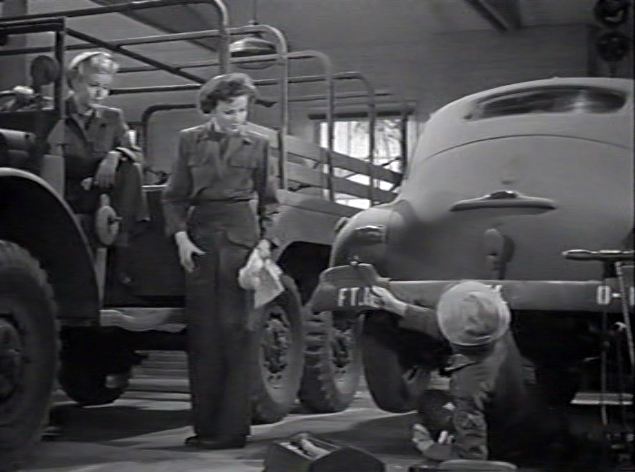
Miss Peters’ character is the least confident of the trio, and her lesson by the end of the film is to achieve through hard work and diligence, and find self-confidence at last.  All of these women go through a pre-feminist era experience of empowerment (catch the scene where the girls fix the general’s broken down car for him), and Hollywood does not begrudge them or belittle them. Not this time.  Not when the country was looking for women recruits.  What a safe incubator Hollywood could be from the real world.
Except, of course, for the burning question of the day as to what a WAC’s panties look like.  We are told they are olive drab, but we do not get a long look at the unmentionables.  If we think this scene is frivolous to the point of eye-rolling, then remember that for the smart-ass journalists covering the first WAC recruitment (which started as the WAAC, Women’s Auxiliary Army Corp before they achieved regular Army status), their most common questions were what color was the girls' underwear, and whom could they date?
The dating question is considered in the film, too.
The title of the film comes from the famous quote from the 1834 poem by William Blacker who, writing about Oliver Cromwell “quotes” Cromwell: “Put your trust in God, my boys, and keep your powder dry!”
Of course, in the cheeky manner of studio writers, not unlike smart-ass journalists, the title in this case also refers to a woman’s cosmetics.
Things to note: Agnes Moorehead as company commander is a woman of quiet, ladylike authority.  Her scene where she gives sad news to Susan Peters is both dignified and gently understated.  She is clearly helpless to do anything more than offer kindness from a respectful distance.
I like the camera shot of Peters alone in Moorehead’s office, shot from above.  It’s an instant image of despair and loneliness.
The girls ride off in a truck on which is painted the words “Wolf Trap”.  Apparently the men in the Army Air Corps weren’t the only ones who could paint sexy slogans on their machines.
Many scenes were filmed in Des Moines, Iowa and Camp Oglethorpe, Georgia, which were actual training places for the WAC. 
The girls do a lot of walking and marching in front of rear screen projection of other troops.  This is why the Allies won the war.  We scared the enemy with our rear-screen projection of thousands and thousands of soldiers following right behind us.
Lee Patrick as the ex-vaudevillian who becomes an Army cook.
June Lockhart as the resident Southern Gal.
They drink a lot of Coke.
A scene of swimming at a pond, like water nymphs basking in the sun, drinking their Coke.  Evidently the WAC has time for picnics, too.
For more on the realities of WAC service, their importance to the war effort during World War II (some 150,000 women served) have a look at this article by Judith A. Bellafaire.  It will fill you in on some remarkable circumstances and achievements of the women who served, and will profoundly increase your respect for the ladies who were pioneers among women in the military.  The WAC was discontinued in 1978, and women serving in the Army from that point served along with men.
On Thursday we’ll have a look at “Cry Havoc” which, though much more serious and troubling in nature due to the extreme danger faced by the women on Bataan during World War II, nevertheless caused less public controversy because these women were Army Nurses.  That a female nurse dying in a jungle was more socially acceptable than a female truck mechanic working in the motor pool is just one of those things we need to discover if we are to lump these two disparate films together as equally important artifacts from World War II.  They are, as you’ll see, quite different.
In the meantime, let us not forget that Her Majesty, Queen Elizabeth, while she was still Princess Elizabeth, served in Britain’s counterpart Auxiliary Territorial Service as a truck mechanic and driver.  Have a look at the Pathé newsreel clip below:

Thursday, June 16, 2011

Vaudeville Hangs On in 1943


The Death of Vaudeville gets mentioned from time to time in movies of the 1930s, but here in Holyoke, Massachusetts (and not a few other places) in 1943, vaudeville hung on as a supplement to the movies. The war brought round the clock working shifts and a round the clock demand for entertainment.

Here at the New Holyoke Theater we have six “headline” acts: Rex Webber, “a vocal allusion”; Senna and Dean in a skit; comedian Ted Leary; dancers Gavin and Astor; acrobats the Winnie Dolly Trio; and singer Joe Martini, three shows a day.

As you can see, they were an addendum on the bill to the film “Johnny Eager” with Robert Taylor and Lana Turner. In this ad, the movie seems almost like an afterthought. Tommy Reynolds and his Orchestra also appeared, at jacked-up wartime prices of 55 cents and 25 cents for kids.

Monday, August 16, 2010

Lester Colodny's Hollywood Memoir


Lester Colodny learned many things in the course of his career, such as Frank Sinatra did not like to rehearse. Mr. Colodny found this out by attempting to direct him in a commercial.

Mr. Colodny also found out that several chimpanzees let loose on live television is not a happy situation. He discovered this as an associate producer for “The Today Show”. Host Dave Garroway, whose idea it was, must have seen his error immediately as the chimps assaulted Mr. Garroway and the rest of his stunned cast, including Frank Blair, Jack Lescoulie, and a very young, beautiful, and horror-stricken Florence Henderson.

In his recently published memoir, “A Funny Thing Happened - Life Behind the Scenes: Hollywood Hilarity and Manhattan Mayhem” (SciArt Media, publisher) written by Mr. Colodny with Susan Heller, an amazing career of twists and turns, often under the silliest of circumstances, is chronicled by this now 85-year-old gentleman who currently directs community theatre in New England.

Lester Colodny has been a writer of plays, ad copy, of news précis, and screenplays. He stumbled into acting and stumbled into Mae West, touring with her show “Diamond L’il”. He worked as a literary agent, a talent agent, and director of television commercials. He won an Emmy Award for a special with Jack Benny he wrote, directed and produced. He won several “Clio” awards for his unique “Xerox” commercials. He created the television show “The Munsters”.

He recounts a Hollywood party where Rod Steiger and Lee Marvin endured a spectacular fistfight. Colodny worked with, and partied with, and shares his memories of such Hollywood luminaries as Lana Turner (whom he dated), Cary Grant, Lucille Ball and Desi Arnaz (and several other party crashers that would be a name-dropper’s paradise), Jerry Lewis, and the Beatles, among a score of others.

He would also direct another commercial with a very young Richard Dreyfuss.

For more on my interview with Mr. Colodny, have a look here at my New England Travels blog, and here at my Tragedy and Comedy in New England blog. To order your copy of this unique memoir by a very funny guy, have a look here at the SciArt Media website.

Thursday, September 3, 2009

In Search of Peyton Place


(Above have a look at the trailer, and also a newsreel of the Hollywood premiere.)

The movie “Peyton Place” (1957) opens with the joyous sound of church carillon chimes and stunning shots of New England pastoral scenes. The opening shots and score exude a sense of triumph and soulful beauty. A remarkable, clever, and somewhat astounding introduction to a story that had been up to that time one of the most controversial novels ever written, banned in most states and some countries for obscenity. Even today, the phrase “Peyton Place” carries the meaning of a morally corrupt community, a den of secrets, a bastion of promiscuity. You’d never know it by the inspiring travelogue over the opening credits.

The first few minutes of the film are really quite magnificent for establishing the setting, and the premise of the story. An outsider to this New England small town, who will be its new high school principal, drives through the countryside on his way to Peyton Place. Passing farms and fields, he arrives at a train crossing and must wait for the train to pass. He glances over to the dilapidated shacks by the tracks, and sees the downtrodden Cross family, whose story is to figure prominently in the film. He drives on, and we are left for the moment with Betty Field, the careworn mother trying to persuade her grown son not to run away from his violent, drunken stepfather, played by the wonderful Arthur Kennedy. We meet her lovely teenaged daughter Selena, played by Hope Lange, and when the slobbering Arthur Kennedy places a heavy hand on Miss Lange’s shoulder for a moment and she shudders, we have a premonition as to how things are going to play out for this wretched family.


We rejoin the new high school principal Mr. Rossi, played by Lee Philips, in his car again as he drives the rain-washed streets of the proper little town, passing the house of Lloyd Nolan, who plays the town doctor, as he comes out in his bathrobe to pick up his morning newspaper. The Doc shows us the headline about US neutrality threatened by Hitler, and we know we are in the early 1940s, just before America’s entry into World War II.

It is as perfect an opening five minutes a movie can get for immersing the audience in the place, the time, and the mood, setting us up for what’s going to happen as the film unfolds.

I would imagine, though, that most people going to see this movie when it was released in 1957 actually did know what was going to happen in the story; or at least thought they did. So many read the book.

There probably had never been up until that time a novel more vigorously criticized and yet more familiar to the public which avowed disgust for it, and claimed disinterest in it on moral grounds. Many called it a “dirty” book, but others evidently found it irresistible. The build-up for the book and the movie were tremendous.

Grace Metalious, the young author of “Peyton Place” was called the Pandora in Blue Jeans in the flood of publicity surrounding the publication of her novel because of her habit of dressing in jeans and flannel shirts, her hair tied back in a ponytail. It added to her intrigue, because she did not look like a glamorous all-knowing town gossip, yet gossip, some of it actually true, was what she peddled in her novel of seamy goings on in a New England mill town.

Her first published novel, the book came out when she was 33 years old. It stayed on the New York Times bestseller list for several months. It made her famous. It made her wealthy, for a time. In the wake of her success, however, there came a degree of pressure that she was perhaps unable to bear. Always a mercurial personality, somewhat self-pitying, obsessive and undisciplined, she died of alcoholism before she was 40. Part of the strain of her success was the ostracism by her community of Gilmanton, New Hampshire for their representation in “Peyton Place,” as much as for the lurid content of her book.

She didn’t help matters when publicizing her novel. In an interview with syndicated columnist Hal Boyle, she noted of Gilmanton, “To a tourist these towns look as peaceful as a postcard picture…but if you go beneath that picture, it’s like turning over a rock with your foot -- all kinds of strange things crawl out.”

This is an intriguing statement to make in view of the film’s beautiful postcard shots of an idyllic New England. We have the voiceover narration by the character of Allison MacKenzie, played very well with a great deal of natural talent by newcomer Diane Varsi, “Time was told not by the clock or the calendar, but by the seasons.” Anyone who has ever lived in New England knows how true this is. Varsi continues to speak in poetic terms of the seasons, and then adds, “There was a fifth season of love, and only the wise or the lucky ones knew where to find it.”

Compare this with how the book actually begins, “Indian summer is like a woman. Ripe, hotly passionate, but fickle…”

The lyrical narration of the film stands apart from the earthy language of the book, and there are so many other differences that illustrate a lot about what film was willing to accept at that time. The anxious, shy boy Norman Page, played by Russ Tamblyn in the film, is made miserable by his possessive mother. His mother’s relationship with Norman in the book is much more twisted and more explicitly so. In the novel, sexual assignations are obviously more frank. It has been suggested by present-day writers, including biographer Emily Toth in her “Inside Peyton Place” (Doubleday & Co., NY 1981) that Grace Metalious represents a beginning to the feminist movement, in part because of her willingness to address mature themes in a frank manner.

There may certainly be some element of that in the legacy of her novel, but I’m not sure I would go so far as to call Metalious a feminist herself. She boastfully admitted a dependence on husbands and lovers, and even bitterly referred to herself as having lost her womanhood when she underwent an hysterectomy. I think in Grace Metalious we have a writer who was not particularly crusading in terms of feminism, or class tension, or gutsy in depicting sex, but simply a woman who unselfconsciously wrote about what interested her, in the everyday speech she used herself. One of the strengths of her novel is its unselfconsciousness.

The film is the opposite in this respect, it is quite obviously self conscious and needs to toe the mark to acceptable social standards in the way the book does not. (Though even Metalious was reined in by her publishers and agent when they changed a key element in the first draft of her novel. She had originally written Selena Cross as getting raped by her biological father, Lucas Cross. To Ms. Metalious’ dismay, though the rape was allowed to be left in, they insisted that Lucas Cross be changed to her stepfather, rather than her father. Rape of a teenaged girl by a male guardian may be ugly, but by a father was evidently unacceptable. It did not seem to matter that this was one of a few episodes in the book that Metalious based on an actual event and real people.)

Other elements in the story, pregnancy by rape, abortion, suicide, murder were either diminished or attempted to be treated tastefully in the film. The shock of Allison MacKenzie on the discovery that her deceased father and her mother were never married remains, but the film’s manner of revealing this scandal later on in the story I think is more effective than it coming out early in the novel.

One thing the novel loses in the translation to film is the undercurrent of ethnic and class tension. The town’s largest employer, the textile mill owned by Leon Ames, whose spoiled son cavorts with the high school trollop, is represented as a backdrop to the story, showing us this is a mill town, but we get very little of the labor versus management, rich people versus poor people in the film than we do in the novel.

Grace Metalious said of the film that she was “pleasantly surprised, but I thought it was too sugar coated.” Well, yeah. It seems with a beguiling innocence Ms. Metalious thought her novel, which echoed and taught an entire generation of teenagers about sexual awakening, would be transferred to the screen literally.

Instead, producer Jerry Wald and director Mark Robson created something that was a hybrid of the novel, but that stood apart on its own, was its own creation.

When selecting a filming location, the town of Gilmanton, New Hampshire adamantly refused to have anything to do with the movie, because it felt that the book had already given the town a bad name. However, though some characters and some incidents told in the novel came from local town stories that Metalious had heard, Metalious admitted that probably 75% of the book was written before she’d ever moved to Gilmanton. Originally she came from the much larger industrial city of Manchester, New Hampshire, and the book depicts a composite of a New England mill town. She actually set the fictional Peyton Place along the Connecticut River, nowhere near Gilmanton.

Where then, is Peyton Place? It’s not Woodstock, Vermont either, a town farther up the Connecticut River that resembled what Metalious described, but refused to let Hollywood film, and brand, their town. Finally, Camden, Maine, a seaside village with no resemblance to Peyton Place in the novel, was chosen not only for its quintessential New England beauty, but its willingness (along with Rockland, and Belfast) to be portrayed as the sinful town.

Over 1,700 locals signed up to be extras in the film. So much for scandal.

The famous Whitehall Inn is depicted in the film. Here’s my photo compared to the movie scene. Here’s a link to my post on Edna St. Vincent Millay at the Whitehall on my New England Travels blog.


One opening overhead shot here looks a lot to me like Boothbay Harbor, Maine, but I can’t find any mention that any shots of Boothbay Harbor were used in the film. Maybe some of our readers can clarify that.

Here is the famous scene of Norman and Allison on the hill overlooking Peyton Place. It is actually Mount Battie in Camden. Here is my photo as it looks today, and from the film. It is truly one of the most lovely sights, and if you ever find yourself in Down East Maine, take a side trip up the auto road and treat yourself to a picnic in paradise.

Speaking of picnics, the film’s Labor Day picnic gives us a cheerful glimpse of small-town togetherness, (barbershop quartets and gluttonous little boys eating more than they should) glossing over the undercurrent of tension, underscoring the importance of the town’s apparently only mill to the local economy, and sets us up for more crisis and conflict.

The film deftly covers, if less frank and in less detail than the novel, a stream of subtle realities about conformity and the consequences of stepping outside what is acceptable. Though the younger actors, particularly Hope Lange, who is touching as the vulnerable Selena, have the weight of society on them, the older generations have an equal part in suffering the consequences of scandal. The small, but moving side story of spinster teacher Mildred Dunnock (last seen here in “I Want You” - 1951) getting cheated on her promotion to principal is one of the film’s many important subplots that are handled well and tell us much about the community with a light touch.

Interestingly, this movie made in 1957 about the early 1940s carries the veneer of nostalgia to it. A cozy, but not condescending, nostalgia. Mostly accurate, there are only a few costume choices which look more like 1957 than 1940. When we see the high school senior dance at the gym, with a banner lauding the class of 1941, we may well cringe with foreboding (as we did not in “Life Begins for Andy Hardy” in this post), that in six months the U.S. will be at war and some of these characters may be war casualties.

A lot happens in the film, but it flows so well, and so remarkably gently, that it remains entertaining throughout and one may actually forget the novel’s lurid reputation because the film is a thing apart. It’s fun to recognize individuals in the large cast, like Lorne Greene as the snide prosecuting attorney, and teen heartthrob David Nelson fresh from TV’s “Ozzie and Harriet” to play Hope Lange’s boyfriend.

Is the film the real Peyton Place? It was very well received, and made the novel perhaps more respectable, therefore making it more popular. Grace Metalious, though she wanted to move on to other projects, went back to the well and wrote a sequel, which was made into another movie (other TV incarnations followed), but this project she frankly admitted was only for the money. She could never really get away from her creation.

But perhaps her creation stopped being hers once it got into the hands of those teenagers and housewives, and all the readers who made it second to “Gone With the Wind” in books sold. Today, few have read the novel and many, thanks to TV, have seen the movie.

Gilmanton, New Hampshire probably need not have worried about “Peyton Place” ruining their town’s reputation, since Peyton Place quickly morphed into Everytown, USA. The film often diligently reminds us it is set in New England with the actors using a light New England-sounding long “ah” sound to vowels that is, if not totally accurate, is certainly enough. Norman is called Naahman by everybody.

It’s probably best when films suggest an accent rather than to try to completely replicate it, because our regional accents are so diverse, that audiences in another part of the country might not catch what is said. In the opening moments of the film when the new principal drives through the countryside and asks a farmer driving a horse-drawn plow for directions, listen to the farmer’s response in his authentic Yankee accent. Could you listen to that for two and a half hours? Particularly if you were from St. Louis, Tallahassee, or Cheyenne? I think not.

The only locals who seem not to use a New England accent are factory owner Leon Ames, who sounds southern, and Lana Turner as Allison MacKenzie’s mother Constance, who makes no attempt and also seems rather more glamorous than the average citizen of Peyton Place. Another actress might have added more depth to the role, though Miss Turner was big name whose stardom, and tragically coincidental real-life scandal, likely added welcome publicity for the film. Lana Turner, unlike many of the principle actors, never traveled to Camden, Maine to film her scenes. We see her strolling a lot past rear-screen projection.

The film ends with its own courtroom drama, with Selena on trial for the murder of her stepfather. Lloyd Nolan defends Selena by accusing the town of neglect, “She couldn’t trust us with the truth.”

“We’re all prisoners of each other’s gossip.”

“Our best young people leave as soon as they’re old enough to pay for the price of a bus ticket.”

“We’re a small town but a prosperous one, and yet we allow tar paper shacks to stand.”

He laments the community’s failure to look after its own. The film ends with another idyllic shot of a tree-covered street lined by houses and white picket fences, two kids lazily bicycling by, with another voiceover by Allison MacKenzie “We finally discovered that season of love. It is only found in someone else’s heart. Right now someone you know is looking everywhere for it, and it’s in you.”

A sweet and gentle way to end a movie based on a novel banned as obscene in several states and some countries. Where is Peyton Place, really? Somewhere back in the 1950s, when things were changing, and we knew even then nothing would be the same?

You might look for it in the “Peyton Place Archives” of the Camden Public Library.

Grace Metalious is buried in a far corner of a Gilmanton, New Hampshire cemetery. For all her resentment of small town oppression, she said in a 1961 interview, “I live there because I couldn’t stand to live anywhere else…in Gilmanton I don’t have to be part of the town.”

Incongruous? There’s a lot of that going around. Come back next Monday when the town picnic moves to the Midwest. Until then, below we have the idyllic ending to “Peyton Place”.


Here’s an interesting article by Sarah Schweitzer from the Boston Globe on the 50th anniversary of the publication of “Peyton Place.”

Grace Metalious is quoted in this post from the above-mentioned “Inside Peyton Place”.

For more on Camden, Maine filming locations, have a look at this website and also here.

For more on Grace Metalious, have a look at this article in Vanity Fair.


Digg!

Thursday, January 22, 2009

Tragedy and Comedy in New England

Henry Fonda and James Stewart found acting work early in their careers in summer stock on Cape Cod, Massachusetts. Both worked with the University Players in Falmouth. Fonda also worked with the Cape Playhouse down the road in Dennis, where a young Bette Davis was an usher, soon to get her own chance to perform onstage under Laura Hope Crews. Robert Montgomery, Constance Collier, Frances Farmer, and Lloyd Nolan all appeared here in their apprentice years. Other movie stars who performed here were Humphrey Bogart, Lana Turner, and Ginger Rogers.

Later on, Fonda, still scrounging for work on the New England summer theater circuit, would do odd jobs at the summer theater in Surrey, Maine, where he chauffeured and picked up guest actor Joseph Cotten’s trunk at the railroad depot.

Humphrey Bogart appeared a little further south in Maine at the Lakewood Theater in Skowhegan.

Jane Wyatt got her start with the Berkshire Playhouse in Stockbridge, Mass., where Mary Wickes also played.

Summer stock and road shows were not only for the novice actors. Ethel Barrymore, Basil Rathbone, Cornelia Otis Skinner, and Judith Anderson regularly trod the boards of rather humble New England playhouses, long after they had achieved their fame.

This post is actually to introduce a new blog of mine (Yeah, I know. The Internet really needs another blog) on theatre in New England, past and present. It’s called Tragedy and Comedy in New England, and I hope you can stop by for a visit.

Related Products