IMPRISON TRAITOR, PEDOPHILE, AND CONVICTED FELON TRUMP.
Showing posts with label Charles Boyer. Show all posts

Thursday, January 21, 2016

Let Them Eat Cake

Hollywood in the studio era has left us a few thousand bushels of images of its stars, both on and off the set.  One of the most recurring images, which always amuses me, is of stars eating cake.  Usually on set.  Often on somebody's birthday.  Above, Charles Boyer, Ann Blyth, and Jessica Tandy take a break from A Woman's Vengeance (1948 - discussed in this previous post) and in my book, Ann Blyth: Actress. Singer. Star.  The occasion is Ann's nineteenth birthday.

 
Both Debbie Reynolds and Jane Powell shared an April 1st birthday.  I wouldn't guess they always spent it together, but on this day it saved MGM from having to buy two cakes.

 
Clark Gable, Greer Garson, Joan Blondell, Lina Romay and director Victor Fleming on the set of Adventure (1946 -"Gable's Back and Garson's Got Him!" - you knew that was coming, didn't you?)  It appears to be Joan's birthday on this one, and she's actually got two cakes there, unlike the unfortunate Debbie and Jane, who had to share one.
Joan Crawford wields a sense of humor and an ax on a cake wishing her luck on her latest film Strait-Jacket (1964).  Back in the day, they had cake to celebrate the start of filming, the end of filming, and probably the middle of filming.   
 

Katharine Hepburn, as skinny as she was, clearly made cake a staple of her diet. Here she is riveted on director Vincente Minnelli's birthday cake, wishing he would hurry up and cut it. Robert Taylor lines up for his piece.  This is the set of Undercurrent (1946).  Something about birthday cake sort of unravels the mystique of Film Noir, doesn't it?
Myrna Loy with an enormous cake.  Beats the heck out of me what the occasion was, but it's clear all these people ever did was eat cake.  They did not work very much at all.  They just showed up to the studio every day for cake.

"I'm ready for my close-up"? -- No-o-o.  It was, "I want the piece with the flower on it."

 
Barbara Stanwyck, Eric Blore, Herbert Marshall, probably on the set of Breakfast for Two (1937).  Another hard day at the salt mine.  Pass the dessert plates.
 
"Quiet on the set!" they'd yell, "We're trying to eat our cake!"

Thursday, May 15, 2014

A Woman's Vengeance - 1948


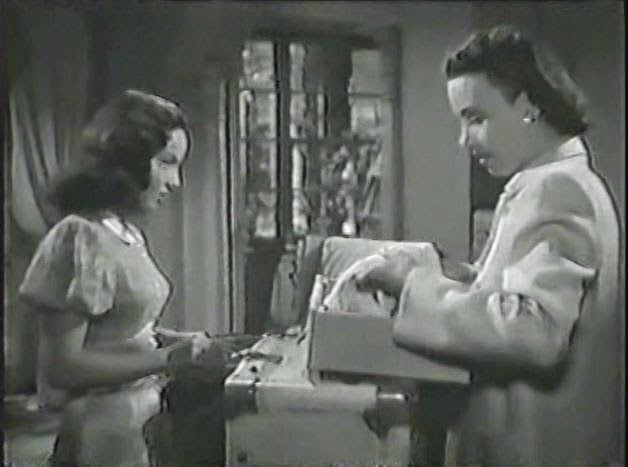
A Woman’s Vengeance (1948) is an English murder mystery that is more psychological drama than whodunit, and in which the three leads played by Ann Blyth, Charles Boyer, and Jessica Tandy form a triangle that is less romantic than it is simply purely lustful.  It is a literate, intelligent film of great power, deep wounds, penetrating remorse, and playful hypocrisy. 

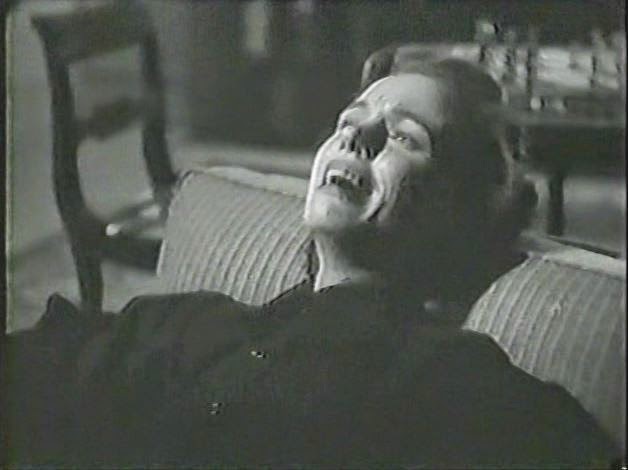
Why Jessica Tandy, in particular, was not nominated for an Oscar, I don’t know, but her performance is astounding.  She plays her role on many levels, beginning with the wry serenity of an unmarried country gentlewoman, navigating waves of tension as the plot develops, that finally leave her the very epitome of emotional wreckage.

Sometimes the commercial success of a film is not based so much only on its quality, but on the boost the studio gives it.  That may have been the case here.  It floundered at the box office.  The film was pulled out of circulation fairly early.  One theory for its early demise, with which I'm not sure I entirely agree—that of the weakly melodramatic title—was put forth by Florence Fish Parry, a columnist for the Pittsburgh Post-Gazette:

“The J.P. Harris Theater showed a motion picture titled “A Woman’s Vengeance” for four days, and withdrew it because of lack of public interest.  This is a recourse that has often been adopted by exhibitors, but seldom, if ever, has such a good motion picture suffered so through non-attendance.”  

Miss Parry suggests the original title of the Aldous Huxley short story, from which the film was taken, “The Gioconda Smile” would have been a better title.  “…one of the best short stores in modern literature…a biting, rather funny and beautifully executed piece of story-telling by one of our greatest writers…its dialogue was sharp, superior to most screenplays…its casting was superlative.”

She relates that the studio, Universal-International, “…deserves to have a flop on its hands; but it is too bad that their stubbornness in giving this fine murder thriller a dumb title deprived intelligent audiences of the opportunity to see one of the very best psychological murder stories of the year.”

“The Gioconda Smile”, of course, references La Gioconda, which is the real name of Leonardo da Vinci’s painting of what is popularly called The Mona Lisa.  In this movie, the Gioconda smile, that enigmatic expression, belongs to Jessica Tandy’s character.  Charles Boyer wonders what is hidden behind that smile, and after a while, so do we.

This being a mystery, I won’t do a play-by-play on the plot, though long before the movie ends we have an idea who the guilty person is, so it becomes not so much a matter of who did it as how do we prove it, particularly when nobody is really guiltless by their behavior.

Several persons in the cast are likely suspects, and certainly, the three major players, Boyer, Blyth, and Tandy have all behaved deceitfully, so we must assume all are capable of even murder.

The victim is Charles Boyer’s wife, played by Rachel Kempson, or Lady Redgrave, of one of the most distinguished British acting families.  She creates a strong impression here.  She is an invalid, short-tempered and shrewish, and baits M. Boyer constantly by accusing him of wishing she were dead.

Hugh French is her worthless playboy brother, who always begs money from her and gets it. Boyer hates his guts.  Especially when Mr. French blackmails him.

Cecil Humphreys is the genial retired general, also an invalid, wheelchair bound, who is a bit more accepting of it, (unfortunately, this would be Mr. Humphrey's last film as he died in November 1947 shortly after this film was completed).  Even his good-natured self-pity at not wanting to be a bother can be a bother to his dutiful daughter, played by Jessica Tandy. 

She is thirty-five years old, unmarried, and we sense one of her great pleasures in an unvarying routine of duty is her friendship with Charles Boyer and his wife.  She, with great tact and gentleness, is a peacemaker between them.  Rachel Kempson is her closest woman friend and in one scene, she softly strokes Miss Kempson’s forehead with the tenderness of a loving sister; yet we also sense, when Boyer gives her a set of Proust for her birthday and they discuss his new Modigliani painting, that her friendship with him is the most satisfying.  He provides an outlet for her intellect and emotions related to her appreciation for art and literature.  In his flippant, casual, but educated way, he feeds her soul.

Ann Blyth is his mistress.

She was nineteen years old when A Woman’s Vengeance was filmed, and still in the early part of her film career when she was often used in strong, sensual roles of compromised and compromising young women.  Decades later, when she was in her sixties, she recounted for interviewer Lance Erickson Ghulam for an article in Classic Images her experience in this movie:

“I liked playing that part very much!  Charles Boyer and Jessica Tandy were so professional, so courteous.  It was never a question of one trying to outdo the other.  Indeed, I’ve never worked that way.  My feeling has always been that when you are with a company, you work in unison to create the whole of it.  Not to isolate yourself.

“I understand that Jessica enjoyed that movie.  In later years when she discussed her career, she mentioned that she had fond memories of it.”

At the time, however, Ann was, according to columnist Sheilah Graham’s 1949 article, a bit anxious about her romantic scenes with the great screen lover. 

“I was afraid I’d look clumsy and inexperienced by comparison.  When his cheek was against mine and he was rumbling love words in his deep voice, I got goose bumps.  Sometimes I thought he was treating me like a child.  I guess psychiatrists handle their patients by soothing them one way or another.  It was like that.  When he kissed me, I was ashamed of being so young and unsophisticated.”

Her work here is surprisingly delicate.  We see her first as a somewhat petulant, glossy young woman who knows her much older lover is married to an invalid wife and she seems unconcerned, even dismissive about it.  Their first scene together in the back seat of his chauffeur-driven car gives us the image of two somewhat bored sophisticates.  When it ends with him teasingly whispering something into her ear and she chuckles with suggestive amusement, we may think both have only one thing on their mind, their immediate pleasure. 

But we also have a glimpse of her envy of Jessica Tandy, whom she has not met, but has heard Boyer talk about her as a good friend, and of whom Ann is growing jealous because Miss Tandy shares an intellectual intimacy with Boyer that she, in her youth and inexperience and lack of education does not.  Ann asks Boyer if he’s ever flirted with Jessica.

He smirks his reply, “Only in the most spiritual way.”  The dialogue crackles with the thrust and parry of mature intelligence. 

One of the most interesting aspects to the movie is how we are allowed to see different sides of the three main characters and come to know them better through watching them caroming off each other like pinballs. 

Though Ann Blyth starts out as common, hard-as-nails and loose, we soon see cracks in her carefully groomed façade.  She actually sounds like, and resembles, a young Merle Oberon, one of her childhood favorite actresses.  (Ann undertook diction lessons for this role to match the British cast, and her breathy accent is light and natural.)  Underneath, she is lacking in confidence, desperate for love and affection, and anxious that her need for Boyer is not reciprocated.  After the death of his wife, she becomes his second wife, and we see her clinging devotion to him, her despondency when he is angry at her, to the point of attempting suicide.  A scene aching with sorrow when they make up, and she gulps her lines through tears.  She becomes pregnant, but even this enormous event does not mitigate her fear that Boyer does not love her, nor does it lessen her envy of Jessica Tandy.

Jessica Tandy’s journey takes her from the intelligent, warm friend to a striking scene before floor-to-ceiling French windows where she stands silhouetted during a violent summer thunderstorm and confesses her passion for Boyer.  Her beautiful, round, dark eyes drink him in, and a moment later, glaze over when he, embarrassed, tells her he has just married Ann Blyth.  The intense expression of desire in her strong face slightly hardness as she echoes, in disbelief, his description of Ann, “Eighteen.”

Immediately, the fake, almost grotesque plastered smile to cover her deep embarrassment. “Nothing like a good joke to bring people together.  You didn’t think I was serious, did you?”

Then when she first meets Ann Blyth, who has burst in to escape the rainstorm, the picture of youth, loveliness, and the energy of a puppy in a sou'wester and Macintosh, looking rather like Paddington Bear—Jessica Tandy rides a fine line between graciousness and steely condescension.  “Isn’t she adorable?” she says to Boyer, and it sounds like an insult.

Ann nervously confesses her ignorance on “Art and things.”

Miss Tandy, with a tense grin like a crocodile echoes, “Art and things.  You sweet child.”

Later, when Boyer and Ann return from their honeymoon abroad, Jessica once again becomes the soothing dogsbody, the wallflower who is left behind while everyone else she knows is married, the friend-servant who helps her to unpack.  She talks wistfully of Ann’s pregnancy and asks questions on what it feels like to be pregnant, and we see the wonder in her soft eyes, as her hands gently fold Ann’s camisoles.

Still despondent over the loss of her friend, Boyer’s first wife, and still emotionally battered by having been present at his wife’s deathbed when the servants called her over because Boyer was on the town with Ann and could not be reached, Jessica slides into an agony of insomnia and the added tension of having to testify at Boyer’s trial.  She eventually must come to terms with the long crush she has had on Boyer, and confront him, “Did I ever ask for mercy?  Did you ever think of showing it?”

And breaks down when she must accept and face her long-denied disappointment at not being his choice, “Just because she is eighteen.  Because of her mouth, because of her skin…Oh, God! Oh, God! Oh, God!”

His wife’s nurse, played by dependable Mildred Natwick with virulent disgust for Boyer and all men because, “Sex, that’s all they think about,” has suggested to the police that Boyer probably murdered his wife, which leads to a hearing, and then a trial. 

Sir Cedric Hardwicke plays the local doctor, longtime friend of Boyer, his wife, and Miss Tandy, must also testify at the trial, along with servants, Mildred Natwick, and Boyer’s no-good playboy brother-in-law.  

John Williams plays the prosecuting attorney.  The supporting players are wonderful in this movie, and Mr. Hardwicke commands every scene he’s in with quiet, somewhat sad dignity, and some crusty humor.  

“Some women cry as easily as a pig grunts.”

He takes charge at the end as the one who ultimately ferrets out the real mystery behind Boyer’s wife’s death.  He is the trustee for everyone's confidences, and is their nagging conscience.

Charles Boyer, is, by turns, a solicitous husband enduring the rudeness of a gravely ill wife; a dog who cheats on her; a flippant bon vivant who has little idea of the hearts he breaking; a latecomer to remorse who finally accepts his guilt and can accept the punishment for it.  He is always likeable, but always a hypocrite.  He complains to Jessica Tandy that he is not able to share his appreciation for art and the finer things with his dull and uninterested wife, that he shares no intellectual companionship with her—yet when he marries again, it is with Ann Blyth, with whom he lies in the grass, and teases her over her worry that she is ignorant and cannot converse with his friends, that she is not educated like Jessica Tandy is.

“That is precisely why I married you and not her, which shows that there is something more in marriage than just the ability to make polite conversation.”

Later, Boyer will talk with Ann Blyth in quiet tones across the table from each other at the prison visiting cell about possible names for the child she is carrying.  She gives him a four-leaf clover she found, then regrets it as a stupid, childish thing to do, but he keeps it as if she had given him a diamond.

A Woman’s Vengeance is exquisitely written by the author of the original short story, Aldous Huxley, and strikingly directed by Zoltan Korda.  The cast could not be better, nor work so well together and if this had been the only film any of them ever made, it would stand as a monument to their prodigious talents.

A Woman’s Vengeance seems to be lost in that world of if it’s not on DVD, it doesn’t exist. (UPDATE - It has been released on DVD in 2016!)  Jessica Tandy, who did not even receive a nomination for this film, went on to Broadway next, creating the role of Blanche Dubois in A Streetcar Named Desire, for which she won the Tony (and would win two more Tonys in her stage career.)  She lost the film role of Blanche, typical for Broadway actors, but won the Oscar, late in life, for Driving Miss Daisy (1989), the oldest Best Actress winner.  She would later be nominated for Best Supporting Actress in 1991 for Fried Green Tomatoes

A Woman’s Vengeance would have the Lux Radio Theater treatment in March 1948, and be adapted for television in the anthology program Climax! in 1954 with its original title, “The Gioconda Smile.”  Dorothy McGuire played Jessica Tandy’s role, and I would so love to see this.  But though we may find cloudy copies of the film, as I did, the chances of a television kinescope being preserved is abysmally less.

The movie script shows shades of the characters that the short story, dry and sarcastic in its wit, even somewhat cruel, does not, and it is a great example of how powerful a story can grow when the original writer of the source material is allowed to take his work to new stages.  I don’t think that happened too often in Hollywood, and I wonder how they came to allow Aldous Huxley, whom we know more for his novel, Brave New World, a crack at it.

The film was a good fit both for Ann’s youth (which she fretted was inexperience in the face of Boyer’s suave screen image), and her emotional depth as an actress.  She holds her own with the veterans, for even at nineteen years old, she was a veteran herself, and contributes energy and vulnerability to this quiet, cerebral film.  From here she would move on to Another Part of the Forest (1948), which we covered here, and a strikingly different character who was decidedly more sure of herself and irresistibly without remorse.

Come back next Thursday as Ann becomes another entirely different eighteen-year old, whose world and her place in it suddenly becomes jolted by a family secret in Our Very Own (1950).  That post will be our entry in the Fabulous Films of the '50s blogathon, hosted by the Classic Movie Blog Association.


***************
Classic Images, No. 236, February 1995, “Ann Blyth: Ann of a Thousand Smiles” by Lance Erickson Ghulam.

Dick, Bernard F., City of Dreams – The Making and Remaking of Universal Pictures (Univ. Press of Kentucky, 1997) p.125  

Hartford Courant, September 3, 1944 p. 6C.

Milwaukee Journal, August 22, 1949, column by Sheilah Graham.

Pittsburgh Post-Gazette, February 20, 1948, column by Florence Fisher Parry, p. 2.

****************************
THANK YOU....to the following folks whose aid in gathering material for this series has been invaluable:  EBH; Kevin Deany of Kevin's Movie Corner; Gerry Szymski of Westmont Movie Classics, Westmont, Illinois; and Ivan G. Shreve, Jr. of Thrilling Days of Yesteryear.

***************************
UPDATE:  This series of blog posts about Ann Blyth's career is now a book, ANN BLYTH: ACTRESS. SINGER. STAR.


The audio book for Ann Blyth: Actress. Singer. Star. is now for sale on Audible.com, and on Amazon and iTunes.

Also in paperback and eBook from Amazon, CreateSpace, and my Etsy shop: LynchTwinsPublishing.


Monday, October 10, 2011

The Constant Nymph - 1943


“The Constant Nymph” (1943) recently premiered on TCM. It would be interesting to get TV ratings data for that night. A film so long tangled up in legal limbo, it’s a rare gem for classic film buffs, probably all of whom with access to TCM were watching or recording it or both.

“Legal limbo” has an otherworldly sound to it. It’s not really a place. It’s an imaginary existence -- or lack of one -- that suggests a challenge yet to be resolved. Those of us on the outside of this struggle, with little understanding of it, merely accept that there is such a plane of existence.

Accepting without understanding can be a kind of safety valve. At other times, it can be a gift we give to those whose feelings or actions are beyond our comprehension. “The Constant Nymph” shows us a musically creative family who need a great deal of understanding, but whose peculiar “insanity” is “of the most enchanting kind.”

This, according to Charles Boyer, friend of the family and not a little insane himself.


The art of illusion plays a big role in this film, gently directed by Edmund Goulding. The dilapidated chalet in the Swiss alps, whose foothills hover just on the back cyclorama, are straight out of “Heidi”. A storybook illusion. The mosses and ferns, and disparate branches and grasses on the furry mounds just beyond the house wave in the light breeze created by the unseen wind machine, and lift the errant strands of hair escaping from Joan Fontaine’s tight, untidy braids.

Joan Fontaine is the biggest illusion in this film. She plays a teenager here, natural and unaffected, completely innocent yet possessed of wisdom beyond her years. She runs with a round-shouldered burst of exuberance, and throws her opinions around like any know-it-all kid. She is funny, and elfin, and tragic. I think it’s one of the best performances I’ve ever seen from any film of that era. She was something like 25 years old at the time. Her skinny, awkward body is the least of the illusion; most of it comes from that hyperactive energy, the clear face with its constantly changing expressions. She is quite remarkably moving.

The way Boyer rustles his hand through her hair roughly and puts a gentle hammerlock on her, tucking her head under his arm. He doesn’t quite get that she’s in love with him, but the film avoids the sexual escapades of the book by putting her love and his misunderstanding of it on a higher plane.

Like legal limbo, I suppose.

Boyer’s main trauma comes from not living up to his potential as a composer. “If he’d only cry,” Joan Fontaine’s dissolute composer papa, played by Montagu Love, declares. M. Boyer recoils from sentiment and tenderness, or maybe just hard work, preferring a lazy joke, or a romantic diversion, which here is played by Alexis Smith.

Alexis Smith, for once in her life, has a role she can sink her teeth into. She is the wealthy, upper class society debutante who is summoned to the storybook chalet to take charge of the girls after the death of Montagu Love (who actually did die a month before this film was released). She is the maternal cousin of Joan Fontaine. Her father, played with typical comic crankiness by Charles Coburn, is the brother of Fontaine’s long-deceased mother.

Rounding out the family we have a few more sisters and half-sisters, one of which is played by Brenda Marshall, who is pursued with middle-European angst by Peter Lorre.

Joyce Reynolds is charming as Fontaine’s closest sister, who shares in her troubles and hijinks. Fontaine dumps Miss Reynolds from her bed onto the floor in our introduction to her character. In a sweet, melancholy scene, Reynolds comforts Joan Fontaine, who has fainted. Noticing a bruise and smudge of dirt on Joan’s upper arm from when she fell like a sack of wet cement in the dirt, she licks the corner of the bedspread and daubs it lovingly on Joan’s skin.

Joan took a dive when she heard that Boyer has suddenly proposed marriage to Alexis Smith. Afterward, whenever Smith and Boyer are around, Joyce Reynolds keeps a close watch on her sensitive sister. On another occasion we see her dark eyes dart from the happy couple to Joan, helpless to prevent the cold slap of reality that she’s just a kid and Boyer is a grown man with a grown man’s appetites.

But soon, it’s Alexis Smith who needs comforting. She has perceived no warning from Joyce Reynold’s alert glances. Miss Smith begins to sense, on her own, a bond between Boyer and Fontaine. She’s almost sick with jealousy. It’s a very good performance, and even at her most harsh and shrill we have to sympathize with an insecure woman who knows she’s losing her handsome husband to a skinny little poor orphan with fainting spells.

“You’re so real, so definite,” Boyer says to Alexis, by way of a compliment, but he has no real interest in reality. It’s much more fun to play in an ethereal existence. Not that he hasn’t the ability to fit in wherever he goes. In a ballroom scene, he meets Dame May Whitty, more cranky than her pal Charles Coburn, and charms her to pieces. How they click immediately is irresistible.

I was a bit thrown by “Danny Boy” being played in the background. Not something I would expect in an upper class British ballroom.

But, Boyer chafes under his bride’s social set, does not want to perform for them, and Alexis deals smoothly with his tantrums and fretfulness. It’s Joan Fontaine that gets under her skin. Still, Alexis has agreed to become the girls’ guardian, save them from poverty, and this may be her chief value to Boyer, though he has the tact not to say it. She even has looked into and learns the name of Joan’s mysterious heart condition that gives her palpitations and fainting spells; Boyer shrugs it off as a bothersome detail, like school enrollment, which is also left to her.

It is the reality of his new everyday existence that perhaps irks Boyer most, with the girls sent to boarding school and Alexis so in love with him she shows him off to all and sundry, when she is not sending him to his studio to work. He needs a little illusion, or at least some self delusion, to buffer against the responsibilities of the everyday.

I think my favorite illusion in the film is the fact that in real life, Alexis Smith was nearly four years younger than Joan Fontaine.

Her height and elegance conveys that she’s the grown up and Fontaine is the kid. Fontaine’s school uniform helps, and the delightfully floppy way she carries herself completes the picture.

The film has a leisurely feel to it, and lightness, and gentleness that compliments the ethereal nature of the story. It takes a different tone from the book -- and has to, to pass muster of the Code, but this is part of the movie’s charm. It could be such a heavy soap opera, and it’s not. Think of other films like “All This and Heaven, Too” (1940) or “Now, Voyager” (1942), which hammer us with the illicitness of the love story. This fable, like Joan Fontaine’s character, is beautifully natural and tenderly developed.

The tension builds with Alexis Smith’s devotion to honesty, which is even stronger than her devotion to Boyer. The truth may set us free, but honesty is often the most callous and brutal road to freedom. Both Smith and Fontaine suffer this, and courageously face honest self appraisals of their shared reality. The two characters change the most, almost in tandem, through the film.

At the end, we have a conversion of sorts, when Alexis Smith, enraptured this time and no longer haunted by this embarrassing romantic triangle, experiences the same thrill of Boyer’s music as Fontaine does, and at the same time. The music here is by Erich Wolfgang Korngold, which launches Fontaine into a dream sequence. It is one of the most imaginative scenes in the film where snippets of previous dialogue are strung together to create a kind of fractured memory effect -- the illusion that the words are familiar and yet completely new. An eerie déjà vu.

Smith is not part of Fontaine’s dream sequence; we do not get to see her epiphany. We only see the ironic twist that Fontaine is roused from her reverie by the fear of death in the reprise of lines she earlier recited with an innocent lack of understanding of what they meant.

I like movies that give me something to think about after they end. What if we had been allowed inside Alexis Smith’s head when she changed her mind about the love between Joan Fontaine and Charles Boyer? Her astonishing turnabout, her offer to release him is done without self-pity or bitterness, but with a heart full of love, a sense of excitement in accepting a situation that exists without understanding it. What went on in that theater box for her to do a 180 on wanting to boot Fontaine out of her house?

What if the ending was different? (I’m going to avoid a spoiler here, but you several million who watched the TCM premiere know what I’m talking about.) Would there still be a romantic triangle tinged with the rumor of pedophilia? Would Boyer ever find his muse without losing it first?

What happens if he is without both his muse and his wife? Is he still going to compose, the new darling of the moneyed set, or just find some other storybook soundstage to lose himself -- that other elusive plane of existence that enchants and entangles, and inevitably leads to sorrow?

Like legal limbo.

Monday, March 21, 2011

History is Made at Night - 1937

“History is Made at Night” (1937)…well, then. Here we are.

We film bloggers can easily ignore movies we don’t like, but I’ve been avoiding this one because I like it so much. Sometimes you destroy something mysterious and lovely when you look behind the curtain. But, ever since this post from our friend Laura at Laura’s Miscellaneous Musings and the comments, (Laura blogs on this film here.)  I’ve been brooding over blogging about this movie. Brooding. Brooding some more.

I think the deciding factor was when TCM yanked “The Public Menace” that was supposed to be on last night and changed their schedule. It put me over the edge. Now you’re going to get “History is Made at Night”, ripped to shreds. Muwaahaaahaa!

But first, the obligatory warning. There will be spoilers. I am going to discuss every frame of this movie (well, almost), for two reasons: one, I am by nature a little too analytical (stop snickering). Put a steak dinner in front of me, and I will analyze it, draw graphs, and make comparisons to Yeats’ poems and the history of Thailand, with little known facts about the modern combustible engine.

The second reason is because it occurred to me, after much brooding, as I have already mentioned, that the manner in which the plot is tossed at us is a key factor in why this movie, with such an improbable plot, seems to work.

Right, then. Do not go beyond this point if you do not want spoilers.

DANGER!!!

PROCEED WITH CAUTION!

And one more…

YOU KIDS GET OFF MY LAWN!

That ought to be enough warning for anybody. Oh, one other thing: this might take a while, so go to the bathroom now.


Ready? You by the windows, draw the blinds.

“History is Made at Night”, an unusual title for an unusual film, features Charles Boyer and Jean Arthur. Their chemistry in this film is something remarkable, and it is an oft-repeated story that a visitor to the set wondered if they were having an affair off camera because their work in this film was so intimate. Even more remarkable to this and other visitors was the professional manner of the two stars when the cameras were not rolling. This demonstrated that not only were they not having an affair; they were two of the most empathetic actors of that period. They became who they were playing and for those moments, seemed to shut out everything else.

It is one of the most romantic movies ever made, and much is credited to director Frank Borzage’s “love conquers all” canon. Something else, though, happens in the direction of this movie that keeps us interested, and believing, in the sometimes unbelievable events. Another director, another cast in this film might easily make us holler, “Oh, PUL-L-E-E-ZZE!” when we are asked to accept what is happening. Somehow, the lustrous magic of this film pulls us along. I think the intimacy of this movie reaches the audience on a personal level.

How it does that is by keeping us completely in the dark.

That’s unusual. The normal routine in films, especially of that period, is to set us up for every scene. For instance, take the old gag about somebody slipping on a banana peel. We see the character eating a banana. We know that he is going to drop the peel on the ground. After that, someone will come along and slip. Before the action ever happens, we know what is going to happen and our enjoyment of the gag is based on, not surprise (ironically), but on being clued in beforehand.

Comedies, dramas, horror movies (think of the scary music that precedes the attack), this foreshadowing happens in most films to help the audience accept what is being told to them -- though not always as obvious as the banana gag.  And an abundance of plot exposition. “History is Made at Night” takes the opposite track and makes the audience experience without any warning what the characters are facing, and makes the audience face it at the same time.

In the above-mentioned comments section in the post by Laura, we discuss the remark by Nick Pinkerton who notes: "to watch her dance with Boyer is to witness a woman falling in love in real time." I love that quote, it’s a great observation. On one level, this is a tribute to Jean Arthur’s charming power on screen, but on another level it is a tribute to Frank Borzage’s delicacy and how much he holds back, giving us a little at a time.

He gives us so little at a time that we are never sure if this is a melodrama, a romantic comedy, a suspense film…and then turns it into one of the very first “disaster movies”. Such sleight of hand is astounding. It almost seems as if they are all making this up as they go along, (and to some extent probably were) yet it is carefully orchestrated.

Mr. Borzage gives us only one set-up at the very beginning of the film. Colin Clive, who most remember as Dr. Frankenstein (“He’s alive!”), is a successful shipping magnate preparing for the maiden voyage of his splendid new passenger liner, the Princess Irene. It is named for his wife. A reporter, one of those scandal-mongering types, asks him to confirm a story that he and his wife are having marital problems. Mr. Clive dismisses him and goes to his Art Deco cabin, which he finds empty. A note is left by his wife, defending herself against his jealous rage, and requests a divorce.

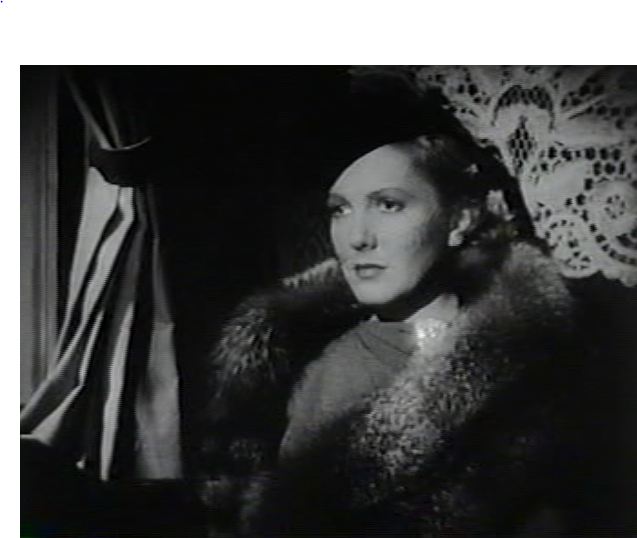
Cut to a shot of Jean Arthur, his wife, on a train to somewhere, with a blank, cold, unblinking stare through the netting on her hat. She is resolute, but emotionally empty. Jean Arthur is photographed beautifully in this film. She masterfully plays an elegant, glamorous society woman, a complete turn from the down-to-earth shop girls or wisecracking reporters she made famous.

Headlines about the split between Clive and his wife.

Cut back to Mr. Clive in a meeting with his lawyer. He wants to scuttle (remember the word, we’ll need it later on) his wife’s divorce proceedings by catching her in a compromising situation with his chauffeur. Michael the Chauffeur, played by Ivan Lebedeff, needs the money, and is hired to enter Miss Arthur’s hotel room that night and “compromise” her.

That’s all the set up we get. From here on, we’re on our own.

Keep together. Hold hands.

Cut to Charles Boyer chattering glibly to an unconscious man in a darkened room. Boyer wears a dark overcoat, with a Fedora low over his eyes. He looks like Lamont Cranston as “The Shadow”. Is he a cat burglar, robbing this defenseless man? Sounds from the room next door, Jean Arthur pleading. Boyer watches from the terrace as Michael the Chauffeur takes liberties. M. Boyer socks him on the jaw and knocks him cold, then shoots a dismissive glance at Jean, surveys the room, and turns off the lights.


Is he going to attack her? Subject her to A Fate Worse Than Death? Colin Clive enters with his hired detective to catch Jean and Michael together, but Boyer threatens them with a gun in his coat pocket, yanks the pearl necklace off Jean’s neck, demands her other jewels, and locks Clive and his henchman in the closet. Oh, yeah, Boyer is a burglar all right, and worse…he’s taking Jean with him as insurance. Now she pleads with him. Both her husband and her chauffeur have been deaf to her entreaties. Will he?

Cut to a cab ride, where Jean, shell shocked and rigid with fear, eyes Boyer, who seems to sneer with arrogance. He leans over her, to place her pearls around her neck, and then ties up the rest of her jewels like a little package in his handkerchief, dropping them in her lap.

Hold the phone. He’s not a thief or kidnapper.

The sneer is a secret smile because he knows something she does not, and playfully confesses that he was putting a drunk friend to sleep in the next room when he heard the commotion. He pretended to be a thief to get her out of there and not compromise her any further in front of her jealous husband.

She is bowled over by this, and begins to chill out, not easy after what she’s been through.

He takes her to a café, which is closing, but he charms the bombastic chef, played with noisy aplomb by Leo Carrillo, by introducing Jean as Miss America, “from America”, and likewise ingratiating himself to the tired musicians to stay a little longer for a nightcap. In another moment, the egoistical Italian chef is creating Lobster Cardinal with Salade Chiffonnade (something you’re going to be hearing a lot about in this movie), and the musicians play while sipping champagne (Pink Cap 1921), and Boyer and Arthur get acquainted. She tells him she is originally from Kansas.

“You are the first Kansas I have ever met.”

Wait a minute. This isn’t a melodrama; it’s a romantic comedy.

Boyer playfully draws a face on his hand, calls his “girlfriend” Coco, and talks to Jean about the events of the evening in much the same way a child psychologist would use crayons and paper with a traumatized child. It reminds you of Señor Wences, doesn’t it? That’s because it is Señor Wences, in the close-ups and his voice. The famed Spanish ventriloquist was wowing them in the mid 1930s at New York’s Club Chico, and evidently got tagged to help with animating “Coco”.

Coco sidles close to Jean’s cheek and confides,

“I hate men. Don’t you?” Coco wants to know why Jean got married, why her husband did that terrible thing to her.

Jean loosens up, shares a little girl talk with Boyer’s hand, and tells Coco to get Boyer to ask her to dance. In a moment, with her fur coat draped modestly around her shoulders, Jean and her hero are taking soft, tiny steps to a quiet tango. She keeps tripping on her slippers. At first, he replaces her shoe like the prince in Cinderella. They talk while they are dancing.

“Would it help if you told me about it?” he asks her and here is where we begin to see her falling in love a little with him, because we are, too. He does not sweep her off her feet or romance her in the manner of the ardent French lover. With exquisite gentleness, he invites her to only to trust him in a leisurely scene that makes no demands on her, and we watch her brittle nerves disappear like a tense body being massaged.

Cut to Colin Clive. He busts out of the closet. Michael the Chauffeur wakes up. His boss interrogates him, wants to know if Boyer was here all the time, if Boyer is her lover. Michael, just wanting out of a bad situation, tells Clive what his jealous, sick mind wants to hear.

Colin Clive plays it sinister in this role. Anyone might play the jealous husband with a kind of mustache-twirling “mellerdrammer” villain, but he is like a ticking time bomb, controlled and calculating. This is what makes him really frightening. He is an intelligent lunatic. He knows that Michael was still unconscious when Jean and Boyer left. If Michael were dead, Boyer would be arrested for killing him in the fight.

Clive smashes Michael’s skull.

Whoa. We were wrong. It’s not a romantic comedy. It’s a suspense story. Colin’s going after Jean, and cops will soon be after Boyer.

Cut back to the café. Jean and Boyer are still dancing, just barely, mainly they cling to each other and whisper over each other’s shoulders, while master chef Leo Carrillo pours out his indignation in a burst of Italian invective.

Cut to Colin Clive, calmly reporting the murder of Michael the Chauffeur to the police.

Cut back to the café, Jean has kicked off both her slippers and her coat has fallen to the floor. She has exposed herself to Boyer, emotionally speaking. Nothing says trust like dancing with a man in your bare feet.

“Tonight’s what I’ve waited for,” she confesses, “Maybe because I’ve needed tonight more than anything in my life, because I’ve never been happy before.”

They look as if they are comforting each other, and we see Boyer is falling in love with her as well. It is now morning. They make plans to see each other tomorrow afternoon.

Boyer brings Jean back to her hotel room, and she skips happily, a far cry from the thoroughly demoralized woman we saw earlier. Uh-oh. In her room are the cops, and Colin Clive pretending to be so worried about her.

Jean is interrogated and tap dances her way through an explanation of how the kidnapper let her go. She does not tell them about Boyer because she thinks his punch must have killed Michael. Colin Clive notes she is still wearing her pearls, the ones Boyer ripped off her neck. He is sure now that his suspicion was right, and that Boyer was her lover all along.

When the cops leave, Clive cuts the phony worried husband act and accuses her of taking Boyer as a lover.

“I ought to kill you for this!”

“Why don’t you? Then I’d never have to see you again.” It is a flat response, not at all hysterical, but the terse reply of someone who has borne too long an abusive marriage.

But Clive holds the whip hand. She knows it. He will turn in Boyer if she doesn’t come back to him. She agrees, and they sail for New York.

Are you still with me? Good. Please, no flash photography on this tour.

The next afternoon, Boyer heads back to the café. The workers there seem to know him. A waiter hands him a menu for his approval. Boyer walks confidently back to the kitchen and checks the meal preparations. He slips into a white dinner jacket, and looks like Humphrey Bogart in “Casablanca.”

Oh, he OWNS this joint. That’s why he brought Jean here and why he was so easily able to make the chef and musicians stay all night.

He tells Leo Carrillo he is in love with Jean and he will marry her.

“You gonna marry with that silly girl who danced with the naked feet?” Leo cannot believe it. The glamorous Jean is not good enough for Boyer.

“You act like a love-sick schoolboy instead of the greatest head waiter in Europe.”

The greatest HEAD WAITER in Europe? Our hero is just a waiter?

We see him next greet the dinner crowd, lighting the cigarettes of patrons, making things run smoothly with an eye for detail and a deferential manner. But something else -- we see he is not cloying or insincere in his attentions to the customers. He is no sycophant who turns tricks for tips. He is elegant and dignified, and controls the dining room like a captain controls his ship. He placates a fussy lady and we see he enjoys making things all right again, and perhaps this is part of his love for Jean. He gets to be the hero by making things all right again, and the love and gratitude in her eyes is bigger than any tips he’s ever gotten.

The drunk he put to bed the night before comes in with a hangover, and starts talking about the cops and some murder that happened in the next room, but Boyer gets distracted by other customers and does not hear him. The suspense makes us grind our teeth.

He goes to meet Jean at the appointment time, but she is not there. He learns from a headline (thank heavens for headlines, they tell us everything, and so quickly), that she is the wife of this great shipping magnate, and she is sailing with him to America that day.

He calls the ship. Cut to Jean, sitting in the half dark, alone in her cabin. She has been crying, and despite the brief ecstasy of hearing his voice on the phone, tells him in her own shaky voice not to try to contact her again.

It’s not a melodrama. It’s a tragedy.

Colin Clive enters the cabin, ready for romance as he slinks his arm around her neck more like a strangler than a lover, and she withdraws from him. Instantly his jealousy spikes again and he taunts her about her Boyer. He asks what she would give to be alone on the sea with Boyer now, instead of with him.

“I’d give my soul!” Another frank, bitter, and excellently executed line. Then she laughs a little hysterically through her tears and points out that though she never had a lover, her husband’s jealously brought Boyer to her aid. She loves Boyer, and Clive made it possible.

He threatens to kill her and knocks her to the ground, but she revives with that cold determination to leave him again.

Cut to another ship. Boyer and Carrillo watch the New York skyline slide by as their ship is about to dock. He has come to find her because he knows she must be in some kind of trouble. Carrillo refers to the skyscrapers as “sky wipers”. It’s okay to laugh, I did.

They don’t know where to find Jean, since she has left her husband. It’s a big town.

Cut to Colin Clive. He knows where Jean is, and where she works now as a dressmaker’s model.

Who will get to her first?

Cut to Boyer and Leo brooding in a New York café. In one of the most improbable, but entertaining subplots of this movie, Boyer notes the crappy service in this café and the lousy food. He decides that he and Leo must use the weapons available to them to lure Jean out. They will take jobs in this café and turn it into one of the best run night spots in New York, where everyone…including Jean, will want to be.

Note to restaurateurs, store supervisors, and pretty much anyone in the service industry. The next few scenes show Boyer whipping this lackluster staff into a crackerjack team of professionals. This is how it’s done. Train your staff like this. The service is improved and you can better be sure that no waiter is ever going to call a table of patrons, “You guys”.

And the comedy has returned to the script, except for one poignant moment. He leaves one table reserved for Jean. No one else may sit there.

Cut to the dress shop where Jean models clothes for rich customers. A hired goon tells Jean that her husband wants a meeting. The murderer of Michael the Chauffeur was caught by the Paris police. Jean thinks, of course, that he’s referring to Boyer. Panicked, she meets with her husband in his New York office where there is a large painting of her. He tells her he is going to hang it in the royal suite of The Princess Irene.

“By the neck until it dies?” she responds. There is nobody that can deliver a line so full of that bewitching combination of pathos and sarcasm than Jean Arthur.

Colin Clive tells her that if she comes back to him, they will go to Paris together and testify on Boyer’s behalf to get him free. She agrees. They will fly back on the Hindenburg tonight.

Yeah, that Hindenburg.

“History is Made at Night” was released March 5, 1937, when The Hindenburg was to start her second year of commercial trans-Atlantic flights. Two months after this film was released, on May 6, 1937, The Hindenburg exploded. For more on that event, have a look at this previous post.


One wonders if the film was altered in any way after the disaster to omit reference the doomed airship, or pulled from the market. I don’t know. Colin Clive, it could be noted here, faced his own private disaster. His wan, strained appearance in this, his last film, might indicate his struggle with tuberculosis and chronic alcoholism. Mr. Clive died three months after the film was released, in June 1937.

For the moment in our film, melodrama has morphed back into comedy…no, wait, tragedy…no, wait…I don’t know…when Colin Clive takes Jean out for supper on their last night in New York. Of course, he takes her to that popular place where Charles Boyer works.

When Boyer sees her from across the packed restaurant, it a miracle moment. His expression is enough to make your heart melt, until she spots him, and starts to laugh hysterically. Jean’s lost it, because her worst nightmare is now officially over. Boyer is not captured by the police, he is here in front of her and she doesn’t have to go on The Hindenburg, or even as far as Brooklyn, with Colin Clive.

But Boyer takes her laughter for mocking. He thinks she is happy with her husband, and that her moment in his Paris café was nothing more than a rich woman slumming. He is hurt, and angry, and seethes as he shows them to the table he has reserved for her all these weeks, and he bitterly suggests Lobster Cardinal and Salade Chiffonnade. And the champagne? Pink Cap ’21.

Tragedy, tragedy, tragedy.

But, wait, it’s a comedy again when Jean rides in the cab with Colin Clive after dinner and rips up her Hindenburg ticket into tiny little pieces. She jumps out and runs back to the café.

Here, she catches up with Boyer, and to reach beyond his hurt feelings and misunderstanding, draws Coco on her own hand and talks to him. I swear, the United Nations ought to get Coco to mediate between warring factions.

I mentioned “Casablanca” earlier, and in this scene where she enters the café at night, and Boyer is sitting dejectedly at a table, alone with a bottle and a glass, it reminds me of when Ingrid Bergman snuck back into Rick’s Café Americain to wheedle the documents from him.

Like Bogey, Boyer is choking on his pain and sarcastically replies, “Madame forgets herself. I am only a waiter.”

She asks him to trust her, and gets Coco to ask him to dance. Soon, we are back to romantic comedy again, and they head to the kitchen for scrambled eggs and pretend to be husband and wife.

Another morning, like that morning after in Paris, when the world wakes up and the dangers of the night are past. She wears his large overcoat to cover her evening gown. She reluctantly breaks it to him that they cannot return to Paris because he is wanted there for murder.

Boyer is shocked. He had no idea he’d hit Michael the Chauffeur that hard, and is even more appalled that another man is being held for the crime.

They walk the streets talking of fleeing to Tahiti or facing the music in Paris, while the New York rear screen projection slips by them.

Cut to the moonlight on board ship, and our two lovers standing at the rail. Where are they headed? The safety of the south Pacific? (First class ticket to Tahiti is $725, it says in the travel bureau window.)

The camera pans to the clock on the wall with the ship’s name. The Princess Irene. They’re going to Paris to see this through.

Now it’s a race against time, for if they are not able to convince the authorities of Boyer’s part in the murder, perhaps have the charges reduced to accidental death or manslaughter, he will not avoid the guillotine.

It’s a suspense movie again.

Cut to Colin Clive in his Paris office. Surrounded by employees, legal retainers and advisors, and newspapers, he learns that Boyer and his wife are returning to testify. Their romance makes the front page.

Mr. Clive’s jealously takes it up a notch and he calculatingly plays his final hand. He puts a call through to his ship captain and orders him to push the envelope and break the speed record for the maiden voyage. The captain tells him that is impossible, there is too much fog this trip, and the northern course puts them in danger of icebergs. But, Clive is the boss.

Avoiding safety procedures to make the boss happy and improve the bottom line is not something new or unbelievable, despite the captain’s willingness to put his passengers at risk and Clive’s frothing at the mouth. It happens too often. This is one improbable scene in the film that is not so improbable.

The captain passes along the orders to a group of surprised and disgusted officers.

Hold the phone. This has now become a disaster movie, and I think possibly the first of its kind (maybe somebody can correct me on this).

Wait, first a little more comedy. Leo Carrillo is a stowaway on the ship and is taking over the ship’s kitchen. He makes -- yeah, what do you think he makes?

A. Grilled cheese sandwiches.
B. Opens a can of ravioli.
C. Orders take-out pizza.
D. Lobster Cardinal, Salade Chiffonnade, and Pink Cap ’21.

Cut to Boyer and Jean in her (their?) cabin. They are getting closer to Paris and running out of time. (They don’t know the half of it.) She kicks off her shoes for old time’s sake and they hold each other. Sublimely sad and romantic.

Then eating the food Leo has cooked for them, Boyer realizes his pal must be on board ship. He goes to find him.

ICEBERG!

This ship set is great. Suddenly the camera pans back in the fog and we get shots of a huge deck listing, of a monstrous gray iceberg cutting into the bow, of a shower of ice. A hundred extras running, screaming, bulkhead doors straining to be shut as the unrelenting ocean gushes into the lower decks. Sailors running for their lives, and the piercing shriek of the siren.

Jean is lying unconscious on the floor of her cabin, knocked there by the force of the collision. Boyer gets Leo to safety in one of the lifeboats, and then goes back for Jean.

Radio distress calls go out to other ships, and many respond, but they are far away. There is nobody close to help.

Elderly couples say goodbye to each other, children are separated from parents. Boyer gets Jean to a lifeboat, but she won’t stay. She goes back to him.

He screams at her, “We would only have a moment together!”

All the women are being evacuated to lifeboats. She will stay and die with him.

Remember when Colin Clive asked what she would give to be alone with Boyer on a ship at sea, and she responds, “My soul”? She gives her life.

Does anybody have a hanky I can use? No, not if you’ve already blown your nose on it. Oh, forget it.

Cut to Colin Clive listening to the radio reports of the tragedy. The ship’s power is cut off and no rescue vessels are close. Likely, the ship has gone down.

His two greatest passions: love and jealously, now have no object of obsession since both Boyer and Jean are evidently dead. He writes a suicide note confession he killed Michael the Chauffeur, and since he knows the investigation of the ship sinking will lead to jail time for him, he goes off screen and shoots himself. There is a close-up on the portrait of Jean, the sound of a shot, and a drifting wisp of gun smoke.

Cut to Leo in the lifeboat making a tearful prayer.

Cut back to the ship, listing in the water, slipping slowly. Doomed men wander on deck.

Boyer and Jean sit perched on the iron steps, barely distinguishable in the fog, and talk of their childhoods, and some of the men start singing “Nearer My God, to Thee.”

If you ever hear that on a ship, it’s not a good sign.

Cut to the main salon of the ship, some men grouped together, singing. The one I find most moving is the fellow off by himself, standing with his face to the wall, slumped heavily to the wall as if he so heartsick and frightened he cannot even move.

Cut back to Jean and Boyer, who have a few more minutes to talk about when they fell in love. They are trying to commit everything to memory because there is so little time.

Then an announcement from a crew member. The forward bulkhead doors seem to be holding. The ship will not sink. They will have time to wait it out until help arrives.

Stunned disbelief at first, then weak, hysterical cries of joy. Some of them are fairly crazed with relief.

Cut to Jean and Boyer, and a final kiss. No need to fade out, there’s too much fog.

What is Director Borzage’s message in this? True love conquers all? True love and good strong bulkhead doors, maybe.

It’s a surprising little movie simply for the way Borzage keeps playing with our assumptions and never lets us get too comfortable. I don’t think the improbability of some of the events is necessarily a weakness of this film, though I do think our final look at Boyer and Jean could be a little stronger, with a more powerful realization that time is no longer their enemy, and that their own courage brought them safely home as much as twist of fate or the screenwriter’s whim.

And I like to think Coco gave up her seat on the lifeboat, too, and stayed with Boyer like Jean did.

A final note: we commented in this earlier post on “Shane” where Jean Arthur’s male leads were often much younger than she. In “History is Made at Night”, all her co-stars, Charles Boyer, Colin Clive, and Leo Carrillo were older than she by a few months to a few years. I don’t think that ever happened again for the remainder of her career.

Related Products