

This is our second entry in our series on childhood during
World War II. Roddy McDowall, whom we
saw last week in The Pied Piper (1942), stars as well
in On the Sunny Side, made in the
same year. Roddy had made a great
impression on audiences in How Green Was My Valley (1941), and became one of the most recognizable, certainly one of
the youngest, members of Hollywood’s “British Colony.” He, his mother, and sister left Great Britain
in 1940, an era when Dunkirk, the Blitzkrieg, and what appeared to be imminent
invasion by the Nazis brought many Brits to the conclusion that London was no
longer safe for their children. Roddy
knew something about the role he was going to play next.
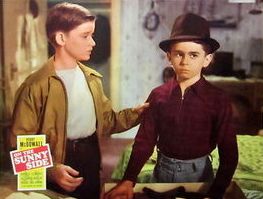
In On the Sunny Side,
Master Roddy is an English boy sent to live with a family in the United States
for the duration of the war. In the
company of a group of other child evacuees, all traveling without their
parents, he arrives on a ship to New York, bound for the Midwest home of
husband and wife Donald Douglas and Katharine Alexander, and their boy played
by Freddie Mercer, who is nearly the same age as Roddy. Their parents were acquainted from a previous
trip to England, good enough friends to be trusted with the care of their child. His father is an RAF officer, and his mother
is played by Jill Esmond, who also played his mum in The Pied Piper. Jane Darwell is their housekeeper.

Much of the story is a fairly routine plot of a boy in
strange surroundings who makes friends and becomes part of the
family/community. Freddie Mercer lets
Roddy into his gang, which, with a clubhouse in the woods that is an old
abandoned bus, seems a lot like the kids from the Our Gang series, but less
scruffy, and not as funny. Indeed, they
are a rather serious and doleful group of youngsters, but the grownups writing
and producing this story are perhaps projecting their own seriousness on the
nice American squeaky clean world they’ve set up for the kids. But, like the Our Gang kids, they even have a
bully to fear: Stanley Clements, whose tough wise-guy talk made him the leader
of the pack in Going My Way (1945)
and in future Bowery Boys films. Ann Todd plays a classmate who, like most
of the girls in the class, fancies gallant Roddy. A guy with an English accent can really clean
up in this town.

The climax occurs when Freddie gets fed up with everybody’s
fussing over the new kid, so much so that he becomes jealous and wants to run
away from home. Freddie, who came to
Hollywood on his singing talents as a noted symphony and choir soloist, also
had a bit part in Going My Way. Here he’s funny as he sputters about the
tea-drinking English kid ruining his life, but he draws our sympathy, and
Roddy’s.
Though the grownups are firmly in charge, the story is
really presented from the viewpoint of the kids, and they have the most screen
time. Though we might wish for a deeper
story less focused on report cards, bullies, and gosh-gee-whiz dialogue, it is
true that the prosaic troubles faced by the kids in the story really do reflect
what’s important to children. The adults
may be reading the war headlines, but the kids—at least in the U.S.—are more
driven by the realities of their world of making friends, doing chores, and
worrying about what others think of them.
We might note that the boys’ teaming up and eventually conquering the
bully is a parallel to the U.S. and Britain teaming up to fight the fascists.
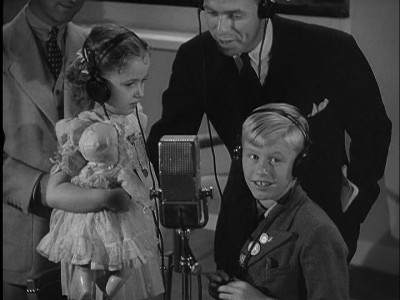
The movie does give us a few quite poignant scenes that hit
on the broader crisis: The British kids on board ship, gathering at the rail to
watch the Statue of Liberty slide by as they enter New York. Roddy’s panic and nightmares when he hears a
police siren, as it reminds him of the air raid sirens and emergency vehicles
of the Blitz back home. Most especially,
the scene where a group of British kids are gathered in a New York radio
studio, Roddy among them, to speak to their parents in a London studio via
short wave. The anxiety on the faces of
the separate shots of kids and parents, their hesitancy to be too personal on
the radio, their brave front of trying to give cheerful messages, and the cruel
brevity of the time they are allowed create an image of both tenderness and
anguish. Tears are fought back. Roddy, who even from a very young age was so
good working before a camera, shows a myriad of feelings with the just the
slight flickering of expressions on his face, in his lovely dark eyes. He is nervous, then he warms up and excitedly
tells his mother about his new life and friends, comically using American
expressions he has learned that he must translate to her. When his time is up, he realizes he has
forgotten to use the notes he made beforehand of all the things he really
wanted to say.
The evacuation of children from the London area had them
seeking refuge in other parts of the U.K., in many dominion nations, including
Canada, and also in the U.S., and involved children of every class. Vera Brittain, noted British writer whose
memoir of World War I, Testament of Youth,
perhaps is more well known, at least in this country, than her other works,
sent her two children away from their London home to stay with friends in
Minnesota during the war. Her son John
was twelve at the time, the age of the boys in On the Sunny Side, and her daughter Shirley (a future member of Parliament),
was not quite ten years old.
In excerpts from her diary, published as Wartime Chronicle – Vera Brittain’s Diary1939-1945, Brittain notes that the decision to send her children was a
difficult one, “There seemed no right decision to be made, whichever course I
took would involve bitter regrets.”
Her children left from Liverpool after Dunkirk, just missing
the start of the Blitzkrieg and bombing of London by a matter of weeks. They remained in the U.S. for three years,
coming home, separately, in 1943. She
writes in her diary of the anguish of not receiving letters, then receiving
them and learning her son has grown taller than she, and they are changing,
experiencing new adventures in summer camp and in school where the curriculum
is different. Missing birthdays and
Christmas. At one point, Vera Brittain
notes that her husband urged her to go to the movies to take her mind off their
troubles.
“G. persuaded me to go to the new Disney film Dumbo, but it depressed me very much by
reminding me of the children.”
Her children became teenagers while they were away. Their mother drilling in firefighting
practice to help after the bombing raids.
“One of the odd incongruities of this war to think that John—who must
now be a fairly vigorous boy on the verge of 15—is safely in America while his
middle-aged mother scrambles round in trousers fighting fires (or learning to).”
She remarks of her son’s return, “I did not recognize him,
but it will take time to get to know him again.” Her daughter arrived home, after a delay in
the Atlantic due to perilous naval battle action, near the end of the
year. (Brittain’s husband, who was a
university lecturer, had traveled to the U.S. for a part-year post and on
returning, was on a ship that was actually torpedoed. Twenty died, but he and some others made it
to lifeboats and were afterwards picked up by a freighter and returned to
England.)
When the family was reunited, a visit to Grandmother brings
a comic conclusion to the adventure:
“Children uproarious over tea, Mother blames their manners
on America.”

The children who remained in war zones with no avenue of
safety were the subject of You, John
Jones! (1943) a short subject about ten minutes long, directed by Mervyn
LeRoy, starring James Cagney as an All-American dad who works as a supervisor
in an airplane factory during the war, and also does his bit at night as a
volunteer air raid warden. Ann Sothern
plays his wife, and their daughter is Margaret O’Brien. When he arrives home from work, little
Margaret is practicing her speech for an elocution contest, soberly delivering
President Abraham Lincoln’s Gettysburg
Address while perched on the living room window seat. There are politicians who can’t deliver a
speech as well as Margaret. Perhaps they
never “stumped” on a window seat.

Cagney leaves for his night watch, dressed in his trench
coat with the Civil Defense armband and his helmet. He sits on a park bench for a little plane
spotting and considers how lucky he is to be living in a land where he is not
likely to see an enemy bomber tonight.
The omniscient narrator, presumably his conscience, and ours, addresses
Cagney (or John Jones), reminding him that if they were in other lands, his
little Margaret, “Your baby, John
Jones, your baby!” would be in
danger.

Then we have a montage of scenes of Margaret as an English
girl in the Blitz; as a Greek girl, her leg amputated, trudging with an amputation
along a line of refugees; of a girl from Yugoslavia sobbing over a dead mother;
from “Australasia” – quite a stunning image of Margaret looking hollow-eyed and
shell shocked, then as the camera pans back, we see she is a prisoner of war
behind barbed wire. Margaret, as a
Russian girl, lies dead in the ruins of a bombed out house.

To perhaps remind us not only of our good fortune in being
spared these experiences in our own country (with the exception of the
Americans of Japanese descent being held behind barbed wire in concentration
camps), we are reminded, too, of the debt we owe our allies who are carrying
the brunt of the war. The narrator
remarks, “If conquered people collaborated, your side couldn’t win this cruel
war—did I say your side? Our
side.”

Then an attack occurs, but Cagney realizes it is only a dream. (Sleeping on duty!) He returns home, and Margaret finishes her
speech with earnest, one may say almost fanatical delivery. You can have a look at You, John Jones! here.
Kids here in the U.S. may have largely been spared the
scenes little Margaret faced, but they were not without trauma caused by the
war. Come back next Thursday when we
discuss the March of Time documentary Youth
in Crisis (1943), and the Youth Runs
Wild (1944) starring Bonita Granville.
**********
Wartime Chronicle - Vera Brittain's Diary 1939-1945, eds. Alan Bishop & Y. Aleksandra Bennett, Victor Gollancz Ltd, 1989.
*********************
The audio book for Ann Blyth: Actress. Singer. Star. is now for sale on Audible.com, and on Amazon and iTunes.
The audio book for Ann Blyth: Actress. Singer. Star. is now for sale on Audible.com, and on Amazon and iTunes.

Also in paperback and eBook from Amazon, CreateSpace, and my Etsy shop: LynchTwinsPublishing.


