IMPRISON TRAITOR, PEDOPHILE, AND CONVICTED FELON TRUMP.
Showing posts with label pre-Code movies. Show all posts

Thursday, November 13, 2025

Terror Aboard - 1933


T
error Aboard
(1933) is an eerie mystery that, though from the Pre-Code era, feels more like a noir film of a later period with its flashbacks and cynicism.  However, we have Charles Ruggles in a comedy relief role to break the omnipresent gloom, and that certainly anchors us to the Pre-Code days.


This is my entry into the Classic Movie Blog Association’s “Early Shadows and Pre-Code Horror Blogathon,” and you can find many more terrific blogs participating here.


A ship, perhaps a fishing boat, travels through murky fog, blasting its horn to warn any unseen vessel.  As the fog clears, they see a yacht a short distance away, and they sound the warning again and try to make contact, but there is no reply, and the boat seems adrift.  


Curiously, from this distance, they can see no one on board.  The captain takes a small detail of men, including the ship’s doctor, and takes a launch over to the yacht to investigate.  The camera cuts to the other side of the yacht, where a man leaps into the water, unseen.  We will get back to him later.  This post, as usual, is awash with spoilers.


As the captain and his men cautiously roam about an empty ship, one of them is clubbed from behind.  They find passengers on the boat at last—dead ones.  A woman is found lying in a hallway—frozen to death.  A man is found hanging in a cabin. The captain mutters morosely, “This is some kind of devil ship.”


Suddenly, a fire breaks out in the engine room, and they quickly retrieve the bodies they’ve found and prepare to leave the yacht.  They also find a telegram addressed to a man named Krieg that had been sent two days earlier, which reads, “grand jury indicted you for forgery and grand larceny…”  This Krieg is bankrupt, and the police are after him.


Now we drop into our first flashback.  We meet Krieg himself, a dapper middle-aged man with a trim mustache, played by John Halliday.  He owns this yacht.  


As he reads the telegram he has just received, he ponders his situation—and we are launched into a second flashback, to October 1929, when the stock market crashes and mobs run on banks, and men swarm in panic on the stock exchange floor. 


The crash of 1929 made for a dismal and sickening backdrop for movies of the Great Depression.  Just its mention, or even the image of falling stocks on a ticker tape was easily recognizable shorthand for catastrophe.  Cinematically, it need not be explained. Certainly, through the decade of the 1930s, repercussions still stung from this event. 


Mr. Halliday, natty in his yachting cap and uniform jacket, visits the ship’s radiographer, played by William Janney, who sends and receives the telegrams.  He knows Janney has seen the message, for he deciphered the Morse code.  He has a companionable chat with him, talking of wanting to live on a nearby deserted island, lays out his plans to change course for it, but Janney seems obtuse either to what might be both a bribe and a threat. He only catches on when Halliday takes out a gun.  Because the camera is cut away from the instant the gun is fired, and we see only Janney’s expression of horror, we are teased into thinking that Halliday has shot himself, committing suicide. 


Then, after a long, rather agonizing pause, Janney falls, slumping to the floor, his white uniform covered in blood.  Halliday sets the scene to make it look as if Janney committed suicide.  Then he takes the guest list of passengers.


We get to meet them one by one, and their relationship to Halliday is briefly etched.  Verree Teasdale is an older woman, the wife of his business partner, encouraging ingenue Shirley Grey in Miss Grey’s forthcoming nuptials to Mr. Halliday.  Yet Grey seems troubled, and perhaps not entirely at the age difference between them. They will marry when the yacht reaches Australia.  We soon learn that she really loves Neil Hamilton, but they had quarreled.


Miss Teasdale will have her own marital problems come to the fore, as she is pursued in an adulterous relationship with Jack LaRue.  Morgan Wallace, Teasdale’s husband, will fight with LaRue and LaRue will knife him to death with a letter opener.  This violence is, however, subtly orchestrated by Halliday.  We come to understand he wants to eliminate his passengers.  We will see his hand scratch their names off the passenger list as they die.


Complicating his plans is the late addition to the guests on board when his fiancĂ©e’s former love, played by Neil Hamilton, arrives unexpectedly by plane, which he ditches in the ocean near the yacht.  He has been tracking down Shirley Grey to reunite with her.  We see a hand add his name on the passenger list, like an additional chore on a things-to-do list. Hamilton is handsome, rugged, flies a plane, and we assume he may be better equipped to cheat death on this cruise than the other passengers, perhaps even saving Miss Grey, to boot, but they end up getting locked in the engine room.  Where a fire breaks out. “It’s all right, darling.  We’ll get out of this somehow.”

Hamilton, you may recognize as the future Commissioner Gordon on the Batman TV series in the 1960s.

There is a poisoning, a hanging, and Verree Teasdale gets locked into the ship’s meat locker, where she freezes to death, and more names are scratched out.


Charles Ruggles has a prominent role as a ship’s steward, and he is comic relief, bumbling around, playing the amiable coward, terrified by all the murder around him, clutching at lucky charms.  We might assume that he will survive because God protects bumbling clowns, at least in old movies.

The captain of the yacht, played by Stanley Fields, begins to suspect Halliday of the horrific deeds.  Meanwhile, the crew grumble among themselves, worried and wanting to escape, and finally they rush a lifeboat, but Halliday shoots them.


Then a blast from a ship’s horn in the fog, and we are immediately taken back to the present when the yacht is seen drifting at sea.  The ship pulls up alongside the yacht, and captain and crew investigate.  Halliday, we discover, lurking about, is the one who smacked the sailor on the head.  He starts the engine room fire, and he is the man whom we earlier saw leaping from the yacht into the sea to swim for it.

Against all odds, Neil Hamilton and Shirley Grey are rescued from the fire, and all are speedily removed from the burning yacht to escape to the other ship.


John Halliday, whether driven mad by his indictment over the stock collapse or whether he was just a diabolical manipulator who was determined to win at all costs, is seen at the end of the film being pursued by a shark.  Horror begets horror, but it seems as if, as with many Pre-Codes, the just desserts are not a moral indictment, but a cheap thrill to round out the final reel. 

For more fun with spooky Pre-Code ne’er do wells, have a look at these great posts at the Classic Movie Blog Association’s “Early Shadows and Pre-Code Horror Blogathon,” and you can find many more terrific blogs participating here.

Terror Aboard can currently be seen on YouTube.


  *******************************


My new non-fiction book, CHILDREN'S WARTIME ADVENTURE NOVELS - The Silent Generation's Vicarious Experience of World War II -- is now available in eBook here at Barnes & Noble, Apple, Kobo, and a wide variety of other online shops.

Or here from my Shopify store if you want to buy direct from me and avoid the big companies.

And it is here in eBook, paperback print, and hardcover, from Amazon.

It is also here in paperback from Ingram.

And here in hardcover from Ingram.

From Cherry Ames, to Meet the Malones, from Dave Dawson to Kitty Carter - Canteen Girl, the Silent Generation spent their childhood immersed in geopolitical events through the prism of their middle grade and young adult books.  From the home front to the battlefield, these books are a window on their world, and influenced their hard-working, conformity-loving generation. 


Friday, January 17, 2025

Gabriel Over the White House - 1933


Gabriel Over the White House
(1933) is an inventive fantasy and apparently, political commentary as well, that has resonance today.  What exactly the meaning or purpose of that commentary is never entirely clear, as there is a great deal of contradiction in ideals presented, and perhaps even a curious display of a lack of knowledge about civics and our political institutions.  There is no innocence about human nature, though, and this was a hallmark of Pre-Code films.  The tone of the movie is sly and sometimes hits hard.


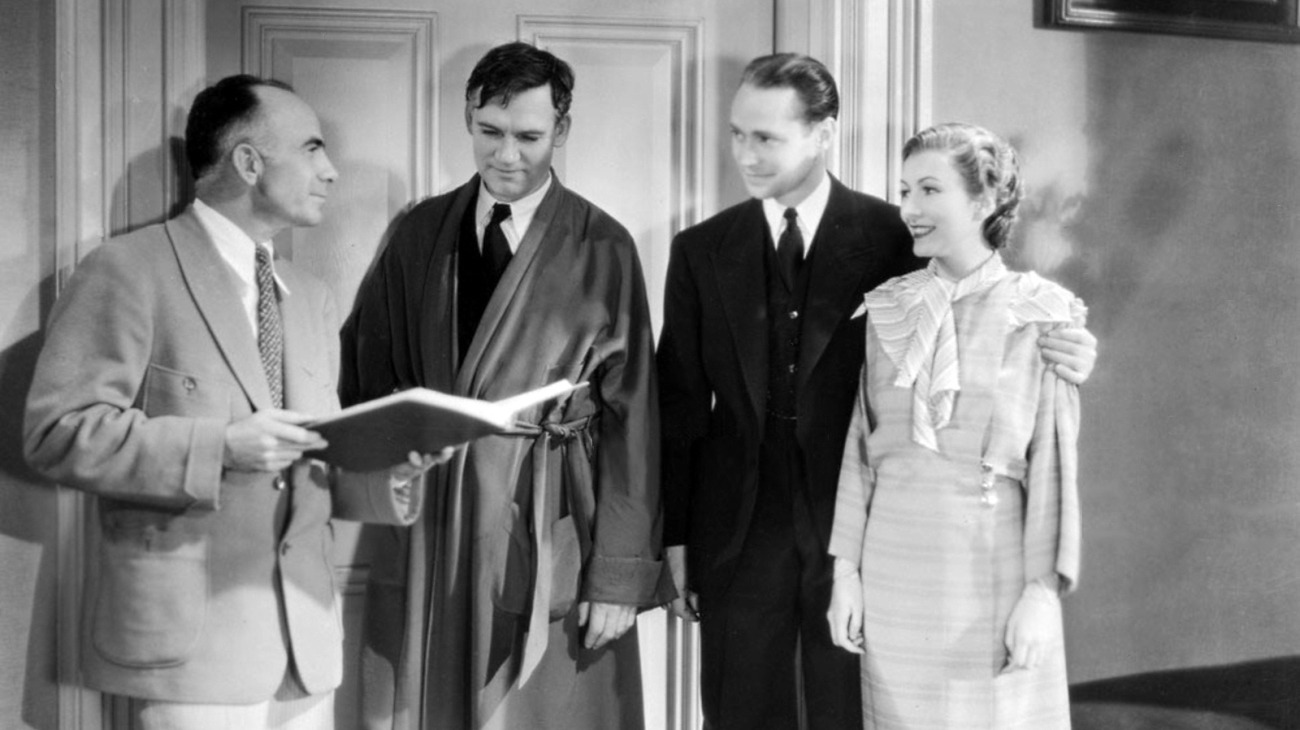
Walter Huston is splendid as the lead, a newly inaugurated president taking the helm of the government during the worst of the early Great Depression years.  He is a freewheeling bachelor, romps with his young nephew played by Dickie Moore as though he were a child himself, and when a sexy, confident, coy woman stops by the White House to see him, he keeps his door open to her and makes up a staff job for her to keep her close.  We already know, even without Franchot Tone’s knowing look, that “Pendie,” played by Karen Morely, is Mr. Huston’s mistress.  He does not trouble to hide it.


Franchot Tone plays Huston’s secretary and presumably chief of staff.  The movie treats what we know about Oval Office appointments with a vague bending of the truth, even as Huston bends the rules, and that is a script writer’s device to funnel the audience into the story he wants to tell without being bogged down by factual details.  Since the movie is frankly a fantasy, there is no need to hold to the mundane facts about actual protocol or how government really works.

But the era is faithfully depicted—if not in a real timeline of events, rather, in the feelings of desperation of a demoralized populace, in angry crowds, in hopelessness.  In such desperate times as these, Walter Huston as president does not seem to be the right man for the job.  He is self-involved, somewhat immature, gleefully corrupt and easily manipulated by special interests, and sometimes astonishingly stupid, which may be the source of his callousness.  Given the actual quill pen (which was NOT the actual pen) that Lincoln signed the Emancipation Proclamation to sign a new bill for a public works project for new sewers in Puerto Rico, Huston jokes flippantly about it, “Well, here goes for Puerto Rican garbage.”  He is coarse, but we may smile at his impishness.  On the other hand, one cannot help but think of another asinine president who threw rolls of paper towels at suffering Puerto Ricans.  He is also immature, gleefully corrupt and easily manipulated by special interests, and sometimes astonishingly stupid.

Mischa Auer plays a serious and disgusted reporter who tries to nail down the details of Huston’s platform, but there are none.  (I half expected Mr. Auer to break into a passionate verse of “Ochi Chornya,” but he’s saving that for director Gregory La Cava’s other movie, My Man Godfrey, which we discussed here.)

However, a change will soon come over the new president.  Huston rides in a short motorcade to an event, but he takes the wheel because he loves to drive himself.  Fast.  Enjoying the white-knuckled response of his Secret Service men, he floors it, trying to pull away from the rest of the staff and police escort in the car behind him, swerving on a winding country highway.  Finally, he loses control and the car flips over.  He is severely injured and near death.


He is kept in seclusion by his doctor for many days, and the public is kept in the dark about the nature of his injuries or details of the accident.  There is some worry about who will take over the reins of government—seemingly unaware that that is precisely why we have vice presidents.


Finally, Huston comes out of his coma—but he is a changed man.  Now serious, now intelligent, now with a sense of purpose.  Franchot Tone and Karen Morely see the change, and notice something supernatural about it.  Huston has been visited by the Angel Gabriel, who is now pulling the strings in Huston’s brain.


Restored to more vigor than he had before, Huston sets about curing the Depression, first by addressing a group of protestors—not unlike the Bonus Army, whose camp was burned out and members shot by Douglas MacArthur’s troops under President Herbert Hoover.

Then he single-handedly repeals the Eighteenth Amendment, getting rid of Prohibition, just as Congress would do under President Franklin D. Roosevelt, but he also establishes government liquor stores to drive out the gangster bootleggers, who bomb the stores.  C. Henry Gordon (in one of an astonishing fourteen movies that year) is compelling as the smooth, sinister mobster in a few devilishly sneering closeups.  Huston fires his cabinet, gets rid of Congress, declares martial law, and has the mobsters shot by firing squad.


In his address, Huston declares that he is a dictator based on Thomas Jefferson’s ideas of democracy.  Here is obviously one of the ridiculous twists in logic, but Huston would not be the first politician, real or fake, then or now, to claim that his fascist intentions would have been applauded by the Founding Fathers. 

Franchot Tone and Karen Morely, meantime, have become romantically involved, but they need not worry about offending Huston.  He has bigger fish to fry, and the Angel Gabriel keeps him pretty busy.   Miss Morely is shot by racketeers, but recovers and Huston blesses their union.


Another bizarre and even troubling move by Huston is when he brings the world powers together during a radio broadcast to demonstrate his new military service—the United States Navy of the Air.  He will move for disarmament of former weapons, but will put billions into the military of the future, which apparently is going to be biplanes, whose pilots will pull a lever and drop a bomb on an enemy ship.  Huston arranges a demonstration, and bullies the foreign governments into paying their World War loans and reparations and promise not to rearm because if they do, we will fly biplanes over them and pull a lever and drop a bomb. 

He tells them and the radio microphones, “The next war will be the story of the failure of antiquated weapons and antiquated myths, of the horrifying destructiveness of the modern agencies of modern arms.  Armies and navies will be destroyed from the air.  And as these planes destroy armies and navies, they will destroy cities, they will destroy populations…the next war will depopulate the earth…invisible gasses, inconceivably devasting explosives.”  Well, he got that right, in part at least. The foreign leaders hurriedly agree to his Washington Covenant.

Now that the important work is done, the Angel Gabriel passes over Huston as in a shadow, and Huston dies.


Even more interesting than the twisting logic of this film, are the sometimes conflicting stories about it.  We know it had its genesis in a novel, but producer Walter Wanger, Democrat and Roosevelt supporter, brought the story to M-G-M head Louis B. Mayer, staunch Republican, under Wanger’s production company owned by newspaper magnate William Randolph Hearst.  Hearst began his unsuccessful political career, including a failed bid for the presidency in 1904, as a Democrat, but as the years rolled by he became more conservative and isolationist, who supported Hitler and the Nazi Party.  Though he was an early Roosevelt supporter, he went to the dark side after 1934 and became his enemy.  We all know he was the prototype for Charles Foster Kane of Orson Welles’ Citizen Kane (1940), but that’s another story.  It is reported that Mr. Mayer held the movie back until after Roosevelt’s inauguration, hoping to pin the stain of fascism on him, rather than on Hoover, as if the story is an examination of the current sitting president.

The political affiliations of these men have a lot to do with any discussion of Gabriel Over the White House today, and because production began during the Hoover administration, but was released just weeks after Roosevelt came into office, what is the message of the film?  Who is the finger of fascism being pointed at—the Democrats or the Republicans, and is dictatorial powers in an American President considered fascism at all, or is it merely what Thomas Jefferson would have liked and what the American people secretly want all along?  Was the film an effort to ingratiate fascism with the American people?  We know only that the movie disappeared quickly enough when by the mid 1930s, fascism appeared to be a clear and present danger at home and abroad.  There were no nice guy dictators.

We are living now in far more dangerous times, and the plot points or message—if there really is any message at all—in Gabriel Over the White House seem innocent in their supposing, though intriguing, and the finger-pointing at what it all means is irrelevant.  What it is, is fantasy in its purest form.  Any good story, fantasy or not, begins with “what if?” and this is a freedom of thought we should celebrate. 

What I admire about many films of the 1930s is the courageous introspection into their own contemporary times, warts and all, and experimenting with different ways of storytelling to do that. The escapist musicals have, I think, sometimes received the lion’s share of attention when movies of the 1930s are recalled as “getting us through the Depression.”  The black-and-white gritty and even grim films of the Dirty Thirties have special historical value, and in their own way, they got us through the Depression, too.

As much as I can this year, I’d like to examine more films of the 1930s that unselfconsciously illustrate their own times. 

*******************************


My new non-fiction book, CHILDREN'S WARTIME ADVENTURE NOVELS - The Silent Generation's Vicarious Experience of World War II -- is now available in eBook here at Barnes & Noble, Apple, Kobo, and a wide variety of other online shops.

Or here from my Shopify store if you want to buy direct from me and avoid the big companies.

And it is here in eBook, paperback print, and hardcover, from Amazon.

From Cherry Ames, to Meet the Malones, from Dave Dawson to Kitty Carter - Canteen Girl, the Silent Generation spent their childhood immersed in geopolitical events through the prism of their middle grade and young adult books.  From the home front to the battlefield, these books are a window on their world, and influenced their hard-working, conformity-loving generation.


Thursday, October 18, 2007

Night Nurse (1931)

One of the most interesting aspects of pre-Code daring in “Night Nurse” (1931) involves not the many scenes of Barbara Stanwyck and Joan Blondell undressing before us, which happens so much it gets to be routine, but rather the film’s treatment of the medical profession.

Barbara Stanwyck plays a nursing school student, who befriends fellow nurse Joan Blondell, endures the leering of interns, and helps a bootlegger patient by not reporting his bullet wound to the police. At first she insists she must, and asks him why she shouldn’t.

“For the same reason you don’t squeal about half the raw work you see done here,” he replies. It is the first indication we are given that the medical profession is not all squeaky clean, and Miss Stanwyck, bristling, defends her profession, “We have professional ethics.” She insists, “The things my profession keeps quiet about we believe is for the public’s own good.”

This young neophyte proudly recites her Florence Nightingale Pledge upon graduation, while Joan Blondell blankly chews her gum, and is released to the world as an idealistic and scrappy nurse, for “fifty-six bucks a week.”

Stanwyck’s job upon graduation is as a night nurse to two ill children whose drunken socialite mother and her evil chauffeur are slowly starving them to the death to get their trust fund. Complicit in this attempted act of murder is the children’s own doctor. Miss Stanwyck, suspicious of the children’s care, gets smacked around some by Nick the Chauffer, played with sexy vigor by Clark Gable in one of his first roles.

She complains to Dr. Ranger about Nick and about the kid’s cruel diet. Dr. Ranger, played by Ralf Harolde, is a bad doctor and a bad man, with a bad facial tic, which may insinuate even more evil about him. He arrogantly accuses Miss Stanwyck of blackmail and medical ignorance, and that worst crime a young woman and a young nurse can commit, that she has forgotten her place.

“You’ve picked up a lot of half-baked medical knowledge around the hospital. All nurses do,” he barks. A surprising and nasty indictment of the medical profession of the day, but Miss Stanwyck, though insulted, is not intimated. She intends to be a whistleblower, but her mentor, kindly Dr. Bell, played by Charles Winninger, talks her out of it. When she tells him of Dr. Ranger’s malpractice of the helpless children in her care, Dr. Bell only backpedals, “You know I can’t interfere in another doctor’s case.”

This is a sad comment on the medical profession if poor medical care cannot be taken to task. One wonders if the audience of the day were shocked by this or merely exchanged knowing smirks of agreement at something that they felt always had been and always would be.

But Miss Stanwyck’s character, Laura Hart, is having none of it. “Ethics, ethics, ethics, that’s all I’ve heard since I’ve been in this business. Isn’t there any humanity in it?”

Dr. Bell smokes a cigarette as he tries to both reason with her and disengage himself from the uncomfortable prospect of having to see faults in another physician. However, he encourages her to return to her case and say nothing, and get enough evidence to trap all those who want to harm the children, Dr. Ranger included.

Stanwyck does this, and when she meekly bows to Dr. Ranger’s authority, the pompous fiend condescendingly instructs her, “A successful nurse is the one who keeps her mouth shut.” She obeys, and gets back to the kids.

Eventually, after some tense scenes with the sick kids and the threatening Nick as the little Nanny Ritchey, played by Marcia Mae Jones, becomes unconscious from her anemia, Dr. Bell is strong-armed on the scene by her old pal the bootlegger and performs a blood transfusion from Miss Stanwyck, whose type is “4A” to the little child. Dr. Bell tells her he will go to bat for her with the police, and she announces with relief that he is “swell.”

He is swell, Dr. Bell, and a bit more like the doctors we would come to know after the Code made such grim and grotesque portraits of the medical profession no longer allowable. The squeaky clean Dr. Kildare was in the vanguard of an army of kindly doctors. They brought us comfort. More then curing, they told us nothing was wrong.

It wasn’t really true, then or now. What was true then, and now, is the genuine rage expressed by Miss Stanwyck’s character that some in the revered medical profession did not deserve the reverence that we desperately wanted and needed to bestow.

It cannot be an accurate portrait of less advanced medical care at the time, but just phony movie drama that makes a doctor in the operation in which Stanwyck participates early in the film call for oxygen only when the patient is near death, and puts his ear on the patient’s chest, instead of using a stethoscope to ascertain whether the patient is still alive. Milk baths for anemia? Medical malpractice to include deliberate murder, as well as the medical innocence of the film, rather than the daring pre-Code titillation, is what is most shocking about “Night Nurse.”

Thursday, April 12, 2007

Forbidden (1932)

The three leads, the snappy dialogue by Jo Swerling, and impeccable direction by Frank Capra make “Forbidden” (1932) one of the most interesting films of the pre-Code era. Daring for the time, it is melodramatic without being simpering. The story of a woman who has a decades-long affair with a married man, bears his child and eventually gives their daughter to him and his wife to raise could be a soppy moralistic mess, but Barbara Stanwyck, Aldophe Menjou, and Ralph Bellamy make their characters believable, equally decent and imperfect.

Stanwyck is introduced to us as an “old maid,” the victim of condescending town gossip. She blows up, declaring she would like to “set fire to the whole town and play a ukulele while it burns.” She has no real big dreams, only wants life on her own terms.

Menjou plays her married lover. Their scenes are delightfully playful, and Stanwyck forms that intense bond with her principle partner that she seems to do in many of her films. Even though she will later marry Bellamy’s character, there is a thin psychological barrier she creates between them, never letting us forget who it is she really loves.

Bellamy is the newspaper reporter who hounds Menjou throughout his political career. Sometimes labeled as a portrayer of somewhat boring character roles, this role really shows his range. He is charming, pushy, intelligent, a little bit obnoxious, and fascinating to watch for the danger he unknowingly represents to Stanwyck.

Stanwyck’s fallen woman is multi-dimensional, and her ability to play a scene on so many emotional levels is especially evident in this film. The look on her stunned face as the society ladies and Menjou’s wife fuss over the child she has given up, shows she is only just realizing the mistake she has made.

Years later, when Menjou, sickened by living a lie, wants to confess their relationship to his wife and to the public, Stanwyck heads him off by breaking up and marrying Bellamy. In an electrifying scene over a cozy dinner table, Bellamy puts before her the documented proof he has of her affair with Menjou. He is calculating, but he is not just a newshound out to ruin a politician. Angry and hurt, he has become a jealous husband. A few moments later, after he pushes her away and bloodies her face, she shoots him, and continues to fire into his already dead body, and burns the documents. Capra has constructed a masterful scene. Stanwyck, still holding the gun, stands trembling in shock, her expressionless eyes riveted to the fire, as we hear Menjou making his acceptance speech on the radio for the governor’s race, and the police pounding at the door.

Even her last sacrifice in the film, when she destroys the dying Menjou’s written confession and naming her as a beneficiary in his will, we see Stanwyck not really as a noble, selfless woman, but as a person who aches to control her own life. She is the same willful woman who stomped out of her library job years before. When the camera pulls back, we see her walk the city streets and we lose her in the crowd. In fact, we may not even know her any better than we did at the beginning of the film. The movie comes to its conclusion, yet you still find yourself wondering what could happen next.

That’s all for this week. See you Monday.

Related Products