IMPRISON TRAITOR, PEDOPHILE, AND CONVICTED FELON TRUMP.
Showing posts with label Billy Wilder. Show all posts

Thursday, December 1, 2011

Uneasy Victors - PT 2 - "A Foreign Affair" - 1948


“A Foreign Affair” (1948) is a broad send-up of American moral hypocrisy, but Jean Arthur turns it into a valentine for American sentimentality. The film is a biting accusation of German duplicity, but alluring Marlene Dietrich dares us to judge. Billy Wilder, whose cynical view peppers each scene with bold satire, still finds himself forgiving the weaker morally ambiguous Berliners for allowing the stronger and far more evil Nazis to ruin the place.

It can’t have been easy for him. In his biography of Billy Wilder, “On Sunset Boulevard - The Life and Times of Billy Wilder” (Hyperion, NY, 1998), author Ed Sikov notes that while watching footage of bombed out ruins in Berlin, after someone remarked that he could not help but feel sorry for the Germans, Wilder, “…jumped to his feet and yelled, ‘To hell with those bastards! They burned most of my family in their damned ovens! I hope they burn in hell!” (p. 272).

In our intro to this series on Uneasy Victors, posted here, we outlined the three films we’re tackling to discuss America’s post-World War II involvement in Occupied Germany. Next week we cover “The Big Lift” (1950) and “Judgment at Nuremberg” (1961).

I’m going to tread lightly on the plots of these three movies and concentrate on the images used so evocatively. The images and stories were current events when these films were made, no deep explanation was required. For background, one needed only to look at the front page of a newspaper.

“A Foreign Affair” brings prudish congresswoman Jean Arthur to Berlin on a fact-finding mission to investigate the morale of American service troops stationed in Occupied Germany. The end “E” in morale gets dropped and the question for Jean Arthur is reduced to what is “moral”.

She encounters John Lund, an Army captain with working in the de-Nazification office. His job is to examine the credibility of German civilians of being complicit in the former regime that was responsible for starting the war and the murder of millions. He must recommend them for further investigation, punishment, or rehabilitation. On those that are judged to be clean, he gets to stamp an APPROVED on their foreheads, and absolve them of further suspicion. His clients range from the precocious little boy who draws swastikas over everything with a piece of chalk, to Marlene Dietrich. He lets the kid off with a warning to his father. He APPROVES Dietrich in a big way.

John Lund has probably his best role here. He is handsome, worldly and he is a scamp. He carries on an illicit, mutually beneficial relationship with cabaret singer Marlene Dietrich. He brings her stockings and she gives him sex. He trades a birthday cake Jean Arthur ferried across the ocean as a gift from one of his old girlfriends, selling it on the black market to buy a mattress for Marlene. Never was a gift less subtle.

Director Billy Wilder shows his cynicism and his delightfully naughty side in this movie. And it is a marvel he could temper the above noted rage against the German people with an affinity for them. He was, after all, a resident of this city himself at one time back in the ‘20s when it was decadent but entirely free.

So was Dietrich a Berliner. They met here years ago. They knew their own people.

Wilder has been accused at points in his career of being something of a misogynist, showing women in a demeaning light, sexualized or mocked. Some critics took umbrage with “A Foreign Affair” for what they felt was shabby treatment of Jean Arthur, that she was brutalized by being shown in such an unflattering manner. She was dressed and coifed with a severe appearance, and her jingoistic response to how are things back in Iowa, “still 62 percent Republican, thank you” sound as if he is chastising her for being one of the so-called American moral majority and making a fool of her for looking for sin in Berlin.

While I agree that Wilder does his best to show the character of Congresswoman Frost as a comic foil, nevertheless I disagree that he used Jean Arthur in a bad way. You have only to look at Jean Arthur in this movie to see how much fun she’s having.

Just her opening scene when the congressional committee flies over the ruins of Berlin. She is making notes, and when her attention is called by the others to look out the window at their vantage point, she takes her time, meticulous in removing her reading glasses and putting them away. Screwing the cap on her fountain pen and tucking it away. Zipping, snapping, and buckling pockets of courier bag and attache. The suspense of her thorough routine builds and becomes enormously funny, as funny as a Buster Keaton slide down a mountain, but she’s just sitting there putting her stuff away.

This is a lady who knows how to control a scene.

There are many opportunities for her to take the ball and run with it. When she’s picked up by two GIs on a bicycle-built-for-two and turn it into an impromptu bicycle built for three, and most spectacularly when she sings the “Iowa Corn Song” in the cabaret (the scene is below). There is nothing Jean Arthur enjoyed more than absurdity. She saw that in this character and in this movie, and she goes to town. That that town happens to be Berlin is the perfect irony and palette for Wilder’s story.

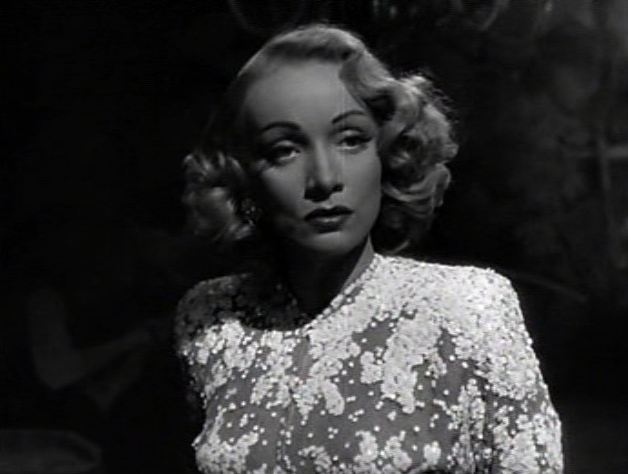
Marlene Dietrich is a rival romantically, but also politically. Miss Dietrich shines in this role. Her cabaret singer is world-weary, street smart, sexy of course, and most of all a survivor. She needs to be a survivor to live in a nearly demolished Berlin with the old regime gone and the new regime questioning her Nazi past and her licentious present.

We see Dietrich’s run-down bombed-out apartment. When we first see her she is in the most unglamorous position of brushing her teeth. She spits her mouthful at Lund and he grabs her and wipes his face on her hair. We see there is no tenderness to their relationship; that it is all business for her, and that his desire for her is accompanied by his contempt. She plays the role of the kitten as long as she’s getting presents. They are using each other, they both know and are both happy with the arrangement.

At the cabaret Dietrich sings about “the ruins of Berlin” and she is dolled up to the nines looking glamorous and svelte and utterly in command. The smoky room is full of civilians on a night out, American servicemen and jolly Russian servicemen who all mix with equanimity.

This is before the Russian blockade of Berlin and so the Russians are not viewed as the enemy yet. We are in the last days before the Cold War. They are shown, these actual conquerors of Berlin, as silly, playful, childlike comrades who sings songs and in a moment of jubilation grab a person from the crowd and throw him into the air like some college football rally. One Russian soldier is delighted when he is sold a Mickey Mouse watch by an American soldier on the black market. He can barely contain his excitement.

This is counterbalanced by Dietrich’s chilling remark, “What do you think it was like to be a woman in this town when the Russians first swept in?”  This is Wilder's restrained reference to the fact that tens of thousands of female Berliners were raped by Soviet soldiers.

And her deft mockery of America's untouchable superiority, “Wash your hands. Wash your lips. You’ve got so much soap in the United States.”

Millard Mitchell is the wry colonel who oversees Jean Arthur’s congressional visit and oversees John Lund’s mission to de-Nazify the Berlin population. But he knows something that John Lund does not. He knows that Marlene Dietrich was the consort of Nazi officials during the war, and moved in high circles. When Lund is eventually shown a newsreel of her partying with Hitler, he is sickened. Millard Mitchell also knows that there is a high-ranking Nazi official, a former lover of Marlene Dietrich, who was in hiding, but can be drawn out into the open by using Dietrich as a decoy.

John Lund is the epitome of the American problems in Berlin, a metaphor for our conflicted attitudes. On the one hand he has a duty to perform. He must stand back objectively and judge these people. On the other hand he wants to let bygones be bygones. And get what he can for himself.

The songs Marlene sings, about “lovely illusions” and the black market, and the ruins of Berlin, are presented like a good stage musical. They are not sung for diversion; rather they further the plot and tell the back story. Never was music employed in a non-musical in such an intelligent fashion. That’s Friedrich Hollaender at the piano, who wrote these songs and was Dietrich’s long-time accompanist and composer.

Billy Wilder walks a fine line in this movie and walks it very well. There is much cynicism, much political and social accusation against American hypocrisy, and in fact this movie was condemned on the floor the House of Representatives for its satirical treatment of Congress. The military complained because it showed them in a less than flattering light. But it is satire and is meant to hold a mirror up to ourselves.

We can tell who the liberals are among the congressmen and who are the conservatives: debate on the plane about giving the starving a loaf of bread, “that’s democracy”, but if you leave the wrapper on - i.e., let them know it’s from the Good Old USA - “that’s imperialism.” We have discussion of “dollar diplomacy”, about labor versus industry that still resonates today. We are about to leave a decade-long military involvement in Iraq, with reductions of troops as well in Afghanistan. These issues raised in Occupied Germany are still with us.

Congresswoman Jean Arthur icily rebukes Dietrich: “We increased our national debt by some 350 billion dollars to win this war. I would regard it as a waste of money if we didn’t eliminate types like you.”

How timely is that? We Americans have always demanded a return on our investment.

Conversely, we are reminded of the horrific regime that ruled here when Millard Mitchell takes the congressional committee, and us, on a Jeep ride with rear-screen projection of the Reichstag, and the Brandenburg Gate, and always sobering devastation of the ruins.

Dietrich tells Arthur, “Let’s go to my apartment. It’s only a few ruins away from here.”

Wilder softened the political edge by adding silly comedy that also works as a wonderful metaphor in this movie.

Both Wilder and Dietrich were hard, cynical people who came of age in a hard and cynical Berlin. They came to America and made their careers in a United States that was and always probably will be remain unabashedly sentimental. We are a nation addicted to happy endings. Neither Wilder nor Dietrich seemed entirely comfortable with wide-eyed optimism.

Millard Mitchell brings the congressional committee to watch German kids playing sandlot baseball taught to them by American soldiers. Mitchell remarks that a local family “has already christened a kid DiMaggio Schultz. That’s when I started believing we really won the war.”

Mitchell is a kind of narrator, a Greek chorus to the story, reminding us of American good intentions that must certainly soften things for Wilder if not for the message of the movie:

“When we moved into Berlin, we found open graves and closed hearts.”

“We’ve tried to make them free men and give them some dignity.”

Added to the soup is the ingredient of American sentimentality, and that is Jean Arthur who does it better than anybody else. Yes, she is foolish. But she is also resilient and strong and brings a sense of hope to the proceedings. She is the American that the Europeans love to mock, but whom they inevitably look to as an example of success. They see her derisively, and enviously, as being in her own protective little world and nothing can really hurt her. Almost nothing.

When John Lund, trying to throw her off her investigation, begins to woo her as a diversion, she falls for him. Jean Arthur has several excellent scenes. First there is a scene in the file room where she talks about a former beau, a fellow member of Congress from the South, and when she talks about her memory of him, her chirpy voice becomes slow and soft and gentle almost with a slight hint of the southern accent. There is a sad, lovely wistfulness to her behind the officious façade she presents.

But the façade is riot. She tells fellow Iowan John Lund news from back home, “We had the lowest juvenile delinquency rate in the country until two months ago. A little boy in Des Moines took a blow torch to his grandmother…We fell clear down to 16th place. It was humiliating.”

And she notes that Main Street had its name changed to Iwo Jima Boulevard -- the kind of memorializing that happened all over the US, which Wilder mocks with his crisp script and Miss Arthur’s incomparable delivery.

“You’re so naïve, you Americans,” Marlene teases John Lund.

“So we are. What of it?”

Lund, despite himself, begins to have feelings for Jean Arthur. He doesn’t fall head over heels - such violent passion might be too much for Wilder - but he grows protective of her. There is the sweet scene when she comes down a long staircase in a too large dress she bought on the black market, (Et tu, Congresswoman Frost?), when he is to take her out on a date.

“I look just awful. It’s like a circus tent in mourning for an elephant that died.” Her trademark running a fine line between humor and pathos. Nobody does it better.

Lund fixes the dress for her, adjusting the bodice and pinning it in the back with expert fashion sense, and then wipes the excess lipstick from her mouth with his handkerchief, and then swipes an ornate table covering for her shawl. He’s like all the mice in Cinderella helping her to get ready for her night on the town.

And what a night it is.

Her political sparring with Marlene is matched by her becoming a romantic rival for John Lund’s affections. Dietrich is wonderfully bold with Jean Arthur, caging the hostility she feels for this sanctimonious American with sleek, sophisticated sarcasm. She criticizes Arthur’s appearance, and with audacity at their first meeting, notes, “Perhaps if you would change the line of your eyebrows a bit,” as she slowly swipes her door key she has tossed out into the street for Lund, as a pointer, tracing Arthur’s brow with it. The gesture is sultry and brazen.

Later, she will attempt to humiliate Jean Arthur by encouraging her to sing in front of the cabaret audience. Arthur is reticent, but she’s also a bit tipsy, and belts out her old campaign song, the “Iowa Corn Song”.


I think it was Katharine Hepburn who was said that acting is like standing up naked and turning around very slowly.

Jean Arthur’s “Iowa Corn Song” rendition is like naked comedy.

She is pathetically awful, disarmingly hilarious, and ultimately endearing. She really gives it the old college try like nobody’s business. Have a look at the scene here, beginning at 8:06. Please remember to scroll down to the bottom of the page first and mute the music so you can hear the video.


There is no reason, ever, to doubt Jean Arthur’s superior acting ability, but if you did, just compare this performance with her next film role, “Shane” which we discussed here. Night and day. You wouldn’t know it was the same woman. She really had remarkable range.

This goofy gal changes yet again later on in the evening to a bitter, and emotionally violated woman. Dietrich, who first does her a favor by getting her out of trouble when the cabaret is raided by police, mercilessly sets her up, letting Jean observe from the shadows Dietrich’s true relationship with Lund.

Dietrich’s triumph over Jean is complete. “Four hours ago you were in a position to have him court martialed and send me to a labor camp. Not now. Not anymore. You’re one of us, now.”

The hostility between Marlene Dietrich’s and Jean Arthur’s characters is a driving force in this movie. The magnetism of these two actresses makes their face-offs fascinating and almost sensual, where in the hands of two other actresses the scenes might only be shrill and without depth. There is great power to their scenes together, and I think this is due more to their unique talents as actresses, rather than the fact that they disliked each other in real life.

Which they did.

Jean Arthur’s famous insecurity made working with Dietrich, who could be openly derisive to others and had industrial-strength self confidence, a nightmare. According to author Kevin Lally, Dietrich called Arthur, "That ugly woman with that terrible twang."  Dietrich also disliked John Lund. She got along with Wilder, with whom she shared many conversations in her dressing room in German about the Berlin of the old days, but even Wilder got on her bad side when he insisted she perform the scene where she parties with the Hitler look-alike.

Dietrich was openly anti-Nazi, and had won America’s Medal of Freedom for her efforts entertaining the troops during World War II. She may have reveled playing a hardened chanteuse, but being seen hanging on “Hitler’s” arm was too much for her.  Both Berliner and naturalized American, she may be the ultimate metaphor in this film for the conflicted emotions of the uneasy victor.

Jean Arthur was almost paranoid in her jealousy of Wilder’s attention to Dietrich, and perhaps in a moment of one-upmanship, insisted that she perform her own stunt when Congresswoman Frost is shown to be tossed into the air by the jolly, drunken Russian soldiers after her song at the cabaret. That’s really Jean Arthur you see getting chucked into the air.

According to the biography on Billy Wilder, “Wilder Times - The Life of Billy Wilder” (Henry Holt and Company, NY, 1996), author Kevin Lally notes that after the take was shot, “Arthur threw back her head and gave the director a piercing look. ‘What will you require next from me, Mr. Wilder?’” The crew and extras applauded her.

For his part, Billy Wilder was exasperated with one actress who constantly looked at herself in the mirror - Dietrich, and one who self-consciously refused to look in a mirror at all - Arthur.

It is interesting to compare the two women in real life. They were born about a year apart, and died about a year apart. Arthur hated stardom and avoided it. Dietrich craved stardom and worked harder on her screen image than her acting. Just before this film was made, Jean Arthur was attending college in the Midwest. She had left Hollywood after her Oscar-nominated role in “The More the Merrier” which we discussed here, to pursue university studies. I can’t think of any other actress, particularly at the top of her game and earning power, who would do this.

But she left school to do this film which she must have realized was a golden opportunity and possibly one of her last, to do screwball comedy.

Dietrich was fighting time as well. She had just become a grandmother, which according to her daughter, she did not like at all. She turned her career to real-life cabaret work and was a success, the irony being she really did not sing well. Jean Arthur, for all her foolishness during the “Iowa Corn Song” routine, had no less singing range than Dietrich.

But Dietrich had that powerful stage personality she created from girlhood, it was her bastion, and bread and butter. 

Until old age took it from her. In their senior years, Jean Arthur returned to college, this time to teach. Dietrich’s health began to fail, and her glamour waned, and she shut herself up in her Paris apartment, bedridden, a recluse who allowed only a very few to visit. 

Jean, who was reclusive her entire life to varying degrees, enjoyed a pleasanter old age in the company of a small group of friends, young and old, her pets, and her house by the Pacific Ocean. They both lived to be 90 years old.

Dietrich, who had been eschewed by Berlin for her pro-American stance in the war, is buried in Berlin, and much of her belongings have been bought by Berlin for a museum collection.


The film “A Foreign Affair” was not seen in Germany until 1977, (in West Germany), when at last, it was appreciated by a German audience. That it took so long to be seen there may be testament to the power of Billy Wilder’s biting political mockery. Comedy can be a dangerous thing.

Come back next Monday for our next in this series on Uneasy Victors when we stay in Berlin to tackle, “The Big Lift” (1950) with Montgomery Clift and Paul Douglas.

Thursday, June 18, 2009

True Life Movies Pt 1 - "The Crowd" - 1928


We begin a two-part series today comparing two films which are similar, and completely different. That they are so similar, and so completely different, may not be ironic, just signs of the times. Perhaps the films are what they are simply because they were made when they were made. Today we examine “The Crowd” (1928), and we conclude on Monday with “Roughly Speaking” (1945).

Each film deals with a kind of “parade of years” theme which shows the main characters through many eras of their lives, and focuses particularly on the misfortunes they experience. Both handle this deftly, and with a remarkable degree of humor. “The Crowd” achieves a stark realism, despite its simplistic treatment, that is more artful, and perhaps is even more easy to relate to today than “Roughly Speaking”, which is so uplifting that we are inclined to remark “they don’t make films like that anymore”, something we usually do with heartwarming films of that World War II era that are so fun to watch, but which have very little resemblance to our lives today.

“The Crowd”, with its wry tone, could have been made yesterday rather than decades ago, and is often considered director King Vidor’s masterpiece. We follow the life of Everyman, an office worker named John Sims, from the moment he is born on July 4, 1900 (the symbolism here to put both the nationalistic stamp on our Everyman and therefore ourselves, and to put him smack at the beginning of our American Century), up to the late 1920s when the film was made, the heyday of The Age of Wonderful Nonsense.

The baby is born to a proud papa who predicts great things for him, but the march of time has different plans for our John. Even at the start of the movie depicting the birth, we may well be startled to see such unaccustomed realism in an era of filmmaking reliant on exaggerated pantomime, fantasy worlds, and mandatory happy endings. The doctor holds up an infant by his ankles (doll or baby?), and smacks his bottom as if to show the moment of birth in a tableau far more bold than anything that would have been filmed in the 1930s or 1940s.

When John is still a boy, he arrives home to learn of the death of his father. The scene where we see him, stunned, climbing the stairs toward the camera to his father’s deathbed is eerie and heartbreaking. We don’t know if having lost his father at a young age is what makes the adult John so lacking in direction. We only see as time goes on that he remains just as helpless as this in moments of decision or trauma.

John is played by James Murray, one of the most natural actors of the silent film era, whose performance in this film is sensitive and stunning. He hits all the right notes, from the humorous scenes, to the tragic ones. John works in an insurance company, and shots of his desk situated among a maze of others you may recognize as well in “The Apartment” (1960), which director Billy Wilder seemed to have taken for a model. All the shots of New York City have that wonderful natural and unselfconscious feel of 1920s films we’ve noted before that are so common in the backgrounds of the films of Harold Lloyd. There is no cozy and artificial feel of a set.

John is coaxed by a co-worker to come out on a double date to Coney Island. At first he must be persuaded. Gradually as they come down their giant office building in the elevator, John warms to the idea. (He is castigated by the elevator operator for not facing front, one of the many times John will suffer for not fitting in with The Crowd.) By the time they have reached the street, John, easily swayed, meets his date and becomes a party animal.

He and his pal take a moment to stare up the skirts of their dates as they climb to the upper deck of an open omnibus. They spend the evening at Coney Island amusement park, and on the sleepy ride home, John sees an advertisement placard directed at newlyweds who want to furnish their new homes. This gives him the impulse to propose marriage to his date.

Obviously, scenes such as this are meant to hurry the plot along, but it does not seem strange for John to be so easily influence by an ad. He is so easily influenced by everything.

His bride is played by Eleanor Boardman, who likewise gives a touching and realistic performance. There are romantic scenes on their train to their honeymoon destination of Niagara Falls, and in their one-room apartment by the El tracks. Soon, however, life intrudes on their bliss, first in the form of her mother and brothers, who seem to disapprove of John, and his foolishly boyish tricks. John is not much of an insurance “company man”. He is really a writer of advertising jingles, an habitual contest entry fanatic, a lazy strummer of the ukulele, an impulsive juggler, and a man so easily distracted by any of these things, that he is prevented from either advancing at work or helping his wife with the house chores. She must constantly, though gently, prod him and keep him to task like a child with ADHD.

(As far a realism goes, we might musingly note this film also shows a toilet in the bathroom, something which would be absent pretty much from all bathrooms and all mention in Hollywood films of the 1930s and 1940s. We even get to see the inside of the tank as John fumbles with it because the toilet is running. Decades pass, but some things never change.)

As the years pass, his boredom with his job, his failure to be a success wears on him and he becomes occasionally churlish. Then one of his contest entries wins, and for a moment we think his ship has come in. However, tragedy of unimaginable horror occurs, and nearly destroys them.

After that, just the business of getting up every day and finding a purpose to go on becomes John’s monumental task. He quits his job, and finds, then quits, several others, not being able to stick with anything. The title cards provide some excellent prose, observations on life more than descriptions of the action.

One tells us, “We do not know how big the crowd is, and what opposition it is…until we get out of step with it.”

Finally, his wife considers leaving him, frustrated by his whining refusal to accept a job offer. His brother-in-law tells him, “You’ve never been anything but a big bag of wind.” It’s true. A loveable guy, a fun guy, but maddeningly undependable, and a big bag of wind. John is shocked by his wife’s criticism, and comes close to taking his life, but instead takes a job wearing a clown suit, and a sandwich board advertising a restaurant, juggling to attract attention. It was just such a person he ridiculed early in the movie. Now, he is the clown, but absurdly grateful to get a job he can handle.

Success is usually measured in dollars in our society, but sometimes we might remember than finding a job that matches our skills is success enough for people out of step with The Crowd.

The end gives us that iconic scene of John, his wife, and their son watching a vaudeville show, as the camera pans back to show the fullness of the audience, as John and his family is lost in The Crowd. They are together, and for the moment, content, but we do not really know if it is a happy ending.

What many film buffs associate with this film is the real-life tragedy of its star, James Murray. King Vidor chose him personally for this film, admiring his natural abilities. Murray was a newcomer to film, reportedly insecure and overwhelmed by the sudden fame which greeted him when this film was released. Some felt he was really playing himself in this movie, and though he gave other good performances in films for the next few years, was unable to handle the pressure of a Hollywood career.

Murray became an alcoholic, and soon, like his character John Sims, could not keep a job. In 1936, he drowned in the Hudson River; though it is not clear if this was a suicide. He was 35 years old. Reportedly King Vidor was so moved by Murray and his tragic life, he would one day write a film script about him, but the movie was never made.

“Roughly Speaking”, which we’ll take a look at Monday, was based on the true-life memoirs of Louise Randall Pierson, but “true life” had a different feel to it in this 1945 movie than the hauntingly artistic reality of “The Crowd.”

If you’ve not seen “The Crowd”, now in the public domain, you can watch it in several parts beginning here on YouTube.

Thursday, January 17, 2008

Double Indemnity (1944)

In “Double Indemnity” (1944), Barbara Stanwyck takes a chance in her career by playing a character without any redeeming values. She had played her share of fallen women before, but Phyllis Dietrichson was cold, and manipulative. Stanwyck, being Stanwyck, plays her not with the one-dimensional evil person who must and will get hers in the end, but adds that irresistible layering of complexity so that her Phyllis is compelling, and she seduces her audience as much as she does Fred MacMurray.

Fred MacMurray is masterful in his role as the insurance agent who gets sucked into planning an insurance scam involving murder. He is the epitome of the average Joe, a regular guy in a regular job, but not so upstanding that he’s above flirting with a married woman. It would be easy to play him simply as a hapless stooge ensnared in the web spun by Miss Stanwyck. Instead, he also, like Stanwyck, adds dimension to his character. His insurance agent is not just a patsy, or even merely complicit. He gets to be the mastermind of the plot. He weighs his conscience, and comes up wanting.

Mr. MacMurray had the ability to play nice guys, and louses, but he was also able to do something a lot of Hollywood actors in this period either never thought to do or were not allowed to do, and that is to play a guy so convincingly on the fence that he makes integrity seem not like a moral quality, but like a chance game one can pick up or decline, depending on the player’s next move. (He does this equally well in “The Caine Mutiny”, but that’s for another time.)

His father/son relationship with his boss, played by Edward G. Robinson, one of the greats, is fascinating and a very important linchpin to the story. Like many film noir movies, this one has a flashback. The entire film, in fact, is a flashback. It begins with MacMurray recounting the events to follow in his Dictaphone. The movies ends with Robinson, and police, putting two and two together without MacMurray’s taped confession. Robinson is MacMurray’s confessor, the one he turns to for chastisement and for forgiveness. He could have easily run after the crime, but instead he heads to his office to leave a confession to the man he respects most.

Directed by Billy Wilder, the script is by Mr. Wilder and Raymond Chandler. It is lean and muscular, not lyric. The cinematography provides the poetry, the murky Los Angeles night which opens the film, and the shots of the city streets.

The insurance company Fred MacMurray works for has its name printed on the office door, “Pacific All Risk Insurance.” The name is like a morbid joke, All Risk. We see how that rings true for MacMurray’s character.

The film was made during World War II, but is set in 1938, so we need no wartime influences to distract us from the story, which is all toughness, ruthlessness, and remorse at the same time. The only anachronism, which is perhaps forgivable, is Stanwyck’s sweater-wearing scene. The sweater girls of the 1940s (again, a topic for another time) was a provocative fad that became a fashion statement, but was not around in 1938).

MacMurray drives to Miss Stanwyck’s Los Feliz Drive Spanish-style home which he ruminates, “must have cost about $30,000, that is if he ever finished paying for it.” He is there to renew a car insurance policy for Stanwyck’s husband. Miss Stanwyck makes her first entrance wrapped in a towel, and after a bit of sexy banter, we sense that Fred is in some kind of danger the minute he leers in the direction of her anklet. He is there to reinsure the LaSalle and the Plymouth, but she drops a hint that he could make a bigger sale. Her, not just the commission on the accident insurance policy she wants to buy for her husband.

At first this regular guy with the regular job hightails it away from the vixen, as he suspects she wants to murder her husband for the insurance. “How could I know that murder can sometimes smell like honeysuckle.” What a great line.

We think, like Fred, that we know what Miss Stanwyck is all about, that we have her number. What surprises us, and Fred, is him. After only his first meeting with her, he cannot stop thinking about her, and especially about the idea of possibly knocking off her husband for the insurance. Though he is appalled and disgusted by the very thought, he cannot make himself stop thinking about it. He broods over it, and to his discomfort, finds himself compelled to wonder how such a thing could be accomplished.

When she arrives at his apartment later on, to clear up any misunderstanding on his part so she says, we see that she has him hooked. The scene in MacMurray’s apartment is intriguing. At first they skirt the uncomfortable subject, but soon, without speaking of it directly, they are encircling the problem and encircling each other. Studying each other. Studying the problem, making it not her problem of the overbearing husband from whom she wishes she could be free, but their problem.

We are informed that her husband is occasionally abusive. This sets up a little sympathy for Miss Stanwyck’s character, and how she makes herself vulnerable to him and to us, and keeping it genuine, is nothing short of marvelous.

Mr. MacMurray is not only seduced by her, he is seduced by her problem, and finds it tragically irresistible, a puzzle to master. Like a Rubik’s Cube. Perhaps like some detectives who might themselves, in some recreational mind game, think how to plan the perfect crime, so MacMurray, an insurance salesman, has already begun to plan how to pull off the perfect insurance scam. The double indemnity clause of the title is his idea. It is a $50,000 policy they mean to sell to her husband, and if he dies in a freak accident, the benefit automatically doubles to $100,000.

Committed to the plan, they meet infrequently thereafter, most famously at the Los Feliz grocery, which must have been one of the first self-service markets in the country. He smokes a cigarette in the store as they discuss their plot in whispers behind the canned goods. Unfortunately, it is at this point in the film I am always reminded of Steve Martin in “Dead Men Don’t Wear Plaid” (1982). Dang, that was funny. It forever ruined the seriousness of the grocery store scene for me, but Martin in the sweater and the wig was funny.

All right, back to work. As MacMurray later puts together his alibi, we are taken along to see his intricate preparations, and we’re in the back seat with him when he tags along behind Stanwyck driving her husband to the train station. The murder, as MacMurray emerges from the back seat to strangle her husband, is done off camera. We only see Miss Stanwyck’s eyes, and her layers of emotion, as she stares right at us, not at the act of murder going on in the passenger’s seat next to her. She is sickened, and triumphant, and even possibly aroused by this violence which she has hoped for, but has not committed and has not even orchestrated. MacMurray, regular guy with a regular job, has done it all. When she tells Mr. MacMurray meekly that she will leave everything in his hands, she wasn’t kidding.

After the crime, MacMurray is no longer the man of action, senses heightened, alive with decision. He is sickened, perhaps not so much by what he has done, as being found out.

“I couldn’t hear my own footsteps. It was the walk of a dead man.”

His voice over narration throughout the film lets us know what Mr. MacMurray is thinking, so the film flows intimately, confidential, and personal. MacMurray is not really the stooge of an evil woman, but a decent guy who has succumbed not just to her charms, but to his own pride and greed. He makes it feel that it could happen to anybody. Barbara Stanwyck is, rather like MacMurray, an opportunist more than an evil mastermind. She sees a chance, she takes it. So does he. They are foiled, not just by the Code which demands evil be punished, but because if they were successful it wouldn’t be nearly as intriguing. They really would be evil masterminds. They wouldn’t be human. The doom of the Greek tragedy, that’s what makes the film great.

Wednesday, August 1, 2007

Sabrina (1954) - Part 1

“Sabrina” (1954) is deceptively a watershed film. Deceptively because it is simply a Cinderella story, nothing unusual about that, but one which stands out as a turning point in film as part of popular culture, likely because of the three main stars and the film’s director. They all came together, and created something unique, a single definitive moment in time, a picture of the early 1950s.

Director Billy Wilder was at the height of his career and all three stars were recent winners of the Academy Award. The film may have come together in terms of script and casting in a last minute and slap-dash sort of way, but the result is almost flawless and remarkably poignant. This was William Holden’s last appearance as a boyish character, before he went on to more dramatic roles in “The Country Girl” and “Bridges of Toko-Ri”. Audrey Hepburn, fresh from her triumph in “Roman Holiday” and on Broadway in “Ondine” would appear in “Sabrina” with a kind of glowing confidence that she did not exhibit in later films, even films important to her career like “Breakfast at Tiffany’s” and “Wait Until Dark” which allowed her to show more range. She ironically appears more fragile in those films, but in “Sabrina” as the awkward girl turned into a sophisticated beauty, she commands the screen every second with a remarkable ease and sureness. Perhaps she is not yet aware she wears the mantle of a star.

Humphrey Bogart had spent the late 1940s and early 1950s comfortably recognized as a major star, and had won the Academy Award in 1951 for “The African Queen” which is all he needed to prove his lion’s position. In three years, by 1957, he would be dead of lung cancer. He had waited a long time in his career to become the romantic hero. This was his last hurrah.

The film makes a picture postcard to us of the early 1950s, a time of post-war opulence and unapologetic yen for the good things in life. The men at the Larrabee’s party are wearing white dinner jackets, to which Mr. Larrabee, played with wonderful crustiness by Walter Hampden complains, “They look like barbers.” It is a time of popular tunes like “Isn’t it Romantic” which haunts Sabrina and marks events in her life, a time before shallow and frenetic rock n’ roll. It is a time when dancing was a social accomplishment and seduction took time. We see it is a time of a single strand of pearls and strapless evening gowns with full skirts. Young people at this period did not want to be young, for to be young was to be gauche. Young people yearned for sophistication and experience, to emulate their elders, as Sabrina does when she spies the party from the branches of a tree on the estate. It was not a time then, as now, of arrested emotional immaturity.

This is so much a film of style that substance, where it exists, is tucked away neatly like a squared-off white handkerchief in the men’s breast pockets. All is well-mannered, like Miss Hepburn’s elegantly intoned speech. When she dances with Holden at the party and reminds him of when they were children, that he stole a kiss from her, she glances up at him with her almond eyes, her face still tilted downward, her voice low and playful, and we can see that he is aching to be alone with her and we do not blame him. The arousal is almost reverent.

When Bogart meets her for the rendezvous at the indoor tennis court instead of the expected Holden, it is a great moment in film. We know, and she suspects, that he is come to head off his brother’s romance with the chauffeur’s daughter which would cause great inconvenience to the family. However their encounter is easy and charming, and soon turns sexy as he pours her champagne and kisses her, telling her the kiss is really only a proxy kiss from his brother David. As she clings to Bogart in their slow, almost somnambulant dance, we see from her expression that he has thrown her off balance emotionally. She finds herself attracted to the older brother instead, something she did not expect or want.

At first it is an unspoken issue for present day viewers of this film (was it an issue for the audience in 1954?) that Bogart’s attitude for young Sabrina ought to seem more fatherly than romantic. It’s laudable, I think, that the film addresses this head on by remarking more than once that Bogart is much older than Hepburn. He even jokes himself when preparing to take Sabrina on an outing, as he looks at himself with sarcasm in the mirror, that he is “Joe College with a touch of arthritis.” This allows us to accept the decades difference in their ages, because they refer to it themselves and accept it.

Bogart is at least hale and hearty enough to carry Hepburn over his shoulder and ascend a flight of stairs with her after her suicide attempt. Does he realize it is a suicide attempt? He makes no comment at the time, it is only later when trying to win her over that he invents a past of suicidal desperation of his own to connect with her that we see he may remember the earlier event and attach some importance to it.

We see early on that though Bogart as the older brother carries the banner for the Larrabee family in responsibility for running their fortunes, he is yet more egalitarian than younger brother David. David is embarrassed at first to have Sabrina attend his family’s party. Bogart runs the business not because money is the means to an end, but because in establishing world trade, “people who never saw a dime before suddenly have a dollar.” He cares about the worth of people in terms of being valuable in their attributes. David is more class conscious.

None are more class conscious than Sabrina’s chauffer father, played by John Williams, who warns Sabrina on her relationship with David, “You’re reaching for the moon.” To which his daughter replies gleefully, “No, Father. The moon is reaching for me.”

So, he is. Some of the films cute moments are when David picks Sabrina up at the train station, not recognizing her after her return from school abroad in Paris, and he marvels that her poodle is called David.

“That’s funny. My name’s David, too.”

Hepburn smiles into the dog’s head for our benefit, “That is funny, isn’t it?”

More tomorrow on "Sabrina".

Sponsored Link:
Sabrina [DVD](1954) DVD

Related Products