IMPRISON TRAITOR, PEDOPHILE, AND CONVICTED FELON TRUMP.
Showing posts with label Irving Berlin. Show all posts

Thursday, October 28, 2021

Halloween -- Musicals and Monsters


Halloween is missing from the roster of holidays celebrated in musical numbers from Holiday Inn (1942).  At the time the film was made, Halloween was barely clawing its way out of the era of time-honored street urchin vandalism of petty theft and streetcar derailment to something different – an adult-supervised, tamer holiday of parties, party favors, and treats.  By the time the Boomers were kids, trick-or-treating exploded across suburbia.

Today, it’s the second-largest holiday of consumer spending in United States, with the National Retail Federation predicting that this year Americans will spend more than $10 billion on Halloween.  This is amazing considering the economy’s fragility while still dealing with a pandemic, and even more so that this is an increase of some $8 billion over last year.  So far, consumer spending on Halloween is still behind the level of Christmas—but for how long?

The single day of Halloween has become a season of a month or even more of decorating indoors—and most dramatically—outdoors.  One wonders if this is merely yet another example of the arrested emotional development of Boomers, Gen-X-ers, and Millennials not so much yearning for the fun times of childhood, but being oblivious to the fact that they might have to actually grow up at all. 

I confess a monstrous craving for candy corn this time of year (similar to the unaccountable monstrous craving I get for candy conversation hearts as Valentine’s Day approaches), so perhaps, like most of us, I have become well trained by the retailers. Though we joke about pumpkin-spice everything this time of year, at least that’s innocuous compared to the severed heads and skeletal displays of sometimes questionable taste on the neighbor’s lawn.

For classic film buffs, society’s growing enthusiasm for Halloween has led to that transfer of movies-as-holiday props such as we see during the approach of Christmas.  Christmas is a holiday wrapped up in nostalgia as much as consumerism, and for fans of old movies, this means dragging out not only decorations, Christmas music, and favorite recipes—but also the retrieval from our own vaults of Christmas movies to watch during December.  To be sure, Turner Classic Movies is there for a reliable backup, but we who have amassed our private stock of movies without which Christmas wouldn’t be Christmas really don’t rely on it, do we?


Holiday Inn
is a teasing, tantalizing hybrid of holidays as Bing Crosby, Fred Astaire, Louise Beavers, Marjorie Reynolds, and Walter Abel parade through the calendar.  Most classic film buffs watch it during Christmastime, and are familiar with the tale that the song “White Christmas” was created for the movie and become an almost instant hit, now a national treasure.  Other songs written specifically for the movie include “Be Careful, It’s My Heart” for Valentine’s Day, “Happy Holidays” (for those smug, hypocritical fools who think saying “Happy Holidays” is somehow a sacrilegious insult to Christmas, a Bing Crosby recording should be played over and over as an answer to their foolishness), and “You’re Easy to Dance With,” which has no holiday connotation at all.

If precious filmstock was being devoted to non-holiday musical numbers, then why, we might wonder, could they not have filled that gap in the movie between Independence Day and Thanksgiving with a Halloween song?  Irving Berlin actually did write a couple that might serve:  “Down Where the Jack O’ Lanterns Grow” written sometime around World War I about a rural love nest and not particularly spooky.  I would vote for “The Haunted House,” a really cute ragtime ditty you can listen to here on YouTube:


As for giving September a little attention, perhaps a Labor Day sequence could have been thrown in with Berlin’s song “And Father Wanted Me to Learn a Trade” written sometime in the middle 19-teens.  We do have that burst of industrial war worker footage montage during the Independence Day sequence, so factory work had achieved a nobility not seen since. 

Also for the war, Irving Berlin wrote the pleasant if unintentionally comical “I Paid My Income Tax Today” which you can listen to here:


Maybe Bing Crosby and Fred Astaire would have a tougher time putting across Income Tax Day in their musical romp.

But it is on the calendar.

It does feel like something of a wrench for us these days to have no Halloween in Holiday Inn, but likely nobody missed it in 1942.  Halloween was strictly for kids.  For the grownups, there were scarier monsters afoot, and they came home to us when as partway through the filming of the movie, Pearl Harbor was bombed.


But classic movie fans, partly as a celebration of Halloween, have revived the popularity of the Universal monsters: Frankenstein, The Wolf Man, Dracula, et al.  Because of Halloween and our movies-as-holiday props habit, monsters walk the earth again, at least once a year.

********************

Jacqueline T. Lynch is the author of Ann Blyth: Actress. Singer. Star. and Memories in Our Time - Hollywood Mirrors and Mimics the Twentieth Century. Her newspaper column on classic films, Silver Screen, Golden Memories is syndicated nationally.  Her new book, a collection of posts from this blog - Hollywood Fights Fascism - is available here on Amazon.

Thursday, February 22, 2018

The 1920s - Then and Now series #4 - The Cocoanuts - 1929


The Cocoanuts (1929) is a sublime way to end this series on The Era of Wonderful Nonsense, not only for the nutty hijinks of the Marx Brothers, but of their shrewd assessment of the foibles of their era so skillfully worked into the story.

We continue our series on the 1920s and its similarities to our era that began with our introduction here, The Racket (1928) here, and Joan Crawford’s Our Dancing Daughters (1928) and Our Modern Maidens (1929). They bring us a gamut of Jazz Age stories: flappers, college capers, hip flasks, gangsters and bootleggers, a world of societal revolution and at the same time a breakdown of what has been termed traditional morals, that was even celebrated.

The Marx Brothers had a hit on Broadway with their musical comedy The Cocoanuts, and its transference to film as one of the very early “all singing, all dancing – all talking movies” is remarkably clever due to some intelligent and laugh-out -oud lines that are a match for any cynical banter in a modern television sitcom.

But instead of using this sarcasm to paint themselves as the leaders of popular taste – since neither “cool” or “hip” or “groovy” were invented yet – and “the cat’s pajamas” just don’t seem to fit the Marx Brothers even if the phrase fits the 1920s – this talented gang of four never aspire to anything but holding themselves apart from society and enjoying the freedom of being outcasts.

As such they are free to mock and parody one of the decade’s most sacred shrines – investment and speculation. It was an era where wealth disparity created a chasm between the very rich and the very poor at an alarmingly fast rate and would have terrible consequences by the end of the decade. To be sure, there was a middle-class somewhere in between which, after World War I, sought to reward themselves with all the newfangled gadgets that were making life so much more easy and exciting, and perhaps expensive, than for their parents’ generation. Consumerism, commercialism, and credit joined together in a frantic dance as people for the first time were able to buy home appliances like electric stoves and washing machines and not only purchase them, but purchase them through credit on-time payments. Buying on credit meant that people could own property and suburban homes in a manner such as they could not at one time and this marvel of credit also extended to the new opportunity of buying common stocks.

Once the world of only the most educated and wealthy investors, now every man could own stocks. Most of the purchases were made “on margin,” which meant one was paying only a fraction of the stock’s price—buying on credit.

Among the myriad of get-rich-quick schemes that occurred in that decade, one of the most enticing, and flawed, was the great Florida land boom. This is the topic of the Marx Brothers play, The Cocoanuts.

It opened at the Lyric Theater in December 1925 and ran through August 1926. George S. Kaufman wrote the book of the musical, and music and lyrics were by Irving Berlin. With this stellar Broadway pedigree was added the brilliant and chaotic four Marx brothers: Groucho, Harpo, Chico, and Zeppo. Straight man, or woman, Margaret Dumont was in the cast as well and made the leap to film with the boys.

The real estate bubble satirized in the play and film had been centered around Miami, which was promoted as an exotic tropical paradise for those who wanted to live there, retire there, and many others who just wanted to invest, flip properties and get in on the ground floor of what was sure to be a spectacular land boom. However, the area saw not so much extensive construction as of mere speculation on land value. At the start of 1925 investment was beginning to look shaky when land was offered at prices not according to appraised value, but according to how much brokers could jack up the price – whether it was swampland, which many naïve outsiders were surprised to find there was so much of in Florida, or land that really had any value for commercial or residential use. Soon the authorities and the banks began to take a closer look at what was revealed to be a bit of a shell game operated by unscrupulous brokers. There were other elements that caused the boom to go bust including difficulties with existing infrastructure and railroad service. In another portent of really bad luck, a schooner sank in Miami Harbor and blocked access to shipping.

Soon the hucksters could not find enough suckers to maintain this game, and the soaring prices of land began to plummet. That September 1926, as if matters weren't bad enough, a hurricane slammed into Miami which drove developers into bankruptcy.  It was a month after The Cocoanuts closed on Broadway.


The film version included Mary Eaton as the daughter of Margaret Dumont, both come to stay at a Florida hotel run by Groucho Marx. He is also involved in the shady land deals. A side story involves Oscar Shaw and Cyril Ring as rivals for Mary’s hand, and Kay Francis along as a jewel thief in partnership with Cyril Ring. Their scheme is to swipe the jewels of Margaret Dumont. Built around this plot is a zany kaleidoscope of music – several tunes by Irving Berlin but not all that were in the play – and Harpo and Chico generally turning the place into mayhem.  The movie, produced by Paramount was filmed at the Astoria Studio in Queens. Soon, the movie industry pulled up stakes on the east coast, put on sunglasses, and headed to Hollywood.

Being an early talkie, the movie seems to be taken pretty much as it might have been produced on stage, a succession of quick gags, skits interspersed with sudden lavish musical numbers, lots of chorus girls (high heels on the beach?).  The idyllic seascape is a noticeably fake backdrop, the kind Wile E. Coyote would usually smash into.

It was an era where men still wore tank tops attached to their bathing suits. For younger classic film fans, I’ll just note that this was not an affectation of the movies. On public beaches right up until the late thirties and even early forties, men were required to wear either a tank top or some kind of shirt along with their swim trunks. Going topless was not allowed.

The lines, a lot of them really laugh-out-loud, are often specifically reflective of their era and may go over the heads of some younger fans. Even something like Groucho’s remark, “There’s nothing like liberty, except for Collier’s and The Saturday Evening Post.” Liberty and Collier’s were, like The Saturday Evening Post very popular magazines. The newsstand on the corner, in the train station, or on the first floor of your office building was the nerve center, the communications headquarters of the day

Mary Eaton and Oscar Shaw sing a romantic duet and Bob has one of those trilling tenors. It really sounds like it’s sung live.  Mary’s hair is Marcel-waved.  She is also equipped with a trilling voice considered proper vocal technique of the stage-trained of the day.

Other favorite lines “This is the biggest development since Sophie Tucker.”

Chico and Harpo arrive at the hotel and are asked “You want a suite on the third floor?” Chico’s response, “No, I want a polack in the basement.”  Inappropriate for today, but funny and evocative of the “melting pot” with which were we once so comfortable.

Groucho remarks, “All along the river there are levies.”

To which Chico responds, “That’s a Jewish neighborhood?”

And then of course, we have the famous viaduct and “why a duck?” exchange.


Kay Francis, sleek and sophisticated, with her short, boyish flapper hair slicked back off her forehead, spends time tussling with Harpo, who of course, has a habit of trying to get people to hold his leg. It was Kay’s second movie after several years in the theater, and her stardom was ahead of her. She seems a little too high voltage for this silly slapstick, but we can see at least the promise not only of her career in the 1930s, but that here, although looking like a flapper, she is not a flighty, man-chasing coed, but instead looks as if she has spent the decade as one of the “Lost Generation,” in Paris with Hemingway and Fitzgerald, and not doing the Charleston with young men who swallow goldfish.

The movie, as with other Marx Brothers movies, breaks for intermittent and surprising cultural interludes as both Chico and Harpo display their splendid musicianship, which brings the chaos down to a quiet reflective center before it revs up again. It is as surprising as their silliest antics because it keeps us off-balance.


It is a way, the movie is like a perfect bridge between the innocent and lighthearted and somewhat sophomoric banter of the 1920s and the more sophisticated screwball comedy of the 1930s with its emphasis on social commentary. The Marx Brothers perfectly bridge the eras.

Groucho conducts a land auction, a common scene in the Florida land boom and he tries to get Chico to jack up the price by putting in outrageous bids. He utters the immortal words “You can get any kind of house you want, even stucco – oh, how you can get stuck-o.”

The jewel thieves are foiled, and true love prevails, although I think the most exquisite moment is the “He wants his shirt” song to the tune of “Habanera”/“Toreador” in Carmen sung by Basil Ruysdael in a bass-baritone.

The Florida land boom had an unhappier ending, that for a time, never seemed to end. A month after The Cocoanuts closed on Broadway, the September 1926 Miami Hurricane hit, leading to a lot of bankruptcies among the land developers, and a second killer Okeechobee Hurricane of 1928 (over 2,500 fatalities) and the stock market crash of 1929 effectively capped off the decade for Florida investment opportunities, real or imagined. The 1930s were bleak.

The stock market crash was also personally devastating to Groucho Marx.  Though known for being very frugal, ever mindful of his poverty-stricken childhood, he invested his entire life savings in the market that came to its own spectacular bubble in 1928. He lost it all in 1929.

In the excellent television documentary from the American Experience series on PBS The Crash of 1929 (1990), Groucho’s son Arthur was interviewed and recalled, “My father was ready to kill himself.”

Eventually, unlike millions of Americans, Groucho had a reprieve from destitution and found a lucrative career with his brothers in Hollywood.

These movies we discussed for the past few weeks tell us a lot about where our mindset was at the end of the Jazz Age but one aspect of that decade I suppose was difficult for the filmmakers then to capture, at least in one single movie, was the great struggle between conservative fundamentalists represented by the bankers and by Wall Street that were seen as demigods who were reflected in the glow of their fabulous ever-rising stock market, with extremists such as the KKK at the height of its power, with the animosity and outright hostility to immigrants and immigration, when Republicans controlled both houses of Congress and the White  House – versus progressives whose influence on the decade must have seemed appallingly radical, such as women flooding of the workforce in jobs such as secretarial work, which was once restricted for men (the new occupation of being a telephone operator was actually deemed better for women than men because it was reckoned that women had more pleasing voices and were more inviting on the phone); the almost shocking change in women’s apparel from what it had been during World War I – as we noted in our introduction, so comically and charmingly alluded to in the 1920s musical parody Thoroughly Modern Millie (1967); and the flaming youth that somehow took the spotlight in a society where the media was beginning not only to reflect who we were but to create who we were.

As regards the stock market, there are ominous similarities today, not only because of the great wealth disparity in our country that, when it happens no matter what era it happens, always leads to crashes, but because of allowing once again our greed to make us so naïve as to think the systems we have put in place are not fallible. Economist Roger Babson is well known for having predicted the 1920s stock market crash and also well known for being greatly disparaged because of it. Nobody wanted such bad news. Recently, we have experienced some market swings, and the market watchers, particularly on CNBC, rather than reporting dispassionately, instantly became cheerleaders and indignant deniers. Granted, money is an excitable issue, but journalists should just report what happens and not make excuses for what happens or attempt to deflect what is happening as if loathing to be held responsible for bad news.

This is not to say that we’re going to end up with bread lines and bank failures if the market takes a dive, but whether we do or not, whether the market crashes and we end up in another depression, we should receive the facts as simply and as unemotionally as possible. The truth, even when it is unpleasant, is better to hear than the same old spin.

We should pay more attention to the 1920s not just because of our bouncing stock market, but because of so many other coincidences that exists between that decade and ours. We might well learn valuable lessons. That’s what our parents, our grandparents, and our great-grandparents are for, to teach us.

As we noted in the intro to this series, historian William E. Leuchtenburg in his The Perils of Prosperity 1914-32 remarked, “Never was a decade snuffed out so quickly as the 1920s.”

The Great Depression loomed on the other side of the door, but also a more liberal and progressive era culturally, artistically, and politically that saved the nation in a frightening time.  It took courage to sing “Happy Days Are Here Again,” and make it so.

Groucho Marx, whose screen persona created sanity from havoc, wrote in his book The Groucho Phile: An Illustrated Life, "I've been a liberal Democrat all my life," and observed,  "I frankly find Democrats a better, more sympathetic crowd.... I'll continue to believe that Democrats have a greater regard for the common man than Republicans do."

Have a look here at the documentary The Crash of 1929.


Thank you for joining me on this series.  This Sunday we’ll take part in the 31 Days of Oscar Blogathon hosted by Aurora of Once Upon a Screen, Kellee from Outspoken & Freckled, and Paula from Paula’s Cinema Club.  My contribution—Joan Crawford’s Oscar for Mildred Pierce.


Monday, February 21, 2011

Happy Presidents Day

Happy Presidents Day, for those of us in the U.S.   Happy retail sales.  Happy day off. 

Others are more reverent.  Here, Connie Milligan, clearly a Lincoln groupie, celebrates her favorite Commander-in-Chief all year long with a modest shrine.  Below. Fred, Majorie, and a resentful Bing, pay homage to One Number in a pastiche of Washington clichés and American history via Irving Berlin.

(Remember to scroll down to the bottom of the page to mute the music so you can hear the video.)

Thursday, November 12, 2009

This is the Army - 1943


“This is the Army” (1943) is considered not quite as timeless for modern day audiences in comparison to other World War II-era films, like maybe “Casablanca”, made in the same year. In some spots you could say it’s a sticky mess. It has a single one-note message of cheerleading. However, this film contains an array of ironic images and symbols to consider.

It is also valuable for demonstrating that irresistible urge for nostalgia we sometimes have that only glosses over what really was, and turning the previous era into a cartoon, further diminishing our ability to really empathize with it. In “This is the Army” this happens with the characters’ (and director’s and producers’) bemused attitudes toward World War I, which is treated as something quaint. The message of tragedy in earlier films like “All Quiet on the Western Front” (1930) is diminished with an almost “those were the good old days” attitude. Watching the film with today’s perspective, this bemused nostalgia repeats itself with our similar attitude toward World War II and the generation that made this film.

We mark yesterday’s observance of Veteran’s Day with this film because like Veteran’s Day, “This is the Army” tends to make opaque our view of World War I, just as Veteran’s Day has supplanted Armistice Day. There was even a move some years ago promoting shifting Veteran’s Day to a Monday holiday in the tradition of our other Monday holidays, but protest prevented this, and this day that recalls the end of World War I remains as it has always symbolically been, on the 11th day of the 11th month, when at the 11th hour in 1918, the War to End All War ended. Even if it did not end war.

“This is the Army” is a musical review, a biography not of a person, but of a play, of a unique theatrical experience. In World War I, songwriter Irving Berlin produced a camp show fundraiser for Camp Upton in Yaphank, New York, a village on Long Island. The entertainers in the show were all soldiers, and this musical variety hodgepodge of singers, dancer, comics, and various novelty acts went on to the Great White Way. After that, it was on to Europe. When the war ended, the show, called “Yip, Yip, Yaphank” would have remained nothing more than a footnote in theatrical history, except that it was revived, in a huge way, for World War II.

Irving Berlin was also involved in this new production, pulled out his old songs, gathered some new ones, and some new soldiers, and put on the new Broadway show, “This is the Army” at the Alvin Theater (now the Neil Simon Theater). After touring, the idea, and much of the cast, went on to Hollywood.


Hollywood required a bit more than a song and dance review, so these numbers were strung together by a thin plot. George Murphy is a hoofer who gets drafted into World War I. George Murphy played another hoofer who was a doughboy in World War I in “For Me and My Gal” (1942), seen in this post. He just had that kind of face, I guess, that belonged to Tin Pan Alley and the trenches. George Tobias (you might remember him better as the long-suffering neighbor Abner Kravitz on the television show “Bewitched”), and bugler Charles Butterworth, are a couple of his pals who all perform in the show “Yip, Yip, Yaphank.”

Fast forward to World War II. Ronald Reagan is George Murphy’s son, who is sweet on Joan Leslie, Charles Butterworth’s daughter, but Reagan is hesitant to marry her because he has been drafted and does not want to leave her a war widow. She spends the rest of the movie trying to change his mind. The old-timers set up a new show, the Army approves, yanks men out from various units, and they put together a new Broadway review called “This is the Army,” stage-managed by Reagan.

The movie is like a crazy quilt of images, but no coherent message except one of patriotism, and one of unintentional irony.


The World War I segment of the film shows us an immigrant neighborhood with hurdy-gurdy music and fruit stands, a cliché of a simpler world. It depicts that dramatic real-life moment when the men ended the stage show “Yip, Yip, Yaphank” one night by filing out of the theater and marching directly onto the troop ships when they received the call to go overseas.

“That’s not the way they rehearsed it!” Rosemary DeCamp cries, “It’s real! They’re going!”

Then we follow the boys to that mysterious location always called in movies “Somewhere in France”, where back lot trenches are exploded, and after George Murphy’s leg is permanently injured, the Armistice is signed, the world now safe for democracy.

Then the World War stopped being that penultimate and almost holy experience when it stopped being the World War and became World War I by default.

This movie, made in the troubled year of 1943 when the Allies had not made much headway to defeating the enemy, treats the current war as the penultimate experience, where sacrifices are honorable, and the ecstasy of duty in the young ones is observed with sad knowledge by the old-timers.

The only bridge between the two eras we are given is the bombastic Alan Hale as a drill sergeant in both wars, who provides stern warnings and comic relief. He is as stalwart as the Republic he serves, and just as horrified by change. But he changes. He goes along with the tide because it is for the greater good. Including dressing like a portly maiden in a chorus number.


Frances Langford stops by for a song. Some of the film’s striking images include Kate Smith singing, “God Bless America”, which Irving Berlin threw out of “Yip, Yip Yaphank” 25 years earlier and revived for this show. It became Miss Smith’s signature tune.

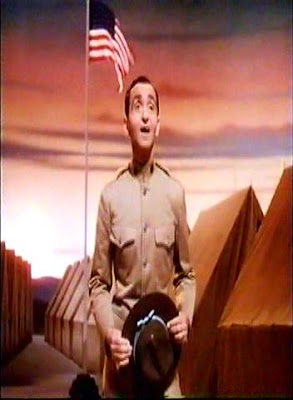
Irving Berlin himself sings “Oh, How I Hate to Get Up in the Morning” in a WWI uniform and his thin, raspy voice. This beloved little man who took Tin Pan Alley lyrics and molded love songs to his adopted nation brings tears to one’s eyes at the very sight of the fragile little guy.

The juxtaposition of the minstrel show scene and the scene by African-American soldiers performing a song called “What the Well-Dressed Man in Harlem Will Wear” is a strange but telling segment in the film.

First, it could be noted here that the men who performed in this stage show that came to Hollywood were all active servicemen. Most were uncredited in the film, but we know that future stars Private Gary Merrill, and Richard Farnsworth were among them. The black performers, including Sgt. Joe Louis (who, as the World Heavyweight Boxing champion was the leading celebrity of the group and the most famous cast member black or white) were also all soldiers. This stage show, made into a movie featuring a cast of actual servicemen, was technically the only de-segregated unit of the Armed Forces during World War II.

The minstrel segment was a part of the original “Yip, Yip, Yaphank” and Irving Berlin wanted it kept for the new show, despite attempts to persuade him that such entertainment was passé. The “Mandy” number performed by white men in blackface could have been performed without the minstrel makeup (as it was in "White Christmas" 1954). Performed with pretend glamor like something from a Ziegfeld show-stopper, it seems less exaggerated than the buffoonery of this scene in “Holiday Inn” discussed in this post.

When the men rush offstage, a pleased George Murphy says, “And you kids were worried about a minstrel number being too old fashioned. Why, it went just as well tonight as it did in the old show.” The words sound a bit hollow. This line might have been thrown in to appease Mr. Berlin, but the following number shows that if the minstrel scene wasn’t as painful to watch as the one in “Holiday Inn”, it was certainly made irrelevant by what followed.


The black soldiers come on next with the swing rendition of “What the Well-Dressed Man in Harlem Will Wear” referring to Joe Louis punching the bag in his Army uniform. It is a patriotic offering, (Joe says, “I’m in Uncle Sam Army, and we on God’s side.”) and the men dance and sing in their uniforms, all with great energy and soldierly precision. These men are not goofing around, they mean business, and that is their message.

A later number set in a stage door canteen appears to be the only scene in which the white soldiers and the black soldiers appear together. That their musical numbers are separate through most of the show may have a message, too.

Another curious image is of the soldiers performing dressed as women. For practical purposes, the men, just as in Shakespeare’s day, had to perform women’s roles because women were not part of these all-male units. If the armed services were segregated by race, they were also separated by gender.

In some numbers the “women” are buffoonish, intended for comedy, and in other numbers they are meant only to represent females. One of the old-timers in the audience remarks to an officer sitting near him, “That’s my son, the fourth from the left.”

The officer replies affably, without a trace of sarcasm, “Very pretty, isn’t he?”

He is quite pretty.

In the number performed by the African-American soldiers, one man likewise plays a woman, jitterbugging with another soldier. Then we see him rush off to wings, where he hurriedly strips off his dress and returns in uniform, completing the row of soldiers tap dancing in unison, as if to reassure us this business of dressing as women is all a matter of course.


The most startling scene of cross dressing comes when two men impersonate the stage actresses/divas Jane Cowl (for more on Jane Cowl’s run-in with James Stewart in Boston, see my post at Tragedy and Comedy in New England), and Lynn Fontanne.


These two men are not just putting on dresses and clowning around. They are female impersonators, and they are very good. In a movie that is otherwise rather naïve and simplistic, this is a stunning bit of sophistication, one most of us might not expect from films of this era.

Back to the raspy-voiced Irving Berlin, of whom it was famously said, “Irving Berlin IS American music.” Is the movie valid for purposes of our study today as an expression of patriotism during World War II? It evidently was considered so once, as this was the highest grossing film of 1943, extremely popular despite quickly becoming a museum piece. It moved people to do great things at the time.

Joan Leslie gets The Speech about what we’re fighting for at the end of the movie, still haranguing Ronald Reagan (actually reserve officer Lieutenant Ronald Reagan in real life) to marry her, telling him that his fear of leaving her a widow is not a reason not to live the life they have together now,

“Why do you act like we’ve lost the war?” Such a horrific slap in the face back in the day.

Perhaps the film’s most ironic image is its finale, where row upon row of soldiers sing with heroic determination that “this time is the last time”, a reference to the Armistice of 1918 that didn’t stick, and that they would remedy, “So we won’t have to do it again.”

They could not have known there would be an armistice for the Korean War ten years later, and a withdrawal from Vietnam, and other geopolitical compromises necessary to fighting so-called “limited” wars of the future.

If it was a “last time” for anything, it was the last time for segregated armed services.

“Then we’ll never have to do it again” they sing lustily as they march off stage.

They seem to make invalid the World War by their bold declaration, relegating the World War to clichés and a scrapbook of silly songs about the Kaiser, men in old fashioned uniforms, and the assumption of a generation’s naiveté. Like the double image of Veteran’s Day over Armistice Day.

But, what goes around comes around. When today’s young people were interviewed about what they knew of World War II at the time Ken Burns’ documentary series premiered on public television (see my post on Burns’ The War here), they demonstrated a condescending dismissal over what they viewed as that generation’s naiveté.

One of the most striking elements of Ken Burns’ documentary series on World War II is the absence of the use familiar popular images we have of the war, which mostly come from the movies. Perhaps the movies of that era are what give today’s younger generations the impression of a more simplistic, naïve people. Hopefully, watching Burns’ excellent series taught them better.

“This is the Army” is not meant to objectively document an era; it is pure cheerleading. Despite this, it does manage to document quite a lot, and one may wonder about how Irving Berlin could have thought “God Bless America” a dud of a song in 1917? It sprouted wings during World War II. It enjoyed an emotional revival after 9/11.

One may wonder about the desegregated entertainment unit in a segregated Army.

One may wonder about the distant shot of an actor playing President Franklin Roosevelt in the theater balcony box (after a stirring rendition of “Hail to the Chief” at his entrance), who is shown being able to stand and sit easily. This was not something FDR could ever do without help, and demonstrates that in 1943, the extent of his paralysis was not known to the general public.

One might consider that Irving Berlin was awarded the Army’s Medal of Merit by General George C. Marshall at the direction of President Harry Truman in 1945 for “This is the Army.” He was awarded the Congressional Gold Medal by President Dwight Eisenhower in 1957, and was awarded the Presidential Medal of Freedom by President Gerald Ford in 1977 for “God Bless America.”

Kate Smith was awarded this same honor for her rendition of “God Bless America” in 1982 by her former cast member in “This is the Army”, now President Ronald Reagan.

Many of the men who performed in this unit gathered for reunions over the years, the last was for their 50th reunion in 1992 in New York’s theater district. How valid was this movie to them?


Seventeen years after that last reunion, another November 11th goes by, for another generation of veterans, who in yet another generation’s time may suffer the humiliation of being regarded as quaint.

For more on the story of this Army unit that performed around the country and around the world during World War II, have a look at this excellent four-part article at the National Archives website by Lawrence Bergreen, who uncovered a great wealth of detail on this unit when writing a book on Irving Berlin.

Thursday, February 12, 2009

Abraham


Lincoln’s Birthday, having been usurped by the all-purpose Presidents Day, is no longer the block on the calendar it once was, but with the many references to President Abraham Lincoln during the inauguration of President Barack Obama, Honest Abe seems to be more in the news than ever.

The connection between Lincoln’s legacy in popular history as it pertains particularly to African-Americans remains at the front of his memory. Today on the 200th anniversary of Lincoln’s birth, we have this clip below from “Holiday Inn” (1942) to examine one Hollywood interpretation of that relationship.

The clip is cringeworthy camp. I can remember broadcast television showings where this scene was omitted, and not just to fit in more commercials. It is, after all, a bit uncomfortable to watch. Leaving it out may make watching this otherwise lighthearted froth of a movie less offensive, but leaving it out is a lie. By watching the scene carefully, we can learn a bit more about a wartime era when our armed forces were still segregated, when popular entertainment leaned heavily on exaggerated stereotypes.

The song is pleasant, another one of Irving Berlin’s patriotic tributes to his adopted country that make up this movie. As illustrated by the photo above, it was also released on a 78rpm. Listen only to the song and you have a stirring tribute in a big band flourish, and Bing Crosby’s steady baritone.

Open your eyes to watch the film clip, and you must really open your eyes to some other things. The stars in blackface, giving it their all as it once was performed in hokey minstrel shows from the 19th century up through the middle 20th century in vaudeville. The chorus in “mulatto” makeup and costumes meant to turn Holiday Inn into a cartoon plantation setting where happy slaves evoke the name of their savior, Abraham.

The only thing more ridiculous looking than Bing Crosby in this scene is the unfortunate Marjorie Reynolds, who bounds out like Harriet Beecher Stowe’s “Topsy” having just ingested some mind-altering substance. It may be laughable, but becomes all the more embarrassing when one realizes this performance is not meant as an insult, but intended as good-natured parody. The condescension in this scene does not seem to be apparent to Bing or Marjorie, the chorus, or the director or studio.

We see it. Many others saw it as well in the era when the film was made; not everyone was so blind. This kind of entertainment was already on its way out. The explanation in the plot for the use of blackface was to hide Marjorie Reynolds from being recognized by Fred Astaire, but the “cover story” if you will, is just to give credence to a typical Lincoln’s Birthday minstrel routine that was now becoming passé. This scene is a museum piece in more ways than one. The “Abraham” number was reused as an instrumental piece in “White Christmas” (1954) some 12 years later, for a fast-paced dance featuring Vera-Ellen. A big production number in “White Christmas” also salutes the days of minstrel shows. Nobody wears blackface.

But keep watching the original “Abraham”. Louise Beavers turns the scene on its ear. The warmth and sincerity she exudes singing to her children is what makes Bing and Marjorie all the more silly. She has dignity, and this was Abraham Lincoln’s great gesture to his fellow Americans of every race, the idea that human beings were born with innate dignity, and nobody could take it away from them, even if they took away their freedom. People can only give up their dignity willingly, which is what Bing and Marjorie are doing in this scene.

No matter that Miss Beavers has only a couple lines to sing in a movie that is a musical; no matter that one line includes the word “darky.” She’s got dignity to spare, which is good because Bing and Marjorie can really use some help to save this number.

I like to think that director Mark Sandrich saw that too, and that was his intention, this striking and moving comparison between the black lady and the white stars in blackface. Perhaps not, perhaps he was as blind to the dignity as he was to the indignation. But the studio left the scene in, and now so does cable television.

Have a look at the clip of “Abraham” below. Enjoy the song, but don’t close your eyes.

Thursday, April 5, 2007

Easter Parade

“Easter Parade” (1948) set in 1911-1912, showcases Irving Berlin’s Tin Pan Alley hits, and one hit of the Great Depression, which was the song “Easter Parade.” The film opens on the day before Easter, and just as Fred Astaire’s spending spree to buy flowers, a hat, and a stuffed bunny for Ann Miller indicate, it once was really the busiest shopping day of the year.

When Ann dumps Fred for bigger things (just as the aforementioned lout Lee Bowman in “My Dream is Yours”) Fred snatches Judy Garland from the gutter pretty much as Jack Carson snatches Doris Day in “My Dream is Yours,” and pushes her to become his new singing and dancing partner.

They rehearse for the first time on Easter Sunday, and she gets a glimpse of the Easter Parade and the beautiful people strolling home from church to see and be seen.

Judy Garland is clearly Fred Astaire’s equal in dancing, and she makes one of his most delightful partners. Their “A Couple of Swells” routine is now classic. Two people in shabby clothes and blacked out teeth never looked so good. The rolling backdrop behind them as they sing “we’ll walk up the avenue” reprises the Easter Parade theme of strolling along with the swells.

Another fun number is “Girl On A Magazine Cover,” which displays elegant fashions and a riot of colors. It’s interesting to note how many of these old-time magazines (Redbook, Harper’s, etc.) are still being published.

Judy, his protégé, makes good and their act is a success. That they fall in love is of course inevitable, and she reverses the roles at the end of the film on the following Easter Sunday by presenting Fred with a top hat “bonnet”, flowers, candy, and a live rabbit, singing to him the song “Easter Parade.” The final shot is Judy and Fred strolling down Fifth Avenue with the wealthy fashion setters, in nice clothes and no blacked-out teeth.

Irving Berlin, responsible for this and all the songs in the film, emigrated to the US from Russia with his family in 1893. Jerome Kern, asked of his opinion of Berlin’s place in American music famously replied, “Irving Berlin IS American music.” Berlin was one of our most prolific, and most patriotic, songwriters. That he celebrated secular aspects of Christmas and Easter so successfully may be due to his realization that compromise, rather than exclusion, is the true American trait. Or, it may due to his being a Jewish man who was happily married to a Roman Catholic woman, which upset both their families, and he learned firsthand the benefits of compromise that sometimes leads to the development of a new, shared heritage. The American secular holiday created just such a new, shared heritage, including an Easter with flowers, fashions, candy, and songs, and movies which celebrated them.

That’s it for this week. See you next week, and Happy Easter.

Monday, April 2, 2007

Easter Films - Sacred vs Silly

With Easter approaching and this week, Holy Week, the most important in the Christian calendar, it’s interesting to take a look at Americans’ ability to walk that line between the sacred and the silly. Obviously jelly beans and chocolate bunnies have nothing to do with liturgy, yet they are now part and parcel of Easter.

Movies have not grasped the holiday and wrung it to bits the way they’ve commandeered Christmas, but two Easter films we’ll be dealing with this week are stamped with that genuine American attitude of compromise. The Passion of Christ cannot, for most of us, be reduced to a lighthearted musical review of songs and dances. But, the secular aspects of any religious holiday are more comfortably shared, celebrated, and kidded. Thus the sacred and the silly are separated, but not necessarily opposing.

By the way, we’re talking “old” movies (see Intro in archives), so “Godspell” and “Jesus Christ Superstar,” despite their merits as musicals, are not the issue here. Nor will either help us to understand that American invention of the secular persona for a sacred holiday.

The two films are “Easter Parade” and “My Dream is Yours,” from 1948 and 1949. These postwar years play a big a part in the character of these films. The post-war years had a strange duality to them. On the one hand, the GI Bill of Rights provided the resources for a generation of young men to pursue education, business, and a suburban tract home. On the other hand, despite this drive to a seek out a wonderful future, there was a kind of fatigue after the horrors of war and a yearning to turn back the mind, if not the clock, to a happier time and place. That’s generally called nostalgia, and it’s usually mostly made up.

There was the bewildered realization that after victory in the war and especially with the invention of the atom bomb, America was now the most powerful nation on earth, an aspect of our lives with which Americans still struggle. Yet, there was a naiveté about our power and our bomb, that led Doris Day, in “My Dream Is Yours” to sing a novelty tune called “The Geiger Counter Song” with a “tick-tick-tick” syncopation to “give me a radioactive kick.”

“Easter Parade” eschewed the modern times and sent us back to 1911-1912, where modernity was represented in large plumed hats and ragtime, a more comfortable spot for us to be, evidently. The film was intended to be a showcase for a variety of Tin Pan Alley Irving Berlin tunes. Ironically, the song “Easter Parade” was not from this era, but was written by Berlin for the musical review “As Thousands Cheer” in 1932. It’s always been hard to film a movie about the past and not get slapped in the head by unruly anachronisms. That is because we want the past to be what we want it to be, and not what it was.

More tomorrow on these Easter films.

Related Products