Killer McCoy
(1947) is an engaging hybrid of genres, a post-war noir with a 1930s
innocence and parade-of-years element; a story where the slum-raised
protagonist is actually a hero rather than anti-hero, as sentimental as he is
cynical. The racketeers are soulless,
except for the one with the most to lose.
The romantic couple never even kiss, but they are bonded together from
the moment they meet. Most
interestingly, it is an MGM movie and not Warner’s, where one might expect to
find a gritty boxing picture. It is a
both a gift, and a challenge, from the studio—perhaps even a dare to test his
box office value—to its prodigal son just back from service in the army, Mickey
Rooney.

This post is part of The getTV Mickey Rooney Blogathon hosted by Once Upon a Screen, Outspoken & Freckled and
Paula’s Cinema Club
taking place throughout the month of September. Please visit the getTV schedule for details on
Rooney screenings throughout the month and any of the host sites for a complete
list of entries.

Ann Blyth, on loan out from Universal for the second time, plays a finishing school debutante, the daughter of the successful racketeer.
Her father, played by Brian Donlevy in a
tailor-made role, has kept his nefarious career a secret from her, but she
learned about it when she was still a child and carries the shame inside her. She doesn’t tell her pop she knows because
she doesn’t want to hurt his feelings.
There’s a lot of protecting of parents by disillusioned young people in
this movie, not exactly a forerunner of the 1950s and 1960s teen films of
mom-and-dad-don’t-understand flicks.
These young adults are much more mature and
compassionate than the malt-shop or beach bum gang of whiners that would
follow. They are not grappling with growing
up; they grew up too soon.
Though this is a remake of the Robert Taylor vehicle, The Crowd Roars (1938), I won’t make any
comparisons, partly because I haven’t seen that movie yet, and partly because Killer McCoy can stand on its own as a
slice of the careers of its prodigiously talented leads.

Mickey Rooney creates a fascinating double-image of his
screen persona. We see flashes of Andy
Hardy in his playful song-and-dance routine with the wonderful James Dunn, who
plays his alcoholic shiftless father, and even in some of the rubbery pratfalls
he takes in the boxing ring. Mr. Rooney,
though he is a natural athlete and is clearly in shape, muscular with good
upper body development, is no boxer. He
doesn’t really have the technique down, but that is covered pretty well by director
Roy Rowland’s judicious direction.

Rooney has famously, both in his autobiography, Life Is Too Short, and in his television
interview with Robert Osborne on TCM’s Private
Screenings series, discussed his fights with Rowland on set, that he felt
the director berated him and was out to get him. You’d never know it by the image on screen,
though, which is a wonderful blend of skillful cinematography and Mickey
Rooney’s own masterful screen presence. In the scene where he first meets Donlevy, Mickey enters the room, casts an eye around, almost as if looking for the camera and for us, as if to say, "Yeah, it's me. I'm back."

It is in the quieter moments of serious dialogue where
Rooney really shines, where we see he has left Andy Hardy behind, in his
beaten, cynical manner and in the lines on his face. He confronts what he feels is Ann Blyth’s
snobbery about boxers in a speech that displays his anger, his resentment for
the fight game and himself a pawn in it, and yet also his compassion for all
the washed-up boxers he’s ever met. Despite his pride, we see his self-loathing later in a scene where crisis comes and he blurts out, "In a way, I had this coming to me."

Most
especially preying on his mind is his friend and mentor, played by Mickey Knox,
a boxer who trained him. Knox left the
game for wife and baby and chicken farm, but when the money was tight, he went
back into the ring for a comeback. He
wasn’t in good condition, and his opponent—Mickey Rooney by luck of the
draw—kills him in the ring.
Mr. Rooney has a terrific scene with Knox’s wife, played by
Eve March, where they, both embarrassed and in pain, try to make small talk in
one of the worst places in the world to do that: a hospital waiting room in the
wee hours of the night. Miss March is
excellent in this scene. Her career
comprised of a lot of bit parts, mostly uncredited, but the strength of her realistic
performance as a careworn, lower class woman of dignity, so striking, makes us
wonder why she wasn’t used more. I love
the quick flashes of a weak smile when she speaks proudly of her little
son. She tells Rooney the boy wants to
grow up to be a boxer like his daddy.
Rooney’s expression hardens.
“Don’t you let him, Mrs. Martin.
Don’t you ever let him.”
“No.” she quietly agrees.
So many scenes, which could come off as cliché, ring true,
such as when Rooney, betrayed and disgusted that his father would sell his
contract to racketeer Donlevy for gambling and drinking money—only one in a
string of disappointments in his washed-up actor father.

Dunn plays his role with relish, a helpless big-talker who
lives for the next stroke of luck, but who can’t settle down to an honest day’s
work, as pitiable as he is repugnant. Rooney
has supported his parents and been the man of the family since boyhood. But there is no hearts and flowers sentimentality to his sacrifice; on the contrary, he is more resentful than a
truckload of George Baileys. Rooney does
not apologize for his father, indeed, lets him have it in strong words and a
slap on the face, but with the extraordinary compassion (one keeps coming back
to that noble word) of his character, he also looks out for him.
“You’re a ham and I’m
a pug. Maybe that’s all we’ll ever be,
but at least we’ll have each other. At
least we can go on hoping.”
Another good, genuine scene with Rooney is when the gold-digging
waitress at the dinner chats him up for a big spender, and he, with
self-depreciating humor, though too shrewd to be taken in, is still generous to her.

The scene where Ann introduces Mickey to her father, unaware they already know each other and are working together in a racket. Her eagerness for them to like each other, their uncomfortable and embarrassed pretending for her sake.
The scene where when he takes Ann Blyth to a nightclub and
she, with youthful importance, orders a drink, and he orders tomato juice.
“Don’t you drink?” she says, startled, expecting more of the
big-time boxer in a night on the town.
“No,” he says with wonderfully unconcerned nonchalance,
showing the maturity and self-confidence of the young man who doesn’t give it a
second thought. He’s got his own code of
honor.
And it’s torturing him.
Though it’s Rooney’s movie, Ann Blyth is a particularly good
choice for the role of the girl. This is
her first time at MGM, the studio that will in a few years give her a chance at
a big musical, The Great Caruso (1951), which we discussed here, and would be her own home studio when she left
Universal in the 1950s.

Her own maturity, her empathy not only for her character, but for Rooney, makes her an intriguing and quietly powerful companion for Mickey. Noting the difference in their social spheres,
he tries to stop seeing her many times, but she won’t let him, yet she is not
clinging, she is even sickened by her first sight of a boxing match, watching
him getting punched, the blood lust of the crowd enjoying it. Their worlds collide because their souls are
drawn to each other.

One particularly affecting scene takes place in a sailboat,
where she confesses to him that she has known since she was a child that her
father was a gangster, and so she had never really fit in with her private
school classmates, his criminal activity like a long shadow over her.
From a technical aspect, the scene is magical, a still and
quiet world away from the noise of the boxing arena and its savage fans. The boat lifts and falls in a lapping of a
gentle wave on an otherwise deserted lake.
The rear-screen projection is used very skillfully here. The scene is exquisitely gentle. There is power in Mickey’s restraint as he
confesses his dream to leave boxing, and in the consoling way he listens to her
and tries to advise her. There is power
in the waver of Ann’s voice and tearing eyes as she tries to carefully unburden
herself with fragile dignity.
“I’m all he has,” she says helplessly of her father, who
lives a double life.

Ironically, the strongest aspect of their relationship is that, as
mentioned above, they do not kiss. They
don’t embrace, there are no confessions of love between them. They just need each other, and are both too
wary, too burdened by others, too fearful to risk loving one more person. They are taking their time. Only at the magnificent end, when his last
terrible boxing match is over, after Rooney screams hoarsely and out of breath
into the radio microphone that he’s quitting, do they share a single, sweaty,
bloody clinch. It’s perfect.


Only one scene doesn’t work for me, when Miss Blyth first
meets Mr. Rooney, and he is playing Franz Liszt’s “Lebestraum” on the
piano. How a guy who never went beyond
seventh grade in school and scrambled to sell papers to feed his parents and
spent every free moment hustling chumps in pool halls ever found the time or
money to learn how to play classical pieces on the piano, I don’t know. We need to have a scene of him learning to
play the piano as a child to believe it.
Interestingly, there is no mention of the war, though the
movie covers a time span of about five years.
The montage of headlines flashes only news of boxing, nothing else.
I won’t go play-by-play on the plot, except to note another
scene were Dunn, in an attempt to save both himself and Ann from mobsters,
finally displays mettle and resolve in a crisis instead of indulgent self-pity.

Donlevy’s devoted father-panic when he rages at Mickey for
hanging around his daughter:
“You’re a pug. You
come from the slums. You’ve fought your
way through back alleys. You’ve killed a
man.”
“Sheila knows that.”
"She’s just a child.
She’ll feel differently,” he says, when Rooney’s been rendered senseless
by one too many punches.
The ending may remind you of Rocky (1976). Coincidence?

Another one of the joys of this movie is the parade of
wonderful character actors: Sam Levene
as Mickey’s trainer and cut-man, Happy, who suffers from the corner every time
he’s hit, and has some great wisecracks.

Tom Tully plays a rival racketeer, a great performance that
runs a knife-edge of humor and frightening cruelty. He tells a funny story about having
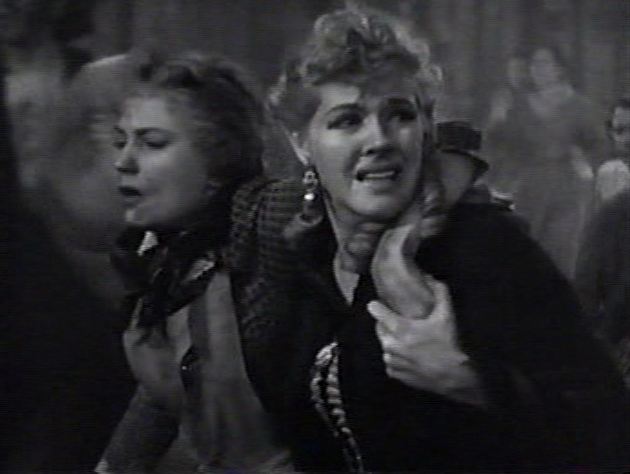
indigestion, and he’s willing to kill for spite, let alone money. Everybody in this movie has two sides. Walter Sande his is partner.
Bob Steele, who’d been around since the days of the silents
and made a name for himself in westerns, plays boxer Sailor Graves in a
delightfully good-natured and even comic performance.
Watch for the extras, including Milburn Stone, Ray Teal, and
blink-and-you-miss-her Shelley Winters in a non-speaking role as a boxing
groupie who crashes training camp. She’s
driving the convertible.

Ann Blyth, we could also note, is photographed absolutely beautifully
in this movie. You can really see the
MGM gloss in how the movie handles her.
She conveys dignity, gravity, and decency, and her thoughtful expression darkens, cringes every time someone speaks of gambling and mobsters. She was coming out of one of the worse periods
of her personal life—her spine injury and death of her mother—and slogged out these
bad memories in her intense bad-girl role in Swell Guy (1946), which we discussed here, and popped up only briefly
in Brute Force (1947), which we’ll
discuss down the road. In a way, this
loan-out to MGM was, for her as much as Rooney, a kind of reboot to her career.

She would head back to Universal and a couple more intense
dramas and characters of dubious moral conduct: A Woman’s Vengeance (1948) which we discussed here, and Another Part of the Forest (1948) discussed here. She was about to enter the busiest and most
prolific period of her screen career. Though
she was still a young woman, just 19, and she would not yet be through playing
teens, still, not since the early four films at Universal in 1944 had she
really been locked into ingénue roles. Instead,
she could and would play women who, if not chronologically older, were
certainly world-wise and knowing. Her
own personal maturity and empathy contributed to this ability. A playfulness, even goofiness that was also
part of her personality, would remain hidden and that would not come out until
later films: Mr. Peabody and the Mermaid (1948) here; Once More, My Darling (1949) here; and Rose Marie (1954) discussed here.
A syndicated review in the Toledo Blade called the movie a…
Great comeback by Ann
Blyth, who’s Mickey Rooney’s sweetheart in Killer McCoy. She’s the Mildred Pierce
Academy Award nominee who broke her back tobogganing. It threatened to end her career! Hollywood’s happy for her...

Mickey Rooney’s career would lose momentum, despite his
splendid performance in this film, and would ride a variety of crests and valleys
through the coming years, but endured with remarkable longevity, which itself
was a tribute to this very talented man.
Killer McCoy is available on DVD from the Warner's Archive Collection.
Killer McCoy is available on DVD from the Warner's Archive Collection.
Have a look at the other great bloggers posting this month
as part of the getTV Mickey Rooney Blogathon hosted by Once
Upon a Screen, Outspoken&
Freckled and Paula’s Cinema Club
taking place throughout the month of September.
Come back next
Thursday when we head back west on TV’s Wagon
Train for another episode, “The Martha Barnham Story” where Ann Blyth plays
an officer’s haughty daughter whose bigotry will alienate a former love and mean life or death for herself and others.

Posted by Jacqueline T. Lynch at Another Old Movie Blog.
******************************
Private Screenings, Turner Classic Movies, Robert Osborne interview with Mickey Rooney.
Rooney, Mickey. Life Is Too Short. (NY: Villard Books, 1991).
Toledo Blade, July 9, 1947, “Filmdom chatter box”.
Private Screenings, Turner Classic Movies, Robert Osborne interview with Mickey Rooney.
Rooney, Mickey. Life Is Too Short. (NY: Villard Books, 1991).
Toledo Blade, July 9, 1947, “Filmdom chatter box”.
As most of you probably know by now, this year's TCM Classic Cruise will set sail (proverbially) in October, and one of the celebrity guests is Ann Blyth.
TCM has just published the itinerary for the cruise. Ann will be doing a couple hour-long conversation sessions, and will also be on hand for a screening of Mildred Pierce.

Have a look here for the rest of the schedule and events with the other celebrity guests. Unfortunately, the cruise is booked, so if' you're late, you can try for the waiting list.
I, sadly, am unable to attend this cruise, but if any reader is going, I invite you (beg you) to share your experiences and/or photos relating to Miss Blyth on this blog as part of our year-long series on her career. I'd really appreciate your perspective on the event, to be our eyes and ears. Thanks.
****************************
***************************
TRIVIA QUESTION: I've recently been contacted by someone who wants to know if the piano player in Dillinger (1945-see post here) is the boogie-woogie artist Albert Ammons. Please leave comment or drop me a line if you know.
****************************
UPDATE: This series on Ann Blyth is now a book - ANN BLYTH: ACTRESS. SINGER. STAR. -

Also in paperback and eBook from Amazon, CreateSpace, and my Etsy shop: LynchTwinsPublishing.

"Lynch’s book is organized and well-written – and has plenty of amusing observations – but when it comes to describing Blyth’s movies, Lynch’s writing sparkles." - Ruth Kerr, Silver Screenings
"Jacqueline T. Lynch creates a poignant and thoroughly-researched mosaic of memories of a fine, upstanding human being who also happens to be a legendary entertainer." - Deborah Thomas, Java's Journey
"One of the great strengths of Ann Blyth: Actress. Singer. Star. is that Lynch not only gives an excellent overview of Blyth's career -- she offers detailed analyses of each of Blyth's roles -- but she puts them in the context of the larger issues of the day."- Amanda Garrett, Old Hollywood Films
"Jacqueline's book will hopefully cause many more people to take a look at this multitalented woman whose career encompassed just about every possible aspect of 20th Century entertainment." - Laura Grieve, Laura's Miscellaneous Musings''
"Jacqueline T. Lynch’s Ann Blyth: Actress. Singer. Star. is an extremely well researched undertaking that is a must for all Blyth fans." - Annette Bochenek, Hometowns to Hollywood

Ann Blyth: Actress. Singer. Star.
by Jacqueline T. Lynch
The first book on the career of actress Ann Blyth. Multitalented and remarkably versatile, Blyth began on radio as a child, appeared on Broadway at the age of twelve in Lillian Hellman's Watch on the Rhine, and enjoyed a long and diverse career in films, theatre, television, and concerts. A sensitive dramatic actress, the youngest at the time to be nominated for her role in Mildred Pierce (1945), she also displayed a gift for comedy, and was especially endeared to fans for her expressive and exquisite lyric soprano, which was showcased in many film and stage musicals. Still a popular guest at film festivals, lovely Ms. Blyth remains a treasure of the Hollywood's golden age.
***************************
UPDATE: This series on Ann Blyth is now a book - ANN BLYTH: ACTRESS. SINGER. STAR. -
*********************
The audio book for Ann Blyth: Actress. Singer. Star. is now for sale on Audible.com, and on Amazon and iTunes.
The audio book for Ann Blyth: Actress. Singer. Star. is now for sale on Audible.com, and on Amazon and iTunes.

Also in paperback and eBook from Amazon, CreateSpace, and my Etsy shop: LynchTwinsPublishing.
"Lynch’s book is organized and well-written – and has plenty of amusing observations – but when it comes to describing Blyth’s movies, Lynch’s writing sparkles." - Ruth Kerr, Silver Screenings
"Jacqueline T. Lynch creates a poignant and thoroughly-researched mosaic of memories of a fine, upstanding human being who also happens to be a legendary entertainer." - Deborah Thomas, Java's Journey
"One of the great strengths of Ann Blyth: Actress. Singer. Star. is that Lynch not only gives an excellent overview of Blyth's career -- she offers detailed analyses of each of Blyth's roles -- but she puts them in the context of the larger issues of the day."- Amanda Garrett, Old Hollywood Films
"Jacqueline's book will hopefully cause many more people to take a look at this multitalented woman whose career encompassed just about every possible aspect of 20th Century entertainment." - Laura Grieve, Laura's Miscellaneous Musings''
"Jacqueline T. Lynch’s Ann Blyth: Actress. Singer. Star. is an extremely well researched undertaking that is a must for all Blyth fans." - Annette Bochenek, Hometowns to Hollywood

Ann Blyth: Actress. Singer. Star.
by Jacqueline T. Lynch
The first book on the career of actress Ann Blyth. Multitalented and remarkably versatile, Blyth began on radio as a child, appeared on Broadway at the age of twelve in Lillian Hellman's Watch on the Rhine, and enjoyed a long and diverse career in films, theatre, television, and concerts. A sensitive dramatic actress, the youngest at the time to be nominated for her role in Mildred Pierce (1945), she also displayed a gift for comedy, and was especially endeared to fans for her expressive and exquisite lyric soprano, which was showcased in many film and stage musicals. Still a popular guest at film festivals, lovely Ms. Blyth remains a treasure of the Hollywood's golden age.

A new collection of essays, some old, some new, from this blog titled Movies in Our Time: Hollywood Mimics and Mirrors the 20th Century is now out in eBook, and in paperback here.