IMPRISON TRAITOR, PEDOPHILE, AND CONVICTED FELON TRUMP.
Showing posts with label Irene Dunne. Show all posts

Thursday, April 17, 2014

Ann Blyth - Profession of Faith


On February 20, 1955, Ann Blyth was given the Star of David Award at a charity ball in Los Angeles for her work in support of the Jewish Home for the Aged.  This was only one occasion of many when she had been noted for the charitable work she'd been involved in since she came to Hollywood, including both religious and civic organizations.  On another occasion, she was awarded an honorary Doctor of Humane Letters degree from St. Joseph’s College in Emmitsburg, Maryland, for her years of participation in these activities. 
Charity and civic work played a large part of her private life, but since this series is focused on her career, we’ll cover in this post those professional gigs that combined her acting career with her personal commitment to her faith.
She found herself part of a small colony of Roman Catholic actors in Hollywood, some of whom belonged to the Catholic Actors Guild, founded 1914.  Its first president was Jerry Cohan, George M.’s father.  Other members included Claudette Colbert, Pat O’Brien, Irene Dunne, Wallace Ford, Rosalind Russell, Ruth Hussey, Raymond Massey, Helen Hayes, and Jane Wyatt.
From time to time, some of these folks, Ann especially, appeared in a long-running radio program called Family Theater, which presented literary classics like A Tale of Two Cities, mixed with family dramas and gentle comedy.  The host, usually a guest actor, would remind the audience that praying together as a family would help lead to world peace.  Founded by Fr. Patrick Peyton, who established the Holy Cross Family Ministries, the program featured such other Hollywood luminaries as James Stewart, Bob Hope, and Barbara Stanwyck.  Fr. Peyton, you might recall, coined the phrase: "The family that prays together, stays together."
Ann’s first appearance on the show was in August 1947, and she appeared several times in the show’s run, which ended in 1957.  The Triumphant Hour was a kind of kin to this show, and she appeared on this radio program, and The Joyful Hour in December 1949, playing Mary to Macdonald Carey’s Joseph in The Nativity.  Bing Crosby and Dennis Day were part of a large cast.
In the late 1950s and 1960s, television broadcast The Christophers, where Ann appeared as a guest in a kind of talk show or panel discussion on such topics as: “Gear Yourself to a Fast Changing World” (1963), “Careers That Count” (1958), “You Can Change the World” (1951), “Give Children Good Reading Habits” (1960), and “Teen Agers: Today and Tomorrow” (1965).  “You Can Change the World” is no longer up at YouTube, but it featured a large cast including Irene Dunne, Loretta Young, Ann Blyth, Jack Benny, all in discussion with Fr. James Keller.  Though Jack Benny was along for comedy relief, it was William Holden’s concerned face being among the earnestly staged discussion that just sort of made me smile.
Here is a clip from a Family Theater short in celebration of Easter, with Ann Blyth singing “Come Holy Ghost.”  The clip demonstrates her rich, surprisingly powerful soprano voice, and I particularly like how relaxed she appears while singing, the leisurely pace of the song and her vocal technique itself creating drama.  It's a fine display of both her artistry, and her contentment in singing and in her faith.
A Happy Easter to those who celebrate it.


For those of you in the mood for a little Easter OTR (Old Time Radio), have a listen to Ann in "The Arbutus Bonnet," a dramatic episode of Hallmark Playhouse, hosted by author James Hilton, in a script adapted by Jean Holloway (one of my favorite radio and TV writers).  It was broadcast April 6, 1950.  Scroll down to "50-04-06" and download or listen.
Come back next Thursday when we discuss the delightful comedy Sally and Saint Anne, a coming-of-age story where small-town girl Ann Blyth suffers vast growing pains amid a daffy family in a circus of a home.  She has the help of her best buddy, Saint Anne.

*************************

Pittsburgh Press, May 8, 1964; also article by Carl Apone, July 28, 1968, p. 13.

*************************

THANK YOU....to the following folks whose aid in gathering material for this series has been invaluable:  EBH; Kevin Deany of Kevin's Movie Corner; Gerry Szymski of Westmont Movie Classics, Westmont, Illinois; and Ivan G. Shreve, Jr. of Thrilling Days of Yesteryear.

**************************
UPDATE:  This series on Ann Blyth is now a book - ANN BLYTH: ACTRESS. SINGER. STAR. -

*********************
The audio book for Ann Blyth: Actress. Singer. Star. is now for sale on Audible.com, and on Amazon and iTunes.

Also in paperback and eBook from Amazon, CreateSpace, and my Etsy shop: LynchTwinsPublishing.


 "Lynch’s book is organized and well-written – and has plenty of amusing observations – but when it comes to describing Blyth’s movies, Lynch’s writing sparkles." - Ruth Kerr, Silver Screenings

"Jacqueline T. Lynch creates a poignant and thoroughly-researched mosaic of memories of a fine, upstanding human being who also happens to be a legendary entertainer." - Deborah Thomas, Java's Journey

"One of the great strengths of Ann Blyth: Actress. Singer. Star. is that Lynch not only gives an excellent overview of Blyth's career -- she offers detailed analyses of each of Blyth's roles -- but she puts them in the context of the larger issues of the day."- Amanda Garrett, Old Hollywood Films

"Jacqueline's book will hopefully cause many more people to take a look at this multitalented woman whose career encompassed just about every possible aspect of 20th Century entertainment." - Laura Grieve, Laura's Miscellaneous Musings''

"Jacqueline T. Lynch’s Ann Blyth: Actress. Singer. Star. is an extremely well researched undertaking that is a must for all Blyth fans." - Annette Bochenek, Hometowns to Hollywood


Ann Blyth: Actress. Singer. Star. 
by Jacqueline T. Lynch

The first book on the career of actress Ann Blyth. Multitalented and remarkably versatile, Blyth began on radio as a child, appeared on Broadway at the age of twelve in Lillian Hellman's Watch on the Rhine, and enjoyed a long and diverse career in films, theatre, television, and concerts. A sensitive dramatic actress, the youngest at the time to be nominated for her role in Mildred Pierce (1945), she also displayed a gift for comedy, and was especially endeared to fans for her expressive and exquisite lyric soprano, which was showcased in many film and stage musicals. Still a popular guest at film festivals, lovely Ms. Blyth remains a treasure of the Hollywood's golden age.


The eBook and paperback are available from Amazon and CreateSpace, which is the printer.  You can also order it from my Etsy shop. 

If you wish a signed copy, then email me at JacquelineTLynch@gmail.com and I'll get back to you with the details.

Thursday, June 14, 2012

Stars and Stripes Forever - 1952


“Stars and Stripes Forever” (1952) strikes a resonant chord with the spirited marches of composer and conductor John Philip Sousa. Clifton Webb plays The March King, and he’s great as always. The movie, like most Hollywood biopics, strays from fact here and there, but captures spot-on the era when Sousa was -- to use a modern term -- a rock star.

We celebrate Flag Day in the US today, those “stars and stripes” with a movie not about flags, or even flag waving, but of patriotism expressed by that once-upon-a-time staple of American popular entertainment -- the marching band.

It’s the 1890s when John Philip Sousa is a Sergeant Major in the Marines and the leader of the Marine Corps Band. In real life, he was a renaissance man -- composer of scores of songs, operettas, even wrote novels and articles. In the movie, he is bummed because he wants to showcase his romantic ballads, but the public likes his marches.


Ruth Hussey is his warmly supportive wife with the wry sense of humor. One of their most charming scenes together is when Mr. Webb, with Miss Hussey accompanying him on piano, sings his latest syrupy love ballad. His bass voice languidly belches the plodding love song, while she giggles at the effect and urges him to pick up the tempo and turn the melody into a march. He will -- later on in the movie -- during another cute scene at a White House reception for President Benjamin Harrison. We recognize his love ballad has become “Semper Fidelis”, the march dedicated to the United States Marine Corps.

We may forget that Clifton Webb had a long career on stage in musical comedy, and as a professional ballroom dancer. The movies gave him a second career as an acerbic fussbudget, and the early 1950s was a busy time for him. In the same year as “Stars and Stripes Forever”, he also did the wonderful parody “Dreamboat” discussed in this previous post. We last saw him in one of his very best performances in “Titanic” (1953), discussed here.

Robert Wagner and Debra Paget are the second leads, and their characters are fictional. Wagner is another member of the Marine Corps Band who follows Mr. Webb into private life after Webb retires from the Marines to form his own celebrated band. Wagner invents the “Sousaphone”, a kind of tuba for a marching unit. Actually, it was a couple of other fellows who came up with Sousaphone, following ideas contributed by Mr. Sousa.

Debra Paget is a feisty music hall singer and dancer who marries the smart aleck Wagner and becomes the girl singer and specialty dancer for Sousa’s band.

We first see her in a scene at a run-down vaudeville house where she is one of the “Living Picture” tableau act. I like this scene for accurately showing what was a kind of risqué exhibition of bodies positioned in dramatic configurations that, for the stage censors’ benefit pretended to be culture -- but for the audience was a most benign source of titillation.


Another scene I like, not because it evokes the era so knowingly, but because it shows an early 1950s consciousness overlapping it in a natural and benevolent way. This is the scene where Webb takes his band on tour in the South. Ever the showman, he cannily marches his band down a street to the United Confederate Veterans reunion which has dubiously hired him to perform -- and he chooses the rousing “Dixie” to make his entrance. He finds a receptive audience to this favorite tune of the South, and then he recounts the story of when Confederate General Robert E. Lee surrendered to Union General Ulysses S. Grant at Appomattox Courthouse. Whether it is meant to placate the (fictional) United Confederate Veterans or to placate the 1952 Southern moviegoers, but Webb delicately refers to the surrender as Lee’s “visit” to Grant. At the time of the surrender, the Marine Corps Band serenaded President Abraham Lincoln, who in the spirit of “with malice toward none, with charity to all” requested they play “Dixie”.

Webb declares that in return for this magnanimous gesture a generation ago, his band, with the help of the choir of the Stone Mountain Church of Atlanta (who play themselves), will perform the song most associated with Lincoln -- “The Battle Hymn of the Republic.”

It is an African-American choir, who step forward among this all-white Confederate picnic and sings the battle cry of their former enemy. They are a mixed choir of men and women, children and elderly, and most strikingly -- lovely young women and handsome young men, serious singers with dignity and grace. They are dressed not in cartoonish slave garb, but in stylish modern (1890s) dress. Their voices are powerful, their diction is precise. They are impressive.

I doubt they would have been welcome at such a wingding in the 1890s (catch the enigmatic expression of the white gentleman in the white linen suit and string tie -- is he moved or merely uncomfortable), but the 1950s was just starting to wake up to certain things and get a little gutsy.

This movie effortlessly evokes the 1890s, but this scene is more about what we wish was, and not what was. However, it works even in its illusionary manner.

In the courting scene at the park between Mr. Wagner and Miss Paget, we hear the old movie background music favorite, “Sweet Marie” and I always think of the William Powell and Irene Dunne duet in “Life with Father” (1947), discussed here.

Another scene that endeavors to revel in the era, but is recalled with a modern twist, is when Clifton Webb receives a note in the middle of conducting in the pit during an operetta. Debra Paget is the lead. He stops the show and faces the audience. He reads the dispatch that the battleship USS Maine has exploded in San Juan Harbor, Cuba. It is the start of the Spanish-American War. The scene cleverly makes use of the audience’s memories of when they first heard the news of the start of World War II, but our brief war with Spain, with its politically murky beginning, has slipped away from modern consciousness though it cost many lives.

What this event in the movie leads to is a touching finale. Robert Wagner, the once and future Marine, happy-go-lucky scamp or not, enlists to fight in Cuba, is wounded in a round of “friendly fire” (more irony) and suffers a leg amputation. Clifton Webb brings his band to the rehabilitation hospital to entertain the wounded troops. His appearance is a surprise to Robert Wagner, and an even bigger surprise when Webb calls him up on stage to play his old Sousaphone. Wagner hobbles on crutches to the place in the band that has been saved for him. A nice gesture when he pats the Sousaphone draped over his shoulder as if it was his trusty steed.

We don’t remember the Spanish-American War, but we know about wounded veterans who need to be welcomed and given a place in the band.

The movie jubilantly reminds us how important music is to define an era. The music performed in this movie is given center stage. We end with Sousa’s march, now the National March of the United States of America -- “The Stars and Stripes Forever”. We are treated to long and leisurely close-ups on the musicians and their instruments.

It is played against a montage of military bands striding across the Mall in Washington, D.C., marching into future bands in future wars.

Listen below at the US Marine Corps Band playing John Philip Sousa’s “Stars and Stripes Forever.”

Happy Flag Day.


Thursday, April 21, 2011

Life with Father - 1947


Oh, GAD! It is with only a little tongue in cheek that I wish those who celebrate Easter a pleasant holiday by discussing a movie about a man who refuses to get baptized.

From the first glimpse in the stereopticon images to the opening theme swelling with a rhythm that suggests the clip-clop of trotting horses, “Life with Father” (1947) sweeps us back to a simpler time that is part history, and part parody.

One could categorize this film along with some of the others in the post-War era that seemed to soothe our raw nerves from the experiences of wartime with gentle nostalgia, a family of films that would include “I Remember Mama” (1948), “Good News” (1947), “Cheaper by the Dozen” (1950). But, “Life with Father” has its own pedigree.

The film is based on the famous stage play that, at the time, had been the longest running show on Broadway. On my New England Travels blog this week, we have a look at the Lakewood Theater in Skowhegan, Maine, where this premiered in 1939. A young Teresa Wright, before she came to Hollywood, played the role taken by Elizabeth Taylor in the film.

Like “Mama” and “Cheaper by the Dozen”, “Life with Father” began as a book. In each case, the authors wrote humorous and heartwarming reminisces about their parents. Opposite of the angst-filled, vitriolic, tell-all books popular today, it’s interesting to think that Mama, and Frank Gilbreth, and Clarence Day could be manufactured by their children into characters in American literature.

Perhaps they are not so well known characters these days, but there was a time when at least a couple of generations of readers claimed familiarity with them. Have a look at this post where we discussed popular novels turned into films.

The movie, with sets painted in those pleasing, soft colors we’ve noted in some other post-War color films, takes us back to 1883 New York City, where irascible Clarence Day, a Wall Street financier, domineers his family not so much with sternness as with overpowering confidence that his own judgment is unfailingly right.  The first glimpse we get of the great man is of his shadow on an upstairs hall landing.  It's a great entrance.

William Powell plays Mr. Day in a performance that deservedly earned him an Oscar nomination. His tolerant wife is played by Irene Dunne. These two, at the sunset of their film careers, are charming in their roles. She would earn her own Oscar nomination the following year for “I Remember Mama”.

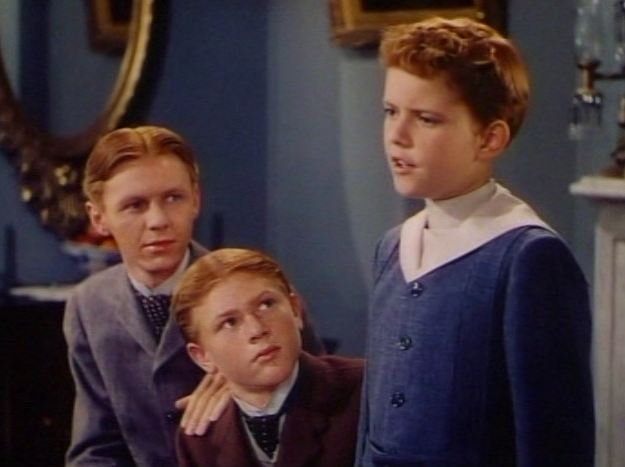
They have a family of four sons, played by Jimmy Lydon, best known for his portrayal of Henry Aldrich (“Coming, Mother!”) in a series of B-movies; a tall 15-year-old Martin Milner in his first film. We last saw Martin here in “I Want You” (1951). Johnny Calkins is next in line, and little Derek Scott plays the youngest. All the boys, like their father, are redheads. Martin Milner reportedly mused that of all the cast, he was the only natural redhead of the bunch.

Monte Blue, from silent film days, gets a brief role as the cop. Zasu Pitts, like Mr. Powell and Miss Dunne, a veteran of Hollywood’s heyday, plays a visiting cousin, but though her role is chipper and chatty, she does not get to display here her tremendous gift for slapstick comedy that we noted in this post on “Bargain of the Century” (1933). It is almost something of a shock to see her act like a regular person, and not that lovable but almost tragically obtuse comic character she created so many years before in Mack Sennett shorts. There’s something vaguely disappointing about Zasu Pitts being normal.  I miss the Olive Oyl warble in her voice, and those hysterical expressions that despite their goofiness seemed to indicate a superior knowledge of the human condition.

Miss Pitts comes to town with a young Elizabeth Taylor. With a handful of films already under her belt, Elizabeth plays her ingenue role with confidence. Much has been written lately in the aftermath of Miss Taylor’s passing about her beauty, her iconic image, and her power as an actress. I can’t refute any of that, but I would note that one scene in this film has always stood out for me, and perhaps it’s because it shows the possibility of an alternate future for Elizabeth Taylor.

I mean the scene where she and oldest boy, the Yale-bound Jimmy Lydon attempt a violin-piano duet on “Ye Servants of God”. She does not recognize the tune, though she is familiar with the words of the hymn on the sheet music. The Day family are Episcopalian, and Elizabeth confesses that she was raised a Methodist. The tune is different in the Methodist church. They make several false starts and struggle badly through the piece.

“It was my fault,” Mr. Lydon gallantly states, but Elizabeth, like a 19th Century Juliet unable to socially bond with her Victorian Romeo:

“No, you’re the Episcopalian.” She then remembers that her father had been baptized in the Episcopal church, but joined the Methodist church when he married her mother.

She was the Methodist,” Elizabeth says, as if she is calling her mother something vile, and it is a sparkling moment of deft comedy. It makes one wonder if Elizabeth Taylor could handle comedic timing so well, so young, what would her career have been like had she not also been so beautiful? Her chirpy voice is an affectation of the moment, but might she have blossomed into a less iconic leading lady, but with a larger range of roles had audiences been allowed to identify with her more and deify her less.

The question of religious affiliation drives a good part of the film, beginning with third son Johnny Calkins constantly seeking help to practice his catechism for his upcoming Confirmation. Still troubled by the “mixed marriage” of her parents, Elizabeth Taylor asks William Powell if he had been baptized Episcopalian, and Mr. Powell jovially confesses he was never baptized at all.

Irene Dunne nearly pops her corset in shock, deeply upset both by Powell’s cavalier insistence that it’s not important, and by the thought that he will not join her in heaven, that they are not really married in the eyes of the church, and that her children are quite possibly illegitimate.

Though she has taken great pains to accommodate the master of the house in all things from scaring away nervous Irish servants, to banishing her new rubber plant, to maintaining accurate household accounts (mostly), she is unrelenting about the horror of his not being baptized and insists he get the ceremony done immediately.

He insists, with what we might consider a quite modern outlook, that he will be a Christian in his own way.

“They can’t keep me out of heaven on a technicality!”

Of course, among Christians, the idea of being a Christian in one’s own way is nothing new. If this were not the case, there would never have been any Methodists or Episcopalians, Lutherans, Quakers, or Baptists, etc. Re-defining, honing perhaps, the essentials of religious practices seems to be part and parcel of what it is to be a Christian.

The movie has a lighthearted grip on this irony, as well as on the elements of Victorian society that also pit tradition versus change. In a scene where Jimmy Lydon asks his father about women, we have William Powell sitting down to tell his son the facts of life, only to sputter about wrong his mother is over her stubborn beliefs. When Lydon wants clarification on men’s relationships with women, Powell turns back into the Victorian father and sternly remarks, “Gentlemen don’t discuss such things.”

Edmund Gwenn plays the gentle minister who makes Powell squirm in his pew (which Powell informs his wife has lost property value in two years - “If the market ever goes up, I’m going to unload that pew.”), by sermonizing on the perils of not being baptized.

“I don’t go to church to be preached at as if I’m some lost sheep!” Powell blusters.

Eventually, Mr. Powell takes his troubles directly to God when Irene Dunne becomes ill. Powell, in a funny, but moving prayer, hollers at the Deity, “Have mercy, I say!” and promises to become baptized if she is spared.

She gets well. It’s time for Powell to pay up, but he still refuses, and it takes a bit more cajoling to get him to the font. It’s another humorous touch that one of the motivating factors that makes him decide to proceed with getting baptized is that the cab Irene Dunne has hired for that purpose is costing him $2 an hour just waiting outside.

One of the sweetest moments in the film is a scene of domestic bliss between Mr. Powell and Miss Dunne, when they sit together, their discussion fading off into a soft duet of “Sweet Marie”. We knew Dunne could sing, but Powell is charming. The camera pans back and we see the stillness, the orderliness of the drawing room with the only movement a slight billowing of the lacy curtains at the window, sifted by the summer breeze. It is a cameo image of the 19th Century.

Michael Curtiz directs this film with his customary economy, but moments like these make one think of Vincente Minnelli.

Another memorable moment is when Jimmy Lydon, wearing one of his father’s old cut-down suits, is unable to kneel in church, or sit with a girl on his lap, or do anything his father wouldn’t do in this suit. The suit seems to control him. When Elizabeth curls up to him, he growls helplessly, “Get up! Get up!” What bigger insult can a young lady have?

The boys try to raise money, and Jimmy Lydon offers his “piece of John Wilkes Booth’s finger” to Martin Milner.

When Irene Dunne laments the newspaper article about a wreck on the old New Haven railroad line because it would disturb Wall Street and therefore her husband: “I do wish the New Haven would stop having wrecks. If only they knew how it upset your father.”

There is, above all, the glorious, just short of scene chewing mastery of William Powell, with his pince-nez glasses on a ribbon, his colossal ranting, and his clear, helpless devotion to his wife. His flirty, “Shall I leave the room?” when Zasu Pitts wants to show Irene Dunne her purchases of intimate apparel.

The horse-drawn streetcar, the quiet country lane that once was Madison Avenue in New York City, and the stereopticon pictures. It’s a feast for the eyes.


And could be a better visual feast if only the film was restored, but it is now in public domain and has become an orphan. (Oh, GAD!)   If you’d like to see it right now, here’s a link where you can watch the whole thing, interrupted by a few commercials. It’s not the best way to see this delightful movie, but even Clarence Day couldn’t argue about the price.

Tuesday, November 27, 2007

Now Playing -1944


“Together Again”, is the aptly titled film reuniting Irene Dunne and Charles Boyer together for the first time since their hit, “Love Affair” (1939). In this comedy, Dunne plays the mayor of small Vermont town and Boyer is a New York City sculptor, with Charles Coburn in a supporting role. This is a full-page magazine ad published in November, just before the film’s release in December of 1944.

Tuesday, November 13, 2007

Love Affair (1939)

“Love Affair” (1939) is the original version of the 1957 “An Affair to Remember” with Deborah Kerr and Cary Grant. The original features Irene Dunne and Charles Boyer, and seems to have a more screwball comedy type feel to it that makes the melodrama at the end all the more poignant.

Boyer is an international playboy who has never worked a day in his life, and Irene Dunne is ostensibly a buyer on a business trip for her boss, but this is only a mask of legitimacy for a carefree socialite who accepts expensive gifts from her boss, whom she does not love. The two of them cross paths on a trans-Atlantic ocean liner, sipping pink champagne and trading smart aleck flirtation in grand salons and even grander staterooms.

We have some pretty good rear screen projection of the ocean behind them as they take numerous walks to the rail to gaze out over the sea (except for one moment when Miss Dunne makes a wide gesture with her arm and we see the shadow of her sleeve on the ocean backdrop). There’s a cute bit of banter between Dunne and little Scotty Beckett, who you will remember from “The Little Rascals” shorts. He plays a little boy performing gymnastics on the banister of a staircase on board ship, and she warns him to be careful.

“You’ll fall and hurt yourself! When I was little like you, I broke my leg.”
“How is it now?”
“It’s all right.”
“Then what are you crabbing about?”

Miss Dunne displays very good comedic timing, and her chemistry with M. Boyer is charming. A very brief, but high note of their journey comes at a port of call where they visit his stately grandmother, played by Maria Ouspenskaya. Her Shangri-La-type villa is a place of otherworldly peace and serenity. There is a small chapel on her property, and when Dunne and Boyer enter for an interesting moment of devotion.

I cannot recall another film of this period (correct me, please, if you can think of others) which illustrates Roman Catholic ritual at a time when most Americans (Catholics not being in the majority) were probably not exposed to it. Director Leo McCarey later gave us “Going My Way” with a Catholic priest as the protagonist, but there was more about the rectory than the Mass in that film. Even Spencer Tracy’s forays into film priesthood did not exhibit demonstrations of Catholic ritual. There had been films with kindly priests counseling gangsters on the way to the electric chair, but few films showing the altar and two lay people going through the act of formal devotions at kneelers.

Miss Dunne replaces the hat on her head that she had removed and carried earlier (pre-Vatican II, cover the heads, ladies). There is an icon of the Virgin Mary prominently displayed, and both Dunne and Boyer cross themselves upon rising from their prayers. It is a simple scene, but quite effective in propelling their romance. The silence and serenity of the chapel creates an intimacy wherein they both feel deeply conscious of each other’s presence, and seem more self-conscious as they leave the chapel. Up until now their flirtation had been harmless and shallow. It is their time spent at the villa, starting with the chapel scene, that their romance really begins.

Another lovely scene is when Mme. Ouspenskaya, whose frail, European dignity is contrasted with Miss Dunne’s tall, healthy, corn-fed, American vigor as they prepare tea. Mme. Ouspenskaya plays the plaintive “Plasir d’Amour” on the piano, and Dunne sings the chorus. The focus is on Boyer as much as the ladies, as we see how affected the carefree playboy is to see the two most important women in his life together and here is where he really begins to fall in love. When the distant sound of the boat horn announces they have to get back to the ship, Maria Ouspenskaya tears up with the almost childlike whimper, “I hate boat whistles.” They leave, but not before Dunne’s sensitive character comes back for a final hug and kiss, knowing that not just they, but life, is leaving this lonely old lady behind.

Back on the boat the couple are confronted with the suspicious, nosy glances of their fellow travelers eager for a bit of gossip, and we trace their voyage with a cartoon boat proceeding on a line across the map. Anytime I travel, I always look out the window for these movie indications of the conquering of distance, but it never happens. This has always been a disappointment.

Acknowledging their love, they firmly resolve to separate and make something of themselves before they can be together. Miss Dunne gets to sing a bit more, and M. Boyer becomes a famous artist, which leads to the final melodrama. When he sees his painting of her in her apartment, which his agent gave to a poor lame woman for free, he realizes she is the lounging on the couch with a blankie over her legs because she can’t walk, not because she callously jilted him by not showing up at their rendezvous point on the top of the Empire State Building a year before.

This is a bit more maudlin in the remake, and I think what makes it work here is Boyer’s wonderful expression of humility, even more than sympathy, in the presence of the self-sacrificing woman he still loves. Only moments before he is full of haughty anger and pride, and pushes her into lying about why she missed their appointment. It is a sudden shift, which has us off balance and leads to a breathtaking ending. Such sentimentality seems more out of place in 1957 with the smooth Cary Grant and the cool Deborah Kerr. Dunne and Boyer do not seem as sophisticated, the times do not seem as sophisticated, for all that pink champagne, and that makes these two oddly more believable.

Related Products