IMPRISON TRAITOR, PEDOPHILE, AND CONVICTED FELON TRUMP.
Showing posts with label Walter Baldwin. Show all posts

Thursday, November 15, 2018

The Desperate Hours - 1955


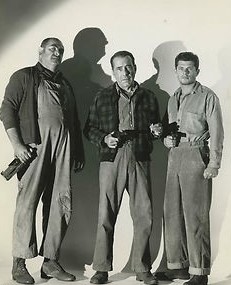
The Desperate Hours (1955) brought the escaped convict genre to suburbia. That’s where everyone else was headed in the 1950s, and the house in the neighborhood is as much a character in this film as the three outlaws and the family they terrorize.

This is our entry into the Outlaws blogathon hosted by the Classic Movie Blog Association. Please check out this link to read some other great blogs on this sinister subject.

In The Desperate Hours, Humphrey Bogart plays the lead bad guy in his second-to-last film and the very last bad guy role he was to play in movies. He shows he’s still got it.

Dewey Martin plays his younger brother who has broken out of prison with him. The third member of their gang is played by Robert Middleton, who is arguably the most frightening member of the trio.

The movie begins with an audience perspective shot as we move down a suburban subdivision. There are lawns and trees, children, a dog or two, people walking on sidewalks. It is deceptively peaceful. The camera moves very quickly to one particular home on the block. If the house looks familiar to you from the outside that’s because two years later, Beaver Cleaver lived here. The television sitcom Leave It to Beaver (1957-1963) used this exterior for the Cleaver home.

Fredric March is the head of the clan, doting father and husband and executive, who works “downtown,” a place which with the settlement of suburbia has become more distant and vaguer to us.

Martha Scott is his wife; Mary Murphy is his grown daughter; and the wonderful Richard Eyer, who as we’ve seen was such a standout in films here like Friendly Persuasion (1956) and here in Slander (1957), plays his young son.

Though we see the family gathered together for a cheerful, if rushed, breakfast, it is not all idyllic on the home front. Fredric March does not approve of his daughter’s latest boyfriend, a hotshot young lawyer played by Gig Young. She is rebellious and they argue in the car when he drives her to work “downtown.”

Young Richard no longer wants to kiss his father goodbye when he leaves for school; he’s too man for that now and he does want to does not want to be known by a nickname anymore. He’s an All-American boy, pretty much goes his own way and his sudden streak of independence, while cute in this scene, is going to prove to be a greater problem later on when he tries to rebel against their captors.


The story was written by Joseph Hayes from his novel and his original script which was performed on Broadway at the Ethel Barrymore Theatre from February to August 1955, the film’s release year. For some years thereafter, it was a popular summer theatre play and the two-level set which was required to tell the story of showing the family in different rooms with the bad guys was always a challenge and always a hit on stage. We take things for granted like a two-story house in the movies, but on stage we appreciate more the architectural skill it takes to build and to work on a two-level open set.

The Broadway version was directed by actor and director Robert Montgomery. Karl Malden played Fredric March’s role as the suburban husband and father, and Paul Newman played the Humphrey Bogart role. We can imagine that the younger gangster in the mid-1950s might have carried a more sinister suspense story because the brothers would have been contemporaries and because they might have appeared more violent and impetuous.


Though Bogart is a generation older than his brother played by Dewey Martin, we can accept them as brothers and accept that Bogart, even though famed for playing dangerous criminals, serves a different function in the screen version. His is rather like a parallel to Fredric March, than to his partner younger brother.  Like March, he is the head of his family, or his gang, and he sometimes has trouble keeping them in line. Fredric March bristles at his daughter’s romance, believing her to still be a kid. Humphrey Bogart is stumped when later in the film his brother rebels not just against his authority but against the whole way of life in which his big brother has raised him.

Bogart and his gang have chosen this house at random, which is certainly an eerie aspect about the story, it could have been any home—maybe even yours. Bogart’s reason for choosing this house was that Richard Eyer has left his bicycle on the front lawn. Bogart knows he would be able to make the family more fearful and more easily cooperative if they have to protect children. This tells us that he has some experience and logic in his craft, and also that he would prefer not to have any trouble if he could avoid it. He intends to hole up here until he can arrange for a former girlfriend to bring them money to escape.  But he also wants to go after the deputy sheriff responsible for putting him in prison.

Arthur Kennedy plays the deputy sheriff, who is the only one among the police officials to take the news of the jailbreak seriously, feeling certain that Humphrey Bogart is coming straight for him. He is not so paranoid as he is analytical, just as logical as Bogart or Fredric March is in this scenario. There is an attempt to turn the story into more or less a triangle to include the efforts of the police to trace Bogart’s whereabouts. This is obviously not something that would have been easily done on stage where the whole story was pretty much set in the home.

Note Bogart’s disgust when he sees that March, whom he resents for his middle-class respectability, has only $800 in his bankbook.  In that era, it would have represented probably something like three or more months’ wages saved.  That may not be terrific in Bogart’s eyes—he’s after all the marbles—but today when it is estimated that only about 18 percent of Americans have three-to-five months’ savings in the bank, then this family is doing okay.

The movie also gives us a lot of familiar faces to pick out in the crowd, Ray Teal as the state police detective, Alan Reed (Fred Flintstone) is another officer, Ray Collins, Simon Oakland will also play police officials, Whit Bissell plays a pensive and intellectual FBI agent. Beverly Garland plays the teacher who drops by and in front of whom March must pretend to be bringing home drinking buddies to cover for her seeing the bad guys. Joe Flynn plays a panicky motorist taken hostage, and poor Walter Baldwin plays the junkman in the greatest danger of all of them.


Shortly after father and daughter leave for work, and Junior’s off to school, mom Martha Scott begins her housecleaning. She brings along a portable radio into every room to listen to music and, of course, to give us the opportunity to hear the news bulletins about the escaped convicts. Later on in the movie, Humphrey Bogart will smash the radio in a fit of anger.

It is interesting that even though this film was released in 1955, we see no television set in the home. It is more than likely that by the mid-1950s, a middle-class home such as this would have a television. I’m not sure why they don’t include one, either because it didn’t figure into the plot, or because the film industry was still chafing with resentment over its new competitor and didn’t want to acknowledge its existence?  Though Fredric March drives an older model car, the movie is not set in the late 1940s—Gig Young’s flashy sportscar alone tells us that.

We might think today that the TV would be a better place than the radio for news bulletins, but this was long before 24-hour news and also it was an era where news broadcasts were infrequent and brief. There were usually only one or two news programs lasting all of about 15 minutes from the 6 o’clock to the 7:30 time frame in the morning, and it was much the same in the early evening from 6 o’clock to about 7:30. We might have one or two news programs 15 minutes in duration. Television news did not really come of age until the 1960s, and much of that, sadly, was launched in the aftermath of the Kennedy assassination. Newspapers were still king of the news--even of bulletins, with the ability to produce "extras" several times a day.

Robert Middleton, the large hulking Neanderthal of the bad guys with one presumes the IQ of a child, plays with Richard Eyer’s toys in his room and break some of them in frustration when he smacks his head while looking out the window.  He fumbles with a toy bank that looks like a little safe, and he cannot open it. At one point he takes a toy gun and blasts it around the house until Humphrey Bogart tells him knock it off. In one scene—one of director William Wyler’s touches, while Bogart is terrorizing Martha Scott in the foreground, in the background we see Middleton drinking from a milk bottle and spilling it down his chest (just as the boy will do later).  These images of the buffoon are only half-comic.  They also point to Middleton’s mental instability, which is the most dangerous thing about him. These fellows had been in prison, we don’t know for how long, but it’s possible that television would have been a complete novelty to them. I imagine if Robert Middleton’s character was so enthralled by Richard Eyer’s toys, then he might have enjoyed CaptainVideo or Hopalong Cassidy.

Bogart snidely says of Middleton to Martha Scott, “Crude, ain’t he?”

Bogart is commanding in his sneering, angry role, indeed, it is a role he has played many times. There is stubble on his face and over the phone he calls his gun moll “Doll,” like a man from another era, and he is supposed to be. He has no place in modern society.


His younger brother, Dewey Martin, feels this more acutely than Bogey. He is more wide-eyed at the appearance of the house, and at the nubile young daughter. At first, when he enters the daughter’s bedroom while she is at work and sees her canopy bed, he touches the frills on the canopy and brushes his face seductively on them.  It is an image which causes us to think he will present a sexual threat to her, but when he meets the girl and examines the whole house more closely, there is an unexpected change in him.  He is strangely awed and respectful of this world and its people.

Interestingly, the scene with her canopy bed reminds me of the scene in Wyler’s other film The Best Years of Our Lives (1946) when Dana Andrews wakes after a drunken night in Teresa Wright’s canopy bed, and he amusedly blows on the canopy’s frills, surprised to find himself in such a feminine haven.

When father and daughter come home from work, and Junior comes home from school, the entire family is held hostage and they are moved from room to room at gunpoint. In some scenes, it even looks as if they are camping in their own home as they try to stay together.

Martin seems more than attracted to daughter Mary Murphy; there is a shy, almost boyish crush he exhibits for her. Bogart notices the attraction and jokes that when they leave, they will take the daughter with them as a hostage just as a present for his younger brother. It is a chilling moment.

But the brother protects the girl from Robert Middleton, who is a far greater danger not only to her but everyone in the house, even to Bogey, because he is so undisciplined and so mentally unstable.

The real terror in the film comes from the sudden destruction of the blessed normality of their everyday lives. They live in a world of 1950s conformity, and though it may get a little stale sometimes, they know they are safe there. Their safety has been shattered not necessarily by three escaped convicts, one of them with a gun, but that the normality is gone and the unknown has entered their lives.

One gun becomes two as Bogart discovers that the family keeps a pistol in the house. This evens up the score a little and makes Bogart happy because Middleton has the other one.

But there is an even greater danger to Bogart than Robert Middleton’s instability. It is his younger brother. Dewey Martin doesn’t want to take over his brother’s life of crime anymore. When Bogart tells him to stick with him, that he got them out of prison and he will take care of him, that he taught him everything he knows – a common manipulation used by the heads of families to keep the younger in line – Dewey Martin disgustedly replies, “You taught me everything, except how to live in a house like this.”

If Dewey Martin was not dissatisfied with his life in prison, he certainly is now because he sees a glaring comparison to how his life has gone. This is a nice home, with a nice family. If Mary Murphy’s beau, Gig Young, is not welcomed by her parents, then what chance would he have? Even though he respectfully calls her, “Miss,” and calls Fredric March, “Sir.”


The family has its own struggles, its own splinters and breakdowns, and coming together. Unfortunately for Fredric March, who tries to shepherd his family through this terrible experience and proves himself to be courageous and very intelligent in how he manages to outmaneuver the bad guys, his greatest handicap is also his greatest treasure – his family. Neither his daughter nor his son obey his explicit instructions and they mess things up, even his wife rebels and throws a monkey wrench into the works. At some point we have to wonder if March just wants to throw his hands up and yell, “All right then, go get yourself killed! I’m sick of talking to you people!”

But he doesn’t. At one point when he is allowed to leave the house on a mission for the bad guys, he stumbles onto the dragnet by the cops who have traced Bogart’s whereabouts, and he has to plead with them to allow him to go back in to mediate the situation because he doesn’t want them shooting up his house and killing his entire family. They reluctantly agree, but give him a gun. He empties it of all the bullets. He takes it with him. The cops think he’s nuts, but we see in the course of his last gambit that he is more clever than anybody.

It is an intricate and interesting movie and fast-paced but I won’t linger too much on the heroics of the family. This blogathon is about outlaws. In the tradition of classic films, none of these outlaws comes to a good end.

We may not mourn Robert Middleton, he’s just too scary and too bad, and has already committed one murder right before our eyes.

Dewey Martin has the greater share of our sympathy and how he meets his end is entirely accidental and tragic because he is escaping his brother and a life he does not want.

Bogart plays his cards all the way to the end, and it’s just March and Bogart at the end. March has outsmarted him because he has managed it so that Bogart holds the gun with no bullets in it.

When March has his own gun, Bogart sneers, “You ain’t got in you.”

March growls, “I’ve got it in me. You put it there.”

Then March does something so effective and perhaps even cruel, to get back at Bogart. Having heard the news about Bogart’s brother’s death – which Bogart doesn’t know – March tells him how his brother died and he sneers and shouts, “You did it! How do you like it?”

This is really the end of Humphrey Bogart. Yes, he has a few more minutes in the film, and yes, he rushes out into the police spotlights and drops down on their front lawn only a few feet from the boy’s bicycle that had brought him to the house in the first place, but it was really upon hearing of the death of his brother, the end of his family, and the collapse of his authority that kills him.


Some may say that Bogart was a little too old to play this role, especially if they had seen Paul Newman play it on Broadway, but this is a different interpretation. Movies are different from plays. We wouldn’t have had all the cops in the play, we wouldn’t have all the bicycles, the milk delivery trucks and the sound of crickets in the evening. We wouldn’t have had March’s bewildered office staff in front of whom he has to pretend, we wouldn’t have had the roadhouse where Dewey Martin tries to escape. We wouldn’t have had the town dump where Robert Middleton commits a cruel and vicious murder.

Bogart was in his element in this role because Bogart was in his own world. Hollywood at this time took its gangster movies from the faux city streets of its backlot and soundstages, to a wider and somehow more complex world on a backlot suburbia. The Cleavers would move into that house – on television of course – and the conformity of suburbia would cover over Bogart, Dewey Martin, and Robert Middleton, like a blanket of snow, masking the ugliness, but not obliterating it.

The 1950s introduced us to new bad guys – psychos, rebellious youth, juvenile delinquents. They would be more at home here in suburbia. They could not be gotten rid of so easily, like the crabgrass on the lawns of the middle-class homeowners; they were rooted and endemic.


Please visit the Outlaws blogathon hosted by the Classic Movie Blog Association for more great entries on bad guys in film.

Thursday, December 4, 2008

I Want You (1951)

On December 4th, in 1950, when the Korean War was roughly about six months old, Navy Ensign Jesse L. Brown was shot down near the Chosin Reservoir. His wingman, Lt. Thomas Hudner crash landed his own plane on purpose to try to rescue Brown, but even when a rescue helicopter arrived to help, they were unable to free Ensign Brown from the wreckage of his Corsair. They were forced to leave him there, and Jesse Brown died.

That Ensign Jesse Brown was the first African-American Naval aviator in a newly desegregated U.S. armed forces, and that Lt. Hudner later received the Medal of Honor for his daring attempt to rescue his pal are more than footnotes to the tragic story. This shadowy war is a grim backdrop, but a curiously subconscious one to the movie I Want You. It’s seldom discussed out in the open; it’s just there somewhere on the radio and in the back of the mind.

I Want You (1951) is roundly acknowledged to be producer Samuel Goldwyn’s Korean War answer to his wildly successful World War II era The Best Years of Our Lives (1946) discussed here. When I Want You succeeds, it is in moments of unconscious reflection that World War II might as well have ended one hundred years ago as five years ago, because the world is in a different place. The movie creaks a bit with slavishly trying to use Best Years as a template, though this must have been understandably irresistible to the Goldwyn staff. Despite this, it is a valuable film for showing us what 1950 looks like, even if inadvertently so.

At the outset we may note that the “template” aspect of using The Best Years of Our Lives is employed first by using a handful of familiar actors from that film. Walter Baldwin, who played the worried father of disabled sailor Homer Parish in Best Years here plays the worried father of young recruit George, Jr., played by a very young Martin Milner. Ray Collins, who memorably played the insincere and controlling bank executive boss of Fredric March in Best Years here plays another man of great power over others, a judge who sits on the local draft board.

Most especially we have the central figure of Dana Andrews, who stars as a World War II vet, a husband and father, who runs a contracting firm. Sitting at a work bench, fiddling with a slide rule in his work shirt, the kind he wore at the end of Best Years when Fred Derry is finally offered a job in construction and peels off his iconic bomber jacket to go to work, Dana Andrews’ character, Martin Greer, is presented to us almost as an extension of Fred Derry. This is what Fred might have been like five years down the road, working in construction, sharing a modest suburban home with wife and kids. It’s the kind of thing Fred Derry used to dream about, but was afraid he wasn’t good enough for, or not lucky enough to ever have. We finally get to see Fred’s happy ending.

But in real life, happy endings are usually temporary. Then a new story begins.

Much of the film involves the contracting firm as being the key to avoiding the military draft. The World War II draft that ended in 1947 was reinstated in 1948 to be implemented for young men who were required to serve 24 months, eventually discontinued in 1973. The draft became a sword hanging over the heads of millions of young men and their families when hostilities broke out in Korea in the summer of 1950. Dana Andrews’ younger brother, played by charming and handsome Farley Granger, is a prime candidate for the draft, and so is his young employee Martin Milner, whose father Walter Baldwin also works for the firm.

Dana Andrews is being pulled in all directions to label the young men under his charge as “indispensable” to excuse them from the draft, like Noah pulling animals out two by two to be saved on the ark. He easily could save his brother, for as his mother reminds him, their family has given enough to their country. Another brother was killed in World War II.

The film begins with a kind of flashback to The Best Years of Our Lives, in an aerial shot of his small town, emulating the ride that the three returning vets took at the beginning of that movie, swooping low over the town. In Andrews’ narration, the scene is described as what the town would look like in a bomber run. His narration, like the character himself, is somewhat world-weary. In his voice over introduction he admits, “I don’t run as fast as I once did. I don’t sleep as well.” When he loosens his belt under the table while enjoying a big meal, he contentedly lets us know that he is going to “retire with honor” from ever being young again.

Dana Andrews also calls his father, who drinks too much, “Pop,” which what Fred Derry called his alcoholic father. His father is a bit of a fool, a man who brags too much, eats and drinks too much, and continually recounts his glory days in World War I as if he’d won that war by himself. He shirks his work at the family contracting business to socialize at the bar down the street. For all that he appears harmless and lovable, and as a result, his careworn wife appears aloof and strained, probably because she has had to bear on her shoulders the responsibility that her husband avoids.


Andrews’ younger brother is played by Farley Granger. He is a likeable rogue and as much a goof-off as his father, and borrows money from an indulgent sister-in-law played by Dorothy McGuire. Granger playfully tells her, “When I get married, I must make sure to find somebody just like you.” He will all but insist that his girlfriend played by Peggy Dow take her for a model, and there lies one of many interesting differences between the World War II era generation and the Korean War generation, even though they are not really of different generations. They might as well be. Though it is only five years since the ending of World War II, the young people are different. Their world is different. And the next generation that is really a generation apart, the little son and daughter of Andrews and McGuire, read comic books about superheroes with atomic powers.

Peggy Dow is a college girl, sassy and independent, with no immediate desire to get married, so she says. She is not the small-town beauty queen that Dorothy McGuire was when she married her solider husband on a weekend pass. Miss Dow has far more advantages and far fewer cares, yet unlike Miss McGuire’s character, has no real ambition for herself, no purpose and no direction. And the young Farley Granger is clearly not his brother. He’s not a serious solider with serious post-war dreams. He’s a happy-go-lucky guy still storming about in the same jalopy he was so proud of as a high school kid. Granger resents her college education and sulks at her time away from him.

Clearly, Dow’s college career is seen by her, by Granger, and possibly by her parents as little more than finishing school experience. This was an era where some, though certainly not all, young women went to college not to obtain credentials for a particular career but to obtain upwardly mobile college men as husbands. We get the feeling Miss Dow is toying with Granger, holding out for something better. She ruminates that “maybe” she will one day get a job.

One of the best lines in the movie goes to Jim Backus, who plays Dana Andrews’ former colonel, “You still salute like a WAC in the Bulgarian Medical Corps.” Backus, who commanded Andrews in an engineering unit, might take a job with his contracting firm, but is waiting to see what transpires with this news from Korea. Backus might re-enlist.

They discuss building being an essential industry and their being fortunate to be considered “indispensable.” Andrews is too old to be drafted and has no desire to return to the military. He intends to apply for the exemption to which he is entitled. Their conversation, a casual plot exposition for our benefit, suddenly seems heartless when we see that his employee played by Walter Baldwin, the father of Martin Milner, has been listening. Only the evening before, Dana Andrews refused, though gently and politely, to write for a deferment for Milner. Baldwin is seething in his resentment.

Milner, called Junior by everybody, which he hates, is looking forward to the Army because he desperately wants to be a man. He is told, by the bombastic Robert Keith who plays Andrews’ foolish father, that the Army will make a man of him. Andrews invites Milner for his first beer to celebrate joining the army, but the bartender refuses to serve him, because he is only 19. Another WWII vet at the bar razzes him, and Milner barks back at him, “Because you guys were old enough to be drafted in the last war, you think you’re something. It wasn’t my fault I was born in 1931.”

Poor Junior is suffering from what every generation of young men experiences who have followed in the wake of heroes. They are emasculated by their very youth and lack of exposure to danger. We can imagine how acute was the humiliation of young men, both North and South, who came after the generation that fought in the Civil War. No matter what wealth or fame they achieved in their lives, they would never be a great as the private who suffered through the heat of Gettysburg and the mud and cold of Fredericksburg.

But then the radio behind the bar announces worse news from Korea, and the bartender grants Milner his beer. We may recall Homer Parish, hoisting a pilsner glass in his prosthetic hook in his homecoming visit to his uncle’s bar in Best Years. Homer is relaxed, and looking very manly with buddy Dana Andrews by his side, who is already half drunk and both happy because they think the worst is behind them. How stark is the contrast with Milner, who hoists his first beer with boyish excitement, and how Dana Andrews by his side watches him a little sadly. All the men in the bar watch Junior in complete silence, knowing better than he what he is in for.

Perhaps the scene still plays in Dana Andrews’ mind when he sits down late at night to try to write an excusal letter for his brother. But the radio interrupts again with news about action at some parallel. It is a war of “parallels” and not very parallel to World War II.

It is interesting that we do not see a single television set in this film. Though most people did not own one in 1950, some people did and perhaps we are still at the stage where movies are ignoring the enemy.

Retiring to find his wife still awake, Andrews remarks with his world-weary demeanor that the news is the same, “People shooting each other as usual. On the domestic scene, hair tonic as usual, rumbas as usual, saloons as usual.” In a world more parallel to the one we know today, the home front is disconnected from the frontlines and society seems rudderless because of it.


Miss McGuire sits up in her twin bed, her knees drawn up to her chest and asks wistfully, “Are you pleased with me? Has it turned out the way that you wanted back in that miserable little Louisiana town when you got your weekend pass and we got married?” In a very sweet scene teasing the Production Code, he sits on her bed and rests his head on her knees as they talk quietly. It’s really more a rhetorical question, and we find this husband and wife, this World War II couple, habitually re-evaluating where they are and where they are going. They take nothing for granted. They have been through too much to take anything for granted. Another difference between them and the younger set, who seem to own the world.

Farley Granger, much more self-confident than Martin Milner, and much more carefree than his older brother ever was or ever will be, gets angry when he is ordered to report to the draft board. Andrews could not bring himself to write the request for deferment, though never articulates why.

Granger’s girlfriend’s father, the judge, sits on the draft board and for a moment we get a brief lesson to Granger on freedom and how other people in the world don’t have any. But it bounces off the fuming Granger, like telling a little kid he should eat his spinach because people in some other country don’t have any. The little kid doesn’t care, and neither does Granger.

We get another lesson in geopolitics when Dana Andrews’ little son shows a neighbor lady his toy B-17 bomber, a gift from his war-mongering grandfather. The lady is a British war bride, and she relates her experience of being bombed in London. Like all young children, he is nonplussed, and helpfully tells her that in school they learned to “duck and cover” when the atomic flash comes. He giddily romps behind a tree showing her how. I don’t know if that broke anybody’s heart in 1950, or if because we’re more aware of the futility of jumping behind a tree during “the flash” that it’s so heartbreaking now.

But his young uncle Farley Granger has a similarly defiant and naïve attitude about atomic weaponry. So self-pitying is he to be drafted, he sulks aloud that he was “railroaded” by his girlfriend’s dad to get rid of him, and wishes that we would just “drop the bomb” so he wouldn’t have to go to Korea.

Dorothy McGuire has a good scene here where she calls Granger down on the carpet for being so immature and heartless. Her moral outrage over his indifference to millions of innocent people shows us she is not just the settled suburban housewife. She is still in her heart the idealistic bride of a soldier who left his wife to make a better world, honestly believing that he would.

Her chastising Granger brings down a family rift between her and her mother-in-law, who shortly gets a fantastic scene of her own. When Granger leaves for duty, Mom, played by Mildred Dunnock, rips down all the old World War I souvenirs that Pop collected and hung on the living room walls, making their home look like a boy’s clubhouse. She knocks all the empty shell casings off the mantle, tosses aside bayonets and helmets, and berates him for what she has known all along: he was an orderly to a general in World War I in a Paris hotel. He never heard a shot fired. She calls him a liar to his face.


Robert Keith slinks, humiliated, to a chair, as she shouts, “Your son Riley was killed; you were proud. When Martin was missing for four days in France, it made you feel important…As of this evening, there are no more professional heroes in this house!” The backbone of the family has had it, and there will be only reality served up in this house from now on.

Strong women seem to be a thread running through this film, as even Peggy Dow confronts the still whining Farley Granger on his accusations against her father. She counters that her father was wounded in World War I, with the shrapnel still in his body and suffers pain every day of his life. He has kept this secret because he does not want pity. Granger, so deeply mired in his own self-pity, no sooner makes up with her than he churlishly goads her into marrying him despite her protestations. He wants her to be like his sister-in-law, to follow him from assignment to assignment.

This being an ensemble movie, we jump from character to character and most of the threads of their stories are held together pretty well. Milner and Granger, both in uniform, have a night on the town, which the jubilant Milner predicts, “It’ll be V-J Day all over again” as they imagine swarms of girls surrounding them. Another feeble and out-dated reference to World War II, and they are disillusioned when it does not happen. Milner even confesses to Granger that he has never kissed a girl. He gets his chance at the Army making him a man, though, when he is shortly sent to Korea and is listed as missing in action. “That poor little boy,” Miss McGuire remarks, and Jim Backus shakes his head, “That little boy.” Even after his sacrifice, Milner will never be called a man.

We wonder if Farley Granger will grow up. He is not going to be sent to Korea; he has drawn a luckier card and is being sent to Europe. He gets his war bride after all when Miss Dow quits college, like so many young women of her generation did, to marry him. When they leave on their honeymoon, it is in his teenager’s jalopy.

Eventually we get back to Dana Andrews’ date with destiny. We know, though it is not hammered at us, that he is tormented about re-enlisting. Jim Backus goes back into the Army and requests Andrews as part of his runway-building crew. The very essential industry of building that makes Andrews eligible for deferment, also makes him indispensable to the Army.


The notion of who is indispensable is given subtle but clever examination in the movie. Maybe nobody is indispensable, and maybe everybody is. Milner’s heartbroken father spends a lot of time at the bar down the street now. In a confrontation with Andrews, he broods on some people’s luck at being indispensable, and mourns of Junior, “Maybe he was only indispensable to me.” Sorrowing Walter Baldwin scoffs at the radio behind the bar with its updates on the war, “Bad news traveling from one end of the world to another before you can blink an eye.” He should see CNN. Or the Internet.

Mr. Andrews comes to conclusion that he can no more demand an exemption from service for himself than he could Milner or Granger. His simple articulation of this complicated decision to his wife is only, “I’ve got to make peace with myself. Ever since I was 15 years old I’ve thought of myself as honest and responsible.”

No mention of fixing of the world’s troubles; that is the remarkable thing. No end in sight to the troubles, either.

One of the most affecting scenes in the film is when Dana Andrews puts his children to bed the last time before reporting for duty. He weaves a bedtime story for his daughter who falls asleep in his arms, about a princess who is partly her mother and partly herself. He is the picture of a man of his era, in his shirtsleeves and his burdens. He tells his wife that someday his son will want to know what Daddy did “when the world was going to pieces” and he wants to be able to tell his son he did more than build luxury hotels. In the hindsight granted to us old movie fans decades later, we know both his son and daughter will come of age during the Vietnam War, and they may never understand him. Only his wife understands him.

It is peculiarly fitting that their farewell takes place not at a crowded train station, but in their own quiet living room, the Shangri-La of the 1950s suburban couple. Miss McGuire sighs, looking around the room, “This is nice. This is a nice house, isn’t it?” It’s not just small talk before the final goodbye. It’s another re-evaluation of where they stand as a couple and where they are going and what they have accomplished together.


Embracing her, Andrews’ voice seems to catch when he says, “Your nose. I’ll never be able to get over your nose.” He might even cry in another moment. Dana Andrews plays the heart wrenching combination of sad and valiant like nobody. In any film, he can be terribly moving when life forces his character to face facts.

His father has faced facts as well. Andrews and Pop hug when it’s time to say goodbye, something pretty unusual in Hollywood films of this era to see two men embracing.

Our hindsight will also cause us to remember that the Korean War never really ended. An armistice was signed in 1953, but no peace treaty. Technically, North and South Korea are still at war, and therefore so are we. Even the morass that was the Vietnam War ended. Today, long after Jesse Brown died, in the cold of a long ago December 4th, there are U.S. military personnel on duty in South Korea on guard near the Demilitarized Zone. They could be the grandchildren or even great-grandchildren of Dana Andrews’ character Martin Greer.  Or Fred Derry.
*********
Jacqueline T. Lynch is the author of Ann Blyth: Actress. Singer. Star. and Memories in Our Time - Hollywood Mirrors and Mimics the Twentieth Century. Her newspaper column on classic films, Silver Screen, Golden Memories is syndicated nationally.

Related Products