IMPRISON TRAITOR, PEDOPHILE, AND CONVICTED FELON TRUMP.
Showing posts with label Ann Doran. Show all posts

Thursday, September 20, 2018

The 1930s - Then and Now - #3 - Wild Boys of the Road (1933) and Girls of the Road (1940)


Wild Boys of the Road (1933) and Girls of the Road (1940) are vivid portrayals of the youthful perspective on the worst years of the Great Depression. The teens and the young adults facing the national economic crisis probably understood little of its causes and were helpless to change the course of the deeply troubled economy.  While feeling the same brunt of the calamity as their fearful parents, this generation that President Franklin Delano Roosevelt would later say “has a rendezvous with destiny” when World War II began could still show resilience and optimism that their elders no longer possessed.


Wild Boys of the Road, directed by William Wellman, is a message film, as many films during the Great Depression with “the times” as its topic inevitably had to be, but the story is well told, vigorous, and without the preaching nature, except for perhaps the last ten minutes, as a film like Our Daily Bread (1933) which we discussed last week here and which was made in the same year.

Wellman was a master at shooting stories full of dramatic action, and this pretty simple tale of teens following the well-worn, desperate trail of hoboes to find work because they cannot find jobs in their own town, has moments that are fiercely compelling.

The start of the movie couldn’t be more deceptive. Frankie Darro has the lead as Eddie and Edwin Phillips plays his best pal Tommy. They are a couple of high school sophomores going to a dance. Their girlfriends are giggly and sweet and inconsequential to the story and we lose them at the beginning of the picture. Somehow, they don’t belong to the rest of what’s going to happen to Frankie Darro and Edwin, and by the end of the picture we can’t imagine these boys ever going back to those girls. They indeed have traveled a long way and they will never be who they were when they were just a couple of kids going to a high school dance.

It is an evening of white trousers and dark coats and ties, of tentatively waltzing to “The Shadow Waltz” (a hit that year in Gold Diggers of 1933 discussed here, and it’s fun to note the string of songs played in the background in this movie, including “Pettin’ in the Park” at the dance, and “We’re in the Money.”)

Darro drives an old broken-down jalopy with witty sayings and phrases on it, just as apparently all his friends do, and though his romance with his girl is innocent we can see by the verbiage on the car that he is the all-American boy, with the hormone-driven predatory attitude for high school girls. This makes his later empathetic relationship with Dorothy Coonan, a hobo girl they meet on the top of a boxcar, all the more poignant.

Note the box of Lux soap in the storeroom at the high school.

These early scenes could be right out of one of the Andy Hardy movies, and after the high school frolics when we are told that Phillips must find work because his widowed mother has only a roomer in their home for income, and Darro learns his father has just lost his job, we might think Andy Hardy is going to rush to the rescue and put on a show or collect bottles or do something to help his folks.

Grant Mitchell, his dad, acknowledges with brave humiliation that as a middle-aged man it’s going to be very difficult for him to get hired again. Darro shows sensitive concern and we have a long sequence where he manfully sells his beloved jalopy for $22 and gives the money to his dad. It’s a nice thing to do, and Darro is not an aw-gee-shucks kind of actor; he is actually quite a good, sublimely subtle dramatic actor who understands the intimacy of the camera (as well he should, having been in silents since a small boy) and we believe him. There is something a little bit more Dead End Kids about him than Andy Hardy, but even though he is fearless and smart mouthed, he is still an innocent.

A couple of months go by and Phillips has not found work, and neither has Darro’s dad. Phillips decides that he’s going to head for the open road because it will be one less mouth for his mother to worry about and she can manage for herself on the money from the roomer.

Darro comes to the same conclusion, that it is futile to find a job in this town and both boys quit school.

They really don’t know what they’re getting into, of course, and so it really starts as a boy’s own adventure. They bring a bag of sandwiches and a hop a freight. Their first rough encounter is with another teen hobo who hauls off and slugs Darro, who is amazed and somewhat appalled to discover that the bloody nose was given him by a girl, named Sally. It’s a funny bit when he tries to continue a conversation with her and he keeps his arm up to guard himself because she’s a very good fighter.


Sally, played by freckle-faced Dorothy Coonan has left home as well. (About six months after this film was released, Miss Coonan would marry Director Wellman, some twenty years her senior, would leave her film career and become the mother of seven.) Her mother has died and she has decided to go live with her single aunt in Chicago so that, like Edwin Phillips, there will be one less mouth to feed at home.

It sounds like kind of a maudlin phrase, “one less mouth to feed,” but it was an extremely common sentiment not just during the Great Depression but certainly before that in the many ages of destitute families and not enough food to go around. Many older children were put to work early or simply just put out of the house.

So many teen boys joined Roosevelt’s Civilian Conservation Corps for just that reason, to save resources at home and not be a burden.  My father did.

The duo becomes a trio and there is something very goodhearted and tender in the way that Darro and Phillips relate to Dorothy Coonan. We have seen Darro’s high school girlfriend and his girl-chasing sentiments painted on his jalopy, but his reaction to Dorothy is sometimes protective and at other times a genuine equal partnership, and we sense that he cares about her and needs her as much as he does Edwin Phillips. It is a friendship without sexism and they have an odd mixture of the sense of responsibility of adults and the innocence of children.


They arrive in Chicago and Sally’s aunt, played by the wonderful and versatile Minna Gombell, welcomes them into her apartment and feeds them a very large chocolate cake about the size of North Dakota. There is a player piano in the apartment playing some kind of bluesy tune, which is a signal to us that all is not right; and indeed, there is a man and a woman sitting at a table drinking. While the kids are in the kitchen chowing down, the cops raid the place and take the three grown-ups off. The kids beat it out the window. Apparently, Auntie is involved with a pretty rough crowd even if she seems very nice.

They are back on the road and the longer they travel, the more hoboes they meet:  Young people like themselves, older men, other girls all dressed to disguise themselves as boys for safety, African-American kids, and always in every train yard a crowd of mean railroad cops with clubs.


We get our moment of pre-Code salaciousness when one girl hobo played by Ann Hovey, tarries alone in a boxcar at a fire to dry her sweater. She pulls it off and sits in her bra to warm by the fire, when a brakeman played by Ward Bond sees her and he gets fresh. When the kids later come back for her they see her disheveled, terrified, and we discover without so many words that Ward Bond has raped her. “He put his hand over my mouth so I couldn’t scream!”

As we know, this line and this situation is the least “dated” thing about this movie. It’s happened before, it’s happening now. Perhaps we have become too cynical about hearing those words, having heard them for generations.

But the young hoboes are angry and shocked enough so that when Ward Bond reappears, they beat him up and they even shove him off the moving train.

Another freight yard and more cops. The adventure is wearing thin and soon it will become dangerous. As they scatter away from the police, Edwin Phillips runs and sickeningly smacks his face into a sign. Dazed, he stumbles and falls on a railroad track. He is barely able to crawl away from an oncoming train, but not before it plows over his leg.


The kids fetch a local doctor, who amputates the leg right there in the hobo jungle.  That may be a little hard to believe, but Phillips and Darro cry together, and that makes it real.

We next see another hobo jungle and Phillips with a crutch. He can’t hop freights very well anymore and he suggests splitting up and letting the other two try their luck. They won’t part from him. Darro even breaks into a medical supply store and steals an artificial leg for Phillips, but it is not the right size and it is useless. More cops come to flush out the hobo jungle, this time literally with water hoses.


The map tells us they eventually make it to New York City and another hobo camp in a garbage dump. I don’t suppose it’s the same garbage dump that William Powell lived in when he was a “forgotten man” in My Man Godfrey (1933) in the same year, and which we discussed here, but the hobo dumps certainly were crowded those days.

Their luck is about to change. Darro is offered a job operating an elevator in the city, at $12 a week, and it is touching that he plans to keep the trio, his little family, together. He says that they will go to a cheap rooming house and rent two rooms – very chivalrous of him – and they will find Dorothy Coonan a job doing housework and Phillips doing a job selling newspapers. They are thrilled, the three of them. Hope has returned and they are joyful.  There is only one drawback: Darro will need a new alpaca jacket as part of his work uniform and it will cost him at least three dollars to get one. He goes panhandling and mistakenly gets involved in the robbery of a movie theater. Kind of neat that a James Cagney movie is actually playing on screen when the melee breaks out.

A cop finally nabs the three of them and they get taken to juvenile court. It looks like the end of the road.


A kindly judge played by Robert Barratt allows Darro to explain himself, and Darro gets a nice dramatic bit where he spews out his hopelessness, his anger and cynicism about the system and we think this young man does not have an optimistic bone in his body anymore. He is almost looking forward going to jail because it can’t be any worse than being on the street.

The judge promises help to the three of them. He will place Coonan in a nice home where she will do housework in exchange for her board, he will make sure Darro gets his elevator job, and he acknowledges that Phillips will be a little harder to help but that he will do something. When the kids are taken away after the judge has dismissed the charges, the judge looks at a portrait photo on his desk of a round-faced well-fed son named Billy and he thinks to himself, there but for the grace of God goes my kid.


The idea of “there but for the grace of God goes my kid,” also occurs to Howard Hickman in Girls of the Road (1940), who plays the governor of an unnamed state. It’s made seven years later, but though the employment rate has improved, the Great Depression still has its tentacles wrapped around the country. The governor’s daughter, who is also his secretary, is played by Ann Dvorak , whom we last saw in the first film of this series, Gentlemen Are Born (1934). They have just heard some statistics about teenage girls taking to the open road looking for jobs or being kicked out of their own homes, girls from 14 to 24 years old who are runaways. The movie starts with headlines and speeding cars and a collage of scenes where we see girls in perilous situations, which mostly involve being lured away by creepy men and being sexually compromised. Or murdered.

Ann Dvorak, who is a college girl, dresses with chic sophistication, and has a responsible and curious nature, wants to know how they can help these girls who live on the road. The girls are destitute, but they are treated as criminals. As she is typing up the report for her father, she suddenly changes her mind and types a farewell note to him. She is going on the road undercover.

It’s probably not a terribly challenging role for someone of the caliber of Ann Dvorak, but she has an authority on camera, she commands attention in her scenes, and it is a chance for her to look beautiful and confident.

Standing on the roadside all dressed up and wearing a snappy beret, (see our previous post on movie berets here), her first few minutes of life as a hobo are her first encounter with a leering guy who picks her up in his car when she thumbs on the highway.  He immediately puts his move on her. She immediately escapes and is observed by the cynical Helen Mack, a gum-chewing girl hobo with a backpack, typically, dressed like a young man, who takes her to a cluster of girl hoboes huddled in a shack with a fire.

One girl, played by Marjorie Cooley, pitifully carries a dress box with her wedding dress as she is going to be married next Tuesday and is traveling to the city where her fiancé is working.

Jerry, played Ann Doran, is a bit of a thief, stealing from the other girls whenever she can. Lording over all of them is the sinister and malevolent Lola Lane. Cops show up before long and drive them out, they are taken to jail and hosed down after a mini riot over food.


Ann Dvorak and Helen Mack develop a friendship and they look out for each other, though Mack is slow to trust anyone. Ann Dvorak earns Mack’s respect first when she faces off with a sheriff, with her knowledge of the Bill of Rights, and gets him to back down. Mack responds, “The Bill of Rights, when they wrote that they didn’t have paved highways and girls walking on them.”

Mack also sheds some knowledge about what it is like to live on the road and she is, in a sense, Ann Dvorak’s mentor. She says when a man loses a job he can still get along and that with a shave he can get another one, “a girl can’t.”

Though we may note that many of these girls look pretty well made-up for people who’ve been on the road for months, Helen Mack’s wry philosophy is a shorthand way of looking at difficulties that women had versus men on the road and that it was, indeed, more difficult for them. A woman who is unkempt is likely to be more judged and assumed less fit for the limited job opportunities open to her at that time than a man would be. Moreover, there is a very real, and undiscussed, subject of how does one cope with menstruation? Without sanitary supplies, or the means to buy them, a young woman might be unable to work certain days of the month and might miss opportunities because of it.
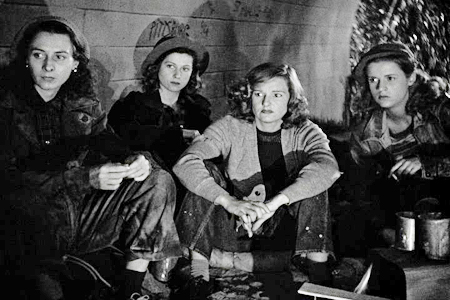

They move from freight yard to hobo jungle and back again and all the while Ann Dvorak broods, watches, and interrogates her fellow female hoboes. At one point, cops force them to get on a train to get out of the county—nobody wants to be responsible for them. Helen Mack doesn’t want to get on the train; she is tired of life on the road and just wants to stay put. As the train slowly pulls in and looms over them, its boxcars are teaming with forlorn men not allowed to get off, but forced to keep moving.

Helen Mack gets into a shoving match with a cop and inadvertently pushes him off the train. He’s fine, but Helen and Ann both leap from the train and head for the woods. Helen Mack suggests they separate but Ann Dvorak won’t let her fend for herself.


They hitch a ride on top of the truck and end up at an auto court and truck stop. Because Ann has $200, she pays for a cabin for them for the night and for one night they have baths and food and a place to sleep and things are looking up until Ann Doran arrives, having stolen Marjorie Cooley’s wedding dress. They take the dress back, but let her stay. But during the night Miss Doran takes off with everything they have and they really are on the skids now.

They eventually arrive at yet another hobo jungle, all-female, run by Lola Lane on a small lake.

We are introduced to new girls; one of them says she is the eldest of seven and just like Edwin Phillips in Wild Boys of the Road, she has left home so that there will be one less mouth to feed. She does not panhandle but she is learning to work in a beauty parlor and gets work from town to town, hoping one day she can settle down.

Mack makes a retort, “Send it in care of Lincoln Highway, U.S.A.”  The Lincoln Highway was one of the first paved major transcontinental routes, opened in 1913, a historic road that, like Route 66, fell on hard times and seemed to express the desperation of a nation during the Depression. Immortalized in songs, films, novels, and a board game, The Lincoln Highway expressed the vigor and optimism of public works of an earlier age.


The girls are fractious and though they try to pool their resources, they fight with each other and grow more dismal in their hopelessness. A trucker tries to help them; he has found Marjorie Cooley dazed and not seeming to know where she is, and he brings her to the hobo camp instead of the hospital because he’s afraid the cops would think that he ran over her.

Marjorie Cooley dies in camp and they bury her and hold an awkward funeral. Her epitaph carved in a wooden sign says “Irene. Died on the road.”

Reminds one of Grandpa Joad who died on the road in The Grapes of Wrath (1939) and they put his name in a small box and put it in his jacket, in case he was ever to be found.

How many bodies were there that died “on the road?”

They lay wildflowers at her grave and Lola Lane, shrugging off her bad girl image, starts a plaintive chorus of Swing Low, Sweet Chariot. They all join in and it is a long, slow, lulling sound until it is broken up by police sirens getting closer.


The cops raid again, but this time the governor of the state, Ann Dvorak’s dad, is with them because Ann has finally been traced to this place. Like the judge in Wild Boys of the Road, he is appalled by the condition of these women’s lives and he makes a vague promise to help. At the end of the film, a government-run camp is being constructed for the women where they are told they can rest and plan to start over and find courage.

It seems like a contrived ending, tacked on because we like happy endings, but government programs were certainly the saving grace of the Great Depression. That era is something so far back in our dim memory that many people today likely have no concept of how important it was that the government seemed to care. It was spending on public works and on social programs that saved the country during those bleak and frightening years. It is also hard for us to imagine a world where social programs and safety nets were brand-new and were untried. We may well imagine how despised they were by the more well-off in this country because we know how earnestly and savagely they are trying to remove them today.

Though government-funded public works projects were important tools to revive the economy and put people work, most of the food relief programs were actually privately run and not subsided by the government—and malnutrition was a leading factor in the rejection rate of around 45 percent of prospective Army recruits during World War II.  They had grown up during hard times.  The healthiest of the recruits were former Civilian Conservation Corps boys.

It’s one of the apocryphal stories of the Great Depression that a teacher in one government health study had told a sick-looking little girl to go home and have something to eat, to which the child replied, “I can’t. It’s my sister’s turn to eat.”

They’ve been called The Greatest Generation, those kids, the ones who had the rendezvous with destiny. Fortunately, the films of that era caught a glimpse of that, lest we forget.


**************

The lack of affordable housing and the devastation that medical expenses can have for struggling families is another Depression-era story that has relevance today. Come back next Thursday for One Third of the Nation (1939) with Sylvia Sidney.

*************

*****************


Thursday, October 15, 2015

Jane Wyatt - We're Only Human and Pitfall


The two films we cover today displayed Jane Wyatt’s strength on screen, no less steely for being presented with genteel poise. She is two different women here – a young urban career girl, and then, thirteen years later, a settled suburban housewife and mother. We recognize what is often referred to as her “finishing school accent,” but is she the same person? She could be. In both, she is supportive of the men in her life, but she demands they measure up to her standards.

We discussed last week how the Turner Classic Movies showing of four films of hers from the 1930s through the late 1940s in chronological order gives the viewer a fun tour of Jane Wyatt’s range as an actress, but the eras which reflected her film career were sometimes vastly different from her 1950s sitcom role as the suburban wife and mother. Because this long role on TV (for which she won three consecutive Emmys) is how most of us were introduced to her work, her film career is something yet to be discovered, sometimes with surprise.

Her early roles were sassy, sexy, and allowed her to demonstrate her talent for comedy, to be both sensual and scrappy. The unruffled 1950s woman who vacuumed in pearls waits in the future – but we shouldn’t just dismiss that role (screen role or real life for millions of women) as a consolation prize for youthful adventure lost. It was, rather, a progression, a maturity. For those who might consider it a regression forget how profound an impact those 1950s TV moms made on our lives and in pop-culture – so much as to leave us shocked at Jane Wyatt “girl reporter.”


We're Only Human (1935) pits Jane Wyatt against Preston Foster in her third film. It’s a gritty, somewhat manic cops-and-robbers story. Foster is a fascinating study as an aggressive cop who pushes the rules, breaks a few, to round up the bad guys, Depression-era gangsters, just so many notches on his gun. He is an adrenaline-junkie, and this will be his downfall, his greatest strength is his curse.

Jane Wyatt is the girl reporter, new to New York City from Kansas City, and it is refreshing that nobody – neither her photog sidekick, her editor, or Preston Foster – or the script, treats her condescendingly. She is as hard-hitting in her profession as Preston Foster is in his, and interestingly, even her good judgment leaves her at the end.

James Gleason is dependable as Foster's crusty-but-lovable partner. Jane Darwell, likewise, as Gleason’s wife. Foster lives with them, and they are his example of a supportive marriage and domesticity - Darwell bullies Gleason through a cold and rules the roost.

A collection of favorite character actors are on hand – Moroni Olsen as the police inspector who chews out Preston Foster over aggressive police tactics. Ward Bond is in a brief scene as a bank robber. Arthur Hohl is a crooked lawyer in league with gangsters, and Hattie McDaniel is his maid, whom Foster pushes past to have a hasty meeting with the pettifogger.  Even a few minutes of Hattie McDaniel is better than no Hattie McDaniel.

Mischa Auer is surprising as the crime boss, a far cry from his more famous comedy roles. His boisterous, goofy, charm and his Russian accent are gone here. He’s a hollow-eyed sinister creep, recently escaped from prison. Foster catches him with a display of foolhardy daring – angering his superiors for not calling backup – and when Auer eventually escapes his custody, Foster looks doubly bad.

Jane Wyatt is at first impressed with Foster's heroics. They begin a playful relationship – and though he barks, “How’d you like to be my girl?” they are friends rather than lovers. He is socially inept, and she is amused rather than devastated by his preoccupation with Mischa Auer.

She steers the course of their romance, just as she steers the roadster. At one point, he thinks she is offering him a home-cooked meal; she steers him to the delicatessen where he pays for the armload of food. She’s not a homebody.

The movie is a great big canvas for Preston Foster and he splatters himself all over it. Foster is in practically every scene, arguing, fighting, pushing, brooding, and loses none of his momentum – though nearly loses his mind – when his beloved partner James Gleason is gunned down by the bad guys.

The above spoiler was brought to you by Another Old Movie Blog – “Cheerfully Serving You Spoilers Since 2007.”

In an intense scene, Foster, accompanied by Jane Wyatt, must tell Jane Darwell that her husband is dead. Like an antsy kid who can’t keep a secret, he just blurts it out, wild and anxious. Jane Wyatt is shocked. His lack of sensitivity had been annoying to her, but now she sees the depth of his failure to appreciate or even understand the feelings of others.

Foster, as a reaction to his own grief and sense of guilt, goes off the wall, repeatedly haranguing the stunned widow with his defense that he told Gleason not to be too cautious, to rush in, that to hesitate would leave him a target, that a cop is as good as dead if he doesn’t strike first. It is a defense of his own carelessness, and an unrelenting rant of anger at his friend for dying.

Miss Wyatt silences him with a no less shocking, “Shut up!”

He tries to continue, but she slaps him down for good. “Get out!…Get. Out.”

The little woman shames him and controls him far more effectively than his bellowing police superiors, for she has worked her way into his self-serving conscience. He leaves.  She remains to console the widow.

In a later meeting when he tries to reconcile, he asks, “Mind if I sit down?”

“I wouldn’t mind if you fell down.” The sass and humor is back, but she is not punishing him like an angry girlfriend, she’s keeping herself at arm's length for her own protection.

The plot takes several twists and turns in the chase for Mischa, who taunts Foster with messages. In a shoot out, Foster is wounded in the head, and his eyes are bandaged temporarily. Another intense scene brings Jane Wyatt to his room to babysit him when Miss Darwell has left to buy groceries. Wyatt then leaves to go to the corner for a pack of cigarettes, and he has a meltdown, panicked by being alone, jumping at every sound.

A light bulb left on a table pops when it falls to the floor, and it sounds like a gunshot. 

Completely unglued, Foster pulls out his own gun and shoots wildly. He runs out of bullets just as Jane Wyatt reenters the room, the gun pointed at her.


Mr. Foster has at last learn to be cautious, so much so that when an opportunity arises to capture Mischa Auer, he hesitates, preferring to call for backup. Now it is Jane Wyatt who is rash. She has a tip on the bad guys' whereabouts and shares it with Foster, but doesn’t want anyone else to know. It might ruin her scoop. She is the aggressor now, pushing him – as Darwell says it is the job of a woman and a wife – “to make a man of him.”

There is an interesting scene using the lie detector technology of the day. Invariably, some comments left on the IMDb website reveal an unfamiliarity with the time, as some younger viewers forget that films were not made for our era, but for theirs. For example, there seems to be some disbelief over Foster's tendency to intimidate witnesses and force confessions from perpetrators by beating them up. This was, if not wholly acceptable, at least common back in the day. It should not be surprising seeing it surface in a film of that era. What is surprising is that police brutality continues in this country today – in an era where such behavior is more likely to be discovered. One can only attribute this to the fact that brutality and stupidity so often go hand-in-hand.

Preston Foster has his final showdown with the bad guys, pushed by Jane Wyatt. In the final scene, she is still in the driver's seat, recklessly kissing him as she steers – or not. She is a dynamo in a short curly bob, with a feather in her hat, and an infectious smile.

Jane is still driving in Pitfall (1948), and still challenges her man to measure up.


She is billed third behind Dick Powell, who plays her husband, and Lizabeth Scott, who plays the other woman.

Pitfall is a smooth and amazingly intricate noir, well-written and meticulously acted. Dick Powell is a revelation as the bored insurance salesman (the schmucks of film noir), frustrated by the sameness of his everyday life, who is nearly destroyed by events that all began when he finally finds something to interest him at his boring job - Lizabeth Scott.

In the opening scenes, we might almost take this for a family comedy, so funny is Powell in his sarcastic expressions of his restlessness, but he displays no sign of that shallow, smart-mouthed guy in earlier films where flippancy took the place of real acting. His usual wise-guy persona in early films seems to keep us at arm's length, not letting us get to know him too well.

Here, Powell turns himself inside out in a gutsy portrayal of a man whose integrity, his security, his family, his very life is slipping through his hands, with no one to blame but himself.


Lizabeth Scott plays her trademark role of the noir dame down on her luck who is bad luck to others but accepts it all with depressing resignation.  She is, however, very likable in the role and very personable. And the black beret she wears in the lounge scene is all I need to know she’s a great gal.


Raymond Burr is terrific as the sleazy private detective who is obsessed with Miss Scott. The scene where he poses as a customer in the dress shop where she works as a mannequin/model is one of the creepiest and most disgusting scenes of film noir. It is amazing how much is accomplished, how much is gotten away with in these days of Production Code censorship. She stands before him in an off the shoulder evening gown that demonstrates her attributes, and he as a customer has the right to ask her to remove her shawl, to turn around slowly before him while he undresses her with his eyes, a sneer indicating not only his pleasure in looking at her, but his pleasure in forcing her to do what he wants in full view of others.

She stands, fully clothed, in the midst of a crowd of workers and shoppers, almost as completely humiliated as if he had accosted her in a back alley.

John Litel is the district attorney whose speech to Powell on his idiocy for taking a gun to solve his problems remind us of the earlier movie, We’re Only Human, when the police inspector berates Preston Foster for ignoring police protocol.

Jimmy Hunt, whom we saw as the cute kid in the library in Katie Did It, is younger as Powell’s and Wyatt’s son. He adores his pop, although they have a difference of opinion as regards the comic books little Jimmy reads.

Byron Barr is the palooka who went to prison for going too far to dress his girl, Lizabeth, in jewels. Ann Doran is Powell’s dependable secretary.  Burr's secretary steals her scenes with the simple act of applying nail polish as she ignores Powell and other potential clients.

One of the treats of the film are the location shots of Los Angeles streets, Wilshire Boulevard, and the May department store where Lizabeth Scott works.

We get several postwar mile-markers – the so-called Busby Boys chapter book Powell reads to his son to distract him from the lurid comic books. “With perfect coordination” the Busby boys leaped to safety. That cracked me up. Young Jimmy wants to know why the Busby boys don’t use ray guns.

Powell snaps at him, “These are the Busby boys. They don’t have ray guns. They have slingshots.”

Jimmy sullenly answers, “Dopes.”

I also like the very small action of Powell wiping the nib of his dip pen before he uses it.  As one who occasionally uses a fountain pen, I was delighted as this bit of “business” that rings true.  I find myself always wiping the nib and lower barrel after I take off the cap.  Pen wipers used to be standard issue for offices and kids going back to school.

We start with Jane Wyatt cracking eggs in the skillet, feeding husband and son at the start of another busy day in their unvarying lives. She is just as sassy and intelligent as she was as a girl reporter in We’re Only Human. We have the feeling Jane Wyatt could not play in unintelligent person – it would be believable. Her intelligence is a huge part of what makes her an appealing screen presence. There is an excitement about her time on screen that is not really present with the languid Lizabeth Scott.
Dick Powell laments the sameness of their everyday lives.

"Whatever happened to those two people were going to build a boat and sail around the world?”

She replies breezily, while eating, “Well, I had a baby. I never did hear what happened you.”


We see at once that despite the burden he feels, theirs is a good marriage. Though his frustration will prove lethal, he is not looking for an extramarital affair.

Mr. Powell first visits Lizabeth Scott to get an inventory of the items obtaind by her imprisoned boyfriend with embezzled funds. 

His relationship with her starts as a fun and pleasant friendship. She is open, easy-going, shares her past with him as he takes notes on the insured items. She takes him for a ride in her motorboat, (not a boat to sail around the world) and we see he is instantly one of the Busby boys, going on an innocent but thrilling adventure in the middle of the workday. But Johnny stays too long at the fair, and Raymond Burr, jealous boyfriend-wannabe is lurking in the dark.

Through well-crafted twists and turns Powell gets more entangled with Scott, Burr, and the boyfriend soon to be released from prison.

Raymond Burr is a compelling creep, so sinister and if, as in the case of Jane Wyatt’s TV fans, one has been introduced to Raymond Burr through his decade-long stint as the stalwart Perry Mason, this turn as a smarmy stalker is fascinating. 

When events lead to Powell’s shooting a man, his conscience can take no more and he finally tells his wife what he’s been up to. Her reaction is cutting. No mourning and defeated little woman, she stares at him, with her expression sliding from disbelief to resentment, to something close to hatred.

“I can’t go on with this on my conscience," he says.

“Conscience?  You make it sound like a dirty word.  You worry about your filthy little conscience.  But I’ve got my son to think about…”

He wants to confess to the cops, too, but she orders him not to – not to drag the family through the dirt. “You lied once,” she snaps at him, “Came easy enough for you then.  You can lie now.”

In their early scenes, though he is troubled and wanting to break off from Scott, deeply seeking to appreciate his simple life once more, we are treated to some great lines and wonderful banter between husband and wife and son. When he is depressed, she cheers him up with the teasing, “We won the war together.” This is a brief comment that is so telling for so many married couples of that generation. The men didn’t just go away to war. The home front was as much involved. And on VJ day they had a right to slap themselves on the backs.

At one point little Jimmy wants to know what his father did during the war. Powell, somewhat shamefacedly confesses he was stationed in Denver. Jimmy is a little disappointed. Jane amusingly pipes up, "The Japs never got to Denver as long as your father was there.”

But Jane is not an idiot. She knows something’s going on with her husband. She’s just cutting him some slack, keeping observant, and waiting.

It is Lizabeth Scott who admonishes Powell, “What happens to men like you, Johnny? If I had a nice home like you do, I wouldn’t take a chance on losing it for anything in the world.”

Powell’s partner has the same opinion, and also chews him out. We see Powell is a man who desperately wants to unburden himself but he just waits too long.  He’s a decent guy, and we are touched by his humanity and his human failings, by the way he explains a nightmare to his son and kisses him goodnight, and the way he owns up to his mistakes, and tries to solve them.  By the time DA John Litel chews him out, we could cry for Powell.

In a final scene, Jane Wyatt is in the driver's seat again, picking him up from the police station and cruising down Wilshire Boulevard. He is beaten, without energy or hope, but she offers him not so much an olive branch, as a lease on a new life, suggesting that they move away to some new town. She has thought about divorce, and she is still very much on the fence. She doesn’t know if she can put this past her, but with flint in her voice, her determined gaze fixed on the road ahead, she suggests that it might be possible.

No clinch. No passionate, reckless kiss behind the steering wheel. They just go forward from that point in heavy traffic. We don’t really know what’s going to happen to them, or to Lizabeth, or to Raymond Burr, and the open-ended finale is refreshingly honest.

Jane Wyatt has backbone and a streak of independence. Her “finishing school accent” is hard and proud.

She could have been a girl reporter in her youth.

But she’s morphed into a suburban mom, a job no less gritty, shoring up the family, demanding her husband measure up, doing her job to “make a man of him.”


But Wait, There's More: Your friend and mine, Laura of Laura's Miscellaneous Musings covers We're Only Human here.

******************************

And another thing:  Join us next week when we take part in the Planes, Trains, and Automobiles Blogathon hosted by the Classic Movie Blog Association.  My pick will be Bright Eyes (1934) with Shirley Temple, James Dunn, and a bunch of flyboys.


And the week after that, the Universal Pictures Blogathon hosted by the Metzinger sisters over at Silver Scenes.  My pick for the party -- Abbot and Costello Meet Frankenstein (1948).


********************************

"Lynch’s book is organized and well-written – and has plenty of amusing observations – but when it comes to describing Blyth’s movies, Lynch’s writing sparkles." - Ruth Kerr, Silver Screenings

"Jacqueline T. Lynch creates a poignant and thoroughly-researched mosaic of memories of a fine, upstanding human being who also happens to be a legendary entertainer." - Deborah Thomas, Java's Journey

"One of the great strengths of Ann Blyth: Actress. Singer. Star. is that Lynch not only gives an excellent overview of Blyth's career -- she offers detailed analyses of each of Blyth's roles -- but she puts them in the context of the larger issues of the day."- Amanda Garrett, Old Hollywood Films

"Jacqueline's book will hopefully cause many more people to take a look at this multitalented woman whose career encompassed just about every possible aspect of 20th Century entertainment." - Laura Grieve, Laura's Miscellaneous Musings''

"Jacqueline T. Lynch’s Ann Blyth: Actress. Singer. Star. is an extremely well researched undertaking that is a must for all Blyth fans." - Annette Bochenek, Hometowns to Hollywood


Ann Blyth: Actress. Singer. Star. 
by Jacqueline T. Lynch

The first book on the career of actress Ann Blyth. Multitalented and remarkably versatile, Blyth began on radio as a child, appeared on Broadway at the age of twelve in Lillian Hellman's Watch on the Rhine, and enjoyed a long and diverse career in films, theatre, television, and concerts. A sensitive dramatic actress, the youngest at the time to be nominated for her role in Mildred Pierce (1945), she also displayed a gift for comedy, and was especially endeared to fans for her expressive and exquisite lyric soprano, which was showcased in many film and stage musicals. Still a popular guest at film festivals, lovely Ms. Blyth remains a treasure of the Hollywood's golden age.

********************

Jacqueline T. Lynch is the author of Ann Blyth: Actress. Singer. Star. and Memories in Our Time - Hollywood Mirrors and Mimics the Twentieth Century. Her newspaper column on classic films, Silver Screen, Golden Memories is syndicated nationally.  Her new book, a collection of posts from this blog - Hollywood Fights Fascism - is available here on Amazon.


Monday, April 9, 2012

Dive Bomber - 1941


Dive Bomber (1941) is a pretty, pretty movie.

The dainty mix of its color schemes and the rather feminine sensibility of its Technicolor palette is a strange but pleasing contrast to the macho world of naval pilots putting themselves in great danger.

So, too, is the interesting, although I’m sure coincidental use, of cigarette smoking as a male bonding ritual. Usually in classic films we’ve come to view the sharing of cigarettes, the dramatic pause in the middle of dialogue to light up, the smoke that curls from one’s lips and over the shoulders of one’s partner as a kind of foreplay between a romantic couple. Here, it’s all part of being one of the guys. It shows comradeship, good will, a "safe" way to demonstrate (or mask) deeper emotions.  Ultimately, a cigarette case, as trophy and mark of identity becomes heartfelt tribute.

And this is such a pretty, pretty movie.

It's also going to be a long post.  Please keep your arms and legs inside the ride at all times.

This is a buddy picture, but the pairing of buddies changes like partners in a square dance throughout the film. First we have Fred MacMurray, Louis Jean Heydt, and Regis Toomey as three veteran naval fliers who are so skilled that the Navy sometimes sends them on promotional tours such as at the famous Akron air speed races.  They are known as the three top hats. At the very beginning of the movie we start our male bonding with cigarettes as the three of them take out their smokes from identical gold cigarette cases with a graphic of a black top hat on them. They are stationed in Honolulu, Hawaii and their training squadron has black top hats painted on the fuselage of their airplanes.

According to the AFI website the movie was filmed between March and May of 1941. The United States would not enter World War II until the end of that year, but the war was already a year and a half old. There are only a couple of small references to the war raging in the rest of the world, but there is still that underlying tension to the shenanigans of the peacetime pilots with their devil-may-care attitude towards war and women and the dangers of flying.

Of course, all this is more deeply sensed today than it was by audiences in 1941. Many Americans back then felt it was likely we would go to war, but did not know when. We know now what, when, where, and how awful it was, and that it began for us only three months after this movie premiered in August 1941.

Much like our look here in this previous post at Navy Blues (1941), which shows an even more lighthearted frolicking among gunnery trainees, yet there is still a sense of foreboding for us.

Part of what gives Dive Bomber an edge over other films of this sort, is the very realistic and at times quite magnificent aerial photography shot in cooperation with the U.S. Navy. The actual ships we see are the USS Enterprise and the USS Saratoga. These were two of only three aircraft carriers that survived the war. The Enterprise would be the highest decorated U.S. ship in WWII, earning 20 battle stars. It was steaming from Midway to Pearl Harbor when the Japanese attacked.

We see shots of Honolulu and of the naval air base at San Diego. There is official footage, all in color, of planes landing on the aircraft carrier deck and the deck crew guiding them in. Some of this provides background in later rear-screen projection shots.

The film begins with a military review, planes flying in formation with Busby Berkeley-like precision. This film was directed by Michael Curtiz. It is shot beautifully. The flying sequences are leisurely and long, nothing is rushed. Perhaps the omnipresent drone of the plane engines might irritate you after awhile, but it’s a visually pleasing film. Planes with bright yellow wings and shiny fuselages, and many of them actually biplanes. They look like those model airplanes you might remember from childhood from Revell kits. They look so much like shiny toys.  (Do kids still make plastic model kits, or was that a Boomer thing?)

Airplanes with yellow wings, floating in an azure sky, the rich chocolate brown bomber jackets, and the myriad of Easter egg pastels that will parade later on in civilian dress…one pretty movie.

In this opening flyover, Louis Jean Heydt’s plane crashes. First on the ground to come to his aid is Navy doctor Errol Flynn, who may be the prettiest thing in this movie. Unlike some of his other swashbuckling roles, where not only is Flynn’s physical prowess displayed but he gets to exhibit a dashing and extroverted personality, here he is an earnest and humble man, passionate only about research into the problem of high altitude sickness and pilots’ blackouts. He takes the brunt of criticism from the men in the ranks, and his superiors in the lab, and we might feel sorry for him for most of the movie.

Flynn muses to his assistant, and everybody’s habitual sidekick, Allen Jenkins, “We represent the uncertainty of life for those pilots. No wonder they don’t love us.”

When he reaches Mr. Heydt, he gets him into an ambulance and, like a good doctor, offers him a cigarette. When Heydt dies on the operating table Mr. MacMurray and Mr. Toomey blame Errol, and they spend the rest of the movie insulting him.

They are all transferred to the naval air base in San Diego, where Toomey and MacMurray are assigned the job of teaching Flynn to fly. More harassment. Add to this Ralph Bellamy, who plays a curmudgeonly research physician. Flynn becomes his assistant and receives his sarcasm, which he returns in kind.

They train in pretty yellow biplanes, the engines of which have to be hand cranked. Hard to believe we’re going to go up against Messerschmitts and Japanese “zeros” pretty soon isn’t it?

Ralph Bellamy is especially good in his role. A commanding presence, he seems genuine and mature where some of the other men in their roles merely seem cocksure. Eventually Flynn and Bellamy become allies and we know this because they share a cigarette together. One offers a match, the other cups his hands around the other’s hand to receive the flame.

Some of the other pilot trainees and grounds crewmen you may spot in this movie, although I admit I didn’t, are DeWolf Hopper, and Alan Hale, Jr. - the future skipper on Gilligan’s Island, and Creighton Hale.  Herbert Anderson has a few lines, he later went on to a featured role opposite the wonderful Ann Sheridan in the above-mentioned Navy Blues.

Charles B. Smith who we might remember from The Shop Around the Corner (1940) in this previous post here plays a bellboy.

Another young man who had made a handful of B movies would be enjoying a small role in this film, his first major movie, was Craig Stevens. Look at this shot of him. Isn’t he pretty?

When he first arrives as a civilian, he and Errol Flynn have a minor fender-bender car accident that evolves into a fistfight. Later on in the film Stevens becomes one of the handful of guinea pigs for the experiments conducted by Ralph Bellamy and Mr. Flynn. Apparently, according to IMDb, so did Gig Young, but I missed him.

Likewise another newcomer to the Warner Brothers studio, who had made a handful of walk-ons in B movies, would be enjoying her first featured role in a major movie was Alexis Smith. Miss Smith and Mr. Stevens had no scenes together in this movie -- the movie was actually completely filmed when the producers decided they needed a girl. Her scenes were added afterwards.  They also each appeared in bit parts in Affectionately Yours early that year.  Dive Bomber was huge leap up to the big leagues for Smith and Stevens.  After this movie was shot, they were paired in another B movie (back to the minors) called Steel Against the Sky (1941) with Lloyd Nolan, but this time in starring roles and playing characters who fell in love.  Third time's the charm, so to speak. They became engaged a year later, and were married from 1944 until her death in 1993.

One might add that Alexis Smith is also, like the yellow airplanes, and the bomber jackets, and Errol Flynn, and Craig Stevens, very pretty. I was struck by these Technicolor shots of her in her suit and hat at a house party, because they look very much like some old Kodachrome slides a shutterbug uncle of mine took during the war. We sometimes muse on the outrageous outfits of actresses in classic films, but here she looks very much like several of my female relatives of that era.  She could be my mother. (I really like the house party scene.  It's quite brief, not necessary to the plot, but there's something so in-the-moment about it, so 1941.  There is a sense of well, here we all are, but where are we going now?)

In this shot, her first close-up in the big leagues, she is immediately thrust into the role of the sophisticate, a part she would play for the rest of her life.  In reality, she is just a girl of 19. That jug-eared bellboy is older than she is.

It was also her first romantic pairing of four with Errol Flynn, some twelve years her senior. She caused a minor stir in the press for refusing to kiss Errol in this movie.  The story made the rounds, but here it is from The Spokesman-Review (Spokane, Washington) , April 25, 1942:

"...she was supposed to jump up from a table, rush forward joyously and buss Mr. Flynn's astonished mouth.

"'That won't do at all.' she told the director, 'It's not in character.'  And she argued so convincingly, the scene was cut."  This from a girl who refused to start her contract at Warners until she completed her last college course.  And would not allow the studio to change her unusual first name and all-too-common last name.  This girl was trouble in an upsweep hairdo.

Here’s that previous post on the tall girl.  Again.

Another character actor fun to see is Robert Armstrong. You will remember him from these previous posts of The Most Dangerous Game (1932), and King Kong (1933). The rascal of the 1930s here is the more knowing and somewhat more tired middle-aged man. He plays an engineer whose job is to help redesign and refit aircraft to match the specifications that are the result of Ralph Bellamy’s research. Robert Armstrong and Ralph Bellamy may not be terribly pretty like just about everybody else, but it’s great to see him.

I have to mention when all the pilots graduate in a ceremony at San Diego, I wondered why the band played “Semper Paratus,” which is the Coast Guard march, not the Navy’s?

Eventually Fred MacMurray and Regis Toomey help out in the experiments to solve the problem of blackouts, partly as a tribute to their deceased friend. A crisis arises when Regis Toomey is found to have pilot fatigue. Ralph Bellamy and Errol Flynn ground him. Toomey is not happy about this, and quits the Navy. He joins the Royal Air Force, and while there are small references to the big job going on in Europe, the main reason for his joining the RAF is for the money. He cannot afford to be grounded, and there’s a great deal to be made in ferrying planes across the Atlantic from Canada to Great Britain.

Toomey visits the men, landing in San Diego in a British fighter plane. (I wonder how likely this is?) The other men tease and congratulate him over his new blue uniform, with his rakish overseas cap (I believe the Brits and Canadians called it a "wedge cap"), and silk scarf tied in a dashing Ascot.  Someone calls to him “Aren’t you pretty?”

He is. He is very pretty. But, he’s still got pilot fatigue even though he’s trying to hide it, and when he leaves to fly his British plane to Canada, he crashes. MacMurray, in a moving scene - he looks as though he has been crying - volunteers as a guinea pig for Bellamy’s tests. We get to watch what seem to be very primitive experiments, but no less frightening because of their apparent technological crudeness.

The men are put in a chamber that will replicate the low pressure of high altitude and the lack of oxygen. Errol Flynn listens to their heartbeats. Craig Stevens, suffering oxygen deprivation, actually looks as if his skin turns slightly bluish. It is an amazing color in this Technicolor film, though I must say it is not pretty.

Some electronic gadget with a neon blinking sign that looks like it belongs in Frankenstein’s lab illustrates their irregular heartbeats. There is no EKG. They all receive X-rays of their knees and elbows to look for gas bubbles in the joints, open X-rays with no protection against radiation to anyone around them.

They still haven’t found the problem of how to fly very high and not suffer illness. The men and the doctors are severely stressed.

To break up the leaden atmosphere -- and the conflict in the script which by nature does not involve a lot of physical action, even if it does involve physical daring do -- we have a few comedy relief moments to lighten up the plot. Allen Jenkins’ wife, played by Dennie Moore, keeps showing up for her allotment checks and he keeps trying to avoid her, aided by double-talking Cliff Nazarro. MacMurray and Flynn take some time to socialize, and we see that in these pre-war days servicemen are allowed to wear civilian clothing off base.

Though many civilians at this time might have privately felt or wondered if time was running out for them, peacetime that is, still this scene seems to illustrate that the spring of 1941 was a leisurely respite, a calm before the storm. Yellow flowers, a pink dress. A nightclub with mauve walls, and the girl singer Jane Randolph singing the new hit, “What’s New,” a lazy, romantic song of wistful parting that somehow does not foreshadow all the partings that would come in the months ahead.

Look at the outfits of the ladies, muted peach and blues, the turquoise, lime green, cream-colored shirts.  You could show this as an Easter movie if there weren't so many gol-darned plane crashes.  Pretty.

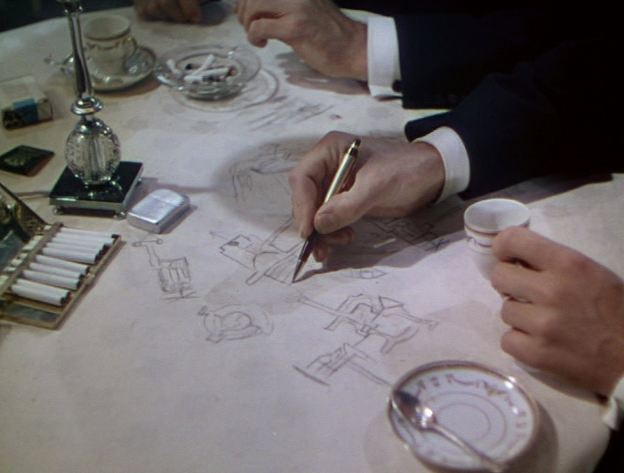
MacMurray and Flynn ignore their dates Alexis Smith and Ann Doran. They are instead preoccupied with a new idea for a pressurized suit to wear in an airplane, something like what a deep-sea diver would wear. They draw plans on the tablecloth. They smoke.

In a way it reminds me of the movie Apollo 13 (1995) where the crisis of the space capsule being unable to return to earth must be solved by the men on the ground with very rudimentary methods. All solutions begin in the human mind.

And by drawing on the tablecloth. And playing with Alexis’ lipstick.

Errol and Fred are really excited about the lipstick screw function. More male bonding. Not usually done over lipstick, but I like to think I’m open-minded.

The lipstick is a very pretty shade of red.

Both Flynn and MacMurray take to the air in some very scary dive sequences. Fred MacMurray eventually succumbs to pilot fatigue and he is grounded. He is consoled in what is one of the few foreshadowing moments of our involvement in the war, “Kind of tough to be yanked out of a ring when the main event may be about to start.”

But, one more test must be performed before their invention can be approved. MacMurray takes it on himself to fly the test.

MacMurray performs his test successfully, but crash lands and is killed. (Yeah, spoiler-schmoiler.) In the final scene we see Errol Flynn flying off to join a squadron with the Pacific Fleet. We know he is going to Pearl Harbor, and we know what will happen there. It is with poignancy and sadness that we realize he does not.

In tribute to his pal, he drops MacMurray’s gold cigarette case, which he retrieved from the crash, into the ocean, tossing it out of the cockpit of his airplane.

The last shot of the squadron flying towards the rays of the sun is brilliant enough to make you want to shield your own eyes.


Who says macho can’t be pretty?


*********

Jacqueline T. Lynch is the author of Ann Blyth: Actress. Singer. Star. and Memories in Our Time - Hollywood Mirrors and Mimics the Twentieth Century. Her newspaper column on classic films, Silver Screen, Golden Memories is syndicated nationally.


Related Products