IMPRISON TRAITOR, PEDOPHILE, AND CONVICTED FELON TRUMP.
Showing posts with label Richard Eyer. Show all posts

Thursday, November 15, 2018

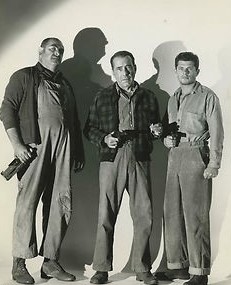
The Desperate Hours - 1955


The Desperate Hours (1955) brought the escaped convict genre to suburbia. That’s where everyone else was headed in the 1950s, and the house in the neighborhood is as much a character in this film as the three outlaws and the family they terrorize.

This is our entry into the Outlaws blogathon hosted by the Classic Movie Blog Association. Please check out this link to read some other great blogs on this sinister subject.

In The Desperate Hours, Humphrey Bogart plays the lead bad guy in his second-to-last film and the very last bad guy role he was to play in movies. He shows he’s still got it.

Dewey Martin plays his younger brother who has broken out of prison with him. The third member of their gang is played by Robert Middleton, who is arguably the most frightening member of the trio.

The movie begins with an audience perspective shot as we move down a suburban subdivision. There are lawns and trees, children, a dog or two, people walking on sidewalks. It is deceptively peaceful. The camera moves very quickly to one particular home on the block. If the house looks familiar to you from the outside that’s because two years later, Beaver Cleaver lived here. The television sitcom Leave It to Beaver (1957-1963) used this exterior for the Cleaver home.

Fredric March is the head of the clan, doting father and husband and executive, who works “downtown,” a place which with the settlement of suburbia has become more distant and vaguer to us.

Martha Scott is his wife; Mary Murphy is his grown daughter; and the wonderful Richard Eyer, who as we’ve seen was such a standout in films here like Friendly Persuasion (1956) and here in Slander (1957), plays his young son.

Though we see the family gathered together for a cheerful, if rushed, breakfast, it is not all idyllic on the home front. Fredric March does not approve of his daughter’s latest boyfriend, a hotshot young lawyer played by Gig Young. She is rebellious and they argue in the car when he drives her to work “downtown.”

Young Richard no longer wants to kiss his father goodbye when he leaves for school; he’s too man for that now and he does want to does not want to be known by a nickname anymore. He’s an All-American boy, pretty much goes his own way and his sudden streak of independence, while cute in this scene, is going to prove to be a greater problem later on when he tries to rebel against their captors.


The story was written by Joseph Hayes from his novel and his original script which was performed on Broadway at the Ethel Barrymore Theatre from February to August 1955, the film’s release year. For some years thereafter, it was a popular summer theatre play and the two-level set which was required to tell the story of showing the family in different rooms with the bad guys was always a challenge and always a hit on stage. We take things for granted like a two-story house in the movies, but on stage we appreciate more the architectural skill it takes to build and to work on a two-level open set.

The Broadway version was directed by actor and director Robert Montgomery. Karl Malden played Fredric March’s role as the suburban husband and father, and Paul Newman played the Humphrey Bogart role. We can imagine that the younger gangster in the mid-1950s might have carried a more sinister suspense story because the brothers would have been contemporaries and because they might have appeared more violent and impetuous.


Though Bogart is a generation older than his brother played by Dewey Martin, we can accept them as brothers and accept that Bogart, even though famed for playing dangerous criminals, serves a different function in the screen version. His is rather like a parallel to Fredric March, than to his partner younger brother.  Like March, he is the head of his family, or his gang, and he sometimes has trouble keeping them in line. Fredric March bristles at his daughter’s romance, believing her to still be a kid. Humphrey Bogart is stumped when later in the film his brother rebels not just against his authority but against the whole way of life in which his big brother has raised him.

Bogart and his gang have chosen this house at random, which is certainly an eerie aspect about the story, it could have been any home—maybe even yours. Bogart’s reason for choosing this house was that Richard Eyer has left his bicycle on the front lawn. Bogart knows he would be able to make the family more fearful and more easily cooperative if they have to protect children. This tells us that he has some experience and logic in his craft, and also that he would prefer not to have any trouble if he could avoid it. He intends to hole up here until he can arrange for a former girlfriend to bring them money to escape.  But he also wants to go after the deputy sheriff responsible for putting him in prison.

Arthur Kennedy plays the deputy sheriff, who is the only one among the police officials to take the news of the jailbreak seriously, feeling certain that Humphrey Bogart is coming straight for him. He is not so paranoid as he is analytical, just as logical as Bogart or Fredric March is in this scenario. There is an attempt to turn the story into more or less a triangle to include the efforts of the police to trace Bogart’s whereabouts. This is obviously not something that would have been easily done on stage where the whole story was pretty much set in the home.

Note Bogart’s disgust when he sees that March, whom he resents for his middle-class respectability, has only $800 in his bankbook.  In that era, it would have represented probably something like three or more months’ wages saved.  That may not be terrific in Bogart’s eyes—he’s after all the marbles—but today when it is estimated that only about 18 percent of Americans have three-to-five months’ savings in the bank, then this family is doing okay.

The movie also gives us a lot of familiar faces to pick out in the crowd, Ray Teal as the state police detective, Alan Reed (Fred Flintstone) is another officer, Ray Collins, Simon Oakland will also play police officials, Whit Bissell plays a pensive and intellectual FBI agent. Beverly Garland plays the teacher who drops by and in front of whom March must pretend to be bringing home drinking buddies to cover for her seeing the bad guys. Joe Flynn plays a panicky motorist taken hostage, and poor Walter Baldwin plays the junkman in the greatest danger of all of them.


Shortly after father and daughter leave for work, and Junior’s off to school, mom Martha Scott begins her housecleaning. She brings along a portable radio into every room to listen to music and, of course, to give us the opportunity to hear the news bulletins about the escaped convicts. Later on in the movie, Humphrey Bogart will smash the radio in a fit of anger.

It is interesting that even though this film was released in 1955, we see no television set in the home. It is more than likely that by the mid-1950s, a middle-class home such as this would have a television. I’m not sure why they don’t include one, either because it didn’t figure into the plot, or because the film industry was still chafing with resentment over its new competitor and didn’t want to acknowledge its existence?  Though Fredric March drives an older model car, the movie is not set in the late 1940s—Gig Young’s flashy sportscar alone tells us that.

We might think today that the TV would be a better place than the radio for news bulletins, but this was long before 24-hour news and also it was an era where news broadcasts were infrequent and brief. There were usually only one or two news programs lasting all of about 15 minutes from the 6 o’clock to the 7:30 time frame in the morning, and it was much the same in the early evening from 6 o’clock to about 7:30. We might have one or two news programs 15 minutes in duration. Television news did not really come of age until the 1960s, and much of that, sadly, was launched in the aftermath of the Kennedy assassination. Newspapers were still king of the news--even of bulletins, with the ability to produce "extras" several times a day.

Robert Middleton, the large hulking Neanderthal of the bad guys with one presumes the IQ of a child, plays with Richard Eyer’s toys in his room and break some of them in frustration when he smacks his head while looking out the window.  He fumbles with a toy bank that looks like a little safe, and he cannot open it. At one point he takes a toy gun and blasts it around the house until Humphrey Bogart tells him knock it off. In one scene—one of director William Wyler’s touches, while Bogart is terrorizing Martha Scott in the foreground, in the background we see Middleton drinking from a milk bottle and spilling it down his chest (just as the boy will do later).  These images of the buffoon are only half-comic.  They also point to Middleton’s mental instability, which is the most dangerous thing about him. These fellows had been in prison, we don’t know for how long, but it’s possible that television would have been a complete novelty to them. I imagine if Robert Middleton’s character was so enthralled by Richard Eyer’s toys, then he might have enjoyed CaptainVideo or Hopalong Cassidy.

Bogart snidely says of Middleton to Martha Scott, “Crude, ain’t he?”

Bogart is commanding in his sneering, angry role, indeed, it is a role he has played many times. There is stubble on his face and over the phone he calls his gun moll “Doll,” like a man from another era, and he is supposed to be. He has no place in modern society.


His younger brother, Dewey Martin, feels this more acutely than Bogey. He is more wide-eyed at the appearance of the house, and at the nubile young daughter. At first, when he enters the daughter’s bedroom while she is at work and sees her canopy bed, he touches the frills on the canopy and brushes his face seductively on them.  It is an image which causes us to think he will present a sexual threat to her, but when he meets the girl and examines the whole house more closely, there is an unexpected change in him.  He is strangely awed and respectful of this world and its people.

Interestingly, the scene with her canopy bed reminds me of the scene in Wyler’s other film The Best Years of Our Lives (1946) when Dana Andrews wakes after a drunken night in Teresa Wright’s canopy bed, and he amusedly blows on the canopy’s frills, surprised to find himself in such a feminine haven.

When father and daughter come home from work, and Junior comes home from school, the entire family is held hostage and they are moved from room to room at gunpoint. In some scenes, it even looks as if they are camping in their own home as they try to stay together.

Martin seems more than attracted to daughter Mary Murphy; there is a shy, almost boyish crush he exhibits for her. Bogart notices the attraction and jokes that when they leave, they will take the daughter with them as a hostage just as a present for his younger brother. It is a chilling moment.

But the brother protects the girl from Robert Middleton, who is a far greater danger not only to her but everyone in the house, even to Bogey, because he is so undisciplined and so mentally unstable.

The real terror in the film comes from the sudden destruction of the blessed normality of their everyday lives. They live in a world of 1950s conformity, and though it may get a little stale sometimes, they know they are safe there. Their safety has been shattered not necessarily by three escaped convicts, one of them with a gun, but that the normality is gone and the unknown has entered their lives.

One gun becomes two as Bogart discovers that the family keeps a pistol in the house. This evens up the score a little and makes Bogart happy because Middleton has the other one.

But there is an even greater danger to Bogart than Robert Middleton’s instability. It is his younger brother. Dewey Martin doesn’t want to take over his brother’s life of crime anymore. When Bogart tells him to stick with him, that he got them out of prison and he will take care of him, that he taught him everything he knows – a common manipulation used by the heads of families to keep the younger in line – Dewey Martin disgustedly replies, “You taught me everything, except how to live in a house like this.”

If Dewey Martin was not dissatisfied with his life in prison, he certainly is now because he sees a glaring comparison to how his life has gone. This is a nice home, with a nice family. If Mary Murphy’s beau, Gig Young, is not welcomed by her parents, then what chance would he have? Even though he respectfully calls her, “Miss,” and calls Fredric March, “Sir.”


The family has its own struggles, its own splinters and breakdowns, and coming together. Unfortunately for Fredric March, who tries to shepherd his family through this terrible experience and proves himself to be courageous and very intelligent in how he manages to outmaneuver the bad guys, his greatest handicap is also his greatest treasure – his family. Neither his daughter nor his son obey his explicit instructions and they mess things up, even his wife rebels and throws a monkey wrench into the works. At some point we have to wonder if March just wants to throw his hands up and yell, “All right then, go get yourself killed! I’m sick of talking to you people!”

But he doesn’t. At one point when he is allowed to leave the house on a mission for the bad guys, he stumbles onto the dragnet by the cops who have traced Bogart’s whereabouts, and he has to plead with them to allow him to go back in to mediate the situation because he doesn’t want them shooting up his house and killing his entire family. They reluctantly agree, but give him a gun. He empties it of all the bullets. He takes it with him. The cops think he’s nuts, but we see in the course of his last gambit that he is more clever than anybody.

It is an intricate and interesting movie and fast-paced but I won’t linger too much on the heroics of the family. This blogathon is about outlaws. In the tradition of classic films, none of these outlaws comes to a good end.

We may not mourn Robert Middleton, he’s just too scary and too bad, and has already committed one murder right before our eyes.

Dewey Martin has the greater share of our sympathy and how he meets his end is entirely accidental and tragic because he is escaping his brother and a life he does not want.

Bogart plays his cards all the way to the end, and it’s just March and Bogart at the end. March has outsmarted him because he has managed it so that Bogart holds the gun with no bullets in it.

When March has his own gun, Bogart sneers, “You ain’t got in you.”

March growls, “I’ve got it in me. You put it there.”

Then March does something so effective and perhaps even cruel, to get back at Bogart. Having heard the news about Bogart’s brother’s death – which Bogart doesn’t know – March tells him how his brother died and he sneers and shouts, “You did it! How do you like it?”

This is really the end of Humphrey Bogart. Yes, he has a few more minutes in the film, and yes, he rushes out into the police spotlights and drops down on their front lawn only a few feet from the boy’s bicycle that had brought him to the house in the first place, but it was really upon hearing of the death of his brother, the end of his family, and the collapse of his authority that kills him.


Some may say that Bogart was a little too old to play this role, especially if they had seen Paul Newman play it on Broadway, but this is a different interpretation. Movies are different from plays. We wouldn’t have had all the cops in the play, we wouldn’t have all the bicycles, the milk delivery trucks and the sound of crickets in the evening. We wouldn’t have had March’s bewildered office staff in front of whom he has to pretend, we wouldn’t have had the roadhouse where Dewey Martin tries to escape. We wouldn’t have had the town dump where Robert Middleton commits a cruel and vicious murder.

Bogart was in his element in this role because Bogart was in his own world. Hollywood at this time took its gangster movies from the faux city streets of its backlot and soundstages, to a wider and somehow more complex world on a backlot suburbia. The Cleavers would move into that house – on television of course – and the conformity of suburbia would cover over Bogart, Dewey Martin, and Robert Middleton, like a blanket of snow, masking the ugliness, but not obliterating it.

The 1950s introduced us to new bad guys – psychos, rebellious youth, juvenile delinquents. They would be more at home here in suburbia. They could not be gotten rid of so easily, like the crabgrass on the lawns of the middle-class homeowners; they were rooted and endemic.


Please visit the Outlaws blogathon hosted by the Classic Movie Blog Association for more great entries on bad guys in film.

Thursday, November 13, 2014

Slander - 1957


Slander (1957) is a noble experiment, and if it fails to be as biting a drama on the scandal press as it could be, perhaps that is because it is difficult to make a tasteful movie about a distasteful subject.  It’s trying desperately to appeal to the better instincts of its audience.

That it also tries, at the same time, to indict the readers of scandal magazines—the movie-going audience—is a daring, but ultimately futile, tactic to legitimize the film’s message.  A lot of people bristle at any message in a movie, considering it preaching.  They like a clear-cut villain to shoulder all the blame and get his comeuppance in the end.  We have a villain here, and he does get foiled in the end.  But our villain does not, cannot shoulder all the blame for the evil in the story.  We must assume some of it.  The result is inevitably awkward.

Ann Blyth was rounding the corner on her 28th birthday when she made this film, her last film for MGM under her contract.  It would be the first of her three final movies, all of them released in 1957.  Slander came out in January; The Buster Keaton Story, which we covered here, was released in May for Paramount, and finally, The Helen Morgan Story, for Warner Bros., which we will cover in weeks to come, released in October 1957.  With this flurry of activity, more films at one time than she had made in years, and for three different studios, it did not seem like her film career was winding down.  There was no handwriting on the wall, no way to predict she would be a “former movie star” soon at 29 years old.

Harrison Carroll, a syndicated columnist, visited the set while Slander was being filmed, and watched her confrontation scene with character actor Harold J. Stone.

After the shot is over, I remark to Ann that it is an unusual sort of role for her to play.  Her face becomes very serious.

“It is a difficult decision for the woman in the story to make,” she says, “And anyway,” she defends, “It gives me a different sort of a part.  Audiences get tired of you if you fall into a rut.  And, just as important, a performer also gets tired of being in a rut.”

Her previous film to this had been the musical, Kismet, which we discussed here, and which had capped a string of several films, musical and non-musical which put her in fairy-tale circumstances and fanciful costumes.  In Slander, however, she is the picture of unglamorous modern reality, a housewife making beds and preparing meals for a husband and son in a tiny New York apartment in the low-rent district, her costume a neat but nondescript housedress and a wary, anxious demeanor.  Her last three films would feature her in serious, even doleful roles that were mature, sedate, and emphatically told the audience and future potential producers that she had grown up.

Her husband here is Van Johnson, in one of his last starring roles, as an up and coming entertainer.  He is a puppeteer (his work with marionettes being done by famed puppeteers Bil and Cora Baird), who has just landed a plum job with his own children’s show on TV.  Van had a hardscrabble youth in a rough neighborhood, and his past will come back to haunt him.

Their young son is played by Richard Eyer, whom we saw here in Friendly Persuasion (1956), a natural and charming kid.  His goofy, cockeyed grin is sweet, and he is the sort of gosh-gee all-American boy who loves baseball, and gets a huge kick out of his father being a TV star, as it makes him top dog at school.  But there is a down side to fame, and young Richard will suffer for it.

Harold J. Stone is Van Johnson’s agent, a friend to the family and a loyal, but ineffectual barrier to the cruelties of public life.

Directed by Roy Rowland, who directed Ann in Killer McCoy (1947), which we discussed here, the film is a good attempt at delivering a socially conscious agenda, but falters when some of the dialogue goes terribly mawkish.  I don’t think Mr. Rowland’s work here is as good as it was with Killer McCoy, most of the camera work is fairly lackluster, but I would lay most of the blame on the script for the movie’s just missing the mark.

The opening credits show the title as a blot on screen, and the actors’ names awash in a nightmarish image of floating tabloid magazine covers.  We are given the impression of sordidness from the beginning.

Then Rowland sets his opening shot on the city, its canyons of brick and steel monuments to mankind that represent both wealth and poverty, depending upon the angle.  We settle in on wealth and power first, in the palatial Park Avenue apartment of Steve Cochran, who plays the editor/publisher of one of those dirty tabloid confession magazines.  We don’t know that yet.  At first, all we see is a well-dressed man, fastidious in manner and speech, who with extraordinary thoughtfulness, arranges the daily activities of his semi-invalid mother, played with seasoned, nuanced irascibility by Marjorie Rambeau.

He is dapper, polished, refined and deliciously unrushed.  But there is a seed of doubt about him planted for the viewer by his mother’s resentfulness toward him, and by what we may suspect is the false adoption of his well-groomed self-superiority.  There’s more to this guy, and it doesn’t take long to find out.

We follow him to his office, where the gloves come off and we see that he is the master of his own kingdom of hack journalists, losers on the edge of the profession who deal in dirt, secrets, even outright lies when it serves them.  But all is not well in Steve Cochran’s world.  He has been in business for two years, enjoying enormous profits, but now he has competitors, other magazines imitating his formula for spoon feeding scandal to their readers.  Cochran’s gentlemanly demeanor of the introductory scene is stripped away when we see his work, and his cutthroat manner.

“The public has about as much brains as a halibut steak.”

He has found his success in the public’s appetite for filth.  But to top his competitors, he needs a big new story, and has found it in a well-known actress named Mary Sawyer.  Interestingly, we never see Mary Sawyer in this film, and though not showing a character that is spoken about is usually a problem in film, in this case her not being seen is perhaps a way of illustrating the point that it does not matter who is smeared.  Anyone can be a victim.  All we know of this Mary Sawyer is that she has been an actress for a long time, and is currently appearing in an uplifting film called Song of Faith.  “In the minds of the American public, she’s practically a nun.” 

One tipster has supplied information that Mary Sawyer is not practically a nun and that she fell upon some sort of disgrace in her youth.  Someone who might be able to give the magazine more information is a person who knew her from way back when, grew up with her in their old neighborhood—Van Johnson.

From this point, Van Johnson and Ann Blyth are squeezed in the jaws of a vise of moral conscience.  Van must tell what he knows about Mary Sawyer to Steve Cochran’s magazine, or else Cochran will spill the beans on Van’s secret.

As a teenager, Van committed robbery and assault with a knife, and went to prison for several years.  If the public found out, his career as a performer on a kid’s TV show is over.  There are arguments between husband and wife about the logic of throwing Mary Sawyer to the wolves to save themselves. 

What might appear as mere screen melodrama to younger viewers today was really a hot issue when this film was made, and based on numerous factual cases.  One of the most famous of these was probably when the foremost of these new scandal magazines, Confidential, threatened to disclose Rock Hudson’s homosexuality to the public.  His agent stepped in and made a deal, feeding them info on his other client instead, newcomer Rory Calhoun, who had a past involvement in armed robbery and prison time as a teen.  

Gossip columns and magazines had been part of the Hollywood scene since the first reel was shot, but what had been fairly innocuous, if occasionally irritatingly intrusive, interest in the stars’ homes, hobbies, and romances, exploded in the post-war era as a sinister inquisition into the private lives of stars, a wildly cruel seek-and-destroy mission. Hollywood actors and actresses were attacked not merely on peccadilloes in their private lives, but for their politics, and sometimes created scandal where there was none to be found.  Confidential, and other magazines and columnists of this sort who were politically conservative had taken their cue from the infamous blacklist tactics and sought to sink the careers of Liberal-leaning actors, directors, and members of the film community.

Shirley MacLaine, in her first memoir, Don’t Fall Off the Mountain, recounts a run-in with one such trash columnist of the day, Mike Connolly of the Hollywood Reporter, who, apparently believing her affiliation with liberal causes required punishment, inferred that she had her nose fixed, had attempted suicide over an unhappy love affair, had undergone an abortion, and other lies.  Sufficiently fed up, and after consulting her attorney and bringing along her secretary as a witness, Ms. MacLaine marched into Connolly’s office and slapped him hard, twice, across the face.

Columnist Hedda Hopper, despite being known, and feared, for her own self-important brand of heavy handedness, called her and told her, “Why didn’t you knock him out cold at least?  As far as I’m concerned, you should be ashamed of yourself for not finishing him off completely.”

Everyone applauded Shirley MacLaine when she visited Chasen’s restaurant; former middleweight champ Rocky Graziano sent her a pair of boxing gloves; and she received many congratulatory telegrams by those in the industry, by the governor, and a humorous one from President John F. Kennedy. 

I think of Ms. MacLaine’s the-slap-heard-around-Hollywood during the scene where Van Johnson visits Steve Cochran in his office, and slaps him.  It’s a temptation to draw similarities with Cochran’s character to real-life figures working for the scandal mags, but they’re really just types, there were plenty of them, and megalomaniacs exist in every industry.

The upshot of all this nonsense was an ugly grab for power.  This is the template by which Steve Cochran wields the whip hand over Van Johnson.  Van, his wife and child, mean nothing to Cochran, but the end result of more power, more circulation is irresistible to him.

In this climate of real-life controversy, we might suggest that the studio was brave to make this film, throwing such a moralistic dart at these magazines.  However, we could also note that the story takes place in New York, with an unknown puppeteer and involves the world of TV.  It’s as if the studio pulled a punch on this one.  If Hollywood really wanted to tell the story as it was, they’d place the setting in their own backyard, they’d show a studio mogul or two throwing an innocent actor under the bus to quash a story about to be planted about someone more valuable to them and to stay in the magazines’ good graces, the way you fork over your lunch money to a bully.  That was the way the HUAC worked during the blacklist; that’s the way all power is achieved.

But Slander attempts to show more than how the rotten deal worked; it attempts to educate the audience that buying these magazines and reading them is not nice.  That’s a tougher message to sell.

There’s a secondary social blot here to examine, but it falls by the wayside, and that’s how our society tends to grab children in a headlock and feed them garbage.  The sponsors of Van Johnson’s kids’ show, who make breakfast cereal, have the most to lose—the most money, that is, especially when, as Van’s agent Harold J. Stone proudly announces, “Kids would eat carpet tacks if Jeff Martin told them to!”

The sponsors admit their nervousness over Van’s past, and frankly admit, “We’re trying to sell children.”  It’s about as opportunistic and unseemly as the scandal mags pushing dirt on a public dirty-minded enough to enjoy that stuff.

Not all enjoy it, and some look down on Steve Cochran—respected publishers who bar him from speaking on a television panel show, waiters and maître d’s who won’t serve his mother in swank restaurants, and even his mother, who wishes he would quit this racket.  Cochran just grows more defensive and more poisonous.

The movie skirts just shy of another big issue, and that is what truth worth knowing?  We may regard a movie star’s third marriage as his own business and not worth shouting about.  But if our congressman was, say, an abusive spouse or parent, wouldn’t we want to know?  That aspect of his personality may have nothing to do with balancing the fiscal budget, but most of us would feel ill to realize we voted for such a person, and would want to avoid voting for someone who, if not a saint, at least was not cruel or involved in illegal activities.

A wise old respectable editor, who is meant to represent the nice journalists, says of Cochran: “If our drinking water was being poisoned, none of us would think it funny.  Why should we laugh at something that is doing us the same sort of damage?”

Cochran tells his ashamed mother, “I’m giving the public something that they not only want, but something they need.”

Two sides of the coin, indeed, but the movie pulls back from any thoughtful debate, preferring to show us Cochran’s arrogant sneer, Van’s hunted look of fear, and all-American boy Richard Eyer’s silly grin. 

I’ve got to give you a spoiler here, because I really can’t discuss this film without it, so go down to the corner and get a paper if you don’t want to hear this.  Or a magazine.  A nice one.

Despite a wedge driven through his marriage because of this, and his career on tenterhooks, Van won’t give Steve Cochran the information.  In part, his decision not to fold is because of the shame he carries from his crime as a teen and his prison sentence.  He is deeply sorry for that and is determined not to carry any more shame in this life than what he’s already got.  That should be played up more; instead we are given only the picture of a decent man doing the decent thing.  Honorable, to be sure, but his motives are more than pure righteous stubbornness. He’s haunted.

In retaliation, Cochran prints the story, and the sponsors, horrified at the loss of sales of cereal, drop Van Johnson from the show.  His sponsor apologetically tells him, “The public always calls the tune.”

So true, which is why when we get inferior products, either in the form of entertainment or anything else we deserve it because we don’t demand better.

The cost of his marriage and career isn’t enough, and Van must suffer one more great sorrow: the death of his son.  The kids (a microcosm of the adult world with its own rules for bullying and swaying public opinion), turn on young Richard and tease him.  Distressed, he bolts out of the schoolyard and gets hit by a car in traffic.  He dies. 

On the one hand, it’s tempting to view this scene as really going overboard, as indeed, some critics of the day felt.  On the other hand, it’s so shocking and unexpected, just by itself the scene has immense power.  We may or may not draw a direct correlation to Steve Cochran’s bullying and the death of a little boy due to the boy’s own negligence, but we see the pattern of poison entering the minds of society and the minds of children that has far-reaching effects we cannot imagine.

The aftermath also gives Ann Blyth one of her most intense scenes.  She is at her mother’s apartment, sitting in an almost catatonic state, when Van Johnson, who has just heard the news about the death of their son, rushes to her.  She had been on her way to pick him up from school when the tragedy happened.  She thaws out of her shock, and it is as painful for us to watch her allow herself to grieve as it must be for a woman to smack hard against the realization her little boy isn’t coming home anymore.  When Van kneels to embrace her, she gulps slurred words in broken sentences of helpless, almost apologetic explanation to him, and wails, a heartbreaking moan, repeatedly calling her son’s name.  A very real and powerful scene.  She goes deep here, and it is deftly played.

Van Johnson is nearly sick trying to hold himself together.

The dénouement of this is for Van to appear on the nice editor’s TV panel show to have his say on things, and though his illusion to his son being poisoned by the gossip is an analogy as true as it is emotional, unfortunately the rest of his cautionary speech limps along, weakly written.

Because we have to have an ending to all this horror, agent Harold J. Stone catches up with the sorrowing Van and Ann, and tells them that the TV station is being flooded with phone calls of support, that the public is determined not to buy anymore of these kinds of magazines.  Hurray.

It would have been a better film, and a better service to an impressionable movie audience, to simply have them walk down a street, see the latest issue with their son’s grisly death splashed across the cover, and a line of eager customers waiting to buy it.  That’s not the kind of thing we might want to see, but it would be the truth.

Though there are still a few tabloids knocking around today, for the most part they have been rendered harmless by their ridiculous stories of Hitler’s brain being kept in a laboratory or celebrities being abducted by space aliens.  Truly, only idiots buy them.  However, the real reason we have few of the old-time scandal mags is that this kind of reporting is no longer considered gossip.  It’s considered news.  Dirt, and at the very least, fascination with the superficial and shallow, has gone mainstream. The line between good solid journalism and schlock has blurred, and not only the public, but the professionals in journalism don't seem to know the difference anymore.

A few more good scenes:

When Ann and Van lie in their beds at night, unable to sleep, are acutely aware the other is awake, but are loathe to continue the fight they had earlier in the evening, and any words, even ones of comfort, are difficult now.

Van’s tortured struggle with his past and his guilt, and his pained refusal to be anything less than the decent man he wants to be.  He loses everything in the attempt, but still seems like a champion. 

Marjorie Rambeau’s caustic sniping at her son, and her futile, and melodramatic, visit to Ann Blyth after the death of the little boy to determine for herself if the cause of his death was the smear campaign.  Ann lets her have it between the eyes.

Then Miss Rambeau’s careful, pained walk down the steps of their brownstone, thumping with her cane, shoulders slumped in sorrow, just an unknown old lady to Van and Mr. Stone as they rush past her.

The triumph, the fire in Cochran’s eyes when Van Johnson calls him out on TV, because he knows it will mean even more publicity for his magazine.  Steve Cochran is very good in this role, especially as this is not the usual sort of bad guy.

One may feel the story jumped the shark when Steve Cochran is shot to death by his own mother, like a bad seed she must kill for the greater good.  Since he had made a remark earlier in the film about someone being driven to a suicide attempt over one of his previous smear jobs, perhaps it would have been more in keeping with the flow of the story to have his mother commit suicide over her son’s activities.  Some grisly end for Cochran is generally what would happen in these scenarios, though the reality is nothing would ever happen to him to make him regret his actions.

Here’s the trailer for Scandal:


A review in the Florence (Alabama) Times wrestles with the telling of this story and the idea that, like Steve Cochran’s gleaming eyes at the kill, may have given more power to the scandal mags by giving them importance:

For what is an obvious attempt at retaliation at one of Hollywood’s most feared foes, Scandal could hardly be classified as a mortal blow.

In fact, this middle bracket drama…might not only have missed the target altogether, but may have inadvertently given aid, if not comfort, to the enemy…where even the hardest knocks boomerang into boosts.

Ann Blyth took a more gentle, if no less earnest, course to address the scandal mags.  In February 1955 she was called upon to be hostess, and Pat O’Brien was master of ceremonies, at the film industry’s fourth annual Lenten Mass and Communion breakfast.  Around 1,500 film workers attended at the Blessed Sacrament Church in Hollywood, where Mass was celebrated by James Francis Cardinal McIntyre (who had performed Ann’s marriage ceremony two years previously – see this post).

She delivered a speech that she and her husband, Dr. James McNulty, wrote together.  It was reprinted in several newspapers afterward, and even today you can still find the tale of it's enthusiastic reception bouncing around the Internet.

“In the beginning was the Word, and the Word was with God, and the Word was God.”  And since then one million billion words have been said.

There are words that sing and jump and skip and dance: little girl words.  And there are words with fun in their eyes and things in their pockets and their hair mussed: little boy words.

There are young words.  And there are wise old words with a glint in their eyes.  There are words wide-eyed with wonder, soft as a baby’s feet, strong as a baby’s twining fingers.

There are steel words and iron words; thrusting, stinging, lancet words; cruel blades of words.  And there are sweet words; soothing, unguent words: father, mother words: the words that raise you like a child again, and hoist you on their shoulders.

Words are everything that man is; everything he can be-they are everything he should not be.  They are his slave; they are his master.  In a world of mercy, of the word of God, man is at the mercy of words.

In the beginning was the word—all the infinite wonder and beauty and truth and love and life that God is, uttered in one divine word.  This is the truth.  And, by its nature, every word should be a reflection of the divine Truth.

I plead with you, gentlemen of the press to remember that words are written about men, and read by men.  I plead that infidelity is not new—it isn’t even news.  That a Decalogue broken on the front page helps no one and hurts many.  That sensationalism and emotionalism and carnalism are a direct appeal to man’s baser part and the betrayal of a trust.

You are the light bearers, men of the press.  Don’t burlesque man; lead him.  You have the words.  You have the truth.  Lead not the child of God into darkness.

Come back next Thursday for Ann Blyth and Robert Mitchum, adversaries and lovers in the Korean War in One Minute to Zero (1952).

A love triangle: Ann, Robert Mitchum, and the box on which she is standing.

**********************************

Catholic Herald, (London, England) February 25, 1955, p. 1.

The Florence (Alabama) Times, February 19, 1957.

MacLaine, Shirley.  Don’t Fall Off the Mountain. (NY: W.W. Norton and Company, 1970) pp 108-110.

The Saskatoon Star-Phoenix, May 26, 1956, letter to the editor by G. E. Grezaud, p. 16.

The Warsaw (Indiana) Times-Union, September 1, 1956, syndicated column by Harrison Carroll, p. 12.
**********************************
 THANK YOU....to the following folks whose aid in gathering material for this series has been invaluable:  EBH; Kevin Deany of Kevin's Movie Corner; Gerry Szymski of Westmont Movie Classics, Westmont, Illinois; and Ivan G. Shreve, Jr. of Thrilling Days of Yesteryear.  And thanks to all those who signed on as backers to my recent Kickstarter campaign.  The effort failed to raise the funding needed, but I'll always remember your kind support.
***************************
TRIVIA QUESTION:  I've recently been contacted by someone who wants to know if the piano player in Dillinger (1945-see post here) is the boogie-woogie artist Albert Ammons. Please leave comment or drop me a line if you know.


mel said...


I consulted David Meeker's authoritative and exhaustive book "Jazz On The Screen - a Jazz And Blues Filmography" (2008) and Albert Ammons is not mentioned as performing in Dillinger (1945).

So my educated guess is a negative.
November 7, 2014


Thanks, Mel.
Delete
****************************
UPDATE:  This series on Ann Blyth is now a book - ANN BLYTH: ACTRESS. SINGER. STAR. -
*********************
The audio book for Ann Blyth: Actress. Singer. Star. is now for sale on Audible.com, and on Amazon and iTunes.

Also in paperback and eBook from Amazon, CreateSpace, and my Etsy shop: LynchTwinsPublishing.


 "Lynch’s book is organized and well-written – and has plenty of amusing observations – but when it comes to describing Blyth’s movies, Lynch’s writing sparkles." - Ruth Kerr, Silver Screenings

"Jacqueline T. Lynch creates a poignant and thoroughly-researched mosaic of memories of a fine, upstanding human being who also happens to be a legendary entertainer." - Deborah Thomas, Java's Journey

"One of the great strengths of Ann Blyth: Actress. Singer. Star. is that Lynch not only gives an excellent overview of Blyth's career -- she offers detailed analyses of each of Blyth's roles -- but she puts them in the context of the larger issues of the day."- Amanda Garrett, Old Hollywood Films

"Jacqueline's book will hopefully cause many more people to take a look at this multitalented woman whose career encompassed just about every possible aspect of 20th Century entertainment." - Laura Grieve, Laura's Miscellaneous Musings''

"Jacqueline T. Lynch’s Ann Blyth: Actress. Singer. Star. is an extremely well researched undertaking that is a must for all Blyth fans." - Annette Bochenek, Hometowns to Hollywood


Ann Blyth: Actress. Singer. Star. 
by Jacqueline T. Lynch

The first book on the career of actress Ann Blyth. Multitalented and remarkably versatile, Blyth began on radio as a child, appeared on Broadway at the age of twelve in Lillian Hellman's Watch on the Rhine, and enjoyed a long and diverse career in films, theatre, television, and concerts. A sensitive dramatic actress, the youngest at the time to be nominated for her role in Mildred Pierce (1945), she also displayed a gift for comedy, and was especially endeared to fans for her expressive and exquisite lyric soprano, which was showcased in many film and stage musicals. Still a popular guest at film festivals, lovely Ms. Blyth remains a treasure of the Hollywood's golden age.


***************************
A new collection of essays, some old, some new, from this blog titled Movies in Our Time: Hollywood Mimics and Mirrors the 20th Century is now out in eBook, and in paperback here.


Related Products