IMPRISON TRAITOR, PEDOPHILE, AND CONVICTED FELON TRUMP.
Showing posts with label Merle Oberon. Show all posts

Thursday, February 26, 2015

Deep in My Heart - 1954


Deep in My Heart (1954) is a delightful musical, a biography of composer Sigmund Romberg that is perhaps not so much biography as it is pastiche—but this is what makes it so successful.

It is long a common complaint of classic film fans, even fans of musicals, that filmed biographies of composers fall short of the mark when it comes to being authentic or factual.  I won’t disagree.  However, neither do I expect a musical, even in the form of a biography of a composer, to be a documentary.  It is first and foremost a revue of his music, and Deep in My Heart, though giving us a smattering of Romberg’s experiences as in immigrant to the U.S. in the days of Tin Pan Alley, nevertheless firmly keeps to his music as a method of telling the story of his aspirations as a composer.  To this end—fighting the “modern” trends of music with its soul-crushing disposable fads, and yearning for the opportunity to express himself in his own way—these ideals are timeless among creative people and in telling this story the film is completely successful.

Stanley Donen, I think, was an exceptional director of musicals, and his quick style and expressive camera work reminds me a little of the work of Michael Curtiz in a way, the way the camera sweeps, pans, and catches little things.  It is never static.  But it is the unlikely cast of this musical that is the most intriguing.  José Ferrer stars as composer Sigmund Romberg.  A star on Broadway in Shakespearian roles, and, of course, his Tony-Oscar-Emmy win for Cyrano—who in the world suggested, “Ah, a frothy musical on a Viennese composer of operettas!  Let’s get José Ferrer!”?  I don’t know whose idea it was, but it was a serendipitous choice.  Mr. Ferrer is astounding in this role.  A true Renaissance man, his abilities not only in dramatic acting, musicianship, languages, and a beautifully silly flare for comedy, Ferrer is perfect in this film.

Helen Traubel, another in the “how did they ever think of her?” category, is splendid as Ferrer’s longtime buddy, an immigrant like himself from the Austro-Hungarian Empire who carries the sentimental veneer of Old Vienna, while at the same time espousing a scrappy American immigrant’s idealism and love for her new country.  She owns the café where Ferrer, a newcomer to the New World himself, plays piano, sometimes his own lovely compositions, and also waits on tables.  She is with him through thick and thin throughout his career, just as much a part of his life at the beginning as at his triumphant final moments before the fade out.  Miss Traubel was something of a Renaissance woman herself: one of the Metropolitan Opera’s Wagnerian sopranos in the 1940s, she later wrote mystery novels and was a long-time baseball fan, eventually becoming part-owner of her favorite, and unhappily unsuccessful team, The St. Louis Browns.  She and Ferrer play off each other well, as much celebrating as parodying the gemütlichkeit of their culture.

Joining Miss Traubel in supporting Ferrer’s career is Merle Oberon as Dorothy Donnelly, Sigmund Romberg’s real-life partner in musical theatre.  Dorothy Donnelly had an interesting and important place in American theatre in the early days of the twentieth century; noted stage actress, even appearing in a few silent films, playwright, producer, and director.  She also enjoyed fame as the librettist to many of Romberg’s most successful operettas.  In this movie, she has the rather shadowy role of being Romberg’s advisor, supporter, partner, but also as played by the fey and lovely Merle Oberon, a woman silently in love with him, who, for whatever reason, keeps her infatuation to herself.  Miss Oberon gives the role an intriguing sadness.  Her best roles, the height of her career was behind her, but she gives this slight role a lustrous charm.
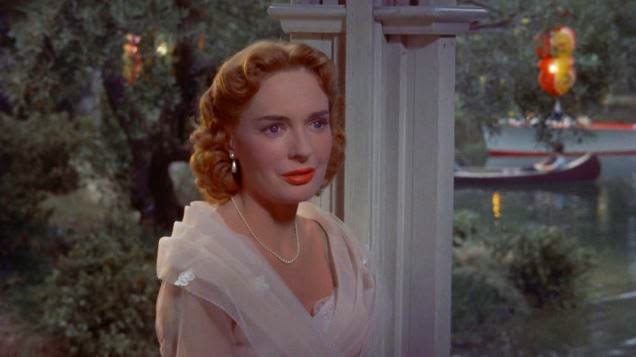
 

Rounding out the cast we are given more real-life personages, but presented, in typical Hollywood fashion, more as “types.”  Doe Avedon, who enjoyed only a brief career in film, plays the elegant upper crust debutante with whom Ferrer is smitten and eventually marries. 

Walter Pidgeon, now relegated from leading man to character roles, mostly fuddy-duddy businessmen, plays theatre impresario J.J. Shubert. 

Paul Henreid briefly plays Florenz Ziegfeld.  Later this year, we’re going to discuss a bit more about Florenz Ziegfeld and the actors who played him on film.
 

Paul Stewart, normally relegated to gangster types with that icy stare, here has a prominent role as Bert Townsend, Shubert’s producer who frankly admits to being in the theatre racket for the money and who panders to a public he feels are more likely to attend snappy shows with up-to-date situations, dialogue, and tunes.  He stomps down hard on Ferrer’s artistic bent for presenting operetta with all its cultural, dramatic, and musical richness, and this is the running theme of the story:  The artist being allowed to create what he wants versus what is currently the rage in the marketplace.

This theme pulls this splendid movie from the cozy dream world of the usual MGM musical and plants it firmly in today’s era of art versus product marketability.  It’s the same for music, theatre, books, as it is for any artistic endeavor, and every artist can relate.  The only thing perhaps holding back a modern appreciation of the struggles Romberg faces in this film is that the struggles are over operetta.  Unfortunately, as we discussed last year in our posts on The Student Prince (1954), Rose Marie (1954) and The Great Caruso (1951), operetta, outside of regional theatre, no longer enjoys the popularity it once did.  Paul Stewart, the grumpy producer, feels the same.  He wants no part of these Viennese-inspired cupcakes.  He wants Al Jolson in blackface, college co-eds, and flaming youth.

Needing the money, and the exposure, Ferrer sells his soul, as it were, and allows himself to become the composer of a great number of these now-forgotten topical “hits” of the World War I era and the early 1920s.  He constantly hammers at Mr. Stewart to allow him to write the kind of music he wants to write, constantly shoving the score of Maytime in his face, at which Stewart turn up his nose like smelly garbage.  Maytime would become one of the colossal hits of Broadway, which finally gave Romberg a leg up on doing the kind of music he wanted.

The Student Prince, Desert Song, and Rose Marie were even bigger hits in the 1920s, and it is for these operettas, Romberg’s pride, that he is remembered and not the dreck he was forced to write earlier in his career.

So there, Paul Stewart.

A few scenes of note:  I love how the movie starts, slowly, elegantly, and grandly with a full orchestra, as the camera pans probingly, lovingly on the musicians at their instruments (I doubt close-ups were ever given to orchestra musicians before or probably since), then finally lands on José Ferrer conducting, and then, bang, the credits.  It is a classy way to begin.

The use of a roster of MGM stars to present the various musical numbers is genius: it allows the studio to play its first-stringers, and it allows most of the story to be centered on the music and not on any awkwardly strung-together “biography.”  Jane Powell and Vic Damone, Howard Keel, Tony Martin, Ann Miller all are presented in numbers that show off their best talents.

Ferrer, who, among his other talents, can sing a little as well, is presented in a charming number with his new wife, Rosemary Clooney, “Mr. and Mrs.”  And proves to be a pretty snappy dancer.

He also performs the ragtime novelty song and dance “Leg O’ Mutton Rag” with the delightfully game Helen Traubel.  Wagner?  Who’s that?

Cyd Charisse and James Mitchell dance to “One Alone” from The Desert Song in one of filmdom’s most sensual performances ever.  They way they move and cling to each other in perfect interpretation of the music makes her climbing over his body look curiously almost like ice dancing.  You’d swear there is more movement than the camera is capturing.

We see the fun stuff, and the most exquisitely beautiful popular music ever written.  “Softly, as a Morning Sunrise” is tops among these, and Helen Traubel gets to save it, most majestically, from its early foot-stomping mangled version as concocted by the Shuberts and the manic styling of Tamara Toumanova.

Gene Kelly, in a rare film duet song and dance with his brother Fred, appear in the “I Love to Go Swimmin’ with Wimmen.”

But the tops is José Ferrer’s tour-de-force performance in the scene where he is requested to describe his latest work for the Shuberts, a silly romp called “Jazzadadadoo” from Bombo.  Embarrassed about this show, he is reluctant to act and sing it in front of his lady friend and her snobby mother, but once persuaded, he throws himself into it, manic and most hysterically funny.  The performance is incredible; not only does he compresses the entire plot of the ridiculous show in a single scene, but he dances, does mimicry, funny voices, smears on a little blackface to imitate Al Jolson, and will make you laugh until you cry or wet your pants or both.   It’s like a Monty Python skit.

Dignity slowly returns to Romberg, and the movie, when we witness his eventual vindication among the Shuberts and all low-brow folks when his operettas are the hits of the shallow 1920s; when he mourns the loss of his pal, Merle Oberon as Dorothy Donnelly, who sadly died at only 47; and in the final majestic number before a full orchestra, Romberg’s signature tune, “Deep in My Heart.”

But were the Shuberts right, did they have the last laugh in knowing that someday operetta would no longer be what the public wanted?

Listen to the music.  “Softly as a Summer Sunrise” is one of the loveliness, most sensual tunes ever written, and is still performed by jazz/blues singers today, as well as “Lover, Come Back to Me” both from the operetta The New Moon.


And consider that if Linda Rondstadt and Kermit the Frog can perform “When I Grow to Old to Dream,” then it really is a cool song after all, isn’t it?


In this old radio show, we have Ferrer, Rosemary Clooney, Jane Powell and others on the soundtrack promoting the film: 


Deep in My Heart, sometimes shown on TCM, is available on DVD here:


©Jacqueline T. Lynch, 2007-2015. All rights reserved. If you're reading this on a site other than Another Old Movie Blog, please be aware that this post has been stolen and is used without permission. 

**************************************

My book on Ann Blyth's career--Ann Blyth: Actress. Singer. Star. will be published on June 18th. To that end, I’ll be looking for some help in the pre-launch phase, so I’d like to invite any blogger—film blogger or book blogger—to participate in a blog tour. I’ll be looking for blogs to schedule publicity-oriented posts beginning Monday, June 1st. The last day will be June 17th. If anyone wants to pick a day, please let me know so I can coordinate with others. Think of it as a kind of blogathon. On your day, you can post a review of the book (I’ll have ARCs – advanced reading copies - available in PDF form which I’ll email to you that you can read on your computer), or you can do a Q&A with me, or I can just send you a 250-word excerpt of the book, or you can just post the cover and a link to the Amazon page, if you will. Just a little something to spread the word. I will be posting here every day from June 1st through the 18th and I’ll be linking to your blogs, pushing traffic to you.

Among those 17 bloggers who participate, I’ll throw your names in a hat and pick five winners who will receive a print book of Ann Blyth: Actress. Singer. Star. when it is published on the 18th. The rest will receive an eBook file in whichever format you choose: ePub, Mobi, or PDF (Note, the ARC copies will not have the index).


Thursday, March 17, 2011

Beloved Enemy - 1936

“Beloved Enemy” (1936) attempts to dramatize the events that led to the establishment of the Irish Free State in the early 1920s, and at the same time, spin a “Romeo and Juliet” fairy tale of two star-crossed lovers who bring together two nations.

It’s easy to point out where this film fails. “The Troubles” as those times are called of Irish civil unrest against the British Empire, and then civil war amongst its own people, is captured in too simplistic a manner. Hollywood shunned complications, particularly in a 90-minute script.

Both the British characters and the Irish characters are represented in varying degrees of stereotype.

Most obviously, the lead character played Brian Aherne is meant to be a take-off on Michael Collins, the Irish leader who engaged in diplomacy with the British and won self-rule under dominion status for Ireland, except for the six counties in Ulster which opted for membership in the United Kingdom. Many of his countrymen felt Collins had betrayed them, and Collins was murdered by an Irish assassin.

In the movie, not only is Mr. Aherne successful at bringing peace and independence to Ireland, under so vague a set of terms we are not allowed to know them, but he survives an assassin’s bullet and he and Merle Oberon live happily ever after.

Oh, and Omar Kiam’s costumes for Merle Oberon are a bit off, too 1936 and not enough 1920.

All right, that’s off our chest. What is more telling about this film is what they somehow got right.

The movie, directed by H.C. Potter (thanks Caftan Woman), begins with one of those scrolling narratives in some script font that sets us up for what we’re about to see. In historical movies, it often seems like these narratives are really just disclaimers. That’s what this one sounds like. Part way into it, we are informed that the events we are about to see reflect “A time of horror and heroism, with men on both sides dying bravely for what they believed was right.”

It is a cleaned-up judgment that tells us nothing of the filthy side of The Troubles, with men on both sides committing soulless acts of revenge, of cruelty, of dirty political self-interest.

We are then told that what we are about to see is “not taken from the pages of history” because we are supposed to be reminded of Michael Collins, but not get close enough to the real story to either alienate the British film market or the quite large number of Irish American filmgoers -- but that the film is “legend inspired by fact.”

Nice and vague.

Fortunately, the sharp black and white cinematography of Gregg Tolland gives us some focus, a glimpse into a world without complete right and wrong. What this movie lacks in script is made up for in atmosphere. Set in Dublin, but filmed entirely on the back lot, we have the dark, wet streets, the soft flat caps of brooding men in trench coats, and the widows and orphans.

Brian Aherne is the ringleader of a political group whose paramilitary function is discussed, but we never see the violence. One scene shows his band about to stage a guerrilla attack on a British convoy, and he steps between the truck and the machine gun to save the Brits, to save his plan for diplomacy. It’s a nice scene, a bold move, but too tidy to really tell the truth. The truth, after all, is complicated, for where does freedom fighter end and terrorist begin? It’s a question that gets asked repeatedly in just about every culture.

That Hollywood even attempts to show this subject and this foreign culture is laudable. Here is one of the few films of that time I can think of about a foreign war or political strife where no American character is the center focus, nor American connection involved. All the characters, and most of the actors and actresses, are all either Irish or British. There is no intended American slant here. Except of course, for being made in Hollywood and carrying with that the usual Hollywood inability, or unwillingness, to authentically capture another culture. Whatever American slant here is organic, but not purposefully skewed to tell the story through an American viewpoint.

Brian Aherne is the rebel, Merle Oberon is the English Lady, daughter to the English Lord who is appointed to travel to Dublin, sort out the troublesome Irish and tidy up the Empire. Aherne and Oberon are beautiful people, and the camera loves them. They love each other, eventually. At first it is snarling and verbal swipes until they make the astonishing discovery that (Irish, English -- fill in the blank) people are people, too.

The film tries to keep us on an even, serious keel with the political strife at hand. We open with a British raid on the secret offices of the Irish resistance, and men are killed. We meet the widow and young son of one of them. The son, played by Ronald Sinclair, and his buddies paint “Up the Rebels” on the back of Miss Oberon’s official government car. He hurts himself running away and she takes care of him and brings him home.

It’s a scene meant to bring the enemies together through empathy, and it’s a tale that’s been told ever since Aesop wrote about Androcles and the Lion.

There’s a bit more here, though. The scene with the boys painting their graffiti to the consternation of the bumbling British soldier assigned to be Oberon’s driver is comic. They are like the Little Rascals, briefly. But we realize after a moment that these boys’ street games are really training for the young men they will one day be when vandalism turns to violence.

Aherne, friend of the boy’s widowed mother, played by Cathleen O’Brien, has been earlier chastised by her when he tries to comfort her on the death of her husband, “What do you know about love? You never let it come near you. You’re married to a cause.”

But he meets Miss Oberon when she brings the widow’s boy home (which is too nice looking, hardly the simple, and possibly impoverished-looking flat it should be), and his fidelity to the cause becomes compromised over his love for her.

We have the often repeated refrain of the old Irish folk song:

“She had a dark and a roving eye,
And her hair hung down in ringlets,
She was nice girl, a decent girl, but
One of the rakish kind.”

(Anybody remember Guy Mitchell’s recording, “The Roving Kind”, B-side to “My Heart Cries for You”? 1950, I think. Much jazzed up, of course. With Mitch Miller’s orchestra. Ah, well, that’s neither here nor there. Just rambling. Come to think of it, anybody remember Guy Mitchell?)

Here, it’s a slow chant, wafting from jaunting carts and upstairs maids, and greengrocers, like a secret code of unity. A comforting musical buffer against “the strangers.”

When Lady Oberon and her father, played by Henry Stephenson, who are the strangers, cross the Irish sea on a dreadnought, we hear instead the majestic strains of “Rule Britannia.” (I’m pretty sure neither Guy Mitchell nor Mitch Miller ever did an up tempo recording of that one.) Her lament, “One nation and one people divided by a strip of water,” is naïve in that the label of “one people” would be balked at by both sides.

However, her naiveté is also appropriate for her character as a representative of the British upper class, insulated and remote. Such foolish myopia denies the bitterness at the root of problems, and also is often taken for insult by people whose national pride is built up by collecting perceived insults against them. This, too, has happened in culture after culture. Condescending assumptions can ignite trouble as well as weapons do.

David Niven is along for the ride as her father’s military aide, and he represents the kind of nice young chap of her own class that she should marry. He’s not in the running for long, though, and it seems almost a cop-out for him to lose interest in her and find someone else, someone to whom we are never introduced. A romantic triangle would have been more interesting. However, he does have a very funny line that he delivers charmingly when he asks Merle how to handle his new girlfriend, who wants him to join her for breakfast:

“I’m not sure if she means me to drop in for breakfast or…be there for breakfast.” The censors were evidently charmed into leaving it in, or they weren’t listening.

Among Aherne’s gang is the old reliable Donald Crisp, who is distrustful of any diplomatic overtures by the British, and who is distrustful of Aherne now that he has a British girlfriend.

Jerome Cowan, who we last saw in “Cry Wolf” (1947), and who made a career of playing stuffy, uninteresting lawyers and businessmen, often in B-movies, has a good role in this, his first film. He is one of the rebel gang, Aherne’s right-hand man. His accent is credible, and his close-ups show the intensity of a hard, hungry, angry man of action.

In one scene, he and Aherne are escaping from a British raid, and they scurry along the rooftops, tumbling down the sharply pitched slate roofs in the darkness. They manage to hang onto a drain pipe to hide, and then after a very long time, pull themselves up, exhausted, to the rooftop when the British soldiers have left. Cowan, sensing Aherne’s loyalties and his good judgment are wavering, makes him promise to never see Merle Oberon again.

While the film misses the gritty authenticity of “The Informer” (1935), made the year before, it has scenes like these to illustrate the complexity of loyalty. Another attempt at honestly depicting the events of the day is to show many scenes of diplomatic negotiations. Aherne heads an Irish delegation to London under a flag of truce to discuss options for ending the violence. He and Henry Stephenson are seemingly the only ones who push for peace. All around them are their English and Irish colleagues who argue and will not compromise.

Negotiations do not make for exciting scenes, but they do honestly depict the real difficulty of the situation. People venting problems, people trying to solve problems through talk. Realism without the explosions.

We drift back into comfortable Hollywood fantasy, however, when peace is declared and truck after truck of British soldiers leaves Dublin, with Irish crowds cheering them and the end of The Troubles, jolly Tommies waving back. Wish fulfillment is one thing, but this is ridiculous.

However, we smack head-on into grisly realism again, when Merle gets wind of the plot to murder Aherne because he made a deal with the Brits for peace. Jerome Cowan, full of the unreasonable, ugly, and long-familiar rush of revenge, takes on the job of assassin. Loyalty for these rebels is really just a game of musical chairs.

When Merle barges in on the men making their murderous plans, to beg for Aherne’s life, there is a moment when they slowly rise to their feet, and one of them sneers, “I think we’ve heard enough from this alien.”

It is a tense moment when we see in their faces, and especially in Miss Oberon’s suddenly knowing expression, the possibility that they are about to assault her. So quickly do the charming Irishmen who sing silly songs and ride in jaunting carts turn to animals. Fortunately, the young Irish widow she earlier befriended, who brought her to this meeting, gets her out.

We see Aherne in his Irish military uniform, making a victory speech before a cheering crowd, and we see for the first time the Tricolor (yes, it’s a black and white movie). Ahearn ends his speech with a flourish, “Erin Go Bragh!” and Cowan pulls the trigger.

The Irish Free State was born in 1922, but this film is more a product of the pacifism of the 1930s between the two wars. Fairy tale, and historical events, and Hollywood. An uneasy mix at best, but considering the complex subject, “Beloved Enemy” is at least an introduction, not so much primer as a pop-up book, on The Troubles for outsiders like us in the American audience.

Monday, February 11, 2008

The Dark Angel (1935)

“The Dark Angel” (1935) is perhaps one of the first films set during World War I that does not carry themes of the wastefulness of war or the tragedy of the political failings of that war, despite the tragic experiences of the leading men, two soldiers. It does not present the soldiers of that war as dupes or victims of heartless or corrupt governments. It seems to be one of the first films that depicts the soldiers of that period as romantic heroes, and that war as a romantic and noble gesture, albeit a doomed one.

The Lillian Hellmann screenplay tells the story of three friends from childhood, a winsome girl growing up in a genteel English country home, and the two boys who are her playmates. The two boys are cousins, and she has a crush on one of them, leaving the other to quietly nurse his own crush on her.

Years later they grow up to be Merle Oberon; Fredric March as the boy she loves; and Herbert Marshall as the boy who wishes he were Fredric March.

The cinematography is all stock Hollywood images of what the English countryside should be: picnics in a sheep meadow, a breeze playing at the curtains, a roaring fire, mannerly servants, and a sense of noblesse oblige.

Then the Great War breaks out and the two young chaps (played by much older actors) manfully take up their duty as officers. Mr. March is still in his matinee idol period of his career, still exuberantly boyish and occasionally mugging. It is a wonder to consider that in ten years’ time he will be the tired, war-weary middle-aged American sergeant returning to his family in “The Best Years of Our Lives” (1946).

Home on leave, Fredric March and Merle Oberon decide to wed. Herbert Marshall, with his stiff-upper-lip is particularly moving as he congratulates them while stifling his own sense of rejection. A quick wedding is made impossible when the boys are recalled to the frontlines. Merle Oberon accompanies Fredric March on a secret tryst to spend one last night with him at a seaside inn. It is interesting in scenes like these, in films like these, to observe the delicate balance Hollywood struggles to keep when deliberately trying to create an atmosphere of romantic desire and yet maintain an aura of innocence. As the night grows on, and sense of dread increases as they sit in a darkened room hours later, cuddling by a window with distant sounds of cannon fire, we are left to imagine for ourselves whether or not they have consummated their love. The Code of the day decrees that while such an occurrence could be suggested for minor characters even if not graphically shown, nevertheless it could not even be suggested if the happy couple are to remain the film’s hero and heroine. It is an amusing and cowardly bit of fence sitting.

A snide gossip later jokes about Mr. March’s romantic last night with some woman, to a shocked Herbert Marshall, who is appalled that March would take up with another woman while being engaged to Merle Oberon. There is a split between them, doubt, suspicion and resentment grows while we are given the iconic image of English World War officers boarding a fog-enshrouded transport ship in their trench coats. (The trench coat was named for the place where English officers wore their all-weather long coats - the trenches.)

So miffed is Herbert Marshall with what he perceives is his junior officer Fredric March’s swinish behavior, he denies him temporary leave, after which March, spitefully volunteering for a dangerous mission, is lost on the battlefield after a big explosion, and presumed dead.

Marshall blames himself, confesses his guilt to Merle Oberon, who in turn confesses that it was not some trollop that Fredric March chose to amuse himself with his last night on English soil, it was her.

The movie could have ended here with this O. Henry type ending and we could have had a different story, but a further melodrama is added when Fredric March turns up in a hospital, blind.

After his rehabilitation, he chooses not to return home and be an object of pity, but hides out in a country inn where his suicide attempt is aborted by three nosy children who have never seen a blind man before. (Fay Chaldecot plays the engaging little girl with a charming natural quality.) From his encounter with the kids, and subsequent afternoons amusing them by telling them stories, he becomes a successful children’s book author. Not as successful as J. K. Rowling, but enough so that he can buy a little cottage of his own in the country and grow roses.

Meanwhile, Mr. Marshall and Miss Oberon, who comfort each other after the loss of their friend, get engaged. By this time it is more or less foregone that they will meet with Fredric March again, and Miss Oberon will dump Mr. Marshall for her old love. Poor old Herbert Marshall. His quiet nobility and silent pain is more affecting than all the romantic promises and occasional overacting both by boyish Mr. March and the lovely Miss Oberon.

More Hollywood England is applied with a trowel for good measure: a fox hunt, teatime, the strains of World War I songs, a benign village vicar. All we are missing is a blustering retired “Major” and a Cockney chimney sweep.

“The war did something to me. I’ve changed,” Fredric March tells us, no less a fact for not being very original. What is poignant about the film is that the sense of resentment for the war, the rueful disgust, is not displayed here as it is famously illustrated by films like “All Quiet on the Western Front” (1930), and most other films made from the end of World War I to the early 1930s.

In three years after this film was made, the Nazis would invade Poland and begin World War II. Already the seeds were being sewn in Spain and Ethiopia, and Manchuria and Korea. You can almost sense in this film the new era to come. Even if one were not able to predict the coming war, there was evidently a atmosphere, as evident in this film, of rehabilitation over the former resentment of War I, and even a sense of wistful nostalgia for the romantic past of 20 years ago. Even men who were really were victims of war, like the character played by Frederic March, blinded in battle, would no longer be seen as dupes and victims, but as romantic heroes.

This is also one of the first films which shows a man with a physical impairment not being an object of pity. He is shown here living independently on his own, earning his own living, and still the preference of the woman he loves. Contrast this with the sweet but utterly helpless blind World War I vet played by David Manners in “The Miracle Woman” (1931), who is more dependent on those around him.

Another irony to the film is that Herbert Marshall, whose character is unscathed by the war, actually served in the British armed forces in World War I and lost a leg. His film career, like his previous stage career, was performed, unknown by most audiences of the day, on a prosthetic leg.

Related Products