IMPRISON TRAITOR, PEDOPHILE, AND CONVICTED FELON TRUMP.
Showing posts with label Martha Scott. Show all posts

Thursday, November 15, 2018

The Desperate Hours - 1955


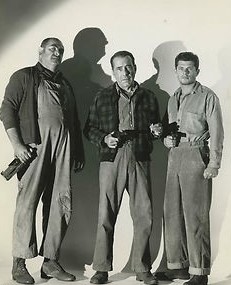
The Desperate Hours (1955) brought the escaped convict genre to suburbia. That’s where everyone else was headed in the 1950s, and the house in the neighborhood is as much a character in this film as the three outlaws and the family they terrorize.

This is our entry into the Outlaws blogathon hosted by the Classic Movie Blog Association. Please check out this link to read some other great blogs on this sinister subject.

In The Desperate Hours, Humphrey Bogart plays the lead bad guy in his second-to-last film and the very last bad guy role he was to play in movies. He shows he’s still got it.

Dewey Martin plays his younger brother who has broken out of prison with him. The third member of their gang is played by Robert Middleton, who is arguably the most frightening member of the trio.

The movie begins with an audience perspective shot as we move down a suburban subdivision. There are lawns and trees, children, a dog or two, people walking on sidewalks. It is deceptively peaceful. The camera moves very quickly to one particular home on the block. If the house looks familiar to you from the outside that’s because two years later, Beaver Cleaver lived here. The television sitcom Leave It to Beaver (1957-1963) used this exterior for the Cleaver home.

Fredric March is the head of the clan, doting father and husband and executive, who works “downtown,” a place which with the settlement of suburbia has become more distant and vaguer to us.

Martha Scott is his wife; Mary Murphy is his grown daughter; and the wonderful Richard Eyer, who as we’ve seen was such a standout in films here like Friendly Persuasion (1956) and here in Slander (1957), plays his young son.

Though we see the family gathered together for a cheerful, if rushed, breakfast, it is not all idyllic on the home front. Fredric March does not approve of his daughter’s latest boyfriend, a hotshot young lawyer played by Gig Young. She is rebellious and they argue in the car when he drives her to work “downtown.”

Young Richard no longer wants to kiss his father goodbye when he leaves for school; he’s too man for that now and he does want to does not want to be known by a nickname anymore. He’s an All-American boy, pretty much goes his own way and his sudden streak of independence, while cute in this scene, is going to prove to be a greater problem later on when he tries to rebel against their captors.


The story was written by Joseph Hayes from his novel and his original script which was performed on Broadway at the Ethel Barrymore Theatre from February to August 1955, the film’s release year. For some years thereafter, it was a popular summer theatre play and the two-level set which was required to tell the story of showing the family in different rooms with the bad guys was always a challenge and always a hit on stage. We take things for granted like a two-story house in the movies, but on stage we appreciate more the architectural skill it takes to build and to work on a two-level open set.

The Broadway version was directed by actor and director Robert Montgomery. Karl Malden played Fredric March’s role as the suburban husband and father, and Paul Newman played the Humphrey Bogart role. We can imagine that the younger gangster in the mid-1950s might have carried a more sinister suspense story because the brothers would have been contemporaries and because they might have appeared more violent and impetuous.


Though Bogart is a generation older than his brother played by Dewey Martin, we can accept them as brothers and accept that Bogart, even though famed for playing dangerous criminals, serves a different function in the screen version. His is rather like a parallel to Fredric March, than to his partner younger brother.  Like March, he is the head of his family, or his gang, and he sometimes has trouble keeping them in line. Fredric March bristles at his daughter’s romance, believing her to still be a kid. Humphrey Bogart is stumped when later in the film his brother rebels not just against his authority but against the whole way of life in which his big brother has raised him.

Bogart and his gang have chosen this house at random, which is certainly an eerie aspect about the story, it could have been any home—maybe even yours. Bogart’s reason for choosing this house was that Richard Eyer has left his bicycle on the front lawn. Bogart knows he would be able to make the family more fearful and more easily cooperative if they have to protect children. This tells us that he has some experience and logic in his craft, and also that he would prefer not to have any trouble if he could avoid it. He intends to hole up here until he can arrange for a former girlfriend to bring them money to escape.  But he also wants to go after the deputy sheriff responsible for putting him in prison.

Arthur Kennedy plays the deputy sheriff, who is the only one among the police officials to take the news of the jailbreak seriously, feeling certain that Humphrey Bogart is coming straight for him. He is not so paranoid as he is analytical, just as logical as Bogart or Fredric March is in this scenario. There is an attempt to turn the story into more or less a triangle to include the efforts of the police to trace Bogart’s whereabouts. This is obviously not something that would have been easily done on stage where the whole story was pretty much set in the home.

Note Bogart’s disgust when he sees that March, whom he resents for his middle-class respectability, has only $800 in his bankbook.  In that era, it would have represented probably something like three or more months’ wages saved.  That may not be terrific in Bogart’s eyes—he’s after all the marbles—but today when it is estimated that only about 18 percent of Americans have three-to-five months’ savings in the bank, then this family is doing okay.

The movie also gives us a lot of familiar faces to pick out in the crowd, Ray Teal as the state police detective, Alan Reed (Fred Flintstone) is another officer, Ray Collins, Simon Oakland will also play police officials, Whit Bissell plays a pensive and intellectual FBI agent. Beverly Garland plays the teacher who drops by and in front of whom March must pretend to be bringing home drinking buddies to cover for her seeing the bad guys. Joe Flynn plays a panicky motorist taken hostage, and poor Walter Baldwin plays the junkman in the greatest danger of all of them.


Shortly after father and daughter leave for work, and Junior’s off to school, mom Martha Scott begins her housecleaning. She brings along a portable radio into every room to listen to music and, of course, to give us the opportunity to hear the news bulletins about the escaped convicts. Later on in the movie, Humphrey Bogart will smash the radio in a fit of anger.

It is interesting that even though this film was released in 1955, we see no television set in the home. It is more than likely that by the mid-1950s, a middle-class home such as this would have a television. I’m not sure why they don’t include one, either because it didn’t figure into the plot, or because the film industry was still chafing with resentment over its new competitor and didn’t want to acknowledge its existence?  Though Fredric March drives an older model car, the movie is not set in the late 1940s—Gig Young’s flashy sportscar alone tells us that.

We might think today that the TV would be a better place than the radio for news bulletins, but this was long before 24-hour news and also it was an era where news broadcasts were infrequent and brief. There were usually only one or two news programs lasting all of about 15 minutes from the 6 o’clock to the 7:30 time frame in the morning, and it was much the same in the early evening from 6 o’clock to about 7:30. We might have one or two news programs 15 minutes in duration. Television news did not really come of age until the 1960s, and much of that, sadly, was launched in the aftermath of the Kennedy assassination. Newspapers were still king of the news--even of bulletins, with the ability to produce "extras" several times a day.

Robert Middleton, the large hulking Neanderthal of the bad guys with one presumes the IQ of a child, plays with Richard Eyer’s toys in his room and break some of them in frustration when he smacks his head while looking out the window.  He fumbles with a toy bank that looks like a little safe, and he cannot open it. At one point he takes a toy gun and blasts it around the house until Humphrey Bogart tells him knock it off. In one scene—one of director William Wyler’s touches, while Bogart is terrorizing Martha Scott in the foreground, in the background we see Middleton drinking from a milk bottle and spilling it down his chest (just as the boy will do later).  These images of the buffoon are only half-comic.  They also point to Middleton’s mental instability, which is the most dangerous thing about him. These fellows had been in prison, we don’t know for how long, but it’s possible that television would have been a complete novelty to them. I imagine if Robert Middleton’s character was so enthralled by Richard Eyer’s toys, then he might have enjoyed CaptainVideo or Hopalong Cassidy.

Bogart snidely says of Middleton to Martha Scott, “Crude, ain’t he?”

Bogart is commanding in his sneering, angry role, indeed, it is a role he has played many times. There is stubble on his face and over the phone he calls his gun moll “Doll,” like a man from another era, and he is supposed to be. He has no place in modern society.


His younger brother, Dewey Martin, feels this more acutely than Bogey. He is more wide-eyed at the appearance of the house, and at the nubile young daughter. At first, when he enters the daughter’s bedroom while she is at work and sees her canopy bed, he touches the frills on the canopy and brushes his face seductively on them.  It is an image which causes us to think he will present a sexual threat to her, but when he meets the girl and examines the whole house more closely, there is an unexpected change in him.  He is strangely awed and respectful of this world and its people.

Interestingly, the scene with her canopy bed reminds me of the scene in Wyler’s other film The Best Years of Our Lives (1946) when Dana Andrews wakes after a drunken night in Teresa Wright’s canopy bed, and he amusedly blows on the canopy’s frills, surprised to find himself in such a feminine haven.

When father and daughter come home from work, and Junior comes home from school, the entire family is held hostage and they are moved from room to room at gunpoint. In some scenes, it even looks as if they are camping in their own home as they try to stay together.

Martin seems more than attracted to daughter Mary Murphy; there is a shy, almost boyish crush he exhibits for her. Bogart notices the attraction and jokes that when they leave, they will take the daughter with them as a hostage just as a present for his younger brother. It is a chilling moment.

But the brother protects the girl from Robert Middleton, who is a far greater danger not only to her but everyone in the house, even to Bogey, because he is so undisciplined and so mentally unstable.

The real terror in the film comes from the sudden destruction of the blessed normality of their everyday lives. They live in a world of 1950s conformity, and though it may get a little stale sometimes, they know they are safe there. Their safety has been shattered not necessarily by three escaped convicts, one of them with a gun, but that the normality is gone and the unknown has entered their lives.

One gun becomes two as Bogart discovers that the family keeps a pistol in the house. This evens up the score a little and makes Bogart happy because Middleton has the other one.

But there is an even greater danger to Bogart than Robert Middleton’s instability. It is his younger brother. Dewey Martin doesn’t want to take over his brother’s life of crime anymore. When Bogart tells him to stick with him, that he got them out of prison and he will take care of him, that he taught him everything he knows – a common manipulation used by the heads of families to keep the younger in line – Dewey Martin disgustedly replies, “You taught me everything, except how to live in a house like this.”

If Dewey Martin was not dissatisfied with his life in prison, he certainly is now because he sees a glaring comparison to how his life has gone. This is a nice home, with a nice family. If Mary Murphy’s beau, Gig Young, is not welcomed by her parents, then what chance would he have? Even though he respectfully calls her, “Miss,” and calls Fredric March, “Sir.”


The family has its own struggles, its own splinters and breakdowns, and coming together. Unfortunately for Fredric March, who tries to shepherd his family through this terrible experience and proves himself to be courageous and very intelligent in how he manages to outmaneuver the bad guys, his greatest handicap is also his greatest treasure – his family. Neither his daughter nor his son obey his explicit instructions and they mess things up, even his wife rebels and throws a monkey wrench into the works. At some point we have to wonder if March just wants to throw his hands up and yell, “All right then, go get yourself killed! I’m sick of talking to you people!”

But he doesn’t. At one point when he is allowed to leave the house on a mission for the bad guys, he stumbles onto the dragnet by the cops who have traced Bogart’s whereabouts, and he has to plead with them to allow him to go back in to mediate the situation because he doesn’t want them shooting up his house and killing his entire family. They reluctantly agree, but give him a gun. He empties it of all the bullets. He takes it with him. The cops think he’s nuts, but we see in the course of his last gambit that he is more clever than anybody.

It is an intricate and interesting movie and fast-paced but I won’t linger too much on the heroics of the family. This blogathon is about outlaws. In the tradition of classic films, none of these outlaws comes to a good end.

We may not mourn Robert Middleton, he’s just too scary and too bad, and has already committed one murder right before our eyes.

Dewey Martin has the greater share of our sympathy and how he meets his end is entirely accidental and tragic because he is escaping his brother and a life he does not want.

Bogart plays his cards all the way to the end, and it’s just March and Bogart at the end. March has outsmarted him because he has managed it so that Bogart holds the gun with no bullets in it.

When March has his own gun, Bogart sneers, “You ain’t got in you.”

March growls, “I’ve got it in me. You put it there.”

Then March does something so effective and perhaps even cruel, to get back at Bogart. Having heard the news about Bogart’s brother’s death – which Bogart doesn’t know – March tells him how his brother died and he sneers and shouts, “You did it! How do you like it?”

This is really the end of Humphrey Bogart. Yes, he has a few more minutes in the film, and yes, he rushes out into the police spotlights and drops down on their front lawn only a few feet from the boy’s bicycle that had brought him to the house in the first place, but it was really upon hearing of the death of his brother, the end of his family, and the collapse of his authority that kills him.


Some may say that Bogart was a little too old to play this role, especially if they had seen Paul Newman play it on Broadway, but this is a different interpretation. Movies are different from plays. We wouldn’t have had all the cops in the play, we wouldn’t have all the bicycles, the milk delivery trucks and the sound of crickets in the evening. We wouldn’t have had March’s bewildered office staff in front of whom he has to pretend, we wouldn’t have had the roadhouse where Dewey Martin tries to escape. We wouldn’t have had the town dump where Robert Middleton commits a cruel and vicious murder.

Bogart was in his element in this role because Bogart was in his own world. Hollywood at this time took its gangster movies from the faux city streets of its backlot and soundstages, to a wider and somehow more complex world on a backlot suburbia. The Cleavers would move into that house – on television of course – and the conformity of suburbia would cover over Bogart, Dewey Martin, and Robert Middleton, like a blanket of snow, masking the ugliness, but not obliterating it.

The 1950s introduced us to new bad guys – psychos, rebellious youth, juvenile delinquents. They would be more at home here in suburbia. They could not be gotten rid of so easily, like the crabgrass on the lawns of the middle-class homeowners; they were rooted and endemic.


Please visit the Outlaws blogathon hosted by the Classic Movie Blog Association for more great entries on bad guys in film.

Thursday, March 29, 2018

Ben-Hur - 1925 and 1959


Ben-Hur: A Tale of the Christ (1925) and Ben-Hur (1959) dramatize the novel from 1880 by Lew Wallace about a wealthy Jewish prince during the time of the Roman occupation of Judea who was sent into slavery by his old friend, now a Roman soldier who aspires to political high office. Judah Ben-Hur will eventually avenge himself, sorrow and suffer, and his path will cross many times with Jesus Christ until the moment of Christ’s Passion. The story combines so many elements dear to Hollywood: a successful novel, a biblical epic wherein images of suffering, torture, a certain degree of salaciousness, are permitted because they are deemed biblical, including a showing fair degree of muscled legs and chest of our hero, and the opportunity to appear as if they are enlightening their public as much as entertaining them. We mark the annual crisscrossing of Passover and Easter with this story of Ben-Hur.

The original feature-length movie from 1925, being a silent movie, and being predominantly in black and white, except for some two-strip Technicolor scenes, is obviously different from the blockbuster 1959 multiple Oscar-winner, which was made in color, and where every sound from grunts and groans, the hoofbeats during the chariot race, a relentless hammering of the wooden mallet on the drum to mark the time of the galley slaves rowing, is gloriously and intimately recorded. It was also shot in a widescreen process allowing us a view of everything on either side of the principal characters in the scene, thereby allowing our eyes, and our minds, to wander.

Astonishingly, however, there is much about both movies that is quite similar, including much of the chariot race and the scenes leading up to the race. The 1925 version is a little closer to the novel, but it is no less an opportunity to embrace all that is lavish and lush about an era in Hollywood where there was no CGI and those thousands of people we see in the arena and on the rocky hillsides and the lonely road to Calvary, were real people and not embedded by computer-aided graphics. One might even note that the naval battle in the 1925 version is actually a little more impressive than the 1959 version because it does not appear so much like models in the M-G-M pool.


One of the great delights of the Easter season is watching these old Hollywood epics on regular broadcast television. As we know, broadcast TV rarely shows classic films these days; they are to be found only on retro channels and on TCM, so fewer people are exposed to classic films today. And though broadcast TV does include those pesky commercials, does include edits which are extremely annoying to us old movie fans, there is still something wonderfully egalitarian about being able to see them for free, especially when one is sated after the holiday family meal and the kids are tired out from a long day of festivities and the whole family can gather in front of the TV and watch Hollywood’s ambitious take on the deeper meaning of the season.


Of course, Hollywood’s take on the deeper meaning is never all that deep, but it is entertaining and picturesque, sometimes as magnificent a feast for the eye as the old Renaissance masters’ versions of biblical events; their views were also slanted viewpoints. We could note that the scene of the Last Supper in the 1925 version of Ben-Hur looks almost exactly like the da Vinci painting. Of course, that was da Vinci’s version of the Last Supper, which probably did not happen on a long rectangular table with all twelve apostles and Christ sitting on one side of the table like the dais at a Friars roast. More likely they were all seated together on the floor, dipping pieces of their unleavened bread into a communal dish. And the lighting wasn’t as good.


The other fun aspect about watching biblical epics is that they always end up containing a dream team of players. Sometime or other we’re going to have to discuss The Ten Commandments (1956), a movie I cannot think of without recalling Edward G. Robinson in one of his most campy roles. Just hearing his gangster delivery makes me laugh. (Or was that Billy Crystal?) But that is Hollywood.

It was in The Ten Commandments that Charlton Heston first became famous for the biblical genre. He played Moses in that epic free-for-all, and he comes to the 1959 Ben-Hur with that under his belt. Sam Jaffe and Finlay Currie as well as Martha Scott are the old-timers from classic films here, but they are joined by popular actors of the day such as Stephen Boyd, and Hugh Griffith, who with great panache plays Sheik Ilderim. Newcomer Haya Harareet plays Esther in what was intended to be a dash of authenticity in this version. Ms. Harareet was herself from Israel, born before that country was established when it was still part of British Palestine. She made only a handful of films after that however.  Director William Wyler cast most of the Romans with British actors and most of the Jews with American actors, because he felt the distinction in accents would help differentiate them in the minds of the viewers.  It seems that most Romans in the old epics were played by Brits, which may lead many of us to assume Caesar studied at Oxford.


The 1925 version of Ben-Hur, untroubled by the need for different accents, we also have a dream team of sorts.  Except for star Ramon Navarro and Francis X. Bushman, the movie features a large cast of actors who are predominantly unknown even to classic film buffs. This might give the film more of a purity in the sense that we come to the story without any preconceived notions about the actors playing the roles. However, most of us would be delightfully shocked to discover that many of the Hollywood stars of the day played uncredited bit parts in this movie, lending themselves to crowd scenes, including John and Lionel Barrymore, who supposedly were spectators at the chariot race, as was director Clarence Brown, Joan Crawford and Marion Davis, Douglas Fairbanks, John Gilbert, Dorothy and Lillian Gish, as well as producer Samuel Goldwyn. Even theater owner Sid Grauman of Grauman’s Chinese Theatre was there in the stands. Gary Cooper is supposed to have played a Roman guard, as was Clark Gable. Janet Gaynor and Myrna Loy played slave girls. I did not see them, but I promise you I’m going to watch this movie over and over again until I can find them. Let me know if you do.  I don’t think there has ever been such a collection of future stars in bit parts in the same movie.


There actually is something very pure and very innocent and strikingly emotional in the 1925 silent Ben- Hur. Directed by Fred Niblo, June Mathis was the scriptwriter, and we may recall that the 1920s was a time of greater opportunity in Hollywood for women. Ramon Navarro, a really excellent actor, is handsome and very moving as Ben-Hur. Francis X. Bushman is his friend and foe Messala the Roman soldier. In the 1959 version Stephen Boyd plays the role and at first, he and Charlton Heston meet after an absence of many years and renew their childhood friendship. It is only after they discuss the political events of the day and Boyd’s request that Heston inform on fellow Jews who work against the Roman Empire that they fall out and become enemies. Though the 1925 version has Navarro welcoming Bushman after a long absence, the beefy and brash Bushman acts like a bully from his first entrance.


May McAvoy plays Esther, the daughter of Simonides who is Ben-Hur’s slave and steward. She will be his future love. Claire McDowell plays his mother and Kathleen Key plays his sister Tirzah. Mitchell Lewis plays the flamboyant Sheik Ilderim but he does not have the grandiose humor of Hugh Griffith. Charles Belcher plays Balthazar, one of the Three Kings who paid tribute to Christ at his birth and who has been seeking him these many years. Finlay Currie gets the job in the 1959 version, and also serves as narrator.

The moments where Ben-Hur’s life intersects with the life of Christ are commonly treated with a two- strip Technicolor process. We see the brightly colored robes and skin tone on the actors.


Though the grand scenes of the enormous palaces, the gigantic sets are mind blowing, we are treated to very small, intimate scenes of equal power as was common in silent film. After the impressive naval battle when Ben-Hur has rescued the Roman captain and they are brought to another ship, he climbs the outer net of rope rigging to the deck and he passes by a porthole where a fellow galley slave looks up at him mournfully. So much is said with a glance. The director gets a lot of mileage out of these kinds of scenes. One of the problems with the widescreen process as used in 1959 is, as director William Wyler himself lamented, all the space has to be used and so even when the director is focusing on two people in the scene, the audience is going to be looking elsewhere because there is so much else to look at. The director is not able to focus on a pinpoint moment.


The chariot race is perhaps the most famous element of either movie or even the book. It is stunning. The silent version gives us remarkable camera angles where both actors are seen handling the four horses that pull their chariots and I’m assuming that stunt doubles were kept to a minimum simply because of the difficulty of filming. There are those amazing shots, replicated in the 1959 version, of the chariot actually driving over the camera which has been placed into the ground. The stunning wide sweeping shots of the chariots making turns and thrusting down the straightaway, sometimes crashing into each other and overturning is breathtaking. What the silent version lacks is the sound of hoofbeats. We have a beautifully restored version of the 1925 film from 1988 scored by Carl Davis which provides a stirring backdrop to this scene, but we have no hoofbeats.

One thing that some critics remarked upon in the 1959 version was that it was a very slow, unwieldy tale, a very long movie and the parade of characters were presented with chronological diligence but with without raw emotion. The 1925 version carries all the raw emotion including several scenes that are utterly heartbreaking. We may note that this movie was remade in 2016, and it was not successful, but though I have not seen it I can imagine one reason for its lack of success among others – the heavy use of computer graphics makes a modern film more cost-effective but it removes us emotionally from the scene. It must have been extremely expensive and extremely laborious to have thousands and thousands of people rising as one, perfectly choreographed to cheer during the chariot race but it is far more effective because it is real, and because people whose emotions we understand are more interesting, and always will be, than technology we don’t understand.


Both movies deal with the representation of Christ as a silent figure and whom we see only from the back or only his arm, or his hand. Christ gives Ben-Hur a drink of water when he has been marching through the desert to become a galley slave and we see his gentle touch on Charlton Heston’s hair; the difference, however, is that the reaction toward Christ is on a more human and less spiritual manner in the 1959 version. When Charlton Heston looks up at Christ, Heston’s expression seems to tell us that he is grateful for the water and relieved he has found a sympathetic person who is helping him. He does not look as if looking into the face of the Messiah. Ironically, the Roman soldier who comes by to bark at him and tell Christ to go away suddenly stops and looks towards Christ with more of a sensation of encountering something strangely mystical. We see a more powerful reaction from the soldier than we do from Heston.

Ramon Navarro always appears as if deeply moved when The Nazarene crosses his path. Another interesting moment done with pure acting, is when his mother and sister are healed from their leprosy by their interaction with Christ. They had been told that The Nazarene performs miracles for those who believe and they arrive in time for his Passion as he drags the heavy cross through the streets. We don’t see his face; we see the cross on his shoulder and his face is behind it. They sorrow for him, and just with lighting, a white light that centers on their faces, the dark circles of their illness disappear and they immediately delight, acting as if they had been cured of their leprosy. There is no Jekyll and Hyde makeup transformation; it is all in the acting.

The 1959 version has Christ on the cross in the storm, the rain pouring down, dripping from his fingers on the hand nailed to the cross.  In a nearby cave, Ben-Hur’s mother and sister discover they are cured of leprosy. The darkness of the cave masks their need to wear makeup. The 1959 version is more sweaty and dirty, but even the realism does not match the heartbreak of the 1925 mother and sister close enough to the sleeping Ben-Hur to touch him, but resisting to wake him from sleep because they want to spare him the knowledge of their leprosy.

Both films make an attempt to address the political issues of a conquered people, for the biblical events, as in current events, are always as much about politics as about faith. Ben-Hur’s quest for Christ is his militant quest for a king to lead them out of Roman bondage, but he eventually adopts Christ’s message of peace. In the 1959 version Stephen Boyd taunts Charlton Heston with the idea that he is a member of a conquered people and he needs to get used to that. “The glory of Solomon is gone... Joshua will not rise again to save you, nor David.” To which Charlton Heston replies, “Rome is evil... Rome is an affront to God.”

The story ends with Ben-Hur reunited with his mother and sister, and with his love, Esther. But there’s a big “what happens next” that is never answered. How does he live with no end to Roman occupation for the rest of his life? We are meant to assume that the early Christian followers find strength and comfort in the teachings of Christ and in their own growing numbers, but though Hollywood enjoyed platitudes as a way of staying on the good side of the public who always thought that movie capital was a Babylon among the orange groves, it did not even trouble to answer the larger questions, preferring to wallow in the spectacle.


I enjoy biblical epics, but not because I find them instructive or inspirational; rather because, like a painting by a great master, they are imaginative pictures of wondrous events brought down to a human level we are better able to relate to – and despite the temptresses, the virile warriors, and the gauzily dressed slave girls, I think the most frivolous thing about them is that they are so irresistibly commercial.

So frivolous that, unlike the more meaningful and reflective rituals of the holidays, I cannot help but equate theses movies with a handful of jelly beans and winding down a busy weekend of celebration.

May I wish a Blessed Passover and a Happy Easter to all who celebrate.

You have a chance to watch the 1959 Ben-Hur this Easter Sunday on TCM.  

Have a look at the chariot scene from the 1925 version below.


Monday, October 1, 2012

Answers to "Who's Cookin'?"


Wash your hands; we’re just about to have supper. Here are the answers to last Thursday’s “Who’s Cookin’?” screen cap trivia:


A - Clark Gable cooks  a couple enormous steaks in “Any Number Can Play” (1949).

B- Alexis Smith in “The Sleeping Tiger” (1954).

C - Barbara Stanwyck learns the culinary arts in “Remember the Night” (1940).

D - Jean Arthur cutting “Shane-sized” wedges of pie in “Shane” (1953).

E - Marjorie Main slings hash for boss Judy Garland and a mob of actors in “Summer Stock” (1950).

F - Joan Crawford in “Mildred Pierce” (1945).

G & H - Martha Scott in “Strange Bargain” (1949).


Monday, March 7, 2011

Strange Bargain - 1949

Strange Bargain (1949) is film noir stepping out of the shadows and into the living room. It’s a great example of what happens when middle America adopts a new fad, tames it, and makes it into something quick, convenient, easily digestible, and appropriate for family audiences. Noir as mainstream entertainment.

It’s not the first time we have suburban America as a scene of the crime and a haven for criminals, Alfred Hitchcock’s Shadow of a Doubt (1943) is a great example of this. Strange Bargain doesn’t have the eeriness, or the humor of Shadow, but it’s not meant to copy Hitchcock; it’s meant to cash in on a powerful new tide in moviemaking of the day.

No back alleys, no dames or molls, no whackos or mobs, or lonely car trips on deserted highways, here. Oh sure, we’re in Los Angeles, but not that Los Angeles. The movie begins innocuously with a paperboy riding his bike down a cozy suburban street, flinging the newspaper at a smiling Jeffrey Lynn, the master of the house on his sunny front porch. It looks like Andy Hardy’s neighborhood. All is right with the world. Not for long.

We quickly meet Mr. Lynn’s family at breakfast: the supportive homemaker wife played by Martha Scott who never gets to sit down and eat, the precocious son who wants a new bike but can’t have one because Pop doesn’t make enough money and they’re behind the bills.

The boy is played by Michael Chapin, whose know-it-all chatter gets on one’s nerves after about 30 seconds. Younger daughter, played by Arlene Gray, who never made a movie after this, is easier on the ears, and she gives her annoying big brother some fantastic glares.

Martha Scott tells Jeffrey Lynn he should ask the boss for a raise. When he gets up the nerve and does, he gets fired.

Jeffrey Lynn, so even-tempered in this role, comes off as an extremely passive character, but there are moments when his quiet reactions are quite moving. The first is when he asks for the raise, fingering the telephone cords on the two phones on his boss’s desk nervously, and then, sitting in a chair to hear the bad news, his shocked expression and low, hoarse “Fired?”

Here is a footnote to the character and a signpost to the era: “I’ve been with the firm 12 years. I guess I expected to spend the rest of my life here.” It’s a sentence both pitiable and enviable, from our economic perspective.

But the horrors are not over this day for our Mr. Lynn. The boss takes him for drinks after work, and we see that he did not intend to fire Mr. Lynn out of animosity or poor job performance. The company is broke. The boss is broke. But, he has a plan to help them both. The boss is played by Richard Gaines, who we last saw as the hysterical boor Mr. Pendergast in The More the Merrier. He also played an officious snob, but less comical, in The Enchanted Cottage which we reviewed here. Gaines was just as good at drama as he was at comedy, but his role is small in this film.

He dies.

Mr. Gaines’ plan, as laid out to his horror-stricken employee Jeffrey Lynn, is to kill himself for his insurance money. That will get his family out of debt and provide for his widow and high-school-aged son. Gaines asked Lynn’s help to make his suicide look like murder, so the insurance company will pay off. He offers Lynn $10,000 to do this.

Of course, Lynn refuses, but later that evening the boss calls him at home, tells him the plan is going into action. Jeffrey Lynn rushes over to the boss’s mansion to try to talk him out of it. Too late. Body on the floor. He has no choice now. He must make it look like murder or the widow and son will be left with nothing.

Here we have the film noir element of a man caught in a web of deceit and treachery which he did not devise, but to which he consented, and he must try and backpedal his way out. Except he just gets deeper and deeper.

Where we part company with more edgy film noir movies is the constant reminder Jeffery Lynn is not a stranger in a strange land; he is on home turf. He is as rooted to his suburban community as the tree in his front yard. He is not alienated from society; he is society. I like the mention of his kids going to the neighbors’, who have a TV, to watch wrestler and early TV superstar Gorgeous George. It’s also a cute bit when the daughter, lying on the living room rug, playing with her movie star trading cards, “I traded Cary Grant to Mary for a Dick Powell and Jane Greer. Gee, I hope I didn’t make a mistake.”

Meanwhile, the boy kneels in front of his dad’s chair, reading the back side of his dad’s newspaper. I remember doing that. Young Michael is fascinated by murder and delights in the thought of the police giving the murderer, “a one-way ticket to the gas chamber.”

His wife and his know-it-all boy play a Greek chorus, innocently haunting Lynn about how terrible the event is, and how the famous police detective will hunt down suspects and find the truth. (Later she passes a kinder judgment on her husband, “You’re a man and men are always making mistakes.” And then to soften the blow, adds, “Even women make them, sometimes.” Quite a concession on her part; that’s not something we women usually let on.)

Jeffrey Lynn’s expression of horror has long since turned to one of sickening dread. It’s a race to see if he can keep from falling completely apart before the end of the movie. Every sound, every passing headlight makes him flinch. The cat jumping off a shelf just about gives him a heart attack. Grimly, he wipes the blood off his hat brim, his steering wheel, his hands.

The famed, dogged police detective is played by Harry Morgan, and in a coincidence that has to make anybody smile, is named Lt. Webb.

We are not-too-subtly set up from the beginning of the movie that Lynn is falling into the no-way-out of most noir films, but gradually the film turns a different direction and becomes a traditional mystery. This occurs from clues we are allowed to discover partly through Harry Morgan’s interviews with everybody who is associated with the deceased, and party through Jeffery Lynn’s own open and sympathetic personality that makes everybody come to him with their concerns.

He becomes a surrogate father figure to the boss’s son, who has a piece of information he withheld from the police. The widow wants Lynn to run the firm, even though he is only an assistant bookkeeper, because she distrusts the boss’s business partner. The business partner also latches on to Mr. Lynn and offers him a promotion.

We discover hidden motives, and lies, and most importantly…and most surprisingly…we discover it wasn’t suicide. The boss really was murdered.

Jeffery Lynn, despite his passive demeanor, is a noble, staunch Samaritan in his sympathy and his unwillingness to finger any of the usual suspects. He worries about everybody, even though he is suspect number one.

We slide back into the realm of traditional noir with the traditional flashback telling the solution.

But the solution didn’t stick, evidently. Some of you Murder She Wrote fans will remember the episode from 1987 called “The Days Dwindle Down” where Jessica Fletcher solves a continuation of this case. Among the notable guest stars in this episode were Jeffrey Lynn, Martha Scott, and Harry Morgan reprising their roles from 38 years previously.  Like true film noir, the flashbacks, and the trouble, never ends.

********************

Jacqueline T. Lynch is the author of Ann Blyth: Actress. Singer. Star. and Memories in Our Time - Hollywood Mirrors and Mimics the Twentieth Century. Her newspaper column on classic films, Silver Screen, Golden Memories is syndicated nationally.  Her new book, a collection of posts from this blog - Hollywood Fights Fascism - is available here on Amazon.


Thursday, July 1, 2010

The Howards of Virginia (1940)

“The Howards of Virginia” (1940) is one of not-very-many movies Hollywood made about the American Revolution. It’s a good effort in some respects, and fails dismally in others, but that may be not just to acting or direction. Sometimes our failure in being able to interpret a particular era in the past may be our own tenuous grasp on what it really was like. We’re not really as good at turning back the clock as we think we are. It’s just not that easy.

The story is one of those span-of-years tales, in this case from the boyhood of lead character Matt Howard, played by Cary Grant, when his father was killed fighting Indians when Virginia was under British rule during the French and Indian War, to Matt’s adulthood as a solider of the young Continental Army fighting to end British rule during the Revolutionary War.

The costumes mostly are pretty good (except for the wedding dress, too modern), and so are the hairstyles, the sets, and furniture. Some care went into the making of this film, and it is impressive that part of the filming was actually done in Williamsburg, Virginia. So far, so good.

But I wonder if sometimes planting a story against an historical backdrop, and using that backdrop only as kind of puppet show stage scenery and not as an organic element to drive the story is kind of like having a canvas with a beautiful landscape on it and then painting stick figures in the foreground. They stand out badly and it’s hard to appreciate the pretty background anymore because all your eye can focus on is those stupid stick figures.

Our chief stick figure here is Cary Grant. Some have called him miscast in this movie, and maybe he was, but I have to wonder if half the problem is just the way the character was written. Grant seems to be pretty one-dimensional, buffoonish and Always! Seems! To! Talk! In! Exclamation! Points!

Cary Grant spends the entire movie shouting, not in anger or with passion, but just normal every day speech. Hello becomes HELLO!!!! His hyperkinetic overacting is a distraction, and rather fatiguing to watch after a while.

Martha Scott plays the well-born lady this frontier fool pines for, and though it would seem her sedateness and dignity might soften Mr. Grant’s explosive personality, it doesn’t really. Sometimes she seems a bit remote with little warmth.

The best performer here for my money is Sir Cedric Hardwicke, who plays her elder brother, the snobbish family patriarch who looks down on Grant. When the Revolution begins, he is a Tory, or would be if there were any profit in it, and he provides a fascinating contrast to Cary Grant. Mr. Hardwicke’s scenes are absorbing, and we discover many layers to this character in a way we never do with Mr. Grant’s character. Hardwicke is noble, self centered, disdainful, and ultimately tragic. So is Grant’s character, but we may find ourselves understanding Grant less and disliking him more.

Cary Grant takes Martha Scott out to the western lands of Virginia in the Shenandoah Valley to carve out a home in the wilderness, but a home similar to the mansion she left behind in elegant Williamsburg. Their new mansion goes up with remarkable speed. It’s nice to see Anne Revere in a brief role as a frontier neighbor lady. Nobody could pull the job off better than she.

These scenes are reminiscent to “Drums Along the Mohawk” (1939) which we discussed last year, but the leap Martha Scott has to take to make a life here with the rustic folk is much greater than the adjustment Claudette Colbert had to make. For one, we may understand that Miss Colbert’s character is likewise from a background more genteel than frontier husband Henry Fonda’s. But her genteel heritage is likely based on commerce. Colbert’s family from the northern colony of New York and New England derived their social superiority from trade.

Martha Scott isn’t just rich. She’s aristocratic. The caste system of Olde England transplanted itself in Virginia and the southern states in a way it never much did in New England, which was the repository of outcast Pilgrims and Puritans bent not on copying life in England but forging a new society where they would be top dog…a level of superiority they would have never achieved back in the old country.

However, aristocratic Scott stands by her man in buckskins and may look horrified at smelly backwoodsmen, but her very acquiescence to this life seems more democratic than someone in her position would actually be. It is the first indication that we are leading to a message of how wonderfully democratic this country is, and was. It’s a nice sentiment, but largely a fairy tale.

Also, the affable Thomas Jefferson, played by Richard Carlson, who is Matt Howard’s lifelong friend was not so affable and hail-fellow-well-met in real life. This shy, reclusive man, though he wrote one of the most noble documents ever penned - The Declaration of Independence - was also an aristocrat who disdained the company of lower-born folk he saw mainly in terms of rabble. This is certainly no crime and is not unusual in anyone well born and well educated. But, we may conclude he is re-drawn here to suit our World War II -era sensibilities.

Then we come to the first disgruntled rumblings of American discontent during all the repressive taxes the Crown placed on the colonies, and we see that Cary Grant has won a seat in the House of Burgesses, Virginia’s lower legislative house, where we are treated to snippets of speeches by Thomas Paine, played by Richard Gaines. Again, just as we discussed a few weeks ago about historical symbols in “Gone with the Wind” (1939), we have a schoolroom quick survey of American taglines as history through Paine’s words. Give me liberty or give me death. You remember that one.

This kind of use of slogans to represent eras does nothing to increase our understanding of an era, but only serves to confirm what we already think we know.

We might note here, however, a difference, though a subtle difference, in the treatment of the colonial African-American experience to what we observed in “Gone with the Wind”. The servants in the grand homes of course are all slaves, and one female slave goes with Martha Scott when the newlyweds strike out for the frontier. She is even more appalled at the rough backwoods people than Miss Scott is, and looks down on them as not being “quality”.

We don’t see too much of Dicey through the movie, she’s not Scott’s constant companion in life the way Hattie McDaniel’s “Mammy” was with Scarlett O’Hara, but we observe she deports herself with every bit as much high-born dignity as does Miss Scott. None of the slaves depicted in this film come off as caricature.

Still, it might be argued by some that the few dismissive glimpses we are given of the slaves indicate this is another example of Hollywood’s racism. I don’t think so, not entirely in this case, and for two reasons. First, the movie isn’t about the slave experience, it’s about the blustering Matt Howard. (Though for my money, a little less shouting Cary Grant and little more soft spoken Dicey might have made it a more interesting movie.)

Second, there is an interesting dramatic dynamic we can see here if we look for it. We learn about the slaves’ place in the world even by their diminished film presence. Just by viewing them in the background, we see how marginalized their lives are, how controlled their lives are, how little credence they were given by both Colonial America and by 1940s Hollywood.

I believe this effect here was unintended, the by-product of an era in Hollywood filmmaking. However, it was used on purpose with great success, if you remember, in the British television series “Upstairs/Downstairs.” We get to know the servants best when they have their scenes “below stairs” in the kitchen or servants’ dining hall. Here they are animated and effusive.

Then, when the bell rings and the butler Hudson, played by Gordon Jackson, goes upstairs to the morning room to answer the summons, the camera, the story, and mood shifts to the upper class family by whom the servants are employed. We are now treated to a scene of what is going on in the masters’ lives, and Gordon Jackson, grog tray in hand, stands in the background and blends in with the wall. Suddenly, the man we thought we knew so much about, with such a strong personality downstairs, becomes a stranger, an enigma to us. It tells us all we need to know about his place in society.

So it is with Dicey and her fellow servants. We get a brief look into her feelings and sensibilities, and then the door slams shut when the focus is back on her owners. It may not be satisfying to the audience who want to know more about her, but it is dramatically effective and historically accurate.

(I wish American television could turn out a product as good as “Upstairs/Downstairs” with similar subject matter. We have a lot of history to dabble in, if only we weren’t so lazy about depicting it in more than just convenient slogans and taglines, and not being willing to spend more money than it would take to put on a “reality” or talent contest shows, or fear being too historically accurate, thereby “losing” an uninformed general audience, or otherwise fear of offending modern sensibilities by being too accurate.)

Besides, a better evidence of Hollywood’s racism is that Libby Taylor, who played Dicey, spent a couple of decades playing maids and ladies’ room attendants.

Another subplot to the film is Cary Grant’s relationships with his sons. The younger, James, played as a young man by Tom Drake, is the apple of his eye. He ignores the older one, Peyton, because Peyton was born with a foot deformity, much like his brother-in-law, Cedric Hardwicke, whom Grant despises. When the child is born and Mr. Grant first sees his baby’s deformity, he suddenly refuses to name him after his father, but adamantly insists he be given her maiden name instead, branding him as an issue from her side of the family. Grant finally bonds with his son Peyton, played by Phil Taylor, when the lad performs a heroic act as a soldier during the Revolution.

The films ends, or we should say, tries to wrap itself up, with the astonished Grant recognizing a quality in his son even more important than his heroism. He observes that young Peyton, though ignored and dismissed his whole life as less worthy, is a kind and gentle person with no hatred in his heart. Grant declares to Martha Scott that their boy represents a new kind of person for the new nation they are founding, the best of both their worlds.


It’s a nice sentiment, and a wonderful goal to reach for, the idea that this republic may ever keep itself righted by the presence of kind, heroic people with no hatred in their hearts and the ability to forgive. It was an important message to send during the early years of World War II when the United States was not yet involved, but surely feared it probably would be before too long. We never quite seem to reach that placid plateau of good fellowship.

Williamsburg, where parts of this movie was filmed, was the capitol of Virginia until about 1780, when the capitol was moved to Richmond, in part at the recommendation of Thomas Jefferson. The town which had contributed so much to the political and cultural heritage of Colonial Virginia sort of became a quaint, gentle, and ignored (like young Peyton Howard), hamlet until about the 1920s, when Reverend Dr. W.A.R. Goodwin of the Bruton Parish Church got together with philanthropist John D. Rockefeller, Jr. to restore some of the historic buildings. We owe those two gentlemen a lot.

This project grew through the years, and now takes up nearly 85 percent of the original town, a beautifully restored living history museum, called Colonial Williamsburg. It is well worth a visit, and should be on the list of anybody with an interest in American history.

For more on Colonial Williamsburg, have a look at this website.

Happy Independence Day. Pace yourself eating those burgers and dogs.

Related Products