IMPRISON TRAITOR, PEDOPHILE, AND CONVICTED FELON TRUMP.
Showing posts with label David Nelson. Show all posts

Saturday, September 21, 2013

-30- (1959)


-30- (1959) is a story of the gritty newspaper game played out entirely in the newsroom.  Unlike the spirited hijinks of The Front Page where a fugitive is hidden in a roll top desk and the smart aleck newshounds will do just about anything for a story, this movie is more mature, more world-weary, more soul-searching, and presents the journalists in a much more human light of both idealism and self-doubt.
This is our entry in the Breaking News blogathon  hosted by Comet Over Hollywood and Lindsay's Movie Musings. Have a look at these two great blogs for a list of the other swell blogs taking part.
Jack Webb, who directed and produced the movie, stars as the editor-in-chief, who, refreshingly, is not the usual barking kind of editor we see in movies about newspapermen.  He’s tough, cunning, but quiet, with a sense of humor and a wellspring of tenderness that is borne of daily reporting on an often unpleasant world, and from being haunted by his own past personal tragedy. 

The barking in this film is left to William Conrad, an editor whose war cry of, “Boy!” refers to the gang of 20-something copyboys on staff always looking for their big break as journalists, but always reduced to menial gofers. 
 
 
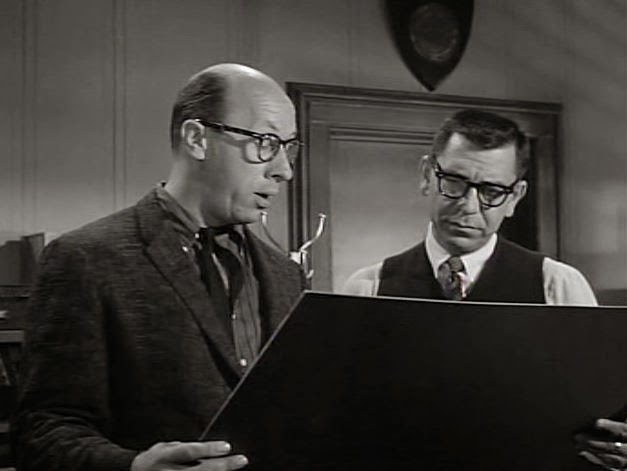
His chief irritant is David Nelson, who just can’t seem to please his boss.  Much of the film’s wry humor comes from the clashing in this newsroom full of oddball personalities: Richard Deacon, the frustrated staff artist whose talent and art education is wasted on retouching photos.  Another editor who is assigned to both real estate and religion, wishes he could cover the weather, and Jack Webb decides to let him do all three, proclaiming him editor of heaven and earth. 
Howard McNear aka Floyd the Barber shows up, too, as an editor, and it's neat the Mr. Webb has casted so many movie lesser knowns and bit players for featured roles in this film.


We have Louise Lorimer at the rewrite desk, an old vet of the paper, who follows on teletype the news of her grandson’s Air Force test flight, and Nancy Valentine, stuck doing obits, who wants her big chance at a story.

We see there are no restrictions on the ladies in this newsroom, as career opportunities in journalism have been a gateway to women since the days Nellie Bly was working as an investigative reporter in 19th century.  Jack Webb is supportive of the gals, and helps Nancy Valentine to get her big break when a big story happens.

They work the evening shift, preparing the morning paper.  The newsroom never closes in these days of big-city dailies that had both morning and afternoon papers, and any number of “extras” as the events permitted.  In 1959, print journalism was at a crossroads, and we see it here.  When the big story happens, they are competing with the new television media, and William Conrad jokingly laments, “Oh, why didn’t we all get together and stamp out TV when there was still time?”

Towards the end of the movie, when the paper goes to press, we can hear the hum of the huge presses rolling on a floor below.  We are past the days of Linotype in the composing room, but on the desks and light tables in the newsroom we see this is still an era of paste-up and layout, literally.  (This era continued, for me at least, into the 1980s, and it is a kick to see them work with blue pencil and rulers and rubber cement, and to crop photos, literally, by drawing margins, where figuring out column inches and percentages was done with math.)


There are other, less technical touches to this film that endear the viewer to this world of second-shift newspapermen and women.  The way William Conrad uses a piece of typing paper to wipe yesterday’s grounds out his small electric coffee percolator at the beginning of his shift, berating David Nelson, who stands before him with a tray of paper cups of water so Conrad can refill his pot.  I like the sweater vests, and the editor wearing the green eyeshade he probably put on with pride in his youth and never took it off. 

I like the back of the swivel desk chair we see behind Conrad with somebody’s name written on it, as if the owner was tired of having it swiped.

There is also the omnipresent rain, like the Day of Judgment.  We see it out the window over Jack Webb’s shoulder as he looks toward the neon sign of the diner across the street.  We hear it, and everybody who comes into the office is drenched.  The rain also plays an ominous role in the big story for this evening.
A little girl has crawled into an open storm drain.  She is lost somewhere in the sewer tunnels below the street, and the sewers are filling rapidly with the unrelenting rain.  It had been a slow news night, but nobody on staff is jumping for joy over this one.  They all approach the story with knots in their stomachs, but with a steely resolve to be emotionless.

In a sense, the same kind of “procedural” style Jack Webb used in his Dragnet series is employed here, as the movie shows us the nuts and bolts of what it takes to put out a newspaper edition, and here and there reminds us that there are people involved.  Their stories are subordinate to the Big Story, and this is the deal they entered into when they signed on to this kind of work.  So subordinate to the news are their personal lives that often when they engage in serious personal conversations with each other, their backs are to us, as if they cannot admit to us they have feelings.
But we do get a peek at a few of their personal stories.

 
Louise Lorimer’s grandson’s test flight turns to tragedy.  She keeps working through her shift to avoid going home alone to her empty apartment.  Eventually, we see she does not go home alone—Nancy Valentine takes her home to her apartment; the bonding of the sorority of young and old “girl reporters.”


Jack Webb, especially torn by the Big Story, ponders, “What those parents must be going through.  At least with me, it was all over before they told me.”  Here is his past tragedy.  His wife and son were killed some years previously, and he is not through grieving.  This night will bring his single greatest challenge.  His new wife of three years, played by Whitney Blake, wants to adopt a little boy.  At first Webb agreed, and the two-year process of adoption and the search for a child is over.  She’s found a little boy, but now Jack has cold feet.  He’s afraid to commit his heart to another child.
 
“The Speech” is given to William Conrad, as he bawls out David Nelson and another copyboy for wanting to quit.  His soliloquy, as he brandishes a rolled up sample of their life’s blood, is capped with, “It only cost ten cents, but if you only read the comic section or the want ads, it’s still the best buy for your money in the world.”

Despite the wisecracks and the cynicism, these are closet idealists who dream big and hurt deeply.

These were the days when the newspaper was the window to the world, something the whole family read, when people had personal loyalties to certain papers, and when a newspaper could be so much the conscience of a community that in later days when they began to close down, the community mourned.  When Jack Webb tears out the planned front page and inserts a new lead story, 72-point heading, with a huge photo of the storm drain, its open jaws threatening to eat us all, he warns the children readers to stay away from this awful thing.  The newspaper is for the whole family to read and discuss.
 
Nancy Valentine pulls off a coup by talking to the family and getting photos.  She has earned their trust.  Richard Deacon puts his art skills to work, finally, by drawing an illustration of the sewer system that is not only informative for the readers, but helpful to the news staff.  These people don’t just want to report on another dead body, they want to find that kid, and flesh out where and when and why and how.

Then through the night we get reports of injured rescue workers and it does not look good for the missing little girl.

Spoilers here.  Go to the water cooler for a minute if you don’t want to know.
The reporter on scene calls in, and it goes to Louise Lorimer, wearing her headphones to type, hunt-and-peck style, the rewrite.  (In these days, you didn’t automatically get a byline; you had to earn it.  Reporters with bylines were rock stars.)  She listens and types, and Jack Webb listens on the other line.  The staff looks up from their work, apprehensively.


The girl is saved.  The newsroom is quiet, only a sigh of relief and big smiles, and a few tears as one fellow mops his face with his handkerchief. 
 
Whitney Blake brings the little boy she wants to adopt to the newsroom to meet Jack. He’s still reticent to go through with it, but when the boy wanders into his office and asks what the noise is—he hears the loud presses running—Jack Webb is faced with his greatest nightmare: the prospect of loving another child.


In a sweet finale, Jack’s emotions are, again, subjugated to the newsroom.  It is his point of reference for everything.  He asks the boy, “Don’t you know what that is?”
The boy, a little scared, shakes his head.

“They’re printing the funny papers,” he says reassuringly. 
 
The little boy has wondered into the magical land where the funny papers come from!  Webb reduces the magnitude of the work and sorrow, tragedy-dwelling and corruption-sniffing of his profession to the simple, but profound level of a small boy who will grow from funny papers to sports page, to editorials and politics. 

Oh, the joy and bliss and magic of the funny papers.

We may wonder if the Big Story didn’t work out with a happy ending, would he still take this child in his arms?  Or would he head for the nearest bar?
As the movie ends, David Nelson passes out the copies of the newspaper they’ve been working on all night.  Very few of us get to see the results of our day’s work so immediately. 

The credits roll, the actors get their bylines.


“-30-” as we are told in the final title card means “the end.”  It comes from the old Western Union telegraph codes established in 1859, one hundred years before this movie was made, when the news was first transmitted over long distances.  The number 30 was telegraphed to mean there was no more news coming across the wire.  Kind of like “over and out.”  It was used by reporters and rewrite staff, and pressmen in the composing room for generations, long after the use became obsolete.  I don’t know if it’s used anymore to signal the end of an article, probably not.

But, with great fondness for the history of journalism and my own very small participation in it over the last few decades, and with a nod to my high school journalism teacher, to this day when I finish a first draft of anything I write—the draft nobody else sees—I end it with…

-30-


Thursday, September 3, 2009

In Search of Peyton Place


(Above have a look at the trailer, and also a newsreel of the Hollywood premiere.)

The movie “Peyton Place” (1957) opens with the joyous sound of church carillon chimes and stunning shots of New England pastoral scenes. The opening shots and score exude a sense of triumph and soulful beauty. A remarkable, clever, and somewhat astounding introduction to a story that had been up to that time one of the most controversial novels ever written, banned in most states and some countries for obscenity. Even today, the phrase “Peyton Place” carries the meaning of a morally corrupt community, a den of secrets, a bastion of promiscuity. You’d never know it by the inspiring travelogue over the opening credits.

The first few minutes of the film are really quite magnificent for establishing the setting, and the premise of the story. An outsider to this New England small town, who will be its new high school principal, drives through the countryside on his way to Peyton Place. Passing farms and fields, he arrives at a train crossing and must wait for the train to pass. He glances over to the dilapidated shacks by the tracks, and sees the downtrodden Cross family, whose story is to figure prominently in the film. He drives on, and we are left for the moment with Betty Field, the careworn mother trying to persuade her grown son not to run away from his violent, drunken stepfather, played by the wonderful Arthur Kennedy. We meet her lovely teenaged daughter Selena, played by Hope Lange, and when the slobbering Arthur Kennedy places a heavy hand on Miss Lange’s shoulder for a moment and she shudders, we have a premonition as to how things are going to play out for this wretched family.


We rejoin the new high school principal Mr. Rossi, played by Lee Philips, in his car again as he drives the rain-washed streets of the proper little town, passing the house of Lloyd Nolan, who plays the town doctor, as he comes out in his bathrobe to pick up his morning newspaper. The Doc shows us the headline about US neutrality threatened by Hitler, and we know we are in the early 1940s, just before America’s entry into World War II.

It is as perfect an opening five minutes a movie can get for immersing the audience in the place, the time, and the mood, setting us up for what’s going to happen as the film unfolds.

I would imagine, though, that most people going to see this movie when it was released in 1957 actually did know what was going to happen in the story; or at least thought they did. So many read the book.

There probably had never been up until that time a novel more vigorously criticized and yet more familiar to the public which avowed disgust for it, and claimed disinterest in it on moral grounds. Many called it a “dirty” book, but others evidently found it irresistible. The build-up for the book and the movie were tremendous.

Grace Metalious, the young author of “Peyton Place” was called the Pandora in Blue Jeans in the flood of publicity surrounding the publication of her novel because of her habit of dressing in jeans and flannel shirts, her hair tied back in a ponytail. It added to her intrigue, because she did not look like a glamorous all-knowing town gossip, yet gossip, some of it actually true, was what she peddled in her novel of seamy goings on in a New England mill town.

Her first published novel, the book came out when she was 33 years old. It stayed on the New York Times bestseller list for several months. It made her famous. It made her wealthy, for a time. In the wake of her success, however, there came a degree of pressure that she was perhaps unable to bear. Always a mercurial personality, somewhat self-pitying, obsessive and undisciplined, she died of alcoholism before she was 40. Part of the strain of her success was the ostracism by her community of Gilmanton, New Hampshire for their representation in “Peyton Place,” as much as for the lurid content of her book.

She didn’t help matters when publicizing her novel. In an interview with syndicated columnist Hal Boyle, she noted of Gilmanton, “To a tourist these towns look as peaceful as a postcard picture…but if you go beneath that picture, it’s like turning over a rock with your foot -- all kinds of strange things crawl out.”

This is an intriguing statement to make in view of the film’s beautiful postcard shots of an idyllic New England. We have the voiceover narration by the character of Allison MacKenzie, played very well with a great deal of natural talent by newcomer Diane Varsi, “Time was told not by the clock or the calendar, but by the seasons.” Anyone who has ever lived in New England knows how true this is. Varsi continues to speak in poetic terms of the seasons, and then adds, “There was a fifth season of love, and only the wise or the lucky ones knew where to find it.”

Compare this with how the book actually begins, “Indian summer is like a woman. Ripe, hotly passionate, but fickle…”

The lyrical narration of the film stands apart from the earthy language of the book, and there are so many other differences that illustrate a lot about what film was willing to accept at that time. The anxious, shy boy Norman Page, played by Russ Tamblyn in the film, is made miserable by his possessive mother. His mother’s relationship with Norman in the book is much more twisted and more explicitly so. In the novel, sexual assignations are obviously more frank. It has been suggested by present-day writers, including biographer Emily Toth in her “Inside Peyton Place” (Doubleday & Co., NY 1981) that Grace Metalious represents a beginning to the feminist movement, in part because of her willingness to address mature themes in a frank manner.

There may certainly be some element of that in the legacy of her novel, but I’m not sure I would go so far as to call Metalious a feminist herself. She boastfully admitted a dependence on husbands and lovers, and even bitterly referred to herself as having lost her womanhood when she underwent an hysterectomy. I think in Grace Metalious we have a writer who was not particularly crusading in terms of feminism, or class tension, or gutsy in depicting sex, but simply a woman who unselfconsciously wrote about what interested her, in the everyday speech she used herself. One of the strengths of her novel is its unselfconsciousness.

The film is the opposite in this respect, it is quite obviously self conscious and needs to toe the mark to acceptable social standards in the way the book does not. (Though even Metalious was reined in by her publishers and agent when they changed a key element in the first draft of her novel. She had originally written Selena Cross as getting raped by her biological father, Lucas Cross. To Ms. Metalious’ dismay, though the rape was allowed to be left in, they insisted that Lucas Cross be changed to her stepfather, rather than her father. Rape of a teenaged girl by a male guardian may be ugly, but by a father was evidently unacceptable. It did not seem to matter that this was one of a few episodes in the book that Metalious based on an actual event and real people.)

Other elements in the story, pregnancy by rape, abortion, suicide, murder were either diminished or attempted to be treated tastefully in the film. The shock of Allison MacKenzie on the discovery that her deceased father and her mother were never married remains, but the film’s manner of revealing this scandal later on in the story I think is more effective than it coming out early in the novel.

One thing the novel loses in the translation to film is the undercurrent of ethnic and class tension. The town’s largest employer, the textile mill owned by Leon Ames, whose spoiled son cavorts with the high school trollop, is represented as a backdrop to the story, showing us this is a mill town, but we get very little of the labor versus management, rich people versus poor people in the film than we do in the novel.

Grace Metalious said of the film that she was “pleasantly surprised, but I thought it was too sugar coated.” Well, yeah. It seems with a beguiling innocence Ms. Metalious thought her novel, which echoed and taught an entire generation of teenagers about sexual awakening, would be transferred to the screen literally.

Instead, producer Jerry Wald and director Mark Robson created something that was a hybrid of the novel, but that stood apart on its own, was its own creation.

When selecting a filming location, the town of Gilmanton, New Hampshire adamantly refused to have anything to do with the movie, because it felt that the book had already given the town a bad name. However, though some characters and some incidents told in the novel came from local town stories that Metalious had heard, Metalious admitted that probably 75% of the book was written before she’d ever moved to Gilmanton. Originally she came from the much larger industrial city of Manchester, New Hampshire, and the book depicts a composite of a New England mill town. She actually set the fictional Peyton Place along the Connecticut River, nowhere near Gilmanton.

Where then, is Peyton Place? It’s not Woodstock, Vermont either, a town farther up the Connecticut River that resembled what Metalious described, but refused to let Hollywood film, and brand, their town. Finally, Camden, Maine, a seaside village with no resemblance to Peyton Place in the novel, was chosen not only for its quintessential New England beauty, but its willingness (along with Rockland, and Belfast) to be portrayed as the sinful town.

Over 1,700 locals signed up to be extras in the film. So much for scandal.

The famous Whitehall Inn is depicted in the film. Here’s my photo compared to the movie scene. Here’s a link to my post on Edna St. Vincent Millay at the Whitehall on my New England Travels blog.


One opening overhead shot here looks a lot to me like Boothbay Harbor, Maine, but I can’t find any mention that any shots of Boothbay Harbor were used in the film. Maybe some of our readers can clarify that.

Here is the famous scene of Norman and Allison on the hill overlooking Peyton Place. It is actually Mount Battie in Camden. Here is my photo as it looks today, and from the film. It is truly one of the most lovely sights, and if you ever find yourself in Down East Maine, take a side trip up the auto road and treat yourself to a picnic in paradise.

Speaking of picnics, the film’s Labor Day picnic gives us a cheerful glimpse of small-town togetherness, (barbershop quartets and gluttonous little boys eating more than they should) glossing over the undercurrent of tension, underscoring the importance of the town’s apparently only mill to the local economy, and sets us up for more crisis and conflict.

The film deftly covers, if less frank and in less detail than the novel, a stream of subtle realities about conformity and the consequences of stepping outside what is acceptable. Though the younger actors, particularly Hope Lange, who is touching as the vulnerable Selena, have the weight of society on them, the older generations have an equal part in suffering the consequences of scandal. The small, but moving side story of spinster teacher Mildred Dunnock (last seen here in “I Want You” - 1951) getting cheated on her promotion to principal is one of the film’s many important subplots that are handled well and tell us much about the community with a light touch.

Interestingly, this movie made in 1957 about the early 1940s carries the veneer of nostalgia to it. A cozy, but not condescending, nostalgia. Mostly accurate, there are only a few costume choices which look more like 1957 than 1940. When we see the high school senior dance at the gym, with a banner lauding the class of 1941, we may well cringe with foreboding (as we did not in “Life Begins for Andy Hardy” in this post), that in six months the U.S. will be at war and some of these characters may be war casualties.

A lot happens in the film, but it flows so well, and so remarkably gently, that it remains entertaining throughout and one may actually forget the novel’s lurid reputation because the film is a thing apart. It’s fun to recognize individuals in the large cast, like Lorne Greene as the snide prosecuting attorney, and teen heartthrob David Nelson fresh from TV’s “Ozzie and Harriet” to play Hope Lange’s boyfriend.

Is the film the real Peyton Place? It was very well received, and made the novel perhaps more respectable, therefore making it more popular. Grace Metalious, though she wanted to move on to other projects, went back to the well and wrote a sequel, which was made into another movie (other TV incarnations followed), but this project she frankly admitted was only for the money. She could never really get away from her creation.

But perhaps her creation stopped being hers once it got into the hands of those teenagers and housewives, and all the readers who made it second to “Gone With the Wind” in books sold. Today, few have read the novel and many, thanks to TV, have seen the movie.

Gilmanton, New Hampshire probably need not have worried about “Peyton Place” ruining their town’s reputation, since Peyton Place quickly morphed into Everytown, USA. The film often diligently reminds us it is set in New England with the actors using a light New England-sounding long “ah” sound to vowels that is, if not totally accurate, is certainly enough. Norman is called Naahman by everybody.

It’s probably best when films suggest an accent rather than to try to completely replicate it, because our regional accents are so diverse, that audiences in another part of the country might not catch what is said. In the opening moments of the film when the new principal drives through the countryside and asks a farmer driving a horse-drawn plow for directions, listen to the farmer’s response in his authentic Yankee accent. Could you listen to that for two and a half hours? Particularly if you were from St. Louis, Tallahassee, or Cheyenne? I think not.

The only locals who seem not to use a New England accent are factory owner Leon Ames, who sounds southern, and Lana Turner as Allison MacKenzie’s mother Constance, who makes no attempt and also seems rather more glamorous than the average citizen of Peyton Place. Another actress might have added more depth to the role, though Miss Turner was big name whose stardom, and tragically coincidental real-life scandal, likely added welcome publicity for the film. Lana Turner, unlike many of the principle actors, never traveled to Camden, Maine to film her scenes. We see her strolling a lot past rear-screen projection.

The film ends with its own courtroom drama, with Selena on trial for the murder of her stepfather. Lloyd Nolan defends Selena by accusing the town of neglect, “She couldn’t trust us with the truth.”

“We’re all prisoners of each other’s gossip.”

“Our best young people leave as soon as they’re old enough to pay for the price of a bus ticket.”

“We’re a small town but a prosperous one, and yet we allow tar paper shacks to stand.”

He laments the community’s failure to look after its own. The film ends with another idyllic shot of a tree-covered street lined by houses and white picket fences, two kids lazily bicycling by, with another voiceover by Allison MacKenzie “We finally discovered that season of love. It is only found in someone else’s heart. Right now someone you know is looking everywhere for it, and it’s in you.”

A sweet and gentle way to end a movie based on a novel banned as obscene in several states and some countries. Where is Peyton Place, really? Somewhere back in the 1950s, when things were changing, and we knew even then nothing would be the same?

You might look for it in the “Peyton Place Archives” of the Camden Public Library.

Grace Metalious is buried in a far corner of a Gilmanton, New Hampshire cemetery. For all her resentment of small town oppression, she said in a 1961 interview, “I live there because I couldn’t stand to live anywhere else…in Gilmanton I don’t have to be part of the town.”

Incongruous? There’s a lot of that going around. Come back next Monday when the town picnic moves to the Midwest. Until then, below we have the idyllic ending to “Peyton Place”.


Here’s an interesting article by Sarah Schweitzer from the Boston Globe on the 50th anniversary of the publication of “Peyton Place.”

Grace Metalious is quoted in this post from the above-mentioned “Inside Peyton Place”.

For more on Camden, Maine filming locations, have a look at this website and also here.

For more on Grace Metalious, have a look at this article in Vanity Fair.


Digg!

Related Products