Swell Guy (1946) is shocking. It grasps the postwar stranger-in-a-strange
land parable of the returning vet and twists it into something depraved. It flaunts movie mores of the day by showing
a community falling under the spell of a conniving charlatan, but not because
he is so persuasive—because their own darker sides are so easily brought to the
surface. It dares to mock the returning
vets—one as an apparent villain, and the other, the “good” one, even worse, as
a weak, boring fool. It dares to show
the villain continually getting away with his villainy, until the end when he
loses, but completely on his own terms and still in control of his destiny. It dares to show dysfunctional families,
adultery, and a pregnancy out of wedlock as everyday circumstances of life that
happen to nice people in nice small towns, as normal as horseshoes at the town
picnic, with no real attempt to “shock” the audience at all. It all comes as laconic as a conversation
over a backyard fence—and that is what is so surprising. There is no
message. It’s just the way things
are. It is 1946, and the movies have
grown up. This isn’t a glossy noir, it looks
rather low-budget, and it is marvelously unconcerned with its audience.
Fine acting from
everybody in this movie, but especially lead Sonny Tufts, which really shocks
me.
Mostly, I am shocked that a movie this good is
unavailable on DVD, is rarely shown, has fallen into public domain, and the
only copy you are likely to snag is probably going to be as beat up, scratched,
and muddy as the one I found.
My only hope for this
film is that it was featured a few years ago in a public showing at the UCLA
Television & Film Archives at the Billy Wilder Theater in Los Angeles, so
perhaps this may indicate a resurrection for this truly oddball, truly shocking
film.
Another surprising
aspect is that it had its world premiere aboard a train. As is usual for me this time of year, this
blog is devoted especially to my favorite holiday this Saturday, National Train
Day, which celebrates Amtrak, our national railroad. Have a look here at the
official website for more info.
What is especially surprising
about the premiere on a train is that trains, which feature prominently in a
few key scenes in this movie, have a rather grim representation. Especially the brutal ending. Nothing you’d want to have on your mind with a
drink in your hand in the bar car. (Better hurry on that one,
the last bar car in the US is being phased out.) More
on the premiere on board in a little bit.
First, I must tell you
that since one of the delights of this movie is how it’s plotted, and how many
scenes are constructed in what, in the theatre, are called “French scenes”
where the focal point changes and the scene kind of begins anew with the
entrance and exit of a character, I’m going to be discussing pretty much the
entire movie and it’s irresistible flow.
As such, this post is going to be a minefield of spoilers. For those of you with no stomach for it, stay
here.
The rest of you mugs,
follow me.
And bring a bag lunch. This is going to take a while.
This was
Ann Blyth’s
first movie after her year-long hiatus due to suffering a spinal fracture in the
early part of 1945, which we covered in our
intro post to this series here. Her last film had been the blockbuster
Mildred Pierce (1945), for which she had
been nominated for a Best Supporting Oscar.
Big things were expected of Ann.
Her home studio, Universal, wanted to finally get a chance to cash in on
the star that Warner’s made (she had been loaned to Warner Bros. for
Mildred Pierce). Ann was eager to take up her career again.
But this movie was
filmed during one of the worst periods of her life, when she found herself
dealing with another personal tragedy.
Halfway through the filming of Swell
Guy, her mother died, which we also discussed in our intro post. They had come to California together from New
York via the national touring company of Watch
on the Rhine, and were seldom apart.

If trouble matures us,
she’d had plenty. Ann Blyth was 17 years
old, and would turn 18 before filming completed. She played older in this movie, a young woman
perhaps in her early twenties, a bored and restless small town rich girl, a
hard drinker, sexually promiscuous, whose grim and fatalistic outlook on life would
have likely made this role a fulfilling challenge for any actress. For someone who’d been through what Ann had,
one might hope it may have offered an emotional outlet, as going back to work
after her mother’s illness and death would have been a horrific struggle, and
possibly playing the role of a troubled young woman was better than a comedy at that time for
her. For those who remember Ann as the
perpetual ingénue soprano of her 1950s musicals,
Swell Guy reminds us that the evil Veda in
Mildred Pierce was no one-off fluke. A number of Ann’s early roles showcased her intuitive,
earthy, and intense dramatic talent. (
We mentioned in this earlier post that
she was afraid of being typecast a villain.) It was at this stage critics were calling her
a young Bette Davis.
She received good
notices.
Edwin Schallert of the Los Angeles Times noted: “Miss Blyth is reputed to give her most
sensational performance in this…she has made a remarkable record in the midst
of terrific emotional turmoil, and what is more, she is amazingly young to have
encountered this…Her experiences have undoubtedly given her an unusual maturity
in her work.”
Syndicated columnist
Dorothy Manners wrote, “This Blyth girl
is real star stuff—young, tempestuous, and definitely a screen personality.”
Even Bosley Crowther of
the New York Times, who generally
gave the most dyspeptic reviews, and, indeed, saw nothing to excite in Swell Guy, still lauded Ann’s work as, “…a quite appealing portrait of the
compromised girl by Ann Blyth.”

It was Sonny Tufts who
was being cast against type this time, his first role as a meanie. He had found a place in Hollywood during the
war years as one of those handsome fellows who, unable to serve in the
military, were lucky enough to replace the generation of actors who did. He first came to prominence as the likeable
Marine in
So Proudly We Hail!
(1943). Unfortunately,
Swell Guy would peak his career, due in
part to the usual throw of the dice in a capricious industry, and due in part
to his own capriciousness and lack of self discipline. His off-screen behavior, including several
arrests for public drunkenness, shortened his career. He careened into bad roles in B-movies, and
eventually became something of a joke in Hollywood. Even he, on TV shows such as
My Mother the Car, and
Laugh-In, where he made cameos as
himself, poked fun at the joke that became of his career and his name.
Even in Swell Guy, we can see the handsome
newcomer of only a few years earlier now bears a heavily lined, puffy and
sagging face from too much alcohol, too much of everything, maybe. But Swell Guy gives us probably his best
performance, and he tackles it with a natural ease. He is so smoothly believable that he carries
this film admirably. What is remarkable
is that he’s playing a creep, but he is compellng and not because of any showman’s
razzle-dazzle, but because his down-to-earth camaraderie, his moments of
vulnerability, and what appears to be his truly helpless inability to change. He has his demons.
We begin peeking
through the credits at what appears to be an overhead shot, a flyover, of a
small town. It tells us the town is as
much a character in the movie as the players, who all have a connection to each
other.
We settle in at the
barbershop where there is a buzz about a visiting celebrity, a war
correspondent with a reputation for gallantry and bravado, who’s coming to see
his brother who lives here with his wife and son, and their elderly mother.
At his brother’s home they
are preparing to leave to meet him at the station. His mother is played by Mary Nash, veteran of
Broadway, and you’ve seen her as Katharine Hepburn’s mother in
The Philadelphia Story (1940) and as
Shirley Temple’s nemesis, Miss Minchin in
TheLittle Princess (1939). This is a
fascinating role for her, as she is strangely enigmatic. When her
daughter-in-law, who has never met Jim, the Sonny Tufts character, wistfully gushes,
“Jim’s led such an exciting life,” Mother Nash replies pleasantly, but
irrelevantly instead of her married son, “Martin’s a steady man.”
When Martin, Jim’s
older brother enters, played by William Gargan, we see he is friendly,
contented, not overly bright, and dull as dishwater. No wonder his wife is looking forward to an
exciting visitor.
The hero-worshiping
wife is played wonderfully by Ruth Warrick, in a role that allows her to ride a
rollercoaster of emotions in a nuanced performance. She is the still waters running deep.
Their young son is
played by Donald Devlin. He is given,
unfortunately, pretty standard and unimaginative gee-gosh kind of dialogue and
delivers a lightweight performance, but the little boy is important to the
development of the Sonny Tufts role, and will figure prominently at the end.
They are the typical
American family that waits at the train depot, a familiar Norman Rockwell scene
that was still repeated for returning vets a year after the war.
Then we are in the
train compartment as Sonny Tufts, the famous war correspondent, snuggles and
chats with a lady friend. A simple of
action of her lifting his cigarette from between his fingers, taking a puff on
it, and him deftly plucking it back from her is going to be repeated through
the movie and take on great significance.
The intimacy of them putting the same cigarette to their lips and
smoking it, of gently snatching it from each other, as if to get control of it,
is a code that tells us they are sleeping together and each is trying to get
control in the relationship.
The Production Code may
have been restrictive, but it could be awfully fun.
On this occasion, Mr.
Tufts wins, while warmly and humbly thanking her for paying for his trip. She is already married, but can’t live
without him and will get a divorce as soon as possible. But when the train pulls into our small town
of Carmelita, California, Sonny tips the Pullman porter to tell the lady for
him, “Goodbye and good luck, permanently.”
It is our first
indication that this heroic adventurer is not what he seems. A moment later, standing on the platform with
his family, he seems genuinely pleased by their welcome.
“Has he changed
much?” Ruth Warrick gushes to her
mother-in-law.
“Not much,” is her half-smiling,
but noncommittal tone.
He asks to be dropped
off at the telegram office so he can conduct some business, and while they take
his bags home and prepare a welcome home dinner. He slips into a bar, and, still sporting
conviviality like a carnation, chats up bartender Millard Mitchell, who gives
him the lowdown on the small-time gamblers betting on a coin toss two stools
down. Mr. Tufts gets in on the game, and
with the same bravado he showed in war, tells the local barfly blowhard played
by Howard Freeman to go ahead and toss the coin while he makes a phone
call. He doesn’t even look, unconcerned,
and such saloon courage earns him quick friends and admirers. He wins the toss.
When he comes out of
the phone booth, Ann Blyth shows up, sassy and smart-mouthed, wanting to use
the phone.
This is the first
instance of many in the movie where a “French scene” is set up by director
Frank Tuttle. Tuttle had been around
since the silents, worked in pretty much every genre, and his work here is excellent. Soon Mr. Tuttle would run into trouble with
the House Un-American Activities Committee for his earlier ties to the
Communist Party, but saved himself by ratting on others. Maybe he knew something about the
self-centered survival techniques so deftly deployed by the Sonny Tufts
character in this movie. Swell Guy shows Tuttle’s mastery of
guiding the audience through the scenes as if we were a fly on the wall. Neither director nor actors are playing to
us. We just happen to be in the room.
First, Tufts and
Mitchell are hunched over the bar giving us the lowdown on the local scene.
Then the camera pulls back and we see the barflies in the foreground, giving us
a visual summation of the citizenry as suckers.
Then Ann walks in and the mood changes to one of sexual tension, but
Tufts is still juggling the gamblers, his inside info from the gossipy
Mitchell, and the phone that represents his apparent quest to get a job on a
Los Angeles newspaper.
He and Mitchell discuss
Ann, that she is a wild girl, that she “gets around,” the daughter of the local
insurance agency owner—who happens to be his brother’s boss. Everybody’s connected. As they speak, huddled over the bar, we see
Ann in the phone booth over Mitchell’s shoulder, in the little box of the booth
like a cartoon strip thought balloon. She’s the object of the conversation and she’s
never left the scene. (We see something
similar in Toland’s wonderful cinematography the same year in
The Best Years of Our Lives.)

Her boyfriend has come
in with her, following her like a puppy dog, and Millard Mitchell brings him
into the conversation. He’s a returned,
vet, too, who saw combat on Okinawa.
Played by John Craven (probably most known for his Broadway turn as
George in
Our Town), he’s a likeable,
sensitive, but intense young man obsessed by the problems of returning veterans
and tiring people with his only topic of conversation. As Mitchell says of him, “He talks like a guy
running for re-election.”
By the way, Ann would
be reunited with Millard Mitchell in four years, on stage, in the La Jolla
Playhouse production of
Our Town in
the summer of 1950. We’ll talk more
about that in a couple months.
Sonny Tufts admiringly
points to John Craven’s “Ruptured Duck” lapel pin, an insignia given to all
honorably discharged military personnel as a symbol showing they had served in
the war, and agrees the vets need all the support they can get. Sonny always says the right thing, and his
sincerity is unquestionable.
When Ann emerges from
the phone booth, sidles up to the bar, downs her first drink and shoos away her
puppy-dog boyfriend, we see both she and Tufts have only one agenda for the
evening. She calls Tufts, “Marco Polo and Ernest Hemingway wrapped up in one,”
and of her earnest boyfriend, “He loves me so much there isn’t any room for me
to love him.”
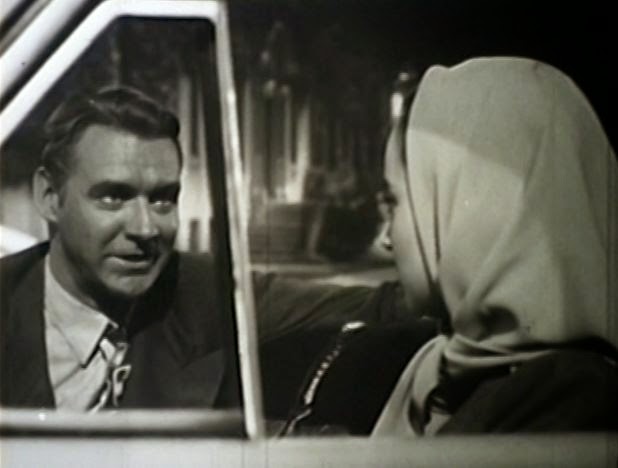
They end up in her
great big fancy convertible in the moonlight, and talk about what makes them
tick. Sonny loves life’s “high spots,”
he says, and she replies, “Well, Marco Polo, this is a high spot staring you right
in the face.”
She snatches the
cigarette from his fingers and takes a puff, and he snatches it back. His gesture is rougher, more urgent than with
his lady friend on the train. Ann
doesn’t want a long-term relationship with him, one-night stands are fine with
her, so he doesn’t have to be too nice.
Finally heading back to
his brother’s house later, he is shamefaced and apologetic for not returning
for his welcome home dinner, but he turns the scene around, enthusiastically tells
them that he had spent the time working on an idea for his new novel, an idea
for which they, in their kindness to him, provided the inspiration. “Trouble is, I’d been away from the real
things too long!”
They are pleased,
excited and flattered to have been part of a great man’s work. His brother William Gargan replies, “Holy
smokes, I guess Carmelita’s not so bad!”
Even the boring guy knows his life is boring.
Tufts never seems phony
even when he is. His warm attention to
their son, his gentlemanly compliments to sister-in-law Ruth Warrick are so
sincere that it’s no wonder they think he’s a “swell guy” because we do, too.
Only one is not
fooled. Mother Mary Nash. She sneaks down to the living room in the
middle of the night where Sonny is trying, unsuccessfully, to type a letter to
someone named Marie. Mom wants him to
leave. Their dialogue is quiet,
intimate, and stunningly harsh.
“Every day I prayed I’d
get a telegram from the war department…” she begins.
“…saying I died?” He fills in.
She wants him to “do one decent thing in your life,” and leave. Apparently at their last meeting, he stole
over $400 from her that was from her late husband’s life insurance policy, all
the money she had.
“You hate me because I
remind you of Pop…he’s been dead for years and you still hate him.”
Sonny idolized his
father, a no-good conniver his mother was ashamed to have married. Sonny asks her to let him stay, that he’s
changed.
“Some can change. Not your father, and
not you. You’re a tramp. You’re no good. You’re just no good.”
But Mom can’t blow the
whistle on him without creating a hornet’s nest in her married son’s quiet,
boring life. She watches with anxiety
how Ruth Warrick develops a crush on Sonny.
Ruth, while fondling
her husband’s shirt, chats with Mom about how exciting Sonny is, how he’s crossed
the ocean on a ship and she would love to do that, meet interesting people,
drink champagne cocktails. She blurts out
a fantasy of dancing with Sonny on shipboard, flustered, tries to take it back,
saying she really meant dancing with her husband. Mom is quietly understanding and eerily enigmatic,
and director Tuttle brings the fluttery scene to an abrupt halt with Mom’s
observation that sounds like a blunt warning.
Ruth Warrick has
another kind of indirect showdown with Ann Blyth, when Ann stops in to pick
Sonny up and take him for a ride in her big fancy convertible. Ann’s first greeting seems condescending,
“How do you do it, Darling, husband, housework, child, etc., and still look
like an ad for contented women?”
Ruth is still flustered
at being caught by her mother-in-law in her crush for Sonny, and through the
film will grow more anxious and neurotic.
She self-deprecatingly replies that looking pretty while folding the
laundry is the way to keep a husband.
She keeps very busy in her scenes with Mom and Ann, as if trying not to
get caught in her fantasies about Sonny.
Meanwhile, Ann’s
dismissive attitude toward home and family, and long-term relationships, seems
to have changed as she anxiously attempts to confide in Ruth. She asks her if
Sonny has ever discussed plans for marriage.
It is weeks later, and she is still seeing him, but he has cooled off
towards her. Ann has fallen for him, and
is just as obsessed with Sonny as Ruth is.
It’s an interesting scene, for both are “the other woman” and Ann doesn’t
realize she’s causing acute discomfort for Ruth.
In another “French
scene” shift, Sonny then enters, his big frame filling the room, and he shushes
the women while he pretends to talk on the phone to a newspaper colleague who
has already hung up on him. His harem
dutifully shushes.
By the way, it was
reported that Ann needed to be lifted four inches to do her close-up standing kissing
scenes with Sonny Tufts. He was a foot
taller than she. It was the first of
many on-screen romances she would conduct standing on a box.
The boy comes in, and
the two women quietly fuss over him. Still
the same scene, it changes again with the addition of the boy. He breaks the sexual rivalry of the women for
Sonny Tufts and represents the home, their maternal instincts, and he, not
Sonny, becomes the center of their attention.
Especially noticeable is the change in Ann, whose first introduction to
us as a hard drinking, selfish, and loose young woman, now tenderly touches the
boy and asks him if he will be her boyfriend at the town picnic tomorrow.
The all-American boy,
no puppy dog, brushes her off. He
doesn’t like girls. He likes football.
When Ann finally pulls
away in her big fancy convertible, with Sonny sprawling carelessly in the
passenger’s seat, her first remark is that she likes Ruth Warrick, and we can
see she envies her.
“Why? What do you expect her to do for you?” Sonny replies sarcastically. He knows he’s already got Ann in his
pocket. So he doesn’t need to be nice to
her anymore.
“Must everybody always
have an angle?” She smiles. She knows him well by now, yet is unphased.
“Uh-huh. We like people because it gives pleasure to
us, not them.”
She wants to spend the
day with him, but he roughly brushes her off.
“Love is feeling, not a diet.” He’s rented an office in town, he says it is
for him to get to work and write his novel.
We will see when he enters, looks at his typewriter at another
unfinished letter to somebody named Marie, that he actually uses his office for
a weekly craps game, and the men of this sleepy little town show up and hand
over their money. I think one of them is
Jack Overman, who played the movie grip we discussed in
Once More, My Darling here, though he’s not credited.
Sonny Tufts wins over
$800, and calls his brother. He has a
plan to help his brother fulfill his dream of leaving the drudgery of the
insurance office and be his own boss, open up a used car dealership. Again, we think Sonny is a pretty swell guy
for doing this.
But he goes to the bar,
where Ann waits, drinking her hurt away with the barflies who flip a coin for
bets. She is bitter, and angry at Sonny,
who blows in like a big shot. She calls
him down in front of everybody, “The champion big shot of the world. He won the war single-handed. He writes books with one finger, and in his
spare time, he amuses the natives.”
Sonny Tufts tenses up,
but lets her talk because she is throwing down a gauntlet, and he’s a sucker
for a dare.
She shouts, a little
drunk and very hurt, “Jim wants to work, everybody stops playing. Jim wants to play, everybody stops
working. The world lives just for Jim
Duncan, but Jim Duncan doesn’t know the world’s alive.”
She dares him to join
the coin toss game, because she knows the men in town have lost all their money
to him. She wants to see him lose. He’s a sucker for a dare.
“Toss it, baby,” he
says. Now regretting her outburst, she
nervously flips the coin, while the barflies cheer.
With his customary
bravado, Sonny doesn’t even look. He
puts up his whole $800, and heads for the phone booth to call his brother. He will have either good news for him, that
he can give him money for his dream, or bad news, to forget it.
He loses. Ann, with tears of frustration, runs out of
the bar. She knows nothing of his plans
to help his brother, only that she’s lost him.
The next day is the
town picnic, sponsored by her father, John Litel, one of the town’s most
prominent citizens. All the cast roam
leisurely around the fairgrounds. Frank
Ferguson, who we mentioned in our last post on
Free for All, here, plays horseshoes.
Ruth Warrick lounges by
the lake in a bathing suit, Sonny Tufts chatting with her. She drinks in the sight of him more than he
does her, though she gives him plenty of chances, but we have the feeling he is
only being careful—or maybe biding his time.
We sense he has her on the hook, waiting for him, so he must sense it
too.
John Craven is called
upon by John Litel to make a speech, and Craven launches into his well-worn
topic of veteran’s needs in a postwar world, but he is nervous, does not speak
well, and quickly bores and irritates his audience, who soon begin to playfully
heckle him. A vet being heckled while
talking about the GI Bill. In a 1946
movie. Shocking.
One of the hecklers is
Jimmie Dodd, our head
Mouseketeer.
Sonny Tufts, like the
hero he is, comes to John Craven’s rescue by taking over the speech and spewing
forth a jumble of jingoistic illusions to gambling on the future and supporting
the vets.
“The only thing we must
never gamble on is the future of the men who won the war for us.” Much adulation for Sonny. He wears it well, humbly, with a halo of light
around his blond hair.
He asks Mom, “How was
my speech?”
“Like a
firecracker. All noise and nothing
inside.” She still wants him to
leave.
He admits, “You’re the
only one that’s got me pegged right. You
always have.” It is a sad moment for
both of them. They’ve never had a good
relationship and never will.
Ann Blyth gets a good
line, which she delivers like a cracking whip, “Only a very accomplished
speaker could have merged patriotism with craps shooting.”
By the way, that
matinee idol Charles Lane gets a brief role as another bombastic speaker. Makes the whole movie.

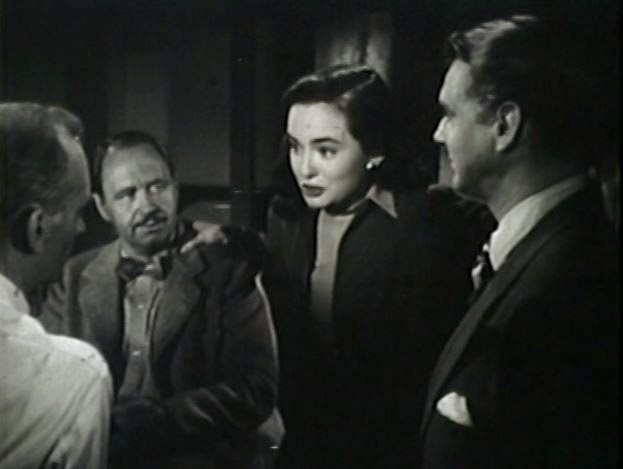
She and John Craven are
sitting on a blanket, he accepts their relationship has cooled and that Sonny Tufts is the winner. He can still thank Tufts for saving him by taking over the speech and be disgusted with Ann for ditching him for Sonny. Nothing sticks to Sonny. Then suddenly, others dancing or drinking
beer huddle around and join in a fascinating and apparently impromptu
conversation on fate. They discuss
whether a man’s fate is pre-destined, or if he controls his own destiny. The extras swarm around for a lazy, but
earnest and casual town meeting in the meadow.
Such an oddball scene, but it’s great.
Director Tuttle continually pulls others in to “widen the shot” so to
speak, and then zeroes in on the principal characters in pairs, and pulls back
again just by how many people are in the scene.
No camera trickery, it’s really more like theatre. The one who’s talking has the football.
Sonny Tufts thinks fate
controls us, that when our number is up, it’s up. Millard Mitchell and others disagree. Sonny, in another sucker’s dare and his need
for excitement, his need to show his bravado, demonstrates that he will walk
into nearby train tunnel to prove that he will not face danger by an expected
train because he doesn’t think his number is up.
It’s another toss of
the dice, but for higher stakes.
We see his broad
shoulders silhouetted against the light of the open tunnel. Ann, at first scoffing, then grows horrified,
and jumps into her big fancy convertible with puppy dog John Craven at her
heels. She speeds around the mountain to
hopefully catch up with Sonny still alive at the tunnel’s end.
As he’s walking through
the dark tunnel, we see that Sonny is searching for something on one wall. He appears to find it, chuckles, and
continues on. What we will learn later
is that he knows there is a safety slot built into a tunnel like this that will
hold one man to take refuge if a train comes.
He was never in any danger. Sonny
knows it’s easier to win with a stacked deck.
On the other end of the
tunnel, Ann, frantic, runs to greet him as he emerges in the light of day, and
they scramble up an embankment, holding each other just as the train comes
barreling down, and thrusts itself into the tunnel. Well, there’s symbolism and there’s
symbolism. I’ll only suggest it’s a nice
crane shot.
Poor John Craven looks
away, heads back to the car alone.
The next day Sonny
heads to LA for a job interview, he hopes, with the former editor who earlier
hung up on him. He paces in his hotel
room, nervously takes a few drinks, and then gets an unexpected visitor.
It’s Ann. She’s followed him. He’s furious, wants to get rid of her, is
just about to walk out on her. Then the
camera gives our attention to the young woman standing in the half-light of his
hotel room, getting older every minute.
“Wait…give me a second
for the oldest story in the world.” I
like that line. I like that way to put
it. It’s a weary delivery, choked with
chagrin and, for her, unaccustomed honesty.
He sneers, “You’re
lying.” She’s pregnant. He doesn’t want to be trapped. He reminds her of her insistence when they
met that there would be no bonds.
Her attempt just to get
his attention at last, breaks her, and she starts to fall apart. “Let’s be honest. The way I lived is wrong. Give me a chance to make it right. The only way I can do that is with you.”
She vows she will not
tie him down, nor even shoulder him with responsibility for the baby. “It will be all mine…just let me be near you
and love you.” She kneels before him and
sobs in his lap, “That’s all I ask. Just
let me love you.”
Sonny is quiet now, his
mood has changed, and he gently asks her to wait for him. She is comforted, and so are we, because
after all, he loves his nephew. Plays
football with him. Teaches him how to
cheat. He might like a kid of his own,
someone perpetually to look up to him and worship him the way his little nephew
does. Sure.
But he’s got to see his
old editor first to get a job on the L.A. newspaper. He tells her to wait here, tells her where he
is going, and tells her to call him there if he’s not back in half an hour.
Dang, but we’re
convinced. He’s such a swell guy.
The scene with his
editor, played really well by Thomas Gomez, who cut such an impression as one
of the gangsters on
Key Largo (1949),
delivers some great lines, and some needed back story on our Sonny.
None of his newspaper
colleagues like him. Gomez gets a strong
scene here in a face-off with Tufts: “You’ve got guts…but you never come back
with a story. Sure, you’re the hero of
every story that happened, but you can’t write about it…you’ve failed because
you’re a liar and a cheat.”
Sonny, meanwhile, has
been punctuating every sentence with another shot of booze, and by the time the
scene ends, he’s drunk. He runs through a
stream of emotions: defensive, sarcastic, self-pitying, confrontational.
“I ought to punch you
in the mouth.”
“Sure, you’re good at
that. But could you put it down on paper
afterwards?...That’s how you’ve handled everything else, with your fists. That’s the way you handled Marie.”
Marie? The person to whom he’s been trying to type
several abortive letters? Marie…is his
wife. Back in Paris. She booted him out. The scene ends with Sonny, now quite drunk, falling
on the floor and sobbing, crying out for Marie to take him back.
For all the sub-par
performances in lousy films Sonny Tufts had racked up in his career, for all
the stories on his private exploits that made him a joke…you have to watch this
scene to give him the credit he deserves for reaching down deep and showing
what he could do when the circumstances allowed and whatever personal motivation
he could muster to do it, at least this time.
The next evening he
arrives back in Carmelita, and puppy dog boyfriend John Craven accosts him,
angry, wants to know what he did to Ann that she returned home “all broken
up.” Tufts tries to wave him off, tells
him he’s off the beam.
“Almost enough to kill
you,” Craven answers, a low growl, his angry eyes under the broad-brimmed hat
searing into Tufts, and we see that this is no puppy dog. Craven’s a battle-hardened veteran. Just because he loves Ann and he’s been patient
with her, doesn’t mean he’s going to extend the same courtesy to anybody
else. To John Craven, Sonny's fallen off his pedestal for not treating his girl right.
Tufts, in another wonderful example of
his clever, exploiting personality, softens and agrees that Craven is the
better man for Ann and suggests they go see her together, as if he is giving
Ann to Craven, as if it were some noble sacrifice.
He can’t wait to get
rid of her.
At Ann’s home, papa
John Litel knows Sonny’s relationship with his daughter has hit a rough patch,
and he’s worried, because he really likes Sonny. He wants them to get married. He has such regard for Sonny that he gave his
boring brother John Gargan a promotion and more responsibility, discovering
what a good employee he had all these years and didn’t know it. “I gave him a chance only on your say so.”
The tight, confidential
relationship between these two men shifts when Ann and John Craven enter the
room. Again, no new scene setup, just
the mood change when another person enters, the tenor of the scene shifts. Ann takes over the scene, confesses to her
father that when Sonny went to L.A. on his job hunt, she went to his hotel
room, threw herself at Sonny.
She doesn’t tell Pop about her pregnancy. She leaves that part out for now.
“Yesterday, if you’d
been willing to marry me, I’d have been your wife, your doormat, anything. But not now.”
Her attitude is not of anger or accusation at him; rather she is taking
a hard look at herself, full of reproach and humiliation. She faces the fact that he does not, will
not, love her. She is resigned to living with her heartbreak like a kind of
penance for her wild lifestyle.
Mr. Tufts, gambler that
he is, just lets her talk, and through the course of her speech, becomes not
the bad guy, but the poor fellow who is being dumped. He leaves, as if wounded, and pathetically,
even comically, John Litel follows him to the door, imploring him to stay. Tufts leaves, again, as if doing the noble
thing. He’s a gambler, and he’s a lucky
guy.
Ann, figuring she owed
it to John Craven to let him witness her degradation after the miserable way she's treated him, thanks him and tells him he's free to walk out of her life now. He’s just
about ready to do that, except for one more twist. He still loves her. She tells him he won’t anymore when she gives
him another newsflash about herself. She’s about to tell him she’s pregnant,
giving him the best reason to run out her life.
Before she can, he takes the floor and angrily has his say, lays down
the law, then ends with the another surprising twist.
He’s already guessed
she’s pregnant.
“I guess I’ll love your
baby just as much, ‘cause it’ll be yours.”
The quiet young hero of Okinawa has become an even bigger hero in a
boring little California town.
Ann’s awestruck
expression, her eyes filling with grateful tears, is an emotional image to show
the instantaneous redemption of this girl.
The director should have held the shot longer, but fades quickly to
Sonny’s next exploit.
It ain’t over, ‘til
it’s over, and the pace of the film only gets faster. Like a runaway train.
Sonny needs to blow
town now, and he heads to his next ace in the hole. Ruth Warrick.
Ruth’s pleased to be
spending a quiet evening alone with Sonny, because her boring husband has been
sent out of town by the boss on an assignment.
But he’ll be home tonight on the 8:27 train. He’s been working on a raffle project to
raise money for the vets, and he’s got $4,000 from the raffle stashed at home,
just waiting to be turned in.
Mr. Tufts knows
that. He makes with the sweet talk to
Ruth, tells her that it’s time he moved on.
She sits, back arched, arms lazily overhead in an easy chair, for the
first time looking relaxed in her own home.
Sonny sits on the arm of her chair, chatting, and she lifts his
cigarette from his fingers and takes an inexpert puff.
Oh, jeez. They’ve been sleeping together.
Sonny’s got another
notch on his belt, and he parlays this one into his escape plan. He wants her to tell him where the raffle
money is hidden. He wants to take her
away with him, and she is thrilled at the idea, willing to leave her husband
and her son, but she can’t give Sonny the money, because that would be
wrong. Eventually, she accidently lets
the cat slip out of the bag, and Sonny grabs the dough, instantly turning on
her, calling her “a married tramp.” He
says he would to anything for her son, but not her, that she’s not fit to be
his mother. Poor Ruth, humiliated, runs
from the room, but Mother Nash has been listening. She has no reproach for her daughter-in-law,
but takes charge and takes the money, telling Sonny he can’t have it. He’s not getting away with it this time. Sonny takes it from her, giving her a light
shove.
He shoves his mother. Gasp!
She threatens to call
the police, and with an evil Grinchy grin, Sonny dares her to call. She can’t, not for his sake, but for her
boring son and her daughter-in-law, to protect them all from scandal and news
of Ruth’s infidelity.
Sonny doesn’t have too
long to triumph, though, because one of his nephew’s little friends rushes in,
panicked with the news that the boy is now hiking through the train tunnel in
an effort to emulate his Uncle Sonny.
The 8:27, the train
boring William Gargan is on, is due any minute.
You may utter your
favorite expletive here.
And get up off that
couch, we’ve got to find that kid!
Sonny rushes over there, and
with the practically useless weak and pale beam of a flashlight, enters the
blackness of the tunnel at night and calls his nephew’s name. Finally, deep in the tunnel, the boy answers.
Here comes the train.
Sonny grabs the kid,
desperately searches for the safety slot.
Train, train, train,
hurry, hurry, hurry…
Will you find that
slot!
Ha, got it. Shoves the kid into the niche in the wall—which
will only accommodate one person. The
boy is scared, wants to run, but Sonny reminds him that he is “Uncle Jim’s
boy,” and can do anything Uncle can. The
boy promises to stay put until the train passes.
Now Sonny has only a minute
to run a half-mile to beat the train out of the tunnel.
He runs, he trips, he
gets up, the train’s blinding headlamp barrels towards us.
Great visuals, as the
back of the boy’s shirt is wind-whipped and gray with soot, but he keeps
himself flat and holds on as the train roars by him.
Sonny can’t beat the
train. His number is up. Curiously, in the last frenetic moments, he stops
running, faces the train and throws his arms up, just as it kills him. Is it a gesture of fright, or a welcome hug of
death?
He’s a hero now, and
always will be in this town to those who don’t know his less noble
exploits. People like boring Bill
Gargan, who mourns his brother, and people like John Litel will always hold Mr.
Tufts up as a man among men. Others,
like Ruth Warrick, Mary Nash, John Craven, and Ann Blyth will always carry
secrets they dare not share. But it is a
strange irony that these people whom he’s wronged have, by his very
interference in their lives, achieved a kind of redemption. They’ve changed for the better because of
him.
His own redemption,
purchased at the cost of his life to save the boy, is not meant to wipe away
his sins in the eyes of the audience.
It’s just to show there are two sides of the coin we toss. It’s all a gamble.
A very intriguing film
with top-notch performances by Ruth Warrick—whose future career would flourish
on television with a long-standing gig as the evil Phoebe Tyler in the soap All My Children; Sonny Tufts—whose future
career would limp along in lesser roles in lesser films and his personal life
overshadowed all; and from Ann Blyth, a brokenhearted teenager whose work ethic
and empathy for her troubled character may have helped pull her through a very dark patch.

Swell Guy, as mentioned above, had its premiere on January 8, 1947
in a most unusual venue—aboard the Chesapeake and Ohio Railroad celebrated
train The George Washington on the
route from Washington, D.C. to Cincinnati, Ohio. Ann Blyth was board that trip, along with
several representatives from Universal, from the railroad, and lots of
reporters. It was an overnight trip, and
upon arrival in Cincinnati, they all attended a dinner and reception at the
Hotel Netherland Plaza (which is a Hilton now, and an Historic Landmark), along
with Cincinnati civic leaders.
Only a couple weeks
later, Swell Guy would be dramatized
on radio’s Screen Guild Theater on
January 27th, with Ann reprising her role, and Joseph Cotten in the
Sonny Tufts role.
Universal-International
had signed a one-year contract with the Chesapeake and Ohio RR, making the
C&O the first American railroad to institute regular nightly movies on
board, of current films in 16mm prints.
It started on The George
Washington, and would be afterward be included on their other trains “as
soon as additional equipment is available, at no extra cost to passengers.”
The George Washington was considered an elite train when it
was inaugurated on April 30, 1932, one of only two all-air-conditioned,
long-distance trains operating in United States. I don’t know how long the C&O, or any
other railroad might have been showing films on board; times were changing fast
for the fortunes of passenger train travel and the golden days were almost
over.
But though taking the
train today might seem a romantic homage to the past, it’s really embracing the
future as the most economic, environmentally sound method to move people around
in this great country. Take the train. And have a happy National Train Day on
Saturday.
Come back next Thursday for
another intriguing film with sinister doings from Ann Blyth’s early career, in
which she becomes the second wife of Charles Boyer…after his first wife dies under suspicious circumstances in
A Woman’sVengeance (1948).
*****************
Deseret News, December 25, 1946, “Movies to be Shown on Trains,”
p.10.
Film Daly, January 6, 1947, p. 29; January 7, 1947.
Los Angeles Times, November 17, 1946, “Mean Girl’ Longs for ‘Sweet’
Roles” by Edwin Schallert, p. A1.
Milwaukee Sentinel, May 31, 1946, syndicated article by Dorothy
Manners, p. 4.
The New York Times, January 27, 1947, review by Bosley Crowther.
****************************
THANK YOU....to the
following folks whose aid in gathering material for this series has been
invaluable: EBH; Kevin Deany of Kevin's Movie Corner; Gerry
Szymski of Westmont Movie Classics, Westmont, Illinois; and Ivan G. Shreve, Jr.
of Thrilling Days of
Yesteryear.
***************************
UPDATE: This series on Ann Blyth is now a book - ANN BLYTH: ACTRESS. SINGER. STAR. -
"Lynch’s book is organized and well-written – and has plenty of amusing observations – but when it comes to describing Blyth’s movies, Lynch’s writing sparkles." - Ruth Kerr, Silver Screenings
"Jacqueline T. Lynch creates a poignant and thoroughly-researched mosaic of memories of a fine, upstanding human being who also happens to be a legendary entertainer." - Deborah Thomas, Java's Journey
"One of the great strengths of Ann Blyth: Actress. Singer. Star. is that Lynch not only gives an excellent overview of Blyth's career -- she offers detailed analyses of each of Blyth's roles -- but she puts them in the context of the larger issues of the day."- Amanda Garrett, Old Hollywood Films
"Jacqueline's book will hopefully cause many more people to take a look at this multitalented woman whose career encompassed just about every possible aspect of 20th Century entertainment." - Laura Grieve, Laura's Miscellaneous Musings''
"Jacqueline T. Lynch’s Ann Blyth: Actress. Singer. Star. is an extremely well researched undertaking that is a must for all Blyth fans." - Annette Bochenek, Hometowns to Hollywood
Ann Blyth: Actress. Singer. Star.
by Jacqueline T. Lynch
The first book on the career of actress Ann Blyth. Multitalented and remarkably versatile, Blyth began on radio as a child, appeared on Broadway at the age of twelve in Lillian Hellman's Watch on the Rhine, and enjoyed a long and diverse career in films, theatre, television, and concerts. A sensitive dramatic actress, the youngest at the time to be nominated for her role in Mildred Pierce (1945), she also displayed a gift for comedy, and was especially endeared to fans for her expressive and exquisite lyric soprano, which was showcased in many film and stage musicals. Still a popular guest at film festivals, lovely Ms. Blyth remains a treasure of the Hollywood's golden age.