IMPRISON TRAITOR, PEDOPHILE, AND CONVICTED FELON TRUMP.
Showing posts with label Busby Berkeley. Show all posts

Thursday, July 11, 2024

Strike Up the Band - 1940


Strike Up the Band
(1940) is a rollicking pastiche of M-G-M Americana, which is probably a genre, but at the very least, a profitable theme for the studio.  Two of its prize properties, Mickey Rooney and Judy Garland, are back for their fourth paring, and once again, prove they can do no wrong.  The question is whether the studio wanted to make a teens in the Depression coming-of-age movie, a barn musical, a patriotic endorsement of our nation in that stick your fingers in your ears and go la-la-la period between the start of World War II in September 1939 and our eventual entry in December 1941—or just a nostalgic, warm, family comedy?  With nothing to lose, the studio decided to make it all of the above.
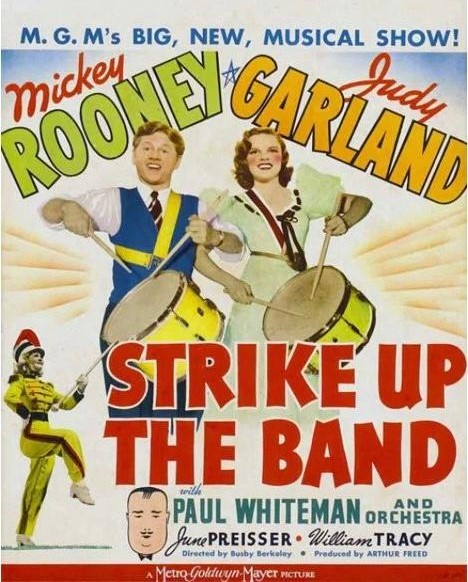

As for the family in family comedy, the few parents we see include Mickey’s widowed mother, whom he insists he will make “a queen” and June Preisser’s rich parents, who will bankroll Mickey’s ultimate success, which is very convenient.  Most of Mickey and Judy’s high school gang talk of parental rules but seem to run their own lives pretty well, to the point that the most important adults in their sphere are the school principal, played by Francis Pierlot, a longtime vaudevillian and stage actor whose film career in his senior years must have surprised and gratified him; and the real-life big band leader Paul Whiteman.


Mr. Whiteman’s orchestra played an important role in the 1920s when the well-mannered and sophisticated jazz of the era evolved into swing music in the early 1930s (Bing Crosby and Rudy Vallee were among those who had their start with him). By the time this movie was made, one could say that, though he had a noted place in the history of early twentieth-century American music, his best years were behind him.  American kids going to the grand party for rich June Pressier’s 18th birthday (How could they afford those rented tuxedos?) would have been thrilled to be listening and dancing to the famous Paul Whiteman’s orchestra; however, they probably had more Dorsey, Miller, and Kyser records at home and were probably wondering when the “boogie-woogie” would start.


Mickey and his pals play in the school band, which is dull and uninspiring to them, but the scene gives us an oh-so-brief comic glance at the disapproving, spinsterish music teacher played by Virginia Sale, who had a long career playing much older character parts.  She was the sister of vaudevillian comic Chic Sale.  She also wrote and played in a one-woman show called American Sketches, with which she toured from the 1930s through the 1950s, including a stint over in Europe to perform for the troops during World War II. 


Mikey Rooney, born in a trunk and growing up on a soundstage, was by now a veteran movie star, not just a movie actor, and could do this role in his sleep.  It does, however, give him a chance to exhibit yet another talent for us—he was a very good drummer, and his solo pieces in this movie are terrific.


Mikey’s dilemma in the movie is that he wants to be a big band leader but his sainted mother wants him to be a doctor.  Money is tight (or as Mikey says, “When’s bank night?”), so we don’t know how she thinks this is going to happen, but Mikey dreads disappointing her.  Still, on the sly, and with a polite, clean-scrubbed rebellious streak, he organizes his buddies on the all-male school band into a dance orchestra.  They want to perform at parties and dances and raise money to go to Chicago to audition for Paul Whiteman and get rich and famous.


Every big band needs a girl singer, and this is where Judy Garland comes in.  Judy is, as always, wonderful, multi-talented, tears your heart out with a look and a lyric, and seems to grow in her powers with each movie she makes at this period.


We are treated to Gershwin tunes and different settings, from the imaginative but weird fantasy where a bowl of fruit becomes an orchestra via stop-motion animation, to a spirited conga number in the high school gym, to a very long and overly produced finale that gives us—either as an afterthought or perhaps a cherry on top—the image of martial bands, Mikey in a white naval uniform, and a salute to the flag.  Clearly, the studio wanted to make sure, even in the last moments of the film, that all bases were covered.


Mikey’s solution to his problem dovetails with Judy’s problem—which is the effervescent June Preisser, the (as we mentioned in this previous post) “eye-rolling junior vamp” with the rolling acrobatic moves that always astound but that never seem to fit in with a musical number.  June’s making eyes at Mikey makes Judy miserable.  Judy pines after Mikey, but the fool never seems to notice.


Pining after Judy is the really funny and quite endearing Larry Nunn as Willie, a boy who is a freshman to their senior grade.  Larry Nunn had a brief movie career—this film was probably his best work—and died tragically at only 49.  Young Willie provides the dramatic crisis in the film when he is injured and requires an operation.  The gang turns over their earnings to him and, as we see in the melodrama play they perform as a fundraiser, virtue is its own reward.


A word about the melodrama, a Gay Nineties spoof called “Nell of New Rochelle.”  I think this is my favorite part of the whole movie, partly because of the silliness, and partly as a tribute to a long-ago form of entertainment.  It’s part of our American theatrical heritage.  When this movie was made, the Gay Nineties was only fifty years ago.  I say “only” because I have now reached the senior citizen stage of my life and to me, the 1990s was last Thursday, and the 1970s was the week before that. 


The spoof also gives William Tracy, one of Mickey’s pals, a spotlight role as the villain of the piece.  His overly made-up and sneering, sinister overtures to virginal Judy is a stark contrast to his somewhat goofy teen personality, always worried about whether or not he is on the outs with his girlfriend, Annie, played by Margaret Early.  Young Mr. Tracy’s most prominent role was likely the jokester junior shop clerk in The Shop Around the Corner, made the same year of 1940 (see this previous post.)


The silliness of this “mellerdramer” also served as an inspiration to me when, a couple decades ago, I directed a similar kind of show for my local community theater called “The Face on the Bar-Room Floor,” and we incorporated many of the gags in this spoof:  the counting of the chimes of the town clock always being wrong, using many of the same songs:  “She Is More to be Pitied Than Censured,” “After the Ball, “ “Father, Dear Father,” etc., and when the unfortunate child, like Willie in the movie, died and suddenly bore a white gown and cardboard angel wings, instead of “flying” him on a wire, we brought out two gum-chewing, bored-looking stagehands to hoist him on their shoulders and parade him off to “heaven.”  The audience loved it.  That community theatre show remains a warm and wonderful memory that returns to me when I see this spoof in Strike Up the Band.


A few other favorite moments: 


When June Pressier, new student, confidently slinks into the classroom, causing Margaret Early to whisper to Judy Garland, “She’s touched it up,” referring to June’s being a dyed blonde—Judy, half admiring and half dreading a competitor murmurs simply, “Yeah.”  It’s a quiet moment, and in moments like these and when she is singing the comic but plaintive, “I ain’t got nobody and nobody’s got me,” in the library is when Judy is at her most powerful, commanding the screen far more than in the frenetic moments when—one suspects at the insistence of Busby Berkeley—her forceful eye-popping enthusiasm is nothing more than a theatrical ploy.  It does not draw us in like the real acting does.


We might also note in the library scene a brief Charles Smith sighting as the boy who’s looking for a book on the fall of the Roman Empire.   We also see Charles in the above-mentioned The Shop on the Corner.


I also like Willie’s pathetic and funny marriage proposal to Judy just before his mother calls to tell him it’s his bedtime, and the long-suffering Willie’s remark to Judy, when he sees that Mikey has snubbed her again, “Just give me the word, Mary, and I’ll slug him,” and “Some birds just got to be shot twice before they stop flying.”


At some point between the high school dance and the big gig in Chicago, the kids have graduated from high school, but we never see the ceremony and it seems of secondary importance to their quest for fame and fortune.  It’s a world of homespun advice from Mom, played by Ann Shoemaker who offers in her society lady diction, “The top of the ladder is very appealing, and for my sake, be careful how you climb that ladder, because that’s very important, too.” 


Paul Whiteman offers his own advice, or something about dying and drumming, “When we get to the last eight bars of the big tune—the last thing to stop is our rhythm.”


It’s a world of neckties and sweater vests, and it’s a nice place to visit, and I wouldn’t mind living there, too.


 *******************

Our greatest gift from the Greatest Generation was freedom from fascism. Relive, and celebrate, how evil was faced, discussed, dramatized...and fought. Classic films were Hollywood's weapon.

Get your copy of my book Hollywood Fights Fascism here at Amazon in print or eBook, or FREE here for a limited time at Barnes & Noble, Apple, Kobo, and a variety of other online shops.

  ************

Jacqueline T. Lynch is the author of Ann Blyth: Actress. Singer. Star. and Movies in Our Time - Hollywood Mirrors and Mimics the Twentieth Century and Hollywood Fights Fascism and Christmas in Classic Films. TO JOIN HER READERS' GROUP - follow this link for a free book as a thank-you for joining.


Thursday, February 1, 2018

The 1920s - Then and Now series #1 - Intro


The 1920s were silent – but only as far as the movies. It was actually a loud and raucous decade, but one that, despite our image of quaint innocence, was actually strangely close to our own era socially, politically, and as regards the economy. The movies captured some of that, either intentionally or incidentally. But not all of it.

Over the next three posts were going to discuss a few films from the 1920s, including The Racket (1928), The Cocoanuts (1929), Our Dancing Daughters (1928), and Our Modern Maidens (1929). The latter two movies, both starring Joan Crawford, leave us with the impression of the decade being dominated by flappers. Perhaps the most well-known chronicler of that era, the writer F. Scott Fitzgerald wrote of Joan:

Joan Crawford is doubtless the best example of the flapper, the girl you see in smart night clubs, gowned to the apex of sophistication, toying iced glasses with a remote, faintly bitter expression, dancing deliciously, laughing a great deal, with wide, hurt eyes. Young things with a talent for living.


The hedonistic young woman of the 1920s with the rouged knees may have shocked her parents, but she has come down to us as a more or less comic cliché. She was called a “modern.” She has been interpreted, and innocuously, many decades later, in the film Thoroughly Modern Millie (1967), and The Boy Friend (1971).

Both movies are musicals, and interestingly, while The Boy Friend had its origins as a Broadway hit starring Julie Andrews in 1954, Thoroughly Modern Millie, which starred Julie Andrews, ended up being a Broadway hit in 2002, taking the opposite direction. The movie The Boy Friend starred Twiggy, whose pencil-thin figure and wide eyes epitomized the flapper. Glenda Jackson plays an uncredited role as the stage star who breaks her foot, for whom Twiggy must go on as an understudy. That movie is a rather heavy-handed spoof of early Hollywood films, overladen with Busby Berkeley fantasy sequences.  Some dialogue, such as when Twiggy is admonished that she must go out a youngster and come back a star, are taken pretty much verbatim from 42nd Street (1933).
The movie lacks the subtler, silly charm that Thoroughly Modern Millie had which, along with Miss Andrews starred James Fox, Mary Tyler Moore, Carol Channing, and John Gavin – who I really think was the funniest of the bunch just by being straight-faced through it all. The wonderful Beatrice Lillie appeared here in her last film. Being spoofs, they are more interested in exaggeration, as is the nature of parody, and though they are fun to watch, they are about is genuine a view of the 1920s as mock apple pie is to real apple pie. Perhaps, though, they were the vanguard of the 1970s nostalgia craze.

The 1920s is remembered for being The Era of Wonderful Nonsense, The Jazz Age.  Often films made much later that are set in that decade, such as The Helen Morgan Story (1957), which we discussed here, are jammed with slangy dialogue and visual triggers like hip flasks as a shortcut to jog something in our collective memory about the decade.

One of the few movies made after the dust of that decade had settled that actually remembered the era not with nostalgia but with chagrin and something like regret was The Roaring Twenties (1939), which we discussed here.  The movies actually made in the 1920s, however, especially the freewheeling chaos of Harold Lloyd or Buster Keaton films, seem to celebrate the technology that shaped the era – the phones, the cars, the flickers. The antics may be as remote to our present day as a black-and-white silent Felix the Cat cartoon to a modern-day CGI animated feature, but this fascination with technology and consumer products should key us into a mindset that was closer to our own than we realize.  It wasn't the only similarity to our era.

Though we recall 1920 as the year women won the right to vote – and all the bold flappers were called “moderns,” the decade was not really as progressive as it may seem. A generation of expatriates, writers, artists, musicians, composers, were living out their dreams overseas because of what they regarded as stifling and overbearing conservatism at home, including its most virulent and perhaps, to them, objectionable edict: Prohibition.

It was the era of the Palmer raids, the red scare and the wholesale roundup and deportation of immigrant aliens.  The National Origins Act restricted immigration. Sacco and Vanzetti were put to death in the electric chair after a trial that left much room for doubt about their actual guilt, but the climate of the red scare and sudden animosity toward the foreign-born usurped any interest in finding out the truth.  As poet Edna St. Vincent Millay noted:

[The] men were castaways upon our shore, and we, an ignorant savage tribe, have put them to death because their speech and their manners were different from our own, and because to the untutored mind that which is strange is in its infancy ludicrous, but in its prime evil, dangerous, and to be done away with.

It was the era of the Scopes trial when a high school biology teacher was tried in court for teaching anything but creationism.

It saw the rise of the Ku Klux Klan to its most powerful point, most especially in Indiana, with resultant beatings, lynchings, and shootings. Benito Mussolini founded a fascist regime in Italy, and Hitler began his fascist crusade, but we flirted with it, too, long before we met up with those devils in another generation.

The 1920s saw the rise of religious fundamentalism joined with materialism.  President Harding spoke of returning to “normalcy” after World War I and yearned for an orderly, Calvinistic world that never existed. The word “normalcy” never existed before that, either; it was made up for the occasion.

Under a trio of Republican presidents there were restrictive tariffs, scandal most notably in the Harding administration, and a stock market run ruthlessly like a Ponzi scheme. The shareholders’ titanic profits took precedence over the workers’ meager share (though wages did increase during the 1920s, unlike our own era), and an expansion of credit and few restrictions led to a booming economy and a dizzying stock market bubble in the year 1928.  Republicans controlled the Congress and the presidency through the decade that began with a depression and ended with one. 

It was an era of pop heroes, perhaps the most famous of which was Charles A. Lindbergh, who flew the first solo trans-Atlantic flight.  In another decade, he became involved in the America First committee and was a Nazi sympathizer.  If we think of the 1920s only in terms of “Oh, you kid,” and “23-skidoo,” it may be that the silent movies, though only a fraction of which that were made have survived, have bequeathed to us the image of an “Era of Wonderful Nonsense.”  There was a lot more going on off the set, and some of it quite serious.  Movies had been around since the turn of the twentieth century, but the 1920s was the turning point that made film a huge part of our national psyche, yet the flickers didn’t catch everything that was going on.


One could say that our era is more like the 1920s than it is of any other decade in the past century.  One film that resonates this is The Crowd (1928), which we discussed here in this previous post. This unflinching examination of a fellow whose failure to cope is summed up in one of its title cards, “We do not know how big the crowd is, and what opposition it is…until we get out of step with it.”

The excellent narrative history The Perils of Prosperity by historian William E. Leuchtenburg gives us many points on which to make the comparisons between that world and ours.  Perhaps another reason why we are left mainly with lightweight images of flappers, speakeasies, and bathtub gin is that the door slammed shut very quickly on the Jazz Age in October 1929 when the stock market crashed and the Great Depression began.  As Mr. Leuchtenburg remarks in a sympathetic if ominous epilogue: “Never was a decade snuffed out so quickly as the 1920s.”

Come back next Thursday, February 8th, when we’ll discuss The Racket (1928) about mobsters and political corruption—the first film to be produced by a young Howard Hughes.

Monday, November 10, 2008

For Me and My Gal - 1942


For the monumental occurrence that happened 90 years ago in 1918 on the 11th hour of the 11th day of the 11th month, we have an unlikely but not I hope inappropriate tribute in “For Me and My Gal” (1942). Like “Yankee Doodle Dandy”, made in the same year, (see blog post here) the movie combines the world of vaudeville with a world at war. The loss of innocence comes wrapped in spats over high button shoes, song and dance, and the sudden interruption of violent reality.

Judy Garland stars, with Gene Kelly in his first film, and George Murphy. Directed by Busby Berkeley, this film, also like “Yankee Doodle Dandy” presents its musical numbers as performances on stage, and not the unreal bursting into song in everyday settings as is common in most musicals. It helps that there appears to be a piano in just about every room.

Judy Garland, despite the turmoil of her private life, presents here her unique and irresistible confidence as a person with more talent than she can possibly contain. Mr. Murphy is her stage partner, a nice fellow who gives her up to the rakish Gene Kelly so that she gets to be a vaudeville star. Mr. Kelly is fresh as paint and full of applesauce. An arrogant opportunist, he sucks up to an operatic headliner with her own railroad car. No private Lear jets these days, just private railroad cars. Conveniently, there is a piano here, too. Judy knows Kelly is no good, but falls in love with the cad anyway.

We have the traditional vaudevillian mélange of acts, the whistle stops in small towns across the country, uncomfortable train upper berths, and the ever-constant desire to headline at New York City’s Palace Theater. It’s a rough and ready world, the chosen way of life of special people.

We see World War I has broken out from the angry headlines on the newspapers the uninterested Gene Kelly tosses aside. When Miss Garland’s kid brother is killed in battle, she leaves Kelly and the act, and their troubled romance, to go to France and perform for the troops. Kelly, who has kept himself out of the Army with a rather rash “accident”, sinks as low as he finally can in her eyes. To redeem himself, he hops over to France as well to perform, and ends up being a hero, which is fortunate for Mr. Kelly’s future acting career.

World War I is significant for the backdrop of a movie about vaudeville, as it was probably the first war that professional entertainers joined together in a voluntary troupe, sort of quasi-official units, to visit the troops. They also sold Liberty Bonds and raised money for Red Cross and other various charity drives. This would all be repeated, of course, on a grander scale for World War II.

At first, Gene Kelly balks at joining them, “You don’t think I’m going over there and sing a bunch of silly songs while all those guys are getting their heads shot off?” But he changes his mind, becomes a hero and finds redemption. Even if he had not become a hero, he still would have been doing his part. The silly songs somehow helped. And somehow got to define a war that has, perhaps more than any other, come to represent lost innocence.

World War I carried something that World War II did not in terms of a kind of folklore of lost innocence. Though the seeds of that war had been present for more than a generation in the form of social unrest, nationalism among disparate European ethnic groups and class turmoil, the war really erupted in an accidental and unintended snowball effect after the tragic 1914 assassination which set everything in motion. It was not many months into the war before generals and politicians alike realized with horror that what they had created to be a limited war was utterly beyond their control to stop. The best hope was that it would somehow burn itself out.

It did, but not before millions of deaths due to battle, disease, and famine.

Ernest Hemingway wrote in “A Farewell to Arms” that “Perhaps wars weren’t won anymore. Maybe they went on forever. Maybe it was another Hundred Years War.”

The other tragedy of World War I was, obviously, its legacy of an imperfect peace that led to World War II.


But another curious aspect to that war so tragic, was the ironic ebullience with which a generation approached it. Even these recruiting posters pictured here do not have that grim, us or them, kill or be killed message. One shows a man quietly examining his conscience as an army of his brothers marches outside the window, and the other shows a group of soldiers on a train gesturing towards the viewer to join them, as if they are happily taking a chartered excursion to a football game.

This ebullience is so marked that when one thinks of that war, one of the first things that comes to mind are the popular songs of the day. So much a part of that war, that the landmark CBS documentary series “World War I” (1964) set aside an entire episode called “Tipperary and All the Jazz” just for the songs the soldiers sang. There was no narration, just song after song played over poignant newsreel footage.

Some of these same songs are performed in “For Me and My Gal” by Judy Garland, et. al., and we are lucky enough to have a front row seat. Because of these funny, raucous, keep-your-chin-up songs, one might think the American Army marched late to the war like party crashers. That is only partly Hollywood; part of it is true. There was an especially hopeful, and for today, an almost unbelievably joyous element in going to war for that generation. “Let’s put on a show” became “Lafayette, we are here!”

It was noted by our allies. British nurse Vera Brittain’s memoir of World War I, “A Testament of Youth” (rpt. Virago Ltd., 1978) notes after three weary years of a war that would not end, “They looked larger than ordinary men; their tall, straight figures were in vivid contrast to the under-sized armies of pale recruits to which we had grown accustomed…I wondered, watching them move with such rhythm, such dignity, such serene consciousness of self-respect…Then I heard an excited exclamation from a group of Sisters behind me.
‘Look! Look! Here are the Americans!’
I pressed forward with the others to watch the United States physically entering the War, so god-like, so magnificent, so splendidly unimpaired in comparison with the tired, nerve-racked men of the British Army…The coming of relief made me realise all at once how long and how intolerable had been the tension, and with the knowledge that we were not, after all, defeated, I found myself beginning to cry.”

One moment in the movie is particularly sober, and its sentiment particularly true, despite the theatrical setting. Judy’s brother, in uniform, finds her at a party with only enough time to say goodbye. His unit is going overseas. The song “Till We Meet Again” is struck up and everybody sings. It is a sad, sweet waltz,

“Smile a while, and kiss me sad adieu.”

We may think of songs like “George M. Cohan’s “Over There” when we think of World War I, but “Till We Meet Again” was the big song of that era. It is not very vaudevillian, at least not as much as the song one of their vaudeville troopers sings with lyrics like, “We’ll crack the Kaiser with a bottle of Budweiser!” It’s more of a front parlor song, the kind of song people sang together when they didn’t feel so brave.

Just that song was the beginning perhaps, of the loss of innocence. After all the song and dance, though the war was won, the generation that won it, particularly its chroniclers in prose and poetry, art and music, would forever be known as The Lost Generation.

The movie gives us some newsreel footage of General Pershing and the victory parades. Judy and Gene are reunited at the end, at the Palace Theater at a servicemen’s show, both of them in uniform. “For Me and My Gal” just ends with boy getting girl, and an audience made entirely of soldiers cheering them on, like those fellows in the poster marching past the window to some unforeseeable future.

Just like “Yankee Doodle Dandy” there are subtle reminders that there is another war going on outside the movie theater in real time, and some not so subtle ones. After “the end” we have “America Needs Your Money. Buy War Bonds and Stamps at this Theatre.”

Monday, February 4, 2008

Gold Diggers of 1933


Gold Diggers of 1933
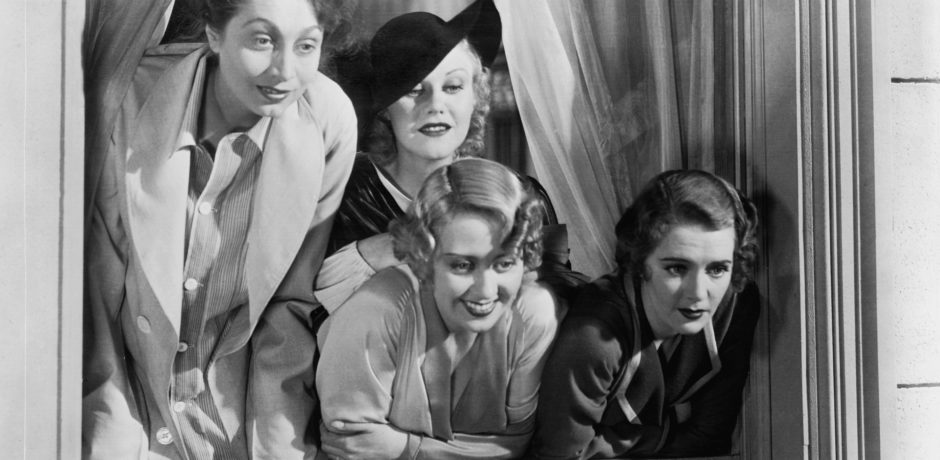
(1933) is kind of a shock to the system. A quintessential “Depression” movie, it actually aspires to be a Depression movie with no claim to be anything else, an in-your-face comment on current events.

The film begins with a barrage of blonde chorus girls singing “We’re in the Money,” in a frenzy of fantasy that must have been fascinating to moviegoers in 1933, the depths of the Great Depression. When you consider that many of those moviegoers had to scrimp for the purchase price of the ticket, probably anywhere from 10 cents to 25 cents depending on where they saw it, whether it was an evening performance or matinee, the sight of women swathed in gold coins placed in strategic places on their bodies must have been nothing short of obscene. Not in a sexual manner (though there is plenty of naughtiness in the movie as well), but obscene in the way you don’t eat a three-course dinner in front of a starving man. It’s cruel.

Choreographer Busby Berkeley, with his customary surreal and eye-popping musical scenarios, gave the crowd more than 10 cents' worth of fantasy, but there is a strange dichotomy between fantasy and cold, hard reality in this film. Warner Bros., as always, had a bead on the grim reality of the 1930s and fixed its reputation on socially relevant films. Gold Diggers of 1933 is a cross between a socially relevant film and lemon meringue.

Joan Blondell stars as the tough-talking chorus girl. Aline MacMahon and Ruby Keeler are her pals, and Ginger Rogers has a featured role, opening the film in the “We’re in the Money” number. The bit where she sings a chorus in pig Latin was put in, as she notes in her autobiography, Ginger, My Story (Harper Collins, 1991), by producer Darryl F. Zanuck after he heard her clowning around with the song and doing a verse in pig Latin during a rehearsal.


The girls are thrown out of work when the Broadway show they are in is shut down by creditors because Ned Sparks, the producer/director, can’t pay the bills. We see the girls struggling in their run-down apartment, stealing milk from the neighbors, and when they hear a rumor that a new show is going to be cast, they pool their clothes for one good outfit for Joan Blondell to wear to go check it out. When she calls them to relay the good news that a new show is on and they might all get jobs, she is crying on the phone. It is one of those real moments that breaks through all the wisecracks and reminds us, more that it does the audience of the day, that this was the Depression. Nostalgia buffs need to remember that for many people it was a nasty time to be alive. Or, as when one of the chorines complains of their hard luck, Ginger Rogers comes back with the world-weary remark, “The Depression, dearie.”

Dick Powell plays a young composer who lives in the apartment across the way. He is sweet on Ruby Keeler. He is also a wealthy playboy in disguise, so he comes up with the money to fund the new show. The show, as Ned Sparks envisions it, is going to be about the Depression, and featuring a number about “the forgotten man,” a 1930s euphemism for unemployed World War veterans. Sparks crows about his inspiration, “Men marching, marching…jobs… JOBS! Gee, don’t it get ya?”

It must have got everybody.

The rehearsals for the new show carry the fun of the typical backstage world the movies occasionally give us a glimpse of, just to remind us that there is hard work behind the magic.

We have some character actors who have very brief time on screen but give the film its quirky personality. Clarence Nordstrom plays the middle-aged “male juvenile” of the show, (we see him as well in the “Shuffle Off to Buffalo” number in 42nd Street) whose sudden attack of lumbago forces Dick Powell into the starring role on stage. Nobody seems to have lumbago anymore. It went the way of “the ague” and “the vapors,” I think.

It is another hard slap reminder that the wolf is at the door when, as Dick Powell first refuses to go on stage, Aline MacMahon chastises him with the information that all the cast will be out of work again, and perhaps some of the starving actresses will “have to do things I wouldn’t want on my conscience.” It brings the wealthy playboy to hard reality, and us, too.

Billy Barty plays the naughty “baby” in the strange “Pettin’ in the Park” park number. Sterling Holloway, future “Winnie the Pooh” voice among other roles, plays a delivery man, and ever dependable, ever-present Charles Lane has a brief spot as a reporter. Mr. Lane played curmudgeonly types in just about every film ever made in Hollywood and most TV shows in the 1950s through the 1990s. When he died at 102 years old, he was still working.

Warren William plays Dick Powell’s older brother, who tries to get Powell away from the clutches of Ruby Keeler, whom he sees as a gold digger. He views all actresses as gold diggers, and in his scheme to separate them, he unwittingly falls for Joan Blondell. He is a stuffed shirt, who grows more likable if only for his helplessness among the streetwise gold diggers, with family retainer Guy Kibbee in tow.

Ruby Keeler undoubtedly appeared very cute and sweet on screen, but her questionable range of talent made her no match for Joan Blondell. Particularly in the striking “Forgotten Man” number, Miss Blondell displays such intensity and commanding screen presence that is it surprising she did not enjoy a longer career as a leading lady, always cast in second leads. Perhaps Hollywood already enjoyed an embarras de richesse when it came to tough-talking blondes and felt it didn’t need another one.

We see a few pre-Code influences in the “Pettin’ in the Park” number with its undressing chorines drenched by rain pouring down on the multi-level “park” set that goes through different seasons.


“The Shadow Waltz” number, where even Ruby Keeler sports blonde finger waves, is typical Busby Berkeley fare, with overhead kaleidoscope shots of the girls in dresses with corkscrew hoops that spring and bounce as they play violins that are eerily lit by neon tubing. One wonders about the expense and the possible safety issues.

The film concludes abruptly with “The Forgotten Man” number, a stark street set where Joan Blondell speaks the first verse of this song about downtrodden World War vets. Only the year before, a “bonus army” of vets were routed by the Army with General Douglas MacArthur at its head and burned out for camping in protest in Washington, D.C., over the issue of their service bonuses.

“Remember my forgotten man.
You put a rifle in his hand.
You sent him far away.
You shouted hip hooray.
But look at him today.”

Etta Moten takes a verse in her rich contralto as the camera pans across the poverty-beaten wives of the jobless forgotten men. Miss Moten made only three films in Hollywood, all in this same year of 1933, but went on to a long career on stage and as a radio journalist. She is reported to be the first African-American performer to be invited to the White House, when the Roosevelts hosted her.

Much of this song is pantomimed, with many extras dressed as World War soldiers marching off to the war jubilantly, crowds waving. The rain beats down on them as they continue to march, now wounded, with a defeated attitude, home from the war, then shuffling in civilian clothes in a breadline with hollow eyes and bleak faces.

When a cop tries to roust a homeless guy sleeping on the sidewalk, Joan Blondell wordlessly comes to his rescue by turning over his coat lapel showing his Medal of Honor, and gives the cop a glare that would kill.

To us today this is a reminder that the Great Depression was not all waltzing with neon-lit violins and romantic fantasies. In 1933, they already knew that. Perhaps Warner Bros. felt the public wanted affirmation of their problems, some legitimacy granted their desperation.

The movie ends, or just slams shut, on this dour note, the complete opposite of how it began with “In the Money.” Both musical numbers are stunning, especially in that they show opposite sides of the “coin.”

   ********************

Jacqueline T. Lynch is the author of Ann Blyth: Actress. Singer. Star. and Memories in Our Time - Hollywood Mirrors and Mimics the Twentieth Century. Her newspaper column on classic films, Silver Screen, Golden Memories is syndicated nationally.  Her new book, a collection of posts from this blog - Hollywood Fights Fascism - is available here on Amazon.

Related Products