IMPRISON TRAITOR, PEDOPHILE, AND CONVICTED FELON TRUMP.
Showing posts with label Natalie Wood. Show all posts

Thursday, February 23, 2017

Happy Land - 1943

Happy Land (1943) is a gentle, yet powerful film of common decency, and the discipline and quiet courage that common decency sometimes requires.  We used to attribute these as American values.  The movie is sentimental about this, and yet bravely forward-thinking for all its nostalgia: there is an underlying current of foreboding almost as if they knew how delicate decency is, and that is must be nurtured.


The title of the movie, as related by the strains of the theme song, comes from the lines in “Hail Columbia,” composed for George Washington’s inauguration, that was often used as a national anthem up until the time “The Star Spangled Banner” was officially made the National Anthem in 1931.  With all due respect to our anthem, I have a preference for “Hail Columbia”.  It is stirring, and sweet, and nobly idealistic, and perhaps a little naïve. “Hail Columbia, happy land!”  Listen to song here on YouTube. 

Don Ameche stars as a man from a Middle West small town at the height of World War II.  He is a pharmacist and owns the town’s drugstore on Main Street, and much of what we see will remind us of a Norman Rockwell painting.  He is married to Frances Dee, lives in a cozy white wood frame house, and his only son is away in the Navy.  He knows all his customers personally.  It is a good life.

At the very beginning of the movie, we see a telegram delivery girl ride her bicycle up to the front steps of Don Ameche’s house.  Perhaps no image ever instilled more fear in the United States during World War II than the telegram delivery person.  Here it is a mere girl.  Her name is Hilda, and Don Ameche, of course, knows her.

Pleasantries are quickly dispensed with.  She hands him the telegram without looking at him.  He stands silently, and the close-up lingers on his expressionless face, on which we see only a flicker of realization that his son has been killed.

The movie is filled with moments like this, strong, gutsy, brave moments that are no less courageous from the actors and the director, Irving Pichel, because they are placed in a comfortable and nostalgic setting.  Sometimes the movie may well remind us of what The Best Years of Our Lives (1946) would have been had it been filmed three years earlier; and it is perhaps no coincidence that the material is from a novel by MacKinlay Kantor, just as Best Years was.

We shift quickly to the town’s newspaper office where the editor composes a hasty eulogy for Ameche’s son in his daily editorial.  There is slight leap forward in time—Ameche takes a leave of absence from his drugstore and his employees are left to run the shop: good old Mary Wickes among them.  The minister calls on Mr. Ameche to lend comfort with the true words, “Suffering and pain are part of life too.  We must accept them.”

But Ameche’s loss of his son Rusty is compounded by his sense of injustice that Rusty “never had a chance at life.  He never went anywhere.  Just a youngster living at home, going to school, working for his dad…It isn’t right.  It isn’t fair.”
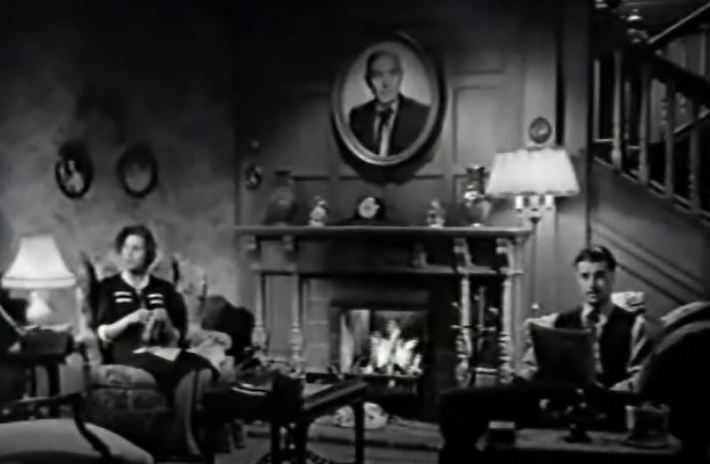
Ameche’s next visitor will have a stronger impact: Harry Carey, who plays his deceased grandfather.  We may compare this scenario with It’s a Wonderful Life (1946), but Harry Carey is no bumbling angel.  He speaks frankly with a kind of homespun horse sense we might expect from Will Rogers or Mark Twain, and though he has been dead twenty-one years, he is still very much alive to Don Ameche.  We know this because of Carey’s prominent portrait in Ameche’s home and at the drugstore.  Grandfather Carey’s influence is strong.  So it is with certain people in our lives, who seem to walk with us now and again even though they’re gone.

Ameche goes for walk into town, and Mr. Carey goes with him, and soon they travel not just through town, but through time.  We are brought to the end of World War I, when Harry Carey and the rest of the town welcomed home a parade of doughboys, including a younger Don Ameche.  (It is really something to consider that Ameche was still playing romantic leads at this point in his career, but in this movie he plays a character who ages, whose main purpose in the film is to be a father.  This would, as it does for aging actresses, signal a turning point, perhaps even a demise of his film career, but this movie is a gem and I hope he didn’t regret it.)  Grandpa Carey ran the drugstore then, and Don becomes a pharmacist as well.  We are then given a tour through Ameche’s adult life, of which his marriage to Frances Dee, and his son Rusty, is the biggest part.

Grandpa Carey died shortly after Rusty was born, and we jump to a Memorial Day of placing flags on Civil War vet Grandpa’s grave when Rusty is about six.  He is impressed, and knows that soldiers get flags.  He says that someday he wants one.  It is a moment of foreshadowing of doom, but Frances Dee confidently notes, “There aren’t going to be anymore wars.”  That, after all, was the slogan of World War I, when it was just still called The World War.

Grandpa Carey’s ghost remarks to Don Ameche, “She was right.  That’s the way to bring up American kids, not to be thinking always of conquests and battles, but to learn to enjoy the homely, simple things that are here all around them.”  It is a mighty thought, that to be peace-loving and grateful should be patriotic, for if we do not appreciate what patriots have won for us in war, we do not deserve the peace.  Then the strain of “Hail Columbia” repeats in chorus during this exchange.  The tune becomes our conscience.

We see Rusty playing with his friends at being Indians in a cornfield, and being dragged home by Mom to take his nap.  He balks at being called and answers, “Me no Rusty, Woman!”

Rusty gets spanked by Pop for refusing to go to kindergarten, but goes and makes pals there of two brothers who live on the other side of the tracks.  He brings them to the drugstore to meet Pop, and Ameche gives them free ice cream and orders some groceries for their family.  Their dad is out of work.  Ameche tells Rusty, “When you come across a fellow that hasn’t got anything and you’ve got things, why, you just give him some of your things.  Some folks call that charity.  I don’t like that word.  All it is, is being friendly.”

Rusty grows older, joins the Boy Scouts, and saves for a hatchet to take on a camping trip with the Scouts.  He’s almost got enough, but when he’s left in charge of the store and an old man comes in for medicine and can’t pay for it, Rusty buys it for him with his own money. Ameche witnesses the scene.  The expression of pride on his handsome face is exquisite.

He buys the hatchet for his son, and we see Rusty with other Scouts singing “MyDarling Clementine” to a harmonica accompaniment.  We are back to homespun pleasures, and a montage of scenes as Rusty plays football and runs track in high school.  He was not always the star, but tried his best, and his father notes with equal pride, “He was a good loser.” This is a virtue as important as being a good winner.

Rusty dates, and his eventual best girl, Ann Rutherford, shares with him an unusual but pleasingly respectful relationship, an old-fashioned courtliness borne of modern wariness.  She does not gush over him, and withholds her kisses from him because she has seen him lose his head over flashier girls and she will not lower herself to compete.  He must win her, and with gallant gentlemanliness, he acquiesces to kisses only on the forehead until the moment when the time for passion is right.

Rusty, played by Richard Crane as an adult, is touchingly mature.  He and his friends have fun at a late summer backyard party, but listen to Hitler’s invasion of Poland on the radio and soberly understand, wise beyond their years, that their future has just been altered.  As President Franklin D. Roosevelt had said only three years earlier in 1936: “There is a mysterious cycle in human events.  To some generations much is given.  Of other generations much is expected.  This generation of Americans has a rendezvous with destiny.”

Back at the drugstore, Old Ben, who works in town as a night watchman, played with eloquent, natural grace by Leigh Whipper, veteran of Broadway and the first African American to receive membership in the Actors Equity Association, remarks of the latest news on the radio about the threat of fascism, “It’s the same old thing, weasel talk.  The same old bunch of gangsters and killers out to make slave of the rest of Europe.”  Mr. Whipper’s too disgusted to be scared.  He sets a fine example in righteousness for the Rusty and his pals planning on joining the service, some fighting in these pre-Pearl Harbor days for Canada.

Along with Leigh Whipper, we must note how well chosen the cast is, from Richard Crane, who despite the enthusiasm of a boy coming of age really plays his role in a careful, understated manner which makes his character very likeable that makes us, like his father, seem to take pride in him.

His best friend is played by Dickie Moore, and Ann Rutherford’s character is played as a child by Darla Hood.  Also for the trivia buffs, this was five-year-old Natalie Wood’s first movie.  She has a brief walk-on as a child who drops an ice cream cone.  It also warms the heart see Adeline De Walt Reynolds in a brief role as a patron of the drugstore who trades homemade loganberry wine for a “snake oil” tonic. (We discussed her career in this previous post.)  The wine is reprised in several scenes as Rusty shares his first drink with Dad, and other momentous occasions.

Rusty decides, rather than enlist in a knee-jerk reaction to the world news, that he will go to pharmacy school.  After the war, he wants to join his father in business, and he feels that if he has his pharmacist’s license, he will be of more use to the service with this skill.  Don Ameche is once again beaming with pride, and invites his son for a toast of loganberry wine.

Rusty’s a strapping sailor in his Navy uniform.  But the world comes crashing down on us when we see his smiling face in the bus window pulling out of town and Ameche says in his soft, low voice, “That was the last time I saw him.”

Grandpa Carey is at his side again; we’re back in the present.  Carey says, “It was all worthwhile, the whole thing.”

We know what he means, that just because Rusty’s life was short doesn’t mean it didn’t have value, and that he didn’t pack a lot into it.  Ameche understand, too, but responds, “Rusty led a good life.  You’re right about that.  I know all the other things you’re hoping I’ll say, but I can’t.  He was my boy.  And now he’s dead.  I miss him.  I can’t help it.  I’ll always miss him.  I’ll always wish he was back, as long as I live.”

This exchange, during the height of World War II, was a very frank thing to say, and brave in its open-faced acknowledgement of grief.  We are most respectful to the grieving not when we try to cheer them up, but when we acknowledge their grief.  There is no cheerleading here, but the end of the movie gives us and Ameche a startling task.  It dares us to continue our lives and force ourselves to find a purpose.

The gentle but no less firm admonition for Ameche comes in the form of Henry Morgan.  He’s a young sailor, a shipmate of Rusty’s.  He shows up to the drugstore on furlough, and in an exchange of very few words, almost as if they are reading each other’s minds, Ameche invites Henry, who has no family of his own, to stay at his house.  Frances Dee, also awed by an unspoken epiphany, kisses Henry upon meeting him as if he was her son, and they, without talking about it, suggest he take Rusty’s room.  We know their bond is sealed when Ameche takes out the loganberry wine.

The strains of “Hail Columbia” rise again with lyrics, “peace and safety we shall find.”

But we shall only find it together.


Special thanks to fellow blogger Moira Finnie (see her blog The Skeins) for introducing me to this movie.  You can watch it here on YouTube.

*********************
The audio book for Ann Blyth: Actress. Singer. Star. is now for sale on Audible.com, and on Amazon and iTunes.


Also in paperback and eBook from Amazon.

Monday, July 14, 2008

The Ghost and Mrs. Muir (1947)

“The Ghost and Mrs. Muir” (1947) is notable for Gene Tierney’s charming performance as the spunky widow who shares a seaside cottage with her young daughter, a meek housekeeper, and a ghost.

Set in England of 100 years ago, we meet her in mourning black, which she eventually sheds when she establishes herself living independently after the death of her husband. In a time when widows with small children were taken in by relatives, this one avoids her husband’s dour family by striking it out on her own, upsetting the notions of proper female behavior held by them, the nervous real estate agent, and society of the day.

The irascible ghost of Captain Gregg tries to get her to “shove off” at first, but then the macho misogynist sea dog, played by Rex Harrison, takes a liking to the lady and allows her to remain, even dictating to her his memoirs, “Blood and Swash” so that she may sell it to a publisher for an income. It is an interesting irony that a character so boldly vocal about the faults of women, is also the one to accept her presence on an equal partnership.

They become fast companions, broken up only by the brash and flirtatious George Sanders, who helps get her foot in the door at the publishing house. Sanders is a writer of children’s books, and a painter as well who paints a saucy portrait of her in a bathing costume on the beach.

The Captain disappears, leaving her for her own good to a more practical romance with a human, but when Sanders is revealed to be already married, our spunky Mrs. Muir seems to lose some of her whimsical personality. The film shows the passing of long lonely years with only her housekeeper for company. As a child, her daughter is played engagingly by Natalie Wood, but the child grows up, and an elderly Mrs. Muir is still waited on by an even more elderly Martha. When Mrs. Muir dies in her sleep in her familiar chair, the Captain returns, and they walk out to some celestial horizon where we are meant to believe they will be together always.

What to do about a friendship with a ghost, let alone a romance with a ghost, is not an easy plot for a writer or director. How funny that we can spin endless fantasies about any manner of unlikely scenarios: time travel, aliens, monsters, etc., but a love story between a living person and the soul a person long deceased gets a bit tricky. We are stubbornly apt to try to infuse logic into the plot. This keeps us grounded to reality, but reality is just what the plot isn’t.

As well known as the movie, the television series which it inspired in the late 1960s also runs into a similar problem. The Captain and Mrs. Muir, played on TV by Edward Mulhare and Hope Lange, present a more romantic pairing, with part of the romance obviously being the longing over the fact that they cannot really be lovers. Rather than have the spirit of Mrs. Muir being united with the Captain in death, the show was simply cancelled after a couple seasons, avoiding this “resolution.” The search for a resolution when there is none is the conundrum.

The television version is also notable for the part of Martha being played by character actress Reta Shaw, who was no dishwater servant, but a more feisty housekeeper and companion to Mrs. Muir. She could make any line funny, dripping with sarcasm, and carelessly referring to the Captain in his grim portrait as “Laughing Boy.” Reta Shaw, who had performed extensively on television and the stage, made her film debut in “Picnic” (1955) which airs on TCM on Tuesday.

The Muir home interiors in the TV version are quite similar to the film’s interiors, particularly Mrs. Muir’s (and the Captain’s) bedroom, which pays homage to the film’s wonderfully evocative setting of living in isolation by the sea.

More sad than a romance that cannot be, is the part where the Captain, hoping that Mrs. Muir will marry George Sanders, magically convinces her that her relationship with the ghost of a sea captain was nothing but a dream, removing all her memory of him. Not having read the novel by R. A. Dick, I wonder if this was part of the original story, or an affectation of a studio uncomfortable with the unresolved romance with a ghost?

Monday, November 26, 2007

Miracle on 34th Street (1947)


Miracle on 34th Street (1947) sets two interesting precedents for the American public. First, it becomes a traditional must-see film for the Christmas holiday season, something warm and fuzzy, and frequently re-made. Secondly, and more importantly, it openly and frankly acknowledges, perhaps even establishes, the phenomenon of yuletide commercialism, Black Friday binges, Cyber Mondays and Thanksgiving as a warm-up act for the big show to follow.

Maureen O’Hara is in Human Resources at New York City’s famed Macy’s Department Store and is in charge of the Thanksgiving Parade. She hires Edmund Gwenn as a last-minute replacement for the fellow supposed to play Santa Claus, whose float brings up the rear of the parade. She has unwittingly hired the real Santa Claus to play himself, and that is where the plot takes off. John Payne is her prospective beau and Santa’s attorney, and young Natalie Wood her daughter, who does not believe in Santa.

We have a few shots of Macy’s and a couple of actors playing Mr. Macy and his rival, Mr. Gimbel, but it’s not really so much about Macy’s or New York City. This could be any department store in any town. These could be your kids waiting in line in to sit in Santa’s lap, or it could be you, or your parents. We have a suggestion of the late war with the most touching scene in the movie probably where the little girl from Holland, who does not speak English, is captivated by a Santa Claus who can easily converse with her in Dutch. But most of the film is not about the past, either good old days or horrors gratefully behind us. It is not even about the present, with bustling well-dressed shoppers using cash instead of credit cards and content to wait until Christmas Eve to decorate their real trees, with dreams of their first suburban post-war homes dancing in their heads, topping their wish list.

It is about the future, a time which this film maps out even if it does not envision. It is about a time of paying with plastic, and of over-spending with plastic. It is about the economic reporters gauging, analyzing, cringing and exulting about how much money is being spent by the shopper, by the minute, in an America where two-thirds of our economy is dependent on this one short season.

It is about putting up the tree on Thanksgiving after rushing through the turkey dinner. It is about watching Miracle on 34th Street not because it is one of the few classic films which mentions that most American of holidays, Thanksgiving, but because leads us into Christmas, ready, set, go right after you finish your piece of pumpkin pie.

Related Products