IMPRISON TRAITOR, PEDOPHILE, AND CONVICTED FELON TRUMP.
Showing posts with label White Christmas. Show all posts

Thursday, December 19, 2024

Anne Whitfield -- Susan Waverly's White Christmas


Susan Waverly, the granddaughter of General Tom Waverly, has a larger role in White Christmas (1954) than might be noticed at first viewing.  She has few lines and is a minor character.  Upon successive viewings (at least once every Yuletide season would rack up a lot of times watching this movie -- some of us watch it more often than that) we see that Susan is a major player.  She's in almost every pivotal scene.

Anne Whitfield was about fifteen years old when she played the part of Susan.  Her passing last March at the age of 85 brought to mind how much I've enjoyed her work over the years -- in television guest roles, and on radio, especially as one of the daughters of Alice Faye and Phil Harris on their radio comedy program -- and certainly as Susan Waverly in White Christmas.  According to her obit online (which you can read here), Anne celebrated the 70th anniversary of the movie by watching it with her family last Christmas. 

Happily for us, a few years ago she did a charming podcast interview with Tammy Tuckey and discussed her impressions of working on the movie. Listen to it here.


We meet Susan for the first time as she enters with an armload of firewood behind her grandfather, played by Dean Jagger (whom, Anne says in the podcast interview was "a sweetie").  Musical performers Vera-Ellen and Rosemary Clooney have just arrived, booked here over the Christmas holidays, to work in Dean Jagger's Vermont Inn.  With them are Bing Crosby and Danny Kaye, big-time Broadway producers and performers who have latched onto the ladies.  When Bing and Danny see Dean Jagger coming through the door they are shocked: he is their old army general, and their bumbling salutes and obvious respect are noticed by Susan.  It's quite endearing how she beams with pride over her grandfather (and will again in a famous scene at the end of the movie).

More than pride, Susan has that look of delight to be a fly on the wall in the world of grownups, where from the safety of her own innocence and perhaps insignificance, she can discover all that is profitable about people-watching.  And to Anne's credit, she does look deeply into the faces of the other actors when they are speaking.  This is not only generous to her castmates, it actually strengthens the character of Susan.

We don't really know much about Susan's backstory.  She lives in the inn with her grandfather and their housekeeper, played by the wonderful Mary Wickes.  We assume she is in the care of her grandfather, now retired from the military, because she has lost her parents, but this is never mentioned.  We don't know how long Mary Wickes has been in the general's employ.  Her crusty, no-nonsense repartee with him, particularly when he blows up at her for sending both of his two suits to the cleaners and she reminds him that when he was in the army, "it took 15,000 men to take my place," that perhaps she has been with the family for a long time, maybe even helped raise Susan.  Miss Wickes and Mr. Jagger do seem something like an old married couple at times.


Susan is quiet, kindly, and respectful.  She has no scenes of teenage angst or drama.  We do not see her friends.  However, she is not mousy or a shy child; she actually seems to enjoy being included in the grownups' world.  She moves about the room during the cast party with a tray of cups of coffee, but we also see her mingling in the background, laughing and talking.  When Danny Kaye and Vera-Ellen announce their pretend engagement, Susan is in the background, but standing right between them in the shot.

Though she lugs firewood and acts as a waitress in the inn's restaurant, she does not seem to be an overworked drudge, but gives the impression of enjoying tagging along with her grandfather and noticing everyone about her.  She understands the importance of making the inn profitable.  When Bing and Danny come up with the idea of bringing their roadshow to the inn, she remarks, "This will bring in business, Grandpa!"

We find her importance to the setting of the inn, if not important to the plot of the movie, and yet she is present at turns in the plot.  When Mary Wickes eavesdrops on Bing's phone call to New York and misinterprets what she hears, causing problems and misunderstandings, Susan interrupts her with an armload of parcels, "Here's the laundry, Emma."

When Rosemary Clooney trots off to New York, putting distance between her and Bing, Susan brings the note to Vera-Ellen to give her the news.


When Danny Kaye has to keep the general busy so he can't watch the TV show Bing Crosby is appearing on to plan a big surprise for him, Susan offers, "Grandpa, the battery's dead on the jeep."  When Danny fakes an injury to keep the general's attention on him, Susan smiles, catching Danny's wink.  She is not just an observer of grownups' antics; this time she is part of the adventure.

There is famously that lovely look of pride on her face when her grandfather comes down the stairs in his Army uniform (she rates a closeup), and she takes his arm.  "Grandpa, you look wonderful!"  They head into the large restaurant where Bing, Danny, and the general's old unit pay him tribute.   Susan and Mary Wickes step back and give the general his moment in the spotlight. But they are there in the background and we see them.


When the long-awaited snowfall happens, the general steps out onto the porch and basks in its loveliness--and the knowledge that the local ski areas will be booming and so will his business.  Susan and Mary Wickes are standing together in the background, his "womenfolk," moved by the moment and happy for him.


At the end of the film, when we take that long pan down the tables of ex-GIs and their families, everyone toasting to the sentiment of the holiday, Susan sits next to her grandfather at the head table and passes a champagne glass.  Perhaps she gets to take her first sip of the bubbly.  She beams a beautiful smile, enjoying being grown up and yet not so grown up that she will ever forget the excitement of the evening.


Just before "The End," if you look hard, you can see Susan leaning over to kiss Grandpa's cheek a second time.

Anne Whitfield, no older than Susan Waverly, seems to have been just as decent, humble, and mature a young lady as the part she played.  Perhaps that is why, as she stated in the podcast interview, that the role was enlarged by director Michael Curtiz, giving her an extra line, a bit of business, including her in the background of yet another scene--because he liked her.  Me too.

*******************

TODAY, December 19th, I'll be a guest on the podcast Forgotten Hollywood, hosted by Doug Hess.  We'll discuss Christmas movies and my book, Christmas in Classic Films, and renew auld acquaintance with some of our favorites.  I hope you can listen in here at this link.

LOOKING FOR A STOCKING STUFFER?


Get your copy of CHRISTMAS IN CLASSIC FILMS here at Amazon in print or eBook...and now, HARDCOVER!

Buy your eBook directly from me at my online shop HERE.

Or here at Barnes & Noble, Apple, Kobo, and a variety of other online stores.

  ************

Jacqueline T. Lynch is the author of Ann Blyth: Actress. Singer. Star. and Movies in Our Time - Hollywood Mirrors and Mimics the Twentieth Century and Hollywood Fights Fascism and Christmas in Classic Films. TO JOIN HER READERS' GROUP - follow this link for a free book as a thank-you for joining.


Thursday, May 16, 2019

5 Favorite Films of the 1950s Blogathon


In celebration of National Classic Movie Day, we join the 5 Favorite Films of the 1950s Blogathon hosted by Classic Film & TV Café.

To pick five favorite films is akin to limiting oneself to only a few items on a buffet when you really want to eat everything.  So I won't suggest these are my only favorites, but I chose them because they represent something about that "mid-century" decade known for conformity and perhaps complacency, when really a lot more was going on under the surface, even though two of them are musicals, and two feature the loveliest new faces of the decade who would come to be icons--Audrey Hepburn and Grace Kelly.

Even in a delightful romantic comedy, Roman Holiday (1953) here, we get a glimpse of post-war Europe, of Rome, "The Eternal City" that had suffered under a fascist dictator, had endured the chaos and destruction of war in its villages, and yet mustered that, now tired, elegance of its monarchal past (and called out some real-life royals to play bit parts and wear their jewels).  To the mix, we add a spritely modern princess who must balance her "untouchable" grace with a mission to "improve trade relations," and an American journalist whose cynicism takes a dive when his mission turns from exposing her to protecting her.

We linger on the post-war world again, this time in the U.S., with our next two films.  First, White Christmas (1954) here, and then It's Always Fair Weather (1955) hereWhite Christmas, a lighthearted musical, still conveys home truths about the postwar world and the adjustment of veterans--even after a decade--to fit in with civilian life.  This, and in It's Always Fair Weather show the comradeship of service buddies who find themselves husbands and fathers, trudging toward a new battle of finding fulfillment and success in an ever-stranger new world.  They are no longer the young, innocent, and carefree recruits who gambled their lives on a better world.  They won--the war and their own survival in it--but are they in a better world?

The theme is carried further with No Down Payment (1957) here, where the ex-servicemen grapple with suburbia and new frontiers of corporate opportunity and enslavement, of fitting in and never fitting in, and losing precious time.

Rear Window (1954) here shows another ex-vet whose once exciting life (as James Stewart and former Air Corps buddy Wendell Corey reminisce) has been reduced to four walls and a peek at his neighbors--and the sinister world he discovers there.  I also like it because it's glamorous, sexy, and has one of the best sets in the movies.

Have a look at the other great blogs participating in 5 Favorite Films of the 1950s Blogathon celebrating National Classic Movie Day.


*********

Jacqueline T. Lynch is the author of Ann Blyth: Actress. Singer. Star. and Memories in Our Time - Hollywood Mirrors and Mimics the Twentieth Century. Her newspaper column on classic films, Silver Screen, Golden Memories is syndicated nationally.


Thursday, April 14, 2016

Letters in Old Movies


Humphrey Bogart stands on the train platform in the rain, reading the letter Ingrid Bergman has written to him.  The next few frames of the movie are focused on the letter, its handwriting melting to a blur as the ink bleeds down the page from the rain.

Some classic films, such as The Letter (1940) and Love Letters (1945) discussed here, and The Shop Around the Corner (1940) discussed here, have plots that are predicated on a letter.  A letter is the catalyst for conflict in the story.  There are a lot of movie plots we could add to this category, like A Letter to Three Wives (1949).  A letter is the incriminating evidence, or provokes a mystery, or a love letter may bring the wrong lovers together, or incite jealousy. 

But the use of letters, moreover, showing the handwriting on the letter is such a typical device used in old movies that we might regard it a clichĂ©, though I don’t think I’ve ever seen it parodied.  It certainly could be, but perhaps the image of handwritten letters is so natural to this era that we accept it without thinking.  In this previous post, readers responded with what were their favorite images commonly seen in old movies: the passage of time with flipping calendar pages, or the candle stick desk phones, men’s broad-brimmed hats, etc.  We can also see all of these in modern movies set in the 1930s or 1940s, and we can see them in parody skits, but I don’t think the use of a handwritten letter has been used in decades since the era when handwritten letter were the major form of communication, in business and in personal use.

I especially love moments in old movies where a letter has nothing to do with the plot, but it’s there as a convenience.  Consider White Christmas (1954), where Anne Whitfield passes a letter written by Rosemary Clooney to her sister, Vera-Ellen.  The letter informs Vera-Ellen that Rosemary, not wanting to stand in the way of what she thinks is her sister’s impending marriage, breaks up their stage act and has taken a job in New York.  Vera-Ellen merely glances at the letter to know all the contents, and passes it to Danny Kaye, who, likewise, merely glances at the letter to know all its contents.  They may be speed readers, but the director gives us a few frames of the actual letter to read because we don’t read as fast.

We are included in the letter reading.  It is as if Vera-Ellen has passed the letter around to us too.  The audience shares the news “real-time.”  We are reading over her shoulder.

Who really wrote the letters in the movies?  Was it a staff of talented handwriting stand-ins?  A studio secretary with a high school prize for penmanship?  I’d love to know.  A reader commented once that the handwriting in two different letters in two different movies looked the same.

I suppose the most famous letter in literature is the very long and detailed letter Mr. Darcy wrote to Elizabeth Bennett in Pride and Prejudice, explaining the back story of his relationship with Mr. Wickham and the treachery done to his sister, and why Darcy interfered with Mr. Bingley’s relationship with Elizabeth’s sister Jane.  It’s a bomb dropped in the middle of the story, and turns the whole plot on its head. 

He may be a closemouthed fellow when it comes to talking, but in a letter, Darcy goes on forever, yadda, yadda, yadda.  We would not likely see such a long letter printed verbatim in a modern novel. Even modern film adaptations of Darcy’s famous letter tend to abbreviate his epistle, or illustrate its points instead in dramatic flashback scenes.  The directors must think modern audiences will not sit still for a little juicy letter reading.

In many schools today, cursive handwriting is no longer taught.  Many of us have youngsters in our families who cannot write or read cursive handwriting.  This is unfortunate on many levels, most especially that they will not be able to read historic documents, including the personal letters preserved in their own families.

But it also means they will not be able to read Rosemary Clooney’s letter to Vera Ellen, or Ingrid Berman’s letter to Bogie, or any of the notes and handwritten clues as to why the actors are behaving the way they do—remember, their actions are not always explained.  Reading the letter saves us from having to say what has happened off screen.

“Why is Bogie sad, Mommy?”  Now, doesn't that just tear your heart out? 

The letter writing and letter reading scenes are passive, yet still powerfully dramatic.  The letters convey intimate news.  Sometimes they are kissed or embraced because they represent the person that wrote them.  Sometimes they are stashed quickly in a hiding place.  Sometimes they are burned, or crumpled and thrown away. 

This is what Bogie does when the goodbye letter that kicks his guts out has become illegible from the rain, substituting for tears, as Ingrid’s words bleed down the page.  He stands on the steps of the now moving train, crushes the soggy paper in his fist, and tosses it to the tracks.

Deleting an email, or "un-friending" someone was never so dramatic, or so satisfying.

What are some other favorite “letter scenes” of yours?

Please have a look at the other great posts in the Words, Words, Words blogathon.


****************************


"Lynch’s book is organized and well-written – and has plenty of amusing observations – but when it comes to describing Blyth’s movies, Lynch’s writing sparkles." - Ruth Kerr, Silver Screenings


"Jacqueline T. Lynch creates a poignant and thoroughly-researched mosaic of memories of a fine, upstanding human being who also happens to be a legendary entertainer." - Deborah Thomas, Java's Journey

"One of the great strengths of Ann Blyth: Actress. Singer. Star. is that Lynch not only gives an excellent overview of Blyth's career -- she offers detailed analyses of each of Blyth's roles -- but she puts them in the context of the larger issues of the day."- Amanda Garrett, Old Hollywood Films

"Jacqueline's book will hopefully cause many more people to take a look at this multitalented woman whose career encompassed just about every possible aspect of 20th Century entertainment." - Laura Grieve, Laura's Miscellaneous Musings

"Jacqueline T. Lynch’s Ann Blyth: Actress. Singer. Star. is an extremely well researched undertaking that is a must for all Blyth fans." - Annette Bochenek, Hometowns to Hollywood


Ann Blyth: Actress. Singer. Star.
 
by Jacqueline T. Lynch

The first book on the career of actress Ann Blyth. Multitalented and remarkably versatile, Blyth began on radio as a child, appeared on Broadway at the age of twelve in Lillian Hellman's Watch on the Rhine, and enjoyed a long and diverse career in films, theatre, television, and concerts. A sensitive dramatic actress, the youngest at the time to be nominated for her role in Mildred Pierce (1945), she also displayed a gift for comedy, and was especially endeared to fans for her expressive and exquisite lyric soprano, which was showcased in many film and stage musicals. Still a popular guest at film festivals, lovely Ms. Blyth remains a treasure of the Hollywood's golden age.


The eBook and paperback are available from Amazon and CreateSpace, which is the printer.  You can also order it from my Etsy shop. It is also available at the Broadside Bookshop, 247 Main Street, Northampton, Massachusetts.

If you wish a signed copy, then email me at JacquelineTLynch@gmail.com and I'll get back to you with the details.

**************************
My new syndicated column SILVER SCREEN, GOLDEN YEARS, on classic film is up at Go60  or check with your local paper.


Thursday, June 23, 2011

Grady Sutton


A long time ago the fellow with this pleasant face began in the movies in a walk-on part with no lines (it was a silent movie, after all), and carved out a decades-long career as the anonymous everyman who was somehow familiar.


Know this guy in the sweater?  That's Student Who Goes to Get the Dean.  This is from Harold Lloyd’s 1925 silent comedy “The Freshman”. This young man was on screen for only a few moments. Prophetically, he would build his entire career around appearing on screen for only a few, very memorable, moments.


He’s Grady Sutton, uncredited in most of his roles. Even though he co-starred in a series of Hal Roach two-reelers early on in his career, he never quite made to top banana fame.

Along the way he played the foil for W.C. Fields, and appeared in “Alice Adams” (1935) with Katharine Hepburn, and was hastily engaged to Carole Lombard in “My Man Godfrey” (1936).

Oddly enough, he managed to be one of the most recognizable bit actors in Hollywood, appearing in something like 200 movies and television shows. Once he made the transition from silents to talkies, we all got to hear that gentle Southern drawl that suited so well his shy, deadpan naivete.

Here he’s the housemaid Hattie’s beau, Butch the Butcher in “Stage Door” (1937), being teased by Lucille Ball.


Here, he’s Gary Cooper’s best man in “Casanova Brown” (1943).

Here, he’s the diner counterman who for several hysterical moments (could be one of his longer roles) agonizes over Jean Arthur’s post-wedding crying jag as he serves her boiled rice.

Here he’s one of the servicemen and the local camp that Jennifer Jones, Joseph Cotten, and Claudette Colbert visit in “Since You Went Away” (1944), as he wanders the party looking for “Suzy Flemming”.


After a few unsuccessful attempts to dance with Rosemary Clooney at the cast party in “White Christmas” (1954), Grady is introduced to Barrie Chase, who delivers her famous line, “Mutual, I’m sure.”


Mr. Sutton went on to several more decades of work in film and television, never saying much, but always a welcome addition to the party.

Monday, January 31, 2011

Snow...Snow...SNOW!

A tribute to those of you in the some 30 states who’ll be taking part in this week’s snow, slush, and ice festival…keep smiling.

(Scroll down to the bottom of the page to mute the music so you can hear the video.)


Thursday, July 22, 2010

Summer Stock - 1950


Summertime will always carry for many of us the intangible essence of freedom, the pursuit of dreams, and a sense of suspended work for play. There are plenty of tangibles that go along with this: the hot weather mainly. But if the livin’ is not always easy, the vague promise of a better life even in just a lawn chair or hammock for a handful of weekends seems like Shangri-la compared to rat race we’ve chosen for ourselves the rest of the time. I don’t know if we can really catch the idyll of summers of our childhood, but the memory of them, perhaps romanticized, is what probably pushes us to think we can.

“Summer Stock” (1950) seems to evoke a lot of what is possible about achieving dreams, or just being left alone to dream them, in the summer. I doubt this was intentional by MGM, for which this was just another (hopefully) blockbuster musical with Judy Garland and Gene Kelly in a post-War era where movie musicals were just about to launch into a decade which would prove both their Golden Age and their swan song. Clearly, in the backwash of World War II, at the dawn of the Korean War, we were dreaming of the easy life, but squirming with a restless foreboding of the summer’s end.

Judy and Gene are grown ups, but this is the old “let’s put on a show” formula Judy had been playing since she was in pigtails. Her next musical four years later, “A Star is Born” would be much more grown up, if still from well-worn material.

Here, Judy runs the family farm in Connecticut, with reliable Marjorie Main in her patented role as a daffy housekeeper. Gloria DeHaven plays Judy’s spoiled kid sister, whom Judy has supported through various colleges and aborted creative endeavors.

The farm is struggling. Judy’s two ancient farmhands are leaving her to go down to “Hartford way” in their Sunday suits to get jobs in factories. But, all is not lost, because kid sister is finally coming home to help on the farm. And Judy has a new tractor to help with the harvest.

Judy’s beau, played by sickly, and very funny, Eddie Bracken, is plagued with allergies and a lack of confidence. The latter we can attribute to his overbearing father, the dependable Ray Collins in a delightfully skewered version of his usual authoratative figures. He runs the general store, in which his milksop son is the clerk. Father wants the two to be married to unite the two oldest families in the community. Judy seems sympathetic to Eddie Bracken, but in no special rush to tie the knot.

The plot thickens. Spoiled kid sister brings home her boyfriend, Gene Kelly, and Mr. Kelly’s crew of actors and stagehands. He is a hopeful young director, and spoiled kid sister has promised him the use of Judy’s barn to put on his show.

We mentioned in this recent post about “A Stolen Life” (1946) how old movies depicting rural New England frequently demonstrate our apparent love of square dancing. But, as we see here, barns in New England (uh, that’s b-a-a-h-n-s), have another use. No, not for housing cows. That other use, summer stock, which is often called The Barn Circuit.

Here we get a two-fer deal, as Judy’s barn is the setting for both a square dance and a summer stock theater. According to Ray Collins, “Square dancing is part of our tradition.” The scene begins with a very proper Portland Fancy (which is an old-time contra dance very popular in New England once upon a time and can still be found in the odd place or two of a summer evening). In this post in my New England Travels blog about the scrapbook of a young girl, you see a dance card from the early 1920s, on the back of which lists the dances to be performed. One is the Portland Fancy.

Before too long, however, this b-a-a-h-n dance turns to be-bop, as the rowdy acting company takes over, and this is only a small bit of havoc they wreak on the farm. Ray Collins is mostly incensed at their presence just because they are, well, actors. You know what theater people are like.

Mr. Collins reminds Judy that her ancestors were part of the community in 1694 that banned “theatrical entertainment of any kind.” This sounds bombastic, funny, and ridiculous, but it’s not. It’s historically true. Puritan, and then Victorian, New England had such a hard time accepting theatre that some early theaters, like the Boston Museum, called themselves…well, museums. Author of “Little Women” Louisa May Alcott loved to attend plays at the Boston Museum. She and her sisters even play acted stories at home in Concord. In the b-a-a-h-n.

At some point in the 20th century, old prejudices died out enough for rural New England communities to take visiting actors as guests in their homes when they played at the local summer stock theater. There weren’t a whole lot of Ramada Inns or quaint B&Bs back in the day, so the theatre folk relied on a spare room where it was offered.


In “Summer Stock”, we have the wonderfully boorish Hans Conried as the lead actor, a peacock who smoothly turns everyone into his servant. He rates his own bedroom in Judy’s farmhouse, while the rest of the cast bunk out in the b-a-a-h-n.

The women are separated from the men, of course, in the dormitory hay loft, with ever-vigilant Marjorie Main guarding their virtue with a double barreled shotgun. Yes, sir, all the comforts of home.

Back to Judy’s troubles. Wanting to support spoiled kid sister, she allows the show to go on, provided the actors help with the farm chores. Never ask Phil Silvers, who plays Gene Kelly’s inept and brutally annoying sidekick, to do anything for you.

We see the rehearsals which, because they are performed regular clothes, with a box and an old cart for sets, look silly and amateurish. We cannot imagine what the show is really supposed to look like, but they can because it’s their show. Like children, it is real to them. They are living their summer fantasy.

And Judy and Gene fall for each other. Nobody wants to hurt anybody, but this is a musical, and everybody gets hurt.

Judy must have been hurting pretty badly in real life about this time. “Summer Stock” has come down to us as the third and final time she was paired with Gene Kelly, the last time she ever worked for MGM, and the movie that was filmed during one of her worst periods of rocky health due to drug addiction. There are backstage stories with this as with just about every film, but what’s remarkable is you’d never know it by what you see on screen.

Judy Garland was what many called a triple threat: she could sing, she could dance, and she could act. Anything she turned her hand to on stage, she did well, and often brilliantly. Here we see her precise comedic timing. She could do more with a look or a gesture than the other comics could do with pages of the best material.

She displays swift and sudden sadness, brittle disappointment, and her eyes tear as she speaks. She makes you believe her. Then she does the “Get Happy” number, filmed after the rest of the movie was in the can, having lost some extra pounds and looking fabulous. How many times had she pulled a rabbit out of the hat?

She certainly pulls a hat trick in this movie, in real life, and reel life. Spoiled kid sister takes off with Hans Conried and Judy must save the day. Gene coaches her, and she does a Ruby Keeler act, learning all the songs and dances in a couple days so they can have still have opening night in the b-a-a-h-n when all the big producers from Broadway will be there.

The acting company names itself “Falbury Farm Players” and their show is called “Fall in Love.” About the second most vague title in play-within-a-movie history, losing out to “Playing Around”, which was the show Bing Crosby and Danny Kaye produced in “White Christmas” (1954). Which was put on up the road in Vermont. In a b-a-a-h-n.

We see numbers from the big show, and we know that Judy and Gene are sweethearts now as well as co-stars. What we don’t know is if she can give up her family farm to become his leading lady in New York. We don’t know what the judgment of the big time Broadway producers is, because the show ends at the final song. There is no one running up from the audience with a contract. The song ends, a playful parody of barnyard hijinks with garish colors and arms thrown upward as if to send that last high note on its way. Roll credits.

It’s a summertime moment, where the adults are kids putting on a show, and act out their dreams, and don’t worry too much if they are practical or even possible. It is a suspended moment. We don’t hang around for harvest time.

This film was made in 1950. For more on Hollywood actors appearing in real New England summer stock in the summer of 1950, have a look at yesterday’s post in my Tragedy and Comedy in New England blog.

Below, have a look at the trailer for “Summer Stock”, and also for Judy’s “Get Happy” number.


Monday, December 14, 2009

Favorite Christmas Music Meme

Having been tagged by J. C. Loophole over at The Shelf (and bearing the angry red dodgeball welts on my forehead) to partake of a little favorite Christmas musical performances meme, mine are as follows:

When it comes to Christmas music in general, I’m partial to any performance, TV, CD, in person or otherwise by soprano Kathleen Battle accompanied by classical guitarist Christopher Parkening. But, since this is Another OLD MOVE Blog, I’m going to sort through only those performances you can find in old movies.

1. “I’ll Be Seeing You” (1945). Joseph Cotten, Ginger Rogers, Tom Tully, Spring Byington, and Shirley Temple all sit around the dining room table singing “O Little Town of Bethlehem.” It is homey, amateur night, and I like the way Cotten sings a little off the others. He is the stranger in the house trying to fit in, and he makes a game try with his touchingly pathetic warbling.


2. “Meet Me in St. Louis” (1944). Judy Garland pacifying little sister Margaret O’Brien after little Margaret freaks out and attempts a mass murder on the snowmen in the yard. Judy sings the really more-sad-than-cheerful “Have Yourself a Merry Little Christmas,” which says so much more about Christmas during wartime when the film was made than it does about St. Louis in 1904.


3. “White Christmas” (1954). Bing Crosby, Danny Kaye, Rosemary Clooney, and Vera-Ellen’s singing double singing “Snow”. I like it because it is staged like a Busbee Berkeley chorus number, yet nobody gets out of his seat. I also like it because it takes place on a train, and I love trains more than I love people. (Oh dear. That sounds a bit mentally unbalanced. It’s not true. I only love trains more than I love some people. Better?)


4. “The Bishop’s Wife” (1947) discussed here, I like this moment with the Mitchell Boys Choir coming together bit by bit as each boy arrives to take the individual parts and meld them into a choir. We should all work so well together.


5. “It’s a Wonderful Life” (1946). At the very end of the movie, James Stewart and gang sing “Auld Lang Synge” and by this time, I am usually sobbing and singing with them. The sobbing almost always starts when his brother Harry raises his glass and says, “To my brother George, the richest man in town.” Cue sob.


6. “Holiday Inn” (1942). Where Bing gives us “White Christmas” for the first time, tapping his pipe on the bell decorations on the tree.

7. “White Christmas” (1954). Where Bing gives us “White Christmas” for the second time, at the very end of the movie where the camera pans back and we see all the soldiers at the reunion table hopping, raising glasses, and little girls hugging their daddies.


8. “A Tree Grows in Brooklyn” (1945), discussed here, when James Dunn helps his kids lug the Christmas Tree up several flights of their tenement building, his wavering tenor leading everybody in “Silent Night” while the neighbors come out to enjoy the sight, and Peggy Ann Garner’s face lights up. I’m not sure I could sing while lugging a large tree up several flights of stairs, but I would give it my best try if somebody really needed me to.

9. “Meet John Doe” (1941), discussed here, in which rapacious and power hungry would-be despot Edward Arnold listens morosely, but perhaps pensively, to the soft chorus of Christmas carolers outside his mansion on Christmas Eve, and he puts a tip for them on his butler’s grog tray. The music is brief, but feels like a benediction. If only he would take it that way, rather than an annoyance.

10. “Christmas in Connecticut” (1945), in which Dennis Morgan sings "Oh Little Town of Bethlehem" at the piano while Barbara Stanwyck decorates the tree, but concentrating more on Morgan. It is the perfect Christmas scene, and it’s being fake to trick Morgan and Sydney Greenstreet, who are willing participants in this “Christmas play” only makes the scene more loveable.

People who celebrate Christmas should sing, no matter how lousy our voices, no matter if there’s no piano or Dennis Morgan. It is perhaps the only time anymore that many of us know the words to the same songs.

“Popular” music is no longer universal. There was a time when singalongs were easy because everybody knew the same songs. Now with so many types of popular music catering to different tastes, we’re not on the same page anymore, unless we happen to be in a room with people our age group, with our exact same musical preferences.

Christmas songs cater to neither young or old, city or rural. If you know some, you learned them as a child. For the rest of your life, you’ll fit into any makeshift street carolers or living room chorus, just like Joseph Cotten, who has a hard time fitting in any place after his bad war experience.

Just like James Stewart, who finds his way back to his community after a frightening “Twilight Zone” nightmare, and celebrates both his victory and his gratitude with a song.

Just like the old soldiers who sing at their reunion at Dean Jagger’s Vermont inn, who are far away from their homes this Christmas Eve, but the song “White Christmas”, sung anywhere, can instantly bring us home again.

Thanks to J. C. for tagging me for this fun meme. Off to pick up some salve for the dodgeball welts. I won’t tag anyone, because I’m still in the middle of wrapping presents and I ran out of tags.

Thursday, February 12, 2009

Abraham


Lincoln’s Birthday, having been usurped by the all-purpose Presidents Day, is no longer the block on the calendar it once was, but with the many references to President Abraham Lincoln during the inauguration of President Barack Obama, Honest Abe seems to be more in the news than ever.

The connection between Lincoln’s legacy in popular history as it pertains particularly to African-Americans remains at the front of his memory. Today on the 200th anniversary of Lincoln’s birth, we have this clip below from “Holiday Inn” (1942) to examine one Hollywood interpretation of that relationship.

The clip is cringeworthy camp. I can remember broadcast television showings where this scene was omitted, and not just to fit in more commercials. It is, after all, a bit uncomfortable to watch. Leaving it out may make watching this otherwise lighthearted froth of a movie less offensive, but leaving it out is a lie. By watching the scene carefully, we can learn a bit more about a wartime era when our armed forces were still segregated, when popular entertainment leaned heavily on exaggerated stereotypes.

The song is pleasant, another one of Irving Berlin’s patriotic tributes to his adopted country that make up this movie. As illustrated by the photo above, it was also released on a 78rpm. Listen only to the song and you have a stirring tribute in a big band flourish, and Bing Crosby’s steady baritone.

Open your eyes to watch the film clip, and you must really open your eyes to some other things. The stars in blackface, giving it their all as it once was performed in hokey minstrel shows from the 19th century up through the middle 20th century in vaudeville. The chorus in “mulatto” makeup and costumes meant to turn Holiday Inn into a cartoon plantation setting where happy slaves evoke the name of their savior, Abraham.

The only thing more ridiculous looking than Bing Crosby in this scene is the unfortunate Marjorie Reynolds, who bounds out like Harriet Beecher Stowe’s “Topsy” having just ingested some mind-altering substance. It may be laughable, but becomes all the more embarrassing when one realizes this performance is not meant as an insult, but intended as good-natured parody. The condescension in this scene does not seem to be apparent to Bing or Marjorie, the chorus, or the director or studio.

We see it. Many others saw it as well in the era when the film was made; not everyone was so blind. This kind of entertainment was already on its way out. The explanation in the plot for the use of blackface was to hide Marjorie Reynolds from being recognized by Fred Astaire, but the “cover story” if you will, is just to give credence to a typical Lincoln’s Birthday minstrel routine that was now becoming passĂ©. This scene is a museum piece in more ways than one. The “Abraham” number was reused as an instrumental piece in “White Christmas” (1954) some 12 years later, for a fast-paced dance featuring Vera-Ellen. A big production number in “White Christmas” also salutes the days of minstrel shows. Nobody wears blackface.

But keep watching the original “Abraham”. Louise Beavers turns the scene on its ear. The warmth and sincerity she exudes singing to her children is what makes Bing and Marjorie all the more silly. She has dignity, and this was Abraham Lincoln’s great gesture to his fellow Americans of every race, the idea that human beings were born with innate dignity, and nobody could take it away from them, even if they took away their freedom. People can only give up their dignity willingly, which is what Bing and Marjorie are doing in this scene.

No matter that Miss Beavers has only a couple lines to sing in a movie that is a musical; no matter that one line includes the word “darky.” She’s got dignity to spare, which is good because Bing and Marjorie can really use some help to save this number.

I like to think that director Mark Sandrich saw that too, and that was his intention, this striking and moving comparison between the black lady and the white stars in blackface. Perhaps not, perhaps he was as blind to the dignity as he was to the indignation. But the studio left the scene in, and now so does cable television.

Have a look at the clip of “Abraham” below. Enjoy the song, but don’t close your eyes.

Thursday, December 13, 2007

Not ready for Christmas?

Not ready for Christmas?

“A Christmas Carol” (1938) was released in time for Christmas, in mid-December 1938. A great deal of effort and planning by the studio was involved for this to happen. Oddly, most films we have come to regard as Christmas classics were never originally released to be shown in theaters at Christmastime.

“It’s a Wonderful Life” (1946) was released in January 1947, the month after Christmas.

“Christmas in Connecticut” (1945) came out in August of 1945, just as the war was ending and not reindeer in sight.

“White Christmas” (1954) came out in October.

“Holiday Inn” (1942) was released in August.

“Miracle on 34th Street” (1947) came out in not just in time for either Thanksgiving or Christmas, but in May.

Makes all those store gimmicks about “Christmas in July” seem not so stupid. That these films have become Christmas classics is due largely to more television, which bundles them all together at this time of year, than to the film industry.

Wednesday, December 5, 2007

End of the Movie Musical Era

It is an interesting paradox that just as movie musicals were coming into their own in terms of technology (Technicolor, VistaVision, etc.), and achieving an art form status, such as “An American in Paris” (1951), the era folded like a house of cards.

When “White Christmas” (1954) was released, Rosemary Clooney was predicted to have a successful career in movie musicals ahead of her, but instead that movie was the pinnacle of her film career, and she found her success instead in television, recording, and live performances. Vera-Ellen, an astonishingly talented dancer, would make only a couple more films before her career ended, in part due to personal circumstances, and in part due to film coming of age with more realistic styles and themes.

“Singin’ in the Rain” (1952) is lauded as the best movie musical ever made, and though Gene Kelly did some of his best work in the 1950s, the sand was running out of the hourglass. Fred Astaire’s career may have become reborn after his retirement, with films like “The Band Wagon” (1953) and “Funny Face” (1957), but it was also the era of “A Streetcar Named Desire” (1951), “Bridge on the River Kwai” (1957), “Rebel Without a Cause” (1955) and “On the Waterfront” (1954).

Rather like a Fourth of July sparkler bursting forth its last white-hot light before abruptly puffing out and leaving only smoke and darkness, the era of Hollywood musicals was ostensibly over after the 1950s. Blockbuster musicals of the 1960s tended to be Broadway shows transferred to film, with big names for the box office.

“White Christmas” is reported to be one of the most-watched films of the Christmas season. I’m not sure how many people gather annually to watch “On the Waterfront,” as good as it was. Even poor old Blanche DuBois of “Streetcar Named Desire” remarked, “I don’t want realism. I want magic.”

Tuesday, December 4, 2007

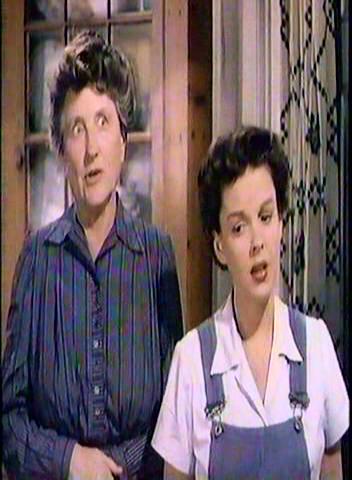
Mary Wickes

Mary Wickes played a series of busybodies, nurses, and nuns, with a quintessential no-nonsense comic flare that was as endearing as it was caustic.

Her film career took off when she brought her Broadway role of Nurse Preen in “The Man Who Came to Dinner” to Hollywood for the screen version in 1942, but after “White Christmas” (1954) where her portrayal of the inn’s housekeeper kept the art of screwball comedy alive in the ‘50s, Miss Wickes headed for what must have been greener pastures in television, where her career lasted several more decades, with a few more forays into films like “The Trouble With Angels” (1966) and “The Music Man” (1962).

Late in her life, it’s especially fun to see an old pro play off a new kid when Mary Wickes plays opposite Whoopi Goldberg in “Sister Act” (1992), and how she adds a deft downbeat of silliness to the character of Aunt March in the classic “Little Women” (1994). There is particular poignancy of her last role, where she voiced the crusty but with a heart of gold Laverne the gargoyle in Disney’s animated feature “The Hunchback of Notre Dame” (1996). This last film was released after Miss Wickes’ death.

The layers of sardonic meaning she could add to a simple line were her trademark, but she never became shrewish or unpleasant. She had more class in one pratfall than many other actors could achieve as glamorous stars.

Monday, December 3, 2007

Ten Things I Like about White Christmas (1954)

Ten things I like about White Christmas (1954):

1. Mary Wickes, for her wry delivery and her power smooching of Danny Kaye and Bing Crosby.

2. Barrie Chase as Doris, whose “Mutual, I’m sure” and “I sure wish it would happen to me,” crack me up no matter how many times I hear them. If she had not gone to dance with the likes of Fred Astaire, she could have been a great comedienne.

3. Newspaper headlines. Gotta love a film that shows plot exposition with newspaper headlines.

4. The moment when Dean Jagger is saluted by his men at his surprise party.

5. The Edith Head costumes of 1950s street wear. Notice at the house party for the cast nobody is wearing jeans, sweatpants, or “Hard Rock CafĂ©” T-shirts.

6. The way motifs are repeated and actors re-used. Patrons of the night club in Florida are the cast that later performs in the Vermont in. In one scene in Florida, if you look between where Bing and Danny are sitting, you’ll see Dick Stabile, who later plays the orchestra leader at the Carousel Club in New York. The girl’s “chiseling rat” landlord, played by Sig Ruman, is later the ex-serviceman in Vermont with the German accent, struggling to get his uniform on over his big belly.

7. The inn, a set remodeled from and meant to invoke the old Holiday Inn set. These are perhaps the only two country inns in New England that have an astonishing amount of space for an impromptu floor show the size of a Broadway musical.

8. The train scenes, especially the musical number “Snow” mentioned previously on this blog. I’ve never been on a train where people carried on like that, but I always hope to be someday.

9. The way the camera pans back at the end of the movie as the crowd sings “White Christmas” and the veterans visit each other’s tables. Usually a film ends focused on the principle characters, but here we see what the movie was about and who the movie was for: the survivors of the war lucky enough to be able to go on with their lives. Love the shot of the little girl being lifted into the arms of her daddy.

10. The way the film evokes personal Christmases past, the way you bring out an old heirloom ornament to hang on the tree. It’s a bit old and scruffy, but it wouldn’t be Christmas without it.


Related Products