IMPRISON TRAITOR, PEDOPHILE, AND CONVICTED FELON TRUMP.
Showing posts with label Loretta Young. Show all posts

Monday, April 28, 2025

Employees' Entrance (1933)


Employees’ Entrance
(1933) is a study of cutthroat capitalism and the depravity that can sometimes exude from a ruthless employer.  If the Great Depression was no time to be out of a job, it could also be a stressful time to actually have one. So many hoops to jump through for the boss, and not one of them safe.


The boss is Warren William, who we last saw as the villainous employer in Skyscraper Souls (1932) here, made the previous year.  The two roles are not exactly the same, however, Mr. William might be headed for typecasting by this point.  In Employee’s Entrance, he is the manager of a large New York City department store, and his character, despite the vigor of his scenes, is less interesting than in the previous movie.  The banker of Skyscraper Souls was smooth, seductive, and devious in a psychological way.  In Employee’s Entrance, the department store manager is just a mean guy.  He takes delight in pushing up the sales numbers any way he can, including removing the deadwood in the office by firing longtime employees at whim.  His sexual pursuit of female employees is more a game of conquest than desire—he dislikes women and distrusts them.


Movies that take place in department stores are always fun, they give us a world unto themselves, a world that, in large measure, no longer exists in many towns.  But this story presents the store with less a sense of showcasing the marvel of American commerce and more a sense of dread for the corruption we do not see when we shop.


The movie begins with a montage of sales figures, always climbing through the 1920s, that decade of wonderful nonsense and consumerism, under the helm of Warren William’s successful regime, but then falling during the early years of the 1930s.  It is now 1933 and we are at rock bottom, and he has to work hard to pull a rabbit out of a hat.  We don’t feel sorry for him; he feels no compassion for his workers.  He tells his board of directors, who dislike him and want to replace him, that “There’s no room for sympathy,” and that to be successful, one must, “smash or be smashed.”


He does that immediately with a vendor, a manufacturer of menswear played by Frank Reicher.  Mr. Reicher tells him the order for coats will be delayed because he is having labor issues, but Warren William walks all over him, canceling the order to punish him. It will ruin Mr. Reicher and put him out of business.


Later on, Mr. William will toss out longtime employee Charles Sellon, a man who, probably like the actor, is in his mid-60s and will not be able to find employment anywhere else.  He will leap to his death from store’s fifth floor.  Waren William will remark, “When a man outlives his usefulness, he ought to jump out of a window.”

Another older employee getting the ax is Edward McWade, whom you may remember as Joe the linotype operator who gets the ax, along with most of the newspaper staff, in Meet John Doe (1941). There’s something more unbearably tragic about an older worker left without any hope of self-support, and it is this reason that Social Security was established by President Franklin D. Roosevelt in 1935.  The first recipient was sent a check in 1940, for $22.54, which was enough to rent a cheap room for a month.  Mr. McWade and Mr. Sellon, in the movie, were seven years away from any such benefit, and with little hope of finding a job when there were so many younger people, unless they had family to take care of them or a local or state almshouse had a cot for them, would be living under bridges until they died.


Ruth Donnelly plays Warren William’s secretary, who always enters with a stricken expression as if embarrassed and horrified at the behavior of her boss, and seems particularly sorrowful at the firing of Mr. Sellon.  She knows the cruel odds.  Miss Donnelly had been in films since the silents of the ‘teens, and had no such worries about work herself in the Depression.  A dependable character actress, she appeared in 15 films and shorts just in 1933 alone.


We have Alice White in a flashy role as hard-bitten yet kittenish Polly, a woman who works in the store and has been trying for some time to turn Warren William into her sugar daddy, but Warren is too smart for her.  He brutishly puts her down, and directs her, quite seriously, to turn her attentions to the ineffectual and somewhat befuddled member of the board left in charge in the owner’s absence to monitor Warren William’s cutthroat operation.  He wants Miss White to divert the old gent to get him out of his hair, she, getting well paid for this mission, turns her little girl flirtations onto Albert Gran, who is reticent at first as if he doesn’t know what to do with her, but then succumbs to her charms.  Scene-stealing Alice is a delight to watch.  The Depression-era tune, “Million Dollar Baby” is heard in the background.


One employee that Warren William can count on is our favorite, Wallace Ford, who also had a minor role in Skyscraper Souls.  Here his role is much larger as the up-and-coming assistant who comes up with clever marketing ideas.  He is given an office next to Warren William, and his fortunes are looking up.

We don’t know if Wallace Ford would, in the course of his burgeoning career, turn into another Warren William.  He may be headed that way, if not for a young woman who’s looking for a job.


Enter Loretta Young.  Warren William, inspecting his store, discovers Miss Young spending the night like a squatter in the store’s “model home.”  She does not know Mr. William is the big boss when she flippantly invites him to her “home” and confesses she has sneaked in to camp out and apply for a job in the morning.  He seems interested in her, amused at her ingenuity, much as he seemed interested in Wallace Ford for his marketing ideas, and knowing she has not eaten, invites her to dine.

Warren William has his way with her, gives her a job as a model in the women’s clothing department, and apparently has no further interest.  As he tells Wallace Ford, “This is no job for a married man,” and “Love ‘em and leave ‘em.”


But Wallace Ford meets Loretta Young and they date in secret, and then marry in secret.

Frank Reicher, the menswear manufacturer whom Warren William ruined is back, working in the store’s shipping department, but he is not bowed.  He openly hates Warren and is learning to be hard and ruthless, which impresses Mr. William, who hands him a $5,000 check to start his own business to partner with him, but Mr. Reicher rips it up in his face.  Spite is preferable to any business dealings with Warren William.

Interestingly, a stock of new toys crosses Mr. William’s desk and he examines them, noting that the “made in Germany” stickers might not sell well and he suggests putting on “made in Japan” instead.  “They’ll sell better.”  While it’s true Germany had moved over to the dark side in 1933, Japan’s imperialist machinations were not yet bold enough for Warren William to predict the future.


The climax of the story hits during an annual employees’’ welfare association ball held in the store after closing.  Warren William has no interest in partying with employees or their welfare, but he notes Loretta Young, a little tipsy after a fight with her husband, Wallace Ford, and helps her to get drunk, encourages her to go to his apartment in an upper floor and lie down.  Stupidly, she does.  He follows, and rapes her.

We do not see the crime, of course, but it is implicit since she has stated she hates him after her first encounter with him (which she never told Wallace Ford about), and she is in no condition to consent, and we already know he is not one for charm, only taking what he wants.

Wallace Ford has had too much to drink at the party as well, and wakes up literally under a table the next day, feeling terrible about his fight with his wife and wanting to make up with her. 

She leaves him a note that she is leaving but does not explain why.  She is shamed.  Warren William wants her to come to him and offers her a promotion, but is blunt that he will not marry her.  He wants a mistress.  She blurts out that she is already married to Wallace Ford.


Cue Warren William to tell Alice White to shift her attentions from Albert Gran to Wallace Ford to get him away from Loretta Young, but Miss White, a good egg, refuses.  He offers her $150 per week, and she turns him down.  Disgruntled, he asks her where she got her principles.

“I saved a couple out of the Crash.”

Great line.  Alice White has moxie. “Why don’t you go keep your nose out of other people’s lives before somebody smacks you down.”

He fires her, but she remarks that Albert Gran will not fire her “not as long as I can play chess.”

Eventually, Wallace Ford will stand up to Warren William, too, though Loretta Young will take poison to attempt suicide.  She’ll recover, and they will start over.

Frank Reicher, meanwhile, after Wallace Ford quits, has become Warren William’s new assistant, but will never kowtow to him.  “If I get the chance, I’m going to break you,” he tells Mr. William.  Success in business seems to be a Faustian endeavor.


The movies of the 1930s seem sometimes astonishingly frank about this, perhaps because the business world let so many people down, but the class war that seems ever on the brink never really materializes beyond guerrilla ridiculing of their betters by the working stiffs.  At least they were working.

   *******************************


My new non-fiction book, CHILDREN'S WARTIME ADVENTURE NOVELS - The Silent Generation's Vicarious Experience of World War II -- is now available in eBook here at Barnes & Noble, Apple, Kobo, and a wide variety of other online shops.

Or here from my Shopify store if you want to buy direct from me and avoid the big companies.

And it is here in eBook, paperback print, and hardcover, from Amazon.

From Cherry Ames, to Meet the Malones, from Dave Dawson to Kitty Carter - Canteen Girl, the Silent Generation spent their childhood immersed in geopolitical events through the prism of their middle grade and young adult books.  From the home front to the battlefield, these books are a window on their world, and influenced their hard-working, conformity-loving generation.


Friday, December 18, 2020

The Stranger - 1946


The Stranger (1946) is a film not so much about the battle of good versus evil as much as it is the inner battle the conscience wages to justify evil.  It was a movie of its time, but in this respect has just as much relevance today.

As we end this bizarre and improbable year, I’ve chosen a couple of off-beat seasonal movies instead of the usual holiday fare, to surrender to the curious and unsettling atmosphere this year, and throw even a few more shadows for good measure.  Next week, we’ll discuss The Curse of the Cat People (1944).  We get a Christmas carol, at least, in that one.

Long post ahead.  Have someone read it to you while you string popcorn for the tree.


The Stranger
is not exactly a holiday film, though it does take place in what appears to be late autumn/early winter in a New England town.  I’ve always thought of it as taking place between Thanksgiving and Christmas, perhaps that torpid state just after the tryptophan wears off and before the hectic shopping begins.  In this quiet netherworld between giving thanks and being relentlessly reminded through songs, holiday cards, and popular programs with contrived Christmas themes that there should be peace on earth but there isn’t, a Nazi hunter travels to a small town to settle some unfinished business.

That, in itself, is a remarkable plot device for a nation weary of war, as we were in 1946, wanting to move on, many not wanting to be reminded of ghastly and unfathomable atrocities – and still others, not choosing to believe them.  This was the first feature film to show clips of official government footage of what became known as The Holocaust.  Film critics and fans have argued for decades whether this is Orson Welles’ worst film or one of his best, but that inclusion of this horrific documentation alone, I think, merits this film as a crowning achievement.  Welles’ celebrated creativity could be freewheeling, but he was also a man whose brashness sometimes took the form of frank courage when it came to the larger themes of life, such as: when is an atrocity not merely an inconvenience?  We discussed his radio commentary on race discrimination and a particular savage event in this previous post.

If his direction, not to say his acting, seems harnessed in this production famed for his being forced by the studio to bring it in on time and under budget, with an editor who slashed out several scenes that apparently would have revealed some character development, the movie nevertheless is appealing for what it does show in its very leanness.  There are a few scenes I would have liked to have been more developed, a back story explored here and there, but for the most part, I just enjoy watching the plodding search of the Nazi hunter for the war criminal in hiding. 


Edward G. Robinson plays the Nazi hunter, good-humored, pleasant, pensive, methodical -- a less crusty character than his insurance investigator in Double Indemnity (1944), but just as persistent.  From the opening moments of the film, we see Mr. Robinson is about to tail a Nazi official who is being allowed to leave his post-war incarceration by American authorities in Europe on the chance he may unwittingly lead them to bigger fish, a more important Nazi official who has escaped capture.  No one knows what the big shot Nazi looks like because he never allowed photographs to be taken of himself, they don’t know his new assumed name, or where he is.  All that is known about him is that he has a passion for clocks.


Konstantin Shayne plays the underling, the dupe Mr. Robinson will follow to get to his real quarry.  Shayne is nervous, pushy, and a self-proclaimed religious convert whose blind fanaticism causes him to search devotedly for the whereabouts of his superior all the way to America, where he finds him and instructs him to pray with him and find salvation.  There is no repentance, however, in this man’s religious fervor; only an obsessive-compulsive switch from one fanatical loyalty to Hitler’s regime to a new zeal for a heavenly Master who will presumably reward him with the blessings of superiority that the Third Reich reneged on. 

Close on Mr. Shayne’s heels is Edward G. Robinson, who lost him when Shayne, realizing he was being followed, lured Robinson into a school gymnasium and conked him on the head with gym equipment.  A sign, with black humor, warns us, “Anyone using apparatus in this gym does so at their own risk.”


The gym is part of a private boys’ school, and the town where Robinson has followed Shayne is the fictional Harper, Connecticut.  It is really an ingenious, deceptively simple movie set, and through inventive camera angles looking out at the common through shop windows, it feels very much like a real New England town.  It has a soul, like a character in the movie, a setting that is not a backdrop but a metaphor for American ideals and innocence. 


Most of the action takes place around the common, which is bordered by shops, including a small general store, administration buildings and dorms that are part of the school, and a church with a tall clock tower that is the town’s most impressive feature.  Though the clock tells accurate time, the works include automatons that are supposed to mechanically emerge from the tower when the clock strikes on the hour, medieval figures with swords, but that feature has been broken for many years and so the figures are still and the clock is silent. 


The use of automatons in the clock works seems incongruous for a New England town, particularly in what appears to be a Congregational-style church.  It seems too European, and I don’t personally know of any such clocks in New England, but I’d love to know if there are any. European architectural influences are more commonly to be found in New England’s Gothic Catholic churches, but the steeples are generally not turned into cuckoo clocks.

Still, if its incongruous, it’s another in a string of oddball aspects to wonder about in this place of scattered and decaying fall leaves, a cold breeze shaking bare branches, and wisps of snow flurries as a harbinger of a storm that seems always on its way but hasn’t quite arrived.

Since Edward G. Robinson has lain unconscious on the gym floor, he has missed some of the plot exposition we’ve observed.  By the time he wakes up and makes his way over to the general store for a bottle of aspirin, he’s lost the guy he was tailing.  He doesn’t know that man has just been murdered – strangled to death by the big shot Nazi official for whom Robinson was really searching, the man he hoped Konstantin Shayne would lead him to.  His trail has gone cold.


But we know that the big shot Nazi is here in this little town, employed as a professor in the boys’ academy, and is about to marry the daughter of the town’s most prestigious person – a Supreme Court justice – to give him further cover.  The daughter is played by Loretta Young.  The big shot Nazi hiding in the plain sight under an assumed name is played by Orson Welles.

The three stars are a triangle in this movie; not a romantic triangle but one of friction, a battle of ideals and loyalties, with a curious co-dependence. 

The minor characters form, as often happens in an Orson Welles film, an ensemble company and this may reflect on Welles’ years in theatre and on radio, notably his Mercury Theater players, which as a unit came to Hollywood before they shot off like an Air Force squadron whose planes, with astounding precision, leave the formation and go off on trajectories apart from each other.  One member of that troupe was Agnes Moorehead, whom Welles had considered casting in the Edward G. Robinson role in The Stranger, but apparently the studio did not want a woman for the part.  Unfortunate, particularly as it would have been interesting to see a dedicated, cerebral woman driven to doing her job as a guardian of democracy trying to make the starry-eyed Loretta Young face some hard facts about her new husband.  Someone who might have treated Loretta Young less delicately than the gentlemanly Robinson.


The supporting cast here are not quite the deep bench that Welles’ had behind him in the Mercury Players, but it’s to his credit that he trusts them enough to give them a lot of freedom.  Billy House plays the owner of the general store, as well as the town clerk, Mr. Potter.  He’s a jovial checkers shark who engages anybody in a game for money, and never appears to leave his chair if he can help it.  He steals scenes while both Robinson and Welles, amused or startled perhaps, seem to be unable to do anything about it.


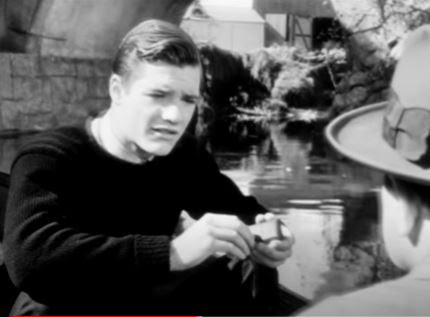
The young doctor in town is played by Byron Keith in his very first movie.   Richard Long plays Loretta Young’s brother, who attends the boys’ academy, and it is only his second film.  He is quite good and very likeable as a quiet young man who enjoys fishing and the outdoors, and seems to make it a code of honor to mind his own business with a refreshing refusal to be judgmental.  But there is a wariness, and sense of being ill at ease with his family situation.  His professor at school is now his brother-in-law.  It takes Edward G. Robinson to point out to Richard Long that Richard does not really like his brother-in-law.  Though Long uncomfortably denies this, he will later help Robinson to trap Welles.


Martha Wentworth plays the housekeeper, and though she did uncredited bit roles, or cartoon voices, and later would appear in television, she did not have a strong career in movies – yet she takes a pivotal scene and really goes to town with it.  Miss Wentworth pops in and out in the early parts of the movie barely noticeable, one might say like a good servant.  But near the end of the film, Edward G. Robinson enlists her help.   Loretta Young is in danger of being murdered by Orson Welles to keep her quiet when she begins to crack in the face of too many of her husband’s dirty secrets and suspicious behavior.  Martha Wentworth must stall Loretta and keep her from meeting Welles at the church clock tower.  Miss Young is impatient to leave, but Wentworth keeps up relentless prattle to distract her.  Loretta gets as far as the door, and Martha bursts into tears (the housekeeper must have had a past life on the stage) and picks a fight with Loretta, accusing her of not wanting her around anymore and which forces Loretta to stay and comfort her. 


Then when Loretta, with dogged persistence, heads for the door again, Martha, a middle-aged woman of no apparent athletic prowess, throws herself on the floor and fakes a heart attack.  It’s a tour de force performance.  These are the kinds of actors Welles populates his films with, and that he gives them free reign to shine is pretty great.


Playing Loretta’s father, the Supreme Court justice, is Philip Merivale, the only one of the supporting cast who really had a long and distinguished acting career, mostly in theatre.  Unlike the newbies, this would be is second to last movie, as he died the year this film was released, 1946, at 60 years old of a heart ailment.  His other theatrical claim to fame is he was married to the magnificent Gladys Cooper.

Though Director Welles may have been canny in shining the spotlight on the supporting players, there are gaps in the motivations for this offbeat lot which really affects what is, after all, a very psychological film.  There are questions that are not answered and they probably should be, because why introduce a thought that the audience will cling to, and not show them the answers?  With his experience in theatre, Welles surely knew the old maxim that if you have a telephone on your set, it had better ring or someone had better talk on it during the course of the play.  If it is left untouched, there only for set dressing, the audience is going to be riveted on that silent phone and pay little attention to the rest of your play.

Doors must be walked in and out of.  Furniture must be sat upon.  The telephone must be used.

Some questions I had:  Why does Loretta Young always call her father by his first name, Adam, and not Father or Dad, or Papa?  Her brother, Richard Long, doesn’t do that.  Why does her father always call Loretta “Sister,” instead of her name, or “Daughter”?  Maybe there was an explanatory scene that got cut.

We have no back story on Loretta, how she met Orson Welles and how he wooed her.  We might assume that she might have been given an excellent university education, or at least a finishing school, yet she appears to have no profession.  She is arranging curtains in the house she will share with Orson Welles on the very day of her wedding.  Was it her husband’s home?  Was the house a wedding gift from her father? 

Most importantly of all, why does she allow her husband to assume so much authority over her, even to making decisions about where her dog is going to sleep (he eventually kills the animal)?  For a Yankee daughter of a Supreme Court justice, we might expect her to have more backbone and independence, if not more sense.  Even the devotion for her husband that a bride in love would feel is not quite a reasonable explanation for her appeasing him – there is too much tension between them, she has caught him in suspicious behavior and lies.  But instead of stopping and thinking to herself, what is this sort of man I married, she adamantly buries her apprehension in stubborn support for him.  Loretta is something of a metaphor for people who do not want to know the truth because it challenges their own self image and everything they want to believe.


Another question left unanswered is why Orson Welles chose this very small town to settle in.  We know he has a mania for clocks and the clock tower in this town is very unusual, so perhaps he’d heard of it and that was the attraction.  He does make the interesting comment to Konstantin Shayne, a brag really, that he is about to marry the daughter of “a famous Liberal.”  The glee of “owning” Liberals by resentful fascists is nothing new.


Robinson’s only clue that Welles could be the Nazi he’s searching for is when Welles, during a dinner party where political discussion strays to questions of German philosophy, Richard Long quotes Karl Marx as an example, but Welles, nonchalantly and unthinkingly dismisses that example by replying that Karl Marx wasn’t a German; he was a Jew, so he doesn’t count.


Later that night, Robinson wakes from a sound sleep with the startling realization: only an anti-semitic person would think a German Jew was not a real German.  He puts this germ of an idea together with the fact Orson Welles is repairing the old clock in his spare time, and decides that this could be his man.  A few more incidents solidify the suspicion.  Then it becomes a matter of getting enough evidence.  He now enlists Orson Welles’ new in-laws.


When Edward G. Robinson, quietly sitting in a rowboat with Richard Long, trying to broach the subject of Orson Welles being a famous hunted Nazi, finally alludes to his sister being in danger and announces, “I know you’re man enough for what I’m going to ask you to do for me,” it’s almost as if Robinson is transforming into a father figure to Long.  He will spend the rest of the movie sharing his Nazi hunter’s work with young Richard, guiding him on what to do, and making expectations of him.  Richard seems a self-sufficient young man, and perhaps that is because his father, a man who though sometimes goes fishing with him, is nevertheless an emotionally remote intellectual, undoubtedly consumed by his lifetime appointment to the Supreme Court. 

Orson Welles, joining the family as his new brother-in-law, might give him comradery with an older, wiser male, but he, too, is an emotionally remote intellectual.  He’s also a Nazi. 

But the scene where Robinson talks to Richard Long in the rowboat is awkwardly cut off.  He is about to tell him all about Orson Welles’ nefarious past, but then the scene fades and resumes again when they are getting out of the boat, Robinson already having told Long the news.  This is wasting what could be a terrific dramatic moment, dropping the bomb on Richard, but we never get to see it. 

Likewise, we do not get to see Robinson explain the vile news about his son-in-law to Philip Merivale.  We are only given a scene where Merivale has already been told, and together, they show Loretta Young the film of the Nazi atrocities.  Perhaps there was a decision by Welles and the producer to save the dramatic moment for Loretta Young to be the one to have the bomb dropped on her and register her shock.


Her reaction, though certainly sickened by what she is seeing, is to remain frozen in denial that her husband could be such a villain.  For the rest of the film, Loretta will either be psychologically devastated by that thought, which for self-preservation she keeps suppressing—or her husband is going to kill her to save himself.


Orson Welles’ role in the movie is not an easy one.  Most actors love to play villains, but perhaps because of Hollywood’s stereotypical treatment of Nazis during the war years, the audience may be inclined to see these characters as one dimensional.  Welles must win his audience over to the idea that unlike the character played by Konstantin Shayne, prone to cartoonish fanaticism, evil can be calculating and charming, and a villain’s greatest need can be to simply justify his evil.

Loretta Young, feeling defensive, must justify her love for her husband by denying his is a Nazi.  As the movie runs to its climax, it becomes a chase not only for clues to build a case against Welles, but to save Loretta’s life.  Welles grows rattled when he realizes he is under suspicion.  Everybody but Robinson is a nervous wreck.


A final showdown in the clock tower – where Welles has triumphantly fixed the mechanism and the automata now move and rotate on the hour – Loretta finally accepts the awful truth and faces down her husband.  The three of them, Welles, Young, and Robinson, the triangle, fight over a pistol.  Welles’ fearfully gives the customary defense of a Nazi, “I followed orders…I only did my duty.”


While there is some satisfaction in seeing Loretta Young not only stand up to her husband but take some responsibility for stopping his ability to spread more evil – she grabs the pistol and shoots him – there is the inevitable Hollywood solution to have him die in a dramatic fall after he is impaled on the sword of one of the medieval mechanical figures. 

Though it is not as dramatic, it would be a more civic-minded move for Hollywood to show such monsters brought to justice through the courts.  Our laws are our sword and our shield in this country.  Fascism was destroyed in post-war Germany not just because the Allied armies were victorious, but because they forced the conquered citizenry to walk through the concentration camps, to accept the horror that they abetted, and to accept responsibility, to acknowledge that neighboring countries reviled them for allowing themselves to be duped and to be complicit.  Democratic law was instituted and they were expected to conform.  Germany crawled out from the shadow of those terrible years through education and courageous soul-searching.  


We don’t know if the citizens of Harper, gazing at the lurid picture of the professor lying in a heap on the steps of their church, will feel shock or disgust to have made this creature welcome in their town.  We look down from the clock tower’s height to see the townspeople below clustered like the Whos down in Whoville on a cold and snowy winter’s night. The movie ends with a quip from Edward G. Robinson, waiting to be rescued from the tower, calmly lighting his pipe, his signature prop through the movie. 

It may not be a Christmas movie, really, but there is a smattering of redemption that we don’t usually see in film noir.

*****************

Jacqueline T. Lynch is the author of Ann Blyth: Actress. Singer. Star. and Memories in Our Time - Hollywood Mirrors and Mimics the Twentieth Century. Her newspaper column on classic films, Silver Screen, Golden Memories is syndicated nationally.  Her new book, a collection of posts from this blog - Hollywood Fights Fascism - is available here on Amazon.

Thursday, February 25, 2016

Loretta Young and The NEW Loretta Young Show - 1962-63


Today we’re going to talk about a TV show and its star.  The New Loretta Young Show (aka Christine’s Children) ran a single season, 1962-63.  It is a striking example of Loretta Young’s abilities both as an actress and as the CEO of her personal brand.  Few have displayed such a canny mastery in the managing of one’s career.

Reinventing oneself is probably one of the greatest assets to a long career and one of the most difficult to achieve. In the acting profession, where reputation is based on roles already played, it is especially confounding. Loretta Young’s career is remarkable. Longevity is only a part of her unique place in Hollywood.  This woman of sizzling Pre-Code films, polished 1930s dramas, an Oscar® for a comedy, and a long-running television anthology show, The Loretta Young Show, in the 1950s, was able to effectively change with the style of the current era and for what was suitable for her as she aged.

The New Loretta Young Show is unlike any other 1960s era family sitcom.  It is imaginative, gutsy, intense, and most refreshingly absent of trite templates of sitcoms before and since.  It is, most especially, a tribute to Loretta Young as an actress and a businesswoman in an industry famous for tossing out female stars once they hit a certain age.

Though I was familiar with her first series that ran for eight years from 1953 to 1961, I knew nothing about this second series until Kay Noske of Movie Star Makeover posted her impressions of the show and interviewed one of its cast members, Beverly Washburn, in May 2015. That interview is here.


Beverly Washburn, whom we’ve mentioned from time to time in her various childhood roles, including here in Here Comes the Groom (1951) and Old Yeller (1957), is one of my favorite child actresses.  In The New Loretta Young Show, she plays the 15-year-old daughter of Loretta Young.  Loretta plays a widow with seven children.  Celia Kaye plays college student Marnie, twins Dirk and Dack Rambo play her 17-year old sons Peter and Paul, Carol Sydes plays the hyperkinetic Binkie, then Beverly Washburn as the sensitive, intellectual and shy Vickie; followed by Sandy Descher as 13 year-old Judy, and little Tracy Stratford as the youngest, six-year-old Maria.

I was, frankly, astounded by the show’s excellence – in terms of bold story ideas, scripts, acting, and directing.  Much of it looks like film cinematography – not the usual two-camera setup of sitcoms of the period.  In style and theme, many episodes really packed a punch.

The pilot episode – innovatively funny – introduces the cast and show by way of a live TV interview program such as was popular in that era with Edward R. Murrow’s See It Now and Charles Collingwood's Person to Person.  The living room is a mass of chaos with cameramen and this family standing in each other’s way, not knowing what to do, giving the most funny, off beat answers, looking for all like reality television.  Someone’s head in profile pops up in front of the camera, getting in the way.  The old town mayor, a feisty ancient Yankee, keeps getting his rehearsed speech interrupted.  From the start, Beverly Washburn stands out in a funny double take when the harried announcer, played by Ted Knight (later famous for playing anchorman Ted Baxter on The Mary Tyler Moore Show) calls her name and she jerks her body with shock, as if wishing the floor would open up and swallow her.  She effectively, and without a word, establishes her character in only a moment. 

Here Loretta Young sets up the show by explaining her attitude toward her children and her role as a mother.  She does not believe in togetherness, which shocks and agitates the announcer, but rather she promotes individuality, confessing that her family do not always like each other.  It’s a breath of fresh air.

Throughout the series, an episode or two will focus on one of the children, but always in relation to how the other family members fit in with that character’s life.  As a twin myself, I can state that I like the depiction of the twin sons and their obvious bond with each other as blessedly positive.  The Rambo boys, and some of the other kids who were new to acting, are used very intelligently, according to their abilities and bringing them along carefully in the series.  It must have been a great learning environment for them.

Some of their experiences are harrowing.

The littlest one, Maria, wisely used sparingly, avoiding clichéd cuteness, has a strong episode towards the end of the season when she is nearly kidnapped in a bizarre and tense episode when a psychotic stranger enters the house, thinking the little girl is his deceased daughter, whose death he never accepted.  A nail biting episode.  What makes it especially poignant is that when this man tells her he is her father, she is enchanted, because her father died before she could form any memory of him.  She is the only one of the kids who cannot remember her father.

Another episode where Beverly Washburn, (unlike some of the other kids, a veteran actress of many years) wanting life experience as a budding writer, detours from her New York City trip to the eye doctor to investigate Greenwich Village and a beatnik coffee house.  But what we might expect to be a funny episode full of humorous oddballs turns quickly sinister as she is unwittingly involved in a drug deal, and is arrested for passing marijuana.  She spends the night in jail with a couple of hard customers not very much older than she, living desperate lives.  One is a streetwalker—not the kind with the funny quip and the heart of gold, but a tough young girl who makes no disguise of her trade and throws it in Beverly’s face. 

Drugs and prostitution on an early 1960s sitcom?  This show is unique not only for its subject matter for a situation comedy, but for the intelligent, sensitive, and classy way it tackles these subjects and these characters.  The topics are not tackled for shock appeal, but as real-life news encroaching upon this suburban family.

Most especially classy, forthright, and intriguing is how Loretta pursues not only a writing career, but a romance with a New York magazine publisher.


Their relationship is developed slowly, leaving no room for the audience to take them for granted, to assume where it’s going.  We really don’t know.  He could be written out next week.  He has to get used to the kids.  They have to get used to him.   But mostly, it's about the relationship between him and Loretta and their adult romance.  Toward the end of the series, his ulcer, due to stress from his job – a plot device introduced in the first few episodes  – ruptures.  Loretta finds him on the floor, passed out, blood dripping from his mouth. He is rushed to the hospital, and she pretends to be his wife so she can be at his bedside.  The doctors wink at it.  He is in critical condition and suffers a kind of stroke so that his speech is impaired.  She knows he has finally come out his coma because there are tears in his eyes, he is crying.  We see his agony and hers.  She takes him home after his release from the hospital to care for him, scandalizing the neighbors.

This is new for a sitcom.

She smokes.  She drinks.  After a particularly bad day, she confesses to her gentleman friend of not liking her children at that moment, ready to scream if they call, “Mom!” one more time.  Their romance is sensual.  They kiss, not a chaste peck on the cheek, but deeply and passionately.  They cuddle and they ache to be alone, and they leave the kids to fend for themselves more than once to accomplish this. Loretta can barely keep her hands off him.

A 1960s sitcom.  You won’t see this on Donna Reed or Leave It to Beaver, none of the shows whose living rooms we came to know as well as our own.

But the 1960s is the real-life background.  There are references to the space race, and they mention it is 1962.  The littlest girl announces she is Caroline Kennedy, at the latest in her game of changing her name.  Loretta spoofs Mrs. Kennedy’s White House Tour television special in the pilot.  It’s a period full of optimism and energy, and we can see it in this show.

Usually on sitcoms of the era, even today, we see a cast positioned precisely around a set the way a little kid might place dolls in a dollhouse – carefully, consciously, serving a purpose to the plot.  The New Loretta Young Show has a casual feel, the characters are randomly everywhere, though this is obviously skillfully orchestrated.  It’s only meant to look casual.  We see her and the kids in the kitchen one chaotic morning, then the camera pulls back and we see what we did not expect – her love, Paul Belzer, the gruff, man’s man editor, sitting off in the distance in the living room, reading the newspaper by himself.  The shot tells us he has spent the night.  He is not quite part of the family yet (though he sleeps in the boys’ room when he stays overnight), and we wonder how they will bridge the gap between them.  I really like James Philbrook in this role.  He is as strong and interesting an individual as she is.

And I like his young assistant at the magazine, played by Allen Emerson, his hard New York accent, with his goatee, very 1962, like Peter Yarrow and Paul Stookey of Peter, Paul and Mary.  He is the image of urban and hip, but with the hint of stickball in his speech.

Another surprising episode where she invites her love’s boss to dinner could have ended up the typical 1950s-60s blustering boss charmed by a home-cooked meal routine.  Instead, it’s a riveting drama where the big cheese, played by Leif Erikson, is an ass, so overbearing and mean, that his longsuffering wife has become an alcoholic.  Loretta, displaying compassion for her, sneaks vodka to her to steady herself under the evening’s onslaught of dinner conversation.  The boss is bullying to Paul, and their combative relationship will continue for many episodes, reaching a crisis point toward the end of the season.  Loretta mouths off to the boss, putting Paul’s job on the line.  There is no happy resolution. The evening ends with bitterness.  It’s actually unpleasant listening to this blowhard trample over everybody in the dining room.  One marvels at the emotional intensity for the viewer, who cannot help but be engaged in this train wreck of a dinner party.

Another, much softer, example of quite unexpected realism in the show is the way Beverly Washburn, after a discussion with her mother as the camera follows them through the hallway, gets ready for bed and casually kneels before it, making the sign of the cross.  Her sister in the next bed, already half asleep, stirs, emits an inelegant muffled grunt, and rolls over.  The prayer is not the focus of the scene, she’s not praying for anything special.  It’s just nighttime and she’s got curlers in her hair, and it’s just what she does. 

I have to say, as a Catholic, I was blown away by that.  Usually prayer in movies and TV shows is reserved for crisis, and is played up as a melodramatic moment.  Usually, Catholics are depicted as jovial priests or ditsy nuns.  The quiet, pleasant normality of this scene is charming.  (I can remember a documentary about The Nat King Cole Show, and an African American woman, recalling the moment decades later in a TV interview, said she called up her friends with the alarm, “Hey!  There’s a Negro on TV!”  I actually hollered, to myself, when I saw the scene, “A Catholic on TV!”  And not a caricature of one.)

Later in the season, we see a snippet of a Catholic wedding ceremony held in an actual Catholic church—though obviously not a High Mass.  Even many Catholics flicking the TV dial might not sit still for that.

Also of note, in the very first episode when Loretta is being interviewed by Ted Knight, he asks about the piano in the room and wants to know who plays it.  Dumbfounded, she answers nobody.  (As if to say, "Why would anybody want to play a piano?  It's not to play, it's just to have.") It is a comic moment, but then we perceive that perhaps her late husband played the piano. She speaks lovingly of him, of a piece of furniture he made, and of his work as a writer.  Much later in the series, we see her new love, Paul Belzer, sit casually at the piano and begin to play it, as if it has been waiting for him all this time.  A wonderful, subtle image of a man coming into a family that will be his, that he has a place here, that he is successfully taking the place of another.  The continuity between the episodes is very skillfully done.


Loretta also has a terrifically natural way of interacting with the kids.  She grabs them, tickles them, kisses their faces, their necks, touches them while speaking to them.  Running her hand through their hair. They flop on her on the couch, and hang on her. They appear to have a comfortable physical relationship with her.  It all looks quite real.  She nags at one girl for constantly talking too fast and mumbling her words. The girl rolls her eyes at her mother, sighing, slumping, and fidgeting, forgetting what she was about to say.  Loretta throws water in her son’s face to wake him up in the wee hours. She does not mince words when they mess up, but she is always supportive.  When she has a meltdown over her romance, she cries in bed and her oldest daughter—who transforms from college kid to new woman friend—cuddles her and comforts her in a fascinating role reversal.

Loretta is also generous as a star, focusing the camera and the attention on her young cast mates when they are in a pivotal scene. In one episode where Beverly Washburn dissolves into tears, Loretta lets her have the scene entirely. She embraces Beverly, but keeps her back to the camera so Beverly can play out her pain in the scene as the more important person in it.  That is generosity, and also shows confidence in herself and in Beverly as a fellow professional.

Loretta Young created this character and supervised every detail of the show including the children who played her kids, the scripts, the costumes, hair and makeup—we must assume director Norman Foster at least took charge of the camera work.  It’s a great accomplishment and a splendid example of an actress of many talents, able and willing to take charge of her career in a way that allowed her to remain producing excellent work when other careers floundered according to the whims of the studio, the public, and the changing times.

Speaking of changing times, I wish this series had lasted longer.  I can only imagine the depth of story angles, the sparks as those kids came of age in the 1960s.  War, civil rights, the generation gap, I know this show would have tackled all of it.  Maybe even the ghastly and tragic assassination that happened some months after the show ended.  Sometimes we hear of something being ahead of its time.  I suppose The New Loretta Young Show was, but it was also a beautiful artifact of its time, and a woman changing and growing with the times—both the character and the intuitive actress playing her. 

In recent years, Loretta Young’s Pre-Code films have gotten long overdue attention, and a lot of raised eyebrows for their sauciness.  I hope this show gets a second look as well.  In its quiet own way, it is equally daring.  It is available on DVD, a four-disc set, including interviews with cast members.

I’d like to thank Kay Noske for blogging about the show last year, or I might never have known about it.  Next week, I’ll be posting an interview with Kay as the third entry in my year-long monthly series on the current state of the classic film fan.  Here’s what we discussed about The New Loretta Young Show:

JTL:  You have called Loretta Young your muse.   One thing I thought I’d bring up is her commanding presence in that show. It speaks a lot to the self-confidence of style.  She seems to project someone who is so totally comfortable in her own skin in a way that is elegant and “old world” and yet rivetingly modern.  There is a great strength and power in her television character that is natural and comfortable.  (Modern female characters, even the strong ones playing cops or doctors or superheroes, are usually riddled with angst.  I suppose a reflection of our times.)

KN:  I have to pause here…you said a MOUTHFUL here, Jacqueline. I’ve never been able to put my finger on why these women do NOT inspire me, but bingo, you nailed it! How can anyone be inspired by angst? Existentialism and I have never been compatible.

JTL:  Though she opens and closes the episodes with a “thought for the day”, a kind of moral to the story, she does not really lecture the kids during the show, which is refreshing.  The family has its adventure, or crisis for the episode, and any lesson the kids, and the audience, takes from it is by her example, how she faces crisis.  She simply is; her dress, her appearance, her behavior, and how she expresses herself.  Someone else’s example is the most compelling incentive we have for change in our own lives, including for self-improvement. 

KN:  EXACTLY! If we can see that someone else did it, so can we. (Unless you’re angst-y, then you assume that no matter how many others did it, you’ll be the pitiful exception to the rule. Groan!). Loretta’s fully in control of her image, her persona, and her expression. She knows what she wants, knows what’s right and knows exactly how she will present it. Since I have a similar iron-clad belief in the power of a single-minded heart, I love her for showing me how it’s done! Her strength comes from an unshakable belief that she’s RIGHT about things, that there is a right and wrong way to live, that mistakes can be corrected, that people are typically GOOD, that God’s in His heaven, and that He is a loving, good force in the lives of everyday people. That’s unstoppable in my book. I love that she uses little quotes to reinforce her position. She was/is a product of her zeitgeist, I think, too, in that she was raised in a world that believed in right and wrong. Today, the arrow simply spins in the compass and signals confusion. For Loretta, her show was a chance to express her faith in what was good and right. That’s what I believe, so, naturally, I love seeing this most elegant, warm, and lovely expression of a powerful, strong, yet utterly feminine woman.  

 ***

Come back Thursday for our visit with Kay Noske of Movie Star Makeover, and our discussion on the current state of the classic film fan, TCM, and how her interest and expertise in image consulting has its roots in classic Hollywood.

*********************


 "Lynch’s book is organized and well-written – and has plenty of amusing observations – but when it comes to describing Blyth’s movies, Lynch’s writing sparkles." - Ruth Kerr, Silver Screenings

"Jacqueline T. Lynch creates a poignant and thoroughly-researched mosaic of memories of a fine, upstanding human being who also happens to be a legendary entertainer." - Deborah Thomas, Java's Journey

"One of the great strengths of Ann Blyth: Actress. Singer. Star. is that Lynch not only gives an excellent overview of Blyth's career -- she offers detailed analyses of each of Blyth's roles -- but she puts them in the context of the larger issues of the day."- Amanda Garrett, Old Hollywood Films

"Jacqueline's book will hopefully cause many more people to take a look at this multitalented woman whose career encompassed just about every possible aspect of 20th Century entertainment." - Laura Grieve, Laura's Miscellaneous Musings

"Jacqueline T. Lynch’s Ann Blyth: Actress. Singer. Star. is an extremely well researched undertaking that is a must for all Blyth fans." - Annette Bochenek, Hometowns to Hollywood


Ann Blyth: Actress. Singer. Star. 

by Jacqueline T. Lynch

The first book on the career of actress Ann Blyth. Multitalented and remarkably versatile, Blyth began on radio as a child, appeared on Broadway at the age of twelve in Lillian Hellman's Watch on the Rhine, and enjoyed a long and diverse career in films, theatre, television, and concerts. A sensitive dramatic actress, the youngest at the time to be nominated for her role in Mildred Pierce (1945), she also displayed a gift for comedy, and was especially endeared to fans for her expressive and exquisite lyric soprano, which was showcased in many film and stage musicals. Still a popular guest at film festivals, lovely Ms. Blyth remains a treasure of the Hollywood's golden age.


The eBook and paperback are available from Amazon and CreateSpace, which is the printer.  You can also order it from my Etsy shop. It is also available at the Broadside Bookshop, 247 Main Street, Northampton, Massachusetts.

If you wish a signed copy, then email me at JacquelineTLynch@gmail.com and I'll get back to you with the details.


**************************

My new syndicated column SILVER SCREEN, GOLDEN YEARS, on classic film is up at Go60  or check with your local paper.

Related Products