IMPRISON TRAITOR, PEDOPHILE, AND CONVICTED FELON TRUMP.
Showing posts with label Anita Page. Show all posts

Thursday, April 10, 2025

Skyscraper Souls (1932)


Skyscraper Souls
(1932) is an example of the ironic sense of fun teased out of terrible times—a hallmark of enduring the Great Depression—and the audacious bemusement over immorality that contributed to the adoption of The Code. 


A rift in the timeline of cinematic history was torn, and movies like Skyscraper Souls were afterward deemed Pre-Code, not merely to suggest they were of a lesser standard but that they were emblematic of an era of don’t-give-a-damn long before Clark Gable was ever given official, one-time-only, permission to utter the phrase.

We were on our way down in 1932, a few years after the 1929 Wall Street Crash, and not yet hit rock bottom, but we could see which way we were headed.  It made many people fearful and others, especially filmmakers, fearless.  The setting is a New York City skyscraper, notably a bit taller than the only other building rivaling its height—the real-life Empire State Building, which was finished the previous year.  


The fictional building is owned by Seacoast Bank, which is owned by Warren William, whose financial buccaneering life is centered on this massive monument to his investment prowess.  His sexual prowess is another thread to the tale.

In this huge building are many businesses, and the several minor roles comprised of fellow financiers and the massive support system to their lives including clerks, secretaries, waiters, and elevator operators, make up the cast of characters.  We don’t get to know all of them well, most are given only a thumbnail sketch, but we know them because for the most part, they are us, the little guys.  Some ride the coattails of the big shots, others are gullible enough to think that emulating them will make themselves big shots, too.  There is comedy in the mix, and tragedy.


The story centers on Maureen O’Sullivan, only two years into her Hollywood career and already this was her 12th movie (she had even made one Tarzan film by this time—and will be forever remembered as Jane).  She plays the secretary to the assistant of Warren William.  The assistant is Verree Teasdale, herself only a few years in Hollywood and her 7th film.  She is intelligent, polished, runs her department with efficient and no-nonsense authority, clearly Mr. William’s trusted right-hand man.  She has a somewhat motherly relationship with Maureen O’Sullivan, whose family she knew, and so she has taken a protective interest in the young woman, alone in the wicked city.  Heaven may protect the working girl, but not if she doesn’t want to be protected, and this is the case with Miss O’Sullivan.


Her boss, Warren William, has designs on her.  First, he must dispense with her self-appointed chaperone, Miss Teasdale.  Verree Teasdale is his current mistress.

By the way, if you’re new to this blog, there are going to be so many spoilers it will make your head spin, so discreetly look away if you don’t want the sordid details and your innocence shattered.


Warren William, tall, so handsome, with sudden surprising dimples and a twinkle in his eyes, reminds one of John Barrymore, but there is even something more suave and impressive.  A charming seducer, unrelenting in the chase, but not so lustful as rather being amused by life, as if it is one big joke.  Eventually, we will see that his charm disguises a deep and arrogant lack of empathy for others, and that winning is everything no matter what it takes.

This is one of the surprises in the movie and of the Pre-Code era, in that a character who is essentially a villain can be so likable.  He is not the only one who shows more than one flaw, and yet we can forgive the flaws because everyone here is human.  We may not, by the end of the movie, wish to associate with any of these people, but cannot be angered or repulsed by them, because they are just people in the rat race.  If the big building is a monument, it is also a trap.


We get our first lesson in flawed character when we see that Warren William, who also has an apartment in the building, shares breakfast with his right-hand…mistress.  Verree Teasdale sits across from him in a negligee, chuckling that she will be late for work and need to make excuses, while Mr. William, in his robe, shares companionable conversation in front of a sheer curtain which does not hide the bed in the background.  The scene is deftly accomplished with a wink and a nod to the audience. 


Warren William is, however, married to Hedda Hopper, who breezes into his office later on for a fill-up on her allowance.  They also have a happy relationship, but it is much more open and honest than the one he has with Verree Teasdale.  Hedda Hopper knows he has relationships with other women and laughs at him, and takes his money, and they part as good friends.  She knows, as she will explain much later in the movie to Miss Teasdale, that Mr. William is not the sort of man who can be tied down, and he will not divorce her because she is his convenient excuse to never get caught in a real marriage.  He can always say his wife will never give him a divorce.

This is what he tells Teasdale, and she accepts the arrangement, until a chance meeting with Hedda Hopper compels her to ask why she will not give Warren a divorce so that she can marry him.  Hedda schools her on the reality of their marriage arrangement, and Teasdale is shocked. 


But there is more gnawing at her.  Warren William has, in the meantime, taken a liking to Maureen O’Sullivan, luring her to his apartment during a party where he (and his silly drunken pal played by George Barbier) plies her with champagne to get her drunk.  A few scenes later, we see she has accepted the post as his new mistress.  This is not a case of an honest girl led astray by love.  She doesn’t particularly love him, but he is charming, fun, and…rich.

It's the Great Depression, Charlie Brown, and everybody in the building is in survival mode.


It’s why she is reticent to marry her new beau, played by Norman Foster, who is a teller in Warren William’s bank on a lower floor.  He is a fast-talking wiseacre with a habit of bumping into people, store displays, and generally bumbling his way through the magnificent Art Deco lobby of the building.  He is pushy in the manner of early 1930s film boyfriends, to the point where we can understand Maureen O’Sullivan’s annoyance with him.  Especially when he does the particularly creepy ploy of calling the security guard to bring her to him so he can find out her name and address under the guise of investigating a theft.  Why she suddenly thinks he’s cute and wants to date him is a mystery to any sensible person, but it is necessary for the plot, so we accept it.  Why she holds out marrying him is largely due to his $50 per week salary (which was actually pretty good), and his $1,800 in the bank.  It’s not enough to live on. Millions of others were living on far less, but they are not Maureen O'Sullivan.

Warren William offers furs, jewels, money, and a trip on his yacht.  She’s raring to go.


We meet one of my favorites, Wallace Ford, as another working stiff in the building, who, in vying for the attention of Helen Coburn, will join a frantic mob at the stockbroker’s office, also conveniently in the building, to attempt to make a killing.  Money is everything, and for these folks, the sure path to love.


But not to Jean Hersholt, a mild-mannered jeweler who is trying to woo Anita Page, a street-wise woman of easy virtue, also desperate for cash.  In the movie’s most touching scene, she confesses to him her sordid past, and he says he knows but does not care, and she is moved and shamefacedly asks for a dollar so she can buy something to eat.  Later, we are told they are on their honeymoon.  There seems to be such need and open honesty between them, that we cannot help but believe they are the only ones in the movie who will succeed in finding contentment.

But even they are touched by scandal when Wallace Ford, who has lost a bundle on the market, sneaks into Jean Hersholt’s open jeweler’s vault but gets caught there when Hersholt, who does not know he’s there, shuts and locks the door.  Helen Coburn knows he’s stuck in there, she was helping to create a diversion so he could sneak in.  She was going to share the loot with him.  In a story of scamps and miscreants, she, a minor character, pulls off the most venial act by walking away and knowingly letting Wallace Ford suffocate in the vault overnight because she does not want to be implicated.  We see her afterward parasitically attaching herself to a new prospective suitor.

It is not the only death.  But we’ll get to that in a minute.

Warren William, pressed by his associates as well as his business rivals, is in danger of losing his bank and his building.  He smoothly cuts out his associates and makes a backdoor deal with George Barbier.  It’s a fun series of shots where they talk business first thing in the morning—to recover from a night of drinking—in the fitness center in the bowels of the building.  They talk furtively in the gymnasium, in the steam room, get massages by rough masseurs, and swim together in a large pool, floating on their backs and finalizing their verbal pact to create a merger.  To really capitalize on their new arrangement, they will launch a stock market scheme that was once called “painting the tape.”  They will send the bank stock soaring, and then dump it, shorting the market.  Warren William’s character actually reminds one of Jesse Livermore, in his piratical market maneuverings and his sexual appetite, but I don’t know if he was patterned on Livermore or only a type.


Later that day, Verree Teasdale, still working on the problem of keeping Warren William away from Maureen O’Sullivan, takes Norman Foster to lunch in the grand restaurant on an upper floor and urges him to continue his relationship with Maureen.  When he complains that she will not marry him because of his lack of wealth, Miss Teasdale gives him the tip about putting his cash into the Seacoast stock.  Thrilled, he rushes down to the broker’s and buys shares.  Wallace Ford observes him, and copies him, doing the same.  Jean Hersholt, normally reticent about stock speculation, also joins in, and a crowd of people clamor at the broker’s to get their Seacoast shares as the stock rises and rises throughout the afternoon.  It is a fury of greed and high hopes for a high life and dreams coming true.

Then the nightmare.  Warren William skillfully pulls out, the stock tumbles, and so do the life savings of many a little guy. "More margin!" is the old familiar cry.  We see Norman Foster sobbing into a handful of tickertape.

The next day, Wallace Ford, left with nothing, dies in Jean Hersholt’s jeweler’s vault he has attempted to rob.

Anita Page confesses her sins to Jean Hersholt, who cares nothing about his stock losses and everything about her.

Maureen O’Sullivan, blithely jumping over to Warren William’s caresses and enormous wealth, increased by the merger and the stock swindle, plans her new life as a pampered mistress.

In Mr. William’s case, it is also out with the old and in with the new.  We see him tell his manager to arrange for a house in New England for Teasdale and to pension her off.  She’s retiring, he says.

When Miss Teasdale becomes aware of her forced “retirement,” especially with Mr. William’s cold explanation, “A man needs youth.  Without it, life is stale, meaningless.”

She tells him to give up Maureen O’Sullivan or she will kill him.  He laughs at her, and she takes the pistol from his desk and shoots him.  Is it out of hurt and jealousy or is she really just protecting Maureen?  Both, I expect.

But he seems not seriously hurt; he is shocked, chuckles, takes the gun from her when she apologizes, and sits in a chair.  When his manager enters, he does perhaps the only unselfish act in his life when he says it was all an accident, that he shot himself when he dropped the gun.  The manager runs to get help, and Mr. William takes his handkerchief and wipes her fingerprints off.

Then he slumps over, collapses to the floor, and dies.
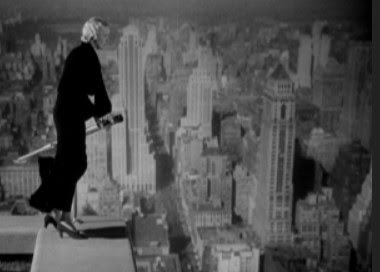

Verree Teasdale, in shock, goes to the roof of his magnificent building, stands precariously on the ledge, and allows herself to fall into oblivion.

In a previous scene, Warren William boasts of the grand accomplishment in life this skyscraper means to him.  “A million men sweated to build it.  I hate to tell you how many men dropped off these girders when it was being built, but it was worth it.”

We have barely enough time to catch our breath when the next scene is many months later, snow is falling softly in the city, and Hedda Hopper breezes by again, happily concluding a deal to sell the building and carry on with her immensely privileged life.


Maureen O’Sullivan chases Norman Foster for a second chance, and after some pouting, he agrees.  His fifty bucks a week salary is good enough now.  They are so shallow, we have a hard time caring about them.  Sometimes the very rich and the very poor have a lot in common if all they value is money.

  *******************************


My new non-fiction book, CHILDREN'S WARTIME ADVENTURE NOVELS - The Silent Generation's Vicarious Experience of World War II -- is now available in eBook here at Barnes & Noble, Apple, Kobo, and a wide variety of other online shops.

Or here from my Shopify store if you want to buy direct from me and avoid the big companies.

And it is here in eBook, paperback print, and hardcover, from Amazon.

From Cherry Ames, to Meet the Malones, from Dave Dawson to Kitty Carter - Canteen Girl, the Silent Generation spent their childhood immersed in geopolitical events through the prism of their middle grade and young adult books.  From the home front to the battlefield, these books are a window on their world, and influenced their hard-working, conformity-loving generation.

Thursday, February 15, 2018

The 1920s - Then and Now series #3 - Our Dancing Daughters (1928) and Our Modern Maidens (1929)


In Our Dancing Daughters (1928) and Our Modern Maidens (1929),  Joan Crawford epitomizes the daring flapper, living only for the moment, the eternal symbol (one of many glitzy symbols) of the 1920s. We continue today with part 3 of our series on the 1920s – Then and Now.

Novelist-turned-Hollywood-writer F. Scott Fitzgerald saw in Joan Crawford the essence of the flapper, as he is noted to have remarked:

Joan Crawford is doubtless the best example of the flapper, the girl you see in smart night clubs, gowned to the apex of sophistication, toying iced glasses with a remote, faintly bitter expression, dancing deliciously, laughing a great deal, with wide, hurt eyes. Young things with a talent for living.

He might have been describing her in these two movies.  Our Dancing Daughters stars Joan as a high-octane flapper or “modern,” her name for the first time above the title.  This movie and Our Modern Maidens are "modern" morality plays of sorts – Joan Crawford is not so much a scandalous woman but a survivor on her own terms in a fast-paced world. There is something brave and admirable about her, despite the implied warning about a life of burning the candle at both ends.

We open on Joan Crawford during a frenetic shimmy as she changes into a party frock for an evening out. Her well-to-do parents, played by Dorothy Cumming and Huntley Gordon, give her free reign, and she adores them. They have a great relationship.


This is immediately contrasted with the less well-off family of a conniving mother and daughter played by Kathlyn Williams and Anita Page. Her mother wants Anita to marry rich and passes on the age-old advice that men want wives who are virtuous – but to get them one must be only virtuous-appearing and yet not so virtuous that one fails to entrap a male and drag him to the altar. This will happen to our hero Johnny Mack Brown, the millionaire’s son.


Life is a whirlwind of parties for Joan and her “crowd.” Dorothy Sebastian plays Beatrice, a friend with a “past” which she loathes to confess to her intended, played by Nils Asther. She eventually does confess, he forgives her, they are happily married, but reminders of her past are thrown in her path every moment, straining her marriage. It is not smooth sailing for those who are not virtuous to begin with, even if their friends and their families give them pass.


I’d have to say my favorite character is played by Edward J. Nugent, who also appears in Our Modern Maidens as a slick-haired callow youth with a smart line, a boyish worthlessness, and a tennis sweater.  He has enormous personality and plays to the camera very well.  I get a kick out of him.


When we first meet Joan getting dressed to go to her party, she goes downstairs – every private home and every public ballroom is dripping with Art Deco ornamentation – she has a companionable drink with her father, and is toasted by three young men all standing at attention in their tuxedos. Each offers her a sip from his glass, and she obliges because she is Diana the famed huntress – not of men, but of life and good times.

When she meets Johnny Mack Brown, she does not immediately throw herself at him but she flirts with him and they develop feelings for each other. Anita Page, however, openly throws herself at him in pseudo-virtuous manner – always insinuating herself in between Joan and Johnny.

Johnny is clearly smitten with Joan, but he is wary about her goodtime girl reputation, and he feels he must uphold the family honor by considering the matter very carefully. In the meantime, on an outing with the fake good girl Anita Page, she traps him, with the help of her conniving mother, into not so much proposing to her as refusing to embarrass her in public by saying, “Hold the phone, I never asked you to marry me.”  He is too much of a gentleman for that.

Joan, of course, is crushed. And she is angry, because she feels that even though she has led life in the fast lane, she has never lied about herself or attempted to trick anybody into marrying her.

She lashes out at Anita Page and her "nasty little mind.” She is disappointed in Johnny Mack Brown but she doesn’t blame him. She understands that one must play by the rules or at least accept the consequences for not doing so. Anita marries Johnny, but they are miserable. She never loved him, she just loves his money and she has grown bored stiff being the wife of the millionaire’s son. She runs around on him.

In a climactic scene at a party, she catches Johnny Mack Brown and Joan having a quiet conversation and accuses them of infidelity.  She has had a little too much to drink. 

At the bottom of a very long staircase are three scrubwomen, and she mocks them in a way that will engender our pity for her. She asks them why they are working, and thinking of her own self-interested mother, “Don’t you have pretty daughters?” She knows she has been prostituted by her mother for a cushy life. Here we see what will be a theme in later decades for movies: The younger generation blaming the elder.

While quite drunk, Anita will fall down the very long set of stairs, landing at the feet of three scrub women in a terribly sad end to her life.


We cut to two years later when Joan returns from Europe and she will marry Johnny Mack Brown. Moral of the story? To thine own self be true. And suffer the consequences.


Our Modern Maidens is not the sequel we might expect, at least not in terms of having the same characters, but there is the continued theme of what’s a flapper to do to find true love?

Here, Joan Crawford is called Billie, and an interesting point of trivia is that she went by the nickname of Billie as a kid, and this is what her first husband, Douglas Fairbanks, Jr., called her. This movie capitalizes on their real-life romance by putting young Doug in the role of her boyfriend.

The movie starts on the night of the prom where Joan is a senior at an exclusive girls' school – again she is the rich, spoiled flapper with the zest for living. Two jalopies careen down the road at night nearly causing a traffic accident, and they pull up and have an impromptu prom on the side of the road, dancing to the music on the car radio. This is a generation besotted with technology, radio and cars in a way that baffled their elders. Our friend Edward J. Nugent is along for the ride in this movie as well, only here he plays Reg. Playing fellows named Freddie or Reg pretty much indicates this is going to be a guy with a hip flask in the pocket of his white flannel tennis pants.

Anita Page is back along for the ride, only this time she’s not the rival nasty girl, she’s Joan’s good friend named Kentucky. She is sweet, innocent, naïve, and as loyal as a hound dog. She also has an unspoken crush on Douglas Fairbanks, Jr., and her infatuation with him is rather heartbreaking.

Just as the title suggests, these young women are “modern." These are modern maidens who crash life like they are crashing a party. On the train, Joan meets Rod La Rocque, who is a wealthy man well connected in government. It seems that upon graduation from college Douglas Fairbanks, Jr. wants to pursue a career in the diplomatic corps. They believe that Rod La Rocque can open doors for them and get him a post in Paris – Paris in the 1920s—this is about the only flirtation we get with the famed expatriates of the decade.

Joan Crawford flirts shamelessly with Rod La Rocque in order to wheedle a position out of him for Doug, and Doug, though he has misgivings, goes along with it.


Anita Page is also seen in many scenes strumming a ukulele. So far we are meeting our quota of 1920s images.


At a party, again in the giant Art Deco ballroom, Joan is the center of attention, dancing herself silly, playing drums, in a whirlwind of jazz. Douglas get the spotlight, too, doing impressions—silent impressions – of John Barrymore and Jack Gilbert and Robin Hood, perhaps a take on his father? Joan disappears for a moment and then returns in a scanty outfit with a wild pattern and performs not just for the crowd but specifically for Rod La Rocque in a dramatic scene.

Douglas knows she’s going over the top for his sake and he feels uncomfortable with it but assuages his discomfort by having a brief fling with Kentucky, who has such a crush on him. He feels like a cad. “I was cad!” The title card tells us.

Meanwhile, Joan gets herself invited to Rod’s hunting lodge, a rustic venue with knives, guns and whips on the walls, guy stuff. Whips? He is in love with her and he agrees to help Doug get a position in Paris because she affirms that Doug is only a friend of hers. However, after the appointment to Paris, Rod La Rocque reads in the newspaper that Doug and Joan are going to be married. Well now, isn’t this awkward.

She tries to apologize for shamelessly using him and leading him on, but he, hurt and angry, sets her up at his hunting lodge for a fate worse than death, and when she shrinks from him, he goads her, “What’s the matter? I thought you were a 'modern'!” Wearing nothing but his bathrobe (clothes got all wet in the rain), she submits to him because she feels she owes him, but he pulls back and she admiringly says, “I knew you were too decent.”


He throws it back in her face. “It’s not decency. I just don’t want you.” It is a great line and she is as shattered as she is relieved, because she is ashamed.


Doug and Joan have an opulent wedding, but Kentucky is clearly upset and not just because she is losing Doug. Finally, Joan gets the truth out of her when Joan discovers a doctor’s appointment card for “Mrs.” Kentucky. This is movie code for Kentucky has gone to a GYN and she is pregnant.

“I didn’t want you to know, Billie!” Kentucky apparently wants to spare both her friends and when Doug enters to collect his bride and go on the honeymoon, he is flummoxed because he didn’t know Kentucky was pregnant after their one fling either. “You poor, brave little kid!” Doug says.  Nobody seems to realize how humiliating this sounds, even in a silent movie. 

Unlike Our Dancing Daughters, where Joan paid the price of losing a lover but then eventually gets him back through the convenient death of the third person in the triangle, this movie takes an interesting turn. Joan simply gives Doug to Kentucky. We’re never told if Doug, who is truly fond of Kentucky, really wants to spend the rest of his life married to her.  Nevertheless, this is what Joan does because she loves both of them, and she skips out and pretends to be a true modern, an uncaring, selfish woman with loose morals and no feelings, parading this persona for the sake of the reporters, of her friends, and her father, who washes his hands of her.

“What you think of a girl going on a honeymoon alone. Modern, isn’t it?” For a moment, our Edward J. Nugent steps out of his callow youth role and attempts to stand up to the crowd with her to give her support, but she kindly and sweetly says she is going alone. She will take no one along the path to perdition with her.

She goes off to Paris, but she is eventually joined by Rod, still reading about her in newspapers.  He still loves her, and she will go back with him to his cottage in the Argentine. 


It doesn’t seem like the “modern” thing to do, but perhaps the 1920s flappers were having second thoughts about the whole flapper thing.  Society might have gotten a little tired of the wild party, too.  A huge hangover was coming at the end of 1929.

The decade was notable for being perhaps the first wave of a future norm where the youth of the country seemed to run the show. Their tastes and their interests were catered to, and created, American pop culture.

Both Joan Crawford and Douglas Fairbanks, Jr., are quite good in this movie, both attractive and able to woo the camera with a glance or a clinch, or, as in Joan’s case, a spirited Charleston, and we can see why Joan Crawford became a star in this role of the flapper. She gets to show a lot of different emotions like selfishness, regret, loyalty, love, shame. She laughs, she cries, she dances.

It’s a silent movie but there are sounds added to the track in which we hear the buzz of a crowd, a radio announcement. There is no dialogue except for what we see on the title cards, but there is incidental background noise, a way to ease us into sound pictures. Our Dancing Daughters made her a star. It has been reported that she climbed out of the lesser roles in Hollywood by making the producers notice her when she moonlighted in dance contests.  She “rocked” the Charleston, and the Black Bottom.

Douglas Fairbanks, Jr., and Joan were married just before the movie was released and they were married for four years. But unlike the characters of the “moderns” she played, she was not welcome by Doug’s father, Douglas Fairbanks, Sr., and stepmother, Mary Pickford, and she felt out of place in their world. Her background was really more like the shop girls that she would portray in the 1930s, beginning with her next film released in 1930, which was considered the third in the trilogy of films, called Our Blushing Brides. That one is a sound film and we see that Joan makes the transition to sound recording very well. She does not play the same character, of course; she plays a department store clerk and her love interest is Robert Montgomery.  When glancing at this trilogy of films, we can see where Joan’s career and film persona was headed, and where the country was going, too.  The flashy “moderns” she played in Our Dancing Daughters and in Our Modern Maidens were left behind in the 1920s.  When the party ended, the flapper had either left the room, or was passed out on the floor.  

In Our Blushing Brides she’s the working girl, who might be Cinderella, or maybe just another dame down on her luck.

Women revolutionized the decade as much as they scandalized it.  Fashions, mores, work force, and the economy rode the waves of women's empowerment.  This was gently satirized in Thoroughly Modern Millie (1967), as we mentioned in the intro, but our now somewhat condescending view of that era and its women belies the fact that they set the stage for much of the twentieth century.

Come back next Thursday the 22nd when we discuss the last film in our 1920s series, a Marx Brothers romp, The Cocoanuts from 1929.  It reflects not only the zaniness of the 1920s, and of the Marx Brothers brand in particular, but also hints at our near future as it makes fun of the Florida land boom that went bust in the middle 1920s, a forerunner to the terrific stock market crash just a few months after the movie was released.

The first two posts in this series are the intro here, and The Racket (1928).

Related Products