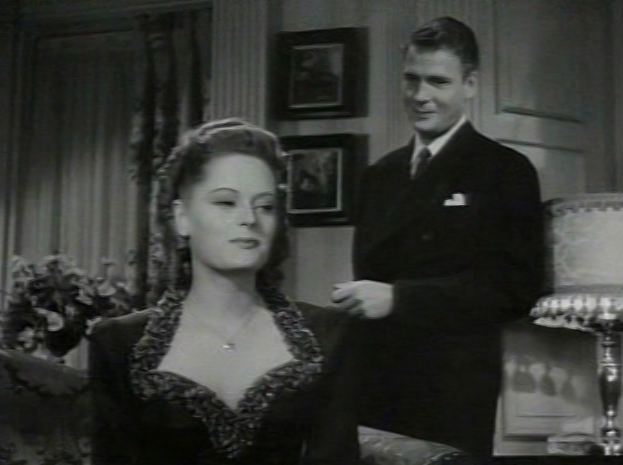
Conflict (1945) starts with title and credits that ooze like residue from the background of a dark and stormy night, and melt in a sinister haze while we squint through the curtain of rain. Could be a monster movie with an opening like that, but film noir adopted such techniques from their monster movie cousins, and presented a new kind of monster for us: the darker side of ourselves.
Robert Siodmak, who directed such films as the magnificently creepy
The Spiral Staircase (1945), which we discussed here, co-wrote this script which blends the customary fatalism of film noir with a new emphasis on psychiatric analysis to help solve the mystery.
The psychiatric element to the story begins innocently enough. Sydney Greenstreet is a jovial, avuncular bachelor professor of psychology (love that man’s jolly guffaws), a practicing psychologist, and an avid grower of prize roses, who hosts a small intimate dinner party to honor the fifth wedding anniversary of his two friends, played by Humphrey Bogart and Rose Hobart. The film opens with what we suppose is Mr. Greenstreet’s beefy hand patiently writing out an invitation in elegant handwriting, one of the lost social graces.
Because this is a mystery, I’m going to try not to heave any gigantic spoilers at you, but step as delicately as I can around this movie by focusing on the performances. The performances give us a lot of back story we may assume about the characters, which gives the movie more depth than appears on the surface. In fact, the plot of the film is spilled out for us at the very beginning, and the real mystery is not so much who done it, or even who done what, but how is the guilty party going to meet with just desserts?

This is one of Bogart’s most interesting roles, not so much for the character as written, but for what he does with it. We meet him and his wife getting dressed to attend Mr. Greenstreet’s house party. They seem to bicker a bit, but there is nothing really to suggest an unhappy marriage. His moaning about wanting to stay home tonight and her complaining that he leaves his clothes all over the place make them seem comfortable with each other, a solid marriage if not a very exciting one.
Then a bombshell. Rose Hobart, with a single, severe streak of gray in her pompadour, speaks with the coolness of a sophisticate when she suddenly remonstrates him for his “ridiculous infatuation with Evelyn.”
Evelyn is her younger sister, played by Alexis Smith.
Mr. Bogart is surprised, but remains calm, even when she chides him that, “The way you look at her and hang on her every word is positively nauseating.” His wife insinuates, due to her sister’s extreme youth and inexperience, that Bogart is entering a kind of second childhood. His wife does not seem threatened or hurt, as much as she seems embarrassed for him. Her accusation is belittling.
Seeing himself through her eyes, perhaps he also feels that such an infatuation should be beneath him. He replies when she asks him what he’s going to do about it:
“I’m not going to do anything about it…I haven’t said anything to her and I don’t intend to.”
I like that shot of him answering her with a confident, if somewhat world-weary acceptance, in his voice. He is not apologetic or defensive. His code is self-restraint, which is what makes his later loss of self-restraint so interesting.
“When I married you, your sister was just a kid. Now she’s grown up and I happen to find myself in love with her. It’s just one of those things that can’t be helped.”
Yet, he has no intention of leaving his wife, even acknowledges that she would never let him go. Miss Hobart also contends that were he to confess his love to Alexis Smith, she’d never marry him out of loyalty to her sister, and he knows that, too. Bogart has this all figured out, he’s done a lot of brooding on it, and seems determined to face his comfortable rut of marriage and his unspoken crush on his young sister-in-law, and keep them separate.
But his stoic veneer cracks a little when Rose Hobart, who can’t seem to leave well enough alone, taunts him that Alexis would laugh at him were she to find out. This stings him. Bogart looks hurt.
But he’s determined to soldier on through this new unpleasant turn in his marriage. His love for his sister-in-law was a precious thing as long as nobody knew about it. Now it’s spoiled for good.
Alexis Smith pops her head into their bedroom and reminds them to hurry. She is fresh-faced, beautiful, and open. What back story she brings to her role is largely in these qualities, and in a lack of sophistication that makes her utterly unaware of both her beauty and her affect on Humphrey Bogart.
She lives with them. Their mother lives in another part of the country. We are told nothing about a father or other siblings. We may assume she was a teenager when her sister and Bogart married, and now she is in her early 20s. Her guileless good-natured attempts to be both pleasant and useful might make her seem a dishwater character on paper, but what Alexis brings to the role is a gentle vulnerability. She seems in awe of both of them and holds them as an example of the perfect married couple.
There is a subtle difference between her relationship with her sister and her relationship to Bogart. She seems deferential to the older, more confident, more worldly sister, who has taken her into her home. In some respects, her sister will always be the knowing grownup and she will always be the mousy youngster. With Bogart there is a more comfortable friendship, as if she has not quite grown out of the teen who finds herself with the unaccustomed pleasure of an indulgent older brother. There is not a little hero worship for him.
“I only hope that someday I’ll find a husband as good as you,” she says, and drops an affectionate kiss on his cheek after a round of congratulations at the party, which Bogart accepts with a charming look of being comforted. He nearly blushes. Yeah, Bogie, no less.
Family doctor Grant Mitchell is also at the party, and so is Sydney Greenstreet’s young colleague, played by Charles Drake. Mr. Greenstreet does his best at matchmaking through the course of the movie, trying to get the lovelorn Drake and the reticent Alexis Smith together.
The party conversation turns to the nature of love and the psychology of it. Alexis wants to know what Mr. Greenstreet does as a psychologist, and he explains that he battles the nature of psychosis.
“Sometimes a thought can be like a malignant disease that starts to eat away the willpower.”
Bogie is visibly uncomfortable with this, and we know he is afraid his precious, private infatuation might be construed by the misunderstanding outside world, certainly by his wife, as a mental disease.
“Love and its frustration is the worst offender,” Greenstreet pontificates, but Alexis Smith counters with an eager recitation of all the famous lovers in history and literature. Here we see for an instant, another flash of Bogart’s versatility. Look at his expression as he watches her tentative attempt to illustrate the enviable flush of romance that she has never experienced. His adoring expression is the picture of a schoolboy crush. Yeah, Bogie, no less. Maybe the most sensitive tough guy that ever lived.
But when forced to bring her fantasies about romance down to earth Alexis affirms to her sister, “When I marry, I want it to be something solid, like you and Dick.”
They drive home in the omnipresent film noir rainstorm, Bogie and the missus in front, the kid sister in the back -- because of the camera angle, literally as well as figuratively between them. Miss Hobart suggests Alexis go home to Mother because Mother misses her. Obedient Alexis regretfully agrees, and Bogart sneaks an anguished look at her in the rearview mirror.
Which causes the car crash.
The car plows right at us in a sickening flash, and may cause you to use your favorite exclamation of alarm.
A brief, film noir dream (or nightmare) sequence of the faces of the conflicting personalities in his life, from his wife, to Alexis, to Greenstreet, all jumbled in a wet whirlpool, and we see that Bogart is just regaining consciousness. Doc Grant Mitchell assures him he has only a broken leg, and that the ladies are fine. Bogart has asked after Alexis first.
Confined to a wheelchair back home, though hobbling on a cane when nobody is looking, Bogart is the picture of helpless frustration. Alexis has been sent away. He and his wife resume their comfortable rut of a passionless marriage.
Then his wife goes missing.
It’s no secret what happened to her, but I’m going to sidestep that and just go on to another couple of interesting aspects of the movie. Though she is missing and the police haven’t got any clues as to what happened to her, personal items of hers that she wore or had with her when Bogart last saw her begin to show up here and there. Traces of her follow Bogie around. We may wonder if this is a ghost story, or an elaborate hoax and who are involved?
Through the cat and mouse trickery played on Bogart, he begins to unravel. We see the man once an example of confidence and strength become testy, nervous, quick to anger, and nearly unglued by weird happenings, as well as by psychological symbols that almost seem as hallucinations (some of which are something Alfred Hitchcock might have used in
Spellbound or
Vertigo discussed here).
Speaking of becoming unglued, we discussed Mr. Bogart's other forays into the wonderful world of Losing It in this previous post on
Crazy Bogie.
His only comfort is the return of Alexis Smith, who arrives to commiserate about the disappearance of her sister, to bring to and find comfort from, her only other really close relationship: her bereft brother-in-law.
Interesting how the Production Code must not have been invoked by these two sharing a home together unchaperoned, but Bogart’s self-control returns enough to keep him from entering her bedroom across the hall from his.
Lots more rain, the iconic sight of Bogie in his trench coat (did I mention it rains a lot?), and carefully stocked cigarettes in slim cases for smokers on the go.
One small point, but somehow as sweet as his unspoken crush on Alexis Smith, is the unselfconscious and natural picture of her being taller than him. Alexis Smith was 5’9”, and in at least one movie I can think of,
Here Comes the Groom (1951), discussed here, her height was used for comic effect and she played a wallflower partly because of it.
Bogart was 5’8”, and in some of his films, notably
Casablanca (1943), he wore lifts to compensate for his appearance with the taller Ingrid Bergman (like Alexis Smith, 5’9”) and Paul Henreid. In
Conflict, Bogart and Miss Smith stand an inch, and worlds apart.
Another iconic sight, but from another movie is the Maltese Falcon. The statue. It appears high on a cabinet in the police detective’s office, just over Bogart’s shoulder as he paces anxiously and demands progress in the investigation. I don’t know whose joke it was to put it there, but it’s easy to miss if you’re not looking for it. Sydney Greenstreet was, of course, in
The Maltese Falcon (1941) with Bogart.
Speaking of the police detective, played by Patrick O’Moore: close your eyes and listen to him. Doesn’t he sound just like Claude Rains?
And one more: catch all the “B” stickers on all cars? This movie was released in June 1945, so wartime regulations on gas rationing were still in force. However, this does not explain why they are free to take trips to their favorite mountain lodge. A “B” sticker would get you about eight gallons a week (the lodge was something like 100 miles away), and pleasure travel was illegal during the war anyway. We discussed
gas rationing and the movies in this previous post.
But, by the time this movie was in theaters, V-E day had come and gone, and though we were still struggling with the war in the Pacific, the light was at the end of the tunnel and war-weary audiences might not have jumped to their feet hollering, “Hey! What gives? How come Bogie can drive around whenever he wants and I can’t?”
Except Rose Hobart’s car, which, oddly enough, has no sticker. Arrest that woman.
One funny moment: When Bogart, in a daze over a new creepy event, wanders away from a cab he had instructed to wait for him. The cab driver, annoyed, yells, “Hey! Sweetheart! Remember me?”
Now Alexis and Bogart, with sis out of the way, can explore their relationship. Bogart tests her feelings by confessing that his wife “imagined that I’d fallen in love with you.” Her reaction of sisterly concern and discomfort is less than he might have wanted, but Mr. Greenstreet arrives before things develop.
Off they go to the mountain lodge to ease the stress of the tragedy of the missing older sister, fish, and dance in rustic surroundings. Greenstreet’s along, and still tries to shove Charles Drake at Alexis as a prospective suitor.
Bogie, his self-control now stretched to the limit, gets jealous and openly confesses his love for her in a harassing manner, almost as if daring her to laugh at him. She does not deny or confirm her feelings, only pulls uncomfortably away and reminds him, “It can never be.”
After enough badgering, she finally tells him she doesn’t feel that way about him, but diplomatically continues to insist her sister would always be between them. Why he lets her go suddenly is never completely fleshed out, but we may assume his self control has returned in the face of his acceptance that it really cannot ever be.
It’s a stylish film, and even if one or two plot holes keep it from being perfect,
Conflict is an absorbing movie.
For more on
Conflict have a look here at our
Laura’s recent post on “Laura’s Miscellaneous Musings”.
*********