IMPRISON TRAITOR, PEDOPHILE, AND CONVICTED FELON TRUMP.
Showing posts with label Memorial Day. Show all posts

Saturday, May 23, 2026

Memorial Day

Memorial Day, when heroes should be remembered with reverence for fighting not only for our country, but for the very idea of democracy.

Robert Cummings in Saboteur (1942) has an inspirational showdown of words with Otto Kruger.

Monday, May 30, 2011

The General - 1926


“The General” (1926) is a Civil War story remarkable for two interesting qualities. First, it has the intriguing look of a Mathew Brady Civil War-era photograph. Second, the story is entirely apolitical.

Mathew Brady photo: Library of Congress, (now in public domain), Hanover Junction, Pennsylvania, 1863.

As far removed as we are today from the Civil War, and despite our technological proficiencies, we could not achieve either of these qualities in a Civil War film today; nor would we probably try. In the first case, producers might shrug off any attempt to replicate a Mathew Brady photo with the attitude that most younger audiences would neither recognize nor appreciate that effect. Mathew who?


In the second case, we have a self-conscious but determined tendency (as we’ve discussed on this blog before), to justify history (when we’re not over-simplifying it or dumbing it down). Buster Keaton, the film’s star, and one of its writer-directors, avoids explanation or politics by focusing on the story of one stumblebum who tries to retrieve a train engine that has been stolen.

This post is our annual commemoration of Memorial Day with a look at the Civil War through the movies. Memorial Day has its roots in the Civil War. In previous Memorial Day posts we covered “Friendly Persuasion” (1956), and picked apart the symbolism used in “Gone with the Wind” (1939). “The General” has neither message nor sweeping saga, but there is an off-beat realism to the movie that neither “Friendly Persuasion” nor GWTW has.

We might note that 1926, when “The General” was released, was closer to the end of the Civil War than we are today to the end of World War II. That may not be enough in itself to lend authenticity; “Birth of a Nation” (1915) was even closer in proximity to the Civil War, yet has more music hall melodrama about it than a Mathew Brady photo. And director D.W. Griffith’s awkward defensiveness over The Cause resulting in an infamous racist slant on the Southern justification both for the war and the Ku Klux Klan got him in such hot water that perhaps a wish to avoid controversy inspired Buster Keaton’s apolitical telling of an unlikely Confederate hero. Perhaps it only reflected Keaton’s personal lack of interest in anything more than a great gag, a meticulously executed stunt, and above all, trains.

Buster Keaton, a train enthusiast more than a Civil War buff, nevertheless purposely created his calculated “Mathew Brady effect” for historical authenticity.  His longer hair in this film is small but nice touch.  One compromise (or perhaps just an ordinary flaw) is the display in town of the “Confederate” flag of blue crossed bars on a red field, with stars for each Confederate state. As mentioned in last year’s post on GWTW, this flag now commonly referred to as the Confederate flag was not the flag of the Confederacy, and would not have flown over a recruiting office as in this 1861 scene.  General P.G.T. Beauregard, Army of Northern Virginia, sought a different design after the First Battle of Bull Run (or First Manassas) to keep his troops from being the victims of friendly fire, because the actual Confederate flag, commonly called the Stars and Bars, looked very similar to the United States flag.

At times the film’s apolitical nature is too obvious, such as when the war begins. Keaton is spooning with his best girl on the parlor sofa when her brother strides in, and announces, “Fort Sumter has been fired upon.” Her father, seemingly emotionless, replies, “Then the war is here.”

This makes it sound as if they are responding in dull surprise to news of a bad storm destroying crops in another county, an act of God. The Confederates fired upon Fort Sumter purposely to start the war. Some Southerners were pleased, some were anxious, some were certainly baffled and wondering what was going to happen next, but nobody shrugged it off as just one of those things.

There is also the noticeable absence of any discussion of states’ rights or reasons for the war. Toward the beginning of the film, a few African-American actors are shown carrying trunks off a train that has just arrived in town. The camera does not linger on them; they are easy to miss if you’re not watching closely. Keaton seems to have chosen not to show stereotyped slaves -- by not showing slaves at all, nor addressing the issue of slavery. This is how Keaton manages to be apolitical on the two most controversial aspects of the Civil War: that it was started by disgruntled secessionist politicians who wanted to protect their property; and their property was human beings.

On one hand, this seems like a terrific cop-out on Keaton’s part; but his intense concentration on the trains in this movie sweeps away the nefarious causes of the Civil War and the gore of that catastrophe. It isn’t even a case of his ignoring the politicians and generals in favoring a story about the common solider. Keaton’s character isn’t a soldier. He’s a train engineer, and he wears both blue and gray uniforms in the course of the film as disguises in order to guide his engine safely home.  Keaton rigidly sticks to his story, as oblivious to social conflicts around him as his character is oblivious to anything but his beloved train.

The story, based on a true event, is about a unique Civil War train robbery, where Union raiders confiscate a Confederate train. In this movie, Keaton is the engineer of “The General”, which runs on the Western and Atlantic Rail Road in Tennessee and Georgia.

When war is announced, Keaton attempts to enlist in the Confederate army, but is turned away because he is more valuable running the train. A series of misunderstandings, and his girl, played by Marion Mack, thinks he has refused to enlist because he is a coward.

Union spies capture his train, with Keaton in pursuit (on a hand cart, on an early wooden bicycle, and running like crazy). At this point, Keaton is unaware that Marion Mack, who was in the baggage car searching for something in her trunk, was captured by the Union men, who tie her up.

At first Marion Mack is the damsel in distress. Later on in the film she gets some unexpected slapstick moments, is hoisted around in a sack, shows her comedy chops, and even runs the train. She gets pummeled with water from the water tower spout, and in a PBS documentary on Buster Keaton shown some years ago, “Buster Keaton - A Hard Act to Follow”, she acknowledged that she had no idea she was about to be half drowned in that scene.

A funny bit occurs when Keaton directs her to feed with boiler with wood as he drives the train. She picks up the smallest, most dainty pieces, and he sarcastically hands her a sliver of wood, which she quite seriously throws on the fire. He is so exasperated with her at one point, his hands make as though to choke her, but after a shake or two, he kisses her instead.

Another laugh is when Keaton, unable to avoid getting out of a way of a cannon pointed at him, heaves a chunk of firewood at it, as if it were a dog he could chase away.

Despite Keaton’s deserved reputation for being one of the funniest comedians in silent films, this movie is not strictly a comedy. It’s really more of an adventure tale, told in constant motion. The camera following the train is in many scenes on another train running parallel. Keaton’s formidable athleticism is astounding. He runs and climbs all over the train, scrambling over the wood pile, crawling on the cow catcher. Other cast members, including Marion Mack, also clamber all over the moving train.

Just the scene where he sits on the crossbar of the train wheels and gets lifted up and down with the train movement had to be risky.

His gags are amazing for their complexity and precision. When the Union spies in “The General” chuck railroad ties at the train engine which Keaton uses to pursue them, he lies down on the cow catcher, and with a heavy railroad tie in his hands, slams it down to knock another wooden railroad tie off the track with an elementary lesson in physics. The train is still moving while he does it.

The timing of firing the railroad car cannon, first a comic dud, and then a success, was perfect, all while the trains are moving.

The most spectacular effect was, of course, the train wreck on the wooden bridge across the wide gorge. Keaton’s crew built the bridge, and then in a single shot -- it could not have been done twice -- the train engine and wood car are driven to the center, and Buster lights a fire on the wooden bridge to scuttle it before the Union men hot on his tail can use it. The fire starts before he is ready, and he must jump through flames to escape, accidently jumping through a gap in the bridge and plunging to the creek below. The fire engulfs the bridge, and the train collapses into the gorge.

In the PBS documentary on Keaton’s career mentioned above, an eyewitness to the event remarked that the silent stream of steam we see billowing out of the wrecked train was not silent at all. The train’s steam whistle let off a long, continuous shrill blast that sounded ominous and frightening to the spectators. Too bad that sound was not replicated for the movie. Some, horrified, also mistook the dummy planted at the controls for a real person.

After the train wreck there is a brief battle between the blue and gray, who finally catch up to each other. These fellows were played by Oregon National Guardsmen, changing uniforms to be both the Union and Confederate soldiers.

“The General” received mixed reviews when it was released, and some reviewers seemed to find fault with it mainly because it wasn’t what they were expecting: more than just a comedy, but less than a Civil War epic. In both the study of history, and our perception of movies, we are often guilty of clinging to preconceived notions. It was reportedly Keaton’s favorite film and the one of which he was most proud.

When a Confederate soldiers falls in battle while a confused and annoyed Keaton is talking to him, and when a Union soldier dies when Keaton’s sword accidently slips out of his hand and is driven into the soldier’s back, we are shown these events as gags. Maybe that’s what some critics had trouble swallowing. Depictions of historical events, especially in this manner, are going to seem callous, like treading upon hallowed ground. But interestingly, Keaton, both director and character, is determined to take only his train and his lady love seriously. Nothing else is of much significance. Despite its Mathew Brady look, the film’s tone seems quite modern in this respect, with wry, dry humor, at times almost cynical.  This is where he really departs from D. W. Griffith's sentimentality.

When he rescues the “Confederate flag” from a fallen flag bearer, he looks like a hero for only a brief moment. Then he gets jostled and knocked on his rear end. He’s no hero, he seems to be saying. He’s just a guy trying to belong somewhere. It’s still easy to get knocked on your rear end even if you’re trying to tread carefully over hallowed ground.

Monday, May 31, 2010

Symbolism in Gone with the Wind


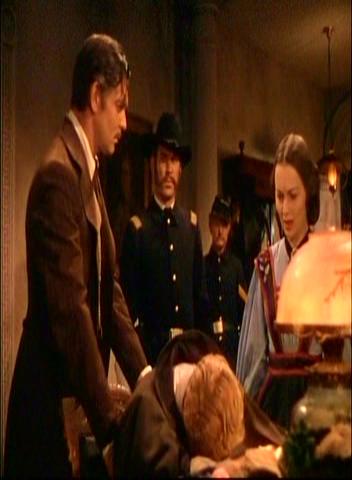
In “Gone with the Wind” (1939), when in the closing days of the American Civil War Scarlett O’Hara, played by Vivien Leigh, berates Melanie, played by Olivia de Havilland for feeding starving Confederate soldiers straggling home. Melanie relates that her husband Ashley was last known to be in a Northern prison camp…

“And maybe if he’s alive and well, he’s on some northern road right now, and maybe some Northern woman is giving him a share of her dinner and helping my beloved to come back home to me.”

Melanie’s typically sweet response reflects in some measure those Southern women who decorated the graves of Union soldiers after the war, which was the beginning of our Memorial Day. Today, we cover Memorial Day with a look at symbols in “Gone with the Wind.”

I have to warn you, this is going to be a long post. You might want to get a sandwich.

We’ve touched on Memorial Day and the Civil War as depicted in movies in previous posts on “Friendly Persuasion” (1956) and here on a compilation of Civil War movies. We noted particularly in this latter post that most Memorial Day television marathons show World War II movies. Since it was the American Civil War that gave us Memorial Day, it’s interesting to look at our film treatment of that war.

“Gone with the Wind” presents some interesting aspects of that era, especially of how that war has come down to us in symbols. Symbols are very important to us. They are stand-ins for deeper meaning or fuller explanation. A wreath on a soldier’s grave is a symbol. A Confederate flag is a symbol. We are still dealing with repercussions, not of the war, but of the war’s complicated aftermath when this flag first developed into a powerful symbol. The war’s aftermath constitutes most of “Gone with the Wind”.

Only last month, Virginia Governor Robert F. McDonnell (R) drew criticism when he issued a Confederate History Month proclamation that paid tribute to the state’s heritage as a member of the Confederate States of America, and omitted any mention of slavery. Gov. McDonnell explained that the proclamation was devoted to issues he felt were most "significant" to Virginia. The proclamation was requested by the Sons of Confederate Veterans.

He afterwards re-issued the proclamation with the additional paragraph:

WHEREAS, it is important for all Virginians to understand that the institution of slavery led to this war and was an evil and inhumane practice that deprived people of their God-given inalienable rights and all Virginians are thankful for its permanent eradication from our borders, and the study of this time period should reflect upon and learn from this painful part of our history…

It was admirable for him to correct the omission. Some may wonder how in this day someone might forget to mention slavery as a significant issue in the American Civil War. On the other hand, most of us by now have grown cynical with the knowledge that there are a vast number of people who dismiss facts which are uncomfortable for them.

However, part of this dismissing of facts, or at least of in-depth explanations, is due to our inevitable packaging of historical events in the form of convenient, no fuss-no mess symbols. These symbols are vivid, triggering instant recognition the same way corporate logos and commercial jingles are used. Sometimes they are used with the same purpose of “selling” an idea or image to us to trigger our acceptance and allegiance to that idea, the way commercials try to trigger our allegiance to a product.

Sometimes, however, we must fault our own laziness in teaching history this way, and our laziness in accepting history this way.

“Gone with the Wind” is a lush, lavish soap opera about survival, told through memorable characters and a dramatic backdrop of the Civil War and Reconstruction periods. It is excellent storytelling, and is a movie that many of us can watch again and again. Despite our familiarity with it, it remains captivating and enjoyable.

It is not an historical documentary. It is storytelling, and yet for many people it is possibly their introduction to the American Civil War, and perhaps even the sum total of their knowledge.

Plucking only a few symbols from this movie tells us a lot about our attitudes about the Civil War based on our ignorance.

When Scarlett receives a letter announcing the death of her first husband during the War, his commander writes, “Though Captain Hamilton was not vouchsafed a hero’s death upon the field of glory, he was none the less a hero, dying of pneumonia, following an attack of measles.” (For one thing, the penmanship is too modern to be 19th century style, but we’ll let that go.)

I can recall watching the film with others who chuckled at this, since it implies that goofy Charles Hamilton was a bit of a loser for dying in this unheroic manner. I believe probably the film’s famous producer, David O. Selznick, thought the same thing and so emphasized this frame of film where we see the letter with the flowery language and the irony of what is perceived to be an ignominious death.

However, most soldiers who died in the American Civil War died of disease, not battle wounds. We also might note that this is especially significant when we know that the battle deaths occurred in the thousands.

To put that into perspective, in the past seven years over 4,700 American service personnel have been killed in Iraq. As terrible a price that is to pay, in the four-year period of the American Civil War over 200,000 battle deaths occurred, North and South. The deaths due to disease were over 400,000, more than twice that of deaths due to battle wounds. About two-thirds of the over 600,000 military personnel who died in the Civil War died of illness.

Many battles resulted in a loss of 30 percent of the soldiers on the field. Thousands were mowed down in minutes. We could not, and would not, endure such statistics today. For deaths due to sickness to top that alarming rate is astounding.

So, Charles Hamilton’s sickbed fatality is not so worth smirking at after all. It is not a joke; it is a tragedy.

Another symbol we may address is the Confederate flag. One of the most striking scenes in the film is when Scarlett wanders out of the hospital to look for Dr. Meade, played by Harry Davenport. She walks out to the railroad yard where wounded men have been deposited and are awaiting treatment. As the camera pans back, we see her become smaller and smaller as she disappears into a sea of wounded men. Finally, the camera pans back far enough for us to have a bird’s-eye view, with a tattered Confederate flag snapping in the breeze in the foreground.

It is a wonderful symbol of pride being humbled by defeat in battle, of a proud young nation struggling to establish its identify under bleak circumstances.

But the so-called Confederate flag, that dramatic design of blue crossed bars on a red field, with stars for each Confederate state in the blue inverted cross, was never the flag of the Confederate States of America. It would never have flown in this manner from a town flagpole at the rail yard. It is a magnificent and stirring piece of symbolism, (movies love visuals) but it is the product of Hollywood imagination.

There were several flags of the Confederacy. The first was a blue flag with a single gold star, the so-called Bonnie Blue Flag, as in the song, “Hurrah, hurrah, for Southern rights, hurrah! Hurrah for the Bonnie Blue Flag that bears a single star!” It is also where the daughter of Scarlett and Rhett Butler, played by Clark Gable, got her name: Bonnie Blue Butler.

This flag was followed by other designs, mostly based on a variation of the United States flag. Here you can see an example behind Harry Davenport as he conducts the ball. Here again it is behind the bandleader who announces to the crowd they are about to play the Virginia Reel. The flag was nicknamed The Stars and Bars.

(The only thing more dashing than Clark Gable is Clark Gable dancing the Virginia Reel. The ball sequence contains a lot of symbolism to illustrate the gracious and elegant heritage of the planter class of the Old South.)

What we know today as the so-called Confederate flag was actually a square battle flag. Flag bearers marched out onto the field of battle along with their company of soldiers. The Stars and Bars appeared too much like the Stars and Stripes on the battlefield, so General P.G.T. Beauregard, Army of Northern Virginia, sought a different design after the First Battle of Bull Run (or First Manassas) to keep troops from being confused in battle and being the victims of friendly fire.

This design was created and was used in various versions for many battle flags for different fighting units of the Confederacy. Late in the war in 1865, part of this design was used in yet another new official flag of the Confederacy. Today part of this design is found on the flags of many southern states.

What makes people today recognize this flag as the Confederate flag is perhaps due to two circumstances. One, the South lost the war, and when devastation occurs it is usual for people to blame politicians first. It may be that the Stars and Bars, though revered as their nation’s flag early in the war, became a bitter reminder of a failed government of a country that no longer existed.

The South’s reverence was transferred from their government and their cause, to their veterans who had fought so bravely and so skillfully against incredible odds. They took the old Army of Northern Virginia battle flag design to their hearts as a symbol of the courage of their men.

A second circumstance is that this flag was early on adopted by the post-war fraternal group, the Sons of Confederate Veterans, that same, still active group which prompted Virginia Governor McDonnell to issue a Confederate History Month proclamation.

There were other circumstances that took root in the late 19th century and continued to blossom in the 20th: the Ku Klux Klan adopting this flag as their standard, as did many hate groups, Neo-Nazis and the like, whose reverence for a self-styled superior heritage is as twisted as their ignorance of the true history of this flag. Today the flag is still used in both ugly hate demonstrations, and also in completely innocuous venues. Neither use, however, either as threat or as an innocent gesture of regional pride, displays an accurate knowledge of the history of this flag.

But the symbolism that has come down to us, that symbolism which spurs us to instant recognition, is complex, mainly due to ignorance of how this flag was really used. To some today it will symbolize the Old South. To others, a rebellion against oppressive government. To others, it means racial domination.

General Beauregard only wanted a battle flag to keep his men from being fired upon by members of his own army in the confusion of battle.

The truth may not always set us free, but it can sometimes shed a light on things.

As for the above-mentioned Ku Klux Klan, this organization was also used by some as a symbol of righteous Southern men preserving their heritage and defending the honor of their women. Director D.W. Griffith famously brought enormous controversy upon himself when he depicted Klansmen as heroes in “Birth of a Nation” (1915), see previous post part 1 here and part 2 here.

GWTW delves into this vigilante-as-hero only a bit in the scene where Scarlett is attacked in Shanytown, and Ashley, played by Leslie Howard, and her second husband, Frank, played by Carroll Nye, along with a gang of other noble heroes of the gentlemen class, must “clean them out”. They set fire to the camp of indigents.

Union solider Ward Bond barks,

“A lot of those shantys were burned. A couple of men were killed. It’s about time you Rebels learn you can’t take the law into your own hands.”

It is mild castigation, and we may note that there is no further reference in the film to the Klan that would become famous as an underground group of terrorists whose sole purpose was to oppress African-Americans, Catholics, Jews, and foreign-born Americans. Hanging, along with mutilation, and setting fires to churches, was a favorite pastime. It might also be noted that the Klan enjoyed its zenith not in the immediate years following the war, but in the 1920s, only the decade before this film was made.

The Civil Rights Movement of the 1950s and 1960s did much to dispel the myth of respectability, and to shine a light on the hypocrisy of so-called respectable men who would see oppression of others as their path to righteousness, as an expression of their heritage.

But GWTW treads lightly on such racial issues, which is quite a trick to pull off. To be sure, the film is racist in its depiction of “good” blacks as being the servile ones. We have Gerald O’Hara, played by Thomas Mitchell, exhorting Scarlett to be firm but gentle with “inferiors.” We have the symbol of the well-dressed haughty (I believe the term back in the day would be “uppity”) black man singing “Marching Through Georgia” to insult the Southerners. We have the sharpster selling gullible ex-slaves on the “40 acres and a mule” slogan. All visual symbols strung together to be a kind of easy survey course in American history. No fuss, no mess, no in-depth explanation.

However, one can see a degree of sensitivity in Mr. Selznick’s helmsmanship. There are interesting clues to make one suspect he was fighting the good fight from behind the lines.

For instance, though Scarlett is attacked by ruffians, those ruffians were white men. The man who came to her rescue was Big Sam, played by Everett Brown, one of the former slaves on her family’s plantation.

In another scene, Big Sam and several other slaves are being marched through Atlanta, taken off their plantations by the Confederate army, to dig defense entrenchments. As they walk along, they ironically sing the spiritual, “Let My People Go.”

And though the African-American actors portray servile slaves, they nevertheless have their own distinct personalities. One of the great joys of this film is watching Hattie McDaniel holler at everybody.

She won a Best Supporting Actress award for her role, the first African-American actor to win an Academy Award. Her best scene is when she is slowly walking up the grand staircase with Melanie, weeping over the death of Bonnie, and explaining the tragedy to Melanie and to us. Her emotional breakdown is one of the most genuine scenes in this film. Here she is not a servile slave, she’s a heartbroken woman, and we feel her agony. She was a great actress, and this is obviously a scene David O. Selznick can be proud to have in his film, because the two actresses in it transcend being either black or white. It just doesn’t matter at that moment.

Prissy, played by Butterfly McQueen, may be empty-headed, but she inflicts her will in her own unique ways. However, the producer missed the opportunity to show the character Uncle Peter, played by Eddie “Rochester” Anderson in a better light.

This character is the slave of Aunt Pittypat Hamilton. Because Aunt Pittypat, played by Laura Hope Crews, is even more empty-headed than Prissy, in the novel this house servant with more sense than anybody actually runs the home. Uncle Peter decides when Melanie may put up her hair and go to parties, and when Charles may have a larger allowance, and he sends him to Harvard. In the movie, we only get to see Uncle Peter chasing a chicken in the rain. It does nothing for the dignity of the man we see in the novel.

One more scene I find interesting if only because I think it’s significant that it has been ignored, is when after the war Scarlett gives her deceased father’s gold pocket watch to their servant, now former slave, Pork. He tells her that she should sell it to pay taxes on the property, but she insists that she would rather give the watch to him, as he was her father’s devoted manservant for many years.

Pork, played by Oscar Polk, is choked up, and Scarlett replies, “Don’t cry. I can stand everybody’s tears but yours.”

There’s more going on here than Scarlett showing kindness. Vivien Leigh actually takes Oscar Polk’s hands in hers, places the watch in his hands. Then she briefly cups his hands in hers and pats them in a comforting manner.

It lasts only a moment, but consider, in the later years of the Civil Rights Movement, in 1968, after so much progress had been made changing the attitudes of bigotry, there occurred the famous incident between Petula Clark and Harry Belafonte. British singer Petula Clark hosted a television special with Mr. Belafonte as her guest star. At the end of one duet they sang together, she lightly touched his arm in an unthinking, friendly gesture.

A representative of the show’s sponsor, Chrysler-Plymouth, requested that gesture be edited out. He did not want to offend his southern market. A white woman touching a black man. Petula Clark, who owned the show, stood her ground and would not allow the gesture to be edited out.

Nearly 30 years earlier in GWTW, a British white actress touches a black actor in a similar gesture, in an era where this could have been a huge problem with the film distribution in the south. It could have so easily been edited out.

It was left in. Perhaps it drew no fire because the woman was supposed to be the mistress of the house, and the man was supposed to be the servant. It was still a white woman touching a black man with affection. I wonder if David O. Selznick knew what he got away with.

All kinds of symbols. We make too much of some; we make too little of others.

The most entertaining aspect of GWTW is Scarlett’s and Rhett’s survival instincts that carry them through so much. When the war is over, Scarlett’s active mind switches immediately from peace to profit:

“Ashley’ll be coming home. We’ll plant more cotton! Cotton ought to go sky high next year.”

She sees before anyone the need to shake off the old failed experiment of the Confederacy and live for the here and now. She sees her downtrodden, confused father shuffle bits of paper, and asks him what they are.

“Bonds. They’re all we’ve saved, all we have left.”

“What kind of bonds?”

“Why, Confederate bonds, of course, Daughter.”

She blows off his reverence both for his bonds and his Confederacy.

We might take a leaf out of Scarlett’s book, or rather, author Margaret Mitchell’s, when we consider the importance of landing on our feet economically. Margaret Mitchell related that she first began to learn the story of the South during the Civil War and Reconstruction when she was still a child and she played hooky from school. Her mother took her on a ride in the country, showing her dilapidated mansions and told her stories of people who could not, or would not adapt, how a whole society collapsed. She impressed upon her daughter the need for education and a sense of perspective, as much as the need for grit in a changing world. It left a seed in young Margaret’s mind.

David O. Selznick may have embroidered his film with flowery verbiage about “Cavaliers” and gallantry that is no more, “of a civilization Gone with the Wind…”, but Margaret Mitchell saw the less romantic and practical side of it, and that is what is most intriguing about the book, and most intriguing, when we see it, in the film.

Some have looked at the novel and the film as dismissing all that was abhorrent in the Old South, but Margaret Mitchell and all Southerners, white and black, deserve their pride of heritage. Margaret Mitchell, Governor McDonnell, and the Sons of Confederate Veterans included, none of us should feel defensive over the ways of our ancestors (especially to the point of diminishing the importance of certain facts), anymore than we have a right to take credit for their good deeds and achievements. Only what we ourselves do and say is what sticks to us. Let the past lie, but don’t kick dirt over it.

What we must all not allow is too much wallowing in symbols that don’t really mean what we want them to.

The American Civil War era was awash in contradictions. (Consider another brief scene in GWTW of a town band playing “Dixie” while the crowd waited for casualty lists after a major battle. The song so identified with the South was written by a Northerner for a minstrel show.)

The war was fought by southerners as a reaction to what they felt was a too-strong centralized government favoring northern interests. The main right they wanted to preserve was the right to own slaves, upon which their economy was based. When Abraham Lincoln was elected President, a man who promised only to limit slavery in new territories, not to abolish it, the southern states kicked over the checkerboard, scattered the checkers and decided they didn’t want to play anymore. The idea of separatism has always been appealing when frustration reaches its peak.

They weren’t the first to think of secession. New England wanted to secede over the War of 1812 because fighting with Great Britain was destroying their economy. Just after the Revolution, farmers in western Massachusetts erupted in Shays’ Rebellion as a response to what they felt were eastern merchants oppressing them economically. Such rebellions never end well, at least not in a nation where working together has always benefited us more. Our whole system is specifically designed to capture the benefits of compromise. Separatists, and special interest groups, should remember that.

It is remarkable to think that after the terrible hatred and violence of the American Civil War, some southern ladies decided to honor the graves of enemy soldiers by placing flowers upon them. By such simple and gentle measures are great nations reborn.

(For another angle on Northern and Southern reconciliation, have a look at my essay on Anne Sullivan and Helen Keller and The American Accent on my New England Travels blog.)

Next year marks the 150th anniversary of the beginning of the American Civil War when southern separatists attacked the United States military post at Fort Sumter. (The order to fire was given by the above-mentioned General Beauregard, who later gave us “the Confederate flag”.) We’ll be up to our eyeballs in symbolism. But I wonder if the anniversary will be as important to reviving interest in the Civil War as did the 100th anniversary commemorations in the early 1960s?

GWTW was re-released in theaters in 1961 just in time for the 100th festivities (again in 1967 in a 70mm stereophonic version). Now on DVD, I wonder if it will play any part in capturing the imaginations of a younger generation for the American Civil War? Or, perhaps for many the movie just seems to carry a greater impression of Hollywood in the 1930s than it does of the Old South.

Monday, May 25, 2009

Friendly Persuasion - 1956


On this Memorial Day here in the US, we turn to a unique kind of war movie.

“Friendly Persuasion” (1956) shows the face of war, in the face of the quest for peace. It gently manages to be an in-your-face kind of movie. Last year our Memorial Day post discussed Hollywood’s treatment of the American Civil War on this day when so many World War II movies are shown on television (see here). Today we return again to the Civil War, to have an about-face look at Hollywood’s version of war. It was the Civil War, after all, that gave us Memorial Day.

The plot of the movie is taken from Jessamyn West’s “The Friendly Persuasion”, a novel made up of a collection of vignettes or short stories about one Quaker family in Indiana around the time of the Civil War, and afterward. The characters actually age quite a bit as individual scenes from a span of decades are depicted. At the heart of the book is the strong marriage between two compatible if very different individuals, Jess and Eliza Birdwell. Played by Gary Cooper and Dorothy McGuire in the film, the actors seem to capture really pretty much how the characters are described in the book.

One chapter in the book that is not depicted in the movie is called “The Vase” and illustrates the flow of their marriage through the years bumping along against their individual personalities, told through a vase Eliza has made from an old broken glass oil lamp chimney. It covers everything from the deeply personal sorrow of failing to be understood, to the most joyful gratitude of shared experience in such deft strokes that it’s no wonder that it’s not in the movie because I don’t think anything this subtle and deep could be transferred to screen. It’s not visual; it’s ethereal, and it is one of the most lovely pieces of writing I’ve ever read.

I refer to the book because in descriptions I’ve read of the movie many seem to fault director William Wyler for somehow sugarcoating the pacifist Quaker experience to produce a blithe family film, or somehow failing to resolve the quandary between fighting for one’s beliefs and very freedom, and refusing to fight from principle. I would suggest Wyler finds no solution because there is no solution.

Wyler is neither preaching nor damning; he’s telling a story. Even the author of the novel, a Quaker herself, does not preach or damn. She just tells a story. Interestingly, the warlike expressions of the Quaker couple’s teenage son who longs to fight are much stronger in the book. In the movie, Anthony Perkins is very moving as the young man torn between his Quaker upbringing and his desire to be a soldier. He is torn and anguished, taking a stand against his parents and ultimately joining the fight. In the novel, he speaks much more harshly to his mother, throwing the Bible right back in her face with the comment,

“Render unto Caesar the things that are Caesars’…my town is Vernon. The Governor said to defend it. My body is my country’s.”

“Thy soul, son, is God’s,” she counters. They debate not just about his being too young to fight, or that he might get hurt, but on the very nature of man’s responsibility to his fellow man versus is responsibility to obeying the sixth commandment. It might look more like teenage rebellion in the movie, but the issues discussed in the book cut to the core of what has troubled human beings for thousands of years.

When finally faced with the enemy, the novel describes the boy’s mindset in wonderful clarity about killing, “My God, Josh thought or prayed -- he didn’t know which -- I hope it’s no boy nor old man. I hope it’s some hard slave-driving bugger.” Josh needs his enemy to be evil. The thought of killing somebody just like him makes him sick.

Part of the impetus of going to war is needing to be the hero. We must imagine our enemy as evil, or we do not have the drive necessary to fight. If we do not believe our cause is right, we cannot defend it, and if we are right, our enemy must be wrong. The commitment it takes to lose our lives depends on that simple logic.

Out of this logic we created propaganda posters in World War II showing the enemy, usually Japanese, with hideously exaggerated features to depict them as monster-like. Perhaps if we had a poster hanging up in the factory break room of a happy Japanese family featuring mother, father and children sitting down to breakfast, we might have wondered why we were fighting. Propaganda is so insidious because it exploits this human quality.

President Abraham Lincoln once remarked to author Harriet Beecher Stowe, whose novel “Uncle Tom’s Cabin” inflamed the abolitionist movement in the North, “So, you’re the little woman who wrote that book that started this great war.” For many, her book about evil slave masters was their propaganda poster.

Not that Josh needs a book or a poster to tell him slavery is wrong. He has two examples leading him to that conclusion. First, the longstanding Quaker conviction against slavery upheld by his family for generations. Secondly, the presence of Enoch, their hired hand.


Enoch, played by Joel Fluellen, has escaped slavery in the South and lost his family. When their town is threatened by a Confederate raid, Enoch, like Josh, joins the Home Guard. Unlike Josh, Enoch fights less for altruistic reasons; simply because if he is caught, he will either be dragged back into slavery, or murdered. Fighting for one’s beliefs is sometimes difficult. Fighting for one’s life makes things pretty clear cut.

William Wyler does not expend much on Enoch’s story. It needs no explanation. He focuses on the Birdwell family’s constant tightrope walk of maintaining their convictions and their lifestyle in a world fast changing around them. Every scene, even the silly and heartwarming, builds up to the final horrific struggle of what to do if people from the “other side” want to kill you.

We see challenges to the Quaker family’s convictions all along the way, large and small. A traveling salesman offers Jess Birdwell, played by Gary Cooper, temptation in the form of a musical instrument. He sells Cooper an organ, and sensitively tries to buck the Quaker man’s faith that dispels the frivolity of music.

“I want you to know, sir, I honor your prejudices…uh, convictions.” There are several such elbow-in-the-ribs jibes about the Quakers, and I sometimes wonder if members of the Society of Friends feel resentment at being treated in Hollywood films as a cross between somewhat naïve plaster saints (no pun intended regarding a religion which does not employ icons), and rather rigid fanatics. “Friendly Persuasion” is most remarkable at showing that the plaster saints and rigid fanatics are found equally among the non-Quaker community, and shows the Birdwell family as human, with faults and with quirks.

Richard Eyer plays their son Little Jess, a small boy with Great Big Talent, who is one of most natural child actors of the day. With Wyler’s legendary difficulties communicating what he wanted from grown up actors, one wonders how he got such a terrific performance out of Master Eyer. Eyer is as rambunctious as any little boy, whether in mortal combat with Samantha, his mother’s pet goose, or foiling the shell game of a county fair huckster. One of his funniest moments is when, ants in his pants, he shouts out loud in the silent prayer session of the Quaker service “GOD IS LOVE!” and the mixture of self-satisfied pride and sheepishness crosses his face as he tries to crawl back into a hole after doing so.


Phyllis Love is their teenage daughter Mattie, in love with the neighbor’s son who is a soldier, and not a Quaker. This scenario could have been explored more as a real threat to their family’s unity and identity as Quakers, but what is touched upon, and very sweetly, is a young girl’s trying to grow up and fit in with a big world outside her family farm. Miss Love was actually about 30 years old when she appeared in this film, only some nine years younger than Dorothy McGuire who played her mother, yet she plays young very well. She is gawky and awkward, daring to dance with her young man at the county fair, daring to kiss him in the attic over the keyboard of the banished sin-tempting organ, yet hesitant to appear before him in bare feet.

Mattie is working on a cross-stitch in her room on which is embroidered “God Is Love”, her younger brother’s attention-getter slogan. Later on in the film, it is finished and hangs a bit crookedly on the wall. After her first shared declaration of love between her and her beau, after she had stood upon his soldier’s boots in her bare feet to more easily reach up to kiss him, she sprawls on her bed contentedly and nudges the framed “God Is Love” to set it straight, swinging her naked foot off the edge of her bed. A sublime moment, and perhaps Wyler cannot communicate easily with his actors because some things are just beyond words.

The three Birdwell children play well against each other, poke each other and tease each other with a naturalness that does not look rehearsed. Anthony Perkins is troubled not only by war, but bedeviled by the man-crazy Hudspeth girls and their mother, wonderfully played by Marjorie Main. Perkins’ look of horror at his father when it is suggested they stay the night among these Amazons is priceless. It’s a shame he didn’t do more comedy.

Gary Cooper’s range as a comic actor is displayed with something so simple as his repeated careful attempts to say the name “Hudspeth”. Cooper plays the gamut here, he is Longfellow Deeds, John Doe, and Marshall Will Kane all rolled into one. The war causes him just as much crisis of conscience as his son, but Cooper is not a boy who can easily rebel. He sees consequences his son does not. His son shoots wildly, without aiming, at strangers. Cooper’s best friend dies in his arms.


Dorothy McGuire plays Eliza, in one of her best roles and demonstrates once again her versatility and impeccable instinct for drawing out a character. Unlike other prim movie Quaker wives like Gail Russell (“Angel and the Badman” - 1947) and Grace Kelly of “High Noon” - 1952 (who was Wyler’s first choice for this part), Dorothy McGuire strikes a cord as honest and many-layered, without any kind of posturing. Perhaps because author Jessamyn West did not write the character Eliza as anything but real, and warm, and independent, and intelligent, and somewhat hardheaded.

In the movie, Miss McGuire’s most memorable scene involves her defense of Samantha, her pet goose. (See here for Moira Finnie’s excellent review of “Friendly Persuasion”, but I still disagree with the conjecture that there was too much of Samantha in movie. I still think Samantha should have won an Oscar. And the Nobel Prize and perhaps the Croix de Guerre.)

Eliza, beyond being the heart and conscience of her family, the maker of pies, and the tucker-in of shirttails, is also a minister in their Quaker community. Possibly more could have been explored in the movie as well on this, that the Quakers were among the first to establish equality between men and women. Dorothy McGuire’s Eliza is a wonderful example of feminine intelligence and independence of spirit. She is also a woman who displays a passion for her husband that is most ardent and very human, and unlike what other virginal movie Quaker ladies seem to have had written into their roles. The romance and intimated sexual pleasure between the long-married characters of Cooper and McGuire is another testament to the fine acting instinct and knowledge of character they both learned over their careers.

However, being a Quaker minister puts Eliza square up against the debate about The War. She debates with her son and husband, prays and argues. But when the Confederate raiders of Brigadier General John H. Morgan cross into Indiana and overrun their farm, she displays both her Quaker resistance to fight, and her human frailty in forgetting her beliefs. This pacifist Quaker minister nearly clubs a man to death because he is about to kill and eat her beloved pet goose, Samantha.

It is one of the funniest moment in the film, and Wyler is perhaps taken to task for it too much by those who suggest that the scene either shows McGuire’s character as being hypocritical, or else that it is a watered down gesture demonstrating that pacifism is illogical and useless in the face of danger.

To be sure, if it had been McGuire’s daughter that had been taken by the Confederate soldier and not the family pet, we would have had a scene more serious and more challenging to her Quaker pacifism. She would have still committed violence against the soldier. Obviously, if one is willing to defend one’s pet, one is surely going to risk all to save a daughter.

The real difference would have been after the daughter had been saved from either being killed or raped by the soldier. Would we see the embarrassment and shame on Eliza’s face after whacking the Rebel on the head with a broom? Or would we see the intense satisfaction of having won the fight, that blood-thirst feeling of justification and victory?

That would have been an interesting scene. But that wasn’t the story of the Birdwell family of the novel, nor would it have solved the conundrum of being a pacifist during wartime.

The raid by the Confederates into Southern Indiana was an actual event. However, the movie is set in 1862, and the raid occurred the following year. That year of 1863 the South famously took the war into Northern territory, at Gettysburg, Pennsylvania, and here in Indiana.

Brigadier General John Hunt Morgan was a daring Confederate cavalry leader who brought around two thousand soldiers across the Ohio River, pretty much on his own initiative as his orders brought him into northern Kentucky only. They spent several days raiding supplies and horses from civilians like the Birdwells, a very common military activity during that war done by both Union and Confederate armies.


A battle eventually occurred when Union forces finally caught up with Morgan’s Raiders, which, though not destroying railroads or infrastructure or anything of what might be called militarily strategic, still gave a huge fright to civilians in Southern Indiana and made many young men, like young Josh Birdwell, ready to do something which had never occurred to them before -- become soldiers. Moreover, the stripping of farms of crops and livestock was devastating to those families who had worked for a year to fill that corn crib or that smokehouse, or that shelf of preserves. What happened next after the raiding soldiers left and everything was quiet, was that they starved. Perhaps that could have been illustrated better in the film as well.

Morgan himself escaped immediate capture, but was eventually killed later in the war. Here is a view of the equestrian monument of John H. Morgan in his home state of Kentucky, a state which did not secede from the Union in a war which clearly brought a crisis of conscience to just about everybody, Quaker or not.

“Friendly Persuasion” is a film that is sometimes very funny, at other times dramatic, but always showing the whimsical side of human nature and human circumstances. It should be considered a homefront movie about a war where the homefront was for some people in this country, especially South but sometimes North, also a battlefield.


The movie ends with a happier scene of amazing compromise. The sin-tempting organ is now allowed in the front room. The daughter is allowed to ride in the buggy of her non-Quaker beau. Gary Cooper jokingly refers to both his son, wounded in battle, and his Rebel-clubbing wife as “veterans.” For these last few moments of film, we abandon the crisis, and rest our conscience.

Permit me a personal note. I wrote this essay yesterday, Sunday. The church service I attended in the morning included the passage from 1 John 4:16 as part of the second reading, “God is love, and whoever remains in love remains in God and God in him.” The service ended with “Battle Hymn of the Republic”. I had to smile at the coincidence of Little Jess’ favorite Bible quote, and one of the most famous anthems to come out of the Civil War.

Afterward, I went down the street to the cemetery to visit my World War II veteran father’s grave and noted, as I knew there would be, an American flag planted by the plaque in the ground noting his rank and branch of service, put there by a local veterans organization. I pulled away clumps of clover encroaching the plaque and threatening to cover his name.

On the way to church, at only about half a mile from my house, a family of Canada geese had just finished crossing the road. The mother goose led the way, with that regal bearing Dorothy McGuire’s Eliza so admired in Samantha, and the papa brought up the rear, nudging the stragglers among their children who bumped into each other as they followed their mother.

This is why I love William Wyler’s attention to the whimsical aspects of life. They’re so simple and so true.


Note: The portrait of Brig. Gen. John H. Morgan and of his equestrian statue are from the Library of Congress. The sketch of Morgan’s raid is from Harper’s History of the Great Rebellion originally published in 1866. For more on Morgan’s Raid, have a look at this website on Ohio history, and here at Civil War Home.

Monday, May 26, 2008

Civil War Movies and Memorial Day


On this Memorial Day holiday, a marathon of World War II movies is the typical fare on television. But we could note with irony that though Memorial Day was created from the wild bereavement and need for reconciliation over the American Civil War, Hollywood’s classic era has given us few Civil War movies. It does not seem to be a subject they wanted to touch.

Four films on the American Civil war we may use as examples both of the scarcity of film treatment of the war and this nation’s or Hollywood’s discomfort with the war itself. These are “The Birth of a Nation” (1915), “Gone With the Wind” (1939), “The Red Badge of Courage” (1951), and “Shenandoah” (1965). Just the years’ distance between each of these films is an indication that the Civil War has not been popular subject matter.

This is amazing when we consider that this war did so much to create a modern nation from a struggling democracy cobbled together from former possessions of the British, Dutch, French, and Spanish empires. The Civil War was not only a turning point in our history; it created “a” United States from “these” United States. No small feat; and it came at horrific cost.

Hollywood easily churned out costume dramas of European monarchs and revolutions, tales of Roman Empire vice and grandeur, and many Biblical epics. The American frontier was occasionally visited, but most film tales of American past seemed to be rooted in westerns. Westerns were easily and cheaply produced, and the idea of the cowboy as an American icon was a thrilling and comfortable topic. White hats and black hats were easily distinguishable and we knew who the villains were.

Likewise during World War II, when Hollywood did much to unify the nation and serve as a kind of arm of the government to bolster morale, the films were churned out by the dozens and the good guys and bad guys were easily distinguishable.

But the Civil War, an era made for storytelling, filled with dramatic events and bigger than life personalities, this was touched upon lightly, with seeming awkwardness.

Both “The Birth of a Nation” and “Gone with the Wind” deal with the Southern point of view of the war, and include the Reconstruction period, which was as wretched an experience for the defeated South as the war had been. “The Birth of a Nation” took a defensive stand on both the South’s desire for political autonomy as well as the racism that created, promoted, and defended slavery. “Gone With the Wind” was a romantic tale, less of battlefield horrors than of the always-fascinating look at the downfall of wealthy upper classes, with a twist. Here they become dogged survivors in a strange new world.

Both “Gone With the Wind” and “The Red Badge of Courage” came from popular novels, the former having won the Pulitzer Prize. “Red Badge” follows one young Union man’s emotional trial in his first taste of battle. It is not about politics or good guys or bad guys. It is personal, and could be about anybody, anywhere, in any war.

“Shenandoah” features James Stewart as the curmudgeonly widowed father of a large Virginia farming family, who refuses to support Virginia’s militia or to pay any mind to the battles raging around his farm. He has created an improbably safe island in the midst of chaos, until his teenage son is mistaken for a Confederate solider, and multiple tragedies strike his family. This is more a tale of war being bad than of personal conviction. There are also a few historical inaccuracies in this film, but that is what sometimes happens when producers are businessmen and not historians.

However, the few and far-between modern films of the past few decades that have addressed the Civil War, though they may be filled with impressive accuracy on weaponry, tactics, and costumes, still shy away from displaying accurately the vehement politics and social mores of those days.

Perhaps it is simply impossible to re-create the emotion like we can the battlefield. Our look at the American Civil War is self-conscious, at arm’s length, and perhaps with some embarrassment. An earnest desire to see all sides sometimes leads to a diluted image.

At the time, the Civil War (which is actually a technically incorrect term, but has become the most accepted title), was called The War of Southern Rebellion by the North, and by the South was called The War of Northern Aggression. This was being polite.

Is it possible for us to understand a world in which thousands of men volunteered with idealism even after battles where typically thousands would be killed in minutes? Is it possible for us to understand why slavery was not abolished sooner, or how it could be logically defended by anyone? Northern and southern soldiers came to have regard for each other’s abilities and steadfastness, but the North and the South hated each other. There was a crude, murderous feeling rampant in the land. Is it even possible for us to understand such bitterness?

Perhaps this is why so few movies were made about the American Civil War. First, the cost of depicting the era accurately has become more and more prohibitive. Secondly, the passions which fueled the war have been spent, and we are invariably revisionists when it comes to history. We may not want to be. We may sometimes disdain revisionist history, but we are often powerless to do anything other than look at the past with our modern perspective.

One might wonder if it’s not for the best. Some things are best left behind us.

Also, in an era when Hollywood preferred not to alienate their southern film distribution market, an area of the country where movie theaters were segregated, blacks were carefully used and exploited in roles of stereotypes comfortable to bigots. “Birth of a Nation” aroused perhaps the first organized outcry against this, and the film became a museum piece from practically the moment it was made. Director D. W. Griffith spent the rest of his life defending the film, and the American Civil War was seen ever afterward by Hollywood moguls as possibly too hot a topic to touch.

“Gone With the Wind” sweeps us away in a romantic fantasy during the last days of grim Depression and the opening salvos of World War II. It nearly killed producer David O. Selznick, his team of revolving directors, his tormented writers, and his bewildered cast to make it. If it occasionally pulls punches, at least it made a grand effort. The film succeeds just as the novel did largely because we are taken with Scarlet and Rhett as characters. They could be southern aristocrats or London street thieves; it makes no difference as to time and place. They may talk about “the cause” but they serve no cause but themselves, and their personalities are irresistible.

“The Red Badge of Courage” sells itself to a Post-World War II audience with Audie Murphy in the lead, the most decorated American soldier of World War II, whose citations included the Medal of Honor. Bill Mauldin, “Stars and Stripes” cartoonist who created the beloved “Willie and Joe” characters in the army newspaper, plays another Union soldier. Even this obvious attempt at transference of the shine of World War II onto a Civil War epic made from a book we read in high school was unsuccessful. The film didn’t do well at the box office. Perhaps no one believed real-life hero Murphy was really a coward who could “skedaddle.”

“Shenandoah” skirts the political edge of the war just as James Stewart’s farm skirts the edge of the battlefield. Stewart was another World War II decorated serviceman. When he expresses disgust for the war and everything about it, we believe him. His own real-life experience lends cache. But where is the wrong and the right of it his character’s world? Where is the message? That war is bad? We already know that. But if a man expresses a couple of film hours’ worth of a lack of conviction, how are we supposed to care about him?

So, Memorial Day comes around, and World War II becomes our film focus for it. It’s easier that way. We knew who the bad guys were, and we’re not ashamed to point them out. It’s easier to find our heroes, too. They were everybody who served.

But the holiday actually began as a thoughtful, careful, tenuous gesture to reconcile the war-torn nation. It was slow to be accepted. Most of the nation did not adopt the holiday until after World War I, and many southern states still hold separate Decoration Day events for Confederate soldiers. World War II, though there are many still living for whom memories of that war are deeply painful, is a more comfortable subject, both in film and in real life. We know where we stand. We all stand together. Roll camera.

Monday, May 28, 2007

So Proudly We Hail (1943)

Today is Memorial Day in the U.S., when we commemorate members of the American armed forces who have lost their lives in war. Among the many films which would aptly illustrate the experiences of the armed forces in various conflicts, one film seems particularly poignant in its ability to reach audiences today. Perhaps because parts of the film are so eerily prescient of our modern struggle with its ironic lack of national purpose and idealism. This is “So Proudly We Hail!” (1943), the story of the Army Nurse Corps experiences on Bataan and Corregidor during World War II.

There is much to recommend this film: some fine dramatic performances from Claudette Colbert, Paulette Goddard and Veronica Lake, an excellent supporting cast and very fine special effects in the battle scenes. The story moves swiftly along and we are caught up in many subplots that inevitably take a back seat to the war itself. What is especially interesting is the script. Written by Allan Scott, who had teamed with this film’s director Mark Sandrich, on so much lighter fare in the 1930s, such as several Fred Astaire and Ginger Rogers vehicles, Scott’s script is surprisingly lean and muscular. There are several bits of dialogue, soliloquies we should actually call them, which illustrate the feelings of the characters regarding their place in the war. These speeches are labeled today as the stuff of propaganda, but they are clear, clean, well-written, and deserve special notice today.

On the ship that takes the Army nurses to the Philippines in the aftermath of Pearl Harbor, the chaplain, played by Walter Abel, addresses the Christmas Eve party of officers and enlisted men: “This is the night before Christmas, and because it is, you must forgive me for being sentimental. We are a sentimental people. And I think we’re proud of it. Despite the fact that our enemies deride us for it, it makes us the stronger.”

The chaplain exhorts them to have, “Such faith in mankind that we are tough about the things we believe in, that we will make those tender and spiritual beliefs, like Christmas, a reality forever.” There are close-up shots of the young men with serious faces listening to him. Then from somewhere a swing version of “Jingle Bells” gets the party going. This, too, like sentimentality, is seen as typically American.

Another speech is given by Colbert after the nurses are stranded on Corregidor, and a nurse wearily complains, “Why are we here anyway?” Colbert responds, “Why? Why isn’t there any quinine? Why isn’t there any food? Why aren’t there any supplies? Why are we waiting here like rats in a cage waiting for the man to come and pour scalding water over us? Why is nothing done? Why? I’ll tell you why. It’s our fault…because we believed we were the world. That the United States of America was the whole world. Those outlandish places, Bataan, Corregidor, Mindanao, those aren’t American names. No. They’re just American graveyards.”

After the initial shock of admitting our own ignorance about the world has left us vulnerable, Miss Colbert’s speech becomes a warning to the stateside audience in the darkened movie theater. One of her nurses wonders why they can’t be removed from Corregidor, and Colbert replies, “They can’t get us off. We’ve become what they call a delaying action…I hope to God the people back home aren’t losing it for us. Do you remember what the chaplain once told us? It’s our present. We’re giving them time.”

These speeches address the past and the present aspects of American military consequences, but their chief nurse, Captain “Ma” McGregor, played by Mary Servoss, mourns her son and addresses the unimaginable future to which these young women, and their country, plod along,

“Like his father, he died for what he knew was right. He was right. My son and his father. And this time, if we don’t make it right, my son and his father and all our dead will rise up and destroy us.” This is reflected more hopefully in George Reeve’s letter to his new wife, Colbert at the end of the film, “This is our war now and this time it’ll be our peace.”

We are less clear today on purpose and ideals, and in a more cynical world, less equipped with the idealism that makes purpose seem clear. There is another image from “So Proudly We Hail!” that lingers, horrifically, in its prescience of 21st century warfare. Veronica Lake becomes a suicide bomber in a scene still shocking today. Her character has witnessed the death of her fiancé at Pearl Harbor, and her barely concealed hostility for the enemy, as well as her fellow nurses and the world in general, is finally broken under the camaraderie of her fellow nurses and the greater cause of fighting the war and keeping themselves, and their patients in the jungle hospital, alive.

When the nurses are trapped by the sudden advance of a Japanese patrol, Lake stuffs a grenade in her uniform blouse, bids a stoic goodbye to Colbert, and loosens her trademark long, wavy blonde hair from its neat military bun. She walks towards the enemy, a mixture of sex and sacrifice, her hair softly cascading over her face and shoulders and she pulls the pin to the grenade nestled hidden beneath her breast. The Japanese approach her to take her into custody, and we are meant to assume she will be raped. Then she explodes, and they are all killed. The nurses escape.

Such a scene has different connotations to us today, and is more distasteful than heroic. It may have an even stronger impact on us today than it did in 1943, for different reasons, just as the impassioned speeches have a lesser impact on us today. When we take this Memorial Day to reflect on the bravery of our fallen service personnel, we should also reflect on the idealism that made them so brave.

Related Products