IMPRISON TRAITOR, PEDOPHILE, AND CONVICTED FELON TRUMP.

Thursday, November 15, 2012

Horse Feathers - 1932


“Horse Feathers” (1932) is about winning a college football game. You have to remind yourself of that from time to time, because so much else happens in the maelstrom of Marx Brothers shenanigans, that football seems hardly the issue. What is the issue? Everything, and nothing.

Groucho, the default leader of the group, is newly arrived college dean at a school dying to beef up its football program, because after all, that’s what college is all about. There’s nothing more important than football. I suppose I could interject a line here about Penn State, but we’ll just let that go.

Although, Groucho would not have let that go.

Zeppo, the handsome, singing, otherwise comically untalented brother, plays Groucho’s college boy son. He spends a good part of the movie chasing the lovely Thelma Todd, who I think we last saw here in “Bargain of the Century” (1933). Unfortunately, as is the case in Marx Brothers movies, Thelma does not really get to show off her marvelous comedic talent; instead she can do little more than react to their antics. This was her second film with the boys, however; she also appeared with them in “Monkey Business” the previous year.

Thelma plays a “college widow”, aka, a vamp, who in this case is trying to obtain the team’s secret plays using her feminine wiles. There are moments, such a very funny canoe ride with Groucho, where she is less than subtle about her objectives.

Harpo is a dogcatcher, and Chico works at a speakeasy. Which you cannot enter unless you know the password, SWORDFISH.

It’s pretty neat that Harpo peels a banana as if it had zippers on either side. In the early 1930s, zippers were just beginning to be used in some clothing, but hadn’t really been used widely by manufacturers in until the end of the decade.

I also like the way Harpo orders a scotch in the speakeasy by pantomiming a highland fling.

We have another topical reference when Thelma tumbles out of the canoe and pleads Groucho to throw her a lifesaver. Of course, he throws the candy. And the “Jumping Anaconda!” line which refers to the stock that dropped like lead during the Crash.

Harpo and Chico are recruited to kidnap the star players of the rival school, but are kidnapped themselves instead. By the end of the film, they are recruited as students to play on the team, with hilarious results.

The songs are melodic, and silly. When Chico gets a chance to show off his piano playing and Harpo gets a really lovely harp solo, some movie fans feel that this brings the action to a grinding halt, but it is for this very reason that I like the musical solos. It’s a moment of calm in the storm that is incongruous because everything about the Marx Brothers is incongruous. That they are so talented musically seems just another absurd thing about them. A harp solo in the middle of chaos doesn’t fit; and for that reason according to the Marx Brothers doctrine, it fits.

Still, in case we fidget, Groucho breaks the fourth wall while Chico has his piano solo and tells the audience, “I’ve got to stay here, but there’s no reason you folks shouldn’t go out into the lobby until this thing blows over.”

Oh yeah, and then there’s football. Have a look here at the climax of the big game, where, naturally, anything goes.


Monday, November 12, 2012

And the Mystery Dentist and Patient are....


Congratulations to Laura who knew it was "Footsteps in the Dark" (1941) with Ralph Bellamy and Errol Flynn.  Have a look for our previous discussion of the movie.
 

Dentists did not routinely wear gloves when I was growing up.  I believe that practice started in the 1980s, possibly related to evolving hygienic protocols during the AIDS scare.  Maybe some of you could dispute or corroborate that. 

I don't suppose the intruments in Errol's mouth are sterile.   (Not that they wouldn't have been in a real dentist's office, but I suspect the prop guy on the set did not posses an autoclave.)


Thursday, November 8, 2012

Mystery Patient and Dentist


Who is the dentist and his mystery patient?  What movie?  Why isn't he wearing sterile gloves?  Answers on Monday.

Monday, November 5, 2012

Mr. Smith Goes to Washington - 1939


Mr. Smith Goes to Washington (1939) has grown to legendary status. It represents an icon of 20th Century American popular culture. It stands tall among the giants of that pantheon of 1939 films. It generated great controversy at its release, but today, though it enjoys restoration and placement in the Library of Congress as a film of significance, it is perhaps seen in the soft nostalgic glow as just another example of “Capra-corn.”

Its simplicity is both its greatest dramatic asset and its singular fault among critics. That is the dichotomy of any Capra film. Paradox is the order of the day. Just a few examples:

This movie was banned both in Nazi Germany and the Soviet Union for showing the American democratic process in a positive light. However, this film was roundly criticized by Washington as showing senators in a negative light and the political process as being rife with corruption. They wanted it banned, too.

The movie shows corruption in Congress, but no political party is ever named. Claude Rains plays the senior senator, who has compromised his integrity for graft, and James Stewart plays the junior senator from the same state. We do not know with which party they are affiliated. We do not even know which state they are from, but since the story is partly based on a book which named Montana as the home state, the senator from Montana walked out on this movie at its preview at Constitution Hall in Washington. Many other senators were no-shows in protest.

Art reflects life, as we realize the main message of this film is the crime of arrogance. Politics is rife with it. Both political parties are guilty. Graft is graft, no matter who does it.

And it’s easy see how Capra both pulled away and exploited the combustible nature of politics in this film. We take politics personally. We cringe and get our backs up when we hear an opposing political viewpoint. That is human nature. How we behave about how we feel is what makes us ladies and gentlemen…or thugs.

Politics is also rife with idealism, sometimes pure and hopeful in its natural state; sometimes exploited in creative political ads meant to play on the emotions of the public and how well they respond to dramatic backlighting of a candidate in his shirtsleeves superimposed over a waving flag. It’s hokey, and it’s still being done. The arrogance of politicians in believing we are really that stupid.

Director Frank Capra was a conservative Republican. The scriptwriter, Sidney Buchman, was a Communist Party member between 1938 and 1945. Yet, they shared ideals and vision for this movie. (Buchman would be blacklisted in the 1950s when he refused to name names.)

Most of those shots of Washington buildings and monuments were taken on the sly; the United States Parks Service denied the filmmaker access.

One more paradox: despite this canon of idealistic films of Capra’s, Mr. Smith Goes to Washington is actually quite a dark movie, sinister and cynical. James Stewart is the only Pollyanna of the bunch, and by the end of the movie even he gets his teeth kicked in.

Long post ahead. You’ve come this far. It would be a shame to turn back now.

We begin the movie with that heartthrob Charles Lane as a reporter, holed up in a phone booth barking in his sexy nasal twang about the sudden death of a senator and the need for his state to send an immediate replacement.

Only a truly great movie would start the show with Charles Lane.

We learn right off the bat that Edward Arnold, the prototype of the greedy corporate thief, runs his state with an iron hand and a bottomless wallet. Guy Kibbee is the harried governor, who asks “How high?” when Mr. Arnold tells him to jump, much to the chagrin of his wife, Ruth Donnelly, and his large family of children. The kids suggest James Stewart as a replacement senator. Stewart runs the Boy Rangers (because the Boy Scouts of America didn’t want to touch this film with a ten-foot pole) and publishes a boys’ newspaper and recently heroically fought a forest fire.


Edward Arnold is great in this film, with his voice kept low and sneering. If he bellowed and blustered it would not be half so chilling as that snide, quiet confidence he displays.

One of the real delights of this film is spotting the character actors. Porter Hall and Grant Mitchell are senators, Jack Carson gets a couple lines as a reporter. Lafe McKee (who we discussed in this previous post) gets a brief, but iconic moment in this film when he stands before the Lincoln Memorial helping his little grandson to pronounce the difficult words in the Gettysburg Address, which is engraved in stone on the building.

As he says the word “freedom,” we get a shot of an elderly African-American man standing nearby, who has removed his hat in respect for Honest Abe. If this man is over 77 years old, he might have been born a slave. Politics is personal.

Eugene Pallette is on board as Edward Arnold’s right-hand man. Catch the scene where Pallette struggles to get his large body out of a phone booth. Dub Taylor, who we last saw in Cowboy Canteen (1944), is a wisecracking reporter who is part of a gang that interviews a bewildered James Stewart upon his arrival in Washington. You might even catch a glimpse of a young Craig Stevens as a reporter in the Senate chamber gallery writing fast and furious with a pencil.

Dickie Jones, the young Senate page who helps out Stewart, you’ve likely seen in many films.

Much of this movie, when it really works well, hinges on the magnificent Jean Arthur. Her performance is transcendent. She is secretary to Claude Rains, and has seen enough of Washington’s seamy side to stamp out any idealism she once might have had. As she tells Rains, “When I came here my eyes were big blue question marks. Now they’re big green dollar marks.”

She is assigned to babysit James Stewart, whom she first regards with eye-rolling bemusement tinged with disdain. Gradually, however, her own latent idealism is re-ignited under his slow-talking, sincere, nervous charm. He tells her about the beauty of his state, and his father, a small-town newspaper publisher who was murdered for standing up to a mining company, and how his father told him to look with wonder at life around him and “Always try to live as if you’ve just gotten out of a tunnel.”

She is moved, in spite of her own misgivings and fear of being duped. You can see all of that in her delicate expression, her sense of breathlessness, and we watch her falling in love with him. As we’ve discussed before, Jean Arthur had a remarkable ability to play pathos and comedy right at the same time. I can’t think of anybody else who could work as well at this deceptively complex role, with perhaps the exception of Barbara Stanwyck. Jean Arthur’s faith in politics and mankind is rekindled, and then dashed again as her heart is broken when James Stewart becomes the prey of Edward Arnold and his machine.

Stewart gets himself targeted when he proposes a bill, with Jean Arthur’s help, to create a national boys’ camp where boys from all walks of life, races and creeds, can come together. The land he chooses is the spot Edward Arnold wants and has been sneakily buying up under false names. Claude Rains, the “Silver Knight,” a respected senator who has been kept in office for decades by allowing himself to be Mr. Arnold’s stooge, must now crush James Stewart on the orders of his boss. He even dangles his society snob daughter, played by Astrid Allwyn, in front of Stewart as a diversion.

Jean Arthur, who knows all of this, is heartsick. One of her best scenes is in the press club bar with pal Thomas Mitchell, as she self-medicates her pain with booze. She and Mitchell also played confidantes that same year in Only Angels Have Wings discussed here. Frank Capra, quoted in Frank Capra-The Catastrophe of Success by Joseph McBride (Simon & Schuster, NYC, 1992), p. 417 - “I defy any other actress to play that scene,” Capra marveled, “She’s a great actress, much better than she knows. She made it believable with little things, like the way she tried to pick up her glass and didn’t know which glass she was picking up.”

During this scene she tipsily mourns sending James Stewart off to the Senate with a bill that was going to make him a target of the bad guys: “I felt just like a mother sending her kid off to school for the first time. Watching the little fellow toddling off in his best bib and tucker. Hoping he can stand up to the other kids.” It’s hysterical, and heartbreaking at the same time.

Though I think my favorite line is when Thomas Mitchell, in her apartment looking for stuff to mix cocktails, asks her where the bitters are. She replies absently, “In the thing there. Behind the thing.”

At her drunken scene, she accepts Mitchell’s longstanding marriage proposal as a way to escape Washington and the hypocrisy around her. In Jean Arthur - The Actress that Nobody Knew (Limelight Editions, NYC, 1997), p. 116 - author John Oller quotes Howard Hawks, who directed Mitchell and Miss Arthur in Only Angels Have Wings, remarking of Arthur’s work in this scene, “That was a beautifully-done thing.”

Jean is quoted explaining the scene, “The trouble about a woman being drunk is you have to be careful not to go overboard because then it’s not funny…A man can be awfully funny when he’s drunk but not a woman.”

Still a little drunk, she and Mitchell head back to her office so she can clean out her desk (her stuff, comically, includes a large rag doll). She runs into Mr. Stewart there, and vents her anger at him for being so gullible. She clues him in on the facts of life, how he is being used, and how the bad guys are playing him for a sap. When she marches out, she stops, as if overwhelmed by her own misery, and leans on the wall out in the empty hallway. Thomas Mitchells hovers by her, concerned. Her back to us, she sobs with her head against the wall and we see, as does Thomas Mitchell, that there will be no marriage between them, that she is in love with Stewart, and that she is hopelessly afraid for him. It’s wordlessly eloquent, all done with body movement.

Two more brief moments I love: When she sleepily awakes, still sitting in the Senate gallery to watch him below standing alone in the middle of the night during his filibuster reading softly from the Bible, “and the greatest of these is charity.” Also when she sends him a love note tucked inside a bound copy of the Constitution.

James Stewart grows up a lot now. He sees the corruption, confronts Claude Rains and tries to spill the beans in Congress. He is silenced when Rains pulls a fast one on him and accuses him of corruption instead. Stewart gets pilloried. Jean Arthur finds him, at last, with his suitcases prepared to leave town, sitting before the Lincoln Memorial at night, crying with that bewildered pain we suffer when people, whether it’s the kids on the playground, our coworkers, or our family, have rejected us.

Just as Jean Arthur was so perfect for her role, I don’t think any other actor would have done as well in his part as James Stewart. Capra had originally hoped to use Gary Cooper in an extension of his “Mr. Deeds” role, but that fell through. Cooper was great, and Jean Arthur loved working with him, had a crush on him, but Cooper’s innocent heroes had something yet sly and knowing about them. Stewart is completely at the mercy of his own unthinking exuberance.

Jean Arthur saves him. She coaches him through a filibuster from her perch in the gallery of the Senate chamber. It’s a terrific showdown, a gunfight with ideals and stubbornness rather than six-shooters.

As Stewart’s voice grows hoarse through the weary hours of his filibuster, Edward Arnold tries to spin lies in the press to their home state, telling the public only what he wants them to know, faster than you can say Fox News.

These scenes are where Capra, in another paradox, both captures the emotions of the audience but also loses believability when small newsboys on the side of James Stewart are used to convey the David versus Goliath aspect. I suppose it’s difficult to find imagery to support the nobility of the common man without getting hokey. It’s difficult sometimes for Capra, anyway.

I get a kick out of real radio newsman H.V. Kaltenborn used here, standing in front of a mic, narrating the magnitude of the moment. Waxing eloquent with the few minutes allotted him in days when live news was in its infancy. Today, we have hack media personalities -- I hesitate to call them journalists -- telling us about the latest poll or topic trending on Twitter. And the overuse by CNN of “breaking news” with asinine repetition to hijack our attention over topics which are neither news nor breaking.

Many of us remember a time when the announcement “Special Report” was given sparingly and only for really big news. Our stomachs turned when we heard it because it usually followed with the first reports of an assassination.

But Mr. Kaltenborn stands at his post, using proper English and trying to give the circus some dignity, instead of trying to turn something dignified into a circus.


The Senate chamber scenes are wonderful. A replica was created on the Columbia lot. The pageboy explains to Stewart, and to us, who sits where, and the history and significance of the setting. In many scenes, we may note that many of the desks are empty -- a silent gesture showing that our senators are not always on the job.

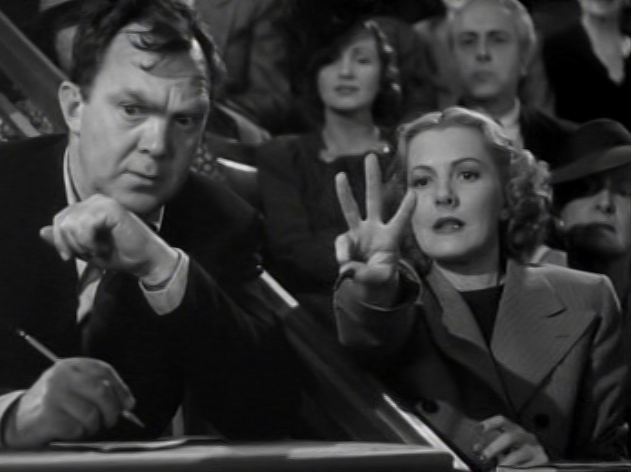
I love the shots of Jean Arthur in the gallery throwing signs to Stewart like a catcher to a pitcher to guide him through the filibuster process.

There is some strong imagery in the Senate chamber. We see Claude Rains and the other senators filmed from the floor to the ceiling so they look like giants. We see shots down from the ceiling at the menagerie of “senators” and extras looking small as they fill the room, a tight cluster of humanity. The arrogance of the senators when they turn their backs to Stewart as he speaks.

The climax is strangely quiet. Claude Rains directs the pageboys to carry in baskets of telegrams from an angry public denouncing James Stewart because of the lies they have been fed by Edward Arnold. It’s almost like that glorious scene in Miracle on 34th Street (1946) when the letters to Santa arrive. But these scraps of paper do not save Mr. Stewart. They condemn him.

He first looks heavenward, a Christ-like figure as if to say, “Why hast Thou forsaken me?” Then he locks his gaze on Harry Carey, who is sublime as President of the Senate, smiling through his fingers as he tries to mask his bemusement at Stewart through previous scenes. He is a kind of craggy-faced Will Rogers-type character whose eloquence is not in his quips, but in his expression.

Mr. Carey gives him a gentle smile of encouragement, and Mr. Stewart finds the will to continue despite it being a lost cause. James Stewart is triumphant in this moment, not because he has won, but because he has fought the good fight.


I find the ending is where Frank Capra loses us again in a saccharine solution. Claude Rains, overcome by his conscience, hysterically confesses his guilt. Convenient, but unlikely. We know too well that people in office rarely admit guilt. Especially if it would lead to a conviction.

Claude Rains is fascinating to watch in the film. He has a complex role and his evolution is just as important as Stewart’s or Arthur’s. He is a man of ideals who gave up most of them in order to survive in the Washington jungle.

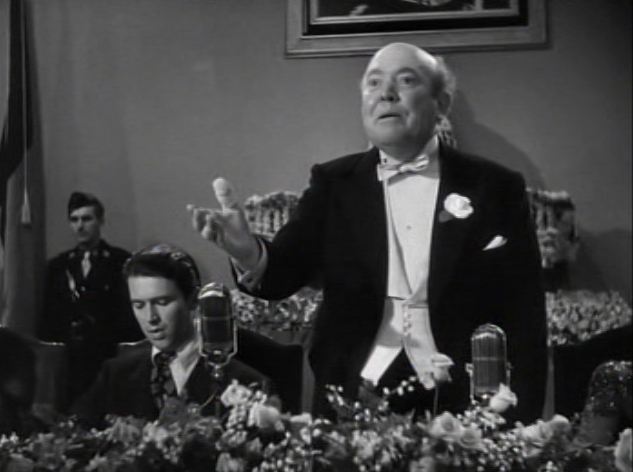
Early on in the film, a banquet is held to welcome Stewart to political life, and Mr. Rains is surprised to discover that Stewart is the son of his old friend. He leans over the dais to spy Stewart’s mother, the lovely Beulah Bondi, who exchanges a look of fond reminiscence. Here is where we first see that Rains has an honest past, and this is where his struggle of conscience begins. He carries the burden through the film.

We see a lot of father-son imagery in the movie: between Rains and Stewart, between Stewart and his Boy Rangers, with the pageboy, between Harry Carey and Stewart.

The first time I went to Washington, D.C., as a young woman and stood in the visitors’ gallery of the Senate chamber, I could not help but think of how it looked in Mr. Smith. It was one of many trips. Washington, D.C., is a place I never get tired of visiting. One can feel cynical and still be inspired.

Despite its occasional hokey sentimentality, these are the real truths expressed in this movie. Jean Arthur reminds a disgusted Stewart that, “They aren’t all Taylors and Paines in Washington. That kind just throw big shadows, that’s all.”

Another truth is Claude Rains’ dismissal of the people voting him out when they learn of the corruption: “You can’t count on people voting. Half the time they don’t vote anyway.”

We get heartily sick of the nastiness of political campaigns, especially when they seem to last so long. But it is a good thing, I think, that we air our grievances so publicly and that other nations can see our anger and discontent. Because they also see that it all leads to election day. No coups, no hanging or shooting the opposing party when you’ve won and they’ve lost. The winners take office. At the end of the term, we vote again. Like clockwork. It’s that splendid confidence in our own system that drove both Nazi Germany and the USSR to ban this movie. It was our suspicion of our own leaders that drove Washington insiders to criticize this film at its premiere. Trust and suspicion, in healthy doses. A marvelous paradox Frank Capra didn’t create, but was clever enough to appreciate. [Addendum: from the perspective of 2022, this last paragraph seems sadly naive.]

This movie, despite, or because of, its sentimentality has inspired many over the decades. It was one of my mother’s favorite movies, and she presented it to me as a kind of civics lesson. When the reporters rush from the Senate chamber shouting, “Filibuster! Filibuster!” -- I recall my mother echoing, “Filibuster!” excitedly when I saw it the first time on TV, grinning, urging me to see what happens next. She was one of the most politically astute people I ever knew. Though neither of my parents were joiners of causes, they learned early the intimate place politics had in their lives when as children the programs like the CCC and the WPA created by President Franklin Delano Roosevelt saved their lives.

Growing up in poor families, President Roosevelt literally kept them from starving and gave them job training and hope for the future. They never took politics for granted after that. It was personal. The most important program in my house was the news. They devoured news magazines and newspapers, and we watched conventions like some people watched the World Series.

When they got ready to go vote, my father shaved. My mother put on makeup. Reading glasses, check. Notes on specific ballot questions, check. They announced with almost theatrical dignity, “We Are Going to Vote,” as if they were about to save the world.  Being able to vote gives you a great sense of power.  Ask anybody who can't.

We were to be good until they got back from saving the world.

I am voting tomorrow because that is what I was raised to do. Because my mother loved Mr. Smith Goes to Washington. Because my mother, rest her soul, who never had a driver’s license or a passport, were she living today would be denied the right to vote by some politicians who are aching to get a whip-smart, no nonsense liberal like her off the books.

And because like James Stewart in the movie, I get all choked up when I visit the monuments in Washington, D.C.

   ********************

Jacqueline T. Lynch is the author of Ann Blyth: Actress. Singer. Star. and Memories in Our Time - Hollywood Mirrors and Mimics the Twentieth Century. Her newspaper column on classic films, Silver Screen, Golden Memories is syndicated nationally.  Her new book, a collection of posts from this blog - Hollywood Fights Fascism - is available here on Amazon.

Thursday, November 1, 2012

Arcade Theater - Springfield, Mass.


This is the Arcade Theater in Springfield, Massachusetts. I think it must be 1933, you can see the marquee listing “College Humor” which was released that summer. Bing Crosby, George Burns and Gracie Allen, and our old pal Grady Sutton.

The theater was on lower State Street. The trolley ran all the way up the hill and out to the residential neighborhoods. The Springfield Armory is up that hill. George Washington established it after scouting the site himself, Dan Shays and his men attacked it, and its skilled machinists helped save the Union during the Civil War, smashed the Axis in World War II. It’s a National Park, now.

You can’t see all the ghosts that walk this street in the photo. You just see the old Fords and trolley tracks. And now, they are ghosts.


It was a “second run” theater in its day, opened for business in 1931. You can see by the ad that Maurice Chevalier got things going with “The Smiling Lieutenant” (1931). Claudette Colbert, directed by Ernst Lubitsch.

According to the Cinema Treasures website, the theater accommodated over 1,000 patrons, even with no balcony. I first heard about it from family members who used to go there.

The Arcade closed in 1971, and was demolished in 1972 to make way for the Springfield Civic Center. That rather ugly cement colossus is now a renovated arena and convention center called the MassMutual Center. The Springfield Falcons hockey team play here. They need a lot of room, more than Bing Crosby or Ernst Lubitsch.

Have a look at the Cinema Treasures website not only for information on historical movie theaters, but for the comments readers contribute with their own memories.  Look up an  old theater you remember, and you may find others remember it, too.

Monday, October 29, 2012

I Married a Witch - 1942


“I Married a Witch” (1942) is a playful examination of three elements: the image of the “good” witch; the idea of a naughty woman being reformed by love; and the idea that love is stronger than witchcraft. One might say stronger than hate or stronger than evil, but witchcraft in this movie is represented as something mischievous rather than diabolical.

Massachusetts -- despite the family-fun atmosphere and tourism dollars raked up like so many autumn leaves over in Salem due to the businesses catering to those interested in the infamous Witch Trials of 1692 (see this post on the monument to Elizabeth Montgomery’s Samantha character in “Bewitched” at my New England Travels blog) -- bears even today a leaden sense of chagrin, if not still a feeling of guilt, over persecution in the 17th century. Salem was only one town; there were others, and witchcraft was an easy card to play in a superstitious era if you did not like your neighbor or spouse and wanted to legally get rid of them.

How we in the 20th century have managed to turn that sorry era into something comic is as much due to a healthy sense of humor as it is a short memory. In the 20th century we manage to see witchcraft as something ridiculous, and yet imagine how fun it would be to have special powers. Especially if they belonged to a pretty, blonde scamp.

Veronica Lake is the witch in the title, and she is charming. The only devil is in her eyes, and she plays both the comedy and the angst of her character with a light, breezy touch. Fredric March is the bumbling mortal she first teases, and then loves.

I wonder if our old pal Glinda “The Good Witch” of the “Wizard of Oz” (1939) was our first exposure to the idea of a “good witch”? The idea of the good witch, by the 1940s and 1950s, turned into the sexy witch through this film, and stage hit and film “Bell, Book, and Candle” (1958) -- see this previous post. Samantha of the TV hit “Bewitched” followed in due course in the 1960s.

The high points of this film are its silliest, small moments that seem to step away from the script, break the fourth wall and say to us, “We’re only kidding.”

This begins only moments after the film starts when, in a prologue, we are taken back to a witch burning in the 17th century, and a man played by Billy Bevan, is selling popped maize, tuppence a bag to the crowd. Later, in the modern era, Cecil Kellaway, who plays Veronica Lake’s warlock father, sets the Pilgrim Hotel afire. There are the usual sly uses of broomsticks, a black cat, and lots of fun special effects.

Fredric March plays, at first, the 17th century Puritan whose testimony sent Veronica Lake to her execution as a witch. She puts on curse on his family, whereby none of his descendents will enjoy a happy marriage. Then we see brief vignettes were Mr. March plays his unhappy descendents in loveless scenarios.

His 20th century self is just as despondent. We join the modern era in a ballroom celebrating both his impending marriage to a shrewish Susan Hayward, who is really very good in this small role, and his impending election to the office of governor. Robert Benchley is Fredric March’s bemused friend and sidekick.

A storm brews, outside as well as in, and a freak bolt of lightning zaps the tree in which the spirits of Veronica Lake and her pop, Cecil Kellaway have been imprisoned through the centuries. Now they’re out and making mischief.

She wants revenge on Mr. March for his ancestor’s part in her execution. Her weapon is a potion to make him love her. However, by mistake, she drinks the love potion and then she’s nuts about him, to her father’s disgust.

Lots of twists and turns both in their romance and his run for elected office, but just a few fun scenes:

When observing the black tie party, Lake (still a formless wisp of smoke before she has found an appropriate 4’11” body) remarks on the cheek-to-cheek dancing of the modern era: “I never thought I’d see close like that in New England.”

I love the several false starts of “I Love You Truly” at the wedding of March and Miss Hayward sung with wavering gusto by Helen St. Rayner. And the gust of wind created by Miss Lake and Mr. Kellaway at their late entrance that wreaks havoc on the wedding.

After spending the entire movie reminding his daughter, Susan Hayward to smile, Robert Warwick finally replies to her anxious, “Do I look all right?” with a bark, “Who cares?” I also love the weary, fake smile she plasters on her face for the cameras as she comes down the aisle for, I think, a third time. She has a very strong presence in this movie despite playing what could be a throw-away role.

Her matron of honor is Bess Flowers, because really, you just can’t have a movie without Bess Flowers.

I think my favorite scene is when Veronica Lake, who has just discovered the joy of waffles, keeps shoving them into her mouth, folding them up like a sandwich.

We have a late entry here into the Women Wearing Men’s Jammies genre. See this previous post.

Good old Elizabeth Patterson, who enjoyed such a long career on stage but is probably known to most of us as Mrs. Trumbull on “I Love Lucy” steps in as Fredric March’s beleaguered housekeeper.

At the end of the movie, we have little Ann Carter galloping around the house on a broom, to the consternation of her parents. She looks like a miniature Veronica Lake. We’d see Ann later doing very good work as Humphrey Bogart’s daughter in “The Two Mrs. Carrolls” (1947). Sadly, she was struck with polio in her teens, ending her film career. Fortunately, her health eventually recovered.

I wonder how many films featured a Justice of the Peace awakened in the middle of the night and officiating a wedding in his bathrobe?

Fredric March is very polished, and good in his deadpan moments, especially when he has won the election through Veronica’s witchcraft. His opponent had no votes. March gapes at Robert Benchley, “He didn’t even vote for himself!”

I like the way he lifts her long locks off her shoulders as he speaks to her. Many fans are aware the two did not like each other at all, but their work does not show that.

Veronica Lake’s comedic timing is quite good as well. She presents March to her father, and adoringly looks up at Fredric, “He’s just like a Greek god.”


The image of the good witch or at least the sexy, charming scamp is challenged only at one chilling point in this movie. It’s a fascinating scene played by Cecil Kellaway with knife-edge tension masked by a roguish smile. He intends to force Fredric March to shoot him (being a sorcerer, only his borrowed body will die, he has no fears for his immortality) so that March will be convicted of murder and be sentenced to death. In the electric chair. As Kellaway puts it, the modern way to “burn”.

His plan is evil, devious, and strangely human. Veronica Lake decides love is stronger than witchcraft. An idea that love can make us superhuman if not supernatural.

The movie was released October 30, 1942, just in time for Halloween. I did not notice any wartime references, so this must truly have been a delightful escape.

Monday, October 22, 2012

Intermission


No blog posts this week, I've got some other fish to fry.  See you next Monday the 29th for our Halloween look at "I Married a Witch" (1942).

Related Products