When Patricia Nolan-Hall, a.k.a. Paddy, a.k.a. The Caftan Woman
left us in March, the classic film blogger world lost one of its greatest
champions and one of its dearest friends.
This is my entry for The Caftan Woman Blogathon. A delightful aspect to Paddy’s love of
classic films is that she embraced a wide range of genres and wrote about them
with passion and humor. She liked the
great films, but also loved series movies, especially the mystery genre, and
especially Charlie Chan.
Have a look at the rest of the Blogathon participants atthis page. Visit them all and leave a
comment. You know Paddy would.
The character of the great Chinese-American detective,
Charlie Chan, was created by novelist Earl Derr Biggers in the early
1920s. Mr. Biggers was inspired by reading
about two real-life Chinese-American police officers in Honolulu. He created Chan as a protest against the “Yellow
Peril” bigotry in California of the day.
He wrote six novels in the Chan series, and by the late 1920s, Hollywood
tentatively expressed interested by producing a few films where Charlie Chan
was only a supporting character. But his
popularity took off when Warner Oland was cast in Charlie Chan Carries On
(1931), and played the detective for the remainder of his life. Upon his death, the role was taken over by
Sidney Toler for another decade.
The Charlie Chan series was quite popular, but in later decades its place in film history seems tarnished – or at least challenged – by modern sensibilities
which naturally recoil from ethnic or racial stereotypes, particularly when
played by white actors. The critiques are fair, but only in part. Charlie Chan spoke in broken English and
spouted Confucius-like proverbs, but that was the extent of his being a Chinese
stereotype. Inspector Chan was a world-famous
detective, intelligent, kindly, urbane, courageous, honorable, modest, and his kids
called him “Pop.” His fast-talking
American kids, who he had to cut down sometimes to keep them from messing up
his latest case. He was an exasperated
father who still managed to save the day despite bad guys, uncooperative witnesses,
and sons who didn’t always listen to him.
Keye Luke, who played his eldest son and sidekick in many
movies felt strongly that the Charlie Chan character was not demeaning to
Chinese. He is reported to have replied,
“Demeaning to the race? My God! You've got a Chinese hero!” He noted, quite accurately, that they “were
making the best damn murder mysteries in Hollywood.”
There were something like 47 Chan movies made in the U.S.
from 1926 through 1949, which made it one of the longest, if not the
longest, movie series. This is not
counting the Spanish-language Chan movies, or the movies (including parodies)
which featured Chan in later decades. The
honorable Inspector Chan found his way into radio shows, television, comic
books, and even a 1970s cartoon series.
Chan was something of a cultural phenomenon. Paddy covered at length or at least mentioned
something like fifteen Charlie Chan movies on her blog. She did not approach the series with any apologetic debate about stereotypes. She
expressed wholeheartedly her delight at his personality, cleverness, the plots
of the films, and her fangirl crush on Number One Son, Keye Luke. I’m with her on that one. In fact, I’m remiss at not having covered
Chan movies before on this blog because I’m also a fan.
Paddy covered in depth the origins of Chan in all formats,
and traced the careers of the character actors who appeared in the films with
her typical encyclopedic knowledge, and most of these posts were for blogathons. Paddy loved blogathons. There is a banner in her sidebar for every blogathon
she joined.
I wanted to pay tribute to Paddy by co-hosting this blogathon and with my
post, but unexpectedly, I also discovered a sense of comfort in going through
her Charlie Chan posts for this entry. Re-reading the words reflecting the vibrancy and wit of my dearly missed friend wasn’t as painful as I thought it would be and I even found myself
laughing at some of her wry and always enjoyable observations.
Here then, is The Caftan Woman facing off with Charlie Chan. Please follow the links to read her full
posts on The Caftan Woman blog.
REEL
INFATUATION BLOGATHON: Keye Luke as Lee Chan
“My tween years were devoted to sneaking up late at night and
watching whatever old movie I could find. One momentous night I was introduced
to Inspector Charlie Chan, 60 summers young and 60 winters old, and his number
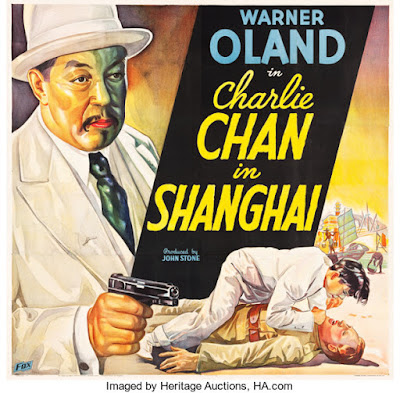
one son, Lee in Charlie Chan in Shanghai.”
“The first scene in the movie had introduced me to Inspector Chan
who seemed a movie detective worth following. Lee immediately impressed me with
his good looks and enthusiasm. It's even more fun to solve a fictional crime if
you have a crush on one of the detectives!”
“Immediately, we can sense the bond of affection between Charlie
and his firstborn. Warner Oland and Keye Luke became close, with Oland a mentor
to the young man, and Luke a fond protector to his often troubled older friend.”
“My admiration and affection for the actor runs deep, but my
crush, the crush of that tween girl up late when she was supposed to be
sleeping on a school night, is only for Lee Chan, #1 son.”
VISITING PARIS WITH INSPECTOR CHAN: Charlie Chan in Paris
(1935) and City in Darkness (1939)
“Charlie Chan in Reno… a terrific movie that could easily be paired with The
Women for a great movie night.”
Of Harold Huber in Charlie
Chan on Treasure Island: “Huber literally throws
himself into the unaccustomed comic relief duties as a character that comes off
like Inspector Clouseau's grandfather.”
Favourite
movies: Charlie Chan at the Olympics (1937)
“Charlie Chan at the Olympics is set amidst a background of political turmoil, contentious
ideology and threats of violence at a sporting event that sees itself in a
bubble apart from those things surrounding it. Perhaps that is the celebration
that the Games should be, but can never be. The movie is an entertaining visit
to the past with an uncomfortable connection to our present.”
AT
THE CIRCUS BLOGATHON: Charlie Chan at the Circus (1936)
“One of the outstanding features of the character of Chan, as
opposed to many other fictional crime-solvers, is the fact that he is a family
man. A family man in a big way with 12 offspring. During the course of the
series, he even becomes a grandfather (Charlie Chan in Honolulu). We
don't generally see a lot of granddads going head to head with the criminal
class.”
“One of the thrilling aspects of the movie is that it was filmed
on the winter location of The Barnes Circus and utilized the sights, sounds,
people and animals from day-to-day circus life.”
Horseathon:
Charlie Chan at the Race Track (1936)
“Oland found an alter ego that touched his soul. He
approached the role of Inspector Chan through diligent study of Chinese history
and philosophy and so fused his personality with that of Chan's that he became
the character. Enduring international fame was Oland's reward for such
fidelity of purpose, especially in China, the land of the fictional detective's
ancestors.”
“Keye Luke always spoke fondly and admiringly of Warner Oland in
interviews, and refused to continue in the series after the death of his friend
in 1938.”
“Charlie Chan 101 for Newbies: If there is a young romantic
couple, and there always is a young romantic couple, you can erase them from
your suspect list. They are included only to be young and romantic.”
Harold Huber
“He is a welcome sight in enjoyable crime programmers and most
important to this child of the late show, he is a superstar in the Charlie Chan
universe.”
Of his work in City of Darkness: “To Harold Huber fell the
job of comic relief. I have acquaintances who do not care for his work in this
movie. I am not of their mind. Perhaps it is because I like Huber or that I
have a soft spot in my heart for those who toil as comic relief…I can't help
but think of him as the emotional Pere de Clouseau, and I get a kick out of the
work.”
Backstage
Blogathon: Charlie Chan at the Opera (1936)
“Boris Karloff rightfully received top billing with Warner Oland
in Charlie Chan at the Opera…Karloff's performance is touching and
assured. It also lays the groundwork for Maurice Cass' line, as Mr.
Arnold, "I'm stage manager here and this opera's going on tonight even if
Frankenstein walks in."
Corny? Perhaps, but delivered with
unabashed gusto and always gets an appreciative chuckle.”
Beach
Party Blogathon: The Black Camel (1931)
“When I read the Nancy Drew mystery The Secret of the
Golden Pavilion as a young girl I longed to visit Hawaii. Later
on when I read Earl Derr Bigger's The House Without a Key my
fondest wish was to visit Hawaii in the 1920s. I imagine the closest I'll
ever get to that far-fetched whim is in watching the 1931 Charlie Chan
feature The Black Camel.”
“If I really could go back in time, I might have tea with Earl
Derr Biggers and ask him about one of the plot points that has always bothered
me concerning the clue of the ripped out newspaper photos. If it didn't
bother Biggers or his editors, it probably shouldn't bother me, but there it
is.”
For
Your Consideration: Sen Yung
“With only extra work in his background (Mr. Moto Takes a
Chance and The Good Earth), Sen Yung was most happily cast
with the new Chan, Sidney Toler. He proved adept at the comic enthusiasm which
was Jimmy Chan's trademark and had a nice chemistry with star Toler. It is a
pleasure watching him in the role today.”
“The Academy should have been taking note of the 24-year-old
actor's work in William Wyler's adaption of W. Somerset Maugham's The
Letter in 1940. As Ong Chi Seng, the law clerk with an agenda, Sen
Yung steals scenes and gives the audience something to think about. While the
British go about pretending the world is theirs, the unctuous young man reminds
them that there is another world around them, one they cannot control. There is
not a trace of the ebullient would-be detective in this fine characterization.
It is a highlight in a film full of wonderful atmosphere and performances.”
Decorating
with Boris
In which The Caftan Woman recounts acquiring this poster for her
kitchen.
“As I spent a joyful couple of hours going through the wares of a
shop it occurred to me that I - one of the world's noted Charlie Chan fans - I
did not have a Charlie Chan poster among my collection. I turned to the
vendor's assistant and, barely able to contain the excited anticipation from my
voice, asked "Do you have Charlie Chan at the Opera"?
"Why?" he responded. "What's so hot about Charlie Chan
at the Opera?"
Taken aback may accurately describe my reaction to his query, but it was more
than that. I was shocked…
"Perhaps," I responded politely, yet coldly, "if I
used the full title card you will realize the folly of your question. I am
speaking of Warner Oland vs. Boris Karloff in Charlie
Chan at the Opera." Unimpressed, the lackey pointed in a vague
direction. "Yeah, that's here somewhere."
THE
HOLLYWOOD GANGSTERS BLOGTHON: Charlie Chan on Broadway (1937)
“The movie world of Charlie Chan
finds him often dealing with cunning murderers and spies, but Charlie
Chan on Broadway is the only time in his 20th Century Fox period where
he dealt with bona fide gangsters.”
And she ends with her 2011 second-place winning
Haiku, a sublime piece:
The gathered suspects
Tremble 'neath Inspector's glare
You are murderer
Sailing
Away on Charlie Chan's Murder Cruise, 1940
Published on her blog only weeks before she passed.
“Charles Middleton and Claire Du Brey play the Watsons. Jimmy
rightly calls them "bluenosers." They are killjoys and she claims to
be psychic. Just the sort you want along on a cruise…
“It's all fun and games until there is another murder or two.”
Paddy Nolan-Hall touched so many bloggers and readers in the past
14 years of writing her blog. I will
continue to visit The Caftan Woman from time to time, the way we
continue to rewatch favorite movies to visit our old friends on film.
Have a look at the other bloggers’ entries to this blogathon hereat this page.
Thank you for reading.