IMPRISON TRAITOR, PEDOPHILE, AND CONVICTED FELON TRUMP.

Thursday, February 25, 2021

Classic Film Props and Memorabilia


If you could have any prop from any classic film, what would it be?

I just saw a post like this on Facebook and I thought I'd swipe the idea for us, but I'd like to expand that to ask what you may already own.   Many of you are collectors of classic film memorabilia anyway and I'd love to know what you have in your collections.

So, what do you have, and what do you want?

Personally, I think I'd get a big kick out of an off-screen item: one of those canvas director's chairs with the name of...oh, say, Humphrey Bogart on it, or Barbara Stanwyck, or Ann Blyth...or Joseph Cotten...or....

Thursday, February 11, 2021

Hal Holbrook on Mt. Tom, Holyoke, Massachusetts


Beloved memories and tributes pour forth as we note the recent passing of actor Hal Holbrook, perhaps most famous for the one-man show he created: “Mark Twain Tonight!”  He first achieved his actor’s union Equity card working for a noted summer theater on top of Mt. Tom, in Holyoke, Massachusetts in the early 1950s.  The ramshackle wooden playhouse was called, grandly, “The Casino.”  The resident troupe was The Valley Players.

Though their name paid tribute to the region of the Pioneer Valley, that broad swath of history and dinosaur tracks that comprise that section of the Connecticut River valley, the playhouse was actually on the grounds of an amusement park…on the top of a mountain…at the edge of a factory town.  No scenic shoreline summer barn, but a working, vibrant company in a glorified shack in as unlikely a place for traditional New England summer theatre as one might find. 

 
Holbrook and his first wife Ruby were members of the company for a few years in the early 1950s.  In 1957, he returned as a guest to open the season with his show on Mark Twain, performing it in its full-length version for the first time.
 
The following passages are from my book, Comedy and Tragedy on the Mountain: 70 Years of Summer Theatre on Mt. Tom, Holyoke, Massachusetts.
 
We begin with Holbrook’s own recollections from his memoir:

 
While The Firebrand was playing eight performances, Monday through Saturday, we were also rehearsing Goodbye My Fancy to open the following Monday.  While Fancy played its eight performance schedule we’d rehearse the next play, and so on down the twelve-week summer season.  We rehearsed five hours a day, but only two hours on matinee days, Wednesdays and Saturdays, and we learned the lines at night after the evening’s performance.  Jean and Carlton’s rambling old home became our clubhouse, where there was close companionship and plenty of beer on ice.  We cued each other over and over until we had nailed those pages of lines into our brains.  Sleep was the only thing that was rationed.
 
In an on-camera interview for the locally produced television documentary, Mountain Park Memories, Mr. Holbrook recalled,
 
You had to learn all new lines.  A new play…I can’t even believe  today what  we  did.   You’d stay up till 2 o’clock working real hard on your lines.  You’d go back, you’re trying to get six, seven hours sleep.  Get up, rehearse all day, do the show again at night, then learn the lines in the middle of the night for the next.  And you do that every night, every day, week after week.  And it took spirit…
 
Mr. Holbrook’s chapter in his memoir, Harold, on The Valley Players is filled with delightful reminiscences of specific plays.  He would receive his first featured role for The Valley Players in Candlelight in late August.
 
 The Valley Players managers noted of Holbrook in a program at the end of the 1953 season:
 
Admirable actor as he was from the outset in 1951, his work has broadened and deepened and humanized as season after season unfolded.  One of the greatest rewards of summer-theater management is to see a fine actor mature in ever-greater and greater achievements.  All that we can provide is the opportunity: the credit for making the most of it belongs to the actor.  Mr. Holbrook, we believe, will go far in the world of theater…
 
The local press had equally warm thoughts that summer towards the acting company:
 
The Valley Players have made this community a richer place in which to live during the summer season.  They’ve made for us a happy feeling that they belong to us…  The Valley Players themselves, as persons, make a happy factor in our community life.  A group with high standards as individuals, people you wish you might know better and still be able to invest them with the glamour that they lay upon us.  We could wish we might show ourselves as hosts eager to do them honor, we thank Carlton and Jean Guild for choosing to settle into our Holyoke life and for wanting to stay with us…
 
 In 1954 Hal Holbrook went to New York and had a regular job on the radio soap opera, The Brighter Day.  He did regional theatre, and appeared in clubs in New York with skits on some new material he had worked up himself – on the nineteenth century humorist Mark Twain.  It would be his making as an actor.  He performed his Mark Twain persona on The Ed Sullivan Show and The Tonight Show with Steve Allen on television, and by the end of the decade, would debut a full-length one-man show on Twain—at The Valley Players as a special guest performer in 1957.
 
Mr. Holbrook notes from his autobiography, Harold
 
On June 6, just before heading to Holyoke, I got another appearance on NBC’s Tonight Show with Jack Lescoulie as host.  Would that help me fill the big open-sided Mountain Park Casino in Holyoke?  I wondered.
 
Mark Twain Tonight!, presented at Holyoke in its first full-length version, was a career-making event for Hal Holbrook.  It opened The Valley Players’ sixteenth season.  The reviews were fabulous.
 
From Louise Mace of the Springfield Union:
 
“…a unique and rewarding program…in all life, so it seemed, there was Samuel Langhorne Clemens himself, complete with immaculate, comfortably wrinkled white suit, brisk red tie, drooping white mustache, ample white headpiece, and the inevitable cigar…a re-creation of a man and a mind in a deeply kneaded personification.”
 
From the Daily Hampshire Gazette:
 
His portrayal is both a science and an art. He has paid scrupulous attention to detail, from the shuffling walk to the twinkle in his eye.  Hal Holbrook never draws a breath on stage—it is Mark Twain even when he tells a story requiring the dialect and mannerisms of three or four additional characters.  A remarkable piece of showmanship, Mark Twain, Tonight at the Casino through Saturday merits your attendance.
 
The Holyoke Transcript-Telegram called it “a fascinating artistic masterpiece…the young Mr. Holbrook, remembered as the company’s handsome leading man a few year ago, is dropped from mind the instant Mark Twain enters the stage…”
 
 Barbara Bernard, who attended the opening night performance, remembers:
 
I thought: this is going to fall flat on its ear, or it’s going to be something so different.  Well, it was—and it was magnificent.  He came out in that rumpled white suit.  Oh, he was terrific.
 
William Guild recalls:
 
It took him two hours to put on that makeup.  You know, back then you had to use putty and all kinds of stuff that they can do so easily now.  But I mean he was late twenties or maybe thirty.  But I used to drive him up to the theater three hours before the performance for the week that he was doing it, and we would sit in the dressing room while he did makeup, and talk.  I have very fond memories of that.  He was kind of like an uncle in a way.
 
In less than two years, Holbrook’s one-man show would be a smash on Broadway.


(Note, the above photo is of Holbrook as Twain as he preformed it in 1957 on Mt. Tom.  Courtesy Holyoke Public Library History Room and Archives.)
 
******

For your copy of Comedy and Tragedy on the Mountain: 70 Years of Summer Theatre on Mt. Tom, Holyoke, Massachusetts, please see this universal link for the eBook available at Barnes & Noble, Apple, and a variety of other online shops.

For the print book and also eBook, please see this link to Amazon.

I hope you enjoy it.  For more of my books on Amazon, Barnes & Noble, Apple iTunes, Kobo, and a variety of other online shops, please see my website here:  www.JacquelineTLynch.com.

Thursday, February 4, 2021

Walter Tetley


Walter Tetley was a giant in a world inhabited by scores of immensely talented colleagues.  He rose to success on his talent, but could only go so far, his career and even his personal life hindered and ultimately crippled because of a physical anomaly.  But since his real bread and butter, and genius, was his voice, he was fortunate to come of age in the first half of the twentieth century when radio was the predominant popular entertainment. Here, he shines.


His story is chronicled in Walter Tetley – For Corn’s Sake by Ben Ohmart (Albany, GA: BearManor Media, 2016).  This is the second edition of the book, and the author notes that if further information becomes available, he would like to issue a third updated edition, recounting the trail he followed to find what information he was able to gather almost like a detective story.  I like the BearManor Media books, a publishing company devoted to the lesser-known stories of the entertainment world, and I’m glad there’s a place where these kinds of books can be fostered.  Mr. Ohmart includes a quite comprehensive list of Walter Tetley’s radio and film work, though his film career was rather brief and featured mostly uncredited roles as bellhops and delivery boys.


His misfortune was a congenital hormonal defect, possibly Kallmann syndrome, which prevented the onset of puberty.  This obviously affects the body in many ways including endocrine and bone problems, the failure of reaching sexual maturation also resulting in stunted growth and a lack of an “adult” appearance.  Any discussion of Walter Tetley invariably calls forth this mysterious condition, the fact that his age was always recorded in the press as much younger than he really was to cover for it, and when even after hormone shots that led to a growth spurt, his child’s voice never changed, he never grew facial hair, and the child’s roles he took had to sustain him for the rest of his life.  Even his appearance in middle age, with a face that seemed puckered, leathery, heavily lined and somewhat jaundiced, prevented him from achieving a film career as a character actor worthy of his prodigious talent. Even his ability to form personal relationships was stunted.  His fellow actors admired his talent and professionalism, but claimed they never really got to know him. Though he belonged to civic organizations and was a faithful supporter of charitable causes, he lived a lonely life and never seemed to fit in.

He found work as a voice actor in cartoons, and fans of The Bullwinkle Show fondly recall his turn as Sherman, the boy that the genius dog Mr. Peabody adopted.


But toward the end of his life there were fewer cartoons made, radio was all but dead, and there was no call for his talent in movies or television.  A few commercials sustained him.  He worked when he could, but medical issues, including a terrible accident he suffered riding his motorcycle, racked his body and saddled him with considerable medical expenses.  He died at 60 in 1975.


But listening to Walter Tetley on Old Time Radio broadcasts is pure delight, and he lives again, towering above his castmates in timing and inflection.  One of his earlier long-term gigs was the Coast to Coast on a Bus show broadcast from New York in the 1930s where he performed a variety of characters in a variety of accents.  His ear was uncanny.  (Perhaps the most famous child actor from this program was Ann Blyth.)  His next big career move was with The Great Gildersleeve, in which he performed for some 17 years from the late 1930s to the early 1950s.  He played Leroy, the nephew of Throckmorton P. Gildersleeve, with Harold Peary first in the title role and later Willard Waterman.  He was the good kid, the sometimes bane of his sister, beloved by Birdie the housekeeper played by Lillian Randolph, and the mischievous, occasional thorn in the side to his bachelor uncle.  He was likeable, funny, and with comic timing that never missed a beat.  “For corn’s sake!”  was his signature exclamation of frustration.

He also had a role on The Phil Harris-Alice Faye Show where he played the grocery delivery boy Julius Abruzzio, with a Brooklyn accent and cartoon-like explosions of outrage, mirth, and incredulousness that is utterly hysterical.  His being the foil of, and often foiling in return, Phil Harris and his troublesome sidekick Frankie Remley, is one of the highlights of the show.  These programs were broadcast some 70 years ago, and Julius will make you laugh out loud as if the years melt away or didn’t matter at all.

Mr. Tetley’s at the mic again.  And he’s a natural.

Have a listen to a couple of shows:  Here’s Tetley as Julius in The Phil Harris-Alice Faye Show from October 1949.  He’s a witness to a brawl that Phil started and now Phil and Remley have to keep him from testifying. 


Here he is as Leroy, home sick with the flu in an episode of The Great Gildersleeve from February 1946.


*****************

Jacqueline T. Lynch is the author of AnnBlyth: Actress. Singer. Star. and Memories in Our Time - Hollywood Mirrors and Mimics the Twentieth Century. Her newspaper column on classic films, Silver Screen, Golden Memories is syndicated nationally.  Her new book, a collection of posts from this blog - Hollywood Fights Fascism - is available here on Amazon.


Thursday, January 28, 2021

Public Domain Day - 2021


On January 1st, the creative works of 1925 entered into public domain.  Here are a few classic films that are now public domain items:

The original Stella Dallas with Ronald Colman, Belle Bennett, Lois Moran, Alice Joyce, Jean Hersholt, and Douglas Fairbanks Jr.

King Vidor's The Big Parade starring John Gilbert.

The Freshman with Harold Lloyd, which we covered here.

Go West, with Buster Keaton.

The Gold Rush with Charlie Chaplin

The Unholy Three with Lon Chaney.


The biggest convenience to classic film writers 
of the annual Public Domain Day is knowing that all works of a certain year have now passed into public domain and that makes it easier to remember than having to research individual titles to see which ones are and which aren't due to failure to renew the copyright under the last century's various copyright extensions.  Some titles of the many produced in 1925 were already in public domain, but now they all are free to use.

Here's a link to last year's Public Domain Day post for films of 1924.

*********

Jacqueline T. Lynch is the author of Ann Blyth: Actress. Singer. Star. and Memories in Our Time - Hollywood Mirrors and Mimics the Twentieth Century. Her newspaper column on classic films, Silver Screen, Golden Memories is syndicated nationally.  Her new book, a collection of posts from this blog - Hollywood Fights Fascism - is available here on Amazon.

Thursday, January 21, 2021

Starring the U.S. Capitol Building

The United States Capitol Building has seen its share of tumult and triumph in a couple of hundred years, and certainly in the past couple of weeks.  James Stewart, seen here in Mr. Smith Goes to Washington (1939), which we covered in this previous post, points us to that magnificent structure, rich in history, beauty, and symbolism.  It was not destroyed two weeks ago, and nor was our democracy.  We have a remarkable and sometimes astounding ability for renewal in this country.  Sometimes it feels so good, it's like a Capra movie.

Thursday, January 7, 2021

Blog goes dark


The blog goes dark today in observation of the fascist insurrection that is, to be realistic, not over.  The dirty rabble that desecrated the Capitol Building are a dramatic visual for the television cameras, but they are the least of our worries. Traitors need to be rooted out in government as well as law enforcement, perhaps also the military, as the unfortunate thug who was shot and killed had been an Air Force veteran. For her to betray her oath to the Constitution, something other than duty and honor was clearly more appealing to her. There must investigations, certainly.  But there must also be trial and punishment on a scale such that our allies and enemies alike will know that democracy is still safe in our hands and we can be trusted to defend it. 

At one point, one traitor climbed the building and removed an American flag, replacing it with a "Trump" flag. A fascist is not loyal to his country, but to his dictator. 

Let's not allow that to ever happen again.

Thursday, December 31, 2020

"What Are You Doing New Year's Eve?" - Ella Fitzgerald

Friends, it's been a hellish year and now it's time to kick 2020 to the curb.  Enjoy this slice of heaven with Ella Fitzgerald singing "What Are You Doing New Year's Eve?"  It's more wistful than celebratory, but maybe that just fits the mood this year anyway.


Thank you for the pleasure of your company.  See you next year.


A reminder as well that the free offer of an eBook, my 
novel Meet Me in Nuthatch runs until January 6th.  It's a comic, poignant tale of a small town that needs a jump start, and the Christmas tree farmer up the road has a nutty idea about reenacting the town as it was in 1904 that just might help.  Follow this universal link to obtain the eBook on your choice of online shops: Apple, Barnes & Noble, Scrbd, 24 Symbols, Playster, or Vivlio.  

*****************

Jacqueline T. Lynch is the author of AnnBlyth: Actress. Singer. Star. and Memories in Our Time - Hollywood Mirrors and Mimics the Twentieth Century. Her newspaper column on classic films, Silver Screen, Golden Memories is syndicated nationally.  Her new book, a collection of posts from this blog - Hollywood Fights Fascism - is available here on Amazon.

Thursday, December 24, 2020

The Curse of the Cat People (1944)


The Curse of the Cat People
(1944) is both a child’s fantasy and a tale of the supernatural, where the worlds of children and adults are separate and cause misunderstanding, even trauma, when they collide.  The adult most affectionate and sympathetic with little Ann Carter is a ghost.  Ann must navigate frustration, terror, even near tragedy before she finds acceptance, peace, and contentment with her parents.


The sequel to Cat People (1942), producer Val Lewton’s landmark low-budget horror film, The Curse of the Cat People brings back Kent Smith and Jane Randolph, lovers who are now married; and Simone Simon, as the ghost of the character she played in Cat People, who had been the first wife of Kent Smith. I won’t go into the plot of Cat People as it has only a cursory relationship to The Curse of the Cat People.  The story does pick up where the first movie left off (six years later, when Kent Smith and Jane Randolph now have a little daughter), but, refreshingly, it constitutes a new chapter in the adventures of the characters (plus a new star), and not just a repetition of events in the previous movie as happens so often in sequels. 

The directorial debut of Robert Wise, who took over from Gunther von Fritsch, the movie is a delicate psychological puzzle from the viewpoint of a sensitive and lonely six-year-old girl played by the captivatingly natural Ann Carter.  We see at once that her imagination, which has her trying to make friends with a butterfly, makes her an outsider when it comes to the company of other children, who think she’s weird.  Her parents, particularly her father, is disturbed by this. He wants her to make friends with other kids, not to live in a dream world, and just be normal like everyone else.  His late first wife was affected by what he felt were mad and self-destructive delusions, resulting in her tragic death.  He is afraid that a similar calamity will fall on his family again if his daughter doesn’t snap out it.  We may forgive his impatience, even anger, towards the little girl because we see he’s clearly frightened.  It’s not easy to control a six-year-old under the best of circumstances, and Kent Smith’s need to control his daughter’s behavior is probably more indicative of his own psychological illness than her daydreaming is hers.


Kent Smith is appealing in the role, able to display a dictatorial attitude in a way that suggests he really loves his daughter but he’s been traumatized by his past – another actor might just seem bossy and mean where Smith comes off as really more skittish.  Mr. Smith had a lot of stage experience, was handsome, but perhaps a certain aloofness on screen and lack of that – for want of a better term, glamor of some male stars like Clark Gable or Tyrone Power, kept him from being a major star.  Joseph Cotten had some similar qualities, but had better luck at being chosen for a few romantic leads that increased his stature.  I think there was among 1940s male stars a kind of wistful melancholy that seems strikingly different from the brash charmers of the 1930s – Alan Ladd, Van Heflin, Kent Smith, Joseph Cotten, Gregory Peck, Robert Walker.  Maybe you can think of others.  The war made us more introspective and less certain about our world, and our young men – even the ones who did not go to war – reflected our skittishness.  Perhaps the ones who did not go to war were even more uncertain about themselves.  So Kent Smith’s character in this movie is not an enemy to the little girl, but a reflection of the baffling and sometimes scary world she lives in.

The world children live in is really the world we adults make for them.  We say that a child is “living in her own little world,” but that’s not really true; she’s just coping with the one we gave her.  Part of Ann Carter’s trauma is she’s not able to follow the rules the grownups give her because the grownups keep changing the rules.  Her father told her a playful story of a cavity in a nearby tree being a magic mailbox to another world. She took him at his word, and put her birthday party invitations into the tree to be delivered to her schoolmates.  When the mail was, obviously, not delivered, no one showed up to the party.  Friends were mad not to be invited.  Daddy’s furious because she did a dumb thing and because she’s alienated the other children even more, and he wants a normal kid, dang it.


A strange old lady down the street gives her a ring.  Ann’s parents’ houseman, played by Sir Lancelot, who appeared in Brute Force (1947) which we discussed here, tells her it is a wishing ring.  (We are treated to a brief calypso tune in his chirpy tenor over the sound of him vacuuming.)  She wishes for a friend.  Ann Carter breaks your heart with the simple expression of deep yearning and profound loneliness.


The friend appears, a beautiful lady draped in a light-colored cape, more like an angel and less like a ghost.  They play in the backyard, and the lady, who is Irena, is gentle and motherly, and little Ann is ecstatic.  That the woman happens to be the vision of her father’s first crazy wife is a little awkward.  Dad wants her to stop talking about her imaginary friend, and when she shows him a photo she has found of his first wife and says that’s her, that’s the imaginary friend – it gives Kent the willies and his takes it out on Ann.  He brings her out in the backyard and tells her she must say she does not see Irena.  The kid may believe in fantasies, but she’s not a liar.  She stalwartly announces she does see her.  Dad spanks her.

Fortunately, we are not shown the physical punishment, because that would be too much for us to bear.  Children often fear what will not harm them: the dark, or monsters that don’t exist.  But spankings and beatings are real.  Here is where the real world encroaches on Ann’s already traumatized make-believe one.

Even her kindergarten teacher, played by Eve March, who seems so sympathetic to Ann and reacts to her daydreaming with intelligence and tact, seems cavalier about the spanking and gives it no importance.  There is no grownup Ann can rely on to come to her aid. 

Except the old lady who gave her the ring.

Who’s nuts herself.


Julia Dean masterfully plays old Mrs. Farren, who had been a grand stage actress in her youth.  Though infirm, she still carries the panache of a life in front of the footlights, and entertains Ann in her spooky old mansion with tales of The Headless Horseman of Sleepy Hollow.  They live in the village of Tarrytown, New York, where Washington Irving set his tale of Ichabod Crane.  At the film’s climax, Ann runs away, crossing the bridge where Ichabod met his fate, and she experiences the full force of eerie imagination run wild.


The move is rife with ghosts.  It is moody and atmospheric. It is filled with terrors of the imagination.  And yet…Halloween intersects with Christmas.  We have presents under the tree.  Ann buys a decorative pin, wraps it up and gives it to Irena for a present.  She pins it to her cape, delighted, and in return, presents Ann with a fantastic crystal illusion in her backyard, courtesy of the lighting guy.


When the caroling neighbors come in to sit at the piano and lumber through “Shepherd Shake off Your Drowsy Sleep,” Irena sings over them the enchanting, “Il Est Né, Le Divin Enfant.”


Is this a Christmas story or a ghost story?  There is no reason it should not be both.  The most majestic secular Christmas story ever written was a ghost story: A Christmas Carol by Charles Dickens.  In the very first lines he writes, “Marley was dead: to begin with…There is no doubt that Marley was dead. This must be distinctly understood, or nothing wonderful can come of the story I am going to relate.”

Christmas is full of mysteries.  There is the greatest mystery of the Child being born in Bethlehem.  And there are the hundreds of mysteries that we manufacture to celebrate the season: folk tales, old ornaments that seem magical, and we are revisited by the ghosts of loved ones who have passed with every task we take whether it's decorating or baking or whatever we do that reminds us of our own Christmases past.

Perhaps the grandest mystery, or we might even call it a conspiracy, is the perpetuation of Santa Claus.  We adults set up an elaborate behavioral control system whereby the child must be good or Santa will not bring presents.  He knows when we are sleeping, he knows when we’re awake.  That’s pretty creepy.  He climbs down chimneys and still manages to get into our home even if we don’t have one.  We tell the kids to leave cookies and milk, carrots for the reindeer.  A friend of mine as a child was told to leave a bottle of beer for Santa.  Santa is as picky as he is mysterious.


We bring our kids to sit on his lap for a photo, and the child bears it as best he can, terrified of this big, fat, stranger who is, let’s face, just another kind of clown, and clowns are scary.  We tell the kids they must be good or face the wrath of Santa and the ignominy of not getting a gift.  How ironic, and cruel, in a world where not getting a lot of presents is considered shameful, for both the child and the parent.  We set up two impossible goals: one, that the child will be good as gold when we can’t even be good all the time ourselves; and two, that if we can't actually afford to give many presents then we are shamed, too.

Since Clement Moore’s “A Visit from St. Nicholas,” we’ve been conjuring and nurturing the fairy tale.  NORAD follows Santa on radar every year.  The Post Office has a box for letters to the North Pole.  Even the good Dr. Fauci announced that he visited Santa, checked him out, gave him his vaccination, and he’s good to go.  No fear of COVID for the jolly old soul.

We are disappointed when our young children no longer believe; however, if Junior got to be, say, 15 years old and still believed, we’d tell him to grow up and knock it off.  Of all the mysteries of Christmas a child must endure, there is none so baffling as the inconsistency of grownups.

Of all the explanations of Santa that ever were, I think the best is still Francis Church’s reply to eight-year-old Virginia O’Hanlon in his editorial in the New York Sun, September 21, 1897. She wanted to know if there was really a Santa Claus, because her friends were getting to be the doubtful age and she wanted an authoritative answer.  I can’t tell you how pleased I am she turned to the Fourth Estate. 

Mr. Church’s famous “Yes, Virginia, there is a Santa Claus…” described the existence of Santa in the form of the intangibles of the season and of life…love, kindness, generosity, curiosity…and mystery. It is probably the most famous editorial ever written, and numerous American newspapers reprint it every year on Christmas Day.  Here is a link to Virginia’s letter to the editor and the editor’s reply.

(By the way, Sleepy Hollow, is a village that officially adopted the name in 1996 because…why not?  You have to do something to legitimize the place for the tourists who come there.  The high school’s mascot The Headless Horseman.  The story was written just a few years before Clement Clarke Moore wrote "T'was the night before Chrismtas..."  It isn’t just Santa we go to great lengths to make real.)


But Kent Smith is not so deft at understanding as the editor Mr. Church of the succor of imagination because to him it has always brought pain, and the pressure he exhorts on his little girl drives her to run away out into a snowstorm.  She finds her way to Mrs. Farren’s house, where the old lady is in the throes of a wild psychological trauma herself.  Though she lives with her grown daughter, played by Elizabeth Russell, she is under the delusion that Miss Russell is a stranger, that her real daughter died when a child about Ann’s age, which explains her attachment to little Ann.


She shuts out her real daughter, who is her caretaker, is rude and hateful to her, and Elizabeth Russell grows jealous of Ann.  In another scary twist, the old lady dies with the exertion of climbing a staircase, and Elizabeth nearly strangles Ann in a fit of morbid resentment.  Elizabeth’s trauma from earliest childhood, living with a mother who denied her, must have been extreme.  Another sequel could probably have been launched with her story. 

Ann, with the sudden shock of sensing real and present danger – which is the first sign we are growing up, to be able to distinguish such a thing – fears Elizabeth and calls for help, calls for her friend, the ghost.

Fantasy returns when Irena appears, superimposed over the threatening figure of Elizabeth, covering her angry scowl and lined face with her angelic expression.  Ann is relieved and runs to who she thinks is Irena for a hug.  She embraces Elizabeth, and for a tense moment, the bony hands that were going to choke her relax, and Elizabeth experiences the unaccustomed gesture of affection.  Almost overwhelming to her, she walks away from the child, just as the police and Kent Smith show up, having tracked the girl in the snow.


When Dad, carrying her in his arms all the way home, asks her again if she sees Irena in the backyard, and Ann, still not a liar, says yes, she sees her, this time Dad says he sees her, too.

He doesn’t.  He’s lying.  He’s learned that pretending is okay, and if it really is the ghost of Irena, she gave them all a really nice Christmas gift. 

The script is by DeWitt Bodeen, who also gave us Cat People, The Enchanted Cottage (1945) which we discussed here, and I Remember Mama (1948) before going on to do a lot of television work.  Crafting such a gossamer story that plays just a little over an hour is amazing, and probably one of the movie’s strengths. 

Ann Carter, who commands the movie in nearly every scene, went on to do only a handful of films, among them The Two Mrs. Carrolls (1947) and I Married a Witch (1942) discussed here, before her career was cut short when she contracted polio.  She later went to college to become a teacher, married and had a family. 

We are in the midst of resurrecting Christmases past under a very different set of circumstances this year.  I hope you may find some comfort and pleasure in the solitude and physical aloneness you must seek and maintain for your own good and the good of everyone else.


To pass the time, allow me to offer a free eBook.  My novel Meet Me in Nuthatch is a comic, poignant tale of a small town that needs a jump start, and the Christmas tree farmer up the road has a nutty idea about reenacting the town as it was in 1904 that just might help.  Follow this universal link to obtain the eBook on your choice of online shops: Apple, Barnes & Noble, Scrbd, 24 Symbols, Playster, or Vivlio.  The eBook will be free until January 6, 2021.

Merry Christmas!

*****************

Jacqueline T. Lynch is the author of AnnBlyth: Actress. Singer. Star. and Memories in Our Time - Hollywood Mirrors and Mimics the Twentieth Century. Her newspaper column on classic films, Silver Screen, Golden Memories is syndicated nationally.  Her new book, a collection of posts from this blog - Hollywood Fights Fascism - is available here on Amazon.

Friday, December 18, 2020

The Stranger - 1946


The Stranger (1946) is a film not so much about the battle of good versus evil as much as it is the inner battle the conscience wages to justify evil.  It was a movie of its time, but in this respect has just as much relevance today.

As we end this bizarre and improbable year, I’ve chosen a couple of off-beat seasonal movies instead of the usual holiday fare, to surrender to the curious and unsettling atmosphere this year, and throw even a few more shadows for good measure.  Next week, we’ll discuss The Curse of the Cat People (1944).  We get a Christmas carol, at least, in that one.

Long post ahead.  Have someone read it to you while you string popcorn for the tree.


The Stranger
is not exactly a holiday film, though it does take place in what appears to be late autumn/early winter in a New England town.  I’ve always thought of it as taking place between Thanksgiving and Christmas, perhaps that torpid state just after the tryptophan wears off and before the hectic shopping begins.  In this quiet netherworld between giving thanks and being relentlessly reminded through songs, holiday cards, and popular programs with contrived Christmas themes that there should be peace on earth but there isn’t, a Nazi hunter travels to a small town to settle some unfinished business.

That, in itself, is a remarkable plot device for a nation weary of war, as we were in 1946, wanting to move on, many not wanting to be reminded of ghastly and unfathomable atrocities – and still others, not choosing to believe them.  This was the first feature film to show clips of official government footage of what became known as The Holocaust.  Film critics and fans have argued for decades whether this is Orson Welles’ worst film or one of his best, but that inclusion of this horrific documentation alone, I think, merits this film as a crowning achievement.  Welles’ celebrated creativity could be freewheeling, but he was also a man whose brashness sometimes took the form of frank courage when it came to the larger themes of life, such as: when is an atrocity not merely an inconvenience?  We discussed his radio commentary on race discrimination and a particular savage event in this previous post.

If his direction, not to say his acting, seems harnessed in this production famed for his being forced by the studio to bring it in on time and under budget, with an editor who slashed out several scenes that apparently would have revealed some character development, the movie nevertheless is appealing for what it does show in its very leanness.  There are a few scenes I would have liked to have been more developed, a back story explored here and there, but for the most part, I just enjoy watching the plodding search of the Nazi hunter for the war criminal in hiding. 


Edward G. Robinson plays the Nazi hunter, good-humored, pleasant, pensive, methodical -- a less crusty character than his insurance investigator in Double Indemnity (1944), but just as persistent.  From the opening moments of the film, we see Mr. Robinson is about to tail a Nazi official who is being allowed to leave his post-war incarceration by American authorities in Europe on the chance he may unwittingly lead them to bigger fish, a more important Nazi official who has escaped capture.  No one knows what the big shot Nazi looks like because he never allowed photographs to be taken of himself, they don’t know his new assumed name, or where he is.  All that is known about him is that he has a passion for clocks.
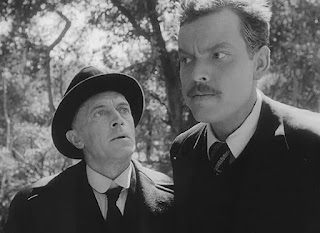

Konstantin Shayne plays the underling, the dupe Mr. Robinson will follow to get to his real quarry.  Shayne is nervous, pushy, and a self-proclaimed religious convert whose blind fanaticism causes him to search devotedly for the whereabouts of his superior all the way to America, where he finds him and instructs him to pray with him and find salvation.  There is no repentance, however, in this man’s religious fervor; only an obsessive-compulsive switch from one fanatical loyalty to Hitler’s regime to a new zeal for a heavenly Master who will presumably reward him with the blessings of superiority that the Third Reich reneged on. 

Close on Mr. Shayne’s heels is Edward G. Robinson, who lost him when Shayne, realizing he was being followed, lured Robinson into a school gymnasium and conked him on the head with gym equipment.  A sign, with black humor, warns us, “Anyone using apparatus in this gym does so at their own risk.”


The gym is part of a private boys’ school, and the town where Robinson has followed Shayne is the fictional Harper, Connecticut.  It is really an ingenious, deceptively simple movie set, and through inventive camera angles looking out at the common through shop windows, it feels very much like a real New England town.  It has a soul, like a character in the movie, a setting that is not a backdrop but a metaphor for American ideals and innocence. 


Most of the action takes place around the common, which is bordered by shops, including a small general store, administration buildings and dorms that are part of the school, and a church with a tall clock tower that is the town’s most impressive feature.  Though the clock tells accurate time, the works include automatons that are supposed to mechanically emerge from the tower when the clock strikes on the hour, medieval figures with swords, but that feature has been broken for many years and so the figures are still and the clock is silent. 


The use of automatons in the clock works seems incongruous for a New England town, particularly in what appears to be a Congregational-style church.  It seems too European, and I don’t personally know of any such clocks in New England, but I’d love to know if there are any. European architectural influences are more commonly to be found in New England’s Gothic Catholic churches, but the steeples are generally not turned into cuckoo clocks.

Still, if its incongruous, it’s another in a string of oddball aspects to wonder about in this place of scattered and decaying fall leaves, a cold breeze shaking bare branches, and wisps of snow flurries as a harbinger of a storm that seems always on its way but hasn’t quite arrived.

Since Edward G. Robinson has lain unconscious on the gym floor, he has missed some of the plot exposition we’ve observed.  By the time he wakes up and makes his way over to the general store for a bottle of aspirin, he’s lost the guy he was tailing.  He doesn’t know that man has just been murdered – strangled to death by the big shot Nazi official for whom Robinson was really searching, the man he hoped Konstantin Shayne would lead him to.  His trail has gone cold.


But we know that the big shot Nazi is here in this little town, employed as a professor in the boys’ academy, and is about to marry the daughter of the town’s most prestigious person – a Supreme Court justice – to give him further cover.  The daughter is played by Loretta Young.  The big shot Nazi hiding in the plain sight under an assumed name is played by Orson Welles.

The three stars are a triangle in this movie; not a romantic triangle but one of friction, a battle of ideals and loyalties, with a curious co-dependence. 

The minor characters form, as often happens in an Orson Welles film, an ensemble company and this may reflect on Welles’ years in theatre and on radio, notably his Mercury Theater players, which as a unit came to Hollywood before they shot off like an Air Force squadron whose planes, with astounding precision, leave the formation and go off on trajectories apart from each other.  One member of that troupe was Agnes Moorehead, whom Welles had considered casting in the Edward G. Robinson role in The Stranger, but apparently the studio did not want a woman for the part.  Unfortunate, particularly as it would have been interesting to see a dedicated, cerebral woman driven to doing her job as a guardian of democracy trying to make the starry-eyed Loretta Young face some hard facts about her new husband.  Someone who might have treated Loretta Young less delicately than the gentlemanly Robinson.


The supporting cast here are not quite the deep bench that Welles’ had behind him in the Mercury Players, but it’s to his credit that he trusts them enough to give them a lot of freedom.  Billy House plays the owner of the general store, as well as the town clerk, Mr. Potter.  He’s a jovial checkers shark who engages anybody in a game for money, and never appears to leave his chair if he can help it.  He steals scenes while both Robinson and Welles, amused or startled perhaps, seem to be unable to do anything about it.


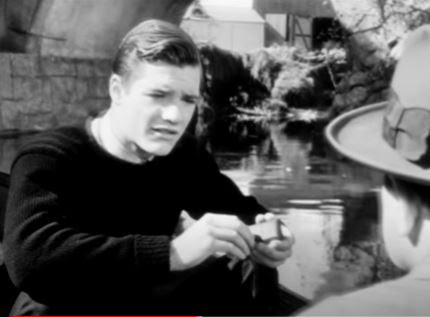
The young doctor in town is played by Byron Keith in his very first movie.   Richard Long plays Loretta Young’s brother, who attends the boys’ academy, and it is only his second film.  He is quite good and very likeable as a quiet young man who enjoys fishing and the outdoors, and seems to make it a code of honor to mind his own business with a refreshing refusal to be judgmental.  But there is a wariness, and sense of being ill at ease with his family situation.  His professor at school is now his brother-in-law.  It takes Edward G. Robinson to point out to Richard Long that Richard does not really like his brother-in-law.  Though Long uncomfortably denies this, he will later help Robinson to trap Welles.


Martha Wentworth plays the housekeeper, and though she did uncredited bit roles, or cartoon voices, and later would appear in television, she did not have a strong career in movies – yet she takes a pivotal scene and really goes to town with it.  Miss Wentworth pops in and out in the early parts of the movie barely noticeable, one might say like a good servant.  But near the end of the film, Edward G. Robinson enlists her help.   Loretta Young is in danger of being murdered by Orson Welles to keep her quiet when she begins to crack in the face of too many of her husband’s dirty secrets and suspicious behavior.  Martha Wentworth must stall Loretta and keep her from meeting Welles at the church clock tower.  Miss Young is impatient to leave, but Wentworth keeps up relentless prattle to distract her.  Loretta gets as far as the door, and Martha bursts into tears (the housekeeper must have had a past life on the stage) and picks a fight with Loretta, accusing her of not wanting her around anymore and which forces Loretta to stay and comfort her. 


Then when Loretta, with dogged persistence, heads for the door again, Martha, a middle-aged woman of no apparent athletic prowess, throws herself on the floor and fakes a heart attack.  It’s a tour de force performance.  These are the kinds of actors Welles populates his films with, and that he gives them free reign to shine is pretty great.


Playing Loretta’s father, the Supreme Court justice, is Philip Merivale, the only one of the supporting cast who really had a long and distinguished acting career, mostly in theatre.  Unlike the newbies, this would be is second to last movie, as he died the year this film was released, 1946, at 60 years old of a heart ailment.  His other theatrical claim to fame is he was married to the magnificent Gladys Cooper.

Though Director Welles may have been canny in shining the spotlight on the supporting players, there are gaps in the motivations for this offbeat lot which really affects what is, after all, a very psychological film.  There are questions that are not answered and they probably should be, because why introduce a thought that the audience will cling to, and not show them the answers?  With his experience in theatre, Welles surely knew the old maxim that if you have a telephone on your set, it had better ring or someone had better talk on it during the course of the play.  If it is left untouched, there only for set dressing, the audience is going to be riveted on that silent phone and pay little attention to the rest of your play.

Doors must be walked in and out of.  Furniture must be sat upon.  The telephone must be used.

Some questions I had:  Why does Loretta Young always call her father by his first name, Adam, and not Father or Dad, or Papa?  Her brother, Richard Long, doesn’t do that.  Why does her father always call Loretta “Sister,” instead of her name, or “Daughter”?  Maybe there was an explanatory scene that got cut.

We have no back story on Loretta, how she met Orson Welles and how he wooed her.  We might assume that she might have been given an excellent university education, or at least a finishing school, yet she appears to have no profession.  She is arranging curtains in the house she will share with Orson Welles on the very day of her wedding.  Was it her husband’s home?  Was the house a wedding gift from her father? 

Most importantly of all, why does she allow her husband to assume so much authority over her, even to making decisions about where her dog is going to sleep (he eventually kills the animal)?  For a Yankee daughter of a Supreme Court justice, we might expect her to have more backbone and independence, if not more sense.  Even the devotion for her husband that a bride in love would feel is not quite a reasonable explanation for her appeasing him – there is too much tension between them, she has caught him in suspicious behavior and lies.  But instead of stopping and thinking to herself, what is this sort of man I married, she adamantly buries her apprehension in stubborn support for him.  Loretta is something of a metaphor for people who do not want to know the truth because it challenges their own self image and everything they want to believe.


Another question left unanswered is why Orson Welles chose this very small town to settle in.  We know he has a mania for clocks and the clock tower in this town is very unusual, so perhaps he’d heard of it and that was the attraction.  He does make the interesting comment to Konstantin Shayne, a brag really, that he is about to marry the daughter of “a famous Liberal.”  The glee of “owning” Liberals by resentful fascists is nothing new.


Robinson’s only clue that Welles could be the Nazi he’s searching for is when Welles, during a dinner party where political discussion strays to questions of German philosophy, Richard Long quotes Karl Marx as an example, but Welles, nonchalantly and unthinkingly dismisses that example by replying that Karl Marx wasn’t a German; he was a Jew, so he doesn’t count.


Later that night, Robinson wakes from a sound sleep with the startling realization: only an anti-semitic person would think a German Jew was not a real German.  He puts this germ of an idea together with the fact Orson Welles is repairing the old clock in his spare time, and decides that this could be his man.  A few more incidents solidify the suspicion.  Then it becomes a matter of getting enough evidence.  He now enlists Orson Welles’ new in-laws.


When Edward G. Robinson, quietly sitting in a rowboat with Richard Long, trying to broach the subject of Orson Welles being a famous hunted Nazi, finally alludes to his sister being in danger and announces, “I know you’re man enough for what I’m going to ask you to do for me,” it’s almost as if Robinson is transforming into a father figure to Long.  He will spend the rest of the movie sharing his Nazi hunter’s work with young Richard, guiding him on what to do, and making expectations of him.  Richard seems a self-sufficient young man, and perhaps that is because his father, a man who though sometimes goes fishing with him, is nevertheless an emotionally remote intellectual, undoubtedly consumed by his lifetime appointment to the Supreme Court. 

Orson Welles, joining the family as his new brother-in-law, might give him comradery with an older, wiser male, but he, too, is an emotionally remote intellectual.  He’s also a Nazi. 

But the scene where Robinson talks to Richard Long in the rowboat is awkwardly cut off.  He is about to tell him all about Orson Welles’ nefarious past, but then the scene fades and resumes again when they are getting out of the boat, Robinson already having told Long the news.  This is wasting what could be a terrific dramatic moment, dropping the bomb on Richard, but we never get to see it. 

Likewise, we do not get to see Robinson explain the vile news about his son-in-law to Philip Merivale.  We are only given a scene where Merivale has already been told, and together, they show Loretta Young the film of the Nazi atrocities.  Perhaps there was a decision by Welles and the producer to save the dramatic moment for Loretta Young to be the one to have the bomb dropped on her and register her shock.


Her reaction, though certainly sickened by what she is seeing, is to remain frozen in denial that her husband could be such a villain.  For the rest of the film, Loretta will either be psychologically devastated by that thought, which for self-preservation she keeps suppressing—or her husband is going to kill her to save himself.


Orson Welles’ role in the movie is not an easy one.  Most actors love to play villains, but perhaps because of Hollywood’s stereotypical treatment of Nazis during the war years, the audience may be inclined to see these characters as one dimensional.  Welles must win his audience over to the idea that unlike the character played by Konstantin Shayne, prone to cartoonish fanaticism, evil can be calculating and charming, and a villain’s greatest need can be to simply justify his evil.

Loretta Young, feeling defensive, must justify her love for her husband by denying his is a Nazi.  As the movie runs to its climax, it becomes a chase not only for clues to build a case against Welles, but to save Loretta’s life.  Welles grows rattled when he realizes he is under suspicion.  Everybody but Robinson is a nervous wreck.


A final showdown in the clock tower – where Welles has triumphantly fixed the mechanism and the automata now move and rotate on the hour – Loretta finally accepts the awful truth and faces down her husband.  The three of them, Welles, Young, and Robinson, the triangle, fight over a pistol.  Welles’ fearfully gives the customary defense of a Nazi, “I followed orders…I only did my duty.”


While there is some satisfaction in seeing Loretta Young not only stand up to her husband but take some responsibility for stopping his ability to spread more evil – she grabs the pistol and shoots him – there is the inevitable Hollywood solution to have him die in a dramatic fall after he is impaled on the sword of one of the medieval mechanical figures. 

Though it is not as dramatic, it would be a more civic-minded move for Hollywood to show such monsters brought to justice through the courts.  Our laws are our sword and our shield in this country.  Fascism was destroyed in post-war Germany not just because the Allied armies were victorious, but because they forced the conquered citizenry to walk through the concentration camps, to accept the horror that they abetted, and to accept responsibility, to acknowledge that neighboring countries reviled them for allowing themselves to be duped and to be complicit.  Democratic law was instituted and they were expected to conform.  Germany crawled out from the shadow of those terrible years through education and courageous soul-searching.  


We don’t know if the citizens of Harper, gazing at the lurid picture of the professor lying in a heap on the steps of their church, will feel shock or disgust to have made this creature welcome in their town.  We look down from the clock tower’s height to see the townspeople below clustered like the Whos down in Whoville on a cold and snowy winter’s night. The movie ends with a quip from Edward G. Robinson, waiting to be rescued from the tower, calmly lighting his pipe, his signature prop through the movie. 

It may not be a Christmas movie, really, but there is a smattering of redemption that we don’t usually see in film noir.

*****************

Jacqueline T. Lynch is the author of Ann Blyth: Actress. Singer. Star. and Memories in Our Time - Hollywood Mirrors and Mimics the Twentieth Century. Her newspaper column on classic films, Silver Screen, Golden Memories is syndicated nationally.  Her new book, a collection of posts from this blog - Hollywood Fights Fascism - is available here on Amazon.

Related Products